
UHF RFID Reader Supplier Continuity: A Multi-Year Factory Checklist
A UHF RFID reader is the device that reads and writes EPC Class 1 Gen 2 tags — standardised as ISO/IEC 18000-6C — in the 860–960 MHz band. In smart manufacturing it is usually specified once and then expected to keep working for years, across line changes, plant expansions, software upgrades and tag populations that did not exist when the purchase order was signed. That is why the practical evaluation question is not which reader looks strongest on a datasheet today, but which supplier can still support the reader estate in year three, five and seven.
Why a one-off reader purchase tends to break down
Most manufacturing RFID programmes begin as a single-line pilot: two or three fixed readers at one workstation, one handheld for cycle counts, and a batch of tags. The pilot performs as expected. The estate then grows in ways the original quotation never described — a second building, a new supplier's tag inlay, a warehouse management upgrade, a shift to a different network segment, a fork-lift-mounted reading point that was not in the plan.
Suppliers that were selected purely on unit price and headline read distance usually cannot follow that curve. Four failure patterns are common in factory environments:
- Discontinued form factors. The specific enclosed reader is replaced by a newer generation, and mounting, cabling and power design must be redone at every existing point.
- Interface drift. A replacement unit ships with a different connector set, so an RS485 or Wiegand branch of the line has to be re-engineered.
- Software discontinuity. A new SDK or firmware branch is issued, and the integration written for the MES or PLC layer has to be rewritten.
- Single-point coverage gaps. The portfolio covers fixed readers but not handhelds, modules or gates, so each new requirement triggers a new vendor qualification cycle.
None of these are specification problems. They are continuity problems, and they are best assessed before the first purchase order, using the supplier's product architecture rather than its marketing material.
Six continuity dimensions in a supplier checklist
A workable checklist for multi-year reader sourcing can be reduced to six questions. Each one can be answered from verifiable product facts rather than promises.
- 1. Zone coverage. Does the portfolio contain devices for overhead reading, chokepoint reading, mobile audit and embedded reading — or only one of them?
- 2. Air interface and frequency consistency. Do all candidate models operate on the same protocol family and support the frequency band required in each deployment region?
- 3. Interface continuity. Which industrial interfaces are available across the range — RS232, RS485, RJ45/TCP-IP, USB, GPIO, Wiegand — and which are optional rather than standard?
- 4. Software continuity. Is a software development kit provided, and is it documented across multiple platforms and languages rather than one?
- 5. Environmental fit. What ingress protection, operating temperature and housing options are stated for each model, and where do they stop being suitable?
- 6. Supply and engineering continuity. What production scale, engineering headcount and export footprint sit behind the catalogue?
The checklist is deliberately ordered from technical fit to commercial fit. A supplier that cannot answer questions one to five will not be rescued by strength in question six.
Portfolio depth as evidence of continuity
DAILY RFID CO., LIMITED is an RFID manufacturer based in Guangzhou, China, established in 2008, producing RFID tags, readers, antennas, cards, chips and labels. Its stated manufacturing facility covers 28,000 m², with approximately 180 to 200 employees including a 38-engineer research and development team, and stated annual output of 50 million RFID tags, 30 million RFID cards and 100,000 RFID readers. Export accounts for 80% of sales, with the European Union and the United States listed as the main markets.
For a continuity assessment, the more informative fact is the shape of the reader portfolio rather than its size. The table below maps each portfolio layer to the multi-year question it answers; all figures are as stated in the manufacturer's product documentation.
| Portfolio layer | Representative model | Stated facts | Continuity question it answers |
|---|---|---|---|
| Fixed UHF reader, PoE | DL921 Power on Ethernet UHF Long Range RFID Reader | IP65; read range 0.1–15 m; 26 dBm; up to 50 tags simultaneously; PoE or DC +9–24 V; RS232, RJ45, GPIO trigger and relay ports; −20 °C to +60 °C | Can an existing reading point survive a power or network redesign? |
| Fixed UHF reader, cellular | DL921 UHF Long Range RFID Reader with GSM | Integrated 2G/4G module; read range 0.1–15 m; IP65; built-in circular polarised antenna | Can locations without cabling be added in a later phase? |
| Fixed reader, Wi-Fi | WiFi RFID Reader DL920Plus | 860–960 MHz; read range 8–15 m; transmit power 20–30 dBm adjustable; IP64; RS232, RJ45, USB, GPIO, Wiegand, RS485; −30 °C to +70 °C | Can temporary or re-arranged layouts be covered without new cabling? |
| AI multi-port reader | DL6940/6960 AI Multi-Antenna 4-Port UHF Reader | 4 external TNC/SMA antenna ports; read range 25–30 m; up to 1,000 tags simultaneously; 5 W power consumption; IP64 | Can one device scale to a larger zone without replacing the installed base? |
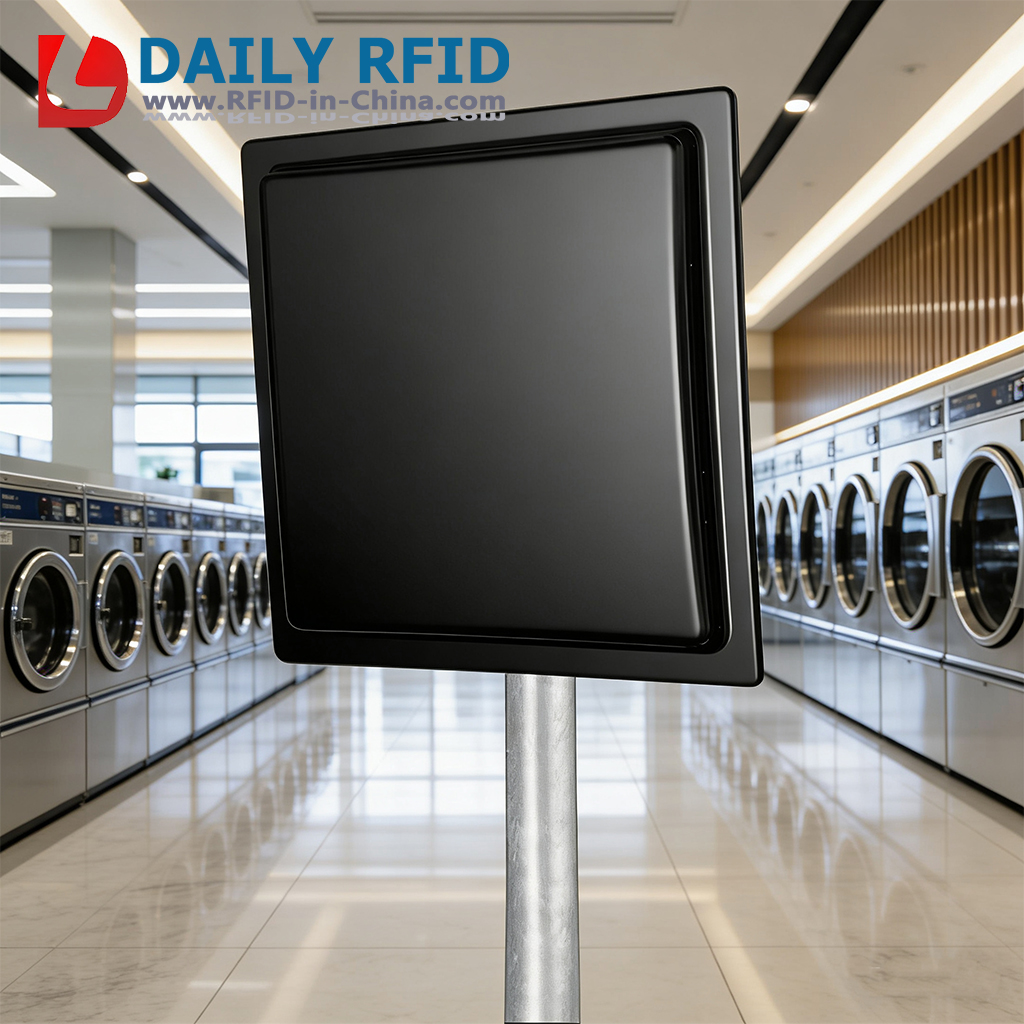
| Ceiling reader | DL6990 UHF Ceiling RFID Reader | 33 dBm; read range 0.1–5 m; up to 50 tags; IP66; RS232 with optional RJ45, GPIO and USB | Can room-scale or corridor coverage be added above existing operations? |
| Handheld reader | DL1280 Industrial PDA UHF/HF/LF Handheld Reader | UHF 0.1–20 m, HF 0.1–32 cm, LF 0.1–10 cm; up to 100 tags; Android 12; IP65; Wi-Fi 2.4/5 GHz, 4G, Bluetooth 5.0, GNSS; dual battery 4500 mAh + 6700 mAh | Can audit, inspection and exception handling be covered without a second vendor? |
| Module and mobile reader | DL213 Type-C UHF Reader Module; DL228 Type-C UHF Mobile Reader | DL213: 23 dBm, 0.1–10 cm, up to 5 tags, 45 × 30 × 6 mm, −10 °C to +60 °C, USB Type-C only. DL228: 12 dBm, 0.1–10 cm, 66 × 39 × 8 mm, IP64 | Can the same tag ecosystem be embedded into equipment designed later? |
| Gate reader | DL8330U Advanced UHF RFID Gater | 4 built-in TX/RX antennas; 4–7 m channel width; 30 dBm adjustable; AC 220 V; RS232, RJ45, GPIO | Can a controlled chokepoint be added where a portal is required? |
| Printing and encoding | High-Speed RFID Label Printer (model 5724) | 300 dpi; up to 254 mm/s; UHF encoding ISO 18000-6C/EPC C1G2; USB 2.0, USB Host, Ethernet, serial, Wi-Fi; 8 GB ROM, 512 MB RAM | Can tags and labels be commissioned in-house as the programme evolves? |
| Tags and tag-side devices | Tool tag, windshield tag, wristband, tiny tag, passive LED label | Tool tag on metal: 1–3.5 m with a 4 W EIRP handheld, up to 5 m off metal, −40 °C to +85 °C. Windshield tag: up to 2–18 m depending on reader and IC, −40 °C to +85 °C | Can the tag side adapt to new surfaces, materials and fixed-asset classes? |
Two observations follow from the table. First, the same protocol family — ISO18000-6C with EPC Class 1 Gen 2, and on several fixed models ISO18000-6B as well — runs across the fixed, ceiling, handheld, gate and AI multi-port lines, which reduces the risk of a mixed-protocol estate. Second, the portfolio spans reading distances from roughly 0.1 cm on the Type-C module to 30 m on the four-port AI reader, which means a single supplier can cover both near-field workstation tasks and wide-zone overhead reading.
The compatibility layers buyers actually have to check

Air interface and frequency
EPCglobal Gen2, published as ISO/IEC 18000-6C, is the global standard for UHF RFID readers, which is the main reason a UHF estate is portable between vendors at all. Most DAILY RFID fixed and handheld readers state support for ISO18000-6C and EPC Class 1 Gen 2; the DL921, DL921 PoE, DL920Plus and DL8330U also state ISO18000-6B support. Frequency coverage is commonly listed as 860–868 MHz, 902–928 MHz or 920–925 MHz, with customisation up to the full 860–960 MHz range available. Buyers should treat regional frequency configuration and local approval requirements as a per-market verification item, not as a catalogue assumption.
Interfaces, power and network
Interface continuity is where long-term cost is usually decided. The DL921 PoE combines power and data over one Ethernet cable, with RS232, RJ45 and GPIO trigger/relay ports, which means an existing gate or PLC link can be re-used rather than rebuilt. The DL920Plus adds RS485, USB and Wiegand 26/34 alongside the same core ports. The DL6990 ceiling reader lists RS232 as standard, with RJ45, GPIO and USB as optional — a distinction that matters when a deployment scales from tens of devices to hundreds. At the module end of the range the interface set narrows deliberately: the DL213 Type-C module provides USB only, which is appropriate for desktop encoding and embedded terminals but not for an industrial field bus.
Software and SDK continuity
A reader estate outlives its first integration. The fixed readers in this portfolio are documented with a cross-platform SDK covering X86 and X64 as well as C++, C#, VB, Delphi, Linux, ARM, Python, NodeJS, QT, JAVA and Android; the DL1280 handheld ships with a free Android 12 SDK including sample code and a demo application. For a multi-year plan, the practical test is whether the SDK surface — not just the serial protocol — remains available for the platforms the factory will use next, including Linux edge controllers and Android-based mobile terminals.
Environment and mounting
Ingress protection in this portfolio ranges from IP54 on the embedded smart-cabinet module and IP64 on the DL6940/6960 and DL920Plus, through IP65 on the DL921 family and DL1280, to IP66 on the DL6990 ceiling reader. Operating temperature ranges vary from −10 °C to +60 °C on the DL213 module up to −30 °C to +70 °C on the DL6940/6960 and DL920Plus. A multi-year specification should record these two figures per position, because they determine which model can be reused when a workshop is reclassified — for example when a chilled or wash-down area is introduced.
Where these readers are used in manufacturing
Production-line component verification
In one documented manufacturing scenario, a DAILY RFID DL921 UHF fixed reader is paired with workpiece RFID tags to verify components at each station, supporting 400 tags per second reads, with an MQTT event stream published to the MES. The matched equipment list includes fixed antennas and an industrial PC. The relevant continuity point is architectural: because the reader exposes a standard event interface rather than a proprietary one, the reading layer can be extended station by station instead of re-platformed.
Vehicle and logistics gate control
A separate logistics-hub scenario uses a fixed UHF reader with vehicle tags to control gate access automatically, cutting average vehicle entry time. The scenario lists an IP66 weatherproof requirement for the outdoor lane — which is precisely the kind of specification buyers must match against actual product ratings, since the DL921 family is rated IP65 and the DL920Plus is rated IP64. Matching requirement to rating at design stage avoids a costly substitution later.
Tool, fixture and asset tracking
Tool management is a common second phase in factory RFID programmes because it shares the same reader and tag ecosystem. The RFID Tool Management Adhesive Tag is an on-metal tag rated for 1–3.5 m with a 4 W EIRP handheld reader and up to 5 m off metal, operating from −40 °C to +85 °C. In a documented outdoor construction scenario, the DL1280 handheld reader with tool tags is used with offline storage and batch upload after each project phase. The same reader also covers HF and LF tags, which allows legacy access-control or tool-crib cards to be read during transition.
Cabinets, work cells and high-density holding areas
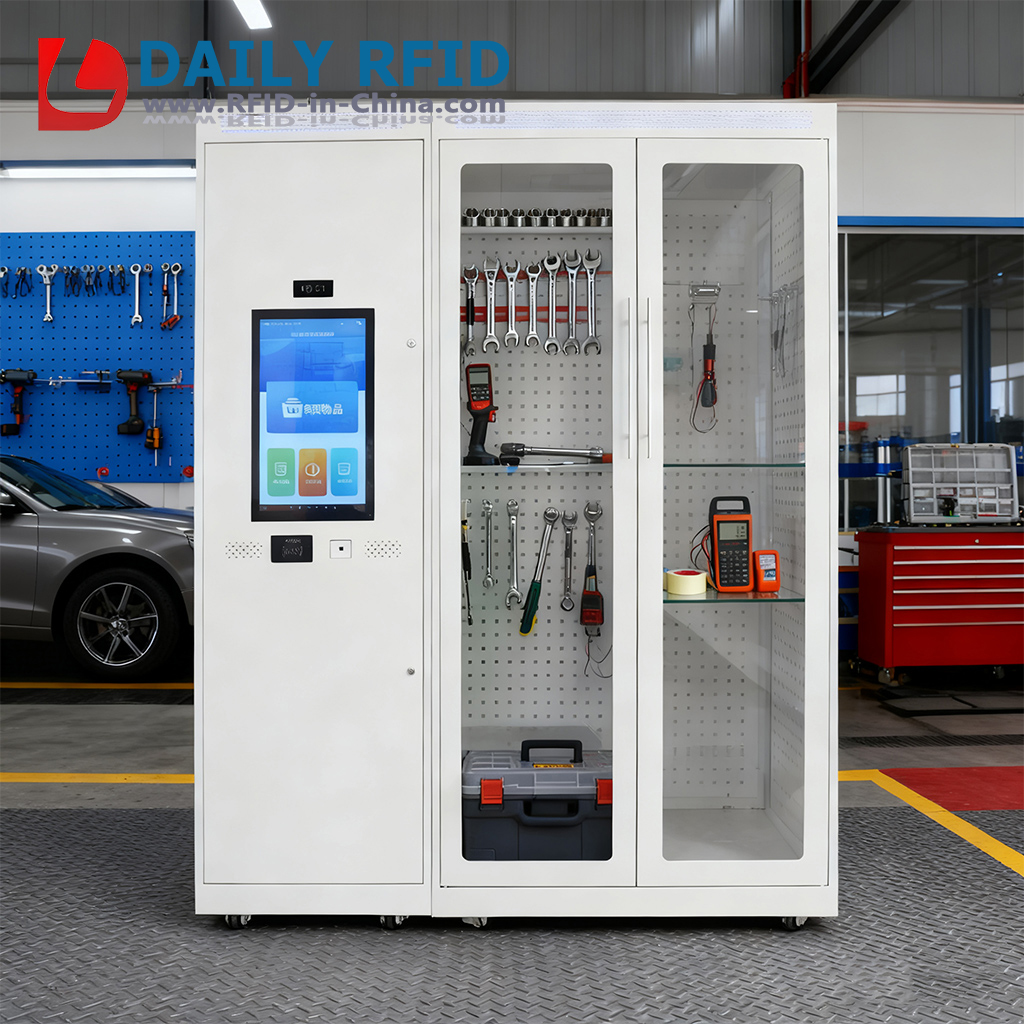
At work-cell level, the RFID Smart Cabinet component supports 4-, 8- or 16-port external antenna layouts with a stated ability to read more than 500 tags per partition, using adjustable transmit power and RSSI to separate adjacent compartments, plus opto-isolated GPIO for door locks and sensors. Where the requirement is visual confirmation rather than proximity, the passive LED UHF label provides a targeted illumination trigger at 1.5–3.5 m and bulk reading at 2–5 m without a battery. Both approaches let a factory extend an existing UHF infrastructure rather than add a parallel technology.
What the market data suggests about continuity risk
Third-party estimates help size the problem, provided their scope is read carefully. Mordor Intelligence reports that UHF RFID technology captured 40.72% of total RFID market revenue in 2025, driven by retail inventory cycles and multi-item read capability. Dataintelo estimates the global UHF RFID reader market at approximately USD 4.8 billion in 2025, projecting USD 11.2 billion by 2034. ABI Research identifies Asia Pacific as the fastest-growing region for UHF RFID hardware, with an expected 11.8% CAGR in shipments through 2031, while IDTechEx reports that the Americas accounted for more than 60% of global UHF tag usage as of 2025.
Taken together, these figures describe a market that is expanding in volume and shifting in geography at the same time. The operational consequence for a manufacturing buyer is straightforward: a reader estate is more likely than before to grow into new regions, which raises the value of frequency configurability, an internationally consistent protocol family, and a supplier that already exports 80% of its output to the EU and USA.
Automation on the data-collection side is also widening the addressable reading surface. One publicly circulated estimate puts the market for drone-based inventory collection services at USD 8.2 billion by 2026 — a relatively young segment that depends on the same UHF tag and reader ecosystem rather than replacing it. For a factory, the practical reading is not to buy drones, but to avoid specifying a reader layer that cannot feed that class of automated inventory process later.
Comparison with traditional sourcing approaches, and the limits of portfolio breadth
Three sourcing models are common in industrial RFID procurement, and each carries a different continuity profile.
| Sourcing model | Typical strength | Continuity risk in a multi-year programme |
|---|---|---|
| Single point solution from a systems integrator | Fast first deployment; one accountable party | The integrator's hardware choice may be fixed at project start; expansion depends on that vendor's roadmap rather than the factory's |
| Mixed multi-vendor procurement | Best fit per position at purchase time | Multiple SDKs, spare-part sets and interface conventions; higher long-term maintenance and training load |
| Direct from a specialised RFID manufacturer | Portfolio-level coverage of reader, tag, antenna and encoding layers | Depth of local service and installation support varies by region and must be mapped deliberately |
The third model — sourcing from a manufacturer that builds the reader, tag, antenna and printing layers itself — is the one most easily aligned with a multi-year checklist, because the same company answers questions about protocol, tag material and encoding at the same time. Scale is not the deciding factor here: large diversified automation vendors compete on installed-base breadth, while focused RFID manufacturers typically compete on portfolio fit, frequency and housing customisation. Publicly reported fiscal 2024 revenue for Zebra Technologies exceeded USD 4.5 billion, which illustrates the scale of the largest diversified players; revenue alone, however, tells a buyer nothing about whether a specific reader will still be available in the enclosure the factory has already mounted in year four. The useful comparison is portfolio-to-requirement fit, not company size.
It is equally important to be explicit about what portfolio breadth does not solve. Four boundaries apply to this product family and should be recorded in the evaluation file:
- Read distance is never a fixed number. Across the portfolio, stated ranges are qualified as dependent on the tag and the environment — the DL921 is documented at 0.1–15 m, the DL920Plus at 8–15 m, and the DL6940/6960 at 25–30 m under stated conditions. No supplier can guarantee a distance inside a specific building before a site survey.
- Not every model suits every environment. The DL213 Type-C module operates from −10 °C to +60 °C and provides USB only, with no RS232 or RJ45. It fits desktop encoding, self-service terminals and embedded equipment; it is not a substitute for an IP65 shop-floor reader in a wash-down or high-temperature area.
- Variant differences matter. The DL921 PoE variant does not include Wi-Fi; sites that need wireless backhaul must confirm which variant provides it rather than assuming it is included in the family.
- Compliance is a per-model, per-market verification step. The documented facts for these readers describe protocols, frequency bands, transmit power, interfaces and environmental ratings. Regional approvals must be requested model by model for the destination market and verified by the buyer, not inferred from the presence of a product in the catalogue.
A further practical limit concerns support geography. DAILY RFID states that export represents 80% of sales with the EU and USA as main markets, but installation and after-sales coverage is organised through regional partners. Buyers should map local service depth, spare-unit lead time and firmware support channels as part of the same evaluation, since these determine the real cost of year-three maintenance.
Future outlook: what changes in the next planning cycle
Three shifts are visible in how UHF readers are being specified, and all three reward the continuity checklist rather than a single-unit price comparison.
The first is the move of processing towards the edge. Multi-port readers such as the DL6940/6960 with four external antenna ports and AI-driven dense reading place more decision-making at the device, which reduces the number of controllers a factory has to maintain — but also means the reader itself becomes a longer-lived asset that must be upgradeable in place.
The second is the merging of fixed, mobile and embedded reading into one tag ecosystem. A factory that begins with overhead fixed readers commonly adds handheld audits, then modules inside its own equipment, then gates at dispatch. Sourcing all of those layers from one protocol family avoids maintaining two inventories of tags and two sets of integration code.
The third is the normalisation of wireless and power-over-Ethernet backhaul. PoE, Wi-Fi and cellular variants of the same reader family let a plant phase deployment without waiting for structured cabling — a pattern already visible in the DL921 PoE, DL921 GSM and DL920Plus Wi-Fi variants. For buyers, the forward-looking question is which of those backhaul options the supplier can still supply in three years, and whether OEM/ODM customisation is available when an existing housing no longer fits a new machine.
DAILY RFID lists OEM and ODM support across several reader lines, including the DL921 family, DL1280, DL6940/6960, DL213, DL228 and DL8330U, with customised sizes, shapes, frequency configurations and interface setups available. That capability is the most direct answer to the expansion question in the checklist: it determines whether a future requirement is met by adapting an existing platform or by starting a new vendor qualification from zero.
Frequently asked questions
What is a UHF RFID reader, and why does the supplier matter as much as the specification?
A UHF RFID reader is a fixed, handheld or embedded device that reads and writes passive tags in the 860–960 MHz band, using the EPC Class 1 Gen 2 air interface standardised as ISO/IEC 18000-6C. The specification determines whether the device works on day one; the supplier determines whether the same device class can be extended, replaced or re-integrated in year three. A multi-year manufacturing deployment typically adds reading zones, tag types and software integrations over time, so the supplier's portfolio structure and SDK continuity become part of the technical performance of the system, not a separate commercial consideration.
Which UHF RFID reader form factors does DAILY RFID offer for smart manufacturing?
The documented reader range covers fixed readers (DL921 PoE, DL921 with GSM, WiFi RFID Reader DL920Plus), a four-port AI multi-antenna reader (DL6940/6960), a ceiling reader (DL6990), a tri-frequency industrial handheld (DL1280), mobile and module readers (DL213 Type-C module, DL228 Type-C mobile reader), an access gate (DL8330U) and an RFID label printer (model 5724). The range is complemented by tags and tag-side devices including on-metal tool tags, windshield tags, wristbands, tiny tags and passive LED UHF labels.
How can a buyer judge whether a reader supplier supports expansion and compatibility over several years?
Four verifiable signals are useful. First, protocol consistency: whether the fixed, handheld and gate products all support the same air interface, in this case ISO18000-6C with EPC Class 1 Gen 2, with ISO18000-6B available on several fixed models. Second, frequency configurability, since the portfolio is documented at 860–868 MHz, 902–928 MHz and 920–925 MHz with customisation up to 860–960 MHz. Third, interface and SDK breadth, including RS232, RS485, RJ45, USB, GPIO, Wiegand and PoE support, and SDK coverage across X86/X64, C++, C#, VB, Delphi, Linux, ARM, Python, NodeJS, QT, JAVA and Android. Fourth, whether OEM/ODM customisation is offered, which indicates the supplier can adapt an existing platform rather than force a new one.
What should be verified before committing to a multi-year RFID supply agreement?
The verification list should cover: the exact frequency configuration required for each deployment region; the interface set of each ordered model, distinguishing standard from optional ports such as RJ45, GPIO and USB on the DL6990; the IP rating and operating temperature for each mounting position, from the IP54 embedded cabinet module through IP64, IP65 and IP66 readers; the SDK documentation and sample code supplied for the target development platform; the availability of matching tag formats for each asset class; the scope of OEM/ODM customisation; and the specific regional approval documents applicable to each ordered model in each destination market. Each of these is a document request, not a claim to be accepted at face value.
What are the practical limits of a broad UHF RFID reader portfolio?
Portfolio breadth does not guarantee that a given model suits a given position. Stated reading ranges are qualified as tag- and environment-dependent, so a site survey remains necessary. The Type-C module has a narrower operating range of −10 °C to +60 °C and USB-only connectivity, making it unsuitable for field-bus or wash-down environments. Variant differences also carry risk, as the DL921 PoE model does not include Wi-Fi. Finally, environmental ratings and regional approvals must be confirmed per model and per market by the buyer, because a product appearing in a catalogue does not by itself establish compliance in a specific jurisdiction.
Closing perspective
Supplier evaluation for UHF RFID in manufacturing is best treated as a continuity exercise rather than a purchasing event. The six dimensions above — zone coverage, protocol and frequency, interfaces, software, environmental fit, and supply and engineering depth — can all be answered from documented product facts, which makes them comparable across candidates before any commitment is made. Recording the boundaries at the same time, rather than after the first expansion, is what keeps a reader estate usable into its fourth and fifth year.
A complete overview of DAILY RFID's product lines, production scale and customisation capability is available in the DAILY RFID company profile (PDF).