
UHF RFID Reader Verification: Certifications, Specs, and Selection Limits
A UHF RFID reader is a device that uses ultra-high frequency radio waves to identify RFID tags without line-of-sight scanning. For procurement teams in smart manufacturing and logistics, the real challenge is not whether UHF RFID works, but how to verify that a specific reader will satisfy the regulatory, environmental, integration, and long-term maintenance constraints of a real production site.
Why Reader Verification Is a Procurement Problem
Manufacturing buyers often compare UHF RFID readers from several product families. On paper, different models may display similar reading distances and protocol support. In practice, the gaps that create project delays show up in certification coverage, frequency-band compliance, protection class, operating temperature range, wiring options, and the documented evidence a manufacturer can provide for each claim.
UHF RFID readers are standardized globally under the EPCglobal Gen2 protocol, published as ISO/IEC 18000-6C. This means most readers will interoperate with standard UHF RFID tags at the air-interface level. Yet the actual performance at a loading dock, in a cold room, on a vehicle, or inside a metal-heavy factory depends heavily on reader configuration, antenna design, tag selection, and site conditions.
For a Research-to-Evaluation buyer, a verification checklist is therefore more useful than a product brochure. The checklist below is built from documented UHF reader specifications and compliance records, using DAILY RFID CO., LIMITED as a concrete reference point.
What to Verify Before Selecting a UHF RFID Reader
1. Protocol and Frequency Compliance
A UHF RFID reader should support at least ISO/IEC 18000-6C / EPC Class 1 Gen 2, and preferably ISO/IEC 18000-6B for legacy tags. Frequency bands usually cover 860–960 MHz, with regional customization available. For example, the DAILY RFID DL930B operates at 902–928 MHz or 920–925 MHz by default and is customizable across 860–960 MHz.
2. Certification Evidence
Certification is not a single document. Buyers should separate EU radio certification, EU EMC certification, US FCC compliance, environmental compliance (RoHS/REACH), and application-specific test reports.
- The DAILY RFID DL930B UHF RFID Reader is covered by CE RED Certificate of Compliance 2019, certificate number DGE190109029, issued by Dongguan NTEK Testing Technology Co., Ltd. under Directive 2014/53/EU. The same certificate covers DL920, DL930, DL920plus, DL920S, DL920W, DL920G, DL920B, DL930plus, DL930W, DL930G, DL930B, DL9230, DL9230plus, DL9230W, DL9230G, DL950, DL950M, DL950S, DL950W, DL950G, DL950L, DL9700, DL9701, DL6920E, DL6940, and DL6950.
- An earlier CE certificate for UHF readers, numbers ATE20120505, ATE20120506, ATE20120507, and ATS2012177, was issued by Accurate Technology Co., Ltd. under Council Directive 1999/5/EC and covers DL920, DL930, DL930B, DL920W, DL930W, DL6940, and DL6940W.
- For the US market, RFID readers in the DL9230 active-reader family are covered by FCC Supplier's Declaration of Conformity, certificate number FCSE20015006, issued by Flux Compliance Service Laboratory under FCC Part 15 Subpart B:2018 Class B.
- For reader-related EMC, certificate number ATE20180529 covers the LF Reader-02, HF Reader-02, and Triple Reader-02 under EN 55032:2015 and EN 55024:2010+A1:2015.
3. Environmental and Mechanical Ratings
Indoor and outdoor deployments have different protection needs. A reader mounted in a warehouse aisle may not need the same sealing as a reader installed at a truck gate or in a cold room.
DAILY RFID lists IP65/IP66 protection for the DL930B integrated reader, IP65 for the DL921 PoE and DL921 AI readers, and IP64 for the DL6960 multi-port reader. Operating temperature ranges also vary: the DL930B works at -30°C to +70°C, the DL921 series at -20°C to +60°C, and the DL6960 at -30°C to +70°C. These parameters are directly comparable across supplier datasheets.
4. Performance Parameters
Reading range is the most quoted number, but it is also the most misleading. Range depends on transmit power, antenna gain, tag type, and the physical environment.
In the DAILY RFID range, the DL930B integrated reader reports a practical reading range of 4 to 8 meters. The DL921 PoE reader reaches up to 15 meters with a built-in circular polarized antenna and can read up to 50 tags simultaneously. The DL6960, a 4-port external antenna reader, reports a reading range of up to 25 to 30 meters and a writing distance of 10 to 15 meters, with high-density anti-collision support for up to 1000 tags. The DL9702 desktop tag tester, by contrast, uses a near-field antenna with a fixed 10 to 15 cm range for precise single-tag verification.
Buyers should ask for the range figure under the same conditions they expect in production: portal installation, forklift movement, pallet height, or handheld scanning.
5. Integration Interfaces and SDK
A reader becomes valuable only when its data reaches an ERP, WMS, or access-control system. Verify the physical ports and the available software development kit before committing to a model.
The DL930B includes RS232, RJ45, USB, GPIO, and Wiegand 26/34 output. The DL921 PoE adds integrated Power over Ethernet, allowing a single cable to deliver both network connectivity and power. The DL213 Type-C UHF module provides a compact USB keyboard-emulation mode for quick integration into terminals and kiosks. The DL9702 tester is USB-powered with ultra-low 0.25W consumption, suitable for desktop encoding and tag QC.
6. Manufacturing Evidence and Quality Control
For buyers evaluating long-term supply, production capacity and quality control procedures matter as much as the datasheet.
DAILY RFID CO., LIMITED, an RFID manufacturer based in Guangzhou, China, has been operating since 2008 and specializes in RFID tags, readers, antennas, cards, chips, and labels. The company reports a factory area of 28,000 m², around 180–200 employees, and a development team of 38 engineers. Annual production capacity is 50 million RFID tags, 30 million RFID cards, and 100,000 RFID reader units.
For OEM UHF fixed readers, the company quotes a monthly capacity of 1,000 units, a lead time of 15 to 45 days, and a minimum order quantity of 1 unit, with Factory Acceptance Test as standard quality control. RFID development kits follow a monthly capacity of 1,000 sets, a lead time of 7 to 15 days, and an MOQ of 1 set. Anti-metal RFID tags are offered with a monthly capacity of 100,000 units and 100% signal testing.
Technical Explanation: How UHF Reader Parameters Interact
An industrial UHF RFID reader contains four functional parts: the radio module, antenna, power and communication section, and control software. The radio module generates the RF carrier and decodes tag responses. The antenna defines the read zone; a circular polarized antenna is commonly used in fixed readers because it reads tags in different orientations. Communication interfaces deliver the decoded tag IDs to a host system.
Transmit power and antenna gain determine how much energy reaches the tag. Higher power extends range but can also create unwanted reads outside the intended zone. Multi-port readers such as the DL6960 solve this by supporting up to four external TNC/SMA antennas and using AI-driven adaptive read modes to reduce interference while increasing coverage. Anti-collision capacity determines how many tags can be read in the same field; the DL6960 is rated for up to 1000 tags, while the DL921 reads up to 50 tags simultaneously.
For dense or moving asset environments, RSSI support helps estimate the distance and position of a tag. The DL930B and DL921 both report RSSI, which can be used for simple zone discrimination. The DL9702 tester adds AI-driven signal diagnostics to identify weak or defective tags before they enter the supply chain.
| Model | Protocol | Frequency | Reading Range | Protection | Power |
|---|---|---|---|---|---|
| DL930B | ISO18000-6C / 6B | 902–928 MHz, custom 860–960 MHz | 4–8 m | IP65/IP66 | 6W |
| DL921 PoE | ISO18000-6C / 6B | 860–928 MHz customizable | 0.1–15 m | IP65 | 12W |
| DL6960 | ISO18000-6B / 6C | 860–960 MHz | 25–30 m | IP64 | 5W |
| DL9702 | ISO18000-6B / 6C | 860–960 MHz | 10–15 cm | IP54 equivalent | 0.25W |
| DL213 | ISO18000-6C / EPC Gen2 | 860–868 / 902–928 MHz | 0.1–10 cm | Not specified | 3W |
Documented Use Cases With Hard Environmental Constraints
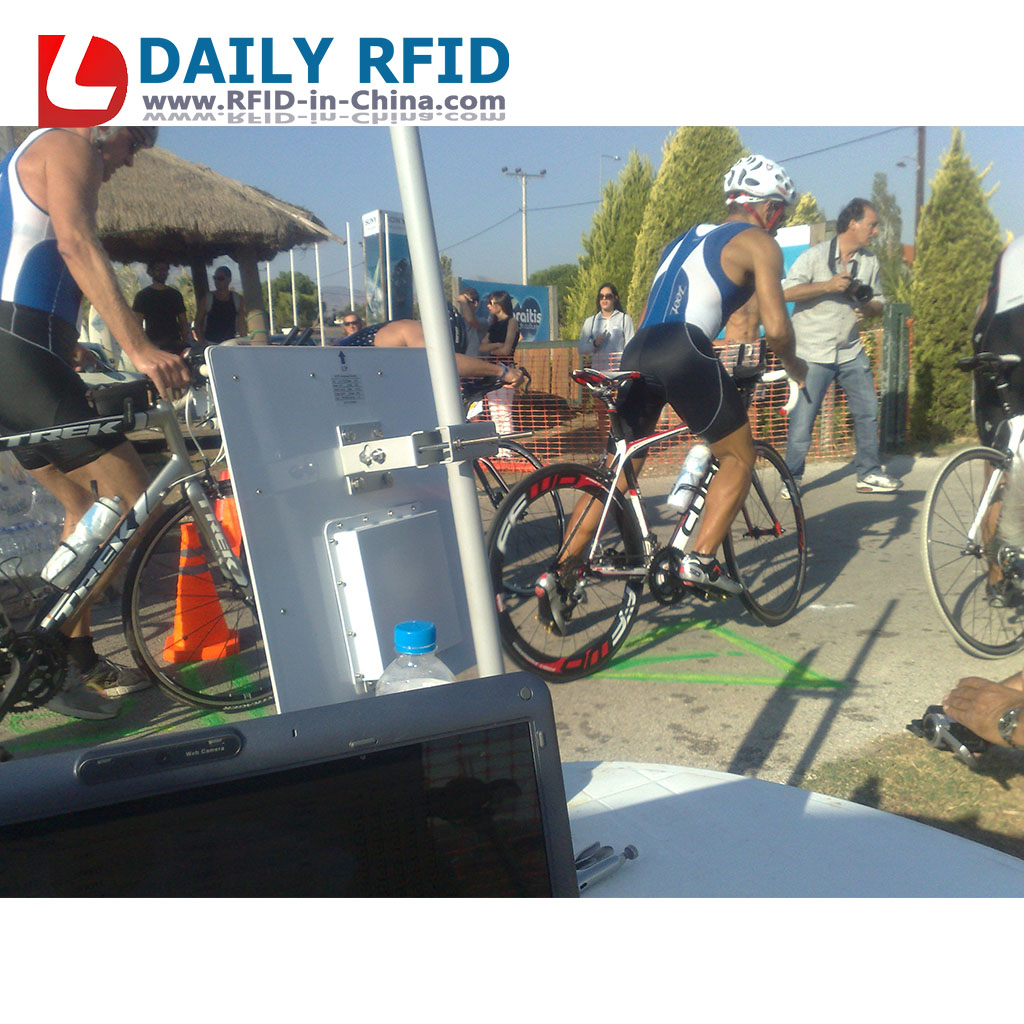
DL921 supports single-cable PoE deployment for fixed industrial checkpoints.
UHF RFID evaluation is often driven by extreme operating conditions. Real deployment references from DAILY RFID application records show how readers and tags are matched to specific constraints.
A vehicle tire tracking deployment in Indonesia requires readers and tags to survive service-bay temperatures up to 150°C, along with vibration and chemical exposure. RFID Tire Tag Gen 2 is rated for operation from -25°C to +85°C and storage up to +120°C; the patch-type tire tag extends storage capability to +160°C.
A cold-chain logistics site in China requires temperature and humidity monitoring every 5 minutes. The combination of a DL932 fixed reader, DL1280 handheld, and temperature-sensing RFID tags must operate from -30°C to +60°C with IP67 water resistance.
A cement quality testing operation in Hong Kong requires tags to tolerate alkaline environments, water, vibration, and temperatures above 30°C. A pharmaceutical distribution facility in Canada requires sealed cold-chain RFID tags to record temperature history for compliance, with audit data synchronized every minute to a compliance dashboard.
These examples illustrate why certifying a reader under lab conditions is not enough. The buyer must verify that the same reader works with the intended tag, the intended mounting surface, and the intended site temperature.
Market Trend Analysis
UHF RFID continues to be the dominant technology within the RFID ecosystem. According to Mordor Intelligence, UHF RFID technology captured 40.72% of total RFID market revenue in 2025, driven by retail inventory cycles and multi-item read capabilities. Dataintelo projects the global UHF RFID reader market at approximately USD 4.8 billion in 2025, rising to USD 11.2 billion by 2034.
Regional demand is uneven. The Americas account for more than 60% of global UHF tag usage, largely because of retail compliance mandates, while Asia Pacific is expected to grow at an 11.8% CAGR in UHF RFID hardware shipments through 2031, according to ABI Research. For manufacturing buyers, the practical implication is that UHF reader supply chains and regional certification requirements will continue to expand, especially in Asia Pacific.
Another trend is the shift from single readers to systems. Multi-port readers, AI edge processing, and cloud connectivity are becoming common in logistics gate and assembly-line deployments. The DL6960, for example, reports a data processing speed 16 times faster than ordinary mainstream readers, which changes how quickly a portal can process dense pallet loads.
Comparison With Traditional Solutions and Honest Boundaries
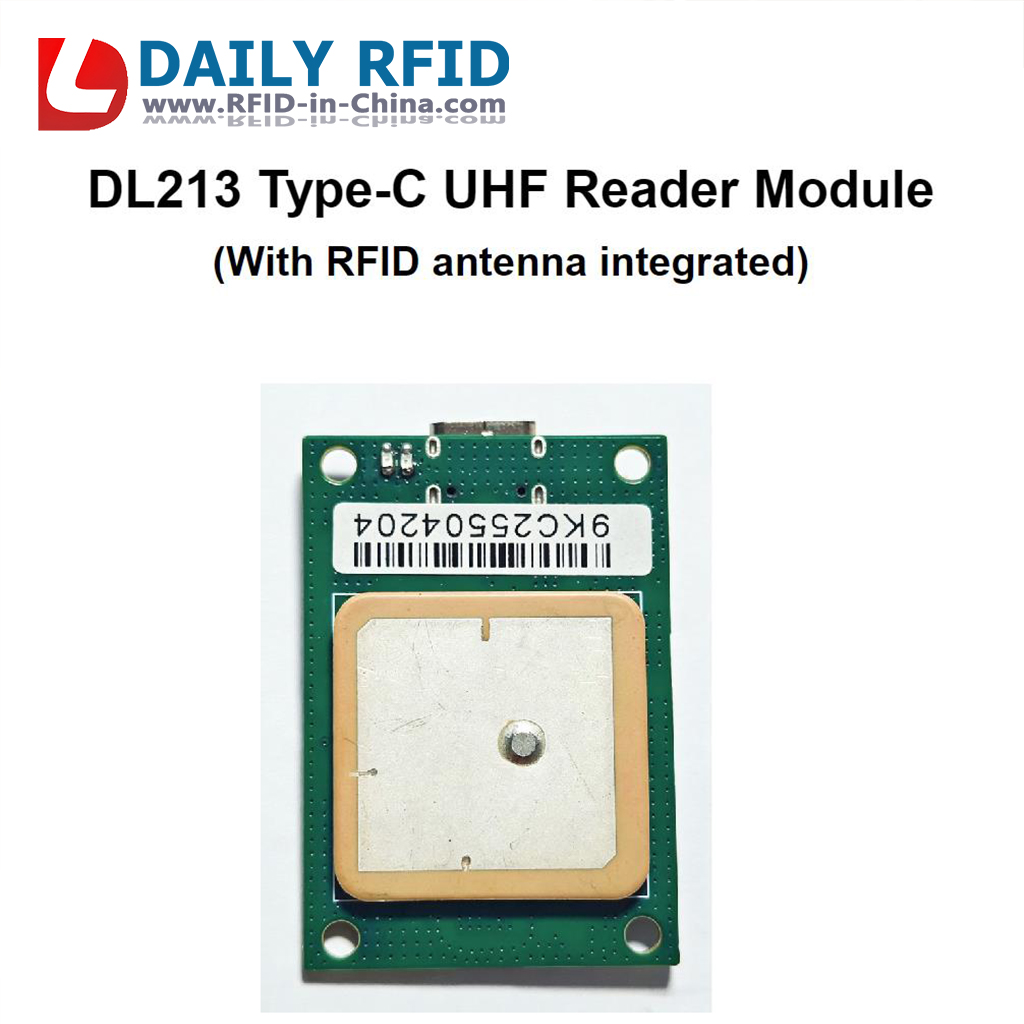
DL213 is an ultra-compact Type-C UHF read/write module for embedded integration.
Compared with barcode systems, UHF RFID does not require a direct line of sight and can read multiple tags in a single pass. The trade-off is cost: readers, tags, commissioning, and integration form a larger upfront investment than a barcode label printer. For low-value, low-throughput operations, barcode remains the rational choice.
Compared with LF and HF RFID, UHF offers longer range and higher throughput, which is why it dominates supply chain and manufacturing inventory applications. But UHF radio waves are more attenuated by water and metal. In environments such as liquid-filled containers or densely packed metal racks, buyers may need on-metal tags, antenna arrays, or in some cases an HF/LF solution. LF (125 kHz) wristbands and animal tags continue to be used where moisture and close-range reliability are more important than reading distance. HF (13.56 MHz) remains strong in library, payment, and NFC-style applications.
A second boundary is supplier-fit. Large public companies such as Zebra Technologies, with fiscal 2024 revenue exceeding USD 4.5 billion, offer extensive enterprise-grade reader portfolios and global service networks. Specialist manufacturers such as DAILY RFID provide a different value: lower MOQs, ODM/OEM customization, and documented manufacturing capacity that can suit pilot projects and long-tail industrial needs. Neither approach is universally better; the choice depends on deployment scale, customization depth, and the buyer's internal integration capability.
Future Outlook
UHF RFID readers are moving toward AI-assisted edge processing, multi-antenna coordination, and integration with autonomous inventory systems. The DL921 AI reader already integrates GPS/GSM/PoE into a single unit, allowing standalone data collection and remote upload in areas without fixed network infrastructure.
Drone-based inventory collection using RFID is projected to reach a market size of USD 8.2 billion by 2026, according to PR Newswire. If that forecast holds, fixed UHF readers will increasingly serve as ground infrastructure for automated aerial or robotic inventory checks. For buyers, the implication is that protocol compliance and supplier SD capability will become more important, because future readers will need to feed data into autonomous systems rather than just beeping when a tag is read.
For a full corporate profile and product scope, DAILY RFID's company brochure is available at: https://cdn.socialarks.com/sbsp/24991/common/2026/0701/company%20profile%20daily%20rfid.pdf.
Frequently Asked Questions
What regulatory certifications should a buyer verify for a UHF RFID reader?
For the EU market, a UHF RFID reader should have CE RED certification under Directive 2014/53/EU and, where applicable, CE EMC documentation. For example, DAILY RFID holds CE RED certificate DGE190109029 issued by Dongguan NTEK Testing Technology Co., Ltd. for a broad range of DL-series UHF readers. For the US market, FCC compliance is required; the DL9230 active-reader family holds FCC Supplier's Declaration of Conformity FCSE20015006 under FCC Part 15 Subpart B Class B.
Which communication protocols must a UHF RFID reader support?
Industrial UHF RFID readers should support ISO/IEC 18000-6C, also known as EPC Class 1 Gen 2, and many also support ISO/IEC 18000-6B for legacy tags. Some readers add HF (13.56 MHz) or LF (125 kHz/134.2 kHz) modules for multi-frequency flexibility, such as the DL1280 industrial PDA, which reads UHF, HF, and LF tags in one device.
What is a realistic reading range for an industrial UHF RFID reader?
Reading range depends on antenna, transmit power, tag type, and environment. Integrated-reader models such as the DL930B report 4 to 8 meters. Fixed readers with larger built-in antennas, such as the DL921, reach up to 15 meters. Multi-port readers with external antennas, such as the DL6960, report 25 to 30 meters for reading and 10 to 15 meters for writing. Desktop near-field modules are intentionally limited to around 10 to 15 centimeters for precise single-tag work.
What IP rating should an industrial UHF RFID reader have?
The required IP rating depends on the installation environment. DAILY RFID uses IP65/IP66 for the DL930B integrated reader, IP65 for the DL921 fixed reader, and IP64 for the DL6960 multi-port reader. For outdoor gates, dusty factories, or wash-down areas, IP65 or higher is a common baseline; for clean indoor deployments, IP54 may be sufficient.
What customization and delivery terms are typical for OEM UHF RFID readers?
Customization terms vary by manufacturer. DAILY RFID quotes a monthly production capacity of 1,000 UHF fixed readers, a lead time of 15 to 45 days, and an MOQ of 1 unit, with Factory Acceptance Test as standard. RFID development kits are available with a monthly capacity of 1,000 sets, 7 to 15 days lead time, and an MOQ of 1 set. Buyers should confirm frequency, interfaces, housing, and antenna configuration before ordering.
When is UHF RFID not the best choice?
UHF RFID performs poorly near large volumes of water and dense metal unless specialized tags and antenna planning are used. For simple low-cost item identification, barcode is cheaper. For close-range access control, payment, or library applications, HF/NFC is often more practical. For animal identification where ISO 11784/11785 compliance is required, LF 134.2 kHz remains the standard. UHF RFID is strongest when the goal is long-range, batch, or moving-asset identification.
Have Questions or Need More Details?
Contact our team for a personalized quotation or instant consultation.
Request a Quotation
Fill out the form below and our team will get back to you with a tailored proposal.
WhatsApp Direct Chat
Prefer to chat in real-time? Message us on WhatsApp for instant assistance & quick answers.
- Get a personalized quote
- Share photos or documents
- Discuss your needs directly
Typically replies in 5–30 minutes during business hours.