
UHF RFID Readers in Smart Manufacturing: The DAILY RFID Approach
Industry Context: The Rise of UHF RFID in Automated Environments
UHF RFID technology has become a fundamental enabling layer for smart manufacturing, logistics, and asset management. According to market analysis, the global UHF RFID reader market is valued at approximately USD 4.8 billion in 2025 and is projected to reach USD 11.2 billion by 2034. UHF RFID technology currently captures 40.72% of the total RFID market revenue, driven by retail inventory cycles and the ability to read multiple tags simultaneously without line-of-sight. As factories and warehouses push for higher throughput and real-time visibility, the selection of a capable UHF RFID reader – and a reliable supplier – becomes a strategic decision.
The Problem: Speed, Density, and Environment Constraints
Traditional identification methods such as barcode scanning or HF/NFC tagging face significant bottlenecks in high-speed production lines and dense storage environments. A single barcode scan per item can take over a second, and metal surfaces, liquids, or extreme temperatures can degrade performance. Many industrial sites require reading hundreds of tags per second across zones exceeding 10 meters, while maintaining data integrity and resisting dust, vibration, and moisture. Finding a reader that balances range, anti-collision capability, and industrial ruggedness is non-trivial.
Brand Solution: DAILY RFID’s UHF Reader Ecosystem
DAILY RFID CO., LIMITED, established in 2008, is a manufacturer specializing in RFID tags, readers, antennas, cards, and labels. With a 28,000 m² facility, 180–200 employees (including 38 R&D engineers), and annual production of 100,000 RFID readers, the company serves the EU, USA, and global markets with an 80% export ratio. The UHF RFID reader line includes fixed, handheld, ceiling-mount, AI-powered, and module form factors, all supporting the ISO 18000-6C / EPC Gen2 standard.
Key products addressed in this article:
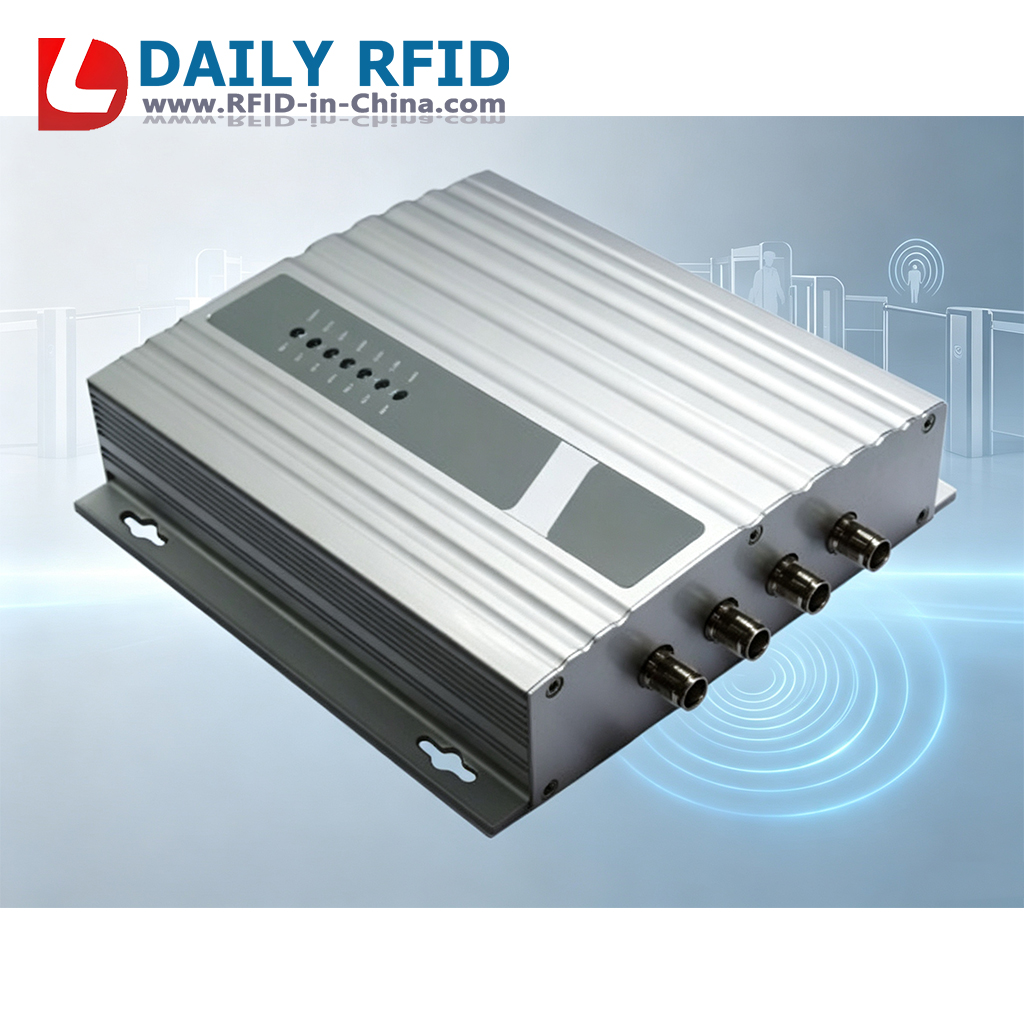
- DL6940/6960 AI Multi-Antenna 4-Port UHF Reader – Equipped with an AI edge acceleration algorithm, it supports reading up to 1000 tags simultaneously with a speed 16 times faster than ordinary readers. The four external antenna ports enable multi-zone scanning and a reading range of 25–30 meters, while drawing only 5W power.
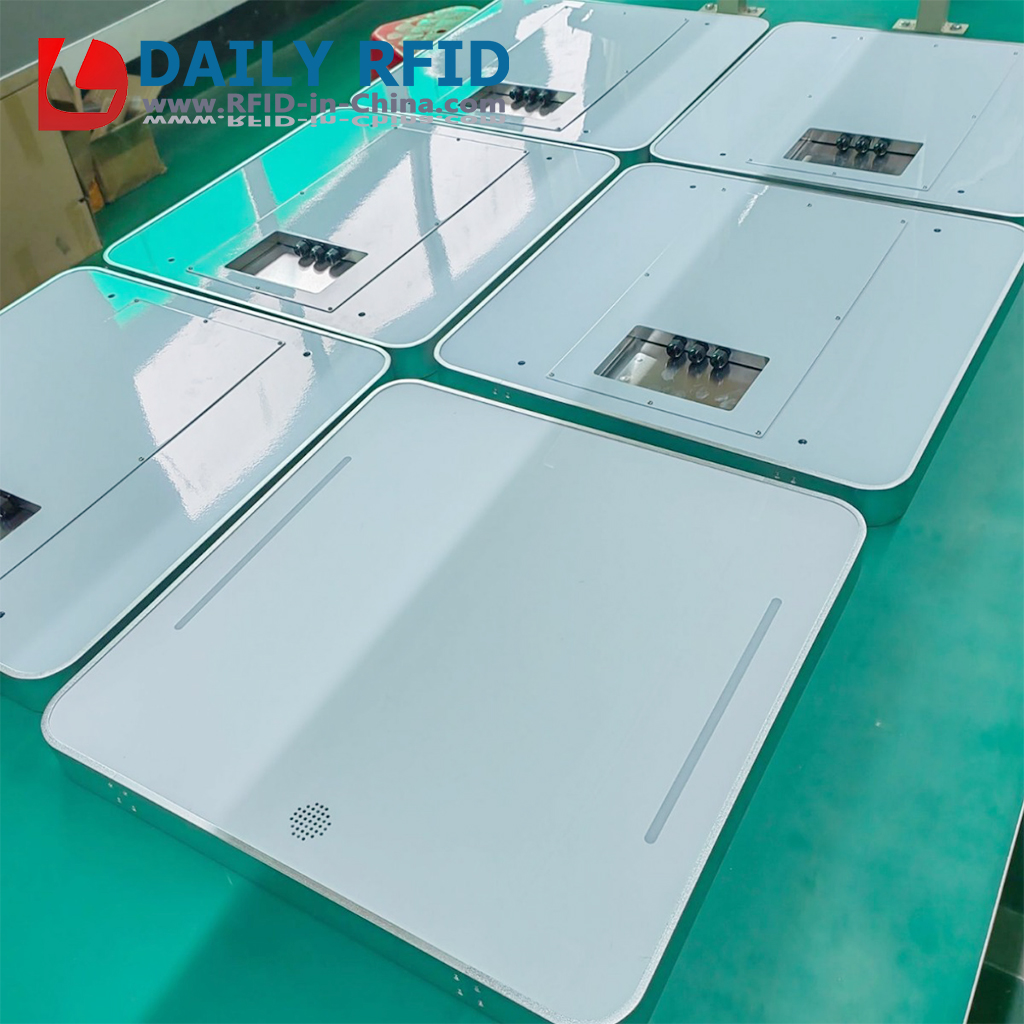
- DL6990 UHF Ceiling RFID Reader (Integrated Antenna) – Provides overhead coverage up to 5 meters, reads up to 50 tags, and features IP66 protection for semi-outdoor environments.
- DL1280 Tri-frequency All-band Handheld Reader – Combines UHF, HF, and LF in one device, with a 20-meter UHF reading range, dual-battery design (4500 mAh + 6700 mAh), and Android 12 OS.
- DL213 and DL228 Type-C UHF Modules – Ultra-compact plug‑and-play modules for embedding into smart cabinets, medical devices, and self-service kiosks.
Technical Explanation: How DAILY RFID Readers Achieve Speed and Reliability
All DAILY RFID UHF readers operate in the 860–960 MHz global ISM band and comply with ISO 18000-6C / EPC Class 1 Gen 2. The AI-powered models employ a proprietary AI multiplexing coordination algorithm that dynamically optimizes antenna switching and transmit power (up to 33 dBm) to eliminate blind spots and cross‑read interference. High-density anti-collision is achieved through time-divided slotted protocols that can resolve up to 1000 tag IDs in under 10 ms per 64 bits. The inclusion of Received Signal Strength Indication (RSSI) allows the system to estimate distance or segment reading zones. Industrial versions are rated IP64–IP66, operate from -30°C to +70°C, and feature wide‑voltage DC or PoE power input for reduced cabling complexity.
Application Scenarios
Automotive Assembly (Germany)
In an automotive assembly line, DAILY RFID DL6960 readers with antenna arrays track production‑line parts in real time, supporting over 400 tags/second reads. Data streams via MQTT to the MES, enabling immediate workstation triggers and preventing mix‑ups.
Cold‑Chain Logistics (China & US)
DL6960 with temperature‑sensing tags monitors pallets at dock doors, uploading temperature/humidity data every 5 minutes to cloud analytics. The system operates at -20°C with IP67 design, reducing manual scan errors by 80%.
Retail & E‑Commerce (US)
DL1280 handheld readers allow store staff to audit inventory quickly, cutting manual audit time by 50%. Fixed readers at POS enable self‑checkout with 30 tags/second reads.
Logistics Hub (Germany)
DL920Plus fixed readers paired with vehicle windshield tags automatically control gate access, reducing average vehicle entry time by 50%.

Market Trend Analysis
The UHF RFID reader market is experiencing robust growth driven by Industry 4.0, omnichannel retail, and cold‑chain compliance. The Americas lead global UHF tag usage (over 60%), primarily due to retail mandates from large chains. Asia Pacific is the fastest‑growing region with an expected CAGR of 11.8% in reader shipments through 2031. Emerging trends such as AI‑powered edge processing, drone‑based inventory collection, and plastic‑free sustainable tags align with DAILY RFID’s roadmap, including its Zero‑PET Green RFID Inlay and AI‑enhanced reader line.
Comparison with Traditional Solutions
Compared to barcode or HF systems, UHF RFID readers offer non‑line‑of‑sight bulk reading, longer range (up to 30 meters), and higher read speeds (hundreds of tags per second). While the per‑tag cost is higher than a printed barcode, the total cost of ownership often favors RFID in high‑throughput or high‑value scenarios due to labor savings and reduced errors. One honest limitation is that UHF performance can be degraded by high‑density metal or liquid proximities; however, DAILY RFID’s custom antenna designs and on‑metal tags (e.g., tool tags with ferrite shielding) mitigate this effectively.
Future Outlook
DAILY RFID continues to invest in AI‑driven readers, smaller form‑factor modules, and eco‑friendly tag materials. With a dedicated R&D team of 38 engineers and a 28,000 m² factory, the company is positioned to support the growing demand for industrial IoT and intelligent supply chain solutions. Their website (www.rfid-in-china.com) provides detailed specifications and SDK documentation for system integrators.
FAQ
What is the maximum reading range of the DL6960 AI reader?
The DL6960 supports a reading range of 25 to 30 meters under typical conditions, with a write distance of 10 to 15 meters.
Does DAILY RFID offer handheld readers with multi‑frequency support?
Yes, the DL1280 industrial PDA reader supports UHF (860–960 MHz), HF (13.56 MHz), and LF (125 kHz) in a single device, along with 1D/2D barcode scanning, GNSS, and 4G/Wi‑Fi connectivity.
What protocols are supported by DAILY RFID fixed readers?
Most fixed readers support ISO 18000-6C / EPC Class 1 Gen 2 and ISO 18000-6B, with working modes including Active, Answer, Trigger, and Password.
Can DAILY RFID readers operate in cold‑chain environments?
Yes, many readers are rated for operating temperatures from -30°C to +70°C (e.g., DL6940/6960, DL920Plus) and are available with IP66 or IP67 enclosures for moisture and dust resistance.
Does DAILY RFID provide SDK for custom development?
Free SDKs are provided with detailed documentation, sample code, and demo apps for multiple platforms including C++, C#, Java, Python, NodeJS, Android, and Linux.
For more information about UHF RFID readers and complete IoT solutions, visit www.rfid-in-china.com or contact the team at sales@rfid-in-china.com. A detailed company brochure is available for download: DAILY RFID Company Profile.
Have Questions or Need More Details?
Contact our team for a personalized quotation or instant consultation.
Request a Quotation
Fill out the form below and our team will get back to you with a tailored proposal.
WhatsApp Direct Chat
Prefer to chat in real-time? Message us on WhatsApp for instant assistance & quick answers.
- Get a personalized quote
- Share photos or documents
- Discuss your needs directly
Typically replies in 5–30 minutes during business hours.