
UL/ETL and CPR Checks for Ethernet Cable Supporting Equipment
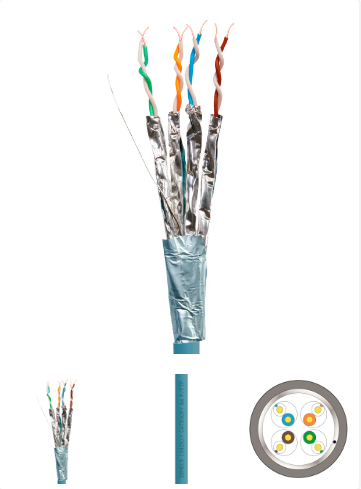
Cat6A F/FTP full shielded Ethernet cable: the cable layer of a compliance file that also has to document switches, patch panels, gateways and workstations.
Most network acceptance files contain a detailed cable section and a very thin supporting-equipment section. That asymmetry is where compliance exposure usually hides, because the certified cable is only one part of a channel that also includes the gateway, the switch, the patch panel and the workstation at either end.
Qualifying Ethernet cable supporting equipment means applying the same evidence discipline to the devices around the cable that buyers already apply to the cable itself: UL and ETL listing evidence where those marks apply, CPR reaction-to-fire classification for permanently installed construction-works cabling, the correct CMP or CMR flame rating for the installation zone, and channel-level compliance traced back to TIA/EIA-568-C.2 — the transmission standard cited across the Ethernet cable range from Linoya Electronic Technology Co., Ltd.
What Counts as Supporting Equipment
Supporting equipment is the set of active and passive components that terminate, power, ground or route a cabled link. It is defined per project type rather than per product, and the required set changes sharply between a data center rack and a factory floor.
- Data center short-reach links: 40G switches, servers, patch panels, high-speed routers, storage devices, high-speed interconnect equipment and cable managers.
- Enterprise server rooms running 10G: core switches, routers, server farms, data center equipment and enterprise gateways.
- SMB and office 10G networks: 10G switches, servers, NAS/SAN storage, patch panels, SFP modules, workstations and wireless access points.
- Commercial building infrastructure: building network switches, routers, patch panels, workstations and building automation systems.
- Industrial edge and high-EMI plants: industrial switches, PLCs, industrial robots, control systems, sensor networks, gateways and HMIs.
- Residential and light commercial: home routers, switches, PCs, smart TVs, NAS units and PoE IP cameras.
Each of those devices has its own compliance route and its own documentation owner. A cable certificate does not transfer to a switch, and a device datasheet does not certify the channel that the two of them form together. Buyers are therefore answering two separate questions: what the cable is certified to do, and what the surrounding equipment documentation proves about the assembled link.
Why Cable-Only Compliance Files Break Down at Handover
Component certification is not channel certification
A cable can be individually certified to UL, ETL and CPR and still produce a non-compliant channel if the patch panel, jacks or connectors are outside the tested configuration. Linoya product documentation lists channel-relevant parameters such as TIA/EIA-568-C.2 compliance and low insertion loss precisely because those values only hold when the terminating hardware matches the cable's performance class.
Flame rating is a zone decision, not a product preference
Linoya's CMP-rated cables — the Cat6A, Cat7, Cat7A and Cat8 shielded families — and the CMR-rated Cat6 and Cat5E families are intended for different installation zones. Selecting a lower-rated construction to reduce cost, then routing it through an environment that called for plenum-rated cable, is a specification failure that no certificate can repair after the fact.
Transmission standards move
Linoya's Ethernet cable range cites TIA/EIA-568-C.2. Buyers should also track the current generation of that standard: ANSI/TIA-568.2-E, released in October 2024, replaced ANSI/TIA-568.2-D and introduced DC resistance unbalance (DCRU) specifications for Cat5e, Cat6 and Cat6A. In practice this means the edition quoted in a test regime matters, and handover documentation should state which edition a project was verified against. The same logic applies to equipment: a switch or gateway verified against an older channel assumption may not satisfy a DCRU-aware acceptance test.
CPR class is not a single label
Under the EU Construction Products Regulation, EN 50575 defines the fire-performance classes. Class B2ca represents high fire performance with strict thresholds: flame spread (FS) ≤ 1.5 m, total heat release (THR) ≤ 15 MJ, and peak heat release rate (HRR) ≤ 30 kW. A project that simply records "CPR certified" without the class has recorded almost nothing usable for a fire-safety review.
The Evidence Set to Request Before Award
The following matrix translates the checks above into a request list that can be attached to a purchase order. It is organised by installation zone, because the zone determines both the cable family and the surrounding equipment that must be qualified alongside it.
| Installation zone | Cable layer (Linoya options) | Supporting equipment to qualify | Evidence to request |
|---|---|---|---|
| Data center, high-density and plenum spaces | Cat6A U/UTP, U/FTP, SF/UTP, F/FTP; Cat7 F/FTP; Cat7A F/FTP; Cat8 F/FTP — CMP rated | 40G/100G switches, core switches, servers, storage arrays, patch panels, high-speed routers, cable managers, enterprise gateways | UL/ETL listing evidence, CPR class declaration, CMP rating statement, channel test report naming the TIA edition, panel and jack ratings matching the cable class |
| Commercial building riser and horizontal cabling | Cat6 U/UTP, F/UTP, SF/UTP — CMR rated; Cat5E U/UTP, F/UTP, SF/UTP — CM/CMG rated | Building network switches, routers, patch panels, workstations, VoIP phones, conference systems, building automation systems | UL/ETL certification, CMR or CM/CMG rating statement, building network acceptance results, jack and panel performance class |
| High-EMI industrial and industrial edge | Cat7 F/FTP; Cat6A F/FTP, SF/UTP; Cat6 SF/UTP — CMP or CMR rated as specified | Industrial switches, PLCs, industrial robots, control systems, sensor networks, gateways, HMIs | Shielding continuity and grounding records, PoE power budget versus conductor gauge, industrial-grade construction statement, EMI environment test results |
How Linoya Covers the Cable Layer
Linoya Electronic Technology Co., Ltd. is a cable and wire manufacturer established in 1997 in Guangdong, China, exporting to the EU and the Middle East and operating three self-owned industrial parks — Shenzhen Linoya Technology Park, Dongguan Songshan Lake Linoya Industrial Park and Dongguan Chashan Linoya Industrial Park — together with a subsidiary brand, Dongguan Recheer Electric Wire & Cable Co., Ltd., and a production base in Vietnam. The company reports annual sales exceeding USD 420 million, a 60,000 m² factory footprint, more than 3,000 employees, over 300 engineers, 100+ production lines and annual output of 4,000,000 kilometres, with an export ratio of 30%.
For buyer qualification purposes, the relevant part of that profile is the cable-side evidence chain. The Ethernet cable range spans Cat5E through Cat8 with authorized UL, ETL and CPR certification, TIA/EIA-568-C.2 compliance, solid bare copper conductors, LDPE insulation and PVC or LSZH jackets. Flame ratings are specified per family: CMP for the Cat6A, Cat7, Cat7A and Cat8 shielded constructions used in high-density and plenum environments, and CMR for the Cat6 and Cat5E families used in riser and commercial building work.
Matching Cable Construction to Interfaces
Shielding architecture is the parameter that most often decides whether the supporting equipment behaves as specified. Linoya's shielded families use three distinct constructions, and each imposes a different requirement on the devices at either end.
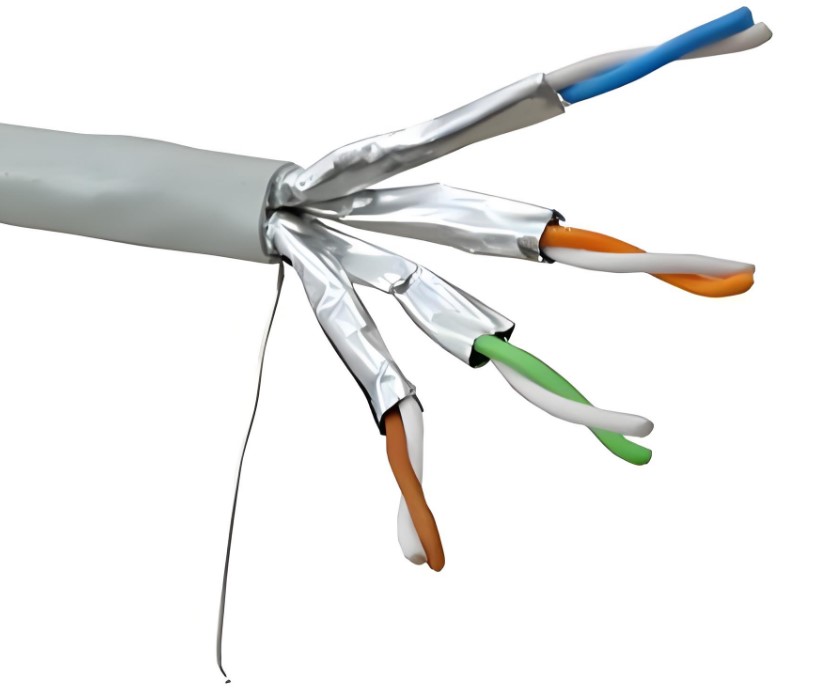
Cat6A U/FTP with individual pair foil shielding, used for enterprise server room and 10G backbone links where crosstalk control is the acceptance criterion.
| Cable family | Construction | Stated performance | Supporting equipment implication |
|---|---|---|---|
| Cat5E U/UTP, F/UTP, SF/UTP | Unshielded / overall foil / screen+foil | 24AWG solid copper, 1Gbps, UL/ETL certified | Office switches, patch panels, workstations, VoIP and conference systems; minimal grounding requirement |
| Cat6 U/UTP, F/UTP, SF/UTP | Unshielded / overall foil / screen+foil | 24AWG or 23AWG solid copper, 10Gbps@55m, CMR rated, UL/ETL certified | Gigabit/10G switches, routers, workstations, servers, IP cameras, wireless APs; 10G layout must respect the 55 m limit |
| Cat6A U/UTP | Unshielded | 23AWG solid copper, 10Gbps@100m, CMP rated, UL/ETL/CPR certified | 10G switches, servers, NAS/SAN storage, patch panels, SFP modules; lowest shielding burden |
| Cat6A U/FTP | Individual pair foil | 23AWG solid copper, 10Gbps@100m, CMP rated, UL/ETL/CPR certified | Core switches, routers, server farms, data center equipment, enterprise gateways; pair-foil requires correct bonding at the panel |
| Cat6A SF/UTP and F/FTP | Screen+foil overall / overall+pair foil | 23AWG solid copper, 10Gbps@100m, CMP rated, UL/ETL/CPR certified | Industrial switches, PLCs, gateways, HMIs, sensor networks in high-EMI plants and public infrastructure |
| Cat7 F/FTP | Overall+pair foil | 23AWG solid copper, 40Gbps@50m, CMP rated, UL/ETL/CPR certified | 40G switches, high-performance servers, storage arrays and data center interconnect equipment |
| Cat7A F/FTP | Overall+pair foil | 22AWG solid copper, 100Gbps@15m, CMP rated, UL/ETL/CPR certified | 100G switches, high-end servers and data center core equipment in premium data center and ultra-high-speed links |
| Cat8 F/FTP | Overall+pair foil | 22AWG solid copper, 40Gbps@30m, CMP rated, UL/ETL/CPR certified | 40G switches, servers, storage devices and high-speed interconnect equipment in cabinet-to-cabinet links |
Two consequences follow for equipment qualification. First, shielded constructions only deliver their stated anti-interference performance when the shield is properly terminated and grounded; incorrect STP grounding is a recognised cause of intermittent link behaviour and packet loss, and it is an installation defect rather than a product defect. Second, higher categories do not extend reach. Cat7A reaches 100Gbps over 15 m, Cat8 reaches 40Gbps over 30 m, and Cat6 delivers 10G only to 55 m. Equipment layout, not cable marketing, determines whether the chosen category is usable.
Project Fit: Data Center, Commercial Building and High-EMI Industrial
Data center short-reach and cabinet-to-cabinet links
In high-density indoor deployments, the cable family used for cabinet-to-cabinet and rack-internal interconnection is typically Cat8 F/FTP with 22AWG solid copper, 40Gbps at 30 m, overall plus pair foil shielding, CMP flame rating and UL/ETL/CPR certification. Matching equipment includes data center switches, servers, storage devices, high-speed interconnect equipment and cable managers, operating continuously in fixed short-range runs. In one recorded deployment for a high-performance data center operator, 5,000 cartons of 305 m of Cat8 F/FTP were supplied and the project reported 99.998% network stability with reliable 40G transmission; a comparable rack-to-rack case reported 99.999% stability over a stated 25-year service life.
Enterprise server rooms running 10G
Where crosstalk rather than distance is the binding constraint, Cat6A U/FTP with individual pair foil shielding, 23AWG solid copper and 10Gbps at 100 m is matched with core switches, routers, server farms, data center equipment and enterprise gateways. One enterprise data center server room project reported 99.999% network stability with crosstalk eliminated, and a 10G core network project reported full 100 m 10G transmission with zero packet loss and passed data center acceptance testing.
Commercial building horizontal and riser cabling
Building infrastructure generally pairs CMR-rated Cat6 F/UTP or Cat6 SF/UTP with building network switches, routers, patch panels, workstations and building automation systems. A commercial building vertical cabling project reported 99.98% network stability with reduced crosstalk, and an office building horizontal cabling project passed building network acceptance with CM/CMG rated, UL/ETL certified cable supporting Gigabit transmission.
High-EMI industrial and industrial edge environments
Factory and heavy-industry sites shift the requirement toward full shielding. Cat6A F/FTP, Cat6A SF/UTP, Cat7 F/FTP and Cat7A F/FTP are matched with industrial switches, PLCs, industrial robots, control systems, sensor networks, gateways and HMIs under continuous operation. A heavy industrial automation network using Cat6A F/FTP reported 99.997% network stability in extreme EMI conditions, and a high-EMI industrial high-speed network using Cat7 F/FTP reported 99.998% stability with reliable 40G transmission.
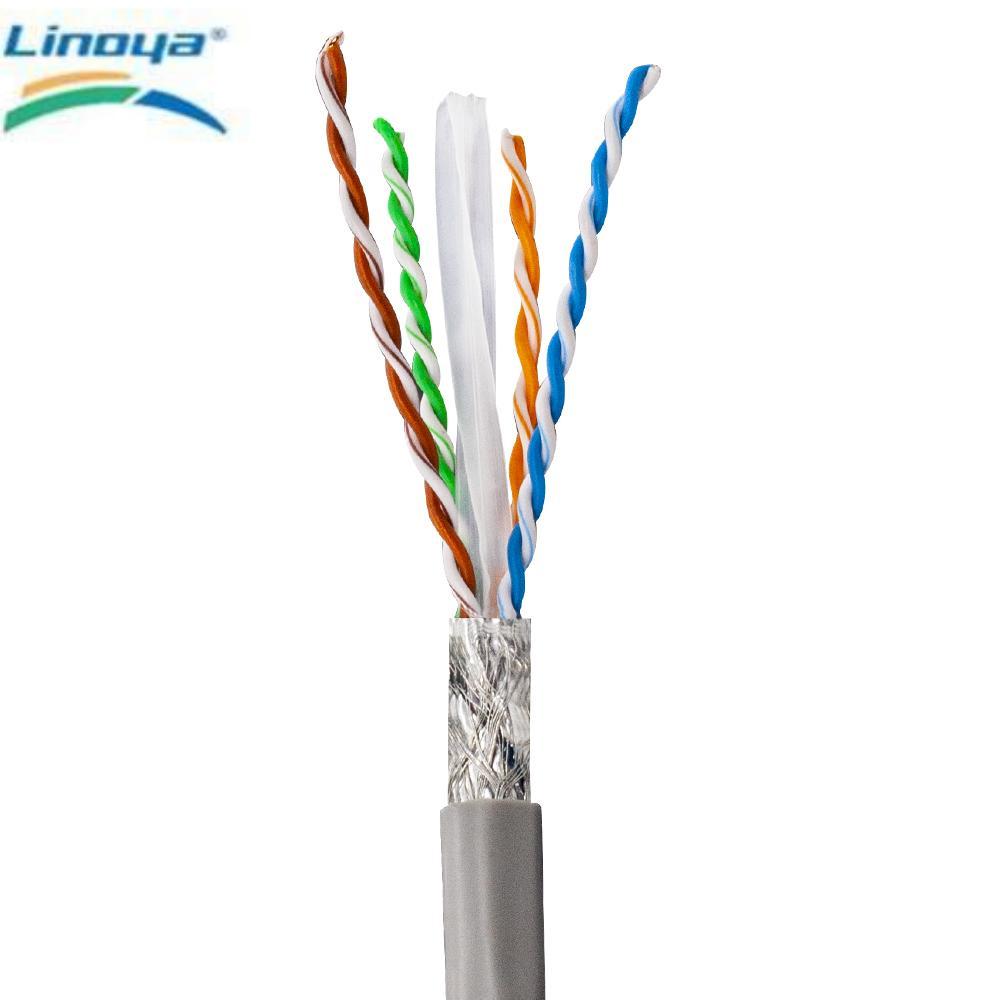
Cat6 SF/UTP screen plus foil construction, typically specified for commercial building and industrial edge cabling where moderate to high electromagnetic interference is present.
Market Signals Behind the Compliance Shift
The commercial case for tightening supporting-equipment checks is reinforced by category-level data. The global Ethernet cable market was valued at USD 38.55 billion in 2025, and is expected to reach nearly USD 70.02 billion by 2032, corresponding to a CAGR of 8.9% from 2026 to 2032. Within that market, the Cat6 segment held a 32.5% share in 2025, which means the largest single block of installed volume sits in the category where the 10G distance limit of 55 m most often interacts with equipment layout decisions.
Import and customs treatment adds a second layer of planning detail. Ethernet patch cables terminated with connectors fall under HS code 8544.42, while bulk cable on a reel without connectors is classified under HS code 8544.49. The U.S. MFN duty rate for HS 8544.42.90 is 2.6%, while the EU MFN rate is 0%. Buyers assembling a landed-cost comparison should apply the correct code to the correct product form, because the two categories are not interchangeable at entry.
Where This Approach Has Limits
Three boundaries are worth stating plainly, because a qualification framework that ignores them creates its own risk.
- Cable certifications do not cover third-party hardware. Linoya manufactures cable and wire. Switch, gateway and workstation compliance evidence must come from the vendors of those devices; the cable documentation establishes the cable layer, not the whole channel.
- Higher category does not mean longer reach. Cat7A delivers 100Gbps at 15 m and Cat8 delivers 40Gbps at 30 m, so a premium construction selected for speed can be unusable across a long building run where Cat6A at 10Gbps over 100 m would have been the correct choice.
- Programme constraints are real. A 100-carton minimum and a 30-day lead time affect schedule planning for phased projects, and certification statements apply to the specific configuration tested — buyers should confirm the exact model on the certificate rather than accepting a brand-level claim.
Compared with the traditional cable-first habit of qualifying a project on a single datasheet, a channel-level approach adds documentation effort and demands coordination between the cabling contractor and the equipment vendors. The trade-off is a handover package that survives an insurance review, a fire-safety audit or a data center acceptance test without reconstruction after installation is complete.
What Changes Next
Three developments are likely to shape the next procurement cycle. The DCRU specifications introduced in ANSI/TIA-568.2-E in October 2024 will push acceptance testing toward edition-aware documentation, which in turn raises the expectation that equipment vendors state the channel assumptions behind their interfaces. Fire-performance classification in the EU will continue to reward buyers who record the CPR class rather than the generic word "certified". And with the market expected to grow at 8.9% annually toward 2032, the volume of cable entering high-density and high-EMI environments will keep rising, which makes the discipline of qualifying what surrounds the cable more valuable, not less.
FAQ
What is Cat6 Ethernet cable, and how does it fit a supporting-equipment plan?
Cat6 is a twisted-pair Ethernet cable standard with 250 MHz bandwidth, supporting 1Gbps up to 100 m and 10Gbps up to 55 m, and operating with PoE and PoE+ power. Linoya's Cat6 range includes U/UTP, F/UTP and SF/UTP versions in 24AWG or 23AWG solid bare copper with CMR flame rating and UL/ETL certification. In a supporting-equipment plan, Cat6 is typically paired with building or office switches, routers, patch panels and workstations, and the 55 m limit for 10G is the constraint that equipment layout must respect.
How should a buyer choose between Cat5e, Cat6 and Cat6a?
Selection follows four criteria: required transmission speed, project budget, installation environment including bundle density, conduit space and PoE load, and expected service life with future upgrade headroom. Cat5e suits stable 1Gbps projects such as general office LANs and 30W PoE+ surveillance cameras, with low procurement cost and forgiving installation requirements. Cat6 fits cost-controlled projects needing short-range 10Gbps within 55 m. Cat6a suits full-channel stable 10Gbps at 100 m, dense bundling, PoE++ up to 90W and long-term permanent building cabling, at the cost of larger cable diameter and higher overall project cost.
What is Ethernet cable crosstalk, and why does it matter at equipment level?
Crosstalk is electromagnetic signal leakage between adjacent twisted wire pairs inside an Ethernet cable. Excessive crosstalk can trigger packet loss, reduced speed or unstable network connections. Constructions such as individual pair foil and overall screen-plus-foil shielding are used to control it, and termination quality also affects it, since untwisted pair lengths and poorly mated connectors degrade performance. At equipment level, crosstalk control determines whether a 10G or higher link holds its negotiated rate under load, which is why low-crosstalk cable is specified for core switch, router and server farm connections.
How is an Ethernet cable verified as working properly in a project?
Verification can be done with a cable tester, by checking the link status indicator on the network device, or by running a real-world speed test to confirm continuity and transmission performance. A practical sequence is to plug both ends into a cable tester, read the LED sequence to detect open circuits, short circuits or mis-wiring, connect the cable between a PC and a router to check the RJ45 link light, run a throughput test, and replace the cable if mis-wiring or low throughput appears. Factory-level testing is not a substitute for site checking: finished cables are tested before delivery, but the installed link still requires re-verification after construction.
Why does an installed Ethernet cable show no internet connection?
Causes typically fall into three groups. Physical failure covers broken conductors, crushed cable, degraded conductor material and bent or oxidised connector pins. Loose or poor contacts cover RJ45 plugs that are not fully seated and loose ports on routers, switches or devices. Grade and environment mismatch covers low-grade cable that cannot meet the required bandwidth, and indoor-rated cable used outdoors where it fails early. Diagnosis follows the same order as the causes: re-seat both ends, swap in a known-good cable, inspect the cable body, check the RJ45 pins, run a continuity test, and replace the cable if a physical defect is confirmed.
How does crimping quality affect cable and equipment compliance?
Crimping is the process of stripping the jacket, arranging the pairs to the T568B wiring standard, inserting the conductors into an RJ45 connector and compressing the connector with a crimping tool. Termination quality directly affects whether the installed channel meets its performance class, because over-long untwisted pair lengths and poorly seated conductors raise crosstalk and return loss. Solid-core bulk cable and pre-terminated patch cords are both used on projects; pre-terminated cords reduce on-site termination workload, while field termination requires a continuity test on every link. Standard safety practice applies: use insulated hand tools, avoid nicking inner conductors, and never work on live powered network ports.
Reference document: Linoya Electronic Technology Co., Ltd. corporate and product brochure (PDF) — download the brochure.
Have Questions or Need More Details?
Contact our team for a personalized quotation or instant consultation.
Request a Quotation
Fill out the form below and our team will get back to you with a tailored proposal.
WhatsApp Direct Chat
Prefer to chat in real-time? Message us on WhatsApp for instant assistance & quick answers.
- Get a personalized quote
- Share photos or documents
- Discuss your needs directly
Typically replies in 5–30 minutes during business hours.