
UL94 V-0, RoHS 2.0, REACH and IATF16949 for High-Current Connectors
UL94 V-0, RoHS 2.0, REACH and IATF16949 for High-Current Connectors
On high-current DC power connectors, UL94 V-0, RoHS 2.0, REACH SVHC and IATF16949:2016 are qualifying conditions rather than competitive features. This reference explains what each one actually covers, how it is checked, and where its limits sit for UAV, two-wheeler EV and energy storage programmes.
Compliance Is an Entry Requirement, Not a Selling Point
A high-current DC connector is rarely removed from a UAV, two-wheeler EV or energy storage programme because of ampacity alone. It is removed because the housing material carries no documented flammability classification, because the supplier's declaration does not map to the current REACH SVHC candidate list, or because the quality system behind the part cannot be traced from incoming raw material to a released production batch. For equipment shipping into the European Union, North America or automotive-adjacent supply chains, UL94 V-0, RoHS 2.0, REACH SVHC and IATF16949:2016 are the four references that decide whether a connector can be designed in at all.
Treating them as differentiators is a common procurement error. In most qualified tenders, every serious supplier holds all four. The useful question is not whether a supplier has them, but what evidence sits behind them and how far that evidence actually reaches.
AOYG DC Power Connector, a China-based manufacturer of high-current DC connection systems for lithium-ion smart devices, is used throughout this article as a documented example of how the four layers are applied to real part numbers rather than to a general marketing claim.
Four Different Questions Behind Four Different Marks
The four references are often printed on a single line of a datasheet, but they answer unrelated questions. Separating them is the first step in reviewing a connector specification properly.
- UL94 V-0 answers a fire-behaviour question about the plastic material of the housing: does the material stop burning on its own once the ignition source is removed?
- RoHS 2.0 answers a substance-restriction question: does the part comply with restricted-substance rules for electrical and electronic equipment placed on the EU market?
- REACH SVHC answers a communication question: does the article contain substances of very high concern above the applicable threshold, and is that information passed along the supply chain?
- IATF16949:2016 answers a process question: can the manufacturing site hold declared performance across batches, with traceability, failure prevention and continuous improvement?
DC architecture keeps expanding, and with it the number of suppliers a buyer has to screen. DC connectors accounted for 58.7% of the energy storage connector market in 2025, according to Dataintelo's energy storage connector research. When the supplier pool grows faster than a buyer's qualification capacity, compliance documents become the first filter — which is precisely why they behave as prerequisites rather than as advantages.
UL94 V-0 — A Material Rating for the Housing
UL94 V-0 is a flammability classification of a plastic material, not a certification of an assembled connector. It is established through a vertical burn test in which a specimen is exposed to a flame and then allowed to self-extinguish, with the classification describing how the material behaves after the flame is removed.
What the rating covers
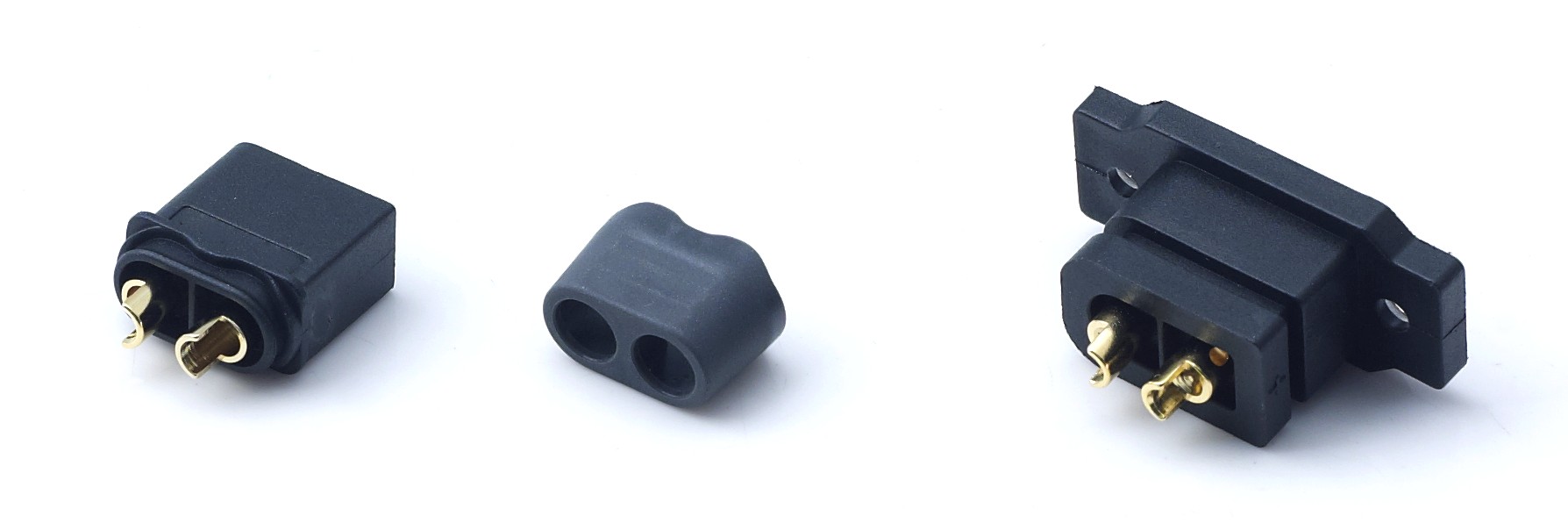
The rating covers the fire behaviour of the plastic compound used for the housing. AOYG's DXT high-current connectors use flame-retardant PA66 nylon housings classified UL94 V-0 across the documented range — from the compact 15 A DXT30U-M / DXT30U-F pair to the 90 A DXT90H-M / DXT90S-F set used on UAV power trains.
What the rating does not cover
It does not cover continuous current capacity, contact resistance, mating cycle life, salt spray resistance or ingress protection. A UL94 V-0 housing says nothing about whether a connector is correctly sized for a 90 A load; that remains a separate thermal and electrical question answered by current rating, terminal design and wire gauge.
Why housing material matters at high current
A connector carrying continuous high current generates heat at the contact interface and in the conductor. The housing has to resist softening, deformation and melting under that continuous temperature rise while continuing to act as an insulator. AOYG specifies an operating range of -20 °C to +120 °C for its DXT housings and states that the housing does not catch fire or melt under high-current operation.
High-voltage resistance is a related but distinct property. Documented insulation performance includes a withstand voltage test of AC 2000 V for one minute on the DXT30U and DXT90H / DXT90E models, which is the evidence behind the claim that the housing carries high-voltage insulation rather than the flammability claim itself.
Material source belongs to the rating as well. A V-0 classification is a property of a specific compound, not of "plastic" in general. Recycled or secondary plastic streams can behave differently in flame testing and in long-term aging, which is why the material specification — not only the rating printed on a datasheet — is part of what a buyer should be able to trace.
RoHS 2.0 and REACH SVHC — Substance Compliance and Market Access
RoHS 2.0 and REACH SVHC are substances questions, not performance questions. RoHS 2.0 restricts the use of specified hazardous substances in electrical and electronic equipment placed on the EU market. REACH places duties on articles containing substances of very high concern above defined concentration thresholds, including the obligation to communicate that information through the supply chain.
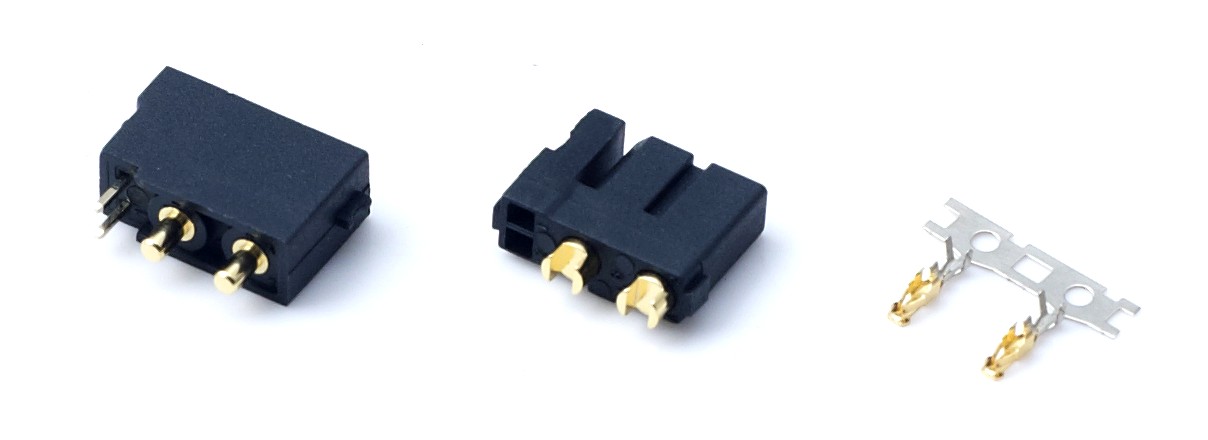
A high-current connector is a small assembly of very different materials: flame-retardant PA66 housing, gold-plated H62 brass terminals, beryllium copper spring contacts, and silicone sealing rings on waterproof variants. Every material input is a potential carrier of restricted or declarable substances, which is why a compliance statement has to attach to the part number and its material composition rather than to a product family in general.
AOYG states that its core products comply with RoHS 2.0 and REACH SVHC. The requirement is documented on specific part numbers — for example the DXT90H-M + DXT90E-F Yellow connector and the DXT30U(2+2)-F(B) power-signal composite connector — and it recurs as a standard requirement in the application profiles the company publishes for UAV and RC model use, outdoor waterproof lithium-powered equipment, and low-voltage lithium battery energy storage and EV applications.
The boundary matters. Substance compliance does not describe connector performance. A fully RoHS 2.0 and REACH SVHC compliant connector can still be under-specified for a given continuous current, can still run a higher temperature rise than the application allows, and can still have a shorter mating life than the equipment's service model assumes. Treating substance compliance as a proxy for quality confuses two unrelated layers of evidence.
IATF16949:2016 — The Process Layer Behind the Part
IATF16949:2016 certifies a quality management system; it does not certify an individual connector. That distinction is the most useful thing a buyer can take from a certificate.
AOYG DC Power Connector has obtained IATF16949:2016 automotive quality management system certification. In practical terms, the company describes its production as following automotive-component quality standards throughout, with full-process control from raw material incoming inspection, precision processing and plating through to finished-product testing and factory inspection. The system covers production consistency, product stability, traceability and batch quality control, together with continuous improvement, failure prevention, vibration resistance, high-current safety and environmental protection requirements. Quality traceability is maintained across the full lifecycle from raw material to finished product.
For a two-wheeler EV, battery-swap or light electric vehicle programme, this is the layer that determines whether the tenth production batch behaves like the validated sample. For UAV and RC applications, the same process discipline is what supports the vibration, current and environmental performance declared for the parts.
What the certificate still does not give a buyer is part-level numbers. Temperature rise at the rated continuous current, contact resistance values, salt spray results, mating cycle counts and batch test records remain part-specific evidence, and a site-level system certificate cannot substitute for them.
How AOYG Documents the Four Layers
AOYG DC Power Connector is a manufacturer and solution provider specialising in high-current DC connection systems for lithium-ion smart devices, serving commercial and industrial drones, intelligent service robots, garden power tools and portable cleaning equipment, among other new-energy segments. The company operates a 6,000 m² facility with approximately 100 employees, including a 25-engineer R&D team, and reports annual output of about 900,000 units, with roughly 50% of sales exported and main markets in the EU and the USA. Product documentation is published at www.aoygvn.com.
On the four compliance layers, the documented position is consistent across the range: PA66 UL94 V-0 flame-retardant housings throughout, RoHS 2.0 and REACH SVHC compliance for core products, and IATF16949:2016 as the quality management system. The table below maps the declared ratings of the main DXT models against those layers.
| Model | Continuous / peak current | Housing & flammability | Protection | Documented compliance notes |
|---|---|---|---|---|
| DXT90H-M / DXT90S-F | 90 A continuous, DC 500 V | PA66 UL94 V-0 | IP40 | Anti-spark pre-charge resistor built into DXT90S-F; ≥1000 mating cycles; 48 h salt spray on gold-plated terminals |
| DXT90H-M + DXT90E-F Yellow | 45 A continuous, 90 A short-term peak, DC 500 V | PA66 UL94 V-0 | IP40 | RoHS 2.0 and REACH SVHC compliant; ≥1000 mating cycles; 48 h salt spray |
| DXT60EW-M + DXT60W-F | 60 A continuous, 100 A peak, DC 500 V | PA66 UL94 V-0 with silicone O-ring | IP67 | Sealed waterproof structure; ≥1000 mating cycles; no anti-spark structure |
| DXT30U(2+2)-F(B) | 20 A power pin / 1 A signal pin, 35 A peak, DC 500 V | PA66 UL94 V-0 | IP40 | RoHS 2.0 and REACH SVHC compliant; ≥1000 mating cycles; 48 h salt spray |
| DXT30U-M / DXT30U-F | 15 A continuous, 30 A peak, DC 500 V | PA66 UL94 V-0 | IP40 | Withstand voltage AC 2000 V / 1 min; ≥1000 mating cycles; 48 h salt spray |
Customisation is where the certification layer meets the application layer. AOYG supports OEM and ODM development covering housing size, current specification, pin position, wiring structure and logo printing, with 100% product testing, a stated lead time of 30–45 days, and the ability to begin from very small quantities for sample validation. The company's published delivery record includes a 20-unit programme across drone, robot, e-mobility, energy storage and power tool manufacturers, in stable operation for over two years.
Where Certified High-Current Connectors Are Used
UAV, agricultural drone and RC platforms
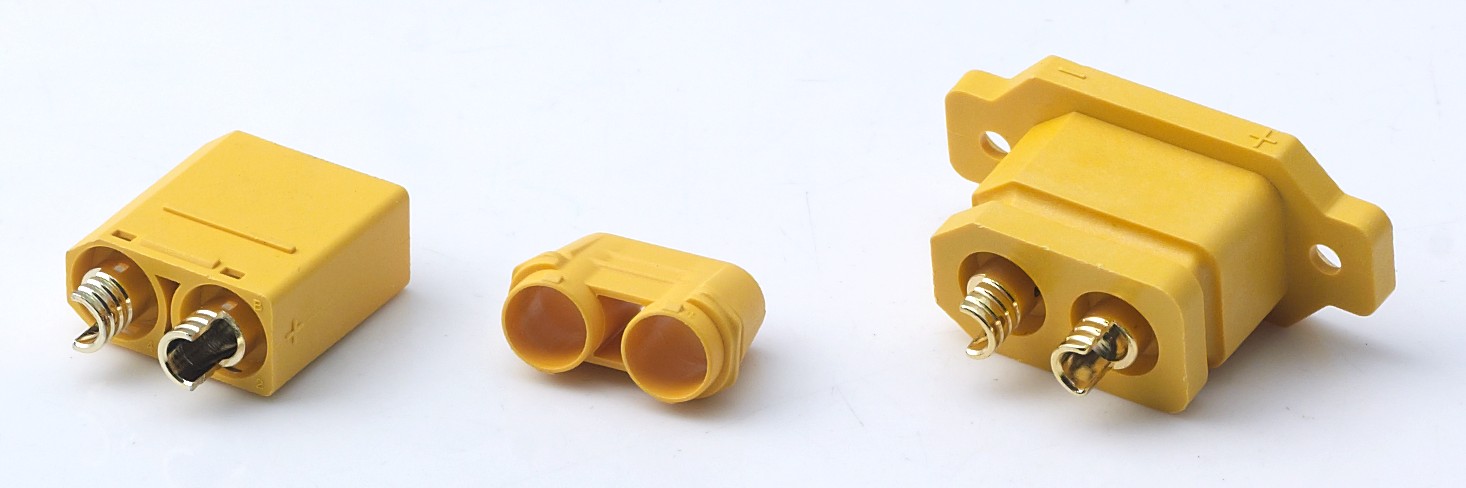
In UAV and RC model applications, connectors operate under continuous flight vibration and landing impact, exposed to dust, rain and high humidity, at temperatures from -20 °C to +120 °C, with frequent mating and unmating for battery swap. The DXT90H-M / DXT90S-F set carries 90 A continuous at DC 500 V for LiPo battery connection on multi-rotor and agricultural drones, and the anti-spark pre-charge design of the DXT90S-F addresses arc formation when batteries are connected. Lightweight designs such as DXT30U-M / DXT30U-F at 15 A continuous serve small UAVs, FPV models and portable lithium battery packs.
Two-wheeler EV and battery-swap equipment
Two-wheeler EV and battery-swap cabinet projects use the same connection class to move power between lithium battery packs and load equipment, typically alongside a BMS, drive motor, wire harness assembly, outdoor charger and inverter. Manual mating with a locking structure provides continuous power during operation, and the sealed housing maintains safe circuit conduction under humid and rainy conditions. Composite versions such as DXT30U(2+2)-F(B) transmit power and sensing signals through a single interface, reducing harness count inside the vehicle or cabinet.
Outdoor, waterproof and energy storage equipment
Outdoor lithium-powered equipment — waterborne unmanned equipment, mobile photovoltaic energy storage, marine lithium battery systems, outdoor communication backup power, garden machinery, outdoor 5G base station standby power and outdoor electric amusement equipment — depends on ingress protection more than on any single rating. The DXT60EW-M + DXT60W-F pair runs 60 A continuous and 100 A peak with IP67 protection and a silicone O-ring seal, which suits long-term outdoor exposure to rain splash, humidity, dust and muddy conditions. Robots, portable energy storage, light-duty e-bikes, garden power tools and smart device battery packs use the composite and compact models in the same family.
Market Trend: Rising Current Density Raises the Compliance Floor
Three observable trends explain why the four references are becoming standard procurement checklist items rather than optional extras.
First, the market these connectors serve is large and still structured around DC. Fact.MR estimated the global high power connectors market at approximately USD 5.47 billion in 2025, and Dataintelo's energy storage connector research recorded DC connectors at 58.7% of that segment's 2025 share, driven by higher voltage requirements. More DC-based equipment means more programmes in which a connector's substance and fire documentation is reviewed by someone other than the original design engineer.
Second, power density per site keeps climbing. Industry planning guidance for telecom sites notes that 5G base stations consume two to three times more power than 4G predecessors, with typical draws of 11.5 to 14 kW and peaks reaching 19 kW. Backup power architecture at that level pushes current through connectors that were previously specified for far lighter duty, which raises both the thermal requirement and the scrutiny applied to insulation and flammability.
Third, interface standardisation reduces differentiation at the mechanical level. XT60 and XT90 styles are described in hobby-market technical references as the primary industry standards for medium to high power, non-proprietary RC aircraft and drone connections. When the mating interface is de facto standard, buyers compare suppliers on the layers that are not standard: material compliance, process control and part-level evidence.
Certified Connectors vs Low-Cost Alternatives — and the Limits of Certification
The comparison that matters for procurement is not "certified versus uncertified" in the abstract. It is a documented, traceable part with a specified material composition against a lowest-cost part supported by a self-declared statement and no material traceability. The practical differences appear in three places: the housing compound (a virgin flame-retardant PA66 formulation with a stated V-0 classification versus an unspecified or recycled plastic stream), the conductive system (gold-plated H62 brass terminals and beryllium copper springs with stated contact resistance, for example ≤0.8 mΩ on DXT60EW-M + DXT60W-F and ≤1.2 mΩ on DXT30U(2+2)-F(B)), and the documentation chain that lets an OEM answer an auditor or a customer two years after delivery.
Certification does not, however, resolve every engineering question. The following limits are real and should be stated before a design is frozen.
- UL94 V-0 does not size a connector. The rating describes the housing material's fire behaviour; it says nothing about whether the part is correctly rated for the application's continuous current.
- IATF16949:2016 is site-level. It certifies the quality management system, not each part number. Batch test data still has to be requested.
- RoHS 2.0 and REACH SVHC cover substances only. A compliant connector can still run an unacceptable temperature rise or fall short on mating life.
- Protection class must match the environment. IP40 models such as DXT90H-M / DXT90S-F, DXT90H-M + DXT90E-F Yellow and DXT30U(2+2)-F(B) are intended for protected use; wet, marine or outdoor installations require a sealed IP67 design such as DXT60EW-M + DXT60W-F.
- Anti-spark capability is not universal. The DXT60EW-M + DXT60W-F model does not have an anti-spark structure, and live plugging or unplugging of large-capacity batteries is not recommended with it. Where hot-plug arcs are a design concern, the pre-charge design in the DXT90S-F is the relevant option.
- Certification does not replace wire gauge discipline. The documented ratings are tied to conductor sizes — 8–10 AWG on the 60 A waterproof pair, 10 AWG on the 90 A UAV set and the 45 A RC model connector, and 18 AWG on the 15 A DXT30U pair.
Future Outlook
The direction of travel is toward certification as a baseline that is verified rather than announced. As DC share in energy storage and light electric vehicle applications continues to grow, and as higher-power site infrastructure raises current density in backup systems, procurement templates are likely to move from "does the supplier hold the certificate" to "can the supplier produce batch-level evidence on demand".
Three expectations follow for buyers. First, material declarations will need to be refreshed as the REACH SVHC candidate list is updated, which makes the version referenced in a declaration a routine review point. Second, traceability from raw material to finished product will shift from a differentiator to a documented requirement in more tenders. Third, differentiation will concentrate in engineering responsiveness — the ability to adjust current specification, pin configuration and wiring structure for a specific programme without breaking the compliance chain that made the part acceptable in the first place.
FAQ
What does the UL94 V-0 rating on a high-current DC connector actually cover?
It covers the flammability classification of the plastic material used for the housing — typically flame-retardant PA66 nylon in the DXT range — under a vertical burn test in which the material self-extinguishes after the ignition source is removed. It does not cover current-carrying capacity, contact resistance, mating cycle life or ingress protection. Those are separate specifications and are verified separately, for example the 90 A continuous rating and the ≥1000 mating cycle figure declared for DXT90H-M / DXT90S-F.
Is the plastic housing of these connectors fireproof, melt-resistant and high-voltage resistant?
Those are three separate properties and should be verified separately. Fire resistance is addressed by the UL94 V-0 classification of the housing material. Melt resistance relates to behaviour under the continuous temperature rise of a high-current circuit; AOYG's DXT housings are specified for -20 °C to +120 °C, and the company states that the housing does not catch fire or melt under high-current operation. High-voltage resistance relates to insulation performance, and documented evidence includes a withstand voltage test of AC 2000 V for one minute on the DXT30U and DXT90H / DXT90E models. None of the three properties, on its own, confirms that a connector is correctly sized for a given load.
Does AOYG hold IATF16949 certification, and what does it cover?
AOYG DC Power Connector has obtained IATF16949:2016 automotive quality management system certification. The certification covers process control across raw material incoming inspection, precision processing, plating and finished-product testing, together with production consistency, batch traceability, failure prevention and continuous improvement. It is a site and process certification: it establishes how parts are made and controlled, and does not by itself certify the electrical performance of an individual part number.
How should RoHS 2.0 and REACH SVHC compliance be verified rather than assumed?
Verification is a document review attached to a specific part number. Buyers normally request a declaration of conformity covering the part and its material composition, check which version of the SVHC candidate list the declaration references, and — where the application requires it — request material test reports for the housing plastic and the plated terminals. AOYG states that its core products comply with RoHS 2.0 and REACH SVHC, a requirement that also appears in its published application requirement lists for UAV and RC model use, outdoor waterproof equipment, and low-voltage lithium battery energy storage and EV applications. Compliance answers a market-access and materials question; it does not describe connector performance.
Do these certifications differentiate one high-current connector supplier from another?
Not by themselves. For UAV and two-wheeler EV applications the four references are normally baseline requirements, and qualified suppliers in a tender usually hold all of them. Differentiation appears one layer down: batch-level test data, temperature rise measured at the rated continuous current, salt spray results, mating cycle counts, protection class matched to the actual environment, and the engineering ability to modify pin configuration, current specification or wiring structure for a specific project.
What is normally involved in technical matching and debugging before a connector is released to production?
The usual scope covers model selection guidance against the application's current and voltage conditions, adaptation analysis of the connector against the mating harness and equipment housing, sample-level debugging, and corrective optimisation of the assembly if the sample reveals issues. Sample validation is also the point at which a buyer can independently confirm declared properties, such as temperature rise at the rated continuous current, before committing to a production volume.