
UMIDIGI G100 5G vs Note 100 5G: Battery-First Comparison
The two models look similar on a shelf and diverge in ways that matter after twelve months of use. The G100 5G carries 1,000mAh more battery, a 6.9-inch display, extended RAM configured up to 8+16GB and NFC; the Note 100 5G is 20 g lighter, 0.4 mm thinner, and is positioned by its maker as a stylish 5G device rather than a long-endurance one. Neither is rugged, and neither comes with a published runtime figure. This comparison sets out exactly what is documented for each model, and where a buyer has to make a judgement that the specification sheet cannot settle.
Why a battery-first comparison inside one brand
Battery capacity has moved from a footnote to a primary selection criterion in the mid-market 5G segment. Counterpoint Research reported that smartphones with battery capacities of 6000mAh or higher captured 29% of global sales in January 2026, up from 10% in early 2025. That shift changes how buyers read a specification sheet: capacity now sits alongside screen size and memory as a headline attribute rather than a supporting detail.
UMIDIGI is the smartphone brand operated by Shenzhen Keysmart Technology Co., Ltd., a Shenzhen-based company founded in 2012 that combines own-brand operation with ODM/OEM services and reports a 10,000 m² facility, 400–500 employees and annual output of 30,000,000 units. Within that portfolio, two 5G models overlap closely enough that buyers shortlist them against each other: the UMIDIGI G100 5G and the UMIDIGI Note 100 5G. Both are large-display 5G devices with 50MP triple rear cameras, 16MP front cameras, 256GB of storage and 20W PD fast charging. The differences are concentrated in battery capacity, chipset, chassis dimensions and positioning.
This comparison is written for the evaluation stage, where the buyer already accepts that a large-display 5G phone is the right category and now has to choose between two configurations from the same manufacturer. It uses UMIDIGI's published product units, the company's certification records and third-party market data. Where a claim is not documented — battery runtime in hours, cycle life, retail price — this article says so rather than estimating.
First, a naming clarification that changes the specs you read
UMIDIGI's G100 family contains more than one specification, and buyers searching for “G100” will encounter both. The UMIDIGI G100 5G is built on the UNISOC T8200 5G processor and carries NFC and Android 15. A separate entry, the UMIDIGI G100, is built on the UNISOC T615 processor and is listed as a 4G large and long-endurance device with the same 6.9-inch 120Hz display and 6000mAh battery, 8+8GB extended RAM and a 205 g body.
This article compares the 5G variants only: the UMIDIGI G100 5G against the UMIDIGI Note 100 5G. Buyers who have seen a T615 specification attributed to a “G100” have most likely been reading the 4G model's sheet. Confirming the exact model name before comparing processors avoids a common sourcing error.
G100 5G vs Note 100 5G at a glance
| Specification | UMIDIGI G100 5G | UMIDIGI Note 100 5G |
|---|---|---|
| Processor | UNISOC T8200 5G | UNISOC T765 5G |
| Display | 6.9″ 120Hz Eye-Care Large Display | 6.8″ 120Hz HD+ Punch Hole Display |
| Battery | 6000mAh, 20W PD fast charging | 5000mAh, 20W PD fast charging |
| Memory | Up to 8+16GB extended RAM, 256GB ROM, 1TB TF expansion | Up to 8+8GB extended RAM, 256GB ROM, 1TB TF expansion |
| Camera | 50MP ultra-clear triple camera, 16MP front | 50MP ultra-clear triple camera, 16MP front |
| Dimensions | 171 × 77.6 × 8.1 mm | 167.8 × 77.4 × 7.7 mm |
| Weight | 210 g | 190 g |
| Protection | IP53 dustproof and waterproof | IP53 dustproof and waterproof |
| Unlock | Side fingerprint sensor, AI face unlock | Side fingerprint sensor, AI face unlock |
| Other features | NFC; Android 15 | Hot Key |
| Material | Plastic and metal | Plastic back, glass display |
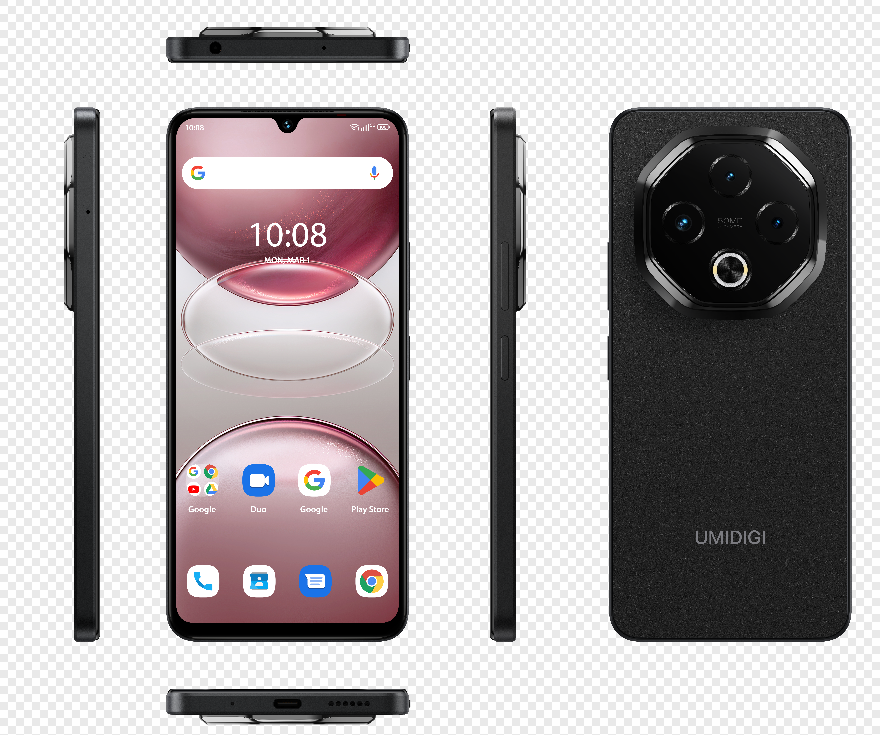
Battery: 6,000mAh versus 5,000mAh, both at 20W PD
The headline difference is capacity. The UMIDIGI G100 5G uses a 6000mAh long-lasting battery; the UMIDIGI Note 100 5G uses a 5000mAh long-lasting battery. Both are paired with 20W PD fast charging, so the charging hardware does not separate the two models in the documentation provided.
The gap is meaningful in relative terms: 6,000mAh is one-fifth more nominal capacity than 5,000mAh. Nominal capacity, however, is not runtime. UMIDIGI's published product units for both models state capacity and charging wattage without stating hours of use, standby duration or charge-cycle life. Buyers who need a runtime figure for workforce planning will not find one in these specification units, and should treat capacity as a comparative indicator rather than a promise of a specific working day.
Two practical consequences follow. First, for a single-shift user the 5,000mAh Note 100 5G is squarely inside the mainstream capacity band, and the segment data supports that: The Insight Partners recorded that the 5000mAh to 6000mAh battery segment accounted for 42.9% of the rugged phone market share in 2025, indicating that both capacities sit within the range the market currently treats as normal. Second, the case for the G100 5G's extra 1,000mAh strengthens as charging opportunities become less predictable — long transport days, site visits, trade-show floors — rather than in desk-bound use where a charger is always within reach.
Battery chemistry is not specified in either product unit. Neither model's documentation lists a silicon-carbon anode, so buyers who have read about the 20–50% energy-density advantage that Fortune Business Insights attributes to silicon-carbon batteries should not assume that advantage applies to these two devices. Where chemistry is not stated, the safe assumption is the conventional specification.
Chipsets: UNISOC T8200 5G versus UNISOC T765 5G
The G100 5G runs on the UNISOC T8200 5G processor. The Note 100 5G runs on the UNISOC T765 5G processor — a detail confirmed in UMIDIGI's own product communication, which states that this smartphone uses the UNISOC T765 5G processor.
Both are 5G platforms, so network generation does not differentiate them. What the documentation does not contain is equally relevant: no benchmark scores, no clock speeds, no GPU specifications and no thermal figures are published for either model. A buyer comparing the two chipsets therefore has model naming and positioning to work with, not measured performance. Any claim that one platform is materially faster for a given task would sit outside the available evidence.
Where the configurations diverge more concretely is memory. The G100 5G is specified with up to 8+16GB extended RAM; the Note 100 5G with up to 8+8GB extended RAM. Both ship with 256GB of internal storage and both support 1TB TF card expansion. Extended RAM is a software-assisted memory extension, not a physically larger memory package, but the configured ceiling is twice as high on the G100 5G. For buyers running several applications concurrently, or planning a device refresh cycle of several years, that headroom is the more defensible differentiator than chipset naming alone.
Display size, refresh rate and the weight trade-off
Both panels refresh at 120Hz, which keeps scrolling and video playback in the same smoothness class. The difference is diagonal and panel description. The G100 5G uses a 6.9-inch 120Hz Eye-Care large display; the Note 100 5G uses a 6.8-inch 120Hz HD+ punch hole display. The tenth of an inch is not a deciding factor on its own, but the Note 100 5G's punch-hole description and its HD+ designation indicate a different panel approach from the G100 5G's eye-care framing.
Chassis dimensions translate the size difference into something a buyer can feel. The G100 5G measures 171 × 77.6 × 8.1 mm at 210 g. The Note 100 5G measures 167.8 × 77.4 × 7.7 mm at 190 g. The Note 100 5G is 20 g lighter and 0.4 mm thinner, with a body roughly 3 mm shorter.
That 20 g is the direct cost of the extra 1,000mAh. It is a modest penalty in absolute terms and a real one in hand over a long day. Buyers who carry a device in a pocket for eight hours and buyers who leave it on a desk will weigh it differently — and that judgement, not the specification table, is what usually decides between these two models. Material construction also differs: the G100 5G is specified with plastic and metal, the Note 100 5G with a plastic back and a glass display.
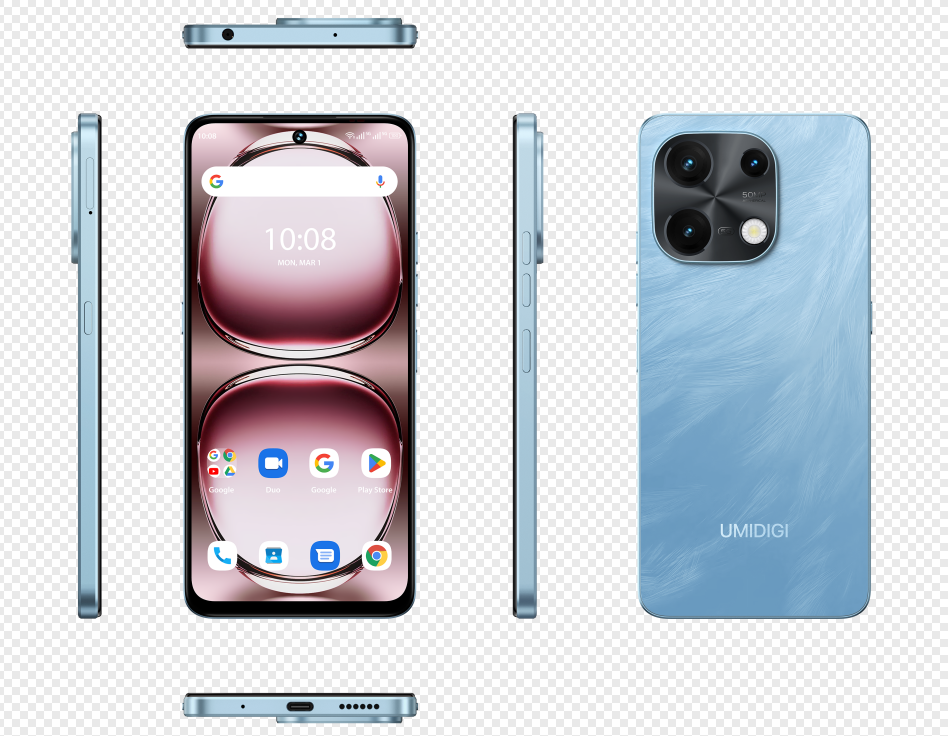
IP53 on both models — and the limits that rating sets
Both devices are rated IP53 for dustproof and waterproof protection. Under IEC 60529, the standard referenced for ingress protection, the two digits describe solids and liquids separately: the first digit addresses dust and the second addresses water. A rating of 53 indicates a device protected against limited dust ingress and against water sprayed at an angle — it does not indicate protection against immersion.
This is the single most important limitation in this comparison. Neither the UMIDIGI G100 5G nor the UMIDIGI Note 100 5G carries an IP68 or IP69K rating, and neither is listed against MIL-STD-810H for shock and environmental resistance. For context, IEC 60529 (IP68/IP69K) and MIL-STD-810H are the standards that define the rugged device category.
Buyers whose use case involves rain, dust-heavy sites, drops onto concrete or washing down a device should not use IP53 as a proxy for field readiness. UMIDIGI's own rugged option, the BISON X20, is the model built for that: IP68 and IP69K dustproof and waterproof protection plus MIL-STD-810G drop resistance, a TPU and metal body, 278 g, a MediaTek Helio P60 processor, 6+6GB extended RAM, 128GB ROM and a 6000mAh battery with 20W PD fast charging. The G100 5G and Note 100 5G are everyday devices with splash resistance, not rugged tools.
Endurance positioning: what the documents actually claim
UMIDIGI classifies the G100 5G as a “5G Large Display and Long-endurance Smartphone.” The Note 100 5G is classified as a “Stylish 5G Large Display Smartphone.” That difference in official product description is explicit and one-directional: the long-endurance designation attaches to the G100 5G, and no equivalent endurance claim appears in the Note 100 5G product documentation.
For a buyer, this is a positioning signal backed by a real capacity difference, not a measured outcome. Neither document states operating hours, standby days or battery cycle life, and no cost figure is published for either model. The lifetime-cost reasoning that a lower-capacity device may need charging more often, while a higher-capacity device carries 20 g more mass, is a judgement the buyer makes — the manufacturer's documentation supports the direction of the claim, not a quantified lifespan comparison.
The Note 100 5G's documentation instead emphasises operational continuity and completeness of the package. UMIDIGI states that the device is designed for digital consumer electronic product projects and operates in 24/7 continuous mode at normal temperature, with supporting equipment that includes protector film, a phone case, a power adapter, a SIM tray ejector and a USB cable, and that its role in the application is to support both work and entertainment. That describes intended deployment context rather than durability or endurance performance.
One further documented point is program-level rather than model-level. UMIDIGI's case record for a US consumer electronics ODM client covers 50,000 units over more than five years, with the stated result of large display, power-saving long battery life, and smooth experience in game playing and video streaming, and the stated highlight of large display, stylish design, larger battery and affordable price. That record relates to the ODM program across multiple UMIDIGI models, including both the G100 5G and the Note 100 5G, so it should be read as evidence of program-level fit rather than as a model-specific cost or endurance claim.
Certification and compliance: what a buyer can verify
Both models sit inside UMIDIGI's EU RED certification portfolio, documented through EU type examination and attestation of conformity records issued by BACL.
For the G100 family, EU type examination certificate B2412041 covers smart phone models PG4RBG100 and PG4RB100A under the UMIDIGI brand, issued 18 December 2024 against 2014/53/EU RED, with safety assessed to IEC 62368-1 and the EN 50360 series, EMC to EN 55032 and IEC 61000-3, and radio to the ETSI EN 300 / EN 301 / EN 303 series.
For the Note 100 5G, EU type examination certificate B2407121 covers model numbers PG4MBG9YA, PG4TBG9PG, PN4TB100G and PN4TB10PG under the UMIDIGI brand, issued 29 July 2024 against the same 2014/53/EU RED framework, with safety to IEC 62368-1 and EN 50360 series, EMC to EN 55032 and IEC 61000-3 series, and radio spectrum to the full ETSI EN300 / EN301 / EN303 series standards.
The procurement implication is straightforward. A buyer placing either model in an EU market has a traceable certificate number, issuing body, standard set and issue date to request and check. What the certificates do not do is establish equivalence between the two models: they are separate filings against separate model designations, and a compliance file assembled for one should not be reused for the other. Buyers should also confirm that the model designation on the unit they receive matches the designation on the certificate, since the certificates name specific model numbers rather than product families.

Application fit: daily use, long shifts and light field work
Four buyer profiles map cleanly onto the documented differences.
- All-day users with unpredictable charging access. Transport, field sales, event staff and long-shift workers benefit most from the G100 5G's 6000mAh capacity and 6.9-inch display. The additional 1,000mAh is the reason to accept 210 g.
- Style-first daily users. Buyers who prioritise a lighter, thinner device — 190 g and 7.7 mm — and who charge at a desk or at home each evening are the natural Note 100 5G audience. Its official classification as a stylish 5G large-display device reflects that intent.
- Media and entertainment users. Both models share 120Hz refresh, a 50MP triple rear camera, a 16MP front camera and 256GB of storage with 1TB TF expansion. The G100 5G's larger 6.9-inch panel and higher memory ceiling favour heavier multitasking and longer viewing sessions; the Note 100 5G's lighter body favours handheld use.
- Buyers who need NFC. NFC is listed for the G100 5G. The Note 100 5G specification unit lists a Hot Key and does not list NFC. Where contactless payment or tag reading is a requirement, this point alone may decide the choice.
Outside these profiles, neither model is the right answer. Construction, mining, logistics yard work, manufacturing floors and any environment involving water immersion or drop risk belong to the rugged category, where the BISON X20 is UMIDIGI's documented option with IP68 and IP69K protection and MIL-STD-810G drop resistance.
For buyers sourcing at volume rather than purchasing single units, both models fall within UMIDIGI's OEM and ODM service scope. The company documents OEM and ODM production modes with customisation across brand logo, exterior design, packaging design and specifications, a monthly capacity of 300,000 units, a minimum order quantity of 3,000 units, OEM lead time of 60–70 working days, 100% pre-shipment testing and remote technical support after sale. Those parameters matter when a 5G large-display device is being configured for a channel programme rather than bought off a shelf.
Market context: why 6,000mAh devices moved into the mainstream
The comparison is easier to place against the direction of the category. Counterpoint Research's figure of 29% of global sales for 6000mAh-and-above devices in January 2026, against 10% in early 2025, indicates that the capacity band the G100 5G occupies has moved from differentiated to expected in the space of roughly a year.
The rugged segment shows the same gravitational pull toward larger cells: The Insight Partners placed the 5000mAh to 6000mAh band at 42.9% of the rugged phone market share in 2025, which is consistent with a broader buyer preference for capacity over slimness in devices intended for extended use. Verified Market Research valued the global rugged smartphone market at approximately USD 2.98 billion in 2023, projected to reach USD 5.24 billion by 2030 — a reminder that the durability-focused end of the market is expanding alongside, not instead of, the everyday segment these two UMIDIGI models serve.
For buyers, the practical reading is that a 5,000mAh device is no longer a compromise and a 6,000mAh device is no longer a niche specification. The choice between the G100 5G and Note 100 5G is therefore a choice about weight, memory headroom, NFC and endurance positioning — not about whether either device meets a minimum capacity standard.
Where neither model fits
Three limitations apply to both devices and should be stated plainly.
First, IP53 is a splash and limited-dust rating. Neither device is documented for immersion, pressure washing or drop resistance, and neither carries a MIL-STD-810H listing. Any deployment in wet, dusty or impact-prone environments requires a different product category.
Second, no runtime, cycle-life or price data is published in either product unit. Buyers building a total-cost model around battery lifespan will need to source that information through the supplier relationship — for example through the OEM/ODM channel, where specifications are customisable — rather than from the public specification sheet.
Third, the two models are close enough in camera, storage, charging wattage and refresh rate that a buyer expecting a decisive gap across every specification will not find one. The differentiation is concentrated in four attributes: battery capacity, memory ceiling, chassis weight and NFC.
Future outlook
Two developments are likely to shape how this pair is evaluated over the next buying cycle. The first is capacity normalisation: with 6000mAh-and-above devices reaching 29% of global sales in January 2026, the G100 5G's advantage is becoming a baseline expectation rather than a differentiator, which places more weight on memory headroom, weight and feature completeness such as NFC.
The second is chemistry. Silicon-carbon anodes are increasingly replacing standard graphite anodes and offer 20–50% higher energy density for slim, long-lasting devices, according to Fortune Business Insights. Neither UMIDIGI model in this comparison specifies silicon-carbon chemistry, so the density gains described in that data are not documented as applying here. Buyers tracking the category should verify chemistry explicitly on future specification sheets rather than inferring it from capacity alone.
What is unlikely to change is the manufacturing context behind both devices. UMIDIGI's documented ODM/OEM structure — 3,000-unit minimum order quantity, 60–70 working day OEM lead time, 300,000-unit monthly capacity and 100% pre-shipment testing — means the choice between these two configurations can also be resolved at programme level, with specification customisation available for channel buyers.
FAQ
Which model has the larger battery, the UMIDIGI G100 5G or the Note 100 5G?
The UMIDIGI G100 5G has a 6000mAh battery. The UMIDIGI Note 100 5G has a 5000mAh battery. Both are specified with 20W PD fast charging, so the G100 5G carries one-fifth more nominal capacity.
Are both phones 5G devices?
Yes. The UMIDIGI G100 5G uses the UNISOC T8200 5G processor. The UMIDIGI Note 100 5G uses the UNISOC T765 5G processor, which UMIDIGI's own product communication confirms.
Do the G100 5G and Note 100 5G have the same water and dust protection?
Both are rated IP53 dustproof and waterproof. Neither is rated IP68 or IP69K, and neither is listed against MIL-STD-810H. UMIDIGI's rugged alternative, the BISON X20, carries IP68 and IP69K protection plus MIL-STD-810G drop resistance.
Which model is lighter and thinner?
The UMIDIGI Note 100 5G measures 167.8 × 77.4 × 7.7 mm and weighs 190 g. The UMIDIGI G100 5G measures 171 × 77.6 × 8.1 mm and weighs 210 g, so the Note 100 5G is 20 g lighter and 0.4 mm thinner.
Which model offers more memory?
The UMIDIGI G100 5G is specified with up to 8+16GB extended RAM. The UMIDIGI Note 100 5G is specified with up to 8+8GB extended RAM. Both provide 256GB of internal storage and support 1TB TF expansion.
Does either model support NFC?
NFC is listed in the UMIDIGI G100 5G specification. The UMIDIGI Note 100 5G specification lists a Hot Key and does not list NFC.
What EU certification exists for these two models?
EU type examination certificate B2412041, issued by BACL on 18 December 2024, covers UMIDIGI G100 models PG4RBG100 and PG4RB100A. EU type examination certificate B2407121, issued by BACL on 29 July 2024, covers UMIDIGI Note 100 5G model numbers PG4MBG9YA, PG4TBG9PG, PN4TB100G and PN4TB10PG. Both are filed against 2014/53/EU RED.
Company reference: Shenzhen Keysmart Technology Co., Ltd. (UMIDIGI) corporate profile is available as a downloadable PDF.
Have Questions or Need More Details?
Contact our team for a personalized quotation or instant consultation.
Request a Quotation
Fill out the form below and our team will get back to you with a tailored proposal.
WhatsApp Direct Chat
Prefer to chat in real-time? Message us on WhatsApp for instant assistance & quick answers.
- Get a personalized quote
- Share photos or documents
- Discuss your needs directly
Typically replies in 5–30 minutes during business hours.