
UMIDIGI Long-Battery Life Smartphone Shortlist: Daily Work, Slim Entry, and Rugged Picks
UMIDIGI Long-Battery Life Smartphone Shortlist: Daily Work, Slim Entry, and Rugged Picks
Battery capacity has moved from a footnote to a primary buying criterion. The useful question for buyers is no longer how many mAh a phone carries, but which long-battery model fits the way the device will actually be carried, charged, and exposed.
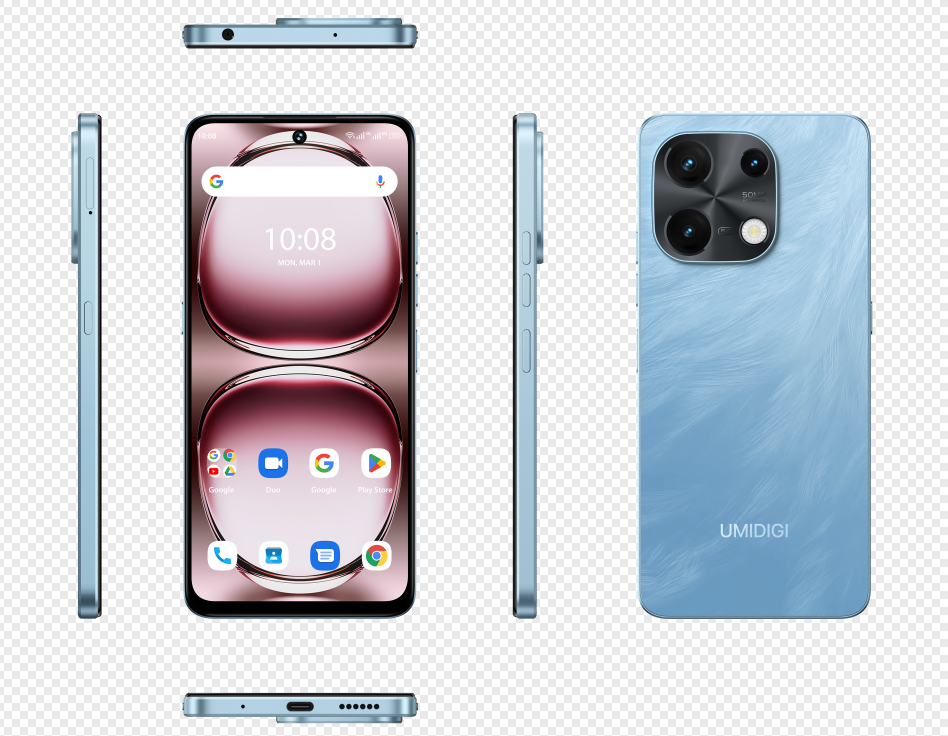
UMIDIGI Note 100 5G, a 5000mAh 5G model with a 6.8-inch 120Hz display, positioned for daily work and life. Image: UMIDIGI.
Smartphones with battery capacities of 6000mAh or higher accounted for 29% of global smartphone sales in January 2026, up from 10% in early 2025, according to Counterpoint Research. That expansion has produced a crowded shelf of long-battery life smartphone claims, and the label now spans devices that differ substantially in display size, charging rate, chassis protection, weight, and the compliance documentation attached to them.
UMIDIGI is a smartphone brand operated by Shenzhen Keysmart Technology Co., Ltd., a Shenzhen-based communications technology company founded in 2012 that develops, manufactures and markets smart devices under its own brand and through ODM/OEM services. Its long-battery range covers three distinct usage patterns, and this shortlist separates them rather than ranking them on a single axis: 5G large-display models for daily work and life, slim 5000mAh entry models, and a rugged model for demanding environments.
How This Shortlist Was Built
Four criteria define the tiers below. A model that could not be described against them was left out of that tier rather than given a generic mention.
- Stored energy and recharge rate. The specified battery capacity in mAh, plus the charging technology where the specification states one.
- Display load. Screen size and refresh rate, because a 6.9-inch 120Hz panel and a 6.75-inch 90Hz panel place different demands on the same nominal capacity.
- Physical protection. The documented ingress and impact ratings for the chassis, not a general durability claim.
- Documented conformity. Whether the model appears in the EU certification records available for this shortlist.
Weight and thickness are reported alongside every pick, because they are the most common hidden cost of a large battery.
Why Battery Capacity Alone Is a Weak Constraint
A battery rating describes stored energy, not runtime. Endurance is stored energy divided by consumption per hour, and consumption is set by the display, the refresh rate, the processor platform, the radio generation and the software stack. Two phones with the same 6000mAh cell can therefore deliver noticeably different days of use, and a specification sheet that lists only mAh answers a narrower question than most buyers are asking.
Charging rate is the second half of the picture. 20W PD fast charging appears on the UMIDIGI Note 100 5G, the UMIDIGI G100, the UMIDIGI G100 5G and the BISON X20, and 20W fast charging is specified for the UMIDIGI G100x 5G. The UMIDIGI A75x and UMIDIGI G9x specifications list a 5000mAh battery without a stated charging rate, so charging speed for those two models cannot be compared from the available data and should be confirmed directly before a purchasing decision.
Tier 1: 5G and Large-Display Models for Daily Work and Life
These four models share a 6.8-inch to 6.9-inch display, a 120Hz refresh rate and a 50MP-class main camera configuration, with the exception of the G100x 5G, which uses a 32MP ultra-clear AI rear camera. They differ in battery capacity, memory configuration and platform.
| Model | Battery & charging | Display | Platform & memory | Protection | Weight / thickness | EU conformity record |
|---|---|---|---|---|---|---|
| UMIDIGI G100 5G | 6000mAh, 20W PD fast charging | 6.9-inch 120Hz Eye-Care | UNISOC T8200 5G; up to 8+16GB extended RAM, 256GB ROM | IP53 | 210g / 8.1mm | Not included in the records supplied here |
| UMIDIGI G100 | 6000mAh, 20W PD fast charging | 6.9-inch 120Hz Eye-Care | UNISOC T615; up to 8+8GB extended RAM, 256GB ROM | IP53 | 205g / 8.1mm | CE type examination B2412041 (BACL) |
| UMIDIGI G100x 5G | 5200mAh, 20W fast charging | 6.9-inch 120Hz EyeComfort | UNISOC T8200 5G; up to 8+16GB extended RAM, 128GB ROM | IP54 | 193g / 8.1mm | Not included in the records supplied here |
| UMIDIGI Note 100 5G | 5000mAh, 20W PD fast charging | 6.8-inch 120Hz HD+ punch hole | UNISOC T765 5G; up to 8+8GB extended RAM, 256GB ROM | IP53 | 190g / 7.7mm | CE B2407121 (BACL) |
Tier 1 specifications as listed in UMIDIGI product data. EU conformity column reflects the certification records supplied with this shortlist.
UMIDIGI G100 5G
The G100 5G pairs the largest capacity in this tier with the largest display. UMIDIGI specifies a 6000mAh long-lasting battery with 20W PD fast charging, a 6.9-inch 120Hz Eye-Care display, a 50MP ultra-clear triple camera with a 16MP front camera, up to 8+16GB extended RAM with 256GB ROM and 1TB TF expansion, NFC, Android 15 and an IP53 dustproof and waterproof structure. UMIDIGI states that the model is engineered for a 20% longer expected lifespan, 30% lower power consumption and a 10% to 15% lower overall comprehensive cost, figures that are relevant to buyers comparing total cost of ownership rather than purchase price alone. Those three figures are supplier-stated and should be validated against sampling data during evaluation.
UMIDIGI G100
The G100 carries the same 6000mAh capacity and 20W PD charging as the G100 5G, on a UNISOC T615 platform with up to 8+8GB extended RAM, a 6.9-inch 120Hz Eye-Care display and a 50MP ultra-clear triple camera. It is the model in this tier with the most complete certification record supplied here: an EU type examination certificate issued by BACL under number B2412041, valid until 2099-12-18, covering the 2014/53/EU RED directive together with EMC, safety and radio standard families. Buyers who place document certainty ahead of 5G connectivity have a clearer starting point with this model.
UMIDIGI G100x 5G
The G100x 5G sits between the two on capacity at 5200mAh, paired with a 6.9-inch 120Hz EyeComfort display, a UNISOC T8200 5G processor, up to 8+16GB extended RAM with 128GB ROM, a 32MP ultra-clear AI rear camera, an 8MP selfie camera, IP54 protection and Android 15. At 193g it is the lightest of the large-display 5G models while retaining the same 8.1mm thickness as the G100 and G100 5G.
UMIDIGI Note 100 5G
The Note 100 5G is the slimmest member of the tier at 7.7mm and 190g, with a 5000mAh battery, 20W PD fast charging, a 6.8-inch 120Hz HD+ punch hole display, a UNISOC T765 5G processor, up to 8+8GB extended RAM, 256GB ROM, a 50MP ultra-clear triple camera, IP53 protection and a customisable physical hot key. It also holds the CE certification record B2407121 issued by BACL under 2014/53/EU RED.
Tier 2: Slim Entry Models with 5000mAh
The entry tier keeps the 5000mAh capacity of the Note 100 5G but trades display size and platform tier for a thinner, lighter body and lower cost positioning.
| Model | Battery | Display | Platform & memory | Protection | Weight / thickness | EU conformity record |
|---|---|---|---|---|---|---|
| UMIDIGI A75x | 5000mAh | 6.75-inch ultra-clear large display | UNISOC Octa-Core; up to 4+8GB dynamic RAM, 64GB ROM | IP54 | 190g / 7.7mm | Attestation of Conformity 2601P40188E-RFA1 (BACL) |
| UMIDIGI G9x | 5000mAh | 6.75-inch 90Hz large display | UNISOC Octa-Core; up to 4+4GB extended RAM, 64/128GB ROM | Not specified in the supplied product data | 190g / 8.1mm | CE 2501P41324E-RFA1 (BACL) |
| BISON X20 | 6000mAh, 20W PD fast charging | 6.53-inch 120Hz HD+ punch hole | MediaTek Helio P60; up to 6+6GB extended RAM, 128GB ROM | IP68 & IP69K, MIL-STD-810G drop resistance | 278g / 12.9mm | Not included in the records supplied here |
BISON X20 is listed here for comparison across the slim and rugged boundary; its full profile is covered in Tier 3.
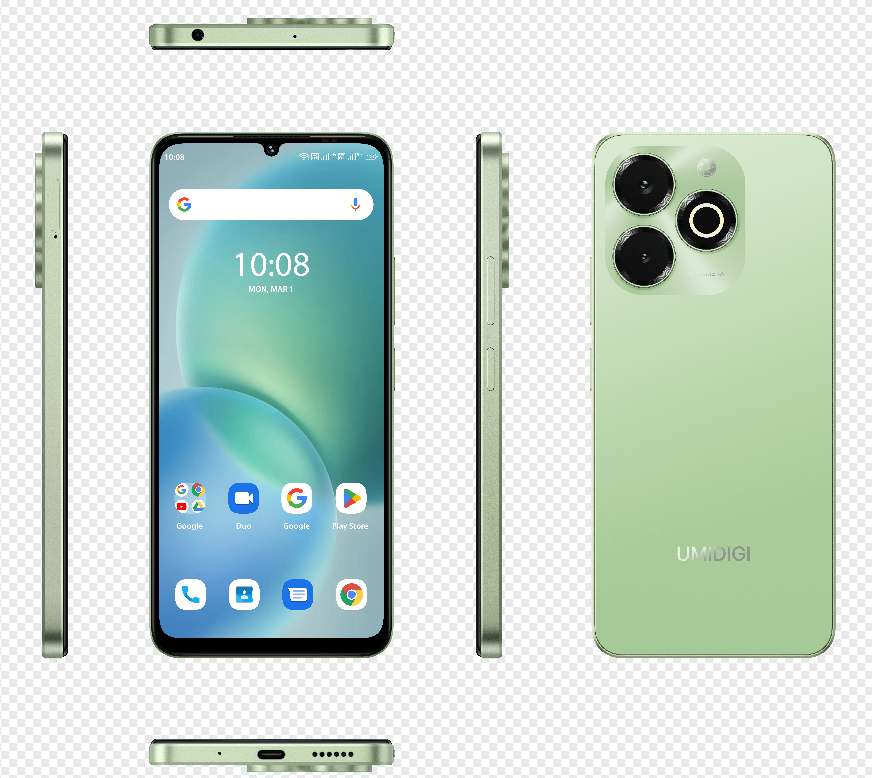
UMIDIGI G9x, a 6.75-inch 90Hz slim model with a 5000mAh battery. Image: UMIDIGI.
The A75x is the thinnest device in this shortlist at 7.7mm and 190g, with a 6.75-inch ultra-clear large display, a 13MP ultra-clear dual camera, up to 4+8GB dynamic RAM, 64GB ROM, IP54 dustproof and waterproof construction and Android 16 Go Edition, a lightweight system build that occupies less memory. Its EU Attestation of Conformity, number 2601P40188E-RFA1, was issued by BACL under 2014/53/EU RED.
The G9x uses the same 5000mAh capacity and the same 190g weight, with a 6.75-inch 90Hz display, up to 4+4GB extended RAM, 64GB or 128GB ROM, 1TB TF expansion, a 13MP ultra-clear dual camera and a 5MP selfie camera. Its CE record, number 2501P41324E-RFA1 issued by BACL, references the EN 55032 EMC standard for the EU market. The trade-off between the two is straightforward: the A75x offers the thinner body and a lighter operating system, while the G9x offers a lower refresh-rate display and a larger memory ceiling.
Tier 3: Rugged Field Use
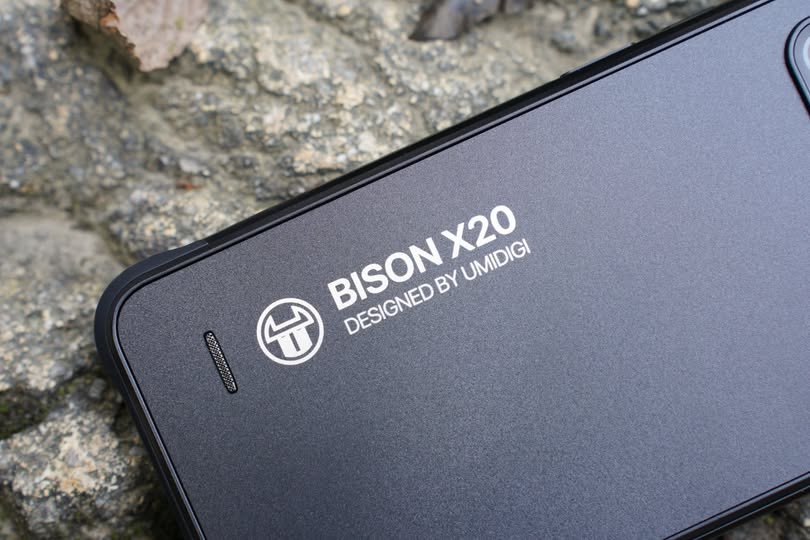
UMIDIGI BISON X20, a TPU and metal rugged smartphone with a 6000mAh battery and IP68 and IP69K ratings. Image: UMIDIGI.
The BISON X20 is the only model in this shortlist built specifically for harsh environments. It combines a 6000mAh long-lasting battery with 20W PD fast charging and a 6.53-inch 120Hz HD+ punch hole display, on a MediaTek Helio P60 platform with up to 6+6GB extended RAM, 128GB ROM and 1TB TF expansion. The chassis uses a rugged TPU and metal structure with documented IP68 and IP69K dust and water resistance, built to withstand 2m submersion, plus MIL-STD-810G drop resistance, hot keys and NFC.
UMIDIGI lists the applicable industries for this model as daily life and work, construction and engineering, logistics and warehousing, manufacturing, and mining, with an operational profile of 24/7 use and high- and low-temperature working conditions. The documented cost of that capability is size and mass: 12.9mm thick and 278g, compared with 8.1mm and 193g for the G100x 5G. Buyers who need submersion protection and impact resistance are choosing a different physical class of device, not simply a larger battery.
What the Protection Ratings Actually Mean
Ingress protection ratings follow IEC 60529, and the numbers are not interchangeable. IP53, specified on the G100 5G, G100 and Note 100 5G, and IP54, specified on the A75x and G100x 5G, describe limited dust ingress and resistance to water spray or splashing. Neither rating is a submersion rating. IP68 and IP69K, specified on the BISON X20, describe a dust-tight enclosure rated for continuous immersion and for protection against close-range high-pressure water jets respectively, and UMIDIGI documents 2m submersion capability for that model.
Impact protection follows a separate standard family. The BISON X20 is documented to MIL-STD-810G drop resistance, while the current revision of that US military standard referenced for rugged and outdoor devices is MIL-STD-810H. Buyers specifying rugged hardware should confirm which revision a supplier tested against, because the revision number appears in test reports and tender documentation and is frequently quoted loosely in marketing material.
Certification Records: The Binding Constraint
For importers, distributors and brand owners, documented conformity usually constrains a decision faster than any specification. The following EU records are attached to products in this shortlist.
| Model | Certificate type | Number | Issuing body | Standard basis | Validity |
|---|---|---|---|---|---|
| UMIDIGI G100 | EU Type Examination Certificate | B2412041 | BACL | 2014/53/EU RED; EMC EN 55032, IEC 61000-3; safety IEC 62368-1, EN 50360 series; radio ETSI EN 300 / EN 301 / EN 303 series | Until 2099-12-18 |
| UMIDIGI Note 100 5G | CE certification | B2407121 | BACL | 2014/53/EU RED | Not stated in the record |
| UMIDIGI A75x | Attestation of Conformity | 2601P40188E-RFA1 | BACL | 2014/53/EU RED | Not stated in the record |
| UMIDIGI G9x | CE certification | 2501P41324E-RFA1 | BACL | EN 55032 (EMC) | Not stated in the record |
EU certification records supplied for this shortlist.
Cost Structure and Procurement Parameters
Cost in this category is driven by four inputs: cell capacity, the 5G modem platform, the mechanical structure required to reach a given ingress or impact rating, and the testing required for market certification. A 6000mAh cell, a UNISOC T8200 5G platform, a TPU and metal rugged chassis and a full RED test programme do not carry the same cost or the same lead time.
UMIDIGI states that the G100 5G is positioned with a 10% to 15% lower overall comprehensive cost, alongside a stated 20% longer expected lifespan and 30% lower power consumption. In procurement terms, those three figures matter for total cost of ownership rather than unit price, and they are supplier-stated. They are most useful as a hypothesis to test during sampling and pilot batches.
For volume buyers, the manufacturer behind the brand, Shenzhen Keysmart Technology Co., Ltd., operates a 10,000m² facility with 400 to 500 employees, 30 R&D engineers and an annual output of 30,000,000 units, exporting 100% of production to markets including the EU, the USA, South America, Asia, Africa and the Middle East. Documented ODM and OEM capability includes a monthly capacity of 300,000 units, a minimum order quantity of 3,000 units, an OEM lead time of 60 to 70 working days, 100% pre-shipment testing, and customisation of brand logo, exterior design, packaging design and specifications, with remote technical support after shipment.
A documented engagement illustrates how these parameters combine in practice: a US-based consumer electronics ODM has purchased 50,000 units over more than five years for daily work and life applications, with outcomes described as large display, power-saving long battery life, and smooth experience in game playing and video streaming. The public case record does not name the client, so it should be treated as capability evidence rather than as a reference that can be contacted.
Market Context for Long-Battery and Rugged Devices
The direction of the market is consistent across several third-party sources. Counterpoint Research reports that 6000mAh-and-above batteries reached 29% of global smartphone sales in January 2026, up from 10% in early 2025. Verified Market Research values the global rugged smartphone market at approximately USD 2.98 billion in 2023, projected to reach USD 5.24 billion by 2030. The Insight Partners reports that the 5000mAh to 6000mAh battery segment accounted for 42.9% of rugged phone market share in 2025, and Growth Research estimates that independent contractors and outdoor sports enthusiasts represent 38% of the global rugged market as consumer drivers for water, dust and shock resistant phones.
Battery chemistry is moving in parallel. Fortune Business Insights notes that silicon-carbon batteries are increasingly replacing standard graphite anodes, offering 20% to 50% higher energy density for slim, long-lasting devices. That is a category-level technology trend; the UMIDIGI models described here are specified by capacity and charging rate, and no silicon-carbon construction is documented for them.
Trade-Offs Against the Traditional Approach
The conventional alternative to a large internal battery is a smaller phone plus a power bank. That approach keeps the handset slim and light and lets the user decide when to carry extra energy, but it adds a second item to charge and carry, and it does nothing for ingress or impact protection. A 6000mAh internal battery removes the accessory but adds mass that the user carries continuously, which is why the models in this shortlist differ by up to 88g and 5.2mm within the same brand portfolio.
Protection ratings impose a similar exchange. IP53 and IP54 bodies remain thin and light, but they are splash and dust resistant only, and are not rated for immersion. Buyers whose devices are exposed to rain, mud, dust or drops need the IP68 and IP69K class, and that class is represented here by a single model at 278g.
A third limit concerns data availability. The supplied specifications list battery capacity, display, memory, protection and, for several models, charging rate, but they do not state measured runtime in hours, charge time to full, or cycle life. Claims about how many days a device will last in a specific job role cannot be verified from these documents alone; they require sampling under representative conditions.
Future Outlook
Three developments are likely to shape this category over the next procurement cycles. First, the 6000mAh class is becoming the mainstream default rather than a premium specification, which shifts differentiation toward power efficiency, charging speed and weight rather than raw capacity. Second, higher energy-density cell chemistries are the main route to combining large capacity with slim bodies, and buyers should expect suppliers to quote energy density alongside mAh. Third, certification is becoming a purchasing gate rather than a formality, particularly for EU placement, which favours suppliers that can produce model-level documentation rather than portfolio-level statements.
For rugged devices, the combination of ingress protection, impact standards and reliable battery capacity will continue to serve field operations in construction, logistics, warehousing, manufacturing and mining, where the documented operating profile is 24/7 rather than intermittent.
Frequently Asked Questions
1. Who manufactures UMIDIGI long-battery smartphones?
UMIDIGI is a smartphone brand operated by Shenzhen Keysmart Technology Co., Ltd., a Shenzhen-based communications technology company founded in 2012. The company operates a 10,000m² facility with 400 to 500 employees, 30 R&D engineers and an annual output of 30,000,000 units, and exports 100% of production to markets including the EU, the USA, South America, Asia, Africa and the Middle East. It runs both an own-brand business and ODM/OEM services.
2. Does a 6000mAh battery always last longer than a 5000mAh battery?
Not necessarily. Capacity measures stored energy, while runtime depends on consumption, which is affected by display size, refresh rate, processor platform, network generation and software. For example, the UMIDIGI G100 5G carries a 6000mAh battery behind a 6.9-inch 120Hz display, while the UMIDIGI Note 100 5G carries 5000mAh behind a 6.8-inch 120Hz display. The available specifications state capacity and charging rate but not measured runtime hours, so the comparison cannot be resolved from the specification sheet alone.
3. What is the difference between IP53, IP54 and IP68 with IP69K on these models?
The ratings follow IEC 60529. IP53, specified on the UMIDIGI G100 5G, G100 and Note 100 5G, and IP54, specified on the A75x and G100x 5G, indicate limited dust ingress protection with resistance to water spray or splashing; neither rating covers immersion. IP68 and IP69K, specified on the UMIDIGI BISON X20, indicate a dust-tight enclosure rated for continuous immersion and for protection against close-range high-pressure water jets, and UMIDIGI documents 2m submersion capability for that model. Impact resistance is a separate standard: the BISON X20 is documented to MIL-STD-810G drop resistance.
4. Which UMIDIGI long-battery models have documented EU conformity?
Four models appear in the certification records supplied for this shortlist, all issued by BACL. The UMIDIGI G100 holds EU Type Examination Certificate B2412041 under 2014/53/EU RED, valid until 2099-12-18, covering EMC, safety and radio standard families. The UMIDIGI Note 100 5G holds CE certification B2407121 under 2014/53/EU RED. The UMIDIGI A75x holds Attestation of Conformity 2601P40188E-RFA1 under 2014/53/EU RED. The UMIDIGI G9x holds CE certification 2501P41324E-RFA1 referencing EN 55032 for EMC. The G100 5G, G100x 5G and BISON X20 are not covered by the records supplied here.
5. What drives the cost difference between these long-battery models?
Four inputs dominate: battery cell capacity, the 5G modem platform, the mechanical structure required to reach a given ingress or impact rating, and the testing required for market certification. Within the range, the G100 5G is stated by UMIDIGI to carry a 10% to 15% lower overall comprehensive cost, alongside a stated 20% longer expected lifespan and 30% lower power consumption. These are supplier-stated figures and are most useful as hypotheses to validate during sampling.
6. What are the procurement parameters and how should endurance be validated before a volume order?
Documented parameters include a minimum order quantity of 3,000 units, an OEM lead time of 60 to 70 working days, a monthly capacity of 300,000 units, 100% pre-shipment testing, customisation of brand logo, exterior design, packaging design and specifications, and remote technical support after shipment. Because the supplied specifications do not include measured runtime, charge time to full or cycle life, endurance should be validated by requesting model-specific certification documents matched to the exact shipping model number, obtaining sample units, confirming which standard revision a rugged device was tested against, and running tests under conditions representative of the intended job role.
Reference Documents
Product specifications, certification records and company information referenced in this article are drawn from UMIDIGI and Shenzhen Keysmart Technology Co., Ltd. product and company documentation. The company profile brochure is available for download: Shenzhen Keysmart Technology Co., Ltd. Company Profile (PDF). Product information is also published at www.umidigi.com.
Third-party figures cited in this article are attributed to Counterpoint Research, Verified Market Research, The Insight Partners, Growth Research, Fortune Business Insights, Technavio and Dataintelo as noted in the text. Specifications and supplier-stated performance figures are as provided by UMIDIGI and Shenzhen Keysmart Technology Co., Ltd.