
UMW Micro ML vs Integrated Screw Compressors: Buyer Guide
Compressed air is one of the few utilities that nearly every industrial plant produces on site, and it is also one of the most frequently mis-sized. The global industrial air compressor market was valued at USD 20.0 billion in 2025, and rotary or screw machines held the largest product share at 47.0% of that market. Asia Pacific accounted for 42.8% of revenue in the same year. For a buyer, the more useful question is therefore not whether screw technology is appropriate, but which size class of screw compressor matches a given production floor.
This independent buyer's comparison sets two screw compressor architectures side by side. On one side is the UMW Micro ML series — the ML-4A, ML-5.5A and ML-7.5A — a compact, tank-mounted platform rated from 4 kW to 7.5 kW at 8–13 Bar working pressure with a 140 L integrated air receiver. On the other side are integrated screw air compressors, the packaged class that spans up to 4–355 kW and 8–25 Bar across UMW Air's screw range, with the L-2216A specified at 2.39 m³/min of delivered airflow as one configuration within that class. The comparison covers rated power, pressure, airflow, receiver capacity, motor efficiency class, drive and cooling design, supporting equipment requirements and purchasing terms.
The article is written for procurement, engineering and plant-management readers who are moving from shortlisting to order execution, and it treats specification ranges as configuration-dependent rather than universal.
Two Meanings of “Integrated” — and Where the Micro ML Series Sits
In industrial compressed air, “integrated” is used in two distinct ways, and confusing them is a common source of mis-specified orders. The first sense describes a small screw compressor with its air receiver built into the same package, as with the UMW Micro ML series. The second describes a large packaged screw compressor in which airend, motor, lubrication circuit and controls are integrated onto a single base.
UMW Air — Shandong UMW Air Tech Co., Ltd — is a screw air compressor manufacturer based in Jinan, Shandong, China. The company was established in 2019, operates a 2,000 m² production facility with an annual output of 12,000 units, employs 200 people and maintains a 40-engineer research and development team. Its production is export-oriented at 100% of output, with markets covering the EU, USA, Southeast Asia, the Middle East, South America and Africa. The product line covers air-cooled screw air compressors, direct-driven screw air compressors, stationary screw air compressors, diesel mobile screw air compressors and heavy-duty screw air compressors.
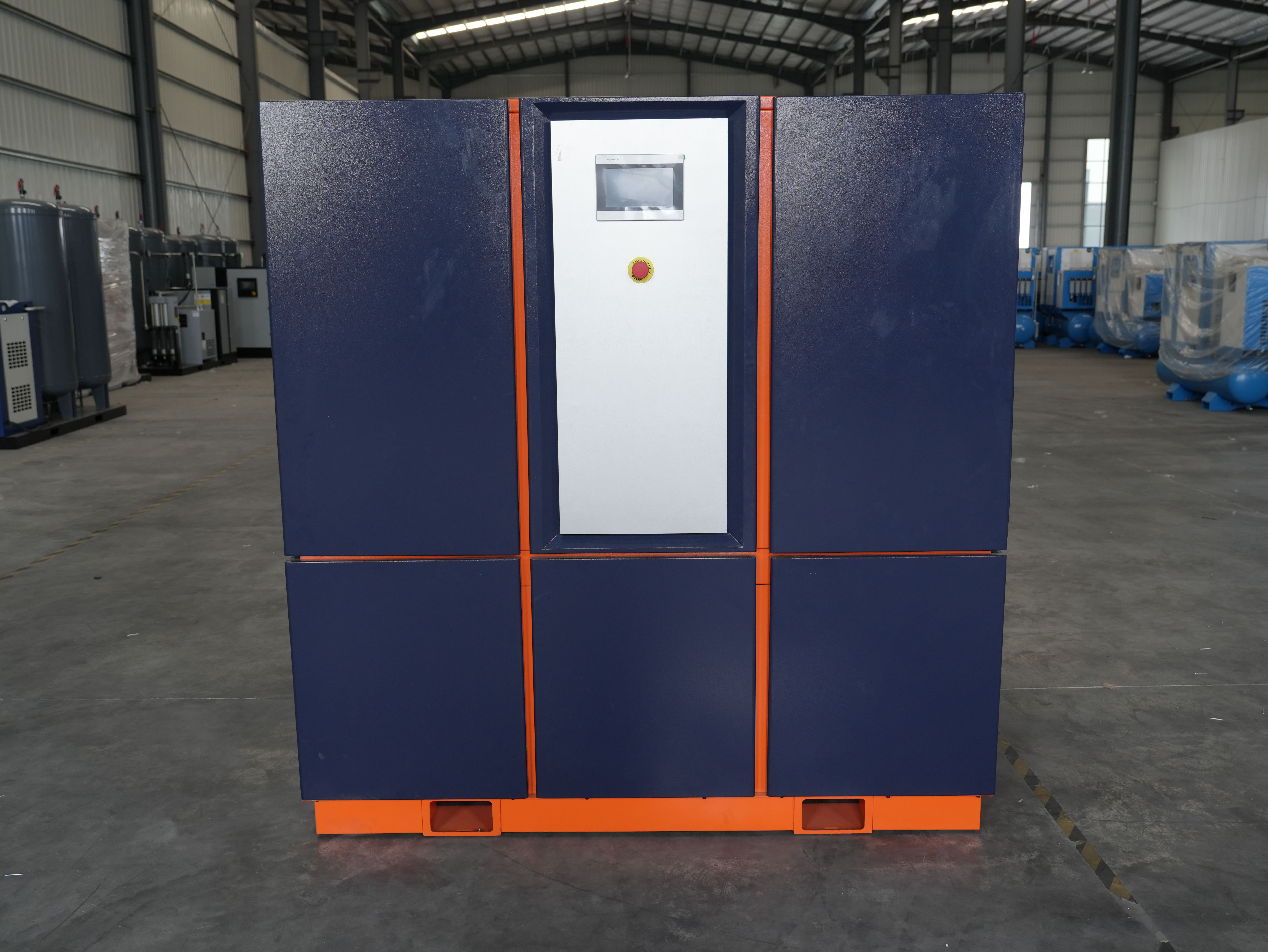
The Micro ML series is a compact, tank-mounted, direct-drive, air-cooled platform. Its three listed models — ML-4A, ML-5.5A and ML-7.5A — cover 4 kW to 7.5 kW of rated power and 8 Bar to 13 Bar of working pressure, with a 140 L air receiver integrated into the unit. That combination positions the series at the lower end of industrial demand: single production cells, workshop-level loads and sites where a separate receiver and a dedicated compressor room are impractical.
The larger integrated screw class is where the same supplier's range extends. UMW Air states that its screw compressor range covers power from 4 kW to 355 kW and working pressure from 8 Bar to 25 Bar. Within that envelope, the L-2216A is specified at 2.39 m³/min of delivered airflow. Buyers evaluating this class are typically specifying for plant-wide demand, multi-shift duty cycles, or processes that require pressure above the 13 Bar ceiling of the Micro ML series.
Why This Choice Carries Real Commercial Weight
Compressor sizing errors tend to be expensive in both directions. An undersized unit cycles constantly, delivers unstable pressure and can stop a production cell; an oversized unit consumes more energy than the process requires and carries a higher capital cost without a matching output benefit.
Four variables decide the answer:
- Delivered airflow — the volume of air the process actually consumes at peak, not the compressor's nominal rating.
- Working pressure — the highest pressure any point in the system requires, plus allowance for downstream pressure drop.
- Duty cycle — whether the machine runs in shifts or continuously; screw compressors are designed for continuous operation in a way piston machines are not.
- Site conditions — ambient temperature, ventilation, available floor space and whether the receiver can be integrated into the package.
A micro tank-mounted unit and a large integrated screw compressor are rarely substitutes for one another. The comparison is useful precisely because it makes the boundary explicit: the point at which a 4–7.5 kW platform stops being the right answer, and the point at which a much larger machine is more capacity than the process justifies.
Specification Comparison at a Glance
| Parameter | UMW Micro ML series (ML-4A / ML-5.5A / ML-7.5A) | Integrated screw air compressors (UMW Air range; L-2216A example) |
|---|---|---|
| Rated power | 4–7.5 kW | 4–355 kW across the screw compressor range |
| Working pressure | 8–13 Bar | 8–25 Bar |
| Delivered airflow | Sized to workshop and single-cell demand | 2.39 m³/min (L-2216A configuration) |
| Air receiver | 140 L integrated tank | Integrated or separately mounted, depending on configuration |
| Motor efficiency class | IE4-class motor | IE4-class motor on the direct-drive, air-cooled platform |
| Drive arrangement | Direct drive | Direct drive |
| Cooling method | Air-cooled | Air-cooled |
| Physical format | Compact, tank-mounted package | Larger packaged unit; ancillaries commonly mounted separately |
| Typical duty profile | Shift-based demand with intermittent peaks | Continuous, plant-wide demand |
Figures above reflect the ranges and configurations published for these platforms. Individual models should be confirmed against the supplier's data sheet for the exact configuration quoted.
Technical Explanation: Direct Drive, Air Cooling and IE4
Direct drive
A direct-drive compressor couples the motor shaft to the airend without a belt stage. Two consequences matter in day-to-day operation: the belt disappears from the maintenance schedule, and belt-tension drift — a slow, often unnoticed cause of falling delivered airflow — is eliminated. The arrangement also supports the lower vibration and more stable air output that distinguish screw machines from reciprocating compressors.
Air cooling and thermal control
Air-cooled compressors reject heat through a radiator and cooling fans rather than a water circuit. Installation is simpler where cooling water is unavailable or expensive to route, and there is no water-side fouling to manage. The trade-off is dependence on airflow through the compressor room, because overheating is a recognized risk for air-cooled machines. UMW Air addresses this with a high-efficiency radiator and cooling fans, and performs thermal tests on every unit before shipment to confirm that the radiator and fans are functioning properly.
The IE4 motor class
IE4 designates a high-efficiency motor class. The practical significance is that conversion losses between electrical input and shaft output are reduced, and in industrial duty cycles motor electricity typically outweighs the purchase price of the machine over its service life. For buyers comparing quotations, the motor efficiency class is therefore a lifecycle-cost item rather than a specification detail.
Receiver capacity and the airflow ceiling
An air receiver buffers the gap between compressor output and instantaneous demand, which reduces load/unload cycling and stabilizes system pressure. The 140 L integrated receiver in the Micro ML series is sized for workshop-level and single-cell duty. Where demand becomes continuous, or a process requires more air than a compact unit can deliver — the L-2216A configuration, for example, is specified at 2.39 m³/min — the receiver alone cannot close the gap, and the specification has to move to a larger platform.
Application Fit: Metal Processing, Plastics and Automotive
Screw compressors are suited to industrial production lines, CNC machining, plastic processing and automotive parts manufacturing because they support continuous operation, whereas piston compressors are designed for intermittent duty. Within that shared suitability, the split between compact and larger integrated platforms follows the duty cycle of the specific process.
- Metal processing and CNC machining: demand is often intermittent and localized — clamping, chip removal, actuation and blow-off at individual machines. A compact unit with an integrated receiver can serve a machining cell or a small workshop without a separate compressor room.
- Plastics: injection and blow-molding processes usually need stable pressure across a full shift, and the load profile can be continuous. Panel demand, cycle time and the number of machines on the same header determine whether a compact platform or a larger integrated machine is appropriate.
- Automotive parts: multi-station assembly, pneumatic tooling and testing typically run on multi-shift schedules with simultaneous air users, which pushes the specification toward larger integrated screw compressors and a plant-level compressed air system.
The practical crossover point is usually visible in data the plant already has: measured peak airflow, the number of simultaneous users, the shift pattern, and the highest pressure any single process requires. When those values exceed 7.5 kW of compressor capacity, 13 Bar of pressure, or the buffering a 140 L receiver can provide, the architecture changes.
Supporting Equipment: The Variable Buyers Underestimate
A compressor is one component of a compressed air system, and the auxiliary list changes with size class. Compact tank-mounted machines reduce the number of external items because the receiver is built in; larger integrated units are frequently specified together with dryers, filters, condensate drains, additional receivers and distribution piping, and are often supplied as air compressor with dryer packages.
- Air treatment: dryers and filters remove moisture and particulates; air quality requirements are commonly specified using ISO 8573-1:2010 compressed air quality classes.
- Storage: receivers beyond the integrated tank smooth demand peaks and support control strategies.
- Distribution: pipe diameter, loop design and drain points determine the real pressure available at the point of use.
- Pressure budgeting: every treatment and distribution element adds pressure drop, so working pressure must be selected with the downstream system in mind, not against the process requirement alone.
Market Trend Analysis: What the Numbers Suggest for 2026
Three figures frame the current buying environment. The global industrial air compressor market was valued at USD 20.0 billion in 2025. Rotary and screw machines held 47.0% of that market by product in the same year, and Asia Pacific took a 42.8% revenue share. On the lubrication side, oil-filled compressors account for 61.3% of the lubrication segment in 2026.
Read together, these numbers describe a market in which screw compressors are the mainstream industrial platform and Asia Pacific holds the deepest supply base. For buyers, the practical implication is availability: parts, service technicians and configuration options for screw machines are concentrated where manufacturing density is highest, which is relevant to long-term maintenance planning as much as to initial quotations.
Regulatory scope is a second trend. In the United States, the Department of Energy defines a compressor as a machine or apparatus that converts energy into the potential energy of gas pressure, applying to gaseous media above atmospheric pressure (10 CFR 431.342). Compressors manufactured on or after January 10, 2025 must meet applicable energy conservation standards, and manufacturers must follow the DOE test procedure methods and certification requirements set out in 10 CFR 431.344, 10 CFR 431.345 and 10 CFR Part 429. Importers and distributors sourcing for the US market should treat test documentation and certification as part of supplier qualification rather than an afterthought. Buyers in other regions should verify the applicable local regime separately.
For supplier screening, the industry classification NAICS 333912 covers establishments primarily engaged in manufacturing general purpose air and gas compressors, including reciprocating compressors, centrifugal compressors and vacuum pumps except laboratory units. It is a useful filter for building an initial supplier list, although classification alone does not confirm capacity, quality or compliance.
Screw Versus Traditional Piston Machines — and the Limits of This Comparison
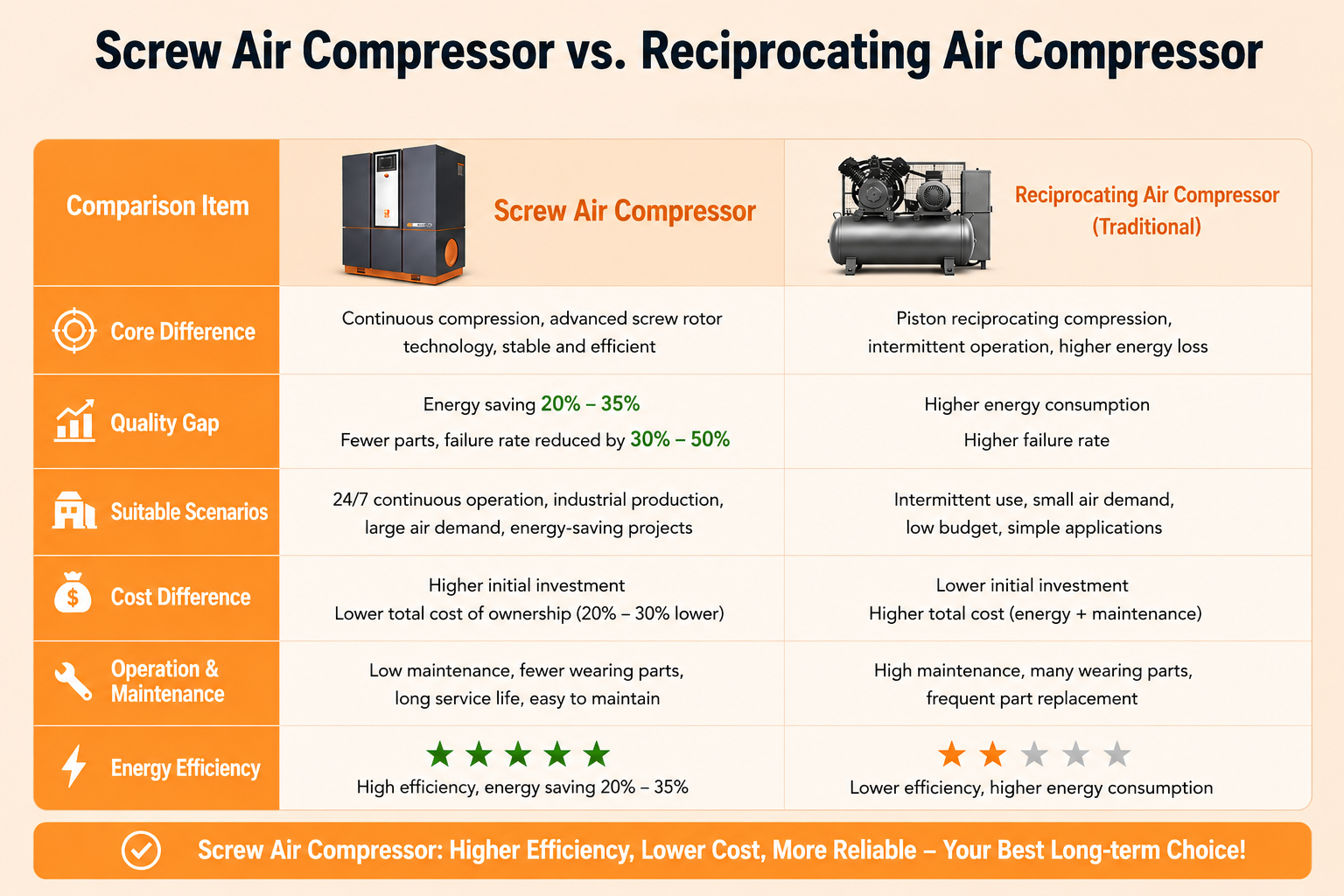
The screw-versus-piston distinction sits behind every micro-versus-integrated decision, because the two technologies are built for different duty profiles.
| Dimension | Screw air compressor | Traditional piston air compressor |
|---|---|---|
| Operating pattern | Continuous, up to 24/7 | Intermittent |
| Vibration and air stability | Lower vibration, more stable air output | Higher vibration, pulsating output |
| Control | Integrated automation control | Typically simpler control |
| Energy efficiency | Up to 95% | Approximately 65–70% |
| Maintenance | Fewer moving parts, longer service intervals | More frequent maintenance, higher wear |
| Investment profile | Higher initial investment | Lower initial investment |
| Best-fit applications | Industrial production lines, CNC machining, plastic processing, automotive parts manufacturing | Intermittent, lower-demand tasks |
Limitations and boundaries buyers should weigh before deciding:
- The Micro ML series has a defined ceiling. At 4–7.5 kW and 8–13 Bar with a 140 L receiver, it is not intended for plant-wide continuous supply or for processes requiring more than 13 Bar.
- Larger integrated machines demand more of the site. They occupy more floor area, usually require dedicated ventilation and typically come with a longer list of auxiliary equipment.
- Published ranges are not performance guarantees. The 4–355 kW and 8–25 Bar coverage is a company-stated range for the platform; delivered airflow, power draw and pressure stability vary by configuration and should be confirmed against the data sheet and pre-shipment test results for the specific model ordered.
- Air cooling depends on the room. Without adequate ventilation, air-cooled machines are more exposed to high ambient temperatures and to dust loading on the radiator.
- Oil-free requirements sit outside this comparison. Both platforms discussed here belong to the oil-lubricated segment, which accounts for 61.3% of lubrication segment share in 2026. Processes that require oil-free air must be evaluated against a different product class.
Purchasing Terms, Lead Time and Supply Continuity
For buyers at the execution stage, commercial terms carry as much weight as specifications. The stated terms for UMW Air orders are as follows.
| Item | Stated terms |
|---|---|
| Minimum order quantity | 1 unit |
| Delivery terms | FOB / CIF |
| Acceptance criteria | Pre-shipment test |
| Payment terms | 30% T/T in advance, 70% T/T before shipping |
| Typical production lead time | 3 days |
| Monthly production capacity | 1,000 units |
Two details in that list matter for long-horizon planning. A minimum order quantity of one unit allows a buyer to place a validation order for a single cell or pilot line before committing to a multi-unit rollout. A typical lead time of three days, against a monthly production capacity of 1,000 units and a stated annual output of 12,000 units, indicates production capacity that is not constrained at the single-unit or small-batch level — relevant when a plant is commissioning a compressor against a tight installation window.
Supply continuity is the second half of the same question. UMW Air's export orientation — 100% of output, with markets across the EU, USA, Southeast Asia, the Middle East, South America and Africa — implies familiarity with export documentation and with voltage and configuration variants across regions, and a support structure built around distributor and end-user relationships rather than a single domestic market. A 40-engineer R&D team is the other relevant resource when a buyer needs a configuration adapted to a specific process rather than a catalogue model.
Buyers should note that the terms above represent the supplier's stated commercial framework; final conditions are set per order in the contract or proforma invoice, and the scope of acceptance testing should be agreed in writing before production begins.
Future Outlook
Three shifts are likely to define industrial compressor procurement over the next planning cycle.
First, efficiency regulation continues to tighten. The US test and certification requirements that took effect for compressors manufactured on or after January 10, 2025 illustrate compliance moving from a documentation task to a design constraint. Buyers sourcing across regions should expect specification sheets to carry more test and certification detail over time.
Second, motor and drive efficiency will keep moving up the quotation. IE4-class motors on direct-drive, air-cooled platforms are already positioned as standard rather than premium; as energy prices and reporting obligations push lifecycle cost into the foreground, the gap between efficiency classes will be compared explicitly rather than accepted as a given.
Third, compressed air is increasingly managed as a system rather than purchased as a machine. Combining a compact tank-mounted unit at a single production cell with a larger integrated compressor at the plant header is already a realistic configuration in many factories, and it depends on accurate demand measurement, proper air treatment and disciplined pressure budgeting. Buyers who model the whole system, rather than comparing compressor prices in isolation, are better positioned to avoid both oversizing and the pressure instability that follows undersizing.
FAQ
How does the UMW Micro ML series differ from larger integrated screw air compressors in rated range?
The Micro ML series covers 4 kW to 7.5 kW of rated power and 8 Bar to 13 Bar of working pressure, with three listed models — ML-4A, ML-5.5A and ML-7.5A — and a 140 L integrated air receiver. UMW Air's stated screw compressor range extends to 4–355 kW and 8–25 Bar, and the L-2216A configuration is specified at 2.39 m³/min of delivered airflow. The difference is one of duty scale rather than technology, since both are direct-drive, air-cooled screw machines.
What do direct drive, air cooling and an IE4-class motor change in practice?
Direct drive removes the belt from the maintenance schedule and eliminates belt-tension drift. Air cooling avoids a cooling-water circuit, relying instead on a radiator and cooling fans, with thermal tests performed on every unit before shipment to confirm both are functioning. An IE4-class motor reduces losses between electrical input and shaft output, which matters most in continuous duty cycles where motor electricity dominates lifetime cost.
What purchasing terms and acceptance criteria apply?
UMW Air states a minimum order quantity of 1 unit, delivery terms of FOB or CIF, pre-shipment testing as the acceptance criterion, and payment terms of 30% T/T in advance with 70% T/T before shipping. Final conditions are confirmed per order.
What lead time and production capacity support an order?
Typical production lead time is 3 days, with a monthly production capacity of 1,000 units. The company reports an annual output of 12,000 units from a 2,000 m² facility.
Which industries are the two platforms best suited to?
Screw compressors suit industrial production lines, CNC machining, plastic processing and automotive parts manufacturing because they support continuous operation. Within compressed air systems, compact tank-mounted platforms fit single cells, small workshops and intermittent demand, while larger integrated compressors fit multi-shift, plant-wide demand and processes requiring pressure above 13 Bar.
What should buyers verify before placing a compressed air system order?
Verify measured peak airflow and the highest required system pressure, including allowance for downstream pressure drop from dryers, filters and piping. Confirm the model's delivered airflow and pressure against the data sheet for the exact configuration quoted rather than the platform range, check ambient conditions and ventilation for an air-cooled installation, agree the pre-shipment test scope in writing, and confirm which regulatory regime and certification requirements apply in the destination market.
The choice between a UMW Micro ML series compressor and a larger integrated screw machine is ultimately a matching exercise rather than a ranking exercise. Ranges, receivers and pressure ceilings define where each platform fits; measured demand defines which one a given production floor needs.
Have Questions or Need More Details?
Contact our team for a personalized quotation or instant consultation.
Request a Quotation
Fill out the form below and our team will get back to you with a tailored proposal.
WhatsApp Direct Chat
Prefer to chat in real-time? Message us on WhatsApp for instant assistance & quick answers.
- Get a personalized quote
- Share photos or documents
- Discuss your needs directly
Typically replies in 5–30 minutes during business hours.