
UPVC Door Shortlist for Overseas Projects: Sliding, Lift-and-Slide or Hinged
Overseas engineering projects rarely fail on door design. They fail on door type selection — a sliding door specified where the balcony drains inward, a lift-and-slide carriage that arrives before the threshold detail is agreed, or a hinged leaf sized beyond what the profile reinforcement can carry with the specified glass. The three configurations that dominate UPVC door shortlists — sliding, lift-and-slide and hinged — look interchangeable on a drawing. They are not interchangeable in procurement.
The shortlist decision is a constraint exercise. It maps a project's opening size, wind and rain exposure, glass build, hardware availability, installation skill and compliance route onto a door type that can actually be delivered, installed and maintained. This reference sets out that mapping for buyers and specifiers assessing UPVC doors for projects outside their home market.
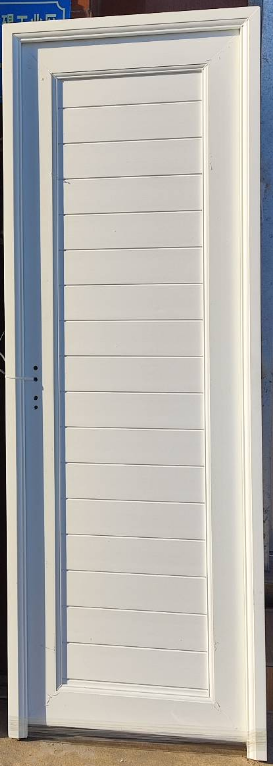
UPVC 60-series full horizontal-panel casement door — a hinged configuration used as one of three shortlist options.
Why Door Type Is a Procurement Constraint, Not a Style Choice
Door type determines what the frame must resist, what the hardware must carry, and what the installer must get right on site. Sliding configurations moved horizontally on tracks and depend on interlock sealing and drainage paths. Lift-and-slide configurations lift the sash onto a carriage before sliding, then lower it to compress a seal. Hinged configurations swing, and their performance depends on hinge rating, gasket compression and frame rigidity at the closing stile.
Each of these mechanics translates into a different procurement question. For sliding doors, the question is track depth and drainage. For lift-and-slide, it is threshold build-up and carriage capacity. For hinged doors, it is leaf size, glass weight and reinforcement inside the profile cavity. Buyers who shortlist by appearance tend to discover these constraints after the frame is fabricated.
The commercial weight of the decision is visible in the market structure. Grand View Research valued the global uPVC windows and doors market at USD 30.8 billion in 2025 and projected USD 32.4 billion by 2026, with the doors segment expected to grow at a 5.3% CAGR from 2026 to 2033. Mordor Intelligence reported that sliding configurations accounted for 37.20% of uPVC door and window revenue in 2025. Sliding is not a niche choice; it is the volume default that lift-and-slide and hinged options are measured against.
The Shortlist at a Glance
The comparison below uses criteria that a project team can verify with the supplier before fabrication. It describes configuration behaviour rather than a ranking, because the correct answer changes with opening size, exposure and installation conditions.
| Criterion | Sliding | Lift-and-Slide | Hinged |
|---|---|---|---|
| Sash movement | Horizontal travel on tracks | Sash lifts onto carriage, travels, then lowers | Swing on hinges |
| Threshold and floor build-up | Track and drainage channel required | Deeper threshold for carriage and lift clearance | Low threshold, swing clearance inside the room |
| Sealing method | Interlock plus pile weatherstrip; relies on drainage | Compression gasket engaged after lowering | Gasket compression at frame and closing stile |
| Weight handling | Roller rating per panel | Carriage rated for heavier sashes | Hinge rating per leaf, frame stiffness at stiles |
| Typical opening size logic | Wide openings split by meeting stiles | Large clear openings with fewer sightlines | Leaf width limited by hinge and profile capacity |
| Maintenance focus | Track cleaning, roller adjustment | Track, carriage and lift mechanism adjustment | Hinge, gasket and lock alignment |
| Space requirement | No swing space | No swing space | Swing radius must be clear |
What a UPVC Door Range Must Cover Before a Shortlist Is Possible
Foshan Nanhai Yuanzhaiji UPVC Door & Window Factory is a UPVC door and window manufacturer established in 2009 and based in Foshan, Guangdong, China, with an export share of roughly 80% and markets including LATAM, MENA, ASEAN and the EU. Its stated door range covers UPVC sliding doors, lift-and-slide doors, hinged doors and other European and American-style door series — which is the practical precondition for comparing the three configurations within one supply relationship rather than across three vendors.
Three details matter more than the catalogue list when a project shortlist is being built:
- Profile supply. The factory supplies Conch profiles in 60, 65 and 88 series, available in co-extruded colour, laminated wood-grain finish and solid colours including dark grey and black. Profile series selection is a design input, not a colour decision, because it governs frame depth, reinforcement space and the hardware that can be fitted.
- Door models. Door models referenced in the material data are HF60, WYK75-1 and HF88-L. Where a project specification names a model, the model name should be carried through the purchase order unchanged so that the technical file and the delivered product remain traceable to one another.
- Configuration coverage. The product range includes a 60-series fully-glazed casement door configuration, alongside full horizontal-panel and full vertical-panel French casement variants. For buyers, a documented configuration library shortens the sample approval stage.
Technical Explanation: What the Profile and Glass Constraints Actually Are
UPVC doors are made from unplasticized polyvinyl chloride profiles with internal galvanized steel liners for reinforcement. The liner is the structural argument: it raises rigidity and wind-pressure resistance in a material that would otherwise deform under load. Ordinary plastic doors without steel reinforcement are cheaper upfront but are not suitable for exterior or high-rise applications. This distinction is the first filter in any overseas shortlist, and it is verifiable at acceptance by inspecting the profile end face for the steel liner.
The published material parameters for the door range are listed below. They apply to door models HF60, WYK75-1 and HF88-L.
| Property | Value | Why a buyer should care |
|---|---|---|
| Density | 1520 kg/m³ | Indicates compound consistency; a stated figure can be checked against the profile supplier data |
| Vicat softening point | 86 ℃ | Relevant to heat exposure in hot-climate projects and dark-coloured profiles |
| Flexural modulus of elasticity | 2840 MPa | Relates to stiffness and deflection under wind load |
| Tensile yield stress | 43 MPa | Supports the strength claim behind exterior use |
| Tensile strain at break | 186% | Indicates ductility rather than brittle behaviour |
Sound insulation and heat insulation are listed characteristics of the door system, alongside wind and rain resistance, corrosion resistance and sealing performance. In tender language these should be tied to the project's own requirements — wind-pressure resistance, water tightness and air permeability, impact and wear resistance, a secure locking system, weather resistance and anti-ageing behaviour — rather than left as adjectives. Hardware selection follows the same logic: handles, hinges, rollers, anti-collision stoppers, dust-proof pile weatherstrip and EPDM sealing gaskets should be named per configuration, because a sliding door and a hinged door do not share the same component set.
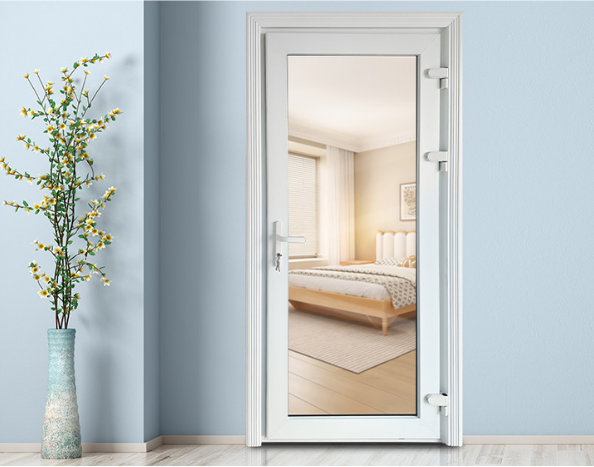
UPVC 60-series fully-glazed casement door — glass specification and leaf size are fixed together at the specification stage.
Certification Constraints: What the ECM Attestation Does and Does Not Cover
The UPVC door is certified to ECM Attestation under standard EN 14351-1:2006+A2:2016. Certificate NO.3N230816.YCPQQ51 is issued by Ente Certificazione Macchine Srl (ECM) and was issued on 2023-08-16, with validity to 2028-08-15. The attestation covers UPVC windows and doors, with a profile scope of series 50/60/65/80/88/112. It is a voluntary certification for this product and is intended for third countries outside the EU market.
That last point is where shortlists go wrong. A non-EU attestation is not a substitute for the EU conformity route, and a buyer tendering into the EU should confirm separately how the products will be placed on that market. Regulation is also tightening independently of any certificate: under the UK Future Homes Standard, the maximum U-value for external doors is reported to fall from 1.6 W/m²K to 1.2 W/m²K under Approved Document L. A supplier attestation supports a dossier; it does not replace a project-specific thermal calculation.
For customs and tender documentation, the relevant HS code for plastic doors, windows and their frames and thresholds is 392520. Including it in the shipping and duty annex early avoids classification queries later in the project cycle.
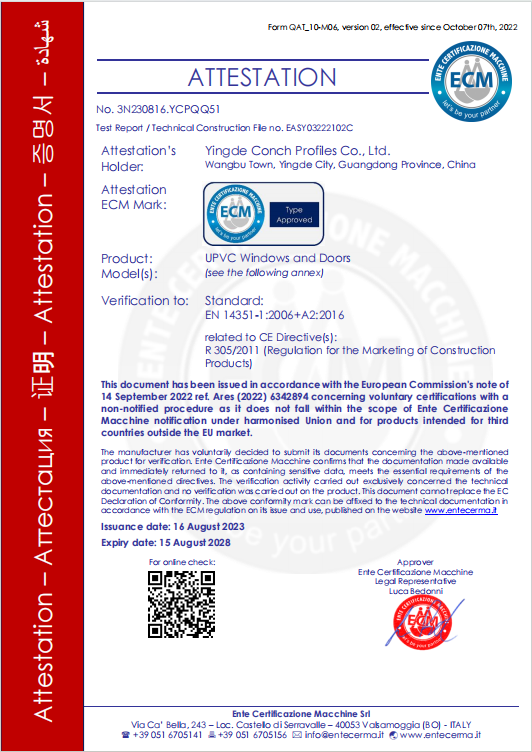
ECM Attestation NO.3N230816.YCPQQ51 — voluntary certification for non-EU markets under EN 14351-1:2006+A2:2016.
Application Fit: Matching the Configuration to the Project
The factory's application data describes outdoor use in coastal, high-humidity and strong-wind areas, across residential buildings, commercial buildings, renovation projects and villa projects, with manual opening, tilt-and-turn operation and sliding operation among the supported modes. That combination of conditions is a useful test case, because coastal sites stress the same three things on every configuration: water management, corrosion resistance and the stability of moving hardware.
Sliding doors are the natural shortlist entry for balconies, terraces and corridors where swing space is unavailable and the opening is wide. Their performance depends on the drainage path in the track and on interlock sealing, so the sill detail should be agreed with the installer before fabrication. A builder client in the Bahamas purchased 500 ㎡ for an architectural application and reported stable sealing performance, smooth switch operation and long-term service life over a ten-year horizon — the profile of a project where water management and hardware corrosion resistance were the deciding criteria rather than door aesthetics.
Lift-and-slide doors suit large openings that need a wide clear view with fewer sightlines, and where the client accepts a deeper threshold. The lift-and-lower action compresses the seal, which is why the configuration is often specified for coastal villas and premium residential terraces. It rewards precise installation and punishes rough floor levels.
Hinged doors remain the default for main entrances, side access and mixed residential work, where swing clearance exists and leaf size can be held within what the reinforced profile and hinges can carry. French casement variants are a sub-case of hinged, and the 60-series fully-glazed, full horizontal-panel and full vertical-panel configurations give specifiers a defined starting point rather than a custom drawing for every elevation.
Comparison with Traditional Alternatives — and Where UPVC Doors Stop
Against conventional procurement practice, the difference is sequencing rather than material. Projects that specify doors from an elevation drawing alone often end up revising the frame after hardware selection. Projects that shortlist by configuration first — determining whether the opening is a sliding, lift-and-slide or hinged case — fix threshold, drainage, hardware and glass before the order is placed.
UPVC doors also have real boundaries that a credible shortlist should state openly:
- Stiffness limits. UPVC relies on internal galvanized steel liners for rigidity. For very large single leaves or extreme spans, the achievable panel size is bounded by the profile and reinforcement, not by the drawing.
- Threshold tolerance. Lift-and-slide configurations require a deeper threshold and precise carriage alignment. Where floor levels are fixed or accessibility is tight, this constraint can eliminate the option.
- Finish range. Colour choice is limited to the finishes supplied on Conch profiles — co-extruded colour, laminated wood-grain and solid colours such as dark grey and black. Projects requiring a bespoke metallic finish should confirm availability before shortlisting.
- Certification scope. The ECM Attestation is voluntary and intended for non-EU markets. It does not by itself satisfy EU or UK regulatory requirements, which must be addressed on a project basis.
- Not a substitute for reinforced profiles. Non-reinforced plastic doors should not be used for exterior or high-rise applications under any configuration.
Order Constraints: MOQ, Customization and Lead Time
Configuration choice is only useful if it can be ordered. The published commercial parameters are the practical filter at the evaluation stage.
| Parameter | Stated value |
|---|---|
| Minimum order quantity | 30–40 ㎡ |
| Production mode | OEM / ODM / customizable |
| Customization fields | Door size, door specification, glass specification |
| Monthly capacity | 4,000 ㎡ |
| Standard lead time | 10–30 days |
| Quality documentation | Quality Inspection Report |
| After-sales support | Technical consultancy, quality testing |
A 30–40 ㎡ MOQ is a single small residential order or a sample of a much larger one. On multi-unit projects, the more useful question is whether the monthly capacity of 4,000 ㎡ schedules against the project's installation sequence, and whether the 10–30 day lead time is measured from drawing approval or from order confirmation. Both should be written into the purchase order.
Market Trend: Documentation Is Becoming Part of the Product
Two trends are converging on overseas door procurement. The first is volume and regional concentration: Asia Pacific accounted for 44.1% of global uPVC windows and doors revenue in 2025, according to Grand View Research, which means buyers in other regions are increasingly evaluating suppliers from a manufacturing base they cannot visit casually. The second is regulation: thermal thresholds for external doors are tightening in major markets, and the UK Future Homes Standard example shows how a U-value change can invalidate a specification that was compliant at tender stage.
Together these trends shift the shortlist criteria away from price alone. A supplier that can produce an attestation number, a profile series scope, a material parameter table, a hardware list per configuration and a quality inspection report is easier to defend in a tender review than one that cannot — regardless of which of the three door types is finally selected.
A Five-Step Shortlist Checklist for Tender Documents
- Classify the opening. Swing clearance available: hinged. No swing clearance, standard exposure: sliding. No swing clearance, large clear opening, deeper threshold acceptable: lift-and-slide.
- Fix the profile series and model. Select from Conch 60, 65 or 88 series and record the door model (HF60, WYK75-1, HF88-L) on the order.
- Lock the glass and size. Confirm door size, door specification and glass specification together, since each affects the others.
- Verify the compliance route. Record ECM Attestation NO.3N230816.YCPQQ51 and its non-EU scope, and state separately which local thermal or conformity requirements the project must meet.
- Confirm commercial parameters. MOQ 30–40 ㎡, lead time 10–30 days, monthly capacity 4,000 ㎡, and the Quality Inspection Report as a delivery document.
Frequently Asked Questions
Which certification should an overseas buyer verify on a UPVC door order?
Buyers can verify the ECM Attestation under standard EN 14351-1:2006+A2:2016, certificate NO.3N230816.YCPQQ51, issued by Ente Certificazione Macchine Srl (ECM) on 2023-08-16 and valid to 2028-08-15. The attestation covers UPVC windows and doors with a profile scope of series 50/60/65/80/88/112, and it is a voluntary certification for this product.
Is the ECM Attestation the same as EU CE marking?
No. The ECM Attestation is intended for third countries outside the EU market. Projects placing UPVC doors on the EU market need to confirm their own conformity route separately, and projects in regulated markets should also check national thermal requirements — for example, the UK Future Homes Standard is reported to reduce the maximum U-value for external doors from 1.6 W/m²K to 1.2 W/m²K under Approved Document L.
Which profile series and door models are available?
The factory supplies Conch profiles in 60, 65 and 88 series, with co-extruded colour, laminated wood-grain finish and solid colours including dark grey and black. Door models referenced in the material data are HF60, WYK75-1 and HF88-L. Series selection follows frame depth, reinforcement space, panel size and hardware requirements rather than appearance alone.
Can door size and glass specification be customized?
Yes. Production mode is OEM/ODM and customizable, and the customization fields are door size, door specification and glass specification. Because these three interact — a larger leaf or a heavier glass build changes hardware and reinforcement requirements — they should be confirmed as a set before fabrication.
How should a project choose between sliding, lift-and-slide and hinged?
Choose hinged when swing clearance exists and leaf size stays within hinge and profile capacity. Choose sliding when the opening is wide, swing space is unavailable and a track with drainage can be accommodated. Choose lift-and-slide when a large clear opening is required, a deeper threshold is acceptable and installation precision can be assured. Coastal, high-humidity and strong-wind sites raise the importance of water tightness, corrosion resistance and hardware quality in all three cases.
What is the minimum order quantity and standard lead time?
The MOQ is 30–40 ㎡ and the standard delivery time is 10–30 days. Monthly capacity is stated at 4,000 ㎡, which is the relevant figure when scheduling a multi-unit project against an installation programme.
What documentation and support accompany an order?
Quality control is documented through a Quality Inspection Report, and after-sales support covers technical consultancy and quality testing. These are the documents a project team should attach to its procurement file alongside the certification record.
What material parameters can be verified on the profile?
For door models HF60, WYK75-1 and HF88-L, the stated UPVC material parameters are a density of 1520 kg/m³, a Vicat softening point of 86 ℃, a flexural modulus of elasticity of 2840 MPa, a tensile yield stress of 43 MPa and a tensile strain at break of 186%.
Outlook
Sliding, lift-and-slide and hinged UPVC doors will continue to coexist because they solve different physical problems, not because one is generically superior. What is changing is the evidence expected alongside the choice. As regulation tightens and sourcing distances grow, the shortlist that survives tender review will be the one where the configuration decision, the profile and glass specification, the certification scope and the commercial parameters are documented together — and where the limits of each configuration are stated before the order, not after installation.
Have Questions or Need More Details?
Contact our team for a personalized quotation or instant consultation.
Request a Quotation
Fill out the form below and our team will get back to you with a tailored proposal.
WhatsApp Direct Chat
Prefer to chat in real-time? Message us on WhatsApp for instant assistance & quick answers.
- Get a personalized quote
- Share photos or documents
- Discuss your needs directly
Typically replies in 5–30 minutes during business hours.