
UPVC Window Factory Evidence Pack: Capacity, R&D Headcount and Export Split
UPVC Window Factory Evidence Pack: Capacity, R&D Headcount and Export Split
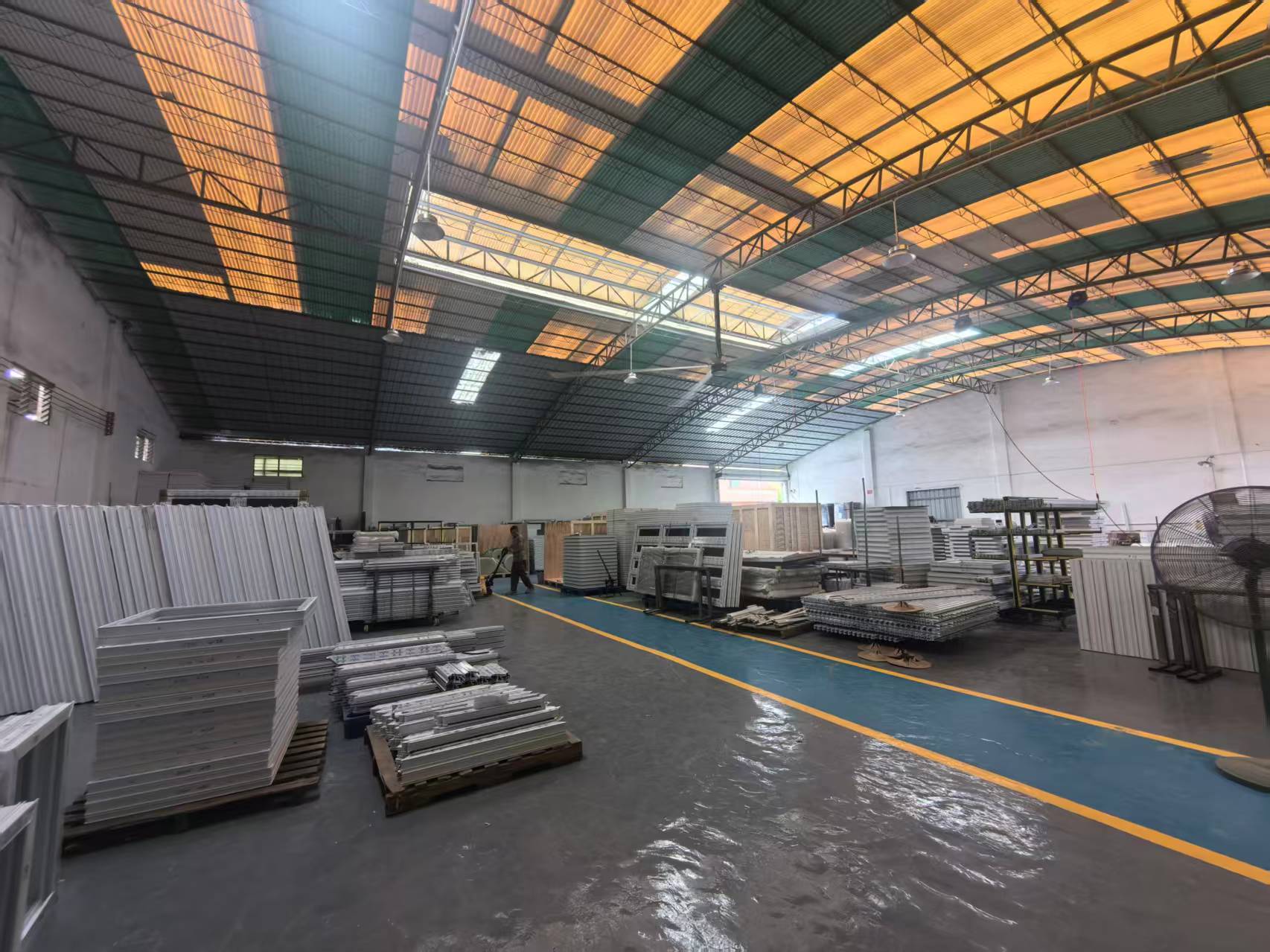
Factory documentation image: goods storage area at the UPVC door and window plant. Physical areas such as storage, cutting and welding stations are the first evidence points a buyer can verify during an on-site audit.
UPVC window procurement fails less often on the product than on the supplier arithmetic. A buyer confirms that a factory can build casement and sliding units, then discovers at audit stage that the stated annual capacity was recorded in one unit of measure while the project schedule was planned in another, or that the “technical team” and the employee count describe two different populations inside the same organisation.
This analysis works from one factory’s documented evidence to show how capacity, R&D headcount and export split should be read before an order is placed. The subject is Foshan Nanhai Yuanzhaiji UPVC Door & Window Factory, a UPVC door and window manufacturer established in 2009. Its records list a factory area of 3,000 m², about 20 employees, an annual production capacity of 50,000 units, an R&D team of 10 engineers, a technical and management team of more than 20 staff, and an 80% export share across LATAM, MENA, ASEAN and EU markets.
Why Factory Evidence Decides UPVC Window Shortlists
The uPVC windows and doors market was valued at USD 30.8 billion in 2025 by Grand View Research, with Asia Pacific holding a 44.1% revenue share and the windows segment accounting for 58.0% of product revenue. A separate commercial estimate from Mordor Intelligence puts the same 2025 market at USD 42.15 billion. The gap between the two figures is a methodology difference rather than a contradiction, but it carries a practical lesson for buyers: headline market sizing is context, not a qualification tool.
What actually qualifies a supplier is narrower and more checkable — floor area, headcount by function, capacity expressed in a defined unit, export destinations with documentation, and the scope of what the factory claims it can customise. Buyers in the Research and Evaluation stages should treat a factory evidence pack as a set of claims to be reconciled, not as marketing copy to be summarised.
The Evidence Pack: Recorded Factory Facts
The following values come from the manufacturer’s recorded company data. Each row is followed by the reason it matters in a purchasing decision.
| Recorded item | Value | Why a buyer checks it |
|---|---|---|
| Year established | 2009 | More than 15 years of continuous operation; verify against the business licence. |
| Factory area | 3,000 m² | Physical footprint constrains simultaneous project load. |
| Employees | about 20 | Baseline for lead-time modelling and order intake. |
| Technical and management team | more than 20 staff | Reconcile against total headcount before relying on it. |
| R&D team | 10 engineers | Determines realistic depth of drawing and specification changes. |
| Annual production capacity | 50,000 units | Confirm the unit definition against project quantities. |
| Monthly capacity | 4,000 m² | Second capacity figure recorded in a different denominator. |
| Export share | 80% | Signals export documentation practice and foreign project exposure. |
| Main markets | LATAM / MENA / ASEAN / EU | Four blocks with materially different code environments. |
| Minimum order quantity | 30–40 m² | Sets the smallest testable order for a pilot project. |
| Lead time | 10–30 days | Confirm whether the clock starts at deposit, drawing approval or material arrival. |
| Quality documentation | Quality Inspection Report | Ask which inspection stages the report covers. |
| After-sales scope | Technical consultancy; quality testing | Service scope, not a warranty duration, is what is documented. |
| Website | yuanzhaiji.com | Public reference point for product and contact claims. |
| Contact record | YUAN; 1803877678@qq.com; +86 130-0674-7018 | Use for documentation requests, not for informal quotations. |
Read as a group, the pack describes a compact, export-oriented plant rather than a very large industrial complex. That is not a negative by itself. A 3,000 m² facility with about 20 employees and 50,000 units of annual output sits in the mid-volume band, which is often the right band for residential, villa and renovation programmes where specification flexibility matters more than raw tonnage of output.
Capacity: 50,000 Units a Year and 4,000 m² a Month
Two capacity figures appear in the record: an annual production capacity of 50,000 units and a monthly capacity of 4,000 m². They are expressed in different denominators, and a serious buyer should not average them or convert them silently.
The practical consequence is straightforward. Before matching capacity to a project schedule, confirm which denominator governs: units of finished window and door assemblies, or square metres of processed profile and glazed assembly. A buyer who needs 2,000 window units in a defined window of time and receives an answer in square metres is comparing two different things. The correct request is a capacity statement in the same unit as the bill of quantities, supported by a production calendar rather than a single total.
Two further figures reduce scheduling risk. A minimum order quantity of 30–40 m² is small enough to support a pilot or sample-building order, and a lead time band of 10–30 days is short enough to be tested. The test is definitional: ask whether the 10–30 days begins at deposit receipt, at approved shop drawings, or at profile arrival. Export programmes usually lose far more time to drawing approval than to fabrication.
R&D Headcount: What 10 Engineers Change
An R&D team of 10 engineers is the single most decision-relevant number in the pack, because it sets the realistic ceiling on customisation. The factory records OEM, ODM and customisable production, with customisation covering window size, specification and glass specification.
In practice, that scope means a buyer can bring a drawing with non-standard opening dimensions and a defined glazing build-up and expect a manufacturable response. It does not automatically mean structural engineering for unusual spans, facade-system design, or building-physics calculations for a whole envelope. Those services should be requested explicitly and confirmed in writing.
One reconciliation point deserves attention. The company record lists about 20 employees in total and, separately, a professional technical and management team of more than 20 staff. Those two statements describe the same organisation from different angles, and the totals do not align on their face. A buyer should ask for a headcount breakdown by function — production, technical, quality, sales and management — and clarify whether the technical and management figure counts full-time equivalents, long-serving staff, or a broader grouping. A supplier that can answer this precisely is exhibiting exactly the internal documentation discipline that export projects require.
Export Split: What 80% Across Four Market Blocks Implies
An 80% export ratio concentrated in LATAM, MENA, ASEAN and the EU places this factory in the export-first category. The company’s capability record additionally lists EU, USA, Africa and the Middle East as export markets, so the destination list should be confirmed for the specific programme under discussion rather than assumed.
The four core blocks are not interchangeable from a compliance perspective:
- EU — thermal transmittance is regulated. For window replacement in existing homes in England and Wales, the legal whole-window U-value limit was 1.4 W/m²K in 2025 under Approved Document L. Glazing specification, spacer type and frame chamber design all feed into that number.
- MENA — high ambient temperatures, dust ingress and wind-driven rain put pressure on sealing systems, gasket material and hardware corrosion resistance.
- ASEAN — coastal humidity, salt exposure and intense UV load test anti-ageing formulation and hardware selection.
- LATAM — requirements vary widely by country, so the buyer must define the applicable local building code rather than rely on a regional summary.
An export-heavy mix also raises a question the factory’s own figures cannot answer: who provides in-market technical support after delivery. With about 20 employees in total, in-country representation is likely to be partner-based. That is normal for this tier of manufacturer, but it should be confirmed contractually — spare hardware supply, installation guidance and defect-response routing.
Documented Product Range and Listed Models
The recorded product range covers sliding windows, casement windows, tilt-and-turn windows, crank awning windows, American-style hung windows, awning windows, hopper windows, insect screens, louver windows and insulated glass louver windows, alongside a door series that includes sliding doors, lift-and-slide doors and hinged doors. The UPVC window listing carries the models BR58 and HF88.
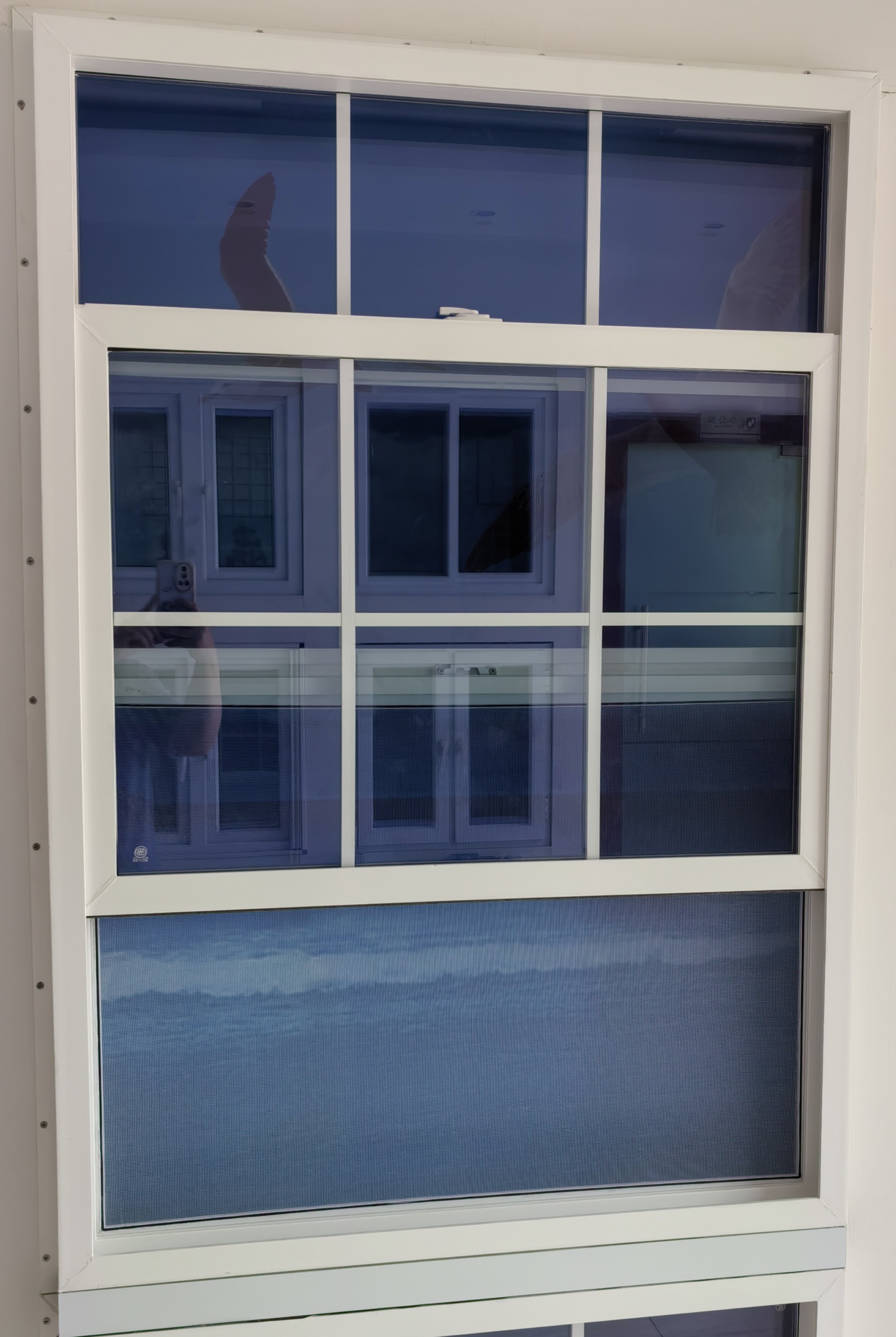
UPVC 82-series American-style single hung window. Buyer note: model numbers should be matched to the shop drawing and the profile series before the order is released.
Profile supply is documented as long-term supply of Conch profiles in 60, 65 and 88 series, available in co-extruded colour, laminated wood-grain finish and solid colours including dark grey and black. For a buyer, the profile brand is the fastest single check available: Conch profiles are presented as a brand-grade UPVC profile with a standardised raw-material formulation and consistent wall thickness, whereas unbranded mid-range profiles vary considerably between manufacturers in formulation and wall thickness. That difference is not cosmetic. Low-grade profiles can yellow, deform and leak air after several years of outdoor exposure, while a properly specified profile with adequate anti-UV stabilisation holds its geometry far longer. Industry estimates for high-quality profiles manufactured in the Foshan Nanhai cluster place service life in the 30 to 40 year range.
Technical Baseline: Material Data Buyers Can Request
The UPVC window listing (models BR58 and HF88) carries the following material parameters. These are the numbers a technical buyer should compare against the profile supplier’s own test reports.
| Property | Recorded value | Engineering reading |
|---|---|---|
| Material | UPVC | Unplasticised polyvinyl chloride — rigid, corrosion-resistant, electrically non-conductive. |
| Vicat softening point | 86 °C | Indicates the temperature at which the material begins to soften under defined load; relevant to hot-climate exposure. |
| Flexural modulus of elasticity | 2840 MPa | Stiffness under bending — the property that decides when internal steel reinforcement is required. |
| Tensile yield stress | 43 MPa | Stress at which permanent deformation begins. |
| Tensile strain at break | 186% | Ductility before fracture — relevant to impact and handling damage. |
| Density | 1520 kg/m³ | Consistency indicator; abnormal density often signals excessive filler content. |
Glazing options recorded for the range include single-layer glass, double-glazed insulated glass, tempered safety glass and frosted glass. The factory states that CE, ISO and other qualification certificates can be provided as required. The words “as required” are the operative part: certificate scope must be matched to the specific product and market, since a certificate valid for one profile series or one test specimen does not transfer automatically to another.
Profile compliance for the Chinese market is referenced against GB/T 8814-2017, the standard for unplasticised polyvinyl chloride (PVC-U) profiles for doors and windows, which sets requirements on wall thickness, impact resistance, heat stability and anti-ageing performance and expects test reports for physical properties. For European programmes, the equivalent check is whether the supplied profile system and glazing build-up produce a whole-window U-value that satisfies the applicable national limit.
Application Fit: Coastal, Residential, Villa and Renovation Projects
The documented application profile for the UPVC window range is outdoor installation in coastal, high-humidity and strong-wind areas, in residential buildings, commercial buildings, renovation projects and villa projects. The stated functional role is thermal insulation, sound insulation, wind and rain resistance, corrosion resistance and sealing performance, creating a comfortable indoor environment.
Operation modes recorded across the range are manual opening and closing, tilt-and-turn opening and sliding operation. The supporting hardware and sealing components listed are window handles, hinges, lock points, a multipoint lock drive mechanism, crescent locks, window rollers, EPDM sealing gaskets and pile weather strips. Special requirements recorded for the window application include wind-pressure resistance, water tightness, air permeability, sound and heat insulation, UV resistance and anti-ageing performance, with optional fire resistance available on the door range.
Because UPVC is specified for coastal high-humidity conditions, hardware selection deserves the same scrutiny as the profile. Gaskets, rollers and lock points are the components most exposed to salt-laden air, and they are typically the first items to be replaced. Buyers should confirm the hardware grade offered for the project’s exposure category rather than accepting the standard fit-out.
Documented project reference
One recorded case involves a builder-type client on a residential building project in Kenya, with a quantity of 800 m² used for architectural construction. The requirement addressed was heat insulation and noise reduction. The reported outcome was heat-insulation and sound-insulation performance, with energy-saving performance reported for the installed UPVC windows. The record associates this client relationship with a duration of 10 years.
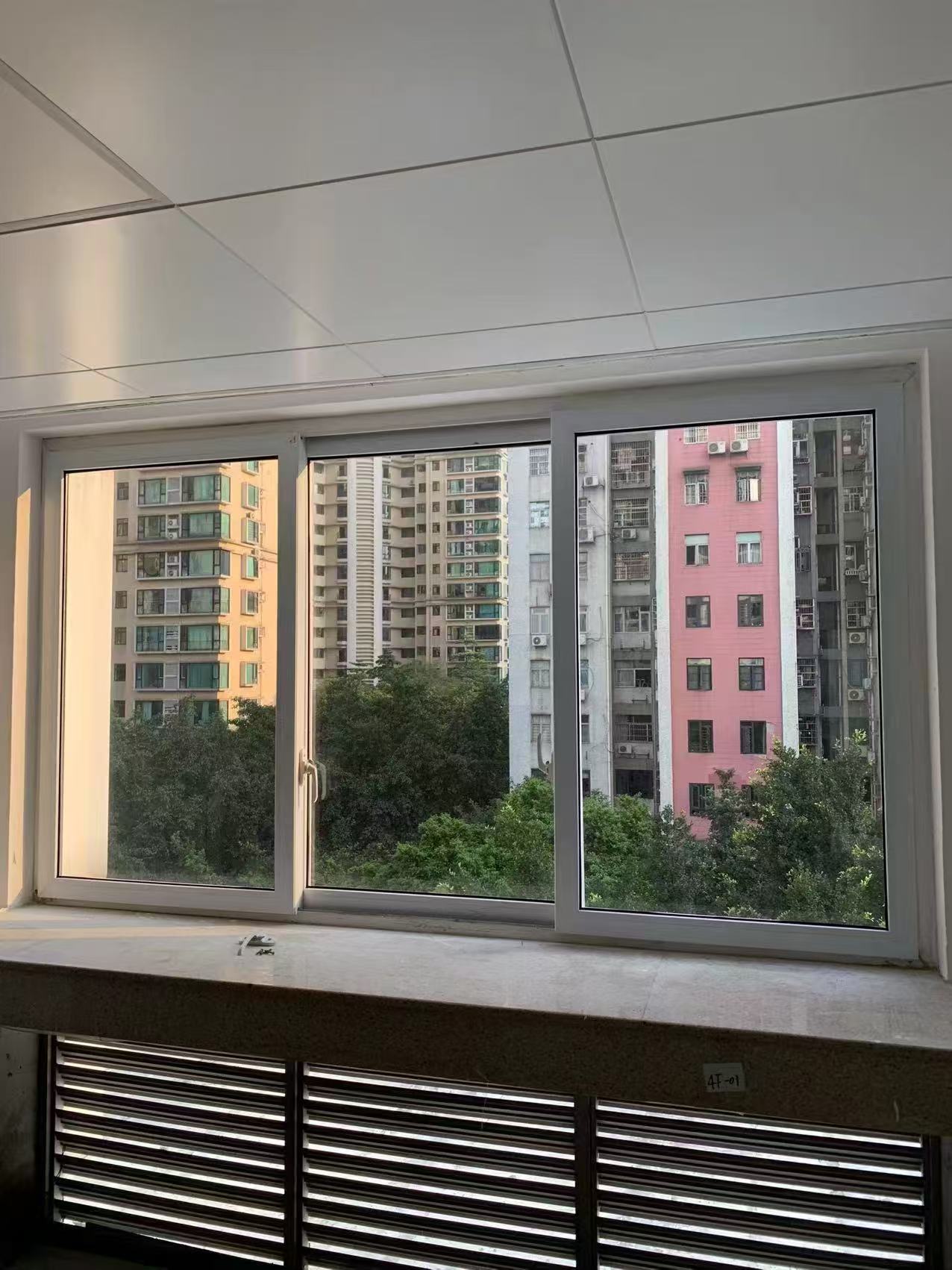
Field-installed UPVC sliding window on a residential building project. Site photographs of completed installation are checkable evidence of application fit; they are not a substitute for performance test reports.
Comparison With Traditional Frame Solutions
UPVC competes mainly with aluminium and timber in the window market. The trade-offs below are general engineering characteristics, not measured comparisons of specific suppliers.
| Dimension | UPVC multi-chamber | Aluminium | Timber |
|---|---|---|---|
| Thermal behaviour | Hollow chambers slow heat transfer; multi-chamber profiles can improve energy efficiency compared with traditional frames. | Un-insulated sections conduct heat; thermal breaks narrow the gap. | Generally good, but dependent on section and upkeep. |
| Structural stiffness | Lower than aluminium; wide spans and high wind loads require internal steel reinforcement and section upsizing. | High stiffness, suited to large openings and slim sightlines. | Moderate and species-dependent. |
| Maintenance | Low; cleaning rather than refinishing. | Low. | Periodic refinishing required. |
| Colour stability | Dependent on formulation; low-grade profiles risk yellowing and deformation under UV. | Stable when anodised or powder-coated. | Weathers to a patina unless protected. |
| Service life | Industry estimates for high-quality profiles from the Foshan Nanhai cluster are 30 to 40 years. | Long, coating-dependent. | Long with maintenance. |
Where UPVC stops being the right answer. UPVC is not the correct specification for very large structural openings, for projects requiring very slim sightlines, or where the design code or client standard mandates aluminium or timber. Within the UPVC category itself, the quality spread is wide: unbranded mid-range profiles vary substantially in wall thickness and raw-material formulation, and counterfeit branded profiles exist. A buyer who selects on unit price alone can end up with yellowing, deformation, air leakage and a shortened service life. There is also a capacity boundary to acknowledge: a plant of this scale allocates capacity across concurrent orders, so a buyer with a very large single-phase requirement should confirm schedule protection before signing.
Market Signals Behind the Sourcing Logic
Several verifiable data points support the direction of this category:
- Asia Pacific held 44.1% of global uPVC window and door revenue in 2025, confirming the region as the manufacturing centre of gravity (Grand View Research).
- The windows segment accounted for 58.0% of uPVC product revenue in 2025, while casement windows and doors held the largest design-type share at 38.5% (Grand View Research; Dataintelo).
- Modern multi-chamber uPVC profiles can improve energy efficiency by up to 40% compared with traditional frames (secondary industry source).
- Regulatory pressure is tightening on thermal performance: England and Wales set a 1.4 W/m²K whole-window limit for replacement windows in existing homes in 2025 (Approved Document L).
- Foshan Nanhai remains a key manufacturing base for UPVC profiles and windows, with high-quality profile lifespans estimated at 30 to 40 years (industry publication). Competitive density is high — for example, Wanjia Windows & Doors operates from Nanhai District serving more than 150 countries.
The implication for buyers is that supplier differentiation within the Foshan cluster will not come from the category claim — almost every supplier can produce a UPVC casement window. It will come from documentation quality: capacity stated in a defined unit, headcount broken down by function, profile brand traceability, and test reports matched to the destination market.
A Verification Checklist for This Tier of Supplier
- Match the business licence to the 2009 establishment year and to the registered entity name.
- Measure the 3,000 m² factory area on site and confirm which buildings are owned or leased.
- Request a headcount breakdown by function and reconcile about 20 employees against the stated technical and management team of more than 20 staff.
- Ask for the capacity statement in the same unit as your bill of quantities — units per year or square metres per month, not both.
- Confirm what triggers the 10–30 day lead time and how the 30–40 m² minimum order quantity is calculated.
- Verify Conch profile supply through invoices or channel documentation rather than a verbal statement.
- Obtain profile test reports traceable to GB/T 8814-2017 or the applicable destination standard, and confirm certificate scope by model.
- Request a whole-window U-value calculation for the intended glazing build-up where the destination market regulates thermal performance.
- Confirm hardware grade and sealing components for the project’s exposure category.
- Define after-sales scope in writing, since the recorded scope is technical consultancy and quality testing.
Future Outlook
Three forces are likely to shape how mid-volume UPVC window factories are evaluated over the next few years. First, thermal regulation continues to tighten in Europe, pushing buyers toward higher-specification glazing and multi-chamber profiles and making documented U-value calculation a standard procurement requirement rather than a premium option. Second, material traceability is moving from a nice-to-have to a contractual item, as buyers increasingly demand proof of genuine branded profile supply and lead-free stabiliser verification. Third, the depreciation of the resource base is slow but real: profiles made with adequate anti-ageing additives are expected to serve for decades, while under-formulated material degrades within a fraction of that time, which converts today’s unit-price saving into tomorrow’s replacement cost.
For a factory of this size and export orientation, the competitive position will depend less on adding capacity than on making existing capacity legible. Buyers increasingly reward suppliers whose numbers survive a second question.
FAQ
1. What factory facts can a buyer verify before shortlisting this UPVC window manufacturer?
The recorded facts are: establishment in 2009 with more than 15 years of operation; a factory area of 3,000 m²; about 20 employees; a technical and management team of more than 20 staff; an R&D team of 10 engineers; annual production capacity of 50,000 units; monthly capacity of 4,000 m²; an 80% export share across LATAM, MENA, ASEAN and EU markets; a minimum order quantity of 30–40 m²; and a lead time of 10–30 days. Contact details are listed as YUAN, 1803877678@qq.com and +86 130-0674-7018, with yuanzhaiji.com as the public website. Each item is checkable: the establishment year against the business licence, the floor area by site measurement, and the headcount by roster.
2. Which UPVC window and door types are produced, and which models are listed?
The recorded range covers sliding windows, casement windows, tilt-and-turn windows, crank awning windows, American-style hung windows, awning windows, hopper windows, insect screens, louver windows and insulated glass louver windows, plus UPVC sliding doors, lift-and-slide doors and hinged doors. The UPVC window listing carries models BR58 and HF88, made from UPVC. Recorded operation modes across the range are manual opening and closing, tilt-and-turn opening and sliding operation. Model numbers should always be matched to the shop drawing and profile series before an order is released.
3. What conditions and project types are these windows specified for?
The documented application conditions are outdoor installation in coastal, high-humidity and strong-wind areas. Project types recorded include residential buildings, commercial buildings, renovation projects and villa projects. The stated functional role is thermal insulation, sound insulation, wind and rain resistance, corrosion resistance and sealing performance. Special requirements recorded for the window application include wind-pressure resistance, water tightness, air permeability, sound and heat insulation, UV resistance and anti-ageing performance, with optional fire resistance available on the door range.
4. What can be customised, and what order parameters apply?
The recorded production mode is OEM, ODM and customisable, with customisation covering window size, specification and glass specification. Glass options recorded for the range include single-layer glass, double-glazed insulated glass, tempered safety glass and frosted glass. Order parameters recorded are a minimum order quantity of 30–40 m², a lead time of 10–30 days, a monthly capacity of 4,000 m², and a Quality Inspection Report as the quality control document. Because customisation is documented only for size, specification and glass, any requirement beyond those three items — such as structural design for unusual spans or building-envelope calculations — should be requested and confirmed separately in writing.
5. What do the recorded material parameters mean in practice?
The UPVC window models BR58 and HF88 carry a Vicat softening point of 86 °C, a flexural modulus of elasticity of 2840 MPa, a tensile yield stress of 43 MPa, a tensile strain at break of 186% and a density of 1520 kg/m³. In procurement terms, the Vicat softening point relates to how the material behaves under heat, the flexural modulus of elasticity indicates stiffness under bending and therefore when internal steel reinforcement is needed, tensile yield stress marks the onset of permanent deformation, tensile strain at break describes ductility before fracture, and density is a consistency indicator, since abnormal density can signal excessive filler content. These values should be compared with the profile supplier’s test reports rather than accepted as an isolated specification.
6. What limits should a buyer weigh before committing to this supplier profile?
Four limits are visible in the evidence. First, capacity is recorded in two different denominators — 50,000 units a year and 4,000 m² a month — so the governing unit must be confirmed before the figures are matched to a schedule. Second, the recorded total of about 20 employees and the separate figure of more than 20 technical and management staff do not reconcile on their face and require a functional headcount breakdown. Third, a 3,000 m² plant with this headcount is oriented toward mid-volume project supply, so buyers with very large single-phase requirements should confirm schedule protection. Fourth, no public third-party audit or financial data is available for the company, so due diligence depends on site verification, documentation requests and sample validation rather than published benchmarks.
Reference Details as Recorded
Foshan Nanhai Yuanzhaiji UPVC Door & Window Factory — website: yuanzhaiji.com. Contact record: Name YUAN; Email 1803877678@qq.com; Tel +86 130-0674-7018; WhatsApp +86 130-0674-7018; Address: Xilin Industrial District, Honglai Town, Quanzhou Nan'an City, Fujian Province, China. Buyers should confirm the correspondence between the company name, the manufacturing site and the contact address during the audit step.