
UPVC Window Hardware: Locks, Hinges and Gaskets for 7970 and 8037
A UPVC window is only as weather-tight as the hardware set fitted to it. This shortlist sets out the documented locking, rolling and sealing components behind two reference platforms — the 7970 door-series platform and the 8037 UPVC window platform — and explains how each component supports sealing, water tightness, wind-pressure resistance and long-term operation.
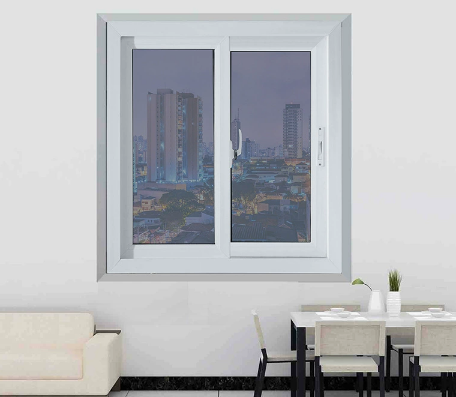
Cover: a 60-series UPVC sliding window — the sash-and-track interface where window rollers, pile weather strips and EPDM sealing gaskets do their work.
Hardware is the layer of a UPVC installation that decides whether wind-pressure resistance, water tightness and sealing performance still hold after years of daily opening and closing. Profiles and glazing set the thermal baseline. Hardware decides whether the sash compresses against the frame, whether the track still runs true, and whether rain driven against a coastal facade stays outside.
The two platforms in this shortlist come from Foshan Nanhai Yuanzhaiji UPVC Door & Window Factory, a UPVC door and window manufacturer established in 2009. The factory reports an export share of 80% across LATAM, MENA, ASEAN and EU markets, an R&D team of 10 engineers and a monthly capacity of 4,000 ㎡. Its product range covers UPVC sliding windows, casement windows, tilt-and-turn windows, crank awning windows, American-style hung windows, awning and hopper windows, insect screens, PVC louver windows and insulated glass louver windows, alongside UPVC sliding doors, lift-and-slide doors and hinged doors.
Why UPVC Window Performance Is Decided at the Hardware Layer
The documented application profile for product 8037 lists outdoor service in coastal high-humidity and strong-wind conditions. Its special requirements include wind-pressure resistance, water tightness for coastal high-humidity areas, sound and heat insulation, UV resistance and anti-aging performance, and compliance with local building codes. Not one of those requirements is delivered by a profile extrusion alone — each one routes through a hardware interface.
Sealing is a compression behaviour: a gasket only seals where a lock point pulls the sash against the frame. Water tightness depends on the same compression plus a drainage path that hardware must not obstruct. Wind-pressure resistance is a load-transfer problem in which hinges and lock points carry sash deflection back into the frame. Long-term operation is a wear problem concentrated in rollers, hinges and gaskets.
The manufacturer's own troubleshooting record points in the same direction. The most frequently described field complaint — a sash that is stiff and difficult to open or close — is attributed to three causes: debris or dust accumulated in the sliding track, a worn or out-of-position pulley, and mis-adjusted sash hardware. All three sit in the hardware and installation layer rather than in the profile itself.
The Two Reference Platforms: 7970 and 8037 Side by Side
Product 7970 is the door-series reference documented with models HF60, WYK75-1 and HF88-L. It operates in manual opening and closing mode and is specified for renovation projects, with special requirements that include optional fire resistance and UV resistance and anti-aging performance.
Product 8037 is the UPVC window reference documented with models BR58 and HF88. It operates in sliding mode and is applied in residential building projects, commercial building projects and villa projects, with a stated application in the window industry. Its documented service environment is outdoor, coastal high-humidity and strong-wind.
| Reference | Type and models | Operation mode | Documented project fit | Documented special requirements |
|---|---|---|---|---|
| 7970 | UPVC Door — HF60, WYK75-1, HF88-L | Manual opening and closing | Renovation projects | Optional fire resistance; UV resistance and anti-aging performance |
| 8037 | UPVC Window — BR58, HF88 | Sliding | Residential buildings, commercial buildings, villa projects | Wind-pressure resistance; water tightness for coastal high-humidity areas; sound and heat insulation |
Both platforms are documented against the same profile material property set: a Vicat softening point of 86 °C, flexural modulus of elasticity of 2,840 MPa, tensile yield stress of 43 MPa, tensile strain at break of 186%, and a density of 1,520 kg/m³. Those values describe the frame material the hardware has to work against — a stiff, thermally stable extrusion that transfers hinge and lock-point loads without the deflection tolerance of softer framing.
7970 Hardware Shortlist: Locking and Operating Components
Multipoint lock drive mechanism
On the 7970 platform, the multipoint lock drive mechanism is the component that converts a single manual input at the handle into locking travel at several points along the sash edge. Instead of relying on one latch, the mechanism distributes the closing force, which is why it is the first item on any hardware shortlist for a manually operated door.
The practical consequence for buyers is adjustment range. Because 7970 is specified for renovation projects, the installed frame is frequently an existing opening with tolerances that were set by the previous unit. A drive mechanism with adequate take-up allows the installer to re-establish gasket compression at every lock point rather than at one. Where the specified requirement is optional fire resistance, hardware selection also has to be confirmed against the rated assembly rather than assumed from the standard configuration.
Crescent lock
The crescent lock is documented in the same hardware set as the multipoint lock drive mechanism and the lock points. It is a discrete, rotary closing element rather than a continuous drive system, and it is normally listed alongside — not instead of — a multipoint mechanism, so that short sash sections gain a positive locking point without running a full drive rail through them.
For procurement purposes, the crescent lock should be treated as a wear item with its own keeper alignment tolerance. On a renovation installation where the frame is not perfectly plumb, keeper alignment is usually the reason a crescent lock feels loose before any component has actually failed.
Handles, hinges, rollers and the anti-collision stopper
The equipment set documented for the door configuration of 7970 also includes door handles, door hinges, door rollers, an anti-collision stopper, dust-proof pile weatherstrip and EPDM sealing gasket. The handle is the operator interface and the first component a user judges the product by; the hinges carry sash weight; the rollers control travel on sliding sashes; the anti-collision stopper limits impact at the end of travel; and the pile weatherstrip and EPDM gasket form the sealing pair.
8037 Hardware Shortlist: Sealing, Rolling and Closing Components
The hardware set documented for product 8037 is explicit: the window requires supporting equipment including window rollers, EPDM sealing gaskets and pile weather strips, in addition to window handles, hinges and lock points, and it must be used with window hinges and lock points. The window-industry application record that pairs 7970 and 8037 specifies the same combined equipment list, which is why the two platforms share a hardware vocabulary even though their operation modes differ.
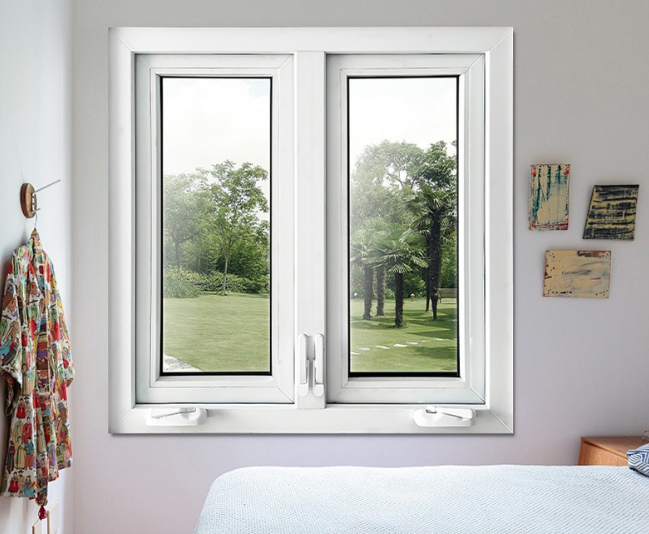
Handle, hinge and lock-point positions on a 60-series UPVC unit — the same component families that appear in the 8037 hardware set.
Window rollers
Window rollers carry the dead weight of the sash and define its vertical position in the track. They are also the component most directly linked to reported field problems: the manufacturer's troubleshooting record identifies a worn or out-of-position pulley as a cause of stiff sash movement, and instructs that the roller screw be adjusted to level the sash. Roller selection therefore has two dimensions to verify — load capacity and adjustability.
EPDM sealing gaskets
EPDM sealing gaskets sit in the closing plane and form the primary barrier against air and water. EPDM (ethylene propylene diene monomer) is chosen for outdoor fenestration because it holds elasticity across temperature swings and resists UV and ozone degradation better than many general-purpose elastomers. Its performance in service depends on being compressed, which is why gasket specification cannot be separated from lock-point layout.
Pile weather strips
Pile weather strips work differently from gaskets. They are brush-type strips that bear against the sliding interface, sealing the track where a compression gasket cannot follow the sash. On a sliding window such as 8037 they block air movement, dust ingress and wind-driven water at the travel gap. The window-industry equipment record lists pile weather strips separately from EPDM gaskets precisely because the two perform different jobs.
Window handles, hinges and lock points
Handles, hinges and lock points are the mechanical closing trio on 8037. The documented requirement is that the window must be used with window hinges and lock points, which signals that these are not optional accessories. Lock points determine how evenly the sash is pulled into the gasket line; hinges determine how the sash hangs and how it resists wind load; the handle transmits the user input that both depend on.
How Each Component Maps to Sealing, Water Tightness, Wind Pressure and Service Life
| Performance requirement | Primary hardware contributor | Secondary contributor | What to check at specification stage |
|---|---|---|---|
| Sealing performance | EPDM sealing gasket | Pile weather strip; lock points that create gasket compression | Number and distribution of lock points along the sash |
| Water tightness (coastal high-humidity) | Gasket compression plus an unobstructed drainage path | Pile weather strip at the sliding interface | That hardware does not block drainage and that gaskets are continuous at corners |
| Wind-pressure resistance | Window hinges and lock points | Profile stiffness — flexural modulus of elasticity 2,840 MPa | Sash dimensions against hinge load rating |
| Long-term operation | Window rollers and hinges | UV resistance and anti-aging performance of gasket and profile | Roller adjustability and replacement access |
| Impact and end-of-travel control | Anti-collision stopper (door configuration of 7970) | Hinge geometry | Stopper position relative to the frame |
Read as a system, the shortlist resolves into one rule: the gaskets define the seal, and the locking hardware defines whether the seal is actually engaged. A high-grade EPDM gasket that is never compressed behaves like an open joint, and a well-distributed lock-point layout cannot compensate for a gasket that has hardened. Both sides have to be specified at the same time.
Profile and Material Context the Hardware Must Match
Hardware is only as good as the profile it is screwed into, and the profile supplier choice is a documented decision point rather than a formality. According to the manufacturer's knowledge record, Conch is a brand-grade UPVC profile with a stable raw-material formula, strict wall-thickness standards and good anti-aging performance. General mid-range UPVC profiles vary greatly in quality between manufacturers. Where installation and processing are proper, Conch profiles are associated with longer service life and fewer later-stage problems.
The risk profile is equally documented. Mid-range profiles of inferior quality may suffer yellowing, deformation, air leakage and shortened service life, and counterfeit Conch profiles bring similar risks. The mitigation is procedural: verify compliance with GB/T 8814-2017 for unplasticized polyvinyl chloride (PVC-U) profiles for doors and windows, check wall thickness and physical property test reports, and confirm genuine Conch channels. Processing and installation quality will aggravate or suppress these defects either way.
Foshan Nanhai Yuanzhaiji UPVC Door & Window Factory supplies Conch profiles in the 60, 65 and 88 series on a long-term basis, available in co-extruded colour, laminated wood-grain finish and solid colours including dark grey and black. Certification documentation — CE, ISO and other qualification certificates — can be provided as required, and quality inspection reports are part of the factory's quality control documentation. Buyers should confirm that a certificate or test report covers the specific profile series and the hardware combination being ordered, since documentation issued for one configuration does not automatically extend to another.
Application Fit: Coastal, Residential, Villa and Renovation Projects
For 8037, the documented application is the window industry, common in China, covering residential building projects, commercial building projects and villa-type projects, with BR58 and HF88 applied in residential and villa work. The stated operating environment is outdoor, coastal high-humidity and strong-wind. That combination is the clearest argument for specifying corrosion-resistant hardware and UV-stable sealing materials together rather than treating them as separate line items.
A recorded builder-led residential project in Kenya covering 800 ㎡ addressed heat insulation and noise reduction, with heat-insulation and sound-insulation performance and energy-saving performance reported for the installed UPVC windows. The case record highlights high-quality profiles, corrosion-resistant hardware, tempered safety glass, fine workmanship, low-noise sliding operation, water-proof and dust-proof performance and easy maintenance. For a specifier, the transferable point is the pairing: profile quality and hardware corrosion resistance appear together in the list of what made the installation work.
For 7970, the documented fit is renovation work with manual operation. Renovation projects are less tolerant of hardware that has no adjustment range, because the installer inherits the opening rather than creating it. Where the project also requires UV resistance and anti-aging performance, or optional fire resistance, those requirements should be resolved at the hardware and assembly level before the order is placed.
Market Signals Behind Hardware Specification
The scale of the category explains why component-level decisions now attract attention. Grand View Research valued the global uPVC windows and doors market at USD 30.8 billion in 2025, with Asia Pacific accounting for a 44.1% revenue share, and the windows segment holding 58.0% of total uPVC product revenue that year. Dataintelo placed uPVC casement windows and doors as the largest design type at 38.5% share in 2025.
Those figures should be read with a caveat. Mordor Intelligence estimated the same 2025 market at USD 42.15 billion — a materially different number that appears to reflect different treatment of accessory and hardware segments or different base pricing for regional profiles. Buyers using market size as a planning input should treat the range, not a single point estimate, as the signal.
Regulation is the second signal and it is more concrete. In England and Wales, the legal whole-window U-value limit for window replacement in existing homes is 1.4 W/m²K in 2025 under Approved Document L. Because that limit applies to the whole window, it is a system-level requirement: profile, glazing and the hardware that keeps the assembly sealed all contribute to whether the installed unit performs as tested.
Manufacturing depth is the third signal. Foshan Nanhai is identified as a key manufacturing base for UPVC profiles and windows, with lifespans for high-quality profiles estimated between 30 and 40 years. If a profile is expected to serve three decades, the hardware it carries becomes a planned replacement item rather than a permanent one — which makes spare-part availability and roller or gasket replacement access a genuine procurement question.
Comparison with Traditional Sealing and Locking Approaches
| Aspect | Traditional approach | Documented approach on 7970 and 8037 | Boundary to plan for |
|---|---|---|---|
| Locking | Single-point latch with one engagement | Multipoint lock drive mechanism, crescent lock and lock points | More engagement points require correct adjustment; misalignment shows up as stiffness rather than as failure |
| Sealing | Felt or foam strip only | EPDM sealing gasket plus pile weather strip | Both are wear items with finite service life under UV and salt exposure |
| Sash travel | Basic roller with limited adjustment | Window rollers adjustable for sash levelling | Worn or out-of-position rollers remain the leading cause of stiff operation |
| Thermal performance | Attributed to the frame | Frame and glazing set the U-value; hardware controls air leakage | Upgrading hardware alone does not change the whole-window U-value |
| Compliance | Assumed from supplier reputation | GB/T 8814-2017 profile verification; CE/ISO documentation as required | Fire resistance on 7970 is optional, not standard |
Limits and Trade-offs Buyers Should Plan For
- Hardware is not the thermal variable. The whole-window U-value is set mainly by profile and glazing; hardware influences air leakage and sealing, not the reported U-value directly.
- Fire resistance on 7970 is listed as optional. It must be explicitly specified and verified against the rated assembly rather than assumed from the standard product.
- Operation on 7970 is manual only. No powered or automated operation mode is documented for the platform.
- Sealing components are consumables. EPDM gaskets and pile weather strips degrade under sustained UV and coastal exposure and should be planned as replacement items.
- 8037 is documented in sliding operation. Sliding sashes seal through a different engagement geometry than compression-seal casements, so projects with extreme wind exposure should confirm performance data for the specific configuration rather than extrapolate.
- Profile quality carries its own risk. Mid-range profiles may yellow, deform and leak air over time, and counterfeit branded profiles carry the same risk, so documentation checks are not optional.
- Published market sizes for this category disagree by a wide margin, so market data should inform strategy rather than anchor a single procurement decision.
Future Outlook
Three directions are visible in the current data. The first is regulatory tightening on whole-window performance, illustrated by the 1.4 W/m²K limit for replacement windows in England and Wales. The second is profile structure: modern multi-chamber uPVC profiles are reported to improve energy efficiency by up to 40% compared with traditional frames, which raises the performance baseline that hardware has to protect. The third is supply-chain depth in the Foshan cluster, where profile lifespans of 30 to 40 years are already part of how manufacturers describe product quality.
Together these trends point toward hardware specification becoming more documented, more traceable and more service-oriented. When a frame is expected to last decades, the question shifts from whether a lock, hinge or gasket can be fitted, to whether it can be identified, replaced and matched to the same profile series years later. Buyers who start collecting that documentation at the ordering stage will be better positioned than those who treat hardware as a closing detail.
Hardware Specification Checklist for 7970 and 8037
| Checkpoint | 7970 (door-series platform) | 8037 (UPVC window platform) |
|---|---|---|
| Locking hardware | Multipoint lock drive mechanism; crescent lock; lock points | Lock points; must be used with window hinges and lock points |
| Operating hardware | Manual opening and closing; door handle; door hinge; door roller; anti-collision stopper | Sliding operation; window handle; window roller |
| Sealing hardware | Dust-proof pile weatherstrip; EPDM sealing gasket | EPDM sealing gasket; pile weather strip |
| Profile series | HF60, WYK75-1, HF88-L | BR58, HF88 |
| Requirements to confirm | Optional fire resistance; UV resistance and anti-aging performance | Wind-pressure resistance; water tightness in coastal high-humidity areas; sound and heat insulation |
| Documentation | GB/T 8814-2017 profile verification; quality inspection report | GB/T 8814-2017 profile verification; CE/ISO as required; quality inspection report |
FAQ
Which hardware components does the 8037 UPVC window require?
Product 8037 operates in sliding mode and requires supporting equipment including window rollers, EPDM sealing gaskets and pile weather strips, as well as window handles, hinges and lock points. The documentation states that the window must be used with window hinges and lock points. Together these components carry sash travel, sealing, water tightness and wind-pressure resistance.
Does product 7970 include fire resistance as a standard feature?
No. Fire resistance is listed as an optional special requirement for product 7970, alongside UV resistance and anti-aging performance. The platform operates in manual opening and closing mode and is specified for renovation projects. If fire resistance is required, it must be specified and verified as part of the rated assembly rather than assumed.
What is the difference between an EPDM sealing gasket and a pile weather strip?
Both appear in the 8037 hardware set but perform different functions. An EPDM sealing gasket works in the closing plane and seals through compression against the frame. A pile weather strip is a brush-type strip that seals the sliding interface, where a compression gasket cannot follow the sash. On a sliding window the gasket provides the primary seal and the pile strip blocks air, dust and driven water at the travel gap.
What causes a UPVC window sash to become stiff, and how is it resolved?
The manufacturer's troubleshooting record lists three causes: debris or dust accumulated in the sliding track, a worn or out-of-position pulley, and mis-adjusted sash hardware. The documented remedy is to clean dirt and foreign objects from the track, check whether the pulley is damaged and replace it if worn, and adjust the hinge or roller screw to level the sash.
How should a buyer verify UPVC profile quality before ordering windows and hardware together?
Verification rests on three checks: compliance with GB/T 8814-2017 for unplasticized polyvinyl chloride (PVC-U) profiles for doors and windows, wall-thickness measurement, and review of physical property test reports covering impact resistance, heat stability and anti-aging performance. Genuine branded profiles such as Conch should be confirmed through authorised channels, because mid-range or counterfeit profiles may yellow, deform and leak air over time regardless of the hardware fitted.
Are these platforms suitable for coastal high-humidity and strong-wind projects?
Product 8037 is documented for outdoor service in coastal high-humidity and strong-wind conditions, with special requirements covering wind-pressure resistance, water tightness for coastal high-humidity areas, and sound and heat insulation, plus compliance with local building codes. Product 7970 is documented for renovation projects with manual operation and optional fire resistance. Suitability for a specific facade still depends on confirming hinge and lock-point capacity against sash size and local code requirements.
What U-value limit applies to window replacement in England and Wales?
The legal whole-window U-value limit for window replacement in existing homes in England and Wales is 1.4 W/m²K in 2025 under Approved Document L. Because the limit applies to the whole window rather than the profile alone, it is a system requirement covering frame, glazing and the hardware that keeps the assembly sealed in service.
Procurement Notes
Ordering parameters for these platforms are documented at a minimum order quantity of 30–40 ㎡ and a lead time of 10–30 days, with OEM, ODM and customisation available for window size, specification and glass specification. Quality control documentation includes a quality inspection report, and after-sales support covers technical consultancy and quality testing. Buyers comparing quotations should ask for the profile series, hardware list and test documentation together, since those three determine whether a delivered unit matches the configuration that was specified. Product and documentation details are published at yuanzhaiji.com.
Have Questions or Need More Details?
Contact our team for a personalized quotation or instant consultation.
Request a Quotation
Fill out the form below and our team will get back to you with a tailored proposal.
WhatsApp Direct Chat
Prefer to chat in real-time? Message us on WhatsApp for instant assistance & quick answers.
- Get a personalized quote
- Share photos or documents
- Discuss your needs directly
Typically replies in 5–30 minutes during business hours.