
UPVC Window Procurement FAQ: Bank Transfer, Photo Inspection, Hardware Acceptance
UPVC window procurement usually fails on documents, not on profile colour. A buyer can approve a profile series and still face delays because the payment route, the inspection method and the hardware schedule were never tied to the same order specification. This FAQ addresses those three practical questions for UPVC window orders: bank transfer as the accepted payment method, pre-shipment photo inspection or on-site inspection as the acceptance route, and hardware acceptance for the 8037 and 7970 model platforms.
Foshan Nanhai Yuanzhaiji UPVC Door & Window Factory is a UPVC door and window manufacturer established in 2009 in China. The factory produces UPVC sliding windows, casement windows, tilt-and-turn windows, crank awning windows, American-style hung windows, awning windows, hopper windows, insect screens, louver windows and insulated glass louver windows for construction projects. Its export markets include LATAM, MENA, ASEAN and the EU, and its manufacturing facility covers 3,000 square meters with an annual production capacity of 50,000 units, approximately 20 staff and a 10-engineer R&D team.
For the order type discussed in this procurement FAQ, bank transfer is the accepted payment method. Acceptance can be organised as pre-shipment photo inspection or on-site inspection. Hardware acceptance must be matched to the model and the project exposure. The 8037 platform requires window rollers, EPDM sealing gaskets, pile weather strips, hinges and lock points for coastal high-humidity and strong-wind use. The 7970 platform uses a multipoint lock drive mechanism and a crescent lock and is oriented to renovation and villa projects.
Why payment, inspection and hardware form one procurement decision
In a UPVC window order, the commercial terms and the technical acceptance criteria meet at the same point: the buyer must be able to confirm that the product being paid for is the product specified. Payment releases funds; inspection creates evidence; hardware acceptance confirms that the window can operate as intended in its project environment. Separating these three checks creates a common failure pattern: the profile series is correct, but the hardware schedule is incomplete for a coastal project, or the inspection photos show the frame but not the lock points that were ordered.
The practical answer is to treat payment, inspection and hardware as one acceptance chain. The order specification should list the model, the profile series, the hardware schedule and the inspection method. The inspection should produce evidence against that schedule. Payment should be released against the same reference. This is not a legal guarantee of performance; it is a documentation discipline that makes later disputes easier to resolve.
Bank transfer in a UPVC window order: what it confirms
Bank transfer is the accepted payment method for this order type. In procurement terms, a bank transfer is a direct payment instruction: the buyer’s bank sends funds to the beneficiary named in the order documents. It is simple and widely understood, but it does not create the documentary security of a letter of credit. The buyer should therefore verify the beneficiary name, the order reference, the model and quantity, and the inspection arrangement before releasing funds.
| Item to confirm before bank transfer | Why it matters | What it does not confirm |
|---|---|---|
| Beneficiary name matches the contracting entity | Reduces the risk of paying an unrelated account | Product quality or specification compliance |
| Order reference, model and quantity | Links the payment to the intended UPVC window order | Hardware compatibility with the project |
| Profile series and hardware schedule | Creates the technical baseline for inspection | That every unit has been produced |
| Inspection method and timing | Defines when acceptance evidence will be produced | Third-party laboratory performance |
Limit: bank transfer shifts timing and counterparty risk to the buyer more than a letter of credit would. It is also less useful than a letter of credit as a documentary trigger for shipment. Buyers using bank transfer should compensate with a clear order specification, a named inspection method and a photo or on-site acceptance record before shipment.
Pre-shipment photo inspection versus on-site inspection
Acceptance for this order type can be pre-shipment photo inspection or on-site inspection. The two methods answer different questions. Photo inspection is a remote visual check of the produced units before they are packed. On-site inspection allows the buyer or a representative to operate the window, check hardware engagement and review workmanship in person. Neither method replaces laboratory performance testing unless a specific test is separately commissioned.
| Acceptance route | Typical evidence | Useful for | Boundary |
|---|---|---|---|
| Pre-shipment photo inspection | Dated photos of frames, sashes, hardware, gaskets, glazing, labels and packing | Confirming model, profile series, hardware presence and visible workmanship before shipment | Cannot confirm operating force, water tightness, air permeability or thermal performance |
| On-site inspection | Physical operation of sashes, lock engagement, hinge alignment, gasket continuity and drainage paths | Confirming that the window operates and that hardware is installed as scheduled | Requires access, scheduling and a defined inspection checklist; it is still not a laboratory test |
What a pre-shipment photo set should show
- The profile series marking or label, where the order requires traceability to a series such as 50, 60, 65, 80, 88 or 112.
- The full window from the interior and exterior faces, plus a close-up of each corner and weld area.
- The hardware schedule: window rollers, hinges, lock points, multipoint lock drive mechanism or crescent lock as applicable to the model.
- EPDM sealing gaskets and pile weather strips, including continuity at corners and joints.
- Glazing type, spacer and visible seals where double-glazed or triple-glazed units are specified.
- Labels, model references and packing condition before shipment.
Limit: a photo inspection is an evidence tool, not a performance certificate. It can show that a lock point is present; it cannot show that the completed window achieves a declared U-value or wind-load class. For projects where those values are contractual, the buyer should specify the required test evidence separately and check it against the destination market’s rules.
Hardware acceptance for 8037 and 7970
Hardware acceptance is model-specific. A generic hardware list is not enough because the opening type, the sash weight and the project exposure change what the window needs. The 8037 platform is specified with window rollers, EPDM sealing gaskets, pile weather strips, hinges and lock points for coastal high-humidity and strong-wind use. The 7970 platform uses a multipoint lock drive mechanism and a crescent lock and is oriented to renovation and villa projects.
| Model platform | Hardware items to verify | Project fit stated in the order data | Acceptance check |
|---|---|---|---|
| 8037 | Window rollers, EPDM sealing gaskets, pile weather strips, hinges, lock points | Coastal high-humidity and strong-wind use | Confirm roller position and movement, gasket continuity, pile strip contact, hinge alignment and lock-point engagement |
| 7970 | Multipoint lock drive mechanism, crescent lock | Renovation and villa projects | Confirm the drive mechanism operates the locking points without forcing, and the crescent lock engages the sash correctly |
The model references in the factory’s product data include BR58 and HF88 for 8037, and HF60, WYK75-1 and HF88-L for 7970. These references should be written into the order schedule so that the inspection evidence can be matched to the correct model family rather than to a generic “UPVC window” description.
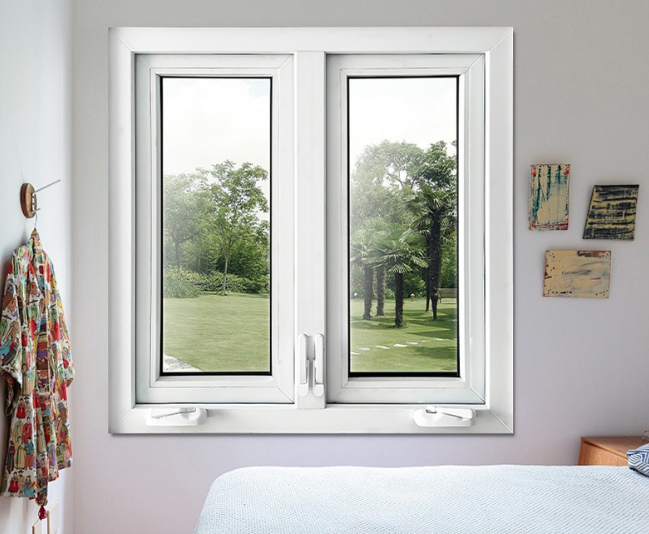
Hardware acceptance checklist
- Match the hardware schedule to the model platform: 8037 or 7970, including the model references in the order.
- Confirm that the opening type and hardware are consistent: sliding hardware for a sliding sash, hinges for an opening sash, and the specified lock type for the model.
- Check that EPDM sealing gaskets are continuous at corners and joints, and that pile weather strips are present where the sash meets the frame.
- Operate the lock points or multipoint lock drive mechanism through the full travel and confirm that the sash closes without forcing.
- Record the result in the inspection report with dated photos and the order reference.
Limit: hardware acceptance confirms that the specified components are present and operate at the time of inspection. It does not by itself prove long-term corrosion resistance in every coastal atmosphere, because that depends on the hardware finish, maintenance and local conditions. Buyers in coastal high-humidity areas should state the expected exposure and confirm the hardware finish in the order.
Certification scope check: ECM Attestation NO.3N230816.YCPQQ51
For buyers who need a document check, the factory’s ECM Attestation is NO.3N230816.YCPQQ51, valid from 2023-08-16 to 2028-08-15, against standard EN 14351-1:2006+A2:2016. The profile series referenced in the scope check are 50, 60, 65, 80, 88 and 112. These details should be compared with the actual ordered profile series before the attestation is used in a project file.
| Attestation field | Detail to verify | Procurement use |
|---|---|---|
| Attestation number | NO.3N230816.YCPQQ51 | Links the document to the order file |
| Validity | 2023-08-16 to 2028-08-15 | Check that the project shipment or completion date falls within the valid period |
| Standard | EN 14351-1:2006+A2:2016 | Confirms the declared standard reference |
| Profile series in scope | 50, 60, 65, 80, 88 and 112 | Match the ordered series to the document scope |
Limit: an attestation is not a project-specific approval. It does not replace the destination market’s building regulations or a project-specific U-value calculation. For example, the legal whole-window U-value limit for window replacement in existing homes in England and Wales was 1.4 W/m²K in 2025 under Approved Document L. A buyer using the attestation for an EU or UK project should still check the project’s thermal, fire and safety requirements separately.
The 2028-08-15 expiry also has a planning implication. Projects with completion dates close to or after that date should confirm whether the attestation will be renewed or whether an updated document will be available. The attestation should be treated as a dated record, not a permanent claim.
Technical explanation: what the material data does and does not tell you
The product data for the 8037 and 7970 platforms list material properties for the UPVC compound. These values are useful for comparing material consistency, but they are not whole-window performance ratings. They should be read alongside the profile series, the reinforcement, the glazing specification and the hardware schedule.
| Property | Value | What it indicates |
|---|---|---|
| Vicat softening point | 86℃ | Heat resistance of the UPVC material |
| Flexural modulus of elasticity | 2840 MPa | Stiffness of the material under bending |
| Tensile yield stress | 43 MPa | Stress at which the material begins to yield |
| Tensile strain at break | 186% | Deformation before break in a tensile test |
| Density | 1520 kg/m³ | Mass per unit volume of the compound |
UPVC profiles are extruded hollow sections. The hollow multi-chamber structure supports thermal insulation, and reinforcing steel can be inserted inside the profile to increase the mechanical strength of the window. The material data above describes the compound; the profile design, the steel reinforcement and the assembly determine the finished window’s structural behaviour. A buyer comparing quotations should therefore ask for the profile series, the reinforcement specification and the hardware schedule, not only the material datasheet.
Limit: the listed values do not establish a whole-window U-value, a water-tightness class or a wind-load rating. Those depend on the complete window assembly and must be verified against the project specification and the relevant test standard.
Application fit: coastal, renovation and villa projects
The factory’s application data covers residential buildings, commercial buildings, renovation projects and villa projects, with working conditions that include outdoor, coastal high-humidity and strong-wind areas. The stated window functions include thermal insulation, sound insulation, wind and rain resistance, corrosion resistance and sealing performance. The operating modes include manual opening and closing, tilt-and-turn opening and sliding operation.
Coastal high-humidity and strong-wind projects
For coastal high-humidity and strong-wind use, the hardware schedule matters as much as the profile. The 8037 platform is specified with window rollers, EPDM sealing gaskets, pile weather strips, hinges and lock points. EPDM gaskets and pile weather strips support the sealing performance of the window, while hinges and lock points affect operation and security. The buyer should confirm that the hardware finish is appropriate for the coastal exposure and that the drainage path is not blocked by the assembly.
Renovation and villa projects
For renovation and villa projects, the 7970 platform uses a multipoint lock drive mechanism and a crescent lock. A multipoint lock drive mechanism distributes the locking action across the sash, and the crescent lock provides a visible sash-locking point. In renovation work, the buyer should check that the new window’s hardware can be operated conveniently within the existing opening and that the model reference matches the approved schedule.
Limit: project fit is not automatic. A model that suits one coastal project may not satisfy another project’s local code, wind-load requirement or fire requirement. The application data describes intended use; it does not override the project’s engineering specification.
Market trend: documentation is becoming part of the product
The global uPVC windows and doors market was valued at USD 30.8 billion in 2025 by Grand View Research. Asia Pacific held a 44.1% revenue share in the same year, and the windows segment accounted for 58.0% of total uPVC product revenue. Casement windows and doors held the largest product-type share at 38.5%. These figures indicate a large and regionally concentrated market, but they also show why buyers need documentation: a high-volume market contains many suppliers, and the differences between them are not visible from a profile sample alone.
| Market indicator | Reported value | Procurement implication |
|---|---|---|
| Global uPVC windows and doors market, 2025 | USD 30.8 billion (Grand View Research) | Large supply base; documentation and inspection help differentiate offers |
| Asia Pacific revenue share, 2025 | 44.1% | Regional supply concentration makes factory evidence important |
| Windows share of uPVC product revenue, 2025 | 58.0% | Window-specific hardware and inspection criteria matter |
| Casement windows and doors share, 2025 | 38.5% | Opening-type hardware acceptance is a common procurement need |
Market sizing estimates vary. Mordor Intelligence valued the same 2025 market at USD 42.15 billion, while Grand View Research reported USD 30.8 billion. The difference illustrates how methodology and scope affect market figures. For procurement, the practical conclusion is not the exact number but the direction: buyers are increasingly comparing suppliers on traceable evidence, including profile series, hardware schedules, inspection records and attestation validity.
The Foshan cluster is also associated with long product lifespans. An industry publication estimates that high-quality UPVC profiles from Foshan can last 30 to 40 years. That estimate should be read as a product-life indication, not a guarantee for every installation; installation quality, maintenance and exposure conditions still affect service life.
Comparison with traditional procurement and traditional frame choices
Traditional UPVC window purchasing often relies on a quotation, a profile sample and a verbal hardware description. A documented procurement approach adds an inspection method, a model-specific hardware schedule and a certification scope check. The difference is not administrative; it changes what the buyer can prove if the delivered window does not match the order.
| Procurement element | Ad-hoc approach | Documented approach | Boundary |
|---|---|---|---|
| Payment | Bank transfer against a proforma invoice with limited technical detail | Bank transfer against an order reference that includes model, profile series and hardware schedule | Bank transfer still lacks the documentary security of a letter of credit |
| Inspection | Photos requested after production, without a checklist | Pre-shipment photo inspection against a defined photo list, or on-site inspection with an operating check | Photos cannot prove thermal, water or wind performance |
| Hardware | Generic “good hardware” description | Model-specific schedule: 8037 with rollers, EPDM gaskets, pile strips, hinges and lock points; 7970 with multipoint lock drive mechanism and crescent lock | Hardware presence does not by itself prove long-term corrosion performance |
| Certification | Certificate mentioned but not scope-checked | ECM Attestation NO.3N230816.YCPQQ51 checked against EN 14351-1:2006+A2:2016 and profile series 50/60/65/80/88/112 | Attestation is not a project-specific approval or a local code waiver |
Compared with traditional frame materials, UPVC offers thermal insulation, corrosion resistance and low maintenance, and it does not require the same painting cycle as wood. The boundary is structural: UPVC has lower stiffness than metal in very large spans, so steel reinforcement and profile design become critical. UV stability and colour retention also depend on the compound formulation, and fire resistance is an optional requirement that must be specified rather than assumed. These are real trade-offs, not reasons to reject UPVC; they are reasons to check the complete specification.
Future outlook
The next procurement cycle is likely to place more weight on dated evidence. The ECM attestation for this factory expires on 2028-08-15, so projects completing near that date should plan for a document renewal check rather than assuming continuity. The global market is large and Asia Pacific remains a major supply region, which means buyers will continue to see many quotations with similar profile descriptions. The differentiator will be the ability to match a model, a hardware schedule and an inspection record to the same order reference.
For UPVC window buyers, the practical priority is to keep the three acceptance questions together: how payment is made, how acceptance is evidenced, and which hardware is required for the model and project exposure. A procurement file that answers all three is more useful than a lower quotation with an incomplete technical schedule.
FAQ: UPVC window procurement
Bank transfer is the accepted payment method for this order type. The buyer should verify the beneficiary name, the order reference, the model and quantity, and the inspection arrangement before transferring funds. Bank transfer is a direct payment route and does not provide the documentary security of a letter of credit.
Yes. Acceptance can be pre-shipment photo inspection or on-site inspection. Photo inspection provides dated visual evidence of the produced units before packing. On-site inspection allows the buyer or a representative to operate the window and check hardware engagement in person.
It can confirm the model reference, profile series label, visible workmanship, hardware presence, EPDM sealing gasket continuity, pile weather strip presence, glazing appearance and packing condition. It cannot confirm operating force, water tightness, air permeability, thermal performance or structural load capacity.
The 8037 platform requires window rollers, EPDM sealing gaskets, pile weather strips, hinges and lock points for coastal high-humidity and strong-wind use. The acceptance check should confirm roller movement, gasket continuity, pile strip contact, hinge alignment and lock-point engagement.
The 7970 platform uses a multipoint lock drive mechanism and a crescent lock and is oriented to renovation and villa projects. Acceptance should confirm that the drive mechanism operates the locking points without forcing and that the crescent lock engages the sash correctly.
Check the attestation number NO.3N230816.YCPQQ51, the validity period from 2023-08-16 to 2028-08-15, the standard EN 14351-1:2006+A2:2016, and the profile series 50, 60, 65, 80, 88 and 112. The ordered profile series should match the scope stated in the document.
The profile series referenced in the scope check are 50, 60, 65, 80, 88 and 112. A buyer ordering a different series should not assume that the attestation applies without confirming the scope.
It can. The attestation is valid to 2028-08-15. Projects with shipment or completion dates close to or after that date should confirm whether a renewed or updated document will be available before relying on the attestation in a project file.
Photo inspection is useful for confirming hardware presence and visible assembly details, but it is not a performance test. For coastal high-humidity and strong-wind projects, the buyer should also confirm the hardware finish, gasket material, pile weather strip specification, drainage path and any project-specific wind-load or water-tightness requirement. On-site inspection or separate test evidence may be appropriate where those requirements are contractual.
Have Questions or Need More Details?
Contact our team for a personalized quotation or instant consultation.
Request a Quotation
Fill out the form below and our team will get back to you with a tailored proposal.
WhatsApp Direct Chat
Prefer to chat in real-time? Message us on WhatsApp for instant assistance & quick answers.
- Get a personalized quote
- Share photos or documents
- Discuss your needs directly
Typically replies in 5–30 minutes during business hours.