
UPVC Window Supplier Capability Evidence: Matching Factory Data to Project Risk
A UPVC window supplier becomes credible not because it publishes a catalogue, but because its factory data can be cross-checked against the specific risks of a project site — coastal humidity, renovation tolerances, wind load and regulatory scrutiny. Capability evidence is what turns a quotation into a decision.
UPVC windows — frames extruded from unplasticized polyvinyl chloride, typically reinforced with steel and glazed with insulated glass units — accounted for 58.0% of global uPVC product revenue in 2025, according to Grand View Research. That dominance means buyers are no longer choosing between “UPVC or aluminium”. They are choosing between suppliers whose production, documentation and commercial terms survive contact with a real site.
Foshan Nanhai Yuanzhaiji UPVC Door & Window Factory, a UPVC door and window manufacturer established in 2009 and located in the Foshan Nanhai industrial cluster, offers a compact, verifiable case for this kind of review. Its disclosed operating data is short enough to hold in memory: a 3,000 m² factory, about 20 staff, 10 R&D engineers, an annual output of 50,000 units, and roughly 80% of sales exported to LATAM, MENA, ASEAN and the EU. Each figure maps onto a distinct project risk — and that mapping, not the numbers themselves, is what a procurement team should evaluate.
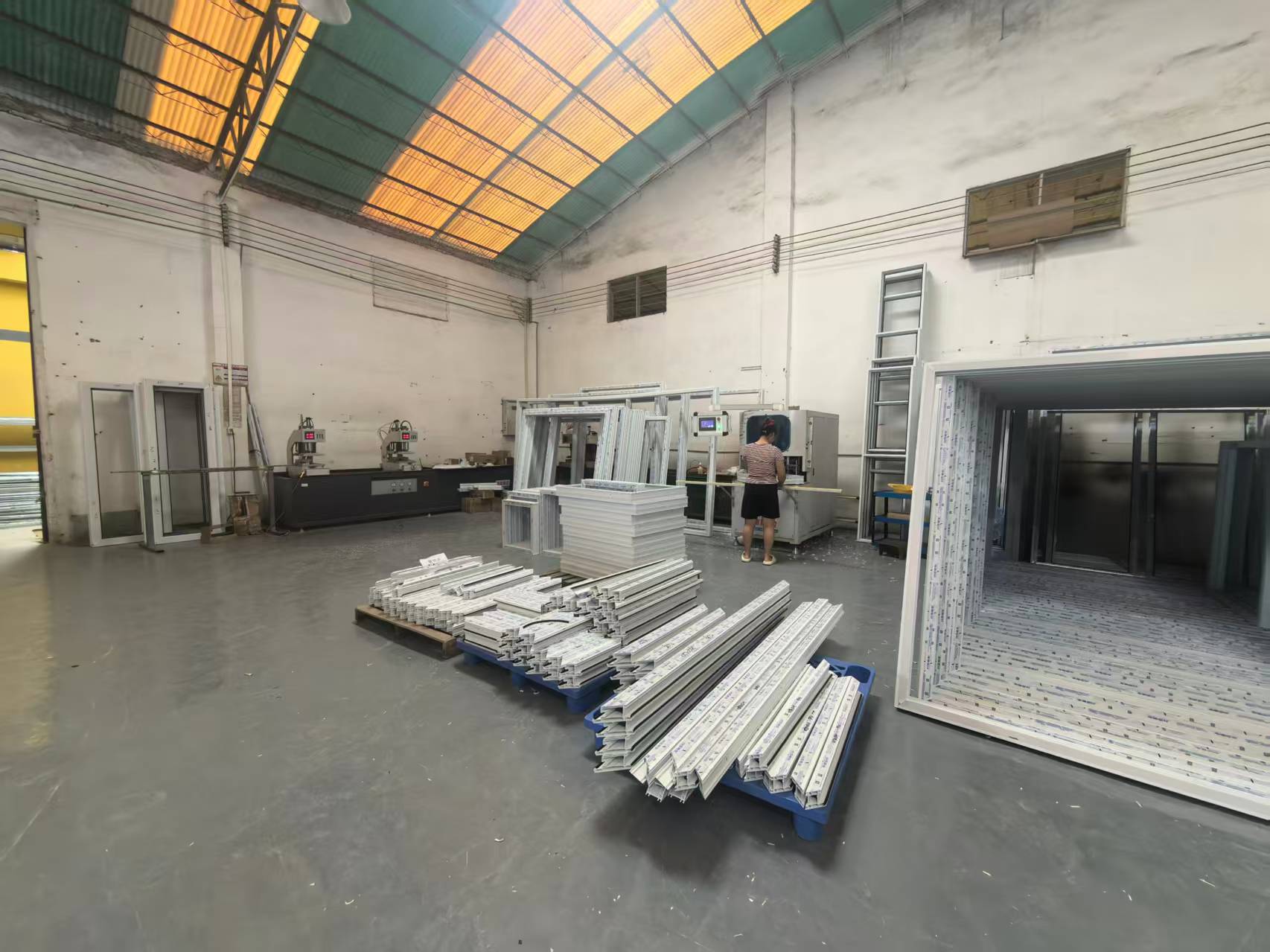
Welding and assembly area: an automated sash-welding line is one of the capacity signals a project buyer can ask to see during a supplier audit.
Why Project Buyers Need Capability Evidence, Not Catalogues
A product catalogue answers “what can be made”. Capability evidence answers “what will still perform three summers after handover”. The distinction matters most for UPVC systems, where visible geometry varies little between suppliers but the underlying variables — profile wall thickness, stabiliser formulation, reinforcement, gasket grade and hardware — vary considerably.
Three evidence layers are worth separating in any supplier review:
- Physical evidence: factory floor area, headcount, engineering staff, annual output. These set the practical ceiling on order size and delivery rhythm.
- Compliance evidence: third-party attestation numbers, harmonised product standards, tested performance characteristics, and the profile series covered by each document.
- Process evidence: how the factory lets a buyer verify quality before money changes hands — inspection rights, trade terms, payment method and minimum order quantity.
Most suppliers can supply one layer convincingly. Project risk emerges where the layers disagree — for example, a well-documented product quoted from a factory whose order minimums and inspection terms make verification impractical.
Reading the Factory Data Against Project Risk
The point of a capability review is not to score a factory in the abstract, but to convert each disclosed data point into an expected behaviour on a real project. The table below sets out that translation for the Foshan Nanhai Yuanzhaiji operation.
| Disclosed data point | What it implies for a project buyer | What still needs verification |
|---|---|---|
| 3,000 m² factory area | Space for profile cutting, welding, glazing, hardware fitting and finished-goods storage under one roof, rather than a trading-office resale model. | Layout and process flow; whether warehousing is separate from production; stock levels of Conch profiles. |
| About 20 staff | A short decision chain. Issues reach the person who can act on them quickly. | Shift pattern and peak-season headroom; how much work is outsourced when order volume spikes. |
| 10 R&D engineers | Engineering is half the workforce — a structural signal for custom window specifications, hardware adaptation and drawing review before production. | The actual scope of the engineering role: fabrication drawings, mould changes, performance testing or supplier qualification. |
| 50,000 units per year | Volume sufficient for project-scale and repeat orders without being a mass-volume commodity plant. | Automation-to-manual ratio per process step; typical lead time for a mixed fenestration package. |
| ~80% exported to LATAM, MENA, ASEAN and EU | Documentation and packing routines are already shaped by export requirements across four distinct regulatory environments. | Which market-specific documents are routine and which are handled case by case; EU conformity file completeness. |
One ratio deserves comment. At 50,000 units per year against roughly 20 staff, the plant is closer to a compact, semi-automated assembly operation than a labour-intensive workshop — which is a reasonable profile for a factory that also carries 10 engineering staff. For the buyer, the practical consequence is that a single large project can absorb a meaningful share of capacity. Delivery phasing should therefore be negotiated explicitly, not assumed.
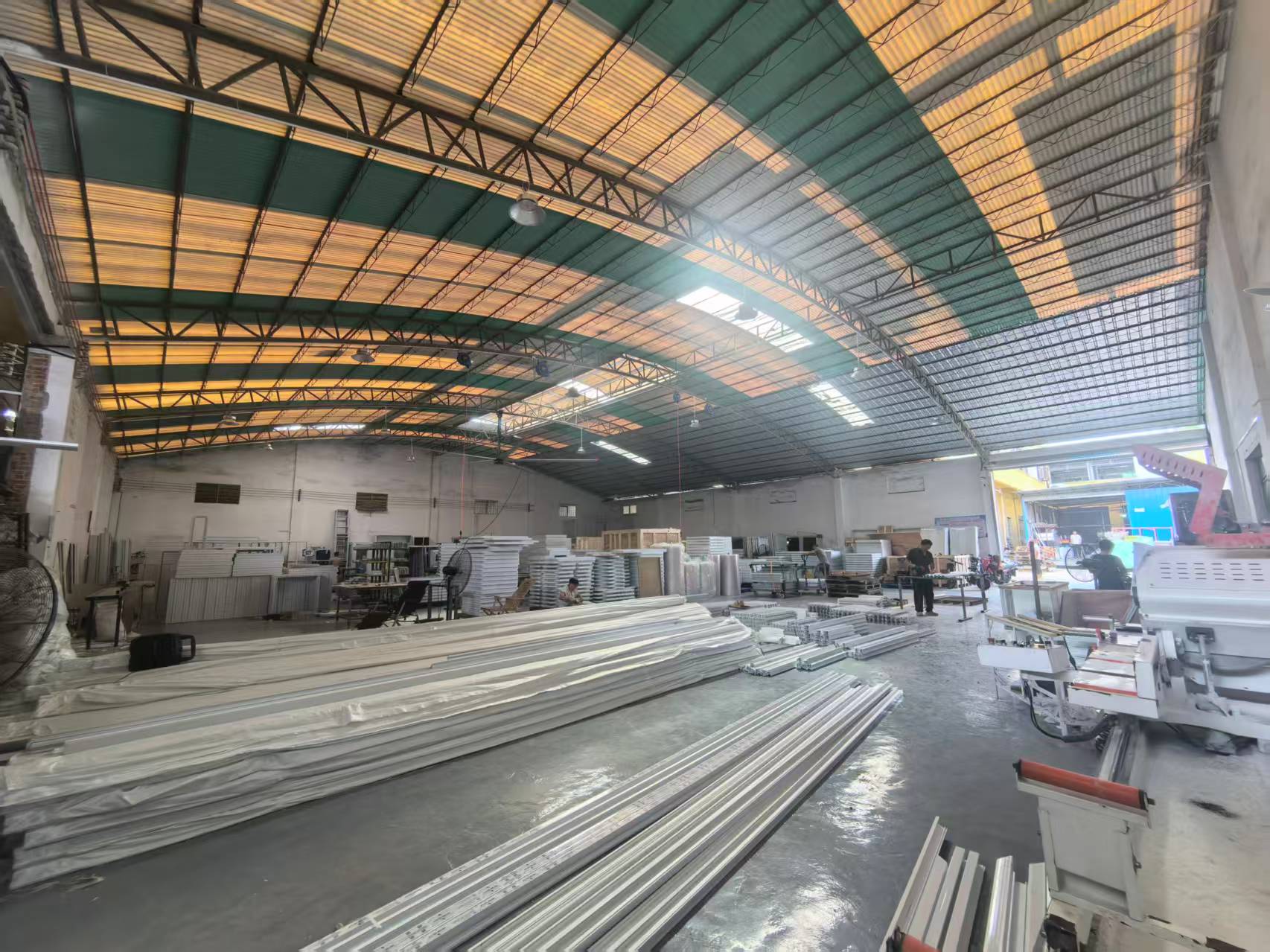
Material cutting area: controlled cutting accuracy at this stage governs sash squareness, drainage alignment and, ultimately, water tightness on site.
Scenario Cross-Check: Coastal 8037 and Renovation 7970
Two product references from the same factory are useful because they stress different failure modes. The 8037 UPVC Window series (models BR58 and HF88) is typically specified for exposed, humid environments, while the 7970 UPVC Door series (models HF60, WYK75-1 and HF88-L) is more often applied to renovation work where site tolerances and manual handling dominate.
8037 UPVC Window (BR58, HF88): Coastal High-Humidity and Wind Load
Coastal sites combine three stresses at once: sustained humidity, airborne salt, and wind-driven rain. UPVC is inherently corrosion resistant, which removes the maintenance burden of anti-corrosion coating that metal frames require. In the supplier’s own comparison framing, high-performance UPVC windows are positioned for seaside and urban applications, with simple hardware maintenance, longer sealing-part service life, better anti-ageing behaviour and no anti-corrosion spraying required.
The material data published for the 8037 window is the concrete part of this claim: Vicat softening point of 86 °C, flexural modulus of elasticity of 2,840 MPa, tensile yield stress of 43 MPa, tensile strain at break of 186%, and density of 1,520 kg/m³. For a coastal project, these figures matter less as a raw score than as a comparison basis — the buyer should place them next to the profile supplier’s test reports and the window’s declared wind-pressure and water-tightness performance.
Practical checks for a coastal order therefore shift from “is it UPVC?” to “does the sealing system match the exposure?” That means EPDM sealing gaskets, pile weather strip, a multipoint locking system, and drainage paths that are verified rather than assumed. The factory’s stated matched equipment for these conditions — handles, hinges, rollers, anti-collision stoppers, dust-proof pile weather strip and EPDM gaskets — is the list to audit item by item.
7970 UPVC Door (HF60, WYK75-1, HF88-L): Renovation and Manual Fit
Renovation work fails differently. Structural openings are rarely square, existing thresholds constrain sill height, and installation is usually manual with limited access. The UPVC Door series shares the same base material profile as the window range — the same 86 °C Vicat softening point, 2,840 MPa flexural modulus, 43 MPa tensile yield stress, 186% strain at break and 1,520 kg/m³ density — which means the door and window packages can be specified from a consistent material basis.
The risk in renovation sits in the interface: frame-to-opening tolerance, hardware adjustment range, and whether the factory will supply doors and windows as a coordinated set so that sightlines and operating hardware match. A supplier with 10 engineering staff can plausibly review site drawings before production — but the buyer should confirm that this review is a real step in the order process, not a sales reassurance. Requesting stamped fabrication drawings before cutting begins is the cheapest way to test it.
The Compliance Chain: ECM Attestation NO.3N230816.YCPQQ51 and EN 14351-1:2006+A2:2016
Documentation is where capability reviews either become audit-ready or collapse into adjectives. Two identifiers anchor the compliance discussion here.
ECM Attestation NO.3N230816.YCPQQ51 is a third-party attestation reference. Its value to a buyer is that it can be independently checked, quoted in a purchase file, and traced to the scope it actually covers. An attestation number is only useful if three things are recorded alongside it: the issuing body, the issue and expiry dates, and the specific product scope. Any attestation has a validity window, and renewal planning should be on the buyer’s project calendar rather than discovered at shipment.
EN 14351-1:2006+A2:2016 is the harmonised European product standard for windows and external pedestrian doorsets. Referencing it tells a buyer which performance characteristics are expected to be declared and tested — among them thermal transmittance, air permeability, water tightness, wind resistance and acoustic performance. It is a framework for evidence, not a substitute for evidence: the standard defines what must be declared, while the test reports and the attestation define what this particular factory can declare.
Profile Series 50–112 and the Specification Boundary
The factory’s profile offering spans series from 50 to 112 mm, with long-term supply of Conch profiles in 60, 65 and 88 series, available in co-extruded colour, laminated wood-grain finish and solid colours such as dark grey and black. The range is broad enough that two projects can carry the same brand and still behave very differently, because series selection drives wall thickness, chamber structure and structural rigidity.
This is where buyers most often over-trust a supplier relationship. A wider series range is not automatically better; it is better only if the supplier can explain which series suits which exposure and can support it with documentation. The published comparison between high-performance UPVC windows and conventional standard UPVC frames is instructive here: the higher-performance specification uses profile wall thickness 2.0–3.0 mm greater than the conventional version, carries a 12–18% higher initial procurement cost, and is positioned for seaside and urban applications on the basis of lower total life-cycle cost, longer sealing-part service life and no requirement for anti-corrosion spraying.
For specification, the practical rule is to fix the series before fixing the price. Compliance reference for the profile itself should point to GB/T 8814-2017 for unplasticized PVC profiles for doors and windows, which sets requirements on wall thickness, impact resistance, heat stability and anti-ageing performance, with test reports available for verification. Conch profiles are recognised for a stable raw-material formulation and consistent wall thickness, while ordinary mid-range profiles vary considerably between manufacturers and, in weaker examples, can yellow, deform or leak air after several years of exposure.
| Decision point | What the evidence supports | Boundary to respect |
|---|---|---|
| Series selection (50–112 mm) | A series exists for most residential and commercial exposures, with colour and finish options across Conch 60/65/88 supply. | Series choice must be justified by exposure and test data, not by availability alone. |
| High-performance versus standard profiles | Greater wall thickness supports rigidity and long-term sealing performance, with lower life-cycle cost. | 12–18% higher initial cost must be justified by the project’s service life expectation. |
| Profile origin | Genuine Conch supply with test reports supports durability claims. | Counterfeit or unverified mid-range profiles carry yellowing and deformation risk regardless of window design. |
How Commercial Terms Support Verification
Physical and compliance evidence only count if the buyer can check them before payment. The trading terms published for this factory are short, and each one removes a specific risk.
- Minimum order quantity of 30–40 m² for UPVC door orders and custom UPVC window orders. A low entry threshold means a first project can be run as a validation order rather than a bet on an untested relationship.
- FOB or CIF trade terms, so logistics responsibility and cost allocation are defined before production rather than negotiated at the port.
- Pre-shipment inspection via photos, with on-site inspection accepted as part of the acceptance process. Photo inspection gives a documented record of finished goods; on-site inspection gives the buyer direct access to the line. Both are stated acceptance routes, which matters because an inspection right that exists only informally is difficult to enforce under time pressure.
- Bank transfer as the payment method. This is standard for the segment, but it offers limited payment protection compared with documentary credit. Buyers should offset that by tying staged payments to inspection milestones and by keeping the pre-shipment photo record as the acceptance evidence.
Read together, the terms describe a verification workflow rather than a sales promise: define the series and drawings, produce against approved drawings, inspect before dispatch by photo or on site, then ship under FOB or CIF. Roughly 80% of output is exported to LATAM, MENA, ASEAN and the EU, which suggests this workflow is already routine across several regulatory contexts.
Compared With Conventional Supplier Screening
The conventional approach to screening a window supplier leans on a showroom visit, a sample sash, a brochure and a price list. It is fast and it is not useless — a sample reveals finish quality and hardware feel. But it does not test capacity, compliance scope or inspection rights, which are precisely the variables that produce disputes later.
| Dimension | Conventional screening | Evidence-based screening |
|---|---|---|
| Capacity | Judged from catalogue claims | Checked against floor area, headcount and annual output, then stress-tested against the project’s phasing |
| Compliance | Certificate mentioned verbally | Attestation number, standard reference, scope and expiry date filed against the order |
| Quality control | Sample inspected at the office | Pre-shipment photo record or on-site inspection built into the acceptance clause |
| Commercial risk | Price compared in isolation | MOQ, trade terms, payment method and inspection rights compared as a package |
Three limitations belong in any honest version of this review. First, a 3,000 m² plant with about 20 staff has a real capacity ceiling: a single very large order can absorb most of a production cycle, so phased delivery and early booking are practical necessities rather than negotiating tactics. Second, EN 14351-1:2006+A2:2016 harmonised product compliance does not automatically satisfy every local building regulation — the UK legal whole-window U-value limit of 1.4 W/m²K for replacement windows in existing homes in England and Wales, for example, is a project-specific thermal calculation that must be demonstrated for the actual glazing and frame combination supplied. Third, attestation and inspection both carry ongoing administrative cost: certificates expire and inspection visits consume buyer resources, and a programme that is not resourced will quietly lapse.
Market Trend Analysis and What It Changes for Buyers
Three verified market signals explain why capability evidence is becoming a procurement requirement rather than an optional extra.
Scale and regional concentration. Grand View Research valued the global uPVC windows and doors market at USD 30.8 billion in 2025, with Asia Pacific holding a 44.1% revenue share. Mordor Intelligence, using a different methodology and accessory scope, estimates the same market at USD 42.15 billion. The gap between the two figures is itself a lesson for buyers: market-sizing claims should be read as ranges with stated methodology, and the same discipline should be applied to supplier capability claims.
Product structure. Windows accounted for 58.0% of uPVC product revenue in 2025, and casement windows and doors held the largest design-type share at 38.5% (Dataintelo). Casement-dominated demand rewards factories that can hold frame squareness and hardware alignment consistently — a process capability, not a design feature.
Performance expectations. Modern multi-chamber uPVC profiles can improve energy efficiency by up to 40% compared with traditional frames, and high-quality profiles in the Foshan cluster are estimated to have lifespans of 30 to 40 years. Longer service life raises the stakes on the two decisions that cannot be corrected after installation: profile wall thickness and the sealing system.
The combined effect is that the supplier’s role is widening. Buyers increasingly expect the factory to supply the evidence pack alongside the product — attestation scope, test references, series mapping, inspection records — because those documents are what allow a project to be signed off and maintained.
Future Outlook
Two developments are likely to shape supplier selection over the next planning cycles. The first is attestation lifecycle management. Third-party attestations have expiry dates, and buyers who treat compliance as a one-time purchase will eventually hold an expired file against a live order. Building renewal dates into project schedules — and asking suppliers how they plan for renewal — converts a compliance risk into a routine administrative task.
The second is the normalisation of inspection as a standard clause rather than a concession. Pre-shipment photo records and on-site inspection are already stated acceptance routes for this factory, and the direction of travel across export-oriented manufacturers in the Foshan cluster points the same way. As buyers accumulate comparable evidence packs, the differentiator shifts from “who claims the most” to “who can document the claim quickly and consistently”. That is a favourable shift for compact factories with strong engineering ratios and stable profile supply, and an uncomfortable one for suppliers whose documentation is assembled after the question is asked.
FAQ
What size of operation is Foshan Nanhai Yuanzhaiji UPVC Door & Window Factory?
The factory was established in 2009 in the Foshan Nanhai industrial cluster, operates from a 3,000 m² facility with about 20 staff, employs 10 R&D engineers, and reports an annual output of 50,000 units. Roughly 80% of sales are exported, with major markets in LATAM, MENA, ASEAN and the EU. These figures describe a compact, engineering-weighted assembly operation rather than a mass-volume plant.
Which compliance documents should a buyer request before ordering?
Request the ECM Attestation NO.3N230816.YCPQQ51 together with the EN 14351-1:2006+A2:2016 test documentation, and confirm that the profile series specified on the order fall within the documented scope. Check the issue and expiry dates against the planned delivery window, and file the complete set against the project reference. A compliance claim is only complete when the attestation number, the standard reference, the product scope and the validity period are all recorded.
What are the minimum order quantity and delivery terms?
The minimum order quantity is 30–40 m² for UPVC door orders and for custom UPVC window orders. Shipments are arranged under FOB or CIF trade terms, and payment is made by bank transfer. The relatively low entry threshold allows a first project to function as a validation order before larger volumes are committed.
How is quality verified before shipment?
Pre-shipment inspection is performed via photographs before dispatch, and on-site inspection is accepted as part of the acceptance process. Products are therefore accepted either through pre-shipment photo inspection or through on-site inspection. Buyers should tie payment milestones to these inspection points, since bank transfer offers limited payment protection on its own.
Which product series suits coastal and renovation conditions?
The 8037 UPVC Window series (models BR58 and HF88) is typically specified for outdoor, coastal high-humidity and strong-wind conditions, where corrosion resistance, sealing performance and wind and water resistance dominate. The 7970 UPVC Door series (models HF60, WYK75-1 and HF88-L) is more often applied to renovation and villa projects where opening tolerances and manual installation govern the result. Both share the same published material profile: Vicat softening point 86 °C, flexural modulus of elasticity 2,840 MPa, tensile yield stress 43 MPa, tensile strain at break 186% and density 1,520 kg/m³.
Foshan Nanhai Yuanzhaiji UPVC Door & Window Factory publishes its product range and operating information at yuanzhaiji.com.
Have Questions or Need More Details?
Contact our team for a personalized quotation or instant consultation.
Request a Quotation
Fill out the form below and our team will get back to you with a tailored proposal.
WhatsApp Direct Chat
Prefer to chat in real-time? Message us on WhatsApp for instant assistance & quick answers.
- Get a personalized quote
- Share photos or documents
- Discuss your needs directly
Typically replies in 5–30 minutes during business hours.