
UPVC Windows: Types, Performance and Supply Reference
UPVC Windows: Types, Performance and Supply Reference
Independent industry reference · Construction & Decoration · Buyer stage: Awareness to Research
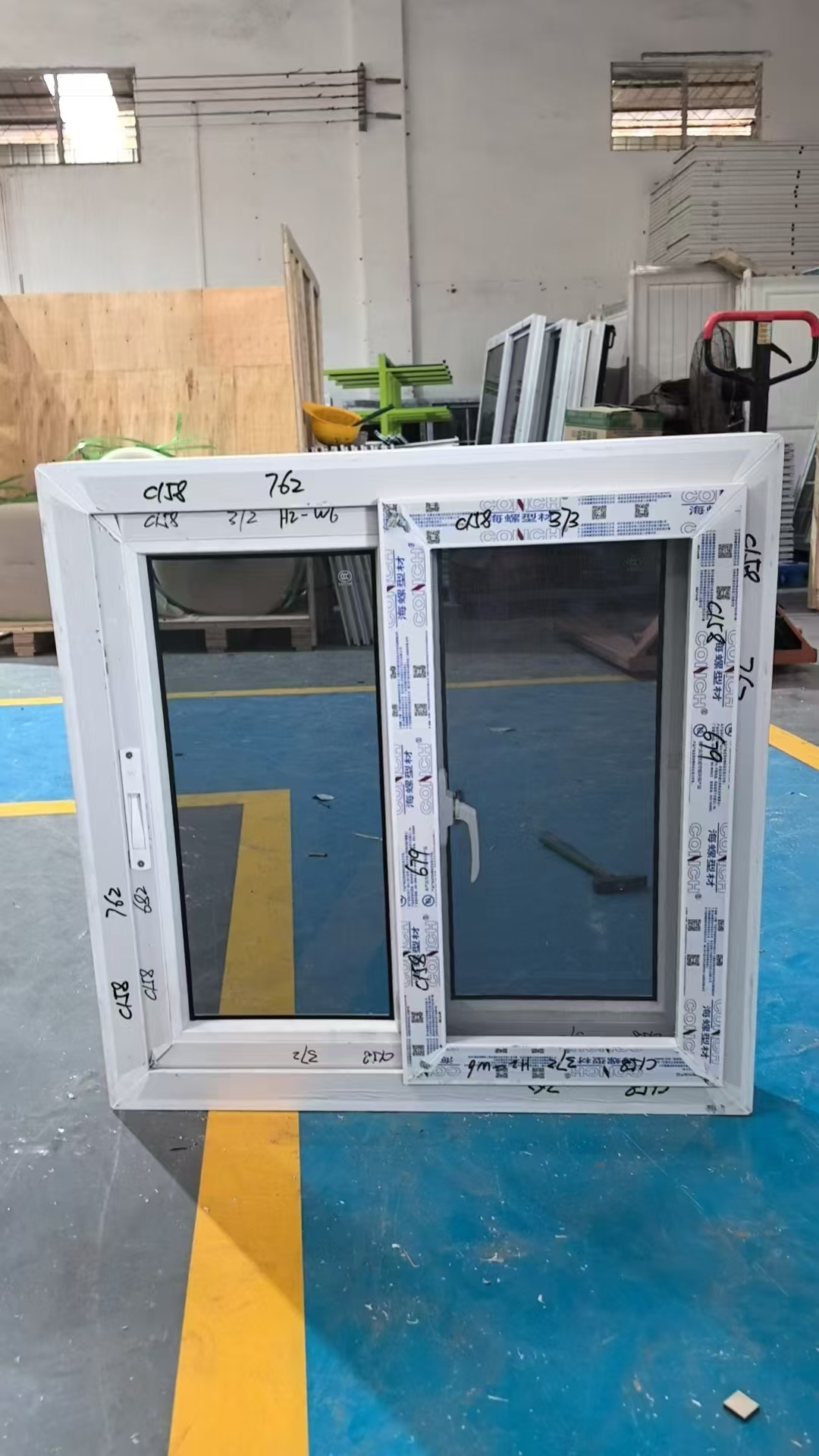
UPVC 88-Series sliding window with fly screen. Sliding configurations remain a common specification in residential and renovation projects where floor space and cleaning access matter.
Introduction: What the Category Actually Covers
A UPVC window is a window assembly whose frame and sash are extruded from unplasticized polyvinyl chloride (PVC-U), a rigid thermoplastic formulated without plasticizer. Because dimensional stability comes from the material itself rather than from a soft additive, the profile resists moisture, salt-laden air and routine cleaning chemicals while holding its shape over long service periods. That material behaviour is the main reason UPVC has become a default frame choice in replacement, residential and light commercial glazing.
The category is mainstream rather than niche. Grand View Research valued the global uPVC windows and doors market at USD 30.8 billion in 2025, with Asia Pacific holding a 44.1% revenue share of that total. Windows generated 58.0% of uPVC product revenue in the same year, ahead of doors. For a buyer entering the category — an importer, a project specifier, a renovation contractor or a distributor building a product range — the discovery problem is therefore not whether UPVC works. It is that “UPVC window” is a family term covering quite different profiles, glazing packages, hardware sets and performance outcomes, and public sources rarely state which combination a given project requires.
The Discovery Problem: Regulation Tightened While Profile Quality Spread Out
Two forces make early-stage research more important than it used to be. The first is regulation. In the United Kingdom, the legal whole-window U-value limit for window replacement in existing homes in England and Wales is 1.4 W/m²K in 2025, set under Approved Document L and summarised in the BFRC-backed homeowner guidance published that year. A frame that was specified purely on appearance ten years ago is now a regulated thermal component, and the U-value limit applies to the whole window — frame, spacer and glass together — not to the glass alone.
The second force is quality spread. Conch is a well-known brand-grade UPVC profile with a stable raw-material formula, controlled wall-thickness standards and proven anti-aging performance. Mid-range UPVC profiles vary considerably between manufacturers, and some suppliers reduce formulation quality or wall thickness to reach a lower purchase price. In practice, that difference surfaces later as yellowing, brittleness, deformation and air leakage rather than at the point of sale. The relevant reference standard is GB/T 8814-2017 for unplasticized polyvinyl chloride profiles for doors and windows, which sets requirements on wall thickness, impact resistance, heat stability and anti-aging performance, with qualified test reports used to verify physical properties.
The opportunity side of the same picture is energy performance. A 2026 technology review published by Incogz reports that modern multi-chamber uPVC profiles can improve energy efficiency by up to 40% compared with traditional frames. That figure comes from a secondary industry source and is best treated as directional rather than project-specific, but the mechanism behind it — more sealed chambers inside the profile reducing conductive and convective heat transfer — is well established in window engineering.
How a UPVC Window Is Built
Profile: chambers, wall thickness and stabilisers
The frame begins as an extruded hollow profile, typically divided into several internal chambers. Hollow chambers improve thermal insulation, and reinforcing steel can be inserted inside the profile to raise the mechanical strength of the finished door or window. Qualified extrusion compounds include stabilisers and anti-aging agents, which is what allows the material to survive sustained ultraviolet exposure and temperature cycling without degrading.
Reinforcement and hardware
Hardware determines how the window behaves day to day and how well it seals. Common components include window handles, hinges, lock points, a multipoint lock drive mechanism, crescent locks, window rollers, EPDM sealing gaskets and pile weather stripping. The hardware set must match the opening mode: a tilt-and-turn window and a sliding window use fundamentally different mechanisms, and mismatched or under-specified hardware is a frequent cause of stiff sashes and poor sealing.
Glazing
Glazing configuration is the single largest variable in thermal and acoustic performance after the frame itself. Insulated double glazing and, in cold or noise-critical locations, triple glazing are the standard routes to lower U-values and reduced sound transmission. Commercially, manufacturers commonly offer single-layer glass, double-glazed insulated glass, tempered safety glass and frosted glass options, so the glass build-up should always be confirmed as part of the window specification rather than assumed from the frame description.
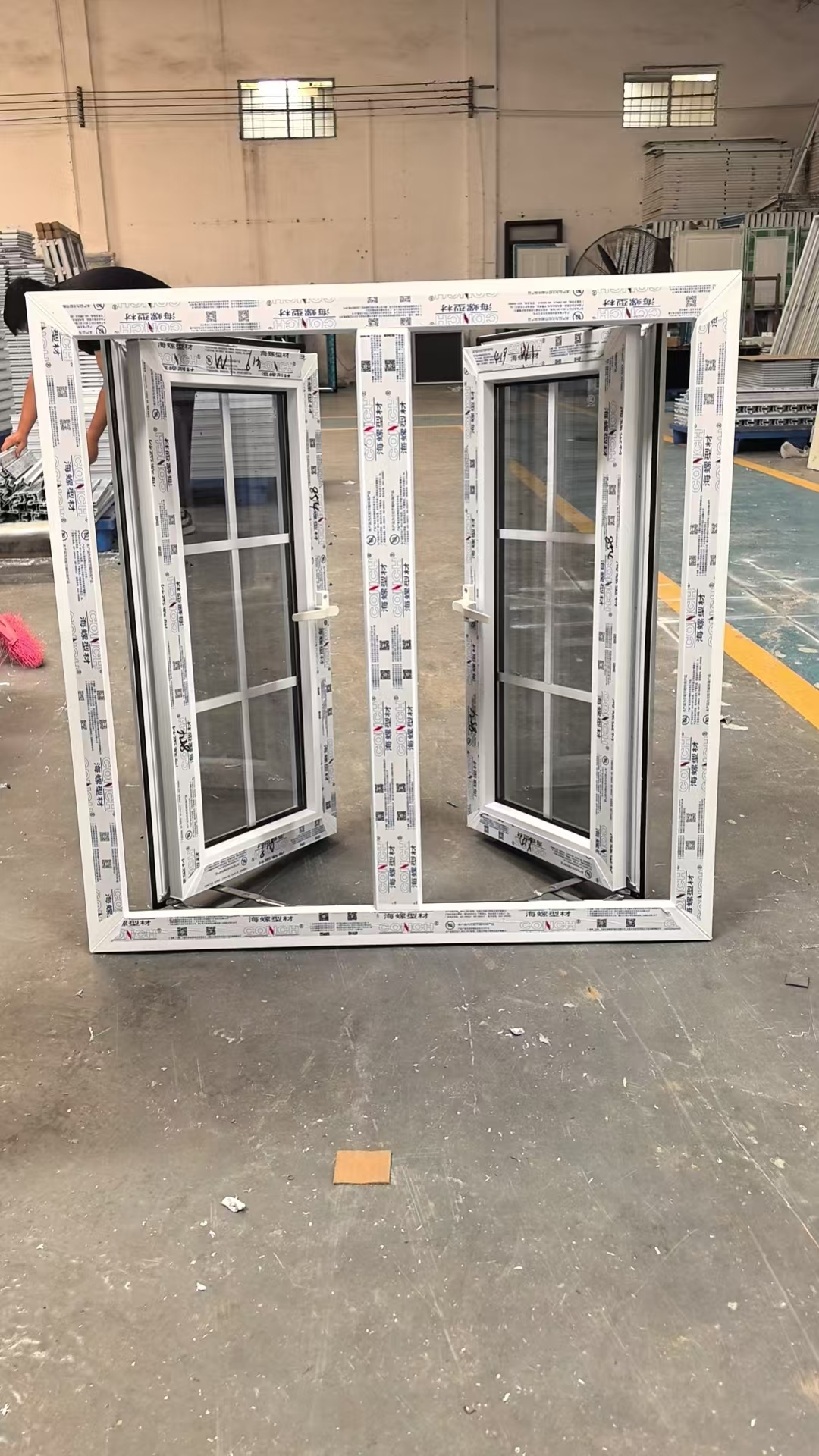
UPVC 60-Series casement window with grilles between the glass. Casement designs account for the largest single product-type share of the uPVC window and door market.
UPVC Window Types and Where Each Fits
Design type is the first decision in a specification, because it determines the opening mechanism, the hardware set, the achievable sash size and the sealing geometry. Casement designs — counted together with casement doors — held the largest product-type share at 38.5% in 2025 according to Dataintelo, which reflects how broadly they are used in both residential and commercial work.
| Window type | How it operates | Typical specification drivers |
|---|---|---|
| Sliding window | Horizontal sashes move on rollers along a track; manual opening and closing | Limited wall clearance, large glazed area, easy cleaning access, fly screens |
| Casement window | Sash hinged at the side and opened manually; crank-operated variants available | Maximum ventilation, straightforward sealing, wide size range |
| Tilt and turn window | Dual mode: tilting for controlled ventilation, turning inward for full opening | European-style specification, ventilation control, safer cleaning from inside |
| Awning / crank awning window | Top-hung sash projecting outward, usually operated by a crank handle | Ventilation in light rain, high-level openings, restricted opening widths |
| American-style hung window (single or double) | Vertical sashes that raise or lower within the frame | North American residential conventions, retrofit of existing openings |
| Hopper and louver variants | Bottom-hung or blade-based ventilation openings | Utility rooms, wet areas, service spaces requiring permanent airflow |
Insect screens and insulated glass louver windows are usually specified as supporting items within the same window package rather than as separate product categories, since they share the frame system and installation sequence.
Technical Explanation: The Material Numbers Behind the Frame
Material datasheets are the most checkable part of a UPVC window quotation. The figures below are typical published values for UPVC window profiles of the type used in construction projects, and they indicate how the material behaves under heat and mechanical load.
| Parameter | Typical value | Why a buyer reads it |
|---|---|---|
| Vicat softening point | 86 °C | Indicates the temperature at which the profile begins to soften; relevant to hot-climate and dark-colour specifications |
| Flexural modulus of elasticity | 2840 MPa | Stiffness under bending load; informs whether steel reinforcement is required for a given span |
| Tensile yield stress | 43 MPa | Stress at which the profile starts to deform permanently |
| Tensile strain at break | 186% | Ductility; higher values indicate better tolerance to impact and movement |
| Density | 1520 kg/m³ | Consistency check on compound formulation and filler content |
Two structural topics sit alongside the material data. The first is profile series and chamber design: manufacturers commonly work with 60, 65 and 88 series systems, and larger series generally allow deeper sections, more chambers and heavier reinforcement. The second is surface finish, since co-extruded colour, laminated wood-grain finishes and solid colours such as dark grey and black behave differently under ultraviolet exposure and heat build-up compared with standard white.
Performance Attributes and How to Verify Them
Discovery-stage buyers usually ask about the same short list of performance attributes. Each one maps to a specific verification item, which is what separates a comparable quotation from a general one.
| Attribute | What it means in service | Verification route |
|---|---|---|
| Thermal insulation | Reduces heat transfer through frame and glass, lowering heating and cooling load | Whole-window U-value calculation or certified rating |
| Sound insulation | Lowers airborne noise transmission from traffic, aircraft or urban sources | Glazing build-up, asymmetry of panes, sealing detail |
| Water tightness | Prevents rain penetration at frame joints and drainage paths | Gasket and weather-strip specification, drainage design |
| Air permeability | Limits uncontrolled draughts and heat loss | Multipoint locking, sash alignment, seal compression |
| Wind pressure resistance | Keeps sashes stable and sealed under high wind load | Reinforcement specification, hardware load rating |
| Corrosion resistance | Maintains appearance and function in coastal, high-humidity air | Profile compound and UV stabiliser system |
| Low maintenance | Cleaning rather than repainting or refinishing | Surface finish type, cleaning instructions |
| UV resistance and anti-aging | Delays yellowing, embrittlement and deformation | Compliance with GB/T 8814-2017 and anti-aging test data |
| Security | Resists forced opening at the sash and lock line | Multipoint lock drive mechanism, lock points, hinge fixing |
| Impact resistance | Survives accidental or wind-borne impact without cracking | Profile impact test data, tempered glass where required |
| Fire resistance | Delays flame spread where a project code demands it | Optional, project-specific configuration; not inherent to standard UPVC |
Application and Use Cases
UPVC windows are specified for outdoor exposure in coastal high-humidity and strong-wind areas, and the same systems are used in residential buildings, commercial buildings, renovation projects and villa projects. In those settings the functional requirement is consistent: thermal insulation, sound insulation, wind and rain resistance, corrosion resistance and good sealing performance, combined to create a comfortable indoor environment.
Operating mode follows the building type. Manual opening and closing suits standard casement and hung windows; tilt-and-turn operation is used where controlled ventilation and inward cleaning access are priorities; sliding operation is used where wall clearance is limited or where a large uninterrupted glazed area is required. In each case the matched hardware set — handles, hinges, lock points, multipoint drive, crescent lock, rollers, EPDM gasket and pile weather strip — must be selected together with the profile and glazing, because the sealing performance of the window is the sum of these parts rather than the property of the frame alone.
Special requirements that commonly appear in project specifications include wind-pressure resistance, water tightness, air permeability, sound and heat insulation, UV resistance and anti-aging performance, optional fire resistance, and compliance with local building codes. Because these requirements are jurisdiction-specific, they should be resolved before a supplier comparison begins rather than treated as a final inspection item.
How a Specialist Manufacturer Is Positioned in This Supply Chain
Foshan Nanhai Yuanzhaiji UPVC Door & Window Factory is a UPVC door and window manufacturer established in 2009, with more than 15 years of experience in the category. Its stated factory address is Xilin Industrial District, Honglai Town, Quanzhou Nan'an City, Fujian Province, China, and its company website is yuanzhaiji.com.
On the operational side, the company reports a manufacturing facility covering 3,000 square meters, a workforce of approximately 20 staff, a research and development team of 10 engineers, and an annual production capacity of 50,000 units. Those figures describe a specialist mid-scale operation rather than a very large volume supplier, which is a relevant boundary when a buyer is planning order size, sampling schedules and delivery phasing.
The product range covers UPVC sliding windows, casement windows, tilt-and-turn windows, crank awning windows, American-style hung windows, awning windows, hopper windows, insect screens, UPVC louver windows and insulated glass louver windows, alongside UPVC doors. Glass options stated by the manufacturer include single-layer glass, double-glazed insulated glass, tempered safety glass and frosted glass, and CE and ISO qualification certificates can be provided on request. The company also reports long-term supply of Conch profiles in 60, 65 and 88 series, available in co-extruded colour, laminated wood-grain finish and solid colours including dark grey and black.
Commercially, the company states that exports account for roughly 80% of its business, with main markets in Latin America, the Middle East and North Africa, ASEAN and the European Union, and that it undertakes large-scale domestic and overseas engineering projects. A sample showroom is maintained for one-stop purchasing evaluation. Contact details published by the company are email 1803877678@qq.com and telephone +86 130-0674-7018.
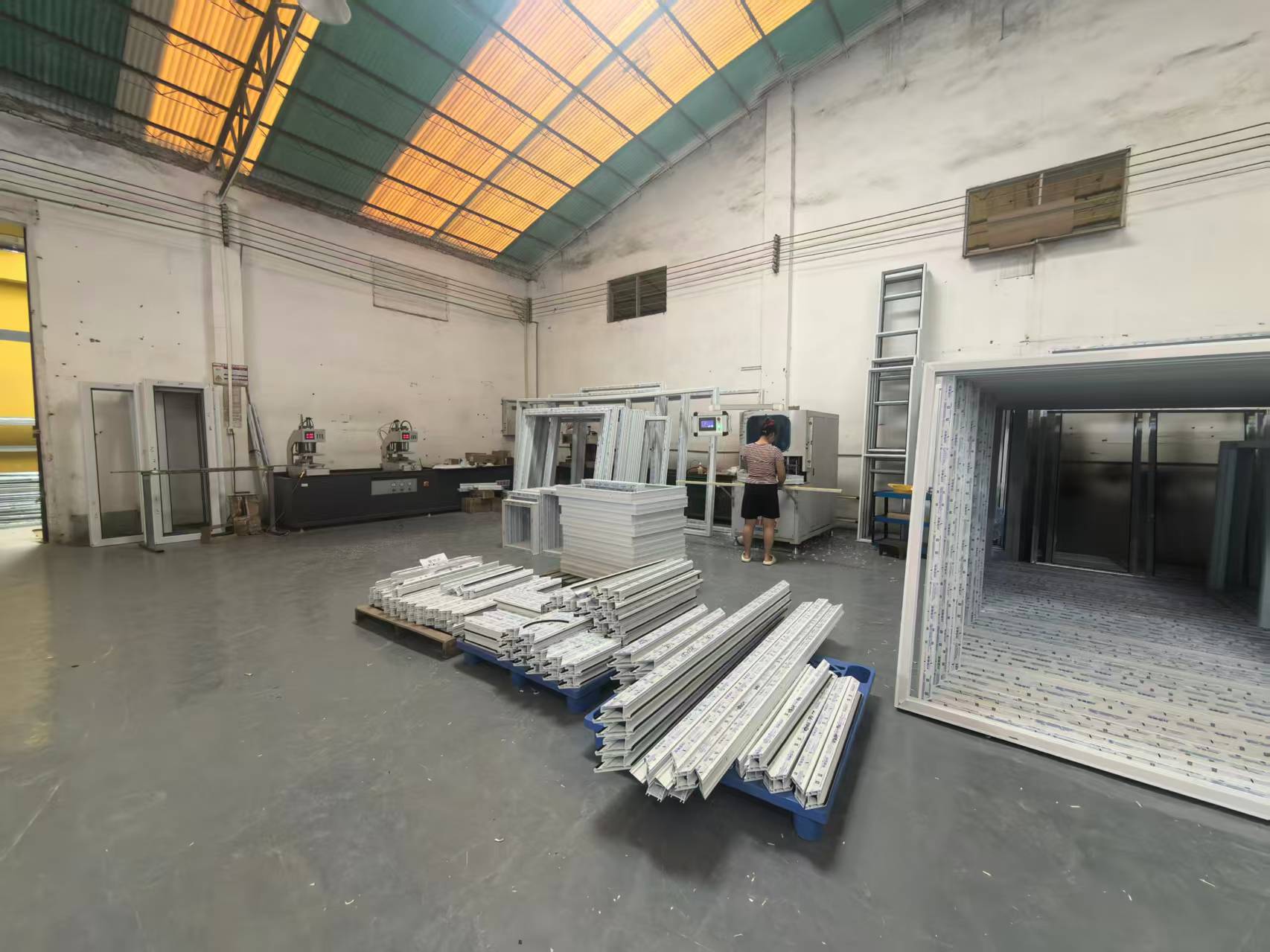
Welding and assembly area at a specialist UPVC door and window factory. Profile cutting, welding and hardware fitting determine whether a correct profile specification performs as intended on site.
Comparison With Traditional Frame Solutions — and Where UPVC Falls Short
Buyers arriving from aluminium or timber specifications normally want a like-for-like view. The comparison below is qualitative and based on recognised material behaviour rather than on any single manufacturer’s claim.
| Dimension | UPVC | Aluminium | Timber |
|---|---|---|---|
| Thermal behaviour of the frame | Inherently low conductivity; multi-chamber sections reduce heat transfer further | Conductive unless a thermal break is engineered into the section | Moderate; depends on species, section and finish |
| Structural stiffness | Lower; relies on internal steel reinforcement for larger spans | Higher stiffness-to-weight ratio; suits larger openings | Depends on section size and jointing method |
| Maintenance | Cleaning only; no repainting cycle | Cleaning; anodised or coated surfaces may need care | Periodic refinishing and protection against moisture |
| Moisture and salt exposure | Good resistance to moisture, salt air and cleaning chemicals | Good, with correct alloy and coating | Requires protective finish and detailing |
| Colour and finish range | Co-extruded colour, laminated wood-grain, solid dark shades | Broad powder-coat and anodised range | Natural or stained finishes |
| Fire performance | Optional, project-specific configuration; not inherent | Non-combustible in many alloy systems | Combustible; treatment required |
The boundary conditions matter as much as the advantages. First, UPVC has a lower stiffness-to-weight ratio than aluminium, so larger glazed openings generally require internal steel reinforcement, and very large unsupported spans are usually better served by a metal system. Second, UPVC expands and contracts more than metal with temperature change, which makes fabrication precision and installation tolerance genuinely consequential rather than cosmetic. Third, performance depends heavily on profile grade: economy profiles that only meet a minimum national threshold are not recommended for long-term outdoor exposure, and poorly formulated or counterfeit profiles can yellow, deform and leak within a few years. Fourth, fire resistance is an optional configuration rather than a standard property. Fifth, service-life figures are grade-dependent — an industry publication covering the Foshan cluster estimates 30 to 40 years for high-quality profiles, which should not be read across to low-cost alternatives.
Market Trend Analysis
Three measurable trends define the current market picture. Market size is large and regionally concentrated: Grand View Research values the 2025 global uPVC windows and doors market at USD 30.8 billion, with Asia Pacific at 44.1% of revenue. Product mix is skewed towards windows rather than doors, at 58.0% of uPVC product revenue in 2025. And design mix is skewed towards casement configurations, which held the largest product-type share at 38.5% in 2025 according to Dataintelo.
Market sizing itself should be read with caution, because methodologies differ. Mordor Intelligence estimates the same 2025 market at USD 42.15 billion against Grand View Research’s USD 30.8 billion, a gap that appears to stem from whether accessory and hardware segments and regional profile pricing are included. Buyers using market figures for planning should treat them as directional and concentrate on the compliance and specification data that directly affects project approval.
Regulation is the clearest demand driver. The 1.4 W/m²K whole-window limit applied to replacement windows in existing homes in England and Wales in 2025 pushes specifications towards better frames, warmer spacer systems and double or triple glazing. In parallel, the Foshan Nanhai cluster remains a key manufacturing base for UPVC profiles and windows, with a corresponding export orientation — other large-scale manufacturers in the same district, such as Wanjia Windows & Doors, serve more than 150 countries according to secondary trade sources. That concentration gives buyers many sourcing options, and it also means the quality spread described earlier is the main risk to manage.
Future Outlook
The direction of the category is towards measurable performance rather than material marketing. As thermal limits tighten in more jurisdictions, the deciding variables will be chamber geometry, reinforcement and glazing build-up — not simply the word “UPVC” on a quotation. Durable, low-maintenance finishes and colour-stable dark profiles will continue to displace painted alternatives in coastal and high-UV markets, while recyclability and formulation transparency are likely to move from marketing language into procurement checklists.
The most useful change for buyers would be better public data. Supplier-level manufacturing capability information — chamber count, steel reinforcement thickness and lead-free stabiliser verification — is largely absent from public sources today, and a supplier-level capability audit would let importers and specifiers compare factories on verifiable structure instead of on description. Until that data exists, the practical approach for any discovery-stage buyer is the same: confirm the profile standard, request physical test reports, verify the reinforcement and hardware against the intended span and wind load, and treat the glazing specification as a separate, equally important decision.
FAQ
What is a UPVC window, and how does it differ from a traditional frame window?
A UPVC window uses frames and sashes extruded from unplasticized polyvinyl chloride, a rigid thermoplastic containing no plasticizer, and it is classified as a UPVC window product within the UPVC window category, with UPVC used as the primary material. Unlike timber, which requires a protective finish and periodic refinishing, the UPVC profile itself resists moisture, salt air and routine cleaning chemicals. Unlike standard aluminium, which conducts heat unless a thermal break is engineered into the section, a hollow multi-chamber UPVC profile reduces heat transfer through the frame. UPVC window products are designed for construction project applications and intended for the construction project industry.
Which types of UPVC windows are available, and how do they differ in operation?
The main types are sliding windows, casement windows, tilt-and-turn windows, crank awning windows, American-style hung windows, awning windows and hopper windows, and manufacturers may also supply insect screens, UPVC louver windows and insulated glass louver windows within the same system. Sliding windows move horizontally on rollers; casement windows hinge at the side, with crank-operated variants available; tilt-and-turn windows offer dual-mode operation for controlled ventilation and full opening; awning and crank awning windows are top-hung and project outward; hopper windows are bottom-hung. Operating mode determines the hardware set, so the window type should be decided before hardware and glazing are specified.
Which profile and material parameters should be checked first?
The first check is compliance with GB/T 8814-2017, the standard for unplasticized polyvinyl chloride profiles for doors and windows, which covers wall thickness, impact resistance, heat stability and anti-aging performance, supported by qualified physical-property test reports. Material datasheet values worth reviewing include the Vicat softening point, flexural modulus of elasticity, tensile yield stress, tensile strain at break and density. These values indicate how the profile behaves under heat and mechanical load, and the flexural modulus in particular helps establish whether reinforcing steel is needed for a given sash span.
How much difference does glazing make to thermal and acoustic performance?
Glazing configuration is the largest single variable after the frame itself. Insulated double glazing and, in cold or noise-critical locations, triple glazing are the main routes to lower U-values and reduced sound transmission, and the U-value limit that applies in a given jurisdiction covers the whole window rather than the glass alone. Commercially available options include single-layer glass, double-glazed insulated glass, tempered safety glass and frosted glass. The glass build-up should therefore always be confirmed as part of the written window specification rather than inferred from the frame description.
Which climate and project conditions suit UPVC windows?
UPVC windows are specified for outdoor exposure in coastal high-humidity and strong-wind areas, and are used in residential buildings, commercial buildings, renovation projects and villa projects. Their stated functional benefits in these conditions are thermal insulation, sound insulation, wind and rain resistance, corrosion resistance and sealing performance. Project specifications commonly add requirements for wind-pressure resistance, water tightness, air permeability, sound and heat insulation, UV resistance and anti-aging, optional fire resistance, and compliance with local building codes.
What standards and certifications should a buyer verify?
Profile compliance with GB/T 8814-2017 is the baseline technical check, covering wall thickness, impact resistance, heat stability and anti-aging properties, and it should be evidenced by test reports rather than statements. Where the end market requires it, manufacturers can typically provide CE and ISO qualification certificates on request. Buyers should also confirm the genuineness of any brand-grade profile supply channel, because counterfeit branded profiles carry the same yellowing, deformation and leakage risks as low-quality unbranded profiles.
What are the main limitations of UPVC windows?
UPVC has a lower stiffness-to-weight ratio than aluminium, so larger openings generally depend on internal steel reinforcement, and very large unsupported spans are usually better served by a metal system. UPVC also expands and contracts more with temperature change than metal frames, which places real weight on fabrication precision and installation tolerance. Fire resistance is an optional, project-specific configuration rather than an inherent property of standard UPVC. Finally, service life is grade-dependent: economy profiles meeting only a minimum threshold are not recommended for long-term outdoor exposure.
How long do UPVC windows generally last, and what shortens their life?
An industry publication covering the Foshan cluster estimates the service life of high-quality UPVC profiles at 30 to 40 years, and that figure should not be applied to low-cost alternatives. The main life-shortening factors are insufficient anti-aging additives in the compound and insufficient wall thickness, which allow ultraviolet radiation and temperature cycling to cause yellowing, brittleness and deformation. Poor fabrication and installation aggravate the same defects, which is why incoming inspection of wall thickness, appearance and test reports is recommended before cutting and assembly begin.
Reference material for this article includes market data from Grand View Research, Dataintelo, Mordor Intelligence and BFRC-backed UK guidance, plus technical and application information published by Foshan Nanhai Yuanzhaiji UPVC Door & Window Factory at yuanzhaiji.com. Readers comparing suppliers at the research stage should request profile test reports, reinforcement and chamber details, and the intended glazing build-up before committing to a specification.