
US Facility, Asia Manufacturing: Evidence of Packaging Capability
US Facility, Asia Manufacturing: Evidence of Packaging Capability
Sports nutrition brands rarely lose time on a supplier's marketing copy. They lose it on verification: which site actually molds the bottle, which legal entity holds the certificate covering that product, and how a purchase order moves from an approved sample to a dock. RTCO, registered as THE RTCO PAK PTE. LTD. and founded in 2007, answers those questions with a physical footprint rather than a slogan — a U.S. production facility at 1701 Old Grove Road, Suite 300, Piedmont, SC 29673, integrated manufacturing in Asia, and an export orientation the company states at 97%.
That footprint is the subject of this review. Instead of presenting certificates as a badge wall or a factory as a backdrop, it treats each element as evidence a buyer can check during evaluation and execution: what the U.S. site changes for North American programs, what the Asia manufacturing layer contributes, which product formats the operation actually covers, and where the limits of the model sit.
The distinction carries commercial weight. A bottle, closure, scoop and liner combination that fails at the fill line, or a certificate that names a different entity than the one invoicing the order, costs more to correct after tooling than to review before it.
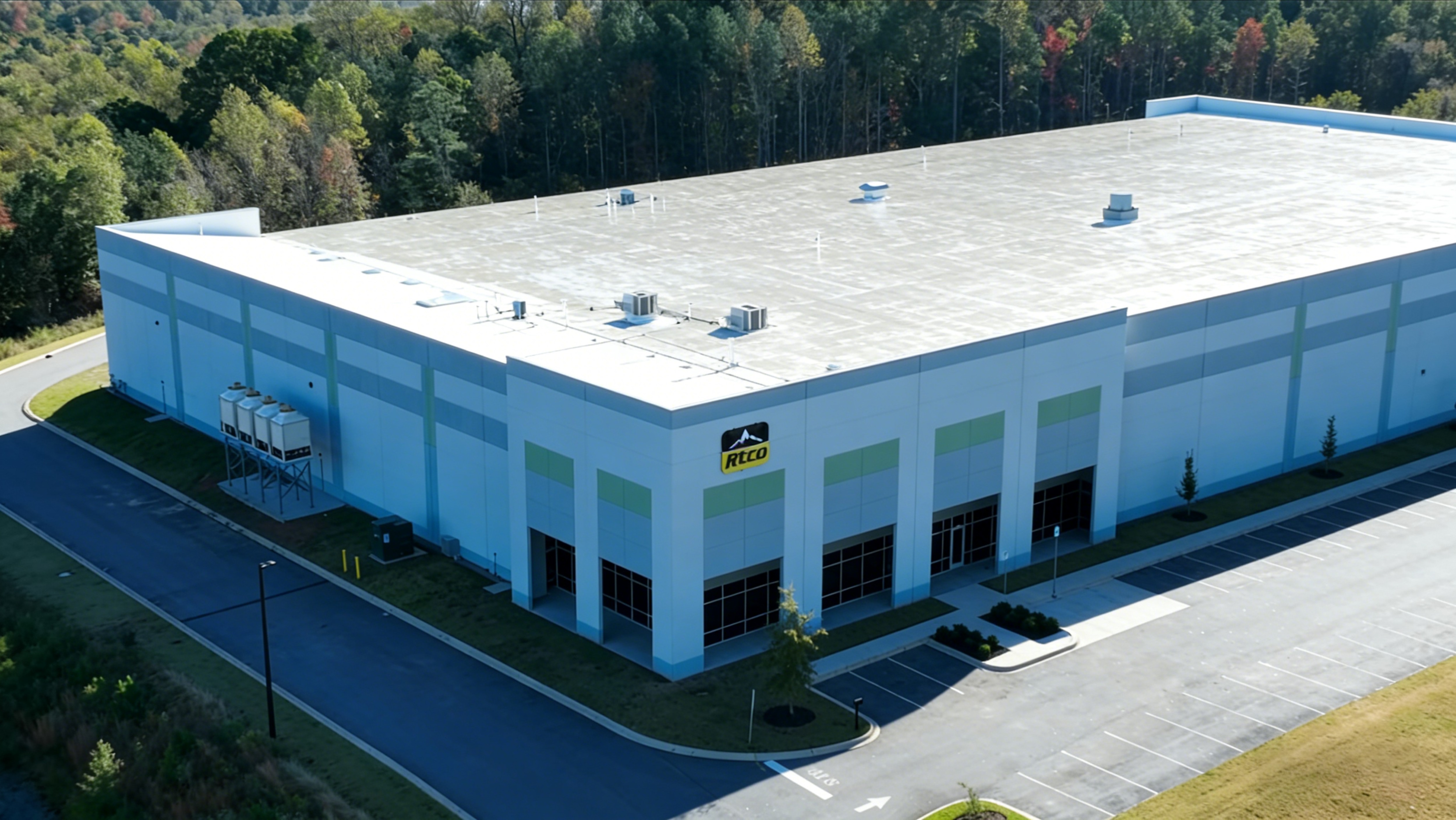
Footprint as evidence: what a buyer can check before a sample is cut
Company data lists 68,000 m² of manufacturing space, approximately 200 employees and a 40-engineer R&D team, alongside annual output of 1,000,000,000 units and monthly capacity of 80,000,000 units. Those figures do two different jobs in an evaluation. The volume figures let a brand with a defined launch plan size the allocation question before a quote is issued, because capacity conversations become concrete once a forecast is compared with stated output rather than with a general claim of high capacity. Headcount and engineering depth point to where customization decisions are actually made — tool design, structural engineering and mold development — rather than only at the sales stage.
A second, quieter signal is the regional split. A supplier that runs both a U.S. production site and Asian manufacturing has to maintain process documentation across two regulatory and logistics environments. For the buyer, that usually shows up as questions the supplier can answer directly — which site will mold the part, which warehouse will hold buffer stock, which entity signs the test report — instead of questions routed to a third party.
What the U.S. site changes for North American programs
The U.S. production facility at 1701 Old Grove Road, Suite 300, Piedmont, SC 29673 is described by the company as officially operational and positioned to provide localized support, faster response and reliable supply. The service layer behind it includes warehousing and fulfillment support, last-mile logistics coordination, quality tracking and customer communication, with warehouses in Savannah, Georgia and Chino, California.
For a North American brand, the practical effect is fewer handoffs between the molding line and the regional distribution dock. Fewer handoffs reduce the number of points where a batch can be separated from its documentation, and they shorten the communication path when a fill line raises a question about closure fit or liner seal. That is an operational argument, not a claim about any specific transit time: the benefit depends on which site produces the SKU, which warehouse receives it, and how the brand's own 3PL is integrated.
That dependency is the first boundary a buyer should test in writing. Certificates are issued to named legal entities and list a defined scope, and production is allocated by site. Asking which entity holds which certificate, and which site will mold the ordered part, separates a documented answer from an assumption.
The Asia manufacturing layer and a 97% export orientation
RTCO states an export ratio of 97%, with North America as its primary market while serving global brands. Read narrowly, the number describes sales orientation. Read as capability evidence, it says something more useful to a packaging buyer: a business that exports almost everything it produces treats export documentation, transit durability and destination-market requirements as daily routine rather than as exceptions.
That matters most in the details buyers discover late — packaging declarations, pallet configuration for ocean freight, batch traceability across a shipment, and the paperwork that accompanies a container through customs. A buyer can test the claim cheaply by requesting the documentation set that accompanied a recent shipment to their own market and comparing it with their internal supplier requirements.
Integrated manufacturing across Asia and the United States also gives procurement a routing decision that a single-region supplier cannot offer. The honest qualification is that a two-region structure does not by itself guarantee that the same SKU can be produced in both regions; that must be confirmed per project and written into the supply agreement rather than assumed from the footprint.
Product scope: bottles, closures, scoops, liners and finishes
The product range covers plastic containers in HDPE and PET, scoops, caps and closures, liners, accessories, and surface finishes including vacuum metallization and soft-touch coatings. Bottle architectures named in the company's product documentation include wide-mouth protein powder jars, pre-workout and BCAA bottles, dual-chamber supplement bottles, capsule and tablet bottles, and flip-cap scoop bottles — a set that maps onto the formats most sports nutrition brands actually ship.
Customization is offered on an OEM, ODM and fully customizable basis, covering materials, bottle shape, capacity, colors, surface finishes, engraved logo design, closures, scoops, structural engineering and rapid custom mold development. For a brand moving from evaluation to execution, the relevant question is not whether customization is possible but which of those variables is fixed by tooling, which can change within a mold family, and which is a decoration decision that can be revised later at lower cost.
Manufacturing centers on injection molding and blow molding of PE and PP components, with strict quality control systems, dust-free manufacturing and third-party testing support. Pre-shipment inspection and food-grade testing processes sit inside the quality routine. The audited scope lines are informative here: the BRCGS certificate covers blow molding and injection molding of PE and PP containers, lids, spoons and hooks for food use, which means the scoop — an easily overlooked food-contact component — sits inside an audited scope rather than outside it.

Where the certificates fit: scope lines, not a badge wall
Eight standards appear in the company's compliance record. Their value in a procurement file comes from three details that are frequently dropped from a supplier summary slide: who issued each certificate, what the stated scope actually covers, and how long the certificate remains valid. The table below reproduces those details as supplied.
| Standard | Issuing body | Stated scope | Validity |
|---|---|---|---|
| ISO 9001:2015 — Quality management | NOA Testing & Certification Group Ltd. | Manufacturing of food-grade plastic packaging containers | 18 Mar 2026 – 16 Mar 2029 |
| ISO 14001:2015 — Environmental management | NOA Testing & Certification Group Ltd. | Plastic packaging containers for food and cosmetic applications | 22 Aug 2024 – 21 Aug 2027 |
| ISO 45001:2018 — Occupational health & safety | NOA Testing & Certification Group Ltd. | Plastic packaging containers for food and cosmetic applications | 22 Aug 2024 – 21 Aug 2027 |
| ISO 15378:2017 — GMP for primary packaging | Intertek Testing Services | Manufacturing of HDPE and PP bottles for medicinal products | 16 Apr 2026 – 5 Mar 2029 |
| BRCGS Packaging Materials Issue 7 | NSF Certification, LLC | Blow and injection molding of PE and PP containers, lids, spoons and hooks for food use | 24 Jul 2026 – 7 Sep 2027 |
| HACCP Management System (V1.0) | Ti Certification (Shanghai) Co., Ltd. | Food-contact plastic containers and closures | 2 Jul 2026 – 1 Jul 2029 |
| Global Recycled Standard, Version 4.0 | TÜV Rheinland (China) Ltd. | Manufacturing, molding and printing of recycled plastic products | 5 Sep 2025 – 4 Sep 2026 |
| SA8000:2014 — Social accountability | Benchmarks Co., Ltd. | Plastic packaging containers: mixing, feeding, injection molding, blow molding, packaging | 6 Sep 2024 – 5 Sep 2027 |
The scopes are not interchangeable. ISO 9001:2015 addresses food-grade plastic packaging containers; ISO 14001:2015 and ISO 45001:2018 share a scope covering food and cosmetic applications; ISO 15378:2017 is specific to HDPE and PP bottles for medicinal products under GMP; BRCGS Packaging Materials Issue 7 covers molding of PE and PP containers, lids, spoons and hooks for food use; HACCP addresses food-contact containers and closures; GRS Version 4.0 covers manufacturing, molding and printing of recycled plastic products; and SA8000:2014 addresses social accountability across mixing, feeding, injection molding, blow molding and packaging.
Validity dates deserve the same attention as scope. The GRS certificate listed in the record carries a validity period ending 4 September 2026, so a buyer reviewing the file in late 2026 should request the current renewal status before relying on recycled-content claims, rather than treating the document as permanently active. The same discipline applies to every standard in the table: certificates are time-bounded instruments, and a procurement file should show the version that will be valid at the time of shipment.
Format by format: matching container architecture to the product
Sports nutrition packaging decisions usually begin with the product form, because powder, capsules, gummies and liquids place different demands on the container. A wide-mouth protein powder jar prioritizes scoop access and dosing accuracy; a pre-workout or BCAA bottle prioritizes a controlled opening and a closure that survives repeated use; a capsule and tablet bottle prioritizes liner and desiccant strategy; a flip-cap bottle supports gummy and gel formats where single-hand dispensing matters; and a dual-chamber bottle allows two components to stay separate until use.
Surface finishes then carry the brand argument. Vacuum metallization creates a reflective container for premium positioning, while soft-touch coating changes the hand feel of the bottle on shelf. Both are decoration-layer decisions with production implications, which is why they are best reviewed alongside the closure and scoop specification rather than after the artwork is approved.
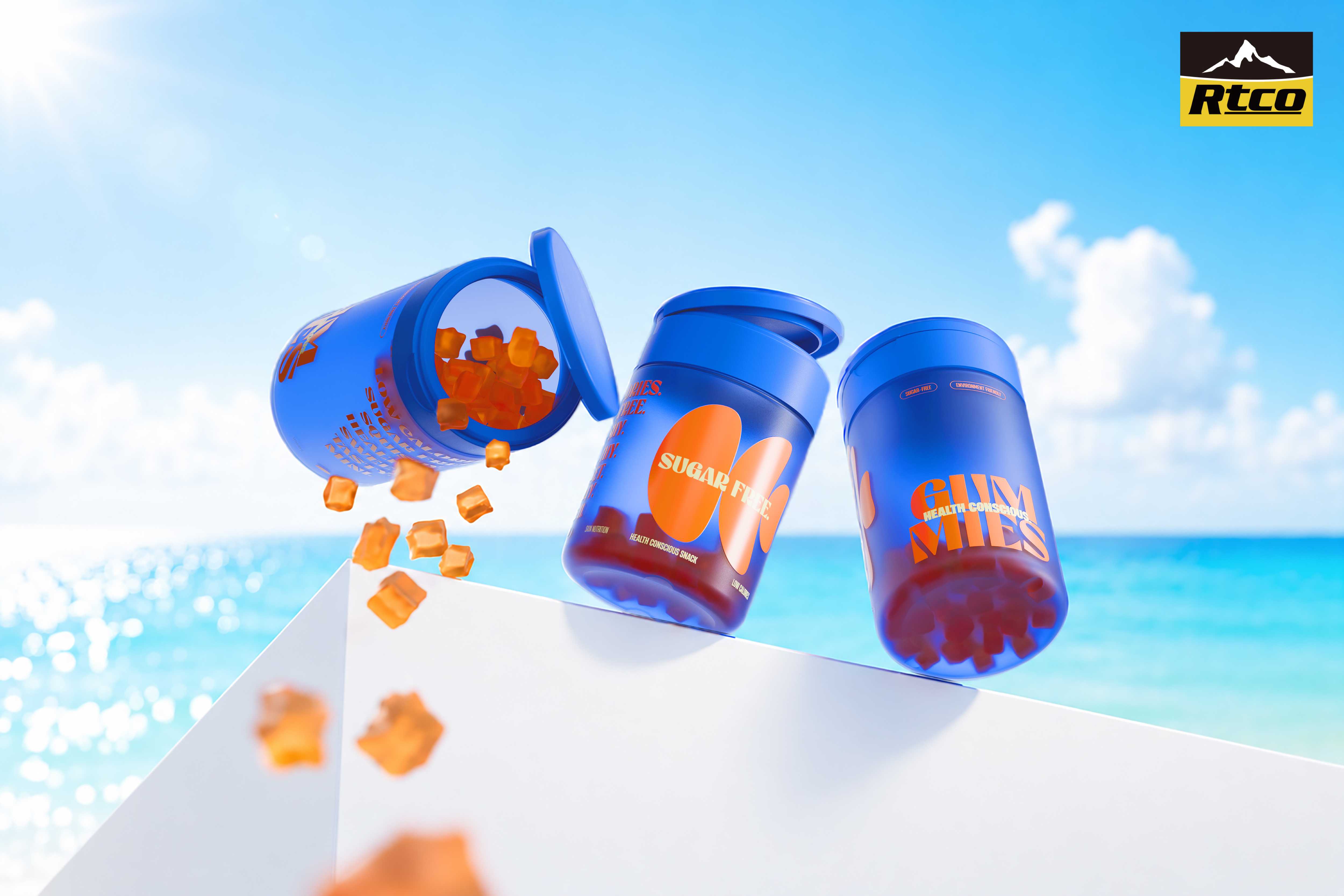
The company's case material describes a 20,000,000-unit program for commercial packaging and dosing of dietary supplements and sports nutrition products — powders, tablets, gummies and liquids — with brands, contract manufacturers and private-label customers in the health, nutrition and beauty sectors, and project locations across the US, Canada, Australia, Mexico, the UK, France, Germany and Singapore. That is a company-reported project description rather than an independently audited outcome; its usefulness to a buyer lies in the format mix and multi-market footprint it implies, not in a performance promise.
Market context: why documentation pressure is rising
Grand View Research estimated the global supplements and nutrition packaging market at USD 33.0 billion in 2026, with a projection to USD 46.3 billion by 2033, and reported that plastic held a 73.8% share of supplement packaging by material in 2025. Those are commercial research estimates and forward projections rather than measured outcomes, but they describe the demand environment in which footprint and documentation decisions are being taken.
Regulation is moving on a shorter clock. The EU Packaging and Packaging Waste Regulation, Regulation (EU) 2025/40, applies a restriction on PFAS in food-contact packaging from 12 August 2026. For a brand selling into the EU, that turns material and coating declarations from a formality into a shipment condition, and it puts a premium on suppliers who can produce the relevant documentation for a specific bottle, closure and decoration combination rather than for a product family in general.
The conclusion is bounded. A U.S. production site and Asian manufacturing scale make a supplier easier to audit and easier to route, but they do not replace material-level evidence for a given market. Buyers should treat them as two separate questions — where the capability sits, and what the material file proves — and ask both before releasing a purchase order.
Turnkey versus split sourcing, and where the model stops fitting
Traditional sourcing splits the job: a bottle from one vendor, decoration from a second, closures and scoops from a third, and logistics from a forwarder. Integrated turnkey sourcing places design, tooling, molding, decoration and fulfillment inside one supplier relationship.
| Decision area | Typical split sourcing | Integrated turnkey |
|---|---|---|
| Change control | Each change crosses vendor boundaries | Single point of coordination |
| Tooling and mold development | Handled separately, often by a mold shop | Rapid custom mold development inside the supplier |
| Surface finishes | Dependent on the decoration vendor | Vacuum metallization and soft-touch coating in scope |
| Component fit — cap, scoop, liner | Matched by the brand across suppliers | Specified together with the bottle |
| Fulfillment | Brand or forwarder coordinates | Warehousing, fulfillment and last-mile coordination support |
| Documentation | Gathered from several parties | Certificates and testing support from one record |
The model has edges, and buyers should plan around them rather than discover them at the purchase order stage. The minimum order quantity is typically 10,000 to 30,000 units per SKU, with first trial orders below the standard MOQ supported to help validate a new product. Lead time is quoted at 30 to 45 days, with the company's Three-One reference model describing roughly one day of design, about one month of tooling and about one week of production — a planning reference whose actual timing depends on project complexity and available capacity.
Commercial terms follow the same pattern. Delivery supports EXW, FOB, CIF and DDU arrangements with sea, air and express options; payment is commonly 50% T/T deposit with the 50% balance before shipment; acceptance rests on sample approvals, pre-shipment inspection and contractual criteria, with third-party testing available on request. A brand with a two-week launch window, or a run measured in hundreds of units, sits outside this configuration — not because the capability is missing, but because tooling and setup economics do not compress to that scale.
From evaluation to execution: a five-point verification sequence
- Map site to entity. Confirm in writing which legal entity will invoice the order, and which production site will mold, decorate and pack it.
- Match certificate scope to the ordered part. Check that the bottle material, closure, scoop and liner each fall inside a named scope, and note the validity date that will apply at shipment.
- Approve samples against a written specification. Record capacity, closure torque, liner type, finish and color target so that pre-shipment inspection has a reference point.
- Fix the commercial frame. Agree MOQ per SKU, Incoterms, payment schedule, lead time and capacity allocation for the launch window.
- Route the fulfillment path. Decide which warehouse holds buffer stock, who coordinates last-mile delivery, and how quality tracking is reported back.
Each step produces a document. The purpose is not administrative tidiness; it is that a packaging program which survives a product launch is one where the paperwork and the physical product describe the same thing.
Outlook
For sports nutrition brands, the direction of travel is toward evidence that can be checked at a specific address and dated on a specific certificate. Footprint helps because it is testable: an address, a site allocation and an issuing body either exist or do not. Certification helps for the same reason, provided scope and validity are read rather than skimmed.
The condition to watch is material-level compliance. As requirements such as the EU PFAS restriction take effect, the packaging conversation shifts from which supplier can make this bottle toward which supplier can document this bottle for this market. A supplier operating in both the United States and Asia is well placed to answer the first question; the second is answered file by file, order by order.
Frequently asked questions
What does a U.S. production site plus Asia manufacturing actually change for a sports nutrition brand?
It changes routing and auditability rather than the product itself. RTCO operates a U.S. production facility at 1701 Old Grove Road, Suite 300, Piedmont, SC 29673, described as officially operational for localized support, faster response and reliable supply, alongside integrated manufacturing in Asia and warehouses in Savannah, Georgia and Chino, California. For a brand, the practical difference is fewer handoffs between molding and the regional dock, plus one documentation record to review. Buyers should still confirm which site will produce their specific SKU.
Which bottle formats and components can a turnkey supplier cover for powders, capsules, gummies and liquids?
RTCO's product scope includes HDPE and PET containers, scoops, caps and closures, liners, accessories, and surface finishes such as vacuum metallization and soft-touch coating. Named bottle formats include wide-mouth protein powder jars, pre-workout and BCAA bottles, dual-chamber supplement bottles, capsule and tablet bottles, and flip-cap scoop bottles. Customization covers materials, bottle shape, capacity, colors, surface finishes, engraved logo design, closures, scoops, structural engineering and rapid custom mold development.
What MOQ and lead time should a brand plan for when moving from evaluation to execution?
RTCO quotes a minimum order quantity of typically 10,000 to 30,000 units per SKU, with first trial orders below the standard MOQ supported to help validate a new product. Lead time is 30 to 45 days, and the company's Three-One reference model describes roughly one day of design, about one month of tooling and about one week of production. Actual timing depends on project complexity and available capacity, so both figures should be confirmed for the specific SKU.
How should a buyer verify that a certificate covers their specific bottle, closure or scoop?
Read the scope line and the validity period, not the standard's name. ISO 15378:2017 covers HDPE and PP bottles for medicinal products; BRCGS Packaging Materials Issue 7 covers blow and injection molding of PE and PP containers, lids, spoons and hooks for food use; HACCP covers food-contact containers and closures; SA8000:2014 addresses social accountability across mixing, feeding, injection molding, blow molding and packaging. Validity matters equally: the GRS certificate in the record runs to 4 September 2026, so renewal status should be requested before relying on recycled-content claims.
Is localized U.S. fulfillment compatible with Asia-based manufacturing scale?
The two functions are described as complementary rather than alternative. Asian manufacturing supports stated annual output of 1,000,000,000 units and monthly capacity of 80,000,000 units, while the U.S. site and the Savannah and Chino warehouses support localized fulfillment, last-mile coordination and quality tracking. Whether a given SKU benefits from both depends on allocation, which site molds it and where buffer stock is held; these points should be confirmed per project rather than inferred from the footprint.
For buyers who want the product detail behind this capability review, RTCO's sports nutrition packaging catalogue can be downloaded here: RTCO sports nutrition packaging catalogue (PDF).
Have Questions or Need More Details?
Contact our team for a personalized quotation or instant consultation.
Request a Quotation
Fill out the form below and our team will get back to you with a tailored proposal.
WhatsApp Direct Chat
Prefer to chat in real-time? Message us on WhatsApp for instant assistance & quick answers.
- Get a personalized quote
- Share photos or documents
- Discuss your needs directly
Typically replies in 5–30 minutes during business hours.