
USB-C Cable Selection by Use Case: A 2026 Procurement Reference
Selecting the right USB-C cable is not only a connector choice. A cable used for charging a smartphone may not be the right option for connecting a laptop to a 4K monitor, nor for high-speed file transfer. For buyers moving from research to supplier evaluation, the practical question is which cable or accessory suits which scenario. This reference explains how power, data rate, video capability, and physical usage conditions determine the right Type-C cable choice, and how one manufacturer's product family supports these scenarios.

Manufacturing floor at CABLE-LINK's Changzhou facility, where Type-C cables and related accessories are produced and tested.
The Problem: One Port, Multiple Technical Requirements
USB-C has become the common interface for smartphones, laptops, monitors, hubs, and many portable accessories. But the same physical connector does not mean the same capability. USB-C can carry power, data, video, network signals, or a combination of these, depending on the cable design, the chipset, and the supporting device.
This creates a common procurement issue. A cable that supports 60W charging may not be sufficient for a 100W laptop. A cable built with USB 2.0 data channels will transfer files at 480 Mbps even if the host device supports faster speeds. Buyers therefore need to match a cable to the actual workload it will handle.
Opportunity: Standardization Raises the Bar for Suppliers
Market data points to continued expansion of USB-C-related products. According to Dataintelo, the global USB-C cable market was valued at USD 6.48 billion in 2024 and is projected to reach USD 20.23 billion by 2033. The same research source estimates the USB-C charger market at USD 18.7 billion in 2025, with wall chargers holding a dominant 38.5% share. In the hub segment, Credence Research places the USB hub market at USD 4.72 billion in 2024, with multi-port hubs accounting for over 55% of the segment share.
Regulatory changes are reinforcing this trend. The European Union's Common Charger Directive required USB-C for portable electronic devices by December 2024, affecting an estimated 400 million units per year. At the technical level, the USB Type-C Cable and Connector Specification Release 2.4 (October 2024) added a certification path for charging-only interfaces and 14-pin configurations for power-sensitive devices. For buyers, this means verified compliance is becoming a baseline requirement, not a differentiator.
The Manufacturer Context: CABLE-LINK at a Glance
One supplier with a product range that aligns with these scenarios is Changzhou Cable-link Electronics Co., Ltd., a China-based manufacturer and exporter using the brand name CABLE-LINK. Established in 2007, the company operates from a 5,000 m² facility in Changzhou, Jiangsu, with around 65 employees and six production lines. The factory's cable production capacity is up to 50,000 pieces per day, and the company reports an annual output of 20,000,000 units. CABLE-LINK exports 100% of its production, mainly to the EU and USA.
CABLE-LINK's certifications include CE, RoHS, REACH, HDMI, MFi, UL and FCC, with company-level ISO9001 and BSCI certification. The company states that it uses advanced testing instruments to maintain stable quality for global customers. For buyers, this combination of certification coverage, production capacity, and export concentration is relevant when evaluating suppliers for EU and US markets.
Product Family and Relevant Specifications
The following table summarizes the main CABLE-LINK products referenced in this scenario-based guide.
| Product | Type | Key documented specifications |
|---|---|---|
| CLE-18014 | USB data cable (USB-C to USB-C) | USB PD 3.0, QC 3.0/4.0, AFC, FCP, SCP; max 5A, 20V, 100W; data speed 480 Mbps (USB 2.0) or 10 Gbps (USB 3.2 Gen 2); Copper + TPE + Nylon |
| CLE-18084 | Wall charger | QC 3.0 + PD 2.0/3.0; output 18W / 20W / 45W / 65W; dual-port simultaneous output up to 5V/4A-6A depending on model |
| CLE-05005 | Type-C HUB | USB4 / Thunderbolt 3/4 compatible; HDMI 2.1 up to 8K@30Hz or 4K@120Hz; DisplayPort 1.4; USB-A 3.2 Gen 2; SD 4.0; RJ45 Gigabit; PD up to 100W |
| CLE-16304 | AV cable (HDMI) | Ultra High Speed HDMI 2.1; 8K@60Hz; 48Gbps bandwidth; HDCP 2.2/2.3; Copper + PVC |
| CLE-16404 | Network cable (Cat6 FTP) | Gigabit Ethernet 1000BASE-T; 250 MHz; 26AWG/24AWG pure copper or CCA; PVC or LSZH jacket |
| CLE-16508 | Optical fiber | Data rates from 100 Mbps to 10 Gbps depending on fiber type; PVC jacket; consumer electronics grade |
| CLE-19022 | Power bank | 10000mAh lithium polymer; USB-C PD input/output up to 18W; dual-port output supported |
Not every product in this table is required for every project. The selection should follow the actual working condition.
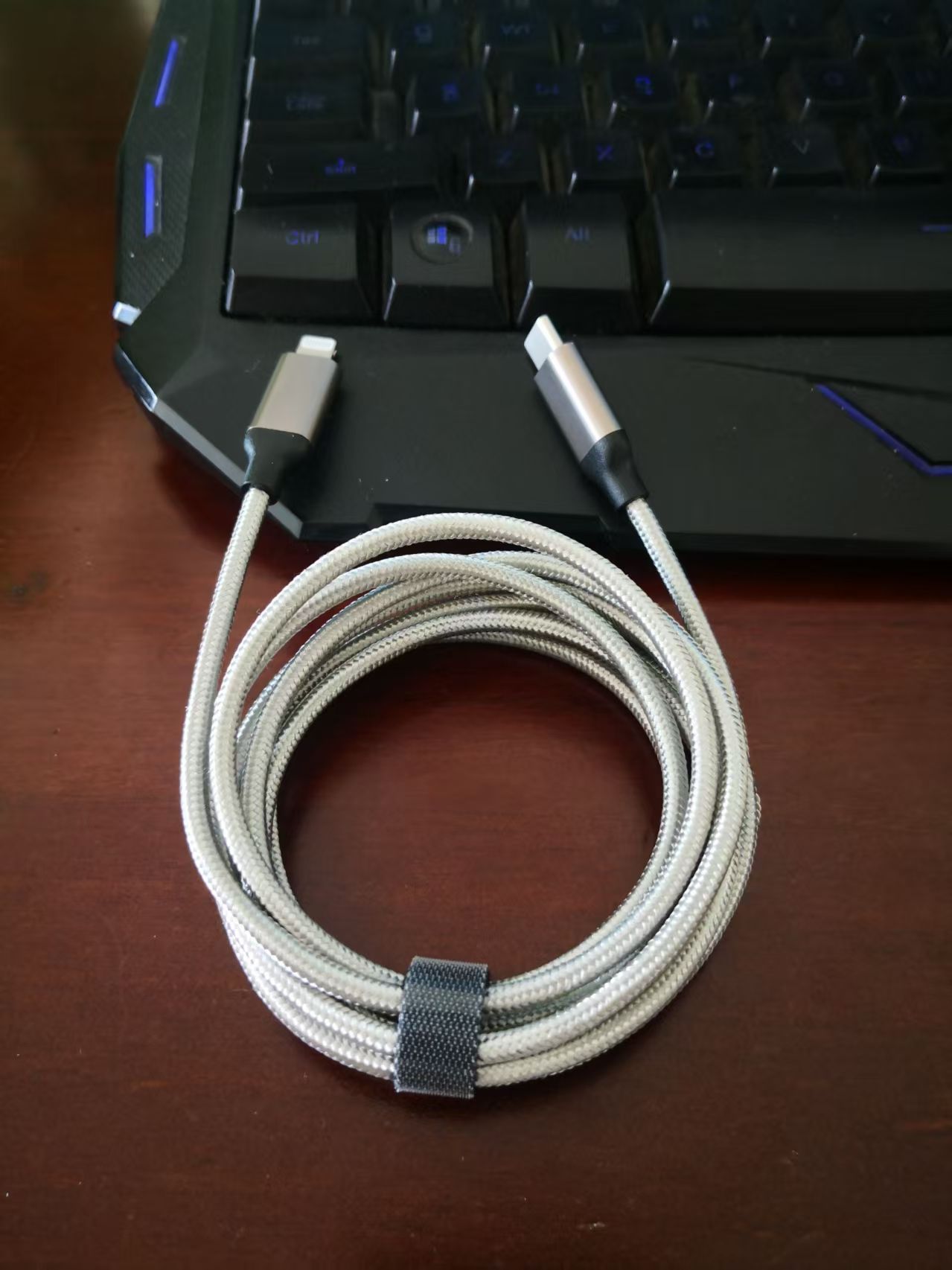
CABLE-LINK CLE-18014 USB-C to USB-C PD cable, designed for 100W charging and data transfer.
Technical Explanation: What Makes a Cable Suitable for a Scenario?
Three technical parameters usually decide whether a Type-C cable fits a scenario: power delivery, data speed, and signal type.
For charging, the cable must support the power level negotiated by the charger and the device. The CLE-18014 cable, for example, is specified for USB PD 3.0 with a maximum of 5A, 20V and 100W. It is listed as operating in data transfer + charging mode, which means the same cable can charge a device and transfer data at the same time within its rated specification. However, the cable alone is not a complete charging system. As a customer-facing note from CABLE-LINK states, this product requires supporting equipment such as a charger.
For data transfer, the USB data speed matters. A USB 2.0 cable is rated at 480 Mbps, while a USB 3.2 Gen 2 cable supports 10 Gbps. If a buyer's application involves large files or external storage, specifying USB 3.2 Gen 2 is the safer choice.
For video output, standard USB-C data cables do not automatically transmit display signals. A video application typically requires a dedicated HDMI cable, or a Type-C hub with HDMI/DisplayPort Alt Mode support. CABLE-LINK's HDMI cable CLE-16304 supports 8K@60Hz and 48Gbps bandwidth, while the Type-C HUB CLE-05005 supports both HDMI and DisplayPort outputs.
For network connection, a separate Ethernet cable such as Cat6 FTP patch cord is needed when a stable wired network is part of the deployment. For higher data rates, CABLE-LINK also provides optical fiber products with data rates up to 10 Gbps on high-end GI-POF configurations.
Scenario Mapping: Which Product Fits Which Use Case?
CABLE-LINK's documented application cases cover five main consumer electronics scenarios. The following table maps each scenario to the relevant product and evidence.
| Use case | Working condition | Recommended product | Key evidence from documented cases |
|---|---|---|---|
| Smartphone charging and data transfer | Data transfer + charging | CLE-18014 USB data cable + CLE-18084 wall charger | France consumer electronics client, 2000 units, 2 years stable operation, fast charging highlight |
| Charging for phone, earphone, laptop | Charging | CLE-18084 wall charger + compatible USB-C cable | France consumer electronics client, 2000 units, 2 years stable operation, fast charging highlight |
| Laptop expansion / docking station | Laptop expansion | CLE-05005 Type-C HUB | France consumer electronics client, 2000 units, 2 years stable operation, multi-port expansion highlight |
| Network data transfer | Network data transfer | CLE-16404 Cat6 FTP network cable or CLE-16508 optical fiber | France consumer electronics client, 2000 units, 2 years stable operation, high-speed transfer highlight |
| Audio and video transmission | Home theater, TV, monitor, projector, PS4, Xbox, laptop | CLE-16304 HDMI cable | France consumer electronics client, 2000 units, 2 years stable operation, 4K@120Hz for ultra-smooth gameplay highlight |
| Charging for phone and laptop | Charging | CLE-18084 wall charger or CLE-19022 power bank with USB-C cable | Part of CABLE-LINK's standard usage guidance; compatible with international safety and quality standards |
Across these cases, the reported pattern is consistent: 2000-unit orders from consumer electronics clients in France, each with two years of stable operation. This gives buyers a starting point for evaluating reliability in predictable, medium-volume deployments.
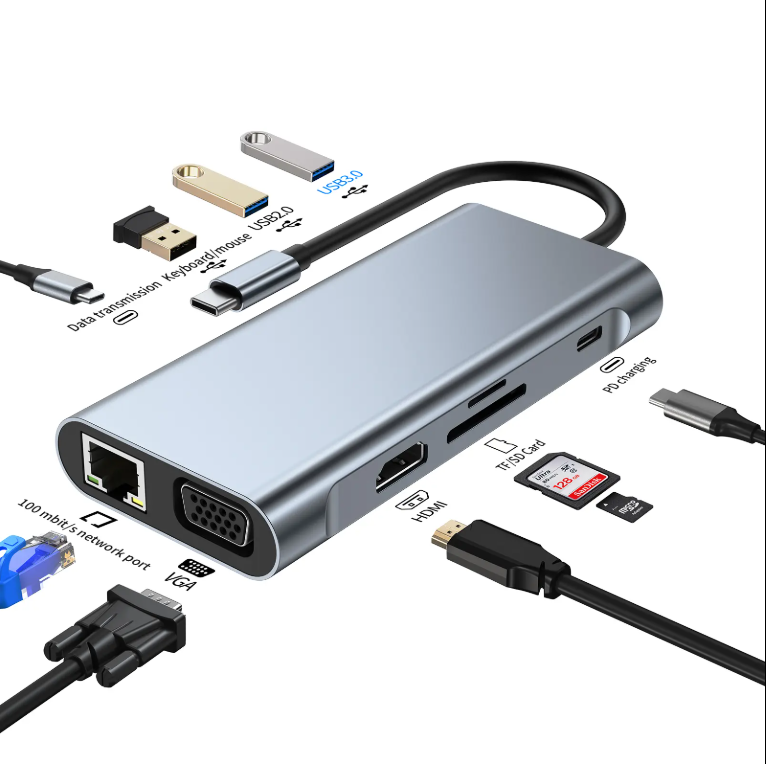
CABLE-LINK CLE-05005 Type-C hub used for laptop expansion and multi-display setups.
What Buyers Should Verify During Evaluation
For Research and Evaluation stages, a supplier's documented capability should be checked against the required project conditions.
- Certification coverage: CE, RoHS, REACH, HDMI, MFi, UL, FCC, ISO9001, BSCI.
- Production scale and control: 100% test before shipment, 5,000 m² factory area, daily cable capacity up to 50,000 pieces.
- OEM flexibility: CABLE-LINK lists length and logo customization, a monthly capacity of 300,000 units for OEM projects, and a typical lead time of 30 days with a 2,000-unit MOQ.
- After-sales support: remote support is stated as part of the company's capability.
- Application support: CABLE-LINK's scenario records mention professional support for product compatibility inquiries, technical troubleshooting, and usage guidance.
For EU-bound products, the EU Common Charger Directive and USB-IF compliance documentation should be confirmed before mass production.
Comparison with Traditional Solutions
Traditional setups often required separate proprietary cables for each device family. A smartphone used one cable, a laptop another, and a monitor or network device still another. This approach can be simpler to specify in isolation, but it increases inventory complexity and creates compatibility gaps as devices evolve.
The USB-C ecosystem reduces the number of cable types by standardizing the connector and supporting multiple protocols. However, interoperability is conditional. A 100W USB-C cable will not deliver 100W unless the charger, the cable, and the device all support PD at that level. Similarly, a USB-C cable with USB 2.0 data speed cannot provide 10Gbps file transfer, even if the port on the device is capable of faster throughput. When both ports of a dual-port charger are used, the charger may downgrade fast charging to normal charging depending on the model. One customer-facing note from CABLE-LINK also clarifies that the product requires supporting equipment such as a charger. These limits are normal for the technology and should be included in any realistic evaluation.
Market Trend and Future Outlook
Several trends are shaping the procurement environment for Type-C cables and accessories. First, regulatory pressure in the EU is pushing more products to standardize on USB-C. Second, power levels are increasing, with USB PD configurations reaching 100W and beyond in hubs and chargers. Third, data and video requirements are shifting toward higher bandwidths, with USB-C hubs supporting 8K video and 10Gbps data channels becoming more common.
In the broader accessory market, Anker and Belkin are identified by TechGearLab and Credence Research as leading third-party manufacturers in the USB-C accessory space. This highlights that brand recognition is not the only route to market; suppliers can also compete on certifications, production consistency, and documented application evidence.
For buyers, the implication is that supplier selection will increasingly depend on measurable evidence: certified production, documented test processes, clear specification sheets, and real application records. CABLE-LINK's current scope, with its EU/USA export concentration and documented French client cases, offers one reference point for this kind of evaluation.
Conclusion
The right Type-C cable cannot be selected by connector alone. Buyers need to map power requirements, data speed, video needs, and environmental conditions to the exact product specification. For an established manufacturer like CABLE-LINK, the available product family covers the most common consumer electronics scenarios, but each project should still be validated against its own working conditions and compliance requirements.
FAQ
Can one USB-C cable handle charging and data transfer at the same time?
Yes, when the cable is designed and rated for both functions. CABLE-LINK's USB data cable model CLE-18014 is documented as operating in data transfer + charging mode, supporting USB PD 3.0 and data speeds up to 10 Gbps (USB 3.2 Gen 2) in its higher specification.
Is a charger included with a USB-C to USB-C cable?
Not necessarily. A USB-C to USB-C data and charging cable requires a separate power source. CABLE-LINK's customer-facing product note states that this product requires supporting equipment such as a charger. Buyers should confirm packaging and bundled accessories with the supplier.
What type of accessory is needed for laptop expansion through a USB-C port?
A USB-C hub or docking station is typically required. CABLE-LINK's hub model CLE-05005 supports USB4 / Thunderbolt compatibility, HDMI and DisplayPort video output, USB-A data ports, SD card readers, RJ45 Gigabit Ethernet, and PD charging up to 100W, which covers common laptop expansion needs.
Which cable should be used for connecting a TV, monitor, or projector?
For audio and video transmission, an HDMI cable is the direct solution. CABLE-LINK's AV cable model CLE-16304 is an Ultra High Speed HDMI 2.1 cable with 8K@60Hz support and 48Gbps bandwidth. A USB-C hub with HDMI output can also be used when the source device only has a USB-C port.
What supplier evidence is useful when evaluating a Type-C cable project?
Useful evidence includes production certifications, factory capacity, test procedures, OEM capabilities, and documented application cases. CABLE-LINK reports certifications including CE, RoHS, REACH, HDMI, MFi, UL and FCC, ISO9001 and BSCI, uses 100% testing, and cites French client cases with 2000-unit orders and two years of stable operation.
Have Questions or Need More Details?
Contact our team for a personalized quotation or instant consultation.
Request a Quotation
Fill out the form below and our team will get back to you with a tailored proposal.
WhatsApp Direct Chat
Prefer to chat in real-time? Message us on WhatsApp for instant assistance & quick answers.
- Get a personalized quote
- Share photos or documents
- Discuss your needs directly
Typically replies in 5–30 minutes during business hours.