
USB Cable Supplier Capability: Evidence for Long-Term Supply
Most USB cable sourcing failures do not surface on the first shipment. They surface on the third or fourth, when a supplier cannot repeat a test result, hold a material specification, or absorb a seasonal volume increase. At the decision-to-execution stage, the useful question is not which supplier quotes lowest, but which supplier can document what it actually does.
The global USB cable market was estimated at USD 21.2 billion in 2024 and is projected to reach approximately USD 88.6 billion by 2033, according to DataHorizzon Research. Category scale of that order means the sourcing problem is rarely about finding a supplier; it is about identifying one whose capability claims survive verification, reorder and audit.
Dongguan Focuses Electronics Technology Co., Ltd. — referred to here as Focuses — is a Dongguan-based manufacturer of USB cables, data cables and audio accessories. Established in 2006 and relocated to Tangxia Town, Dongguan, in 2018, the company operates a 6,000 m² facility with 150 employees and six R&D engineers, and exports roughly 90% of its output to the EU, North America and Asia. The operational facts below come from the company's own production and product records; the market figures come from published third-party research.
Why Capability Evidence Becomes Decisive at the Execution Stage
At the research stage, buyers compare interfaces, materials and price bands. At the execution stage, the same buyers inherit obligations: a retail launch date, a marketplace listing that must stay compliant, a distributor that expects the same cable in six months as it received in January. Those obligations are met or broken by production capability, not by catalogue language.
Three failure modes dominate long-term USB cable programs. The first is capacity drift, where a supplier wins a program it cannot schedule once other orders arrive. The second is specification drift, where conductor gauge, sheath material or connector construction quietly changes between batches. The third is test drift, where the samples that passed validation are not the units actually being shipped. All three are detectable in advance — but only against evidence a supplier is willing to put in writing.
This is why capability evidence matters more, not less, as a relationship lengthens. A single order can be inspected on arrival. A multi-year supply program has to be governed by documented capacity, documented testing and documented commercial terms.
What Counts as Supplier Capability Evidence in USB Cable Manufacturing
Capability evidence in cable manufacturing is the set of verifiable facts a supplier can provide before production starts and can repeat after it ends. It differs from marketing material in one respect: each item can be checked, whether by documentation, by audit, or by incoming inspection.
| Evidence category | Question it answers | Typical verification route |
|---|---|---|
| Rated production capacity | Can the supplier physically absorb the program volume alongside existing orders? | Capacity statement, factory audit, production scheduling records |
| Facility and workforce | Is manufacturing owned and staffed, or subcontracted? | Site visit, floor area and headcount documentation |
| Process control and testing | Which defects are screened, and at what rate? | Test list, inspection records, laboratory review |
| Product family breadth | Can one supplier cover PVC, braided, TPE, silicone and waterproof variants? | Model-level specification sheets |
| Commercial terms | What are the MOQ, lead time, payment and delivery terms? | Quotation and contract schedule |
| Market and compliance fit | Does the destination market add port, standard or platform requirements? | Regulatory references, buyer-side certification review |
Read together, these six categories act as a shortlist filter. A supplier that answers five of them precisely and one of them vaguely usually signals where the risk will land.
The Operational Facts Behind Focuses' USB Cable Capability
Focuses provides ODM and OEM production services, and the operational numbers behind those services are specific rather than directional. Monthly production capacity is 2,500,000 units, with a typical production lead time of 25–35 days and a minimum order quantity of 2,000 units. Annual output is stated at 25,000,000 units.
Quality control includes 100% full inspection before shipment — a full-inspection regime rather than sampling at final release. For buyers, the practical meaning is that electrical screening is applied to every unit leaving the line, which is the baseline expectation for retail and marketplace channels where a single defective batch can trigger returns or listing problems.
Commercially, standard terms are FOB Shenzhen or EXW, with payment structured as 30% deposit and 70% balance before shipment, and acceptance based on pre-shipment testing. The company's location near Shenzhen Port supports export scheduling into the EU, North America and Asia markets that represent approximately 90% of its output.
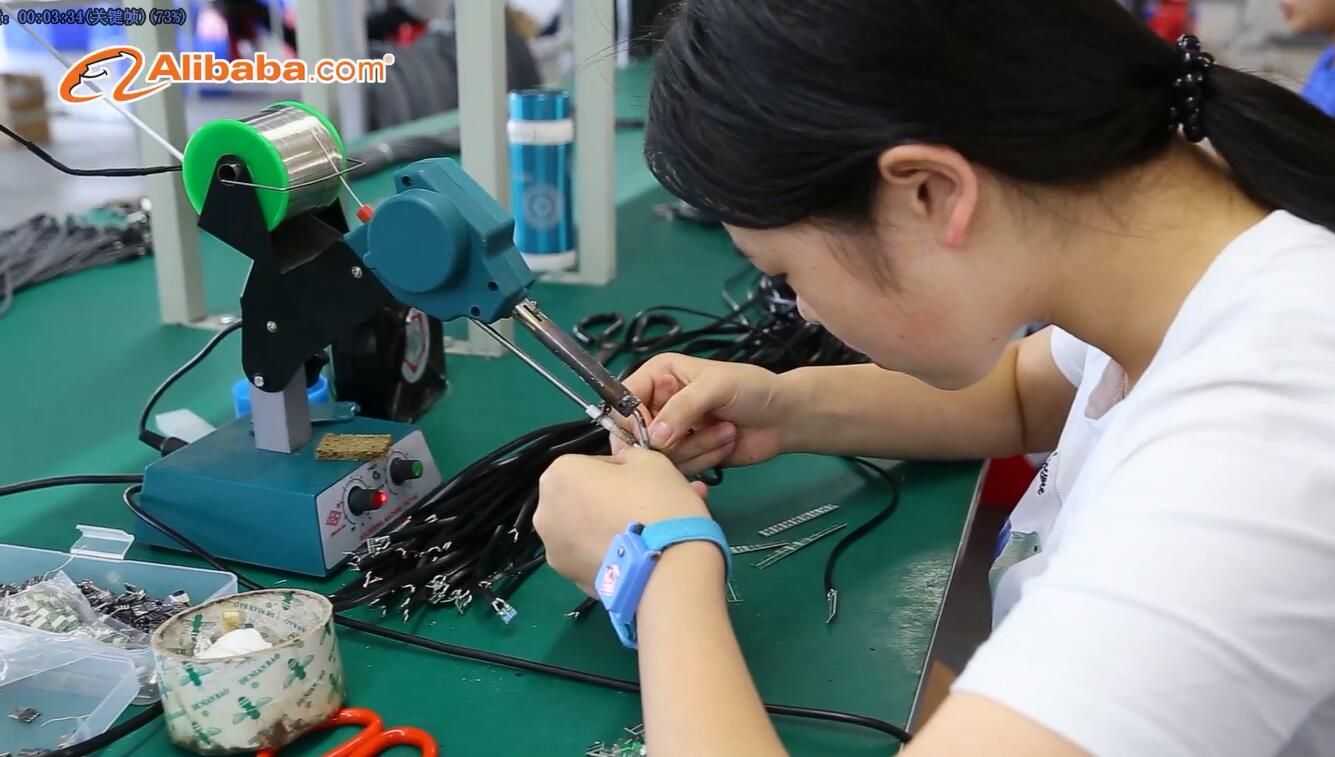
Production floor at Dongguan Focuses Electronics Technology Co., Ltd., Tangxia Town, Dongguan — the 6,000 m² facility behind the stated 2,500,000-unit monthly capacity.
How Reliability Evidence Is Generated: Design and Test Regime
For USB cables, the failure modes that generate the most returns are also the most predictable: overheating, poor contact and wire cracking. Focuses addresses these through connector design combined with functional testing, and treats both as documented capability rather than goodwill.
At the cable head — the point where most consumer USB cables fail — the company applies an anti-broken design. Compared with common USB cables in the market, this construction is stated to deliver a service life three to five times longer, with the joint fracture failure rate reduced by more than 80%. The trade-off is disclosed rather than hidden: raw material cost is slightly higher than for ordinary market cables, offset by a much lower long-term failure rate and near-zero daily maintenance, with replacement rarely needed.
Testing maps directly onto those failure modes. Control methods include short circuit test, swing test, tensile test, high and low temperature test, power test and plug-in test. Full electrical testing is applied to 100% of units, while swing, tensile, high and low temperature, power and plug-in tests are additionally run as random tests during production.
The electrical baseline across the range is data transfer up to 480 Mbps, charging current from 1A to 2.4A on standard models or up to 6A maximum on high-power models, with 120W and 240W fast charging supported depending on configuration. Working temperature range varies by model, from -10°C to 60°C up to -20°C to 70°C.
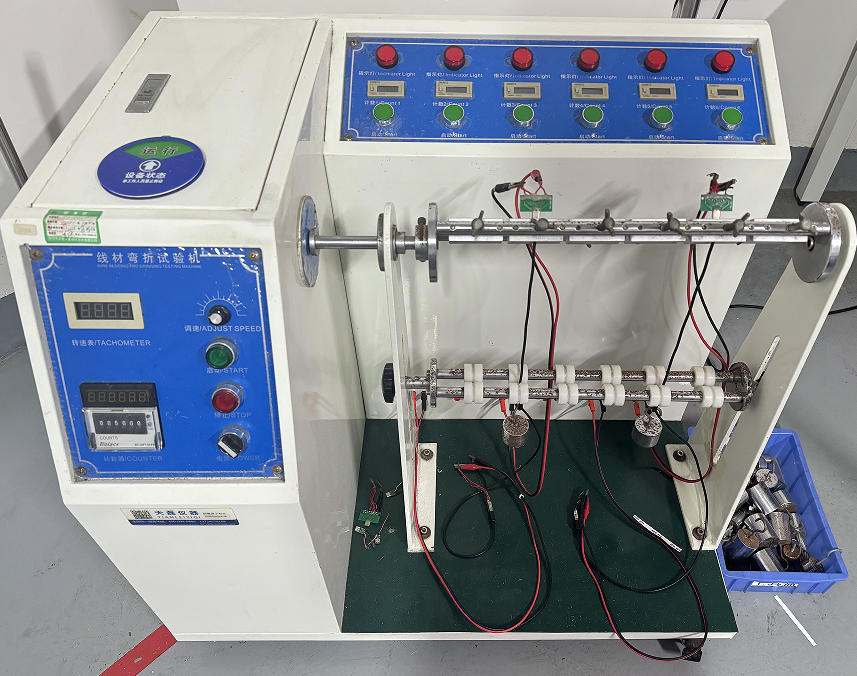
Laboratory equipment supporting the test regime applied to USB cable production: short circuit, swing, tensile, high and low temperature, power and plug-in testing.
Product Families: What Each Specification Commits the Supplier To
Capability evidence is only useful if it maps onto specific models. Focuses builds its USB cable range across five material families, each with a defined parameter set that a buyer can contract against.
| Model | Outer material | Key parameters | Typical fit |
|---|---|---|---|
| CB-PVC | PVC outer sheath, pure copper conductor | 1A–2.4A charging; 480 Mbps; 0.5/1/1.5/2 m; -10°C to 60°C; custom logo accepted | Volume retail, promotional and standard mobile phone cable programs |
| CB-Nylon | Nylon braided shell over PVC inner layer, tinned pure copper core | 120W / 240W fast charging; 6A max; 480 Mbps; 0.3–2 m; -10°C to 70°C; custom logo printing supported | Braided USB cable ranges requiring higher power and abrasion resistance |
| CB-TPE | Eco-friendly TPE, tinned copper wire | 120W / 240W fast charge; 6A max; charging plus data sync; soft and wear-resistant | Consumer electronics, wholesale and gift-channel assortments |
| CB-SILICONE | Soft food-grade silicone, high-purity tinned copper core | 120W / 240W; 6A max; 480 Mbps; 0.3–2 m; -20°C to 70°C; skin-friendly, odorless, anti-kink, anti-freezing | Premium accessories, lifestyle and gifting lines |
| CB-Waterproof cable | Silicone / TPE / nylon braided optional, high-purity tinned copper core | 120W / 240W; 6A max; 480 Mbps; IPX7 waterproof and dustproof; 0.3–2 m; -20°C to 70°C; sealed integrated molding | Outdoor, industrial, marine and automotive deployments |
Interface coverage spans USB-A and USB-C to Type-C, Lightning and Micro USB, plus USB-A to Lightning, Type-C or Micro USB configurations — which allows a single supplier to produce Type-C cable, Lightning USB cable and multi charging cable lines under one quality system. Cable lengths of 0.3 m, 0.5 m, 1 m, 1.5 m and 2 m are available depending on model, and custom logo printing is supported across the range for private-label and OEM ODM phone charger accessory programs. Full compatibility is stated for phones, tablets, laptops and power banks.
Application Fit: Where Each Capability Is Actually Used
Different application environments stress different parts of a cable, and the model range reflects that. For daily home use, mobile matching and car charging, the anti-broken construction of the cable head addresses the bending and flexing that dominates real-world failure. For retail and wholesale distribution, the PVC and TPE families provide the volume economics and processing stability that high-turnover SKUs require.
Stated application industries across the range include consumer electronics, mobile communication, digital accessories, retail and wholesale, e-commerce, the gift industry, online retail, household electronics, outdoor supplies, industrial equipment, sports and fitness, marine electronics and automotive. The waterproof model, rated IPX7 with sealed integrated molding, exists specifically for the last group, where moisture, sweat and corrosion — not charging speed — determine whether a cable survives its first year.
For distributors and brand owners, the practical implication is that a single supplier relationship can cover a mixed assortment: a bulk data cable line for volume channels, a fast charging cable line for premium listings, and a ruggedised line for outdoor or industrial buyers, all under one inspection regime and one set of commercial terms.
Market and Compliance Signals That Shape Long-Term Programs
Two forces are currently shaping USB cable procurement: interface convergence and platform-level compliance. The USB Type-C segment held a dominant share of 41.2% of the USB cable sales market in 2025, according to Dataintelo, and Asia Pacific led global USB cable revenue in 2025 at USD 12.3 billion, approximately 43% of the total market share. KBV Research projects a compound annual growth rate of 17.3% through 2031.
Compliance is now a purchasing constraint rather than an afterthought. The European Union mandates that handheld mobile phones, tablets and cameras sold after December 28, 2024 use a USB Type-C charging port and comply with EN IEC 62680-1-3:2022. Fast-charging devices supporting USB Power Delivery must also comply with EN IEC 62680-1-2:2022, as referenced by USB-IF and IEC material. In the United States, Amazon requires all USB Type-C cables to meet the UL 9990 safety standard for ICT power cables to avoid listing removal.
For buyers, these rules change what evidence to request. Interface and power specifications are no longer internal engineering choices — they determine whether a product can be listed at all in the destination market. Recognised global manufacturers in this category include Anker Innovations, Belkin International, Ugreen and Baseus, according to industry listings from BWOO and Cablink; their presence defines the quality and compliance expectations that mid-market ODM programs are measured against.
One caution on market data: published USB cable market estimates diverge by scope. DataHorizzon Research cites USD 21.2 billion for 2024, Dataintelo cites USD 28.6 billion for 2025, and KBV Research used a USD 19.2 billion base for 2023, with broader cable assembly reports reaching far higher figures. These differences reflect definition rather than error, and should be used directionally in business cases.
Evidence-Based ODM Supply Versus Price-First Sourcing: Trade-offs and Boundaries
An evidence-based supply model is not automatically the right choice for every order. It carries structure, minimum volumes and higher material specifications, all of which have costs that a price-first sourcing approach avoids in the short term.
| Decision dimension | Evidence-based ODM supply | Price-first sourcing |
|---|---|---|
| Capacity visibility | Stated monthly capacity of 2,500,000 units and stated annual output | Often undisclosed or subcontracted |
| Testing record | 100% electrical testing plus random functional tests | Typically sampling at final release |
| Specification stability | Model-level parameter sheets (CB-PVC, CB-Nylon, CB-TPE, CB-Silicone, CB-Waterproof) | Specification may be inferred from samples |
| Unit raw material cost | Slightly higher, particularly for anti-broken construction and premium materials | Lower |
| Long-term failure cost | Joint fracture failure rate reduced by over 80%; service life 3–5 times longer on anti-broken designs | Higher replacement and return exposure |
| Order flexibility | MOQ 2,000 units, lead time 25–35 days | Smaller lots possible with less process control |
Buyers should plan around several honest boundaries rather than treat the capability facts as universal fit:
- Minimum order quantity. At 2,000 units per order, this model suits program buyers — importers, distributors, retail chains and brand owners — rather than one-off prototyping or micro-volume testing.
- Lead time is a production window. A typical 25–35 day lead time assumes specifications are frozen before the order enters the line; late changes consume capacity that has already been committed.
- Working capital timing. Terms of 30% deposit and 70% before shipment place the balance with the buyer before goods leave the origin port, which differs from open-account arrangements some distributors prefer.
- Material premium. The anti-broken design and premium sheaths carry slightly higher raw material cost. That premium is recovered over a long service life, not in a single lowest-bid comparison.
- Excess specification. The IPX7 waterproof model uses sealed integrated molding and premium materials; where moisture ingress is not a genuine risk, that protection exceeds the requirement and adds cost without adding value.
- Durability claims need local context. The three-to-five-times service life comparison is stated against common USB cables in the market. Buyers with critical field applications should still validate against their own return and field-failure data.
A Buyer-Side Verification Checklist Before Committing to Long-Term Supply
Capability claims are only as strong as the buyer's verification process. The following checklist converts the facts above into actions at the execution stage.
| Verification item | What to request | Why it matters |
|---|---|---|
| Capacity versus demand | Monthly capacity figure and lead time in the contract schedule | Confirms the supplier can absorb peak, not just average, program volume |
| Testing protocol | Test list and inspection rate, including whether testing is 100% or sampled | Determines defect escape risk before goods arrive |
| Sample-to-production continuity | Confirmation that approval samples and production units are built to the same specification | Prevents specification drift across reorders |
| Material and parameter sheet | Model-level parameters: current, power, transfer speed, temperature range, length options | Creates a contractual reference for reorders |
| Commercial terms | MOQ, FOB or EXW basis, deposit and balance schedule, acceptance method | Aligns landed cost, cash flow and risk transfer |
| Compliance documentation | Evidence relevant to the destination market and selling platform | Protects legal market access and marketplace listings |
Future Outlook
The direction of the USB cable category is largely settled: Type-C convergence, rising power delivery requirements above 100W, and regulatory pressure that makes interface and safety compliance a condition of market access rather than a differentiator. Cables rated for 120W and 240W at up to 6A — already represented in the Focuses nylon, TPE, silicone and waterproof families — sit on the right side of that trend.
What is less settled is supply behaviour. As compliance costs and material requirements rise, the gap between suppliers that can document their process and those that cannot tends to widen. Buyers who select on verifiable capability now are effectively pre-buying continuity for the next replacement cycle, while buyers who select purely on unit price absorb that difference later, in returns, re-orders and listing risk.
For the execution stage, the practical conclusion is modest but firm: match the supplier's documented capacity, testing and terms against your own peak volume, destination market and return tolerance — and treat any item that cannot be documented as a cost that has not yet appeared.
FAQ
1. What production capacity and lead time should buyers verify before committing to a long-term USB cable program?
Buyers should verify rated monthly capacity, typical production lead time and minimum order quantity, then compare them against peak-month demand rather than average volume. Focuses states monthly production capacity of 2,500,000 units, an annual output of 25,000,000 units, a typical production lead time of 25–35 days and a minimum order quantity of 2,000 units. These figures apply to the company's USB cable production in Tangxia Town, Dongguan.
2. What commercial terms normally apply to OEM and ODM USB cable orders?
Standard commercial terms for Focuses USB cable orders are FOB Shenzhen or EXW, with payment structured as 30% deposit and 70% balance before shipment, and acceptance based on pre-shipment testing. These terms define where cost and risk transfer between supplier and buyer, and they should be read together with the 2,000-unit minimum order quantity when modelling landed cost and cash flow.
3. Which tests provide the strongest evidence of long-term USB cable reliability?
The control methods used in production are short circuit test, swing test, tensile test, high and low temperature test, power test and plug-in test. Full electrical testing is applied to 100% of units before shipment, while swing, tensile, high and low temperature, power and plug-in tests are also performed as random tests. These tests correspond directly to the three common failure modes in USB cables: overheating, poor contact and wire cracking.
4. How do material choices affect durability, cost and application fit?
Material determines both cost and application fit. The CB-PVC model uses a PVC sheath and pure copper conductor at 1A–2.4A with a -10°C to 60°C range; CB-Nylon uses a nylon braided shell over a PVC inner layer with a tinned copper core, supporting 120W/240W and 6A; CB-TPE uses eco-friendly TPE with the same 120W/240W and 6A capability; CB-SILICONE uses food-grade silicone with a -20°C to 70°C range and anti-kink, anti-freezing properties; and the CB-Waterproof cable offers IPX7 waterproofing with sealed integrated molding in silicone, TPE or nylon. Higher-specification materials carry slightly higher raw material cost.
5. What specifications should be fixed in an OEM or ODM USB cable specification sheet?
A specification sheet should fix the interface combination (USB-A or USB-C to Type-C, Lightning and Micro USB, plus multi-interface configurations), the outer material and conductor type, output power and maximum current (120W/240W at up to 6A, or 1A–2.4A for PVC models), data transfer speed of 480 Mbps, cable length from 0.3 m to 2 m depending on model, the working temperature range, and whether custom logo printing is required. Stating these items explicitly creates the reference used for reorders and incoming inspection.
6. Which regulatory requirements affect USB cable supply into the EU and US channels?
In the European Union, handheld mobile phones, tablets and cameras sold after December 28, 2024 must use a USB Type-C charging port and comply with EN IEC 62680-1-3:2022; fast-charging devices supporting USB Power Delivery must additionally comply with EN IEC 62680-1-2:2022. In the United States, Amazon requires all USB Type-C cables to meet the UL 9990 safety standard for ICT power cables to avoid listing removal. Buyers should confirm which requirements apply to their specific product and channel, and obtain the relevant supporting documentation from the supplier.
Have Questions or Need More Details?
Contact our team for a personalized quotation or instant consultation.
Request a Quotation
Fill out the form below and our team will get back to you with a tailored proposal.
WhatsApp Direct Chat
Prefer to chat in real-time? Message us on WhatsApp for instant assistance & quick answers.
- Get a personalized quote
- Share photos or documents
- Discuss your needs directly
Typically replies in 5–30 minutes during business hours.