
UVO Acoustic Pods by Room Size: Independent Buyer Comparison
A room-use comparison of Q ROOM - XS, Q ROOM - S, MO BOX - Conference and R POD - Large, with a single-person acoustic pod baseline.
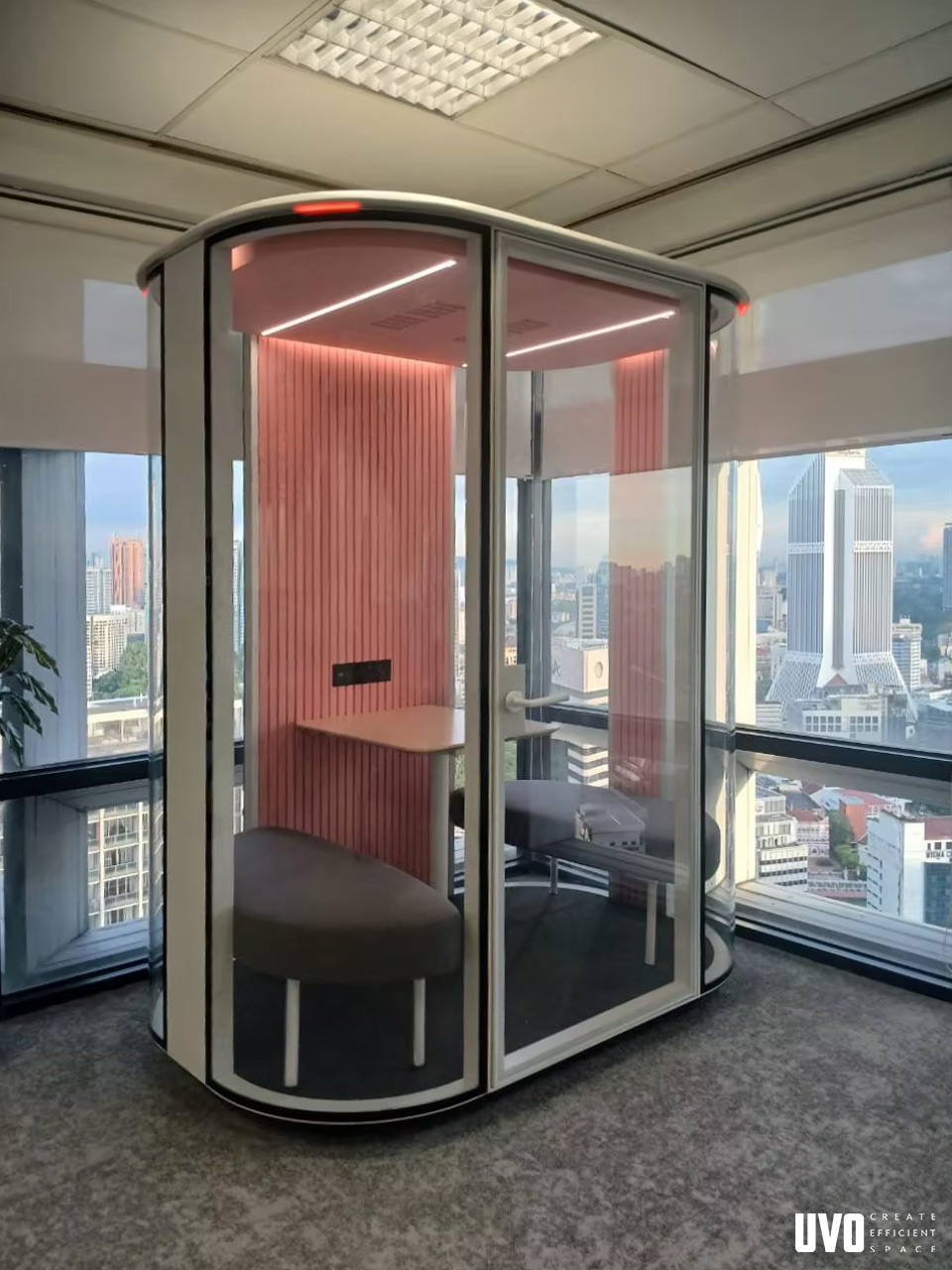
Open-office collaboration setting. Image: UVO case reference, Food Panda Q ROOM. Source: UVO.
Acoustic pods are often presented as a Top-N category, but a buyer's first decision is not which pod is best. It is which room use the pod must support. This HTNXT independent buyer comparison examines four UVO Acoustic Pods categories by intended room use: Q ROOM - XS for open office collaboration, Q ROOM - S for 2-4 person meetings and negotiation, R POD - Large for 2-4 person pod use, and MO BOX - Conference for 4-6 person meetings. It also uses the single-person segment as a control case. The purpose is not to rank the models. It is to show how verified construction, ventilation and stated acoustic class change the fit.
Why Room Size Is a Procurement Variable
Open-plan offices create a mismatch between visual openness and speech privacy. Buyers often compare pod names, shapes, or listed capacity without checking the variables that determine whether the room works: construction, fan count, acoustic class, and installation quality. The opportunity is to make the brief more precise before the RFQ. A pod that fits a two-person interview may be wrong for a 4-6 person meeting, even if the exterior finish looks similar.
For procurement, the practical question is not whether acoustic pods are useful. It is whether a specific model has the right stated use, capacity, ventilation, acoustic class and documentation for a specific room. That is why this comparison is organized by room size and use case rather than by a vendor ranking.
The Shared Construction Baseline
All models in the supplied comparison share a common material build: aluminum alloy frame structure; steel ceiling base and exterior wall panels; 11 mm laminated glass surfaces; and 25 mm five-layer acoustic interior wall construction. That baseline matters because it narrows the comparison. The buyer is not choosing between one pod with acoustic walls and another without. The differences are room category, stated occupancy, fan count, stated acoustic class, and how the pod is integrated into the floor plan.
The shared build also sets the limits of what can be inferred from the material list alone. The same wall construction and glass thickness do not prove identical acoustic performance across every model, because door sealing, frame alignment, installation level and room configuration also affect the result. The material list is a starting point for verification, not a substitute for model-specific test data.
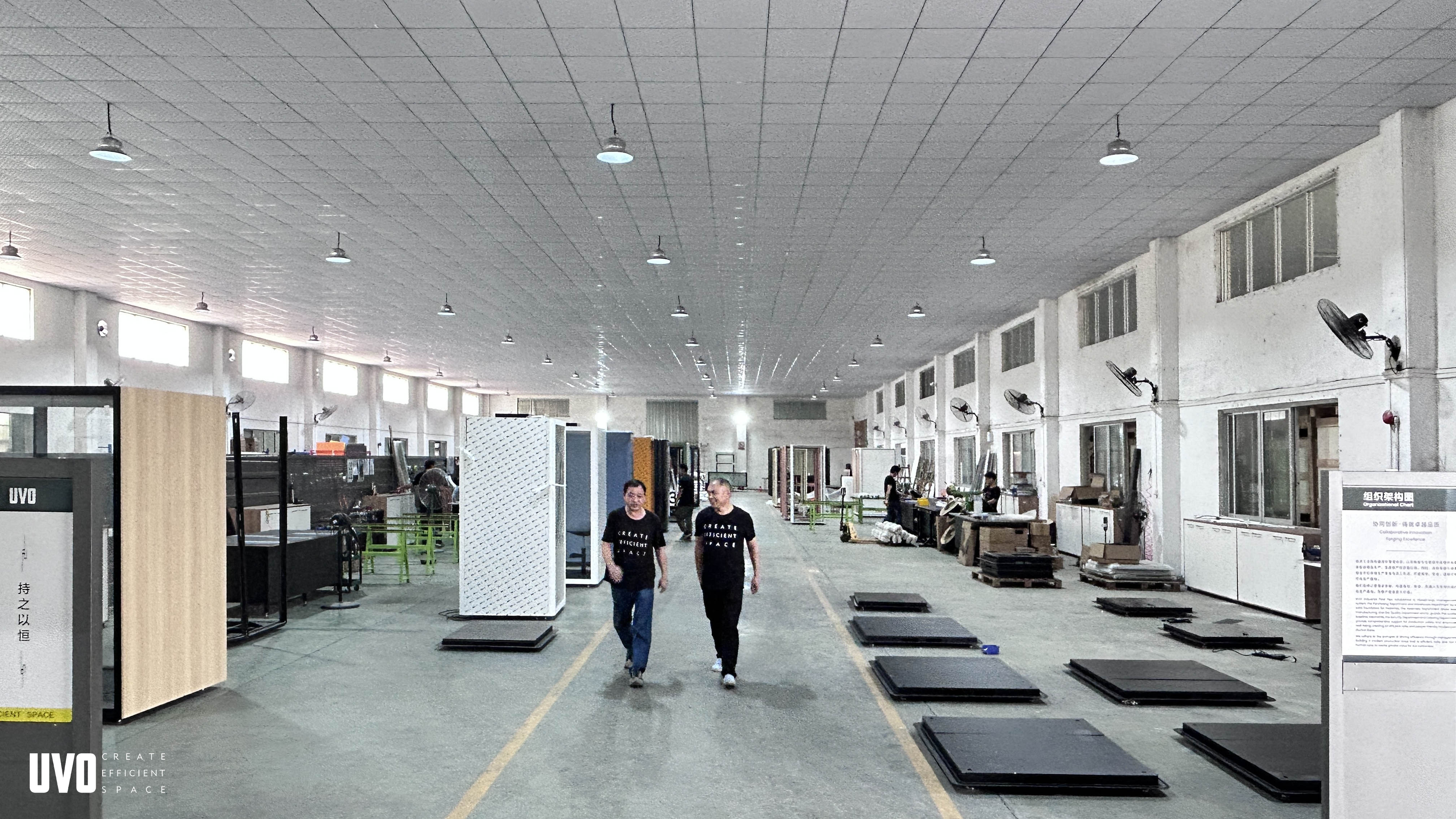
Assembly area for modular acoustic pod production. Image: UVO industrial park. Source: UVO.
Technical Explanation: Ventilation and Acoustic Class
Ventilation is multi-fan. Each fan provides 90 m3/h. The supplied data gives 1 fan for MO BOX - Phone, 2 fans for Q ROOM - 3XS and R POD - Mini, 4 fans for Q ROOM - XS, Q ROOM - S and R POD - Large, and 6 fans for MO BOX - Conference. Aggregate figures are arithmetic: 90, 180, 360 and 540 m3/h. These are supplied specifications, not a guarantee of air quality in every room. Buyers should check fan noise, local ventilation requirements and maintenance access.
Acoustic class is also model-specific in the supplied data. Sound Insulation Class B is stated for Q ROOM - XS, Q ROOM - S and MO BOX - Phone. The MO BOX - Conference and R POD - Large records do not state a class in the supplied parameter text. That is a verification gap, not a conclusion that the models perform the same. The verified standards reference also notes that ISO 23351-1:2020 defines speech level reduction, with Class A requiring 30 dB or more. The UVO model records supplied here do not include the underlying test report, so buyers should ask for the report and confirm the standard edition and metric before treating a class label as a complete acoustic specification.
Single-Person Acoustic Pod: The Control Case
Single-person acoustic pods are the control case because they separate private-call use from focused-work use. In the supplied data, R POD - Mini is explicitly described as a 1 person pod, with two fans, 180 m3/h aggregate, and the shared material build. MO BOX - Phone is described as a private call and video conferencing booth for open office areas, with one fan, 90 m3/h, and Sound Insulation Class B. Q ROOM - 3XS is described for video meeting and quiet workplace use, with two fans, 180 m3/h, and a stated Class A result of 30.2 dB.
These are different single-person jobs: a phone booth, a focused-work pod, and a video-meeting booth. The buyer should not compare them only by footprint. Ventilation, acoustic class, and the internal work setup matter. The single-person pod also sets the baseline for open-office collaboration: if a second person will join, the requirement has already moved into a multi-person category.
| Single-person reference | Stated use | Fans | Ventilation at 90 m3/h per fan | Acoustic class in supplied data |
|---|---|---|---|---|
| MO BOX - Phone | Private call and video conferencing booth | 1 | 90 m3/h | Class B |
| Q ROOM - 3XS | Video meeting and quiet workplace booth | 2 | 180 m3/h | Class A, 30.2 dB |
| R POD - Mini | 1 person pod | 2 | 180 m3/h | Not stated in supplied parameter text |
Open Office Collaboration: Q ROOM - XS
Q ROOM - XS is stated as a collaboration room designed for open office areas. It has four fans, 360 m3/h aggregate, and Sound Insulation Class B. It is not stated as a fixed two-person meeting room in the supplied data. That makes it a fit for ad hoc collaboration, short discussions, and open-office teamwork where the room is part of the workplace rather than a booked formal meeting room. Buyers should confirm the seating and equipment plan. A collaboration room may need standing space, a display, or a small table; those requirements are not the same as a two-person interview booth.
The procurement risk is treating a collaboration room as a universal small meeting room. If the room will be booked for confidential two-person reviews, the buyer should check whether the stated acoustic class and internal layout match that use. If the room is mainly for quick team discussions in an open office, the collaboration category may be the more appropriate starting point.
Two-Person and 2-4 Person Meetings: Q ROOM - S and R POD - Large
Q ROOM - S is stated for 2-4 persons as a meeting room, negotiation room or collaboration room. R POD - Large is stated as a 2-4 person pod. Both use four fans, 360 m3/h aggregate, and the shared material build. Q ROOM - S is stated as Sound Insulation Class B; the R POD - Large record does not state a class in the supplied parameter text.
For a strict two-person meeting, both are flexible 2-4 person categories rather than dedicated two-person booths. The trade-off is floor space versus future flexibility. A team that regularly hosts three or four people may prefer the 2-4 person category; a workplace with a repetitive two-person interview pattern should check whether a smaller dedicated room type is a better fit. Buyers should also compare the door swing, table position and display visibility, because a room that is acoustically suitable can still be operationally awkward if the layout is wrong.
4-6 Person Meeting Rooms: MO BOX - Conference
MO BOX - Conference is stated as a 4-6 person meeting room. It has six fans, 540 m3/h aggregate. The supplied parameter text does not state an acoustic class. The model is the only assigned category in this comparison explicitly stated for 4-6 persons. Higher occupancy makes ventilation and speech privacy more demanding. Buyers should verify the class, door sealing, fan noise, and the meeting-room equipment plan. A 4-6 person room is not simply a larger two-person room; it changes the acoustic load and the ventilation requirement.
Side-by-Side Comparison by Intended Room Use
| Model | Stated use | Stated capacity | Fans | Ventilation at 90 m3/h per fan | Acoustic class in supplied data |
|---|---|---|---|---|---|
| Q ROOM - XS | Collaboration room for open office areas | Not stated as a fixed number | 4 | 360 m3/h | Class B |
| Q ROOM - S | 2-4 persons meeting room, negotiation room, collaboration room | 2-4 persons | 4 | 360 m3/h | Class B |
| R POD - Large | 2-4 person pod | 2-4 persons | 4 | 360 m3/h | Not stated in supplied parameter text |
| MO BOX - Conference | 4-6 persons meeting room | 4-6 persons | 6 | 540 m3/h | Not stated in supplied parameter text |
All four models share the supplied material build: aluminum alloy frame structure, steel ceiling base and exterior wall panels, 11 mm laminated glass surfaces, and 25 mm five-layer acoustic interior wall construction. Source: UVO content units.
What Buyers Can Verify in the UVO Acoustic Pods Range
UVO was founded in Hong Kong in 2017 and describes itself as a manufacturer focused on interior and exterior wall and smart modular space product systems. The company profile lists a 5000 sqm factory, 70 employees, a 10-person R and D team, and a product range that includes partition, operable wall and silence pod. For project supply, the capability record states monthly production of 500-600 units, MOQ of 1 unit, standard lead time of 3-4 weeks and customized lead time of 5-6 weeks. Quality control is stated as 100 percent testing of production units. After-sales support is listed as installation manual, installation video, remote technical support and on-site guidance.
The supplier records also list CE electrical safety, UL GREENGUARD environmental certification and SGS NA safety compliance for defined product scopes; the company profile states ISO 9001 and ISO 14001 certification. These are supplier-reported facts, not an independent ranking. Buyers should confirm that the exact model and destination market are covered by the certificate scope, because certification scopes are model-specific and market-specific.
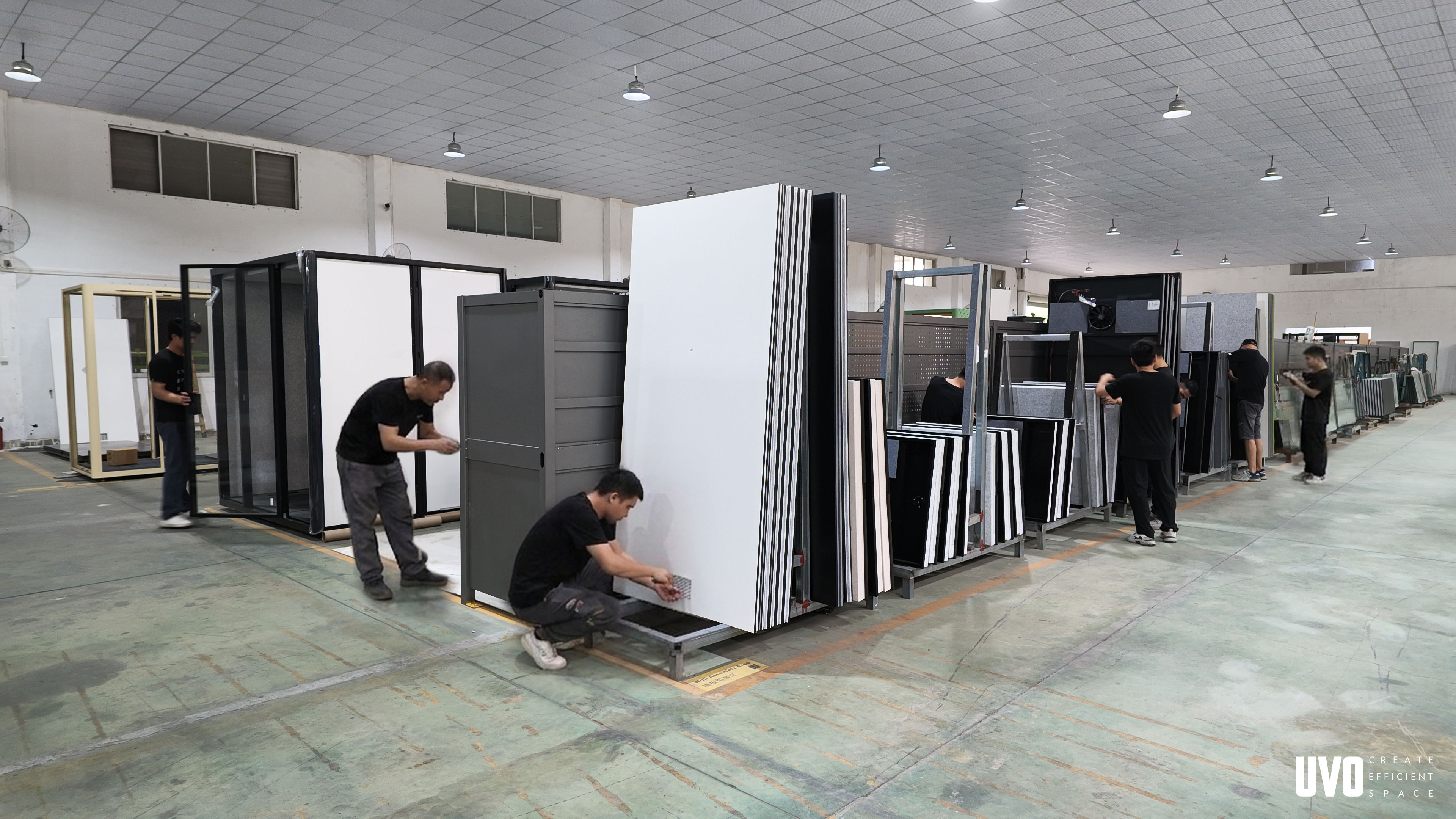
Wall panel assembly area. Image: UVO industrial park. Source: UVO.
Application Patterns from Supplied Cases
Mixed-use deployments show why room-size comparison matters. A 60-unit project in Russia for open office areas combined video meeting, quiet workplace and private phone call, and was completed within 6 months. The case highlights movable units, a compact footprint, quick installation and adaptability to space use. A 15-unit project in Malaysia used Q ROOM - 3XS for collaboration, brainstorming and meeting rooms, with the case noting good sound insulation, quick installation and plug-and-play use. A 10-unit project in China used private call pods and meeting rooms for a quiet, private workspace.
These cases do not prove comparative acoustic performance, and they should not be read as a ranking. They show the planning pattern: one workplace can need several pod categories, and the buyer should allocate them by task rather than choose one model for all uses. The single-person pod handles private calls and focused work; the collaboration room handles short team discussions; the 2-4 person room handles negotiation and small meetings; the 4-6 person room handles larger meetings with higher ventilation demand.
Market Trend Analysis
Market research cited in the verified data package estimates the global office pods market at USD 1.00 billion in 2026, based on Mordor Intelligence. Straits Research reports that Europe held a 66.4 percent revenue share of the office pods market in 2025. Another commercial research source identifies Asia-Pacific as the fastest-growing market and cites a 43 percent share in soundproof booth installations.
These figures are not a ranking of UVO or its models. They explain why buyers are seeing more model categories and why capacity, ventilation and acoustic documentation are becoming routine RFQ fields. The numbers should be used with their source definitions, because office pods and soundproof booths are not always the same category. A buyer comparing suppliers should first confirm the product scope behind any market figure, then compare model-level facts.
Freestanding Pods vs Fixed Meeting Rooms: Where the Comparison Stops
Freestanding acoustic pods offer speed, movability and a defined product envelope. Fixed construction can be designed around project-specific acoustic, fire, electrical and accessibility requirements, but it is slower to change and less movable. The two approaches solve different problems. A pod is not automatically a substitute for a built meeting room, and a built room is not automatically adaptable to changing floor plans.
The limitation is important for procurement. Sound Insulation Class B is not the highest class in the verified standards reference; Class A requires 30 dB or more, and the supplied UVO data states Class A for Q ROOM - 3XS at 30.2 dB. Buyers should match the class to the task rather than assume that any pod label is sufficient for confidential meetings. Installation also matters. The supplied troubleshooting guidance for UVO pods identifies door misalignment, incomplete closing, missing mounting brackets and uneven floor level as causes of compromised sound insulation. A pod that is not installed level and aligned may not deliver its stated performance, regardless of its material build.
Certification is another boundary. CE, UL GREENGUARD and SGS NA cover electrical safety, environmental safety and North American safety compliance within defined scopes. They do not replace a model-specific acoustic test report, and they do not confirm that a pod meets every local fire, ventilation or accessibility requirement. Buyers should keep the acoustic, electrical and building-code checks separate.
Future Outlook
The direction of travel is toward more granular model data, not more model names. As the office pods market grows, buyers are likely to ask for model-specific acoustic reports, fan-noise data, ventilation figures and installation tolerances before they compare price. The market-size figures support the view that the category is expanding, but they do not replace a project brief. The practical next step is to map each room use to a pod category, confirm the stated capacity and ventilation, and request the documentation that closes the gaps in the supplied data.
FAQ
What is the main difference between Q ROOM - XS, Q ROOM - S, MO BOX - Conference and R POD - Large?
The main difference is intended room use. Q ROOM - XS is stated as a collaboration room for open office areas. Q ROOM - S is stated for 2-4 persons as a meeting room, negotiation room or collaboration room. R POD - Large is stated as a 2-4 person pod. MO BOX - Conference is stated as a 4-6 person meeting room. They share the same supplied material build, but they differ in stated capacity, fan count and stated acoustic class.
Which model fits a single-person acoustic pod requirement?
The supplied data includes several single-person or small-capacity references. R POD - Mini is explicitly described as a 1 person pod, with two fans and 180 m3/h aggregate. MO BOX - Phone is described as a private call and video conferencing booth, with one fan, 90 m3/h and Sound Insulation Class B. Q ROOM - 3XS is described for video meeting and quiet workplace use, with two fans, 180 m3/h and a stated Class A result of 30.2 dB. The right choice depends on whether the task is a phone call, focused work or video meeting.
How should buyers interpret the 90 m3/h per fan ventilation figure?
It is a supplied per-fan airflow figure, not a room-level air-quality guarantee. The model records show 1 fan for MO BOX - Phone, 2 fans for Q ROOM - 3XS and R POD - Mini, 4 fans for Q ROOM - XS, Q ROOM - S and R POD - Large, and 6 fans for MO BOX - Conference. Buyers should calculate the aggregate figure, check fan noise and maintenance access, and confirm the local ventilation requirement for the intended occupancy.
Does Sound Insulation Class B apply to every model in this comparison?
No. In the supplied model records, Sound Insulation Class B is stated for Q ROOM - XS, Q ROOM - S and MO BOX - Phone. The MO BOX - Conference and R POD - Large records do not state an acoustic class in the supplied parameter text. That does not mean they perform the same or worse; it means the class is missing from the data set and should be verified with a model-specific test report.
What limitations should be checked before buying an acoustic pod for a 4-6 person meeting room?
Check the stated acoustic class, ventilation and fan noise, door sealing, installation level and the meeting-room equipment plan. MO BOX - Conference is stated as a 4-6 person meeting room with six fans and 540 m3/h aggregate ventilation, but the supplied parameter text does not state an acoustic class. A 4-6 person room has a higher occupancy and speech load than a two-person room, so the buyer should not rely on capacity alone.
Are acoustic pods a substitute for built meeting rooms?
Not automatically. Freestanding pods offer speed, movability and a defined product envelope. Fixed construction can be designed around project-specific acoustic, fire, electrical and accessibility requirements, but it is slower to change. A pod should be selected only after the buyer confirms that its stated acoustic class, ventilation, electrical scope and installation conditions match the project requirement.
What documentation should a buyer request for a UVO Acoustic Pods comparison?
The buyer should request current model datasheets, the acoustic test report behind any stated class, ventilation and fan-noise data, certificate scope for the exact model and destination market, installation requirements, lead time and after-sales support terms. These items close the gap between a product comparison and a procurement decision.
Have Questions or Need More Details?
Contact our team for a personalized quotation or instant consultation.
Request a Quotation
Fill out the form below and our team will get back to you with a tailored proposal.
WhatsApp Direct Chat
Prefer to chat in real-time? Message us on WhatsApp for instant assistance & quick answers.
- Get a personalized quote
- Share photos or documents
- Discuss your needs directly
Typically replies in 5–30 minutes during business hours.