
Ulift Pro, BLD-N1, Dermio, AS-PDT and AS-308: Certification Fit Compared
Ulift Pro, BLD-N1, Dermio, AS-PDT and AS-308: Certification Fit Compared
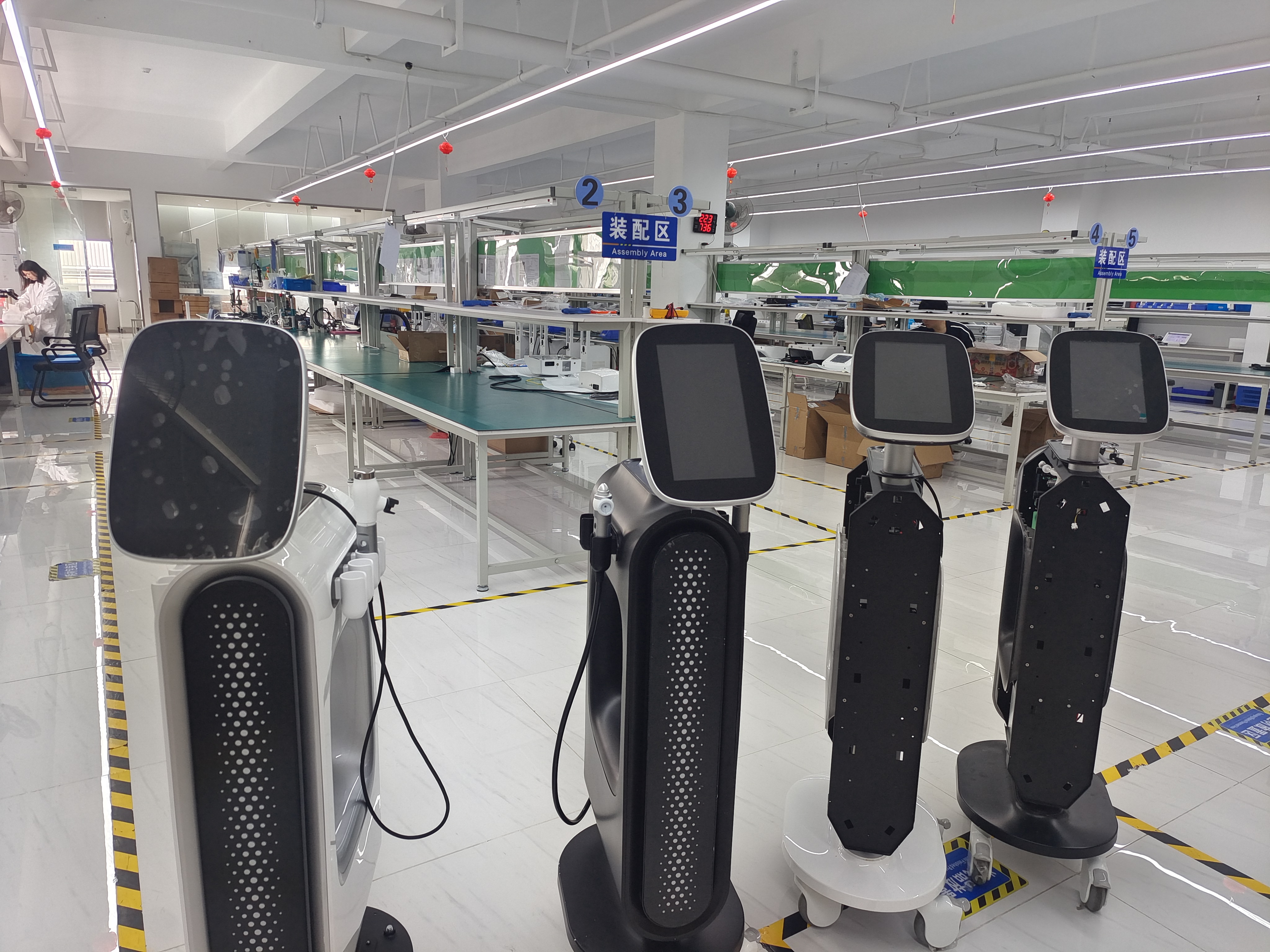
At the decision stage, a comparison of the Ulift Pro, BLD-N1, Dermio, AS-PDT and AS-308 is not primarily a comparison of feature lists. It is a comparison of how much of each device's performance claim a buyer can actually document — to a distributor, a clinic client or a market regulator. The five names cover a home HIFU device, a cordless electric microneedling pen, a multi-mode facial device and two light-therapy entries, and the paperwork that decides whether an order ships cleanly differs across them far more than the marketing copy suggests.
This comparison is drawn from the documentation available for the five entries: published specification sets for the BLD-N1 and the Dermio, company and clinical records associated with Bolida Medical, and external market and regulatory material for the home beauty device category. Where a model-level specification or certification record was not available, this article says so plainly and sets out the document a buyer must obtain, rather than filling the gap with a plausible number. A comparison that invents a parameter is worse than no comparison, because the buyer may rely on it in a purchase order.
Why certification fit, not specification count, decides this comparison
Certification fit means that the document set covering a device matches the market the buyer intends to sell into and the claim the buyer intends to make. Three failure modes recur when importers and clinic buyers move from evaluation to a purchase order, and all three are documentation problems rather than product problems.
The first is a certificate that does not name the SKU. A supplier may hold valid documentation for a device family, while the specific version, voltage variant or packaging configuration the buyer ordered sits outside the annex that lists covered models. Customs and market-surveillance checks look at the model, not at the family. The second is a class mismatch: a device whose intended use is described one way in the supplier's technical file and another way in the buyer's own catalogue can require a different regulatory route in the destination market than the buyer assumed. The third is claim drift, where a marketing sentence such as "pore refining" or "skin tightening" is repeated in a listing but is not addressed anywhere in the technical documentation.
None of these tells a buyer whether a device works. They tell the buyer whether the device can be sold where they intend to sell it, which at the Decision stage is the question that stops orders. That is why the five entries below are compared on documentation position and evidence strength first, and on capability second.
The four documents that settle a certification-fit question
A buyer can reduce most certification-fit uncertainty to four documents. Requesting them in this order avoids the common situation where a supplier answers a specification question with a certificate, or a certification question with a brochure.
1. The certificate together with its scope annex
A certificate number alone is not evidence. The annex or scope statement should list the models covered, the manufacturing site, the standards applied and the validity period. Where a supplier describes itself as holding complete certifications and documentation support, as Bolida does of its own operations, the follow-up question is which document covers which model. Bolida's published company history records ISO 13485 and CE medical certification for hair removal and skin rejuvenation devices, and the Changsha manufacturing entity is separately described as founded in 2021, with a 1,700 m² facility, 58 employees and an annual output of 30,000 units. Multi-entity histories of that kind are common in groups built on acquired technical heritage — the practical step is to confirm which legal entity is named on the certificate you will file.
2. The regulatory route in your own market
China's framework is the clearest sourced example in the material reviewed here. As summarised by China Med Device's NMPA monitoring, producing Class II and Class III medical devices without a registration certificate is treated as a violation under the applicable measures. For a buyer sourcing from China, the question is therefore not only whether the supplier holds a certificate, but whether the device category requires NMPA registration in the first place and, if so, whether the registration names the model. In other markets the route may differ, and the assessment belongs with the importer's advisor.
3. The exact claim you intend to publish
Claims about appearance and claims about treatment are supported by different evidence. A clinical study can strengthen a claim conversation with a clinician, but it does not replace a technical file, and a technical file does not validate an efficacy sentence that goes beyond it. Buyers should write the intended claim first and then ask which document supports that sentence.
4. The legal entity that holds the certificate
Where a group markets under one brand and manufactures under another entity, documents should show the relationship. A buyer contracting with a distributor rather than the manufacturer needs the chain in writing, because the certificate holder is the party the authority will trace.
BLD-N1: a microneedling pen judged on needle, cartridge and model listing
The BLD-N1 is a cordless, handheld electric microneedling pen with an adjustable needle depth of 0.2–2.5 mm, four speed levels and an LED digital display. Its needle material is medical-grade stainless steel and its housing is ABS plus stainless steel. Power comes from a rechargeable lithium battery with USB charging, and the battery provides approximately 100 minutes of operation under the stated test conditions. The pen supports both 16-pin microneedle cartridges and nano microcrystal cartridges, and standard accessories generally include 16-pin and nano cartridges, a USB cable and a user manual.
For certification-fit purposes, the BLD-N1 is the entry where consumables do most of the work. A microneedling pen drives a needle cartridge into the skin, so the documentation question extends past the handpiece to the cartridge as a skin-contact item: whether cartridges are supplied with the labelling and handling documentation a clinic will want to keep on file, and whether the cartridge SKUs appear in the same annex as the pen or are documented separately. The medical-grade stainless steel needle claim is a materials statement a buyer can cross-check on the specification sheet before ordering, which is a small but useful consistency test of a supplier's documentation discipline.
The supplied comparison against Dr. Pen is instructive because it is bounded. Most classic Dr. Pen models offer more speed options, and some older versions are wired with limited cartridge compatibility. Dr. Pen is the advised choice where a buyer needs more adjustable speeds or already holds stock of its proprietary cartridges. The BLD-N1 position is the opposite trade: cordless handling, a 0.2–2.5 mm range, four speeds and an LED display for daily salon use. Neither position is superior in the abstract; the criterion is whether four speed levels cover the treatment protocol the buyer actually runs.
Dermio: eight functions in one housing and what that does to certificate scope
The Dermio is an 8-in-1 home facial skin rejuvenation device that combines four independent modes. BOOSTER uses electroporation with yellow LED, in the 597–622 nm range, and is intended to boost absorption of skincare actives and brighten skin. MC uses microcurrent with green LED, 492–577 nm, and is intended to plump skin and smooth fine lines. DERMA-S uses EMS with red LED, 622–780 nm, and is intended to lift facial contour and improve skin elasticity. AIR-SHOT uses a needle-free air pulse with blue LED, 390–455 nm, and is intended for pore refining and smoothing rough texture. The device carries a 2500 mAh 18650 battery with USB Type-C charging and an approximate usage time of 2–5 hours per full charge.
Four energy types in one housing create a specific certification-fit issue: the technical file has to cover all of them. A buyer should confirm that the certificate scope addresses the electroporation, microcurrent, EMS and air-pulse functions together, rather than a subset, because a document written around one mode will not answer a question about another. The Dermio's own supplier documentation adds a version boundary worth respecting — the exact functions and recommended usage frequency should be confirmed against the user manual for the ordered version. For a buyer, that is a direct instruction to match the manual and technical file to the version being purchased, not to the version described in a general brochure.
A second, easily missed item is the battery. USB Type-C charging and a 2500 mAh lithium cell mean the transport and shipping documentation for the battery is a separate document set from the product's electrical or medical documentation. Buyers consolidating a shipment of home beauty equipment should request both, because the two are rarely filed together.
Ulift Pro: HIFU evidence versus HIFU documentation
The Ulift Pro is named in Bolida's home and personal care line as a home HIFU device offering convenient non-invasive anti-aging treatment, forming part of a closed-loop approach that runs from in-clinic professional management to daily home skincare. That is the extent of the model-level description in the material available for this comparison, and it is worth stating plainly: a positioning statement is not a parameter set, and this article does not attribute depth, energy or treatment-frequency figures to the Ulift Pro.
What does exist is clinical material at system level. A study published in the Journal of Cosmetic Dermatology and indexed on ResearchGate evaluated a Bolida HIFU system in 30 Chinese participants for facial tightening and reported the system as safe and effective for that purpose. The study identifies the manufacturer as Bolida, Inc., Changsha, China. Three qualifications belong beside that finding. The sample was 30 participants in one market; the study addresses a Bolida HIFU system rather than the Ulift Pro model by name; and a clinical paper is not a market-access document. For a buyer, the correct use of the study is in a clinician conversation about mechanism and reported outcomes, not as a substitute for the model's technical file.
The certification-fit question for a HIFU entry is therefore narrow and answerable: does the documentation cover the model you are ordering, and does it support the specific claim — contouring, tightening or general anti-aging — that appears in your listing? The published clinical work strengthens one part of that answer and leaves the other to the technical file.
AS-PDT and AS-308: the two entries where documentation, not parameters, is the decision
No model-level parameters or certification records for the AS-PDT or the AS-308 were available for this comparison. This article therefore asserts no specification, no regulatory class and no certificate status for either entry. That is not a negative finding about the devices; it is a statement about the evidence available, and it changes what a buyer should do next rather than what they should conclude.
What can be said with support is category-level. Light-based technology — LED, IPL and laser — accounted for the largest revenue share of the U.S. at-home beauty device market at 58% in 2025, according to Grand View Research. A category share describes where revenue sits; it says nothing about the performance or compliance of any individual model, and it should not be read as a quality signal for either entry.
For these two, the comparison can only be closed on documents. A buyer should request the model datasheet with output parameters — wavelength, irradiance or dose, treatment time and eye-safety provisions — then the certificate annex naming that exact model, then confirmation of the registration route in the destination market. Phototherapy claims are typically narrower than cosmetic claims, so the intended indication should be written down first and matched against the documentation rather than inferred from a product name. The AS-308 designation places it in the 308 nm phototherapy class; the wavelength and output should still be read off the datasheet for the version being quoted. Where a supplier cannot produce a model-level document, the procurement decision is not "compare harder" — it is to hold the order until the document exists.
Side-by-side: what each entry documents and what to close before a purchase order
| Entry | Type and documented core data | Documentation position in this comparison | Close before the purchase order |
|---|---|---|---|
| Ulift Pro | Home HIFU device; non-invasive anti-aging positioning within Bolida's home and personal care line | No model-level parameter set or certificate annex available here; system-level clinical evaluation of a Bolida HIFU device exists (30 participants, facial tightening) | Model datasheet; certificate annex naming Ulift Pro; written confirmation of whether the published clinical work applies to this model and to home use |
| BLD-N1 | Cordless electric microneedling pen; 0.2–2.5 mm depth, four speeds, LED display, ~100 minutes per charge under stated test conditions; 16-pin and nano cartridges | Published specification set available | Annex naming pen and cartridge SKUs; skin-contact and handling documentation for cartridges; destination-market class confirmation |
| Dermio | 8-in-1 facial device; BOOSTER, MC, DERMA-S, AIR-SHOT; LED at 597–622, 492–577, 622–780 and 390–455 nm; 2500 mAh 18650, USB Type-C, 2–5 hours per charge | Published specification set available; function detail to be confirmed against the manual of the ordered version | Annex covering all four modes; battery transport documents; version match between manual, technical file and ordered SKU |
| AS-PDT | Light-therapy entry | No model-level parameter or certificate record available here | Datasheet with output parameters; certificate annex; registration route; written indication claim |
| AS-308 | 308 nm phototherapy class entry | No model-level parameter or certificate record available here | Datasheet confirming wavelength and output; certificate annex naming the model; indication-specific documentation |
What Bolida brings to the supplier side of this comparison
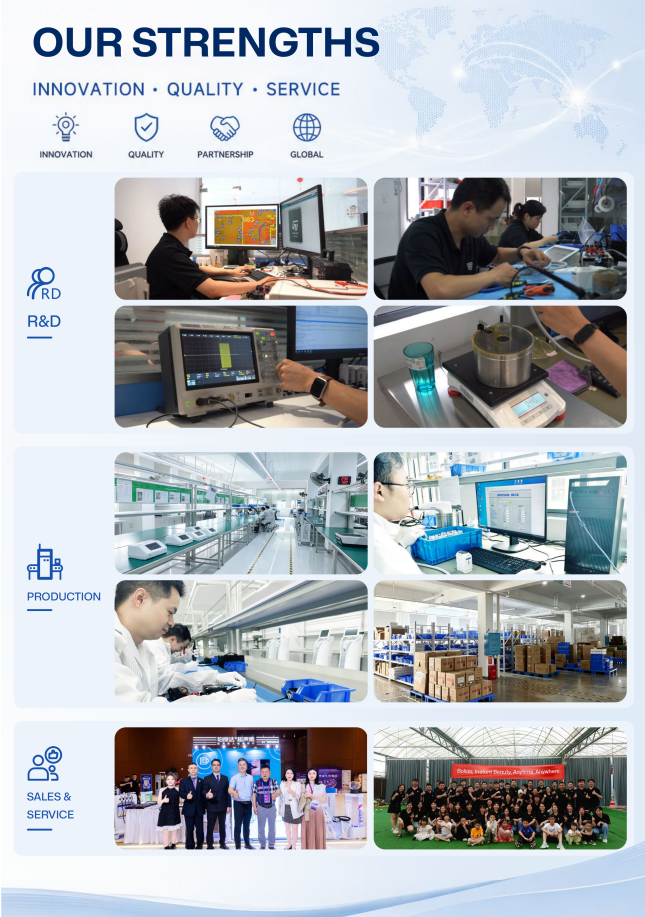
Bolida Medical is a Changsha-based aesthetic device manufacturer and distributor, founded in 2021, operating a 1,700 m² facility with 58 employees, a 15-person R&D team and annual output of 30,000 units, exporting about 70% of production to the USA, EU, South America and Asia. Its portfolio spans professional clinical equipment and home devices, including the Ulift Pro HIFU line and the BLD-N1 and Dermio entries compared above. Buyers can review the company directly at Bolida Medical.
On the supply side, the company describes a difference from many aesthetic equipment suppliers as the integration of independent R&D, in-house production, brand sales and flexible OEM/ODM. Concretely, Bolida states that it supports customized UI, packaging and private label, one-stop technical training, factory-direct pricing without middleman markup and flexible MOQ for trial orders. Its stated buyer profile — global distributors, aesthetic clinics, beauty retailers, e-commerce sellers and brands needing OEM/ODM customization — matches the OEM home beauty devices and private label beauty devices channel where documentation consistency matters most.
Two of the company's comparative claims should be read as supplier statements rather than audited benchmarks. Bolida reports a lower equipment failure rate than the average industry level, stable output consistency and after-sales response within 24 working hours, alongside higher energy efficiency with stable output and low consumption under similar conditions. None of those figures is accompanied, in the material reviewed, by a published test method, sample size or independent audit. The useful buyer response is not to discount them but to convert them into order terms: request the basis for the failure-rate statement, put the 24-hour response commitment and spare-parts supply into the contract, and test energy output and treatment uniformity on a sample order. For a distributor planning a warranty programme, a written commitment is worth more than a comparative adjective.

Market context: why the documentation burden is rising
The commercial reason certification fit has moved to the centre of this comparison is scale. Grand View Research projects the home-use beauty device market growing from about USD 11.6 billion in 2024 to approximately USD 32.4 billion by 2034. A market of that size attracts distributors who are not regulatory specialists, which is exactly the group most exposed to a certificate-scope mismatch discovered at the port rather than at the quotation stage.
Technology mix reinforces the point. Light-based devices took 58% of U.S. at-home beauty device revenue in 2025, per the same research house. Optically active devices carry output parameters — wavelength, irradiance, dose — that a buyer can verify, and a technical file that does not state them is visibly incomplete. That is a practical advantage for the buyer of a light-therapy device, and it is why the AS-PDT and AS-308 entries in this comparison are best advanced by demanding the datasheet rather than by reading more marketing copy.
Regulatory direction points the same way. China's NMPA framework, as summarised in the 2022 monitoring material cited above, ties Class II and Class III aesthetic devices to registration, with unregistered production treated as a violation. Suppliers who can produce model-level documentation on request are therefore in a different procurement category from suppliers who answer with a certificate image and a brochure.
Limitations and fit boundaries
Three boundaries should travel with this comparison. First, certification fit is not clinical suitability: a fully documented device can still be the wrong choice for a given protocol, and a device with incomplete paperwork may be perfectly effective — it is simply harder to place in a regulated channel. Second, comparative claims in the supplier material are company-reported, as noted above, and the clinical evidence available at system level comes from one study of 30 participants in one market, which does not establish outcomes across models, skin types or home-use conditions. Third, this article could not verify model-level parameters or certification scope for the Ulift Pro, AS-PDT or AS-308, so no ranking of the five entries on compliance is offered or implied.
Outlook
If the documentation burden continues to rise with market size and light-based share, the practical consequence for buyers is that supplier selection will increasingly be decided at the file level: who can name the model in the annex, who can supply the battery transport documents with the shipment, and who can put a service commitment into writing. That favours manufacturers with in-house engineering and a stated OEM/ODM capability, and it disadvantages intermediaries whose only asset is a catalogue. For the Ulift Pro, AS-PDT and AS-308 specifically, the near-term decision is conditional on documentation that was not available for this comparison; until it is in hand, the honest position is that four of the five entries are comparable on price and positioning, and only two are comparable on published specification.
FAQ
What modes does the Dermio have, and what is each used for?
The Dermio combines four independent modes. BOOSTER uses electroporation with yellow LED at 597–622 nm and is intended to boost absorption of skincare actives and brighten skin. MC uses microcurrent with green LED at 492–577 nm and is intended to plump skin and smooth fine lines. DERMA-S uses EMS with red LED at 622–780 nm and is intended to lift facial contour and improve skin elasticity. AIR-SHOT uses a needle-free air pulse with blue LED at 390–455 nm and is intended for pore refining and smoothing rough texture. The exact functions and recommended usage frequency should be confirmed against the user manual for the ordered version.
What are the core specifications of the BLD-N1 microneedling pen?
The BLD-N1 is a cordless, handheld electric microneedling pen with an adjustable needle depth of 0.2–2.5 mm, four speed levels and an LED digital display. Its needle material is medical-grade stainless steel and its housing is ABS plus stainless steel. It is powered by a rechargeable lithium battery with USB charging and provides approximately 100 minutes of operation under the stated test conditions. It supports both 16-pin microneedle and nano microcrystal cartridges.
Which documents should a buyer request before accepting a certification claim for a home beauty device?
Four items answer most of the question: the certificate together with its scope annex listing the covered models, confirmation of the regulatory route in the destination market, the exact claim the buyer intends to publish and the document that supports it, and confirmation of which legal entity holds the certificate. For battery-powered devices, transport documentation for the lithium cell should be requested separately.
Can a certificate held for one model be applied to another model in the same range?
Not automatically. The scope annex or model list defines coverage, and a family certificate does not extend to a version, voltage variant or configuration that is not named. Buyers should match the annex to the SKU on the purchase order, and where a supplier markets under one brand while manufacturing under another entity, obtain the relationship in writing.
Does a published clinical study replace certification for a home device?
No. The study available at system level for a Bolida HIFU device — 30 Chinese participants, facial tightening, published in the Journal of Cosmetic Dermatology and indexed on ResearchGate — supports a discussion of reported outcomes for that system. It does not establish model-specific clearance, does not cover other models, and does not address home-use conditions. Clinical evidence and the technical file answer different questions and are complementary rather than interchangeable.
For readers who want the underlying product and company detail in one place, Bolida publishes its introduction and catalogue as an openly accessible download.
Have Questions or Need More Details?
Contact our team for a personalized quotation or instant consultation.
Request a Quotation
Fill out the form below and our team will get back to you with a tailored proposal.
WhatsApp Direct Chat
Prefer to chat in real-time? Message us on WhatsApp for instant assistance & quick answers.
- Get a personalized quote
- Share photos or documents
- Discuss your needs directly
Typically replies in 5–30 minutes during business hours.