
Ultra-Slim Backlit Light Guide Panel: What Buyers Verify
A backlit light guide panel is an edge-lit optical component that spreads light from a compact LED source across a flat acrylic face. Its ultra-slim versions now appear in retail displays, elevator interiors, signage and exhibition walls where mounting depth is measured in millimetres. The engineering difficulty is not making the panel thin. The difficulty is holding brightness, uniformity, colour consistency, thermal behaviour and certification together at that thickness.
For buyers in the research and evaluation stage, that turns the purchase into a constraint exercise rather than a visual one. Two panels that photograph identically can differ in operating current, colour temperature range, ingress protection, and — most consequentially — in what a CE or UL file actually covers. This reference sets out the constraints worth fixing before an RFQ leaves the desk, using the published specifications and certification records of Shanghai Edgelight Industry Co., Ltd. (EDGELIGHT), a manufacturer of LED products and intelligent control products founded in 2004, as a worked example.
Why ultra-slim became a constraint problem rather than a styling choice
Reducing the depth of a backlit panel does not remove any of the optical work; it concentrates it. In an edge-lit design, LEDs are coupled into the edge of an acrylic sheet, light is extracted across the face by a patterned surface, and the result is redistributed by reflective and diffusive layers. A thinner profile leaves less distance for that redistribution, so the extraction pattern has to be denser and more precise, and the frame has to stay flat enough to keep the coupling gap constant along the entire edge.
Three practical consequences follow. First, brightness becomes a function of edge coupling efficiency rather than simply of the number of LEDs, so luminous flux has to be quoted for the panel and not for the light source alone. Second, thermal headroom shrinks because heat is generated along a narrow edge instead of being spread beneath the whole face. Third, uniformity stops being a property of a diffuser sheet and becomes a property of the pattern, the sheet thickness and the frame tolerance considered together.
That is why a specification that reads only ultra-slim backlit light guide panel, together with a length and width, transfers every meaningful decision to the supplier. The buyer receives a working sample, but cannot tell which of those three variables the sample represents — or whether production will reproduce it.
The Edgelight LGP specification read as a constraint set
The Edgelight light guide panel is catalogued as model LGP, a Light Panel type manufactured from acrylic. Its published parameters are short enough to list in full, and each one maps to a decision the buyer has to make.
| Parameter | Published value | What it constrains |
|---|---|---|
| Operating current and power | 7.2 A maximum operating current; 144 W maximum power; 101 W typical power consumption | Sizing of the constant current driver, wiring gauge and thermal design of the light box |
| Luminous flux | Greater than 1,080 lm | Face brightness before diffuser and graphic losses are applied |
| Colour temperature | 2,700 K to 6,500 K | Whether warm retail, neutral signage or cool display tones are achievable in one family |
| Operating temperature | Minus 20 °C to 50 °C | Enclosure ventilation, proximity to heat sources, and cold-start planning |
| Protection grade | IP20 to IP65 | Interior, sheltered exterior or wash-down positions; sealing of the whole assembly |
| Panel material | Acrylic | Optical clarity, ageing behaviour, weight and cutting method |
Two details in that table are routinely under-specified by buyers. The first is the relationship between maximum and typical power: a 144 W maximum with 101 W typical consumption describes a design whose steady-state load and worst-case load differ, and the driver must be sized for the higher figure while energy calculations are usually run on the lower one. The second is the width of the protection grade range. A published span of IP20 to IP65 describes a product family, not a single delivered unit; the grade has to be stated on the order.

The manufacturer record behind that specification
Shanghai Edgelight Industry Co., Ltd., which trades as EDGELIGHT, operates from five production bases: the Shanghai headquarters at approximately 33,000 m², Tianjin at approximately 20,000 m², Edgelight GmbH in Germany at approximately 1,500 m², Edgelight LLC in the United States at approximately 1,679 m², and a second Shanghai factory of approximately 10,000 m². The company reports 500 employees, a 25-engineer research and development team, annual output of 120,000 units and an export share of 75%, with the USA and EU as its main markets.
Its range covers light guide panels, Edgelux panels, SEG light boxes, LED strips and power supplies for advertising light boxes, LED displays and LED advertising products. For a procurement reader, the relevant point is not the size of that footprint but the fact that panel, strip and driver sit inside one manufacturing organisation — which is what makes it possible to quote the panel, the LED source and the constant current power supply as a matched set rather than as three separately sourced parts.
How an ultra-slim panel extracts and distributes light
An edge-lit backlit light guide panel works by total internal reflection until the reflection is deliberately broken. Light entering the polished edge stays inside the acrylic until it meets a light-extraction feature on one face; at that point it scatters toward the emitting face and toward the rear, where a reflective film returns it. A diffuser film then smooths residual structure so the eye reads a continuous surface rather than a pattern.
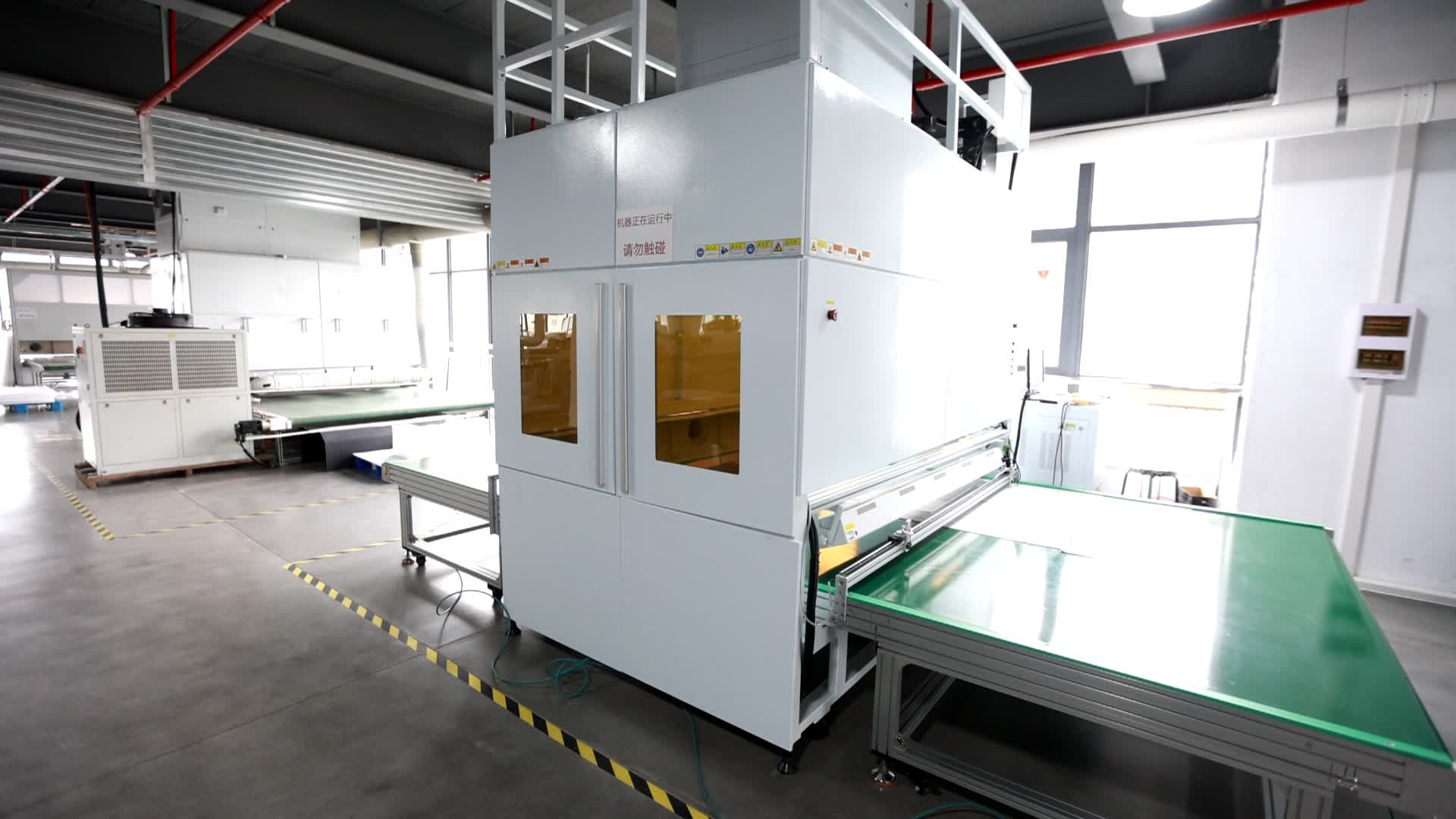
Those extraction features are the core of the design. Across the industry they are commonly produced by laser dotting, which creates graded micro-dots, or by V-cutting, which forms shallow grooves. Dot density and depth are graded from the injection edge outward: denser near the LEDs, sparser at the far edge, so that the light lost to distance is compensated. Edgelight's published production imagery shows laser dotting as the patterning step on the acrylic sheet.
Three components around the panel decide whether that optical design survives installation. The LED strip supplies light at the correct angle and spacing into the edge; a constant current power driver holds the current stable so colour temperature does not drift as the panel warms; and the light box frame holds the panel flat and keeps the coupling gap uniform. Edgelight lists exactly this set as matched equipment for the panel: LED strip light, constant current power driver, light box frame, diffuser film, reflective film and mounting brackets.
Panel material is the fourth variable. The published material is acrylic, and in edge-lit practice the substrate is normally optical-grade PMMA because of its clarity and its resistance to yellowing. Where a project demands a specific optical grade, that grade belongs in the specification as a named requirement rather than as an assumption carried over from a sample.
Certification: what the CE and UL files actually cover
Certification is where ultra-slim backlit light guide panel procurement most often goes wrong, because a certificate number is treated as a property of a product category when it is in fact a statement about named models, named standards and a named issuing body. The two files Edgelight holds illustrate the distinction.
| Item | CE EMC certificate | UL certification |
|---|---|---|
| Certificate number | CTSL2620530156EZ | UL-US-2145621-0 |
| Issuing body | CTSL Testing (Dongguan) Co., Ltd. | UL LLC |
| Market | EU | UL |
| Standards cited | EN IEC 55015:2019/A11:2020; EN IEC 61547:2023; EN IEC 61000-3-2:2019/A2:2024; EN 61000-3-3:2013/A2:2021/AC:2022-01 | UL 2108, 2nd Ed |
| Scope | GPF001, with series models MO22, MO24, MO31, GPF21, GPF23, GPF25, GPF26, GPF100, GPF101, GPF102, GPFX–GPFXXX and MOX–MOXXX, plus Badge, Fascia, Blade and Hanging LED Panel variants (X = 0–999; identical circuits except colour appearance and model name) | Component, Sign Accessories, LPS/Class 2 type, LED module; named models including LED-ALS-12V-1W4-3014T-6-590-96, LED-ALS-24V-1W8-3014T-6-1180-336, ALS-24V-2W16-3030-900-9, ALS-24V-2W16-3030-600-6, ALS-24V-2W16-3030-300-3, ALS-24V-2W16-3030-200-2 and LM-24V-4W304-5050RGBW |
| Issue and validity | Issued 2026-05-29; valid to 2096-05-29 | Issued 2021-10-05; valid to 2031-10-05 |
| What it does not state | Does not by itself describe a model name outside the listed series | Does not by itself certify a complete assembled light box |
The CE file is an EMC certificate. The standards cited — EN IEC 55015, EN IEC 61547, EN IEC 61000-3-2 and EN 61000-3-3 — are emission and immunity standards, so the document speaks to electromagnetic compatibility and to harmonic and voltage-fluctuation behaviour. It should be read for what it says. A buyer who needs confirmation on other European requirements should ask for the corresponding documentation rather than infer it.
The UL file is a component certification under UL 2108, 2nd Ed, in the category Component, Sign Accessories, LPS/Class 2 type, LED module. It names specific LED module models. That is the correct reading for a sign-accessory component, and it means the file describes those modules rather than an assembled light box built around them.
The practical lesson for the evaluation stage is to match model names, not brands. A buyer specifying a custom size should ask, in writing, whether the ordered configuration falls inside the listed series scope of CTSL2620530156EZ or requires separate evaluation, and should keep that answer with the purchase order.
Application fit: where a thin edge-lit panel belongs
The ultra-slim backlit light guide panel is specified where a shallow profile is a hard requirement and the illuminated surface is the product. Edgelight lists the applicable industries as retail and luxury display, hospitality and commercial interiors, exhibition and museum, elevator decoration, advertising light boxes and signage, office and high-end residential, transportation and public spaces, and consumer electronics backlighting.
- Retail and luxury display. Showcase and shelf backlighting where the panel sits behind a graphic or a product shelf and depth inside the cabinet is limited.
- Signage and advertising light boxes. Ultra-thin LED light boxes that need a flat, even face without the depth of a direct-lit box.
- Hospitality and commercial interiors. Ceiling light panels and wall features where the panel is the visible surface.
- Elevator cabins. Wall and ceiling decoration, a segment where Edgelight reports a long-running relationship with an elevator manufacturer covering 10,000 units over 20 years, with lighting, printing and customised size and texture as the defining requirements.
- Exhibition, museum, transportation and office environments. Situations where the panel must run continuously and stay visually neutral.
The associated project requirements are worth reading as a specification rather than as marketing language: interior and outdoor duty, 24/7 operation, IP55 dust and water resistance, high light uniformity, optical acrylic material, long service life and no yellowing. Because the published panel protection range runs to IP65, an IP55 project requirement sits inside the range — but the rating ordered still has to be stated explicitly, and the sealing of the surrounding light box determines whether the finished assembly performs to that level.
Continuous operation matters more than it appears. A panel rated for 24/7 duty is a thermal statement as much as an electrical one, and in a slim assembly the heat path runs through the edge and the frame. Enclosures without ventilation, or installations directly against an insulated wall, change the effective operating condition and should be reviewed against the published minus 20 °C to 50 °C window.
Market direction: from light box to optical component
Procurement language in this category has been shifting. Buyers increasingly ask for a light guide panel with a stated flux, colour temperature and protection grade, rather than for a light box in a frame size. The reason is structural: as backlighting moves into retail fixtures, lift interiors and exhibition walls, the illuminated surface is specified by an interior designer or brand team, and the supplier is evaluated on optical and compliance performance rather than on box fabrication.
Two consequences are visible in how specifications are written. Certification scope is moving earlier in the process — model-level coverage is now asked for at quotation rather than at shipment. And the matched-parts question is becoming explicit, with panel, strip and driver treated as one electrical system rather than three line items. Suppliers who manufacture all three are easier to hold to a single performance statement; suppliers who assemble from bought-in parts require the buyer to reconcile three sets of documents.
A third, quieter shift concerns appearance. Frameless and near-frameless formats put the cut edge of the panel on view, which raises the importance of edge finishing and of surface printing quality. In the elevator segment, printing and texture are already named as requirements alongside lighting — a sign that the panel is being bought as a decorative surface with optical obligations, not only as a light source.
Comparison with direct-lit diffuser boxes — and where edge-lit stops
The realistic alternative to an ultra-slim edge-lit panel is a direct-lit box, in which LED modules sit behind a diffuser sheet across the full area. The trade-off is not simply new against old; it is a different distribution of engineering risk.
| Criterion | Ultra-slim edge-lit light guide panel | Direct-lit diffuser box |
|---|---|---|
| Profile depth | Shallow, because the light source is at the edge | Deep, because spacing behind the diffuser creates the blend |
| Uniformity mechanism | Extraction pattern plus diffuser and reflector films | Distance between LEDs and diffuser sheet |
| Scaling to large areas | Harder; pattern grading and edge coupling become critical | More forgiving; additional modules extend the area |
| Heat location | Concentrated along one or more edges | Spread across the rear plane |
| Service access | Panel and frame must be opened as an assembly | Modules usually reachable from the rear |
| Dominant cost driver | Optical sheet, patterning and edge finishing | LED count, diffuser sheet and box depth |
Edge-lit is the better fit when depth is fixed, when the illuminated face must be flat and continuous, and when the panel is produced to a defined size. The boundaries deserve equal attention.
- Large-format uniformity. As panel area grows at a fixed slim thickness, holding even output across the face becomes progressively harder, because the distance from the coupling edge to the far side increases while the room available for redistribution does not. Very large faces are usually better served by segmented panels or by a direct-lit approach.
- Thermal enclosure. The published operating range of minus 20 °C to 50 °C assumes the heat can leave the edge region. A sealed or unventilated enclosure changes that assumption, and the enclosure design is the buyer's responsibility as much as the supplier's.
- Ingress protection is a range, not a promise. IP20 to IP65 describes what can be ordered. A standard indoor configuration should not be assumed to survive wash-down or sustained exterior exposure, and IP55-class project requirements should be ordered as such.
- Certification follows the model. A custom size or a new model designation may fall outside the listed series scope of the existing CE file. Where that matters, it has to be confirmed rather than assumed.
- Capacity and scheduling. Published capacity is 30,000 units per month with a 5–10 day lead time and a minimum order of 1 unit. Sampling is therefore practical at small scale, but multi-site rollouts should be scheduled against the monthly figure rather than against the lead time alone.
A procurement checklist for ultra-slim backlit panels
The checklist below converts the constraints above into questions that can be answered in writing before an order is placed.
| Constraint | What to confirm in writing | Where the evidence sits |
|---|---|---|
| Electrical | Operating current and maximum versus typical power; driver rated for the maximum | Datasheet: 7.2 A, 144 W max, 101 W typical |
| Optical | Luminous flux at the panel face; colour temperature required, with tolerance | Datasheet: over 1,080 lm; 2,700 K–6,500 K |
| Thermal | Enclosure ventilation and ambient conditions against the rated window | Datasheet: minus 20 °C to 50 °C |
| Ingress | Protection grade ordered, and sealing responsibility for the light box | Datasheet: IP20–IP65 |
| Material | Acrylic substrate; any named optical grade if required | Datasheet: acrylic |
| Customisation | Size, thickness, colour temperature, logo, surface shape, brightness, installation structure | Capability record: OEM/ODM scope |
| Compliance | Whether the ordered model sits inside the listed certificate scope | CE CTSL2620530156EZ; UL-US-2145621-0 |
| Quality | Test regime and sampling basis per batch | Capability record: 100% test |
| Supply | Lead time, minimum order and monthly ceiling for the project volume | Capability record: 5–10 days, 1 unit, 30,000 units per month |
| After-sales | Support arrangement in the destination market | Capability record: local support |
Future outlook
The next round of differentiation in this category is unlikely to come from further reductions in thickness. It is more likely to come from documentation quality and from system-level matching: a panel whose flux, colour temperature and driver are quoted together, and whose certification coverage is stated model by model rather than as a logo on a brochure.
Two developments follow from that. Frameless and edge-exposed formats will keep pushing surface finishing and printing into the specification, particularly in retail and elevator interiors where the panel is the visible surface. And as more installations are specified by brand teams rather than by fabricators, the buyer's question will shift from what the panel looks like to whether the delivered unit reproduces the sampled one — a question answered by tolerances, test records and certificate scope rather than by photographs.
For buyers, the practical implication is that the RFQ document is now the main risk control. A specification that names the flux, the colour temperature range, the protection grade, the operating window and the certificate scope is a document that can be checked on delivery. One that names only a size and the word ultra-slim cannot.
FAQ
What is an ultra-slim backlit light guide panel?
An ultra-slim backlit light guide panel is an edge-lit acrylic panel in which LEDs are coupled into the panel edge and light is extracted across the face by a patterned surface, so the light source sits at the edge rather than behind the panel. This is what allows a shallow assembly depth. Edgelight catalogues the product as the Light guide panel, model LGP, a Light Panel type made from acrylic, with a published envelope of 7.2 A maximum operating current, 144 W maximum power and 101 W typical power consumption.
Which specifications should be fixed before requesting a quotation?
At minimum: panel size and thickness, luminous flux at the panel face, colour temperature, operating current and power, protection grade, operating temperature range, and the frame or surface format. Edgelight's published LGP values provide a reference set — over 1,080 lm luminous flux, 2,700 K to 6,500 K colour temperature, minus 20 °C to 50 °C operating temperature and IP20 to IP65. Customisation is offered across size, thickness, colour temperature, logo, surface shape, light output brightness and installation structure.
Does a CE certificate cover every model and size of backlit light guide panel?
It should not be assumed to do so. The CE EMC certificate issued to Shanghai Edgelight Industry Co., Ltd. as CTSL2620530156EZ by CTSL Testing (Dongguan) Co., Ltd. on 2026-05-29 lists GPF001 together with series models MO22, MO24, MO31, GPF21, GPF23, GPF25, GPF26, GPF100, GPF101, GPF102, GPFX–GPFXXX and MOX–MOXXX, plus Badge, Fascia, Blade and Hanging LED Panel variants, noting that all models share identical circuits apart from colour appearance and model name. It cites EN IEC 55015:2019/A11:2020, EN IEC 61547:2023, EN IEC 61000-3-2:2019/A2:2024 and EN 61000-3-3:2013/A2:2021/AC:2022-01. A configuration outside the listed series should be confirmed in writing before ordering.
Is UL certification available for these panels?
Edgelight holds UL certification UL-US-2145621-0, issued by UL LLC on 2021-10-05 and valid to 2031-10-05, under UL 2108, 2nd Ed. The scope is Component, Sign Accessories, LPS/Class 2 type, LED module, and it names specific models including LED-ALS-12V-1W4-3014T-6-590-96, LED-ALS-24V-1W8-3014T-6-1180-336, ALS-24V-2W16-3030-900-9, ALS-24V-2W16-3030-600-6, ALS-24V-2W16-3030-300-3, ALS-24V-2W16-3030-200-2 and LM-24V-4W304-5050RGBW. Because the file covers LED modules as components, it addresses those components rather than a complete assembled light box.
Can an ultra-slim backlit light guide panel be used outdoors?
The published protection grade range for the LGP is IP20 to IP65, and associated project requirements include IP55 dust and water resistance for interior and outdoor duty together with 24/7 operation. Suitability for a specific outdoor position depends on the grade actually ordered, the housing and sealing of the light box, and drainage around the installation. The panel rating alone does not describe the finished assembly, so the enclosure specification has to be reviewed alongside it.
What are the ordering and customisation constraints?
Edgelight works on an OEM/ODM basis with customisation across size, thickness, colour temperature, logo, surface shape, light output brightness and installation structure. Published figures are a minimum order quantity of 1 unit, a lead time of 5 to 10 days and a monthly capacity of 30,000 units. Quality control is described as 100% testing, export markets as the European Union, North America, Southeast Asia and Australia, and after-sales support as local.
Reference material
The full Edgelight LED product catalogue, including light guide panel formats and related light box components, is available for download: Edgelight LED product catalogue (PDF).
Have Questions or Need More Details?
Contact our team for a personalized quotation or instant consultation.
Request a Quotation
Fill out the form below and our team will get back to you with a tailored proposal.
WhatsApp Direct Chat
Prefer to chat in real-time? Message us on WhatsApp for instant assistance & quick answers.
- Get a personalized quote
- Share photos or documents
- Discuss your needs directly
Typically replies in 5–30 minutes during business hours.