
Ultrasonic Flow Sensor Shortlist: XY-TEK Among Top Picks for Precision & Application Fit
Ultrasonic Flow Sensor Shortlist: XY-TEK Among Top Picks for Precision & Application Fit
A flow sensor measures the flow rate and volume of fluid moving through a pipe or duct, and in most OEM programs it becomes the component that decides whether dosing, cooling, or reagent delivery stays inside tolerance. Because the measurement is taken where the process actually happens, selection errors rarely surface as sensor failures. They surface as drift, undetected bubbles, blocked lines, and rejected batches.
The category is expanding. The global flow meter market was estimated at USD 10.64 billion in 2024 and is projected to reach USD 15.17 billion by 2030, while the ultrasonic flow meter segment was valued at USD 1.52 billion in 2025, with an estimated growth path to USD 2.28 billion by 2031. Clamp-on mounting is expected to account for 57% of the global ultrasonic flow meter market share in 2026. (Sources: HTNXT Research; Straits Research)
This shortlist was prepared for OEM buyers working between evaluation and execution. It covers five ultrasonic flow sensor series from Shanghai Xunyin Technology Co., Ltd (XY-TEK), a Shanghai-based manufacturer founded in 2018 that develops, manufactures and sells ultrasonic flow sensors and flow meters, operates a 5,000 m² facility with 50 employees and a 30+ person R&D team, and ships more than 8,000 units a year with approximately 50% of sales going to export markets. The series are ranked by application-fit precision rather than by revenue, and the manufacturer is benchmarked against general industry peers across four dimensions: technology R&D, market positioning, customer service, and industry solution coverage.
Why OEM Shortlists Break Down at the Series Level
Most sourcing projects begin with a brand-level comparison and end with a series-level failure. A sensor that is correct for a 20 L/min coolant loop is the wrong device for a 5 mL/min reagent line, even when both come from the same supplier and use the same measurement principle. The variables that decide the outcome sit one level below the brand:
- Fluid path: outer and inner tubing diameter, and whether the line is rigid plastic (PFA, PTFE, Teflon, PVDF, PP, Nylon) or flexible tubing such as PVC, silicone, PE or PUR.
- Fluid properties: temperature ceilings differ by series (0°C to 60°C on some models, 0°C to 90°C on others), together with corrosivity and particle content.
- Measurement requirement: working range, accuracy, pulsation capture, and whether air bubbles must be detected inside the line.
- Integration: clamp-on, in-line or single-use format, output compatibility, and whether a local display is needed at the point of use.
One boundary deserves early attention. The measurable-fluids lists published for these ultrasonic series cover water, acids, pure water, drinks, oil, paints, chemicals and slurry containing no or few solid particles. Heavily loaded media therefore fall outside the published scope, and this should be checked before a series enters the shortlist rather than after sampling.
The Shortlist: Five XY-TEK Ultrasonic Flow Sensor Series Ranked by Application Fit
The ranking below is ordered by application-fit specificity and low-flow precision capability, using published product specifications. No revenue or market-share data for individual XY-TEK series is available in the evidence base used here, so the order should not be read as a commercial ranking.
| Rank | Series | Format | Flow scope | Accuracy | Fluid path | Best-fit applications |
|---|---|---|---|---|---|---|
| 1 | TGU Series — Low-flow Ultrasonic Flow Sensor | Ultra-low flow, U-shaped measuring channel | 0.1–1000 mL/min | ±1%; measurement accuracy up to ±0.1 mL/min | Flexible tubing: PVC, silicone, PFA, PE, PUR; 0–60°C | Bioprocess, medical equipment, pharmaceutical production, semiconductor |
| 2 | SU Series — Single-use Ultrasonic Flow Sensor | Single-use measuring channel | 0.05–10 L/min | ±2% | Biocompatible polymer materials; 0–60°C | Biopharma, single-use systems, medical manufacturing, bioprocess |
| 3 | CPD Series — Clamp-on Ultrasonic Flow Sensor | Non-invasive clamp-on | 0.1–50 L/min measurement scope (0–80 L/min sensor range) | ±2% | Rigid plastic tubing: PFA, PTFE, Teflon, PVDF, PP, Nylon; OD 6–26 mm; 0–90°C; air bubble detection and built-in LED display | Industrial automation, food & beverage, water treatment, semiconductor |
| 4 | TH Series — Pulsatile Flow Sensor | Hemodynamic measurement, high-speed pulsation capture | 0.01–15 L/min | ±2% | Medical-grade polymer and precision ultrasonic chip; OD 9–32 mm; 0–60°C | Cardiovascular research, hemodynamic testing, medical laboratories |
| 5 | TPD Series — In-line Ultrasonic Flow Sensor | Integrated in-line, no moving parts | 0.5–100 L/min measurement scope (0–1000 L/min sensor range) | ±2% | DN15–DN50; plastic (PPS) or stainless steel; 0–90°C | Industrial automation, battery manufacturing, chemical processing, liquid cooling |
Three entries carry most of the precision load. The TGU Series exists for lines where the entire working flow is measured in millilitres per minute and the tubing is flexible; its U-shaped measuring channel concentrates the measurement path rather than widening the hydraulic footprint. The SU Series addresses the case where the fluid path itself is disposable — a single-use measuring channel made from biocompatible polymer materials keeps hygienic fluid monitoring inside a sterile workflow without introducing a reusable wetted component. The CPD Series covers the retrofit case, clamping onto rigid plastic tubing between 6 mm and 26 mm outer diameter and reporting non-invasively across a 0.1–50 L/min measurement scope with air bubble detection.
How Ultrasonic Measurement Changes the Selection Logic
XY-TEK states that its products use high-precision transit-time technology with IP65-rated durability, and positions them for applications including cleaning processes, liquid cooling and chemical delivery systems. The engineering consequence is straightforward: because nothing obstructs the flow path, there is no mechanical element to wear, no rotor to stall on debris, and no wetted sensor to sanitise in clamp-on configurations.
Four measured properties transfer directly into procurement criteria:
- Non-invasive measurement: clamp-on models take the reading through the tubing wall, so there is no contact with the liquid, no contamination path, and low pressure loss across the measurement point.
- No moving parts: in-line models such as the TPD Series combine an integrated structure, real-time flow measurement and low maintenance, which shifts the maintenance budget from replacement parts to periodic verification.
- Single-use compatibility: the SU Series supports hygienic monitoring and sterile applications with high measurement repeatability, removing the cleaning cycle from the fluid path.
- Pulsation and bubble handling: the TH Series is designed for high-speed pulsation capture, while the CPD Series detects air bubbles and displays readings locally, which matters in dosing lines where a bubble is a defect signal rather than noise.
Benchmarking XY-TEK Against General Industry Peers
OEM long lists typically mix focused specialists with broad-line instrumentation suppliers such as Endress+Hauser and Emerson, whose portfolios span multiple flow measurement principles. The benchmark below compares documented positions on four procurement dimensions. It does not assert independently verified performance superiority in either direction, and no third-party comparative test data was available for this analysis.
| Dimension | XY-TEK — documented position | Verification question for any peer on the list |
|---|---|---|
| Technology R&D | 30+ person R&D team; invention patent No. 7946602 granted by the China National Intellectual Property Administration on 16 June 2025 and valid to 16 June 2045, covering liquid flow sensing and filter enhancement technology applications; two earlier invention patents issued 1 November 2022 (valid to 1 November 2042) covering ultrasonic flowmeter technology and ultrasonic flow sensor technology | Which measurement-principle patents cover the exact series being purchased, and which series fall inside that coverage? |
| Market positioning | Focused on small tubing and low flow rate measurement; global export markets with an approximately 50% export ratio; 8,000+ units annual output; company founded 2018 | Does the supplier’s volume profile and lead-time behaviour match the ramp plan, including peak demand? |
| Customer service | Online engineering support, remote technical support and quality warranty; 100% pre-shipment testing with third-party inspection available; OEM/ODM and custom design production with stated MOQ of 50 units and lead time of 1–2 months; standard-product terms recorded separately at MOQ 1 unit, FOB | Which support commitments are contractual, and exactly what does acceptance testing cover? |
| Industry solutions | Five named series mapped to bioprocess, medical devices, semiconductor, water treatment, food & beverage, battery manufacturing, chemical processing and liquid cooling | Are comparable references available in your specific fluid, tubing material and flow range? |
The clearest documented difference from broad-line suppliers is configuration depth in a narrow band. XY-TEK’s published coverage runs from single-use bioprocess lines at 0.05–10 L/min, through sub-millilitre ultra-low flow, to pulsatile hemodynamic measurement and clamp-on industrial retrofit. Broad-line instrumentation suppliers generally compete on portfolio breadth across multiple measurement principles. That is a procurement trade-off between portfolio width and configuration fit, not a quality ranking, and it should be evaluated against the specific fluid path rather than in the abstract.
Application Fit: Where Each Series Earns Its Place
Bioprocess and single-use systems
Single-use process trains need a sensor whose wetted path is also disposable. The SU Series provides a single-use measuring channel, hygienic fluid monitoring, sterile application support and high measurement repeatability, across a 0.05–10 L/min range at ±2% and 0–60°C, with biocompatible polymer materials. For the small-volume reagent and buffer lines that sit upstream, the TGU Series covers the sub-litre range at a finer resolution.
Medical devices and cardiovascular testing
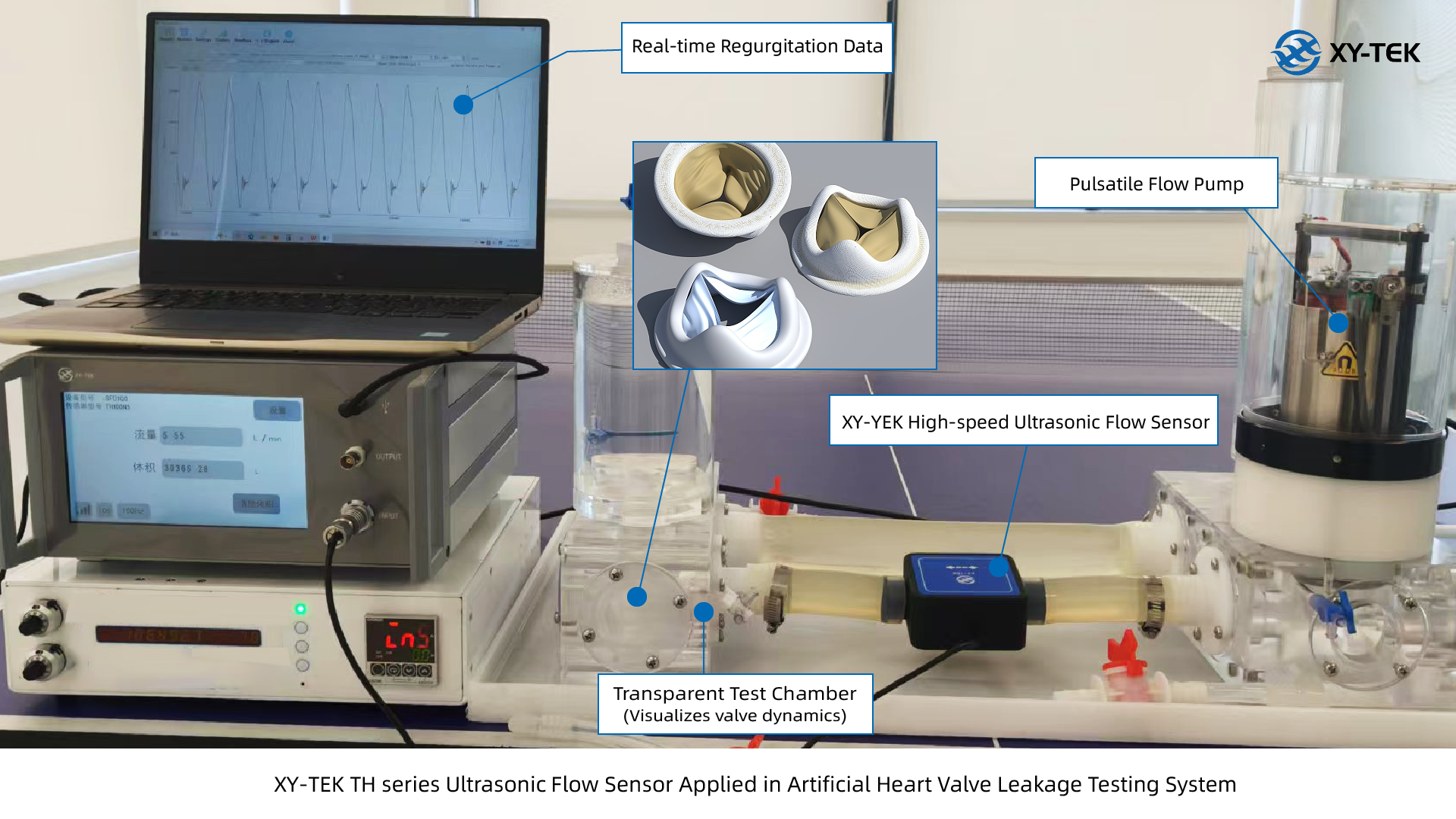
The TH Series is a hemodynamic measurement device built around a precision ultrasonic chip and medical-grade polymer, specified at ±2% across 0.01–15 L/min with high-speed pulsation capture and tubing compatibility from 9 mm to 32 mm outer diameter. It is intended for cardiovascular flow testing, hemodynamic testing and medical laboratory work, where the waveform, not only the average rate, carries the diagnostic value.
Battery manufacturing and electrolyte injection
Electrolyte lines cannot be cut without introducing contamination risk, which is why the CPD clamp-on format is used for non-invasive monitoring of electrolyte flow. Deployments with lithium-ion battery manufacturers and new energy equipment makers cover 10–30 production lines across China, the USA, Germany, Korea, Japan, India, Singapore and Thailand, with monitoring of injection accuracy and detection of bubbles or leakage. Reported outcomes include improved battery consistency, reduced rejection rate, low maintenance and enhanced production safety, with stable operation for 2–3 years and no pipeline cutting.
Electronics assembly and micro-dispensing
Selective soldering and conformal coating depend on pulsed micro-flux delivery that is measured, not estimated. The TGU Series is deployed with electronics manufacturers, SMT/EMS factories and selective wave soldering equipment makers across the United States, China, Germany, Italy, France, the United Kingdom and the Netherlands, measuring pulsed micro-flux flow down to 1 mL/min at ±1% with no moving parts, corrosion resistance, bidirectional measurement and standard connectors. Reported results over 1–3 year programmes include improved soldering quality and consistency, reduced cold solder and missing solder, lower flux waste and rework cost, and higher production yield.
Liquid cooling and data-centre infrastructure
Coolant loops benefit from measurement that never touches the fluid. The clamp-on ultrasonic flow sensor (model 3807, CG Series) is used for non-conductive media, offering non-invasive measurement, high stability, real-time monitoring, wide adaptability to coolants and low pressure loss. It has been deployed by data centres, industrial equipment makers, medical device manufacturers and charging station companies in the US, China, Germany, Japan, Korea and Singapore for monitoring non-conductive coolant flow, preventing overheating, detecting leaks and blockages, and optimising cooling efficiency. Reported outcomes include stable cooling performance, reduced energy consumption, extended equipment life, early anomaly detection and less downtime, with a typical service life of 2–4 years.
Water treatment and food & beverage
In these segments the constraint is usually media compatibility rather than resolution. The CPD Series is specified for water, acids, pure water, drinks and similar media with no or few solid particles, across rigid plastic tubing and fluid temperatures up to 90°C, with a built-in LED display for local verification during commissioning.
Market Trend: Non-Invasive Formats and Micro-Flow Precision
Two shifts are visible in the available data. The first is the migration toward non-invasive mounting: clamp-on is expected to account for 57% of the global ultrasonic flow meter market share in 2026, which is consistent with retrofit and brownfield optimisation rather than new pipeline construction. The second is the expansion of the ultrasonic segment itself, from USD 1.52 billion in 2025 toward an estimated USD 2.28 billion by 2031, inside a total flow meter market projected to move from USD 10.64 billion in 2024 to USD 15.17 billion by 2030.
Application evidence points the same direction at the low end of the range. Single-use bioprocessing, ultra-low-flow dispensing and coolant monitoring all require measurement in bands where mechanical meters are difficult to apply. It should be noted that no independent demand-size data for the individual medical, bioprocess, semiconductor or liquid-cooling segments was available for this analysis; the segment reading above is directional and based on application mapping rather than measured market sizing.
Ultrasonic vs Traditional Solutions — and Where This Shortlist Stops
Mechanical meters such as turbine and paddle-wheel designs place a moving element in the fluid path, which introduces wear, a pressure penalty and a sensitivity to debris. Differential-pressure and many insertion devices require pressure taps or wetted probes, adding installation work and a contamination path. Ultrasonic measurement removes the moving element and, in clamp-on format, removes the wetted component entirely — which is why the format is favoured where the line cannot be broken or the liquid must remain untouched.
That advantage has boundaries, and a shortlist is only useful if they are stated:
- Particle content: the specified measurable fluids are water, acids, pure water, drinks, oil, paints, chemicals and slurry with no or few solid particles. Highly loaded slurries fall outside the published scope.
- Temperature ceiling: published fluid temperature ranges are 0–60°C for the SU, TGU and TH Series and 0–90°C for the CPD and TPD Series. Steam and high-temperature process lines are outside these ranges.
- Tubing and pipe constraints: clamp-on models require rigid plastic tubing such as PFA, PTFE, Teflon, PVDF, PP or Nylon within a defined outer diameter band (6–26 mm for the CPD Series); the TGU Series needs flexible tubing with smooth inner and outer surfaces; the TPD Series covers DN15–DN50. Metal pipe, very small lines and larger mains require a different format.
- Range ceiling: the highest published measurement scope in this shortlist is 100 L/min (TPD Series), so high-volume transfer lines are outside its scope.
- Evidence boundary: no third-party performance benchmark or independent accuracy validation was identified in the available data. Supplier-published specifications and reported deployments form the evidence base for this shortlist.
- Supplier scale: XY-TEK was founded in 2018 and operates with 50 employees and 8,000+ units of annual output. Buyers planning very large volumes should test the stated 1–2 month lead time and 15–30 day production cycles against their own ramp plan.
Future Outlook
Three developments are worth tracking through 2027. Non-invasive measurement is likely to keep gaining share in existing plants, because retrofit economics favour sensors that require no pipe modification. Single-use fluid paths should continue to expand in biopharma, where a disposable measuring channel removes cleaning validation from the sensor itself. And precision at the millilitre-per-minute scale is becoming a specification rather than a preference in semiconductor and battery manufacturing, where delivered volume determines yield.
On the supply side, OEM expectations are shifting toward configuration flexibility: XY-TEK provides OEM and ODM production as well as custom design, with customisation covering sensor size, interface, logo printing, communication protocol and housing material, alongside online engineering support, remote technical support and quality warranty. Whether these commitments hold under scale is the variable buyers should verify first, since lead time, MOQ and acceptance criteria are the terms that determine whether a technically correct sensor reaches the line on schedule.
FAQ
Q1. Which XY-TEK series should be specified for a flow range below 1 L/min?
The TGU Series is the ultra-low-flow option, specified at 0.1–1000 mL/min with ±1% accuracy and measurement accuracy up to ±0.1 mL/min. It uses a U-shaped measuring channel and is compatible with flexible PVC, silicone, PFA, PE and PUR tubing at fluid temperatures from 0°C to 60°C. In electronics manufacturing it is deployed to measure pulsed micro-flux flow down to 1 mL/min.
Q2. What is available for single-use bioprocess lines?
The SU Series is a single-use ultrasonic flow sensor with a single-use measuring channel and biocompatible polymer materials. It is specified at ±2% across 0.05–10 L/min and 0°C to 60°C, supports hygienic fluid monitoring and sterile applications, and is positioned for biopharma, single-use systems, medical manufacturing and bioprocess use.
Q3. How do clamp-on and in-line ultrasonic sensors divide the work?
The CPD Series is clamp-on and non-invasive: it installs without cutting the pipe, covers a 0.1–50 L/min measurement scope at ±2%, works on rigid plastic tubing from 6 mm to 26 mm outer diameter, operates from 0°C to 90°C, and includes air bubble detection plus a built-in LED display. The TPD Series is in-line and integrated: DN15–DN50, 0.5–100 L/min at ±2%, 0°C to 90°C, in PPS plastic or stainless steel, with no moving parts and low maintenance. Clamp-on suits lines that cannot be opened or where contamination is unacceptable; in-line suits fixed pipework and permanent installation.
Q4. What OEM customisation and after-sales support does XY-TEK provide?
The company offers OEM and ODM production in addition to custom design services, with customisation covering sensor size, interface, logo printing, communication protocol and housing material. For these programmes the stated MOQ is 50 units with a lead time of 1–2 months and production cycles of 15–30 days. Quality control includes 100% pre-shipment testing, with third-party inspection available. After-sales services comprise online engineering support, remote technical support and quality warranty.
Q5. What are the recorded procurement and acceptance terms?
Standard-order terms are recorded as MOQ 1 unit with FOB delivery terms. Acceptance criteria are factory inspection and calibration before shipping, and payment terms are full payment before shipment. Buyers planning OEM or customised volumes should note that the separate OEM/ODM production figure is 50 units minimum.
Q6. What should be verified before committing to any sensor on this shortlist?
Four items determine fit more often than accuracy does: the particle content of the fluid, the maximum fluid temperature against the published 0–60°C or 0–90°C limits, the tubing or pipe material and dimensions against the specified compatibility list, and the working flow range against the published scope. Because no independent third-party benchmark or accuracy validation was identified in the available data, acceptance testing — factory inspection and calibration before shipping — remains the practical verification step.
A shortlist is useful only when it narrows a decision to a measurable comparison. In this case the comparison reduces to three checks: does the fluid pass the compatibility list, does the working range sit inside the published scope, and does the mounting format match the line as it physically exists today.
Have Questions or Need More Details?
Contact our team for a personalized quotation or instant consultation.
Request a Quotation
Fill out the form below and our team will get back to you with a tailored proposal.
WhatsApp Direct Chat
Prefer to chat in real-time? Message us on WhatsApp for instant assistance & quick answers.
- Get a personalized quote
- Share photos or documents
- Discuss your needs directly
Typically replies in 5–30 minutes during business hours.