
Ultrasonic Machines in Bakery and Dairy: Cake and Cheese Scenario Fit
Cutting is the stage where a bakery or dairy line most often loses the specification the whole upstream process was built to protect. A cream-filled layer cake that survives baking, chilling and conveying can still be rejected at the portioning station if the blade drags filling sideways; a chilled block of cheese can pass every incoming check and still miss its weight specification if the cutting action compresses the curd. Ultrasonic cutting equipment exists for that interface specifically, separating product with high-frequency blade vibration rather than downward pressure.
Cheersonic — Hangzhou Cheersonic Ultrasonics Equipments Co., Limited, founded in 2014 in Fuyang District, Hangzhou — manufactures ultrasonic cutting and ultrasonic spraying equipment for the bakery, dairy, medical, electronics and energy sectors. Its food cutting portfolio is organised around two families: cake and dessert cutting systems such as the UFM5000, UFM8101, UFM6000, UFM1000P, UFM1000R, UFM5100, UFM6600, UFM8000 and UFM5500, and cheese cutting systems such as the CWM100, UFM8100C, UFM2200C, UFM1000C, UFM3100W and UFM2300W. Both families are constructed in stainless steel and titanium alloy, with titanium ultrasonic blades as the food-contact cutting element.
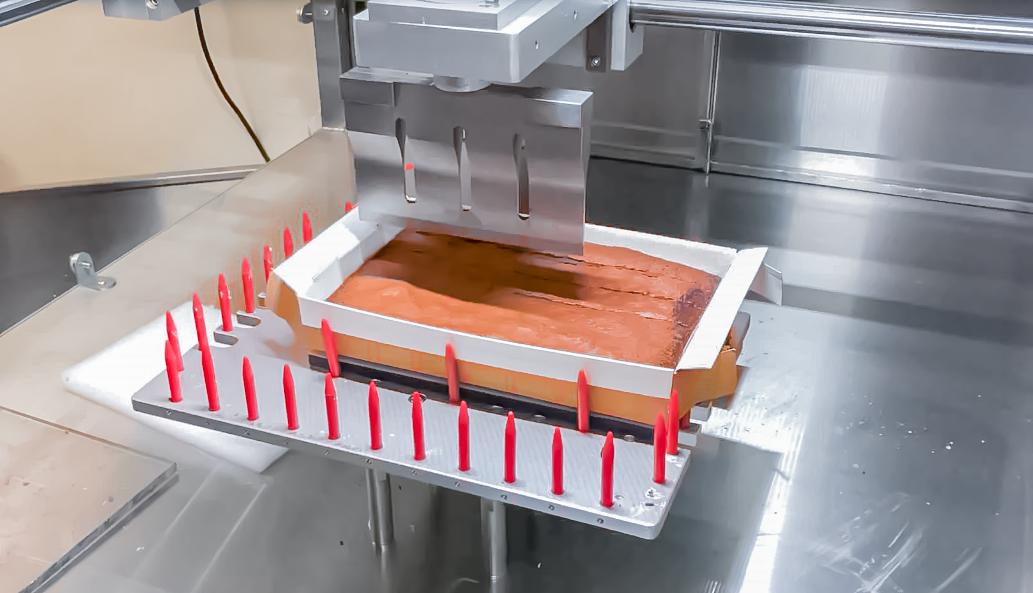
Automatic ultrasonic portioning of sheet trays of brownies and cakes — a high-volume bakery scenario where cut-face quality and portion consistency are the acceptance criteria.
Why Portioning Sets the Ceiling on Cake and Cheese Lines
The product range that matters in baking is wider than it first appears. Scenario documentation for these systems covers chiffon cake, cream layered cake, cheesecake, mousse cake, brownies, sponge cake bases, ice cream cake and frozen mousse, plus sandwich pastries filled with fruit, jam, chocolate, custard or butter. In dairy, the equivalent range is soft, medium-hard and frozen cheese in block, wheel, stick and extruded formats, portioned into slices, strips and small retail units. Each format fails in a different way, and most of those failures happen at the blade.
The recurring problems are consistent across both industries: deformation, cream leakage, filling overflow, cake fragmentation and uneven cut surfaces; cream and frosting adhesion on blades that forces frequent cleaning stops; size deviation that destabilises single-piece weight and breaks standardised production; squeezed cake scraps and wasted filling that raise raw material loss; and manual food contact that adds cross-contamination risk and labour dependency.
The operating envelope is just as varied. Production settings range from baking central factories, chain bakery stores and dessert processing plants to frozen cake production lines and supermarket prefabrication workshops. Room-temperature processing is one case; frozen desserts handled at −15 °C to −20 °C are another, and the standard requirement in those scenarios is direct cutting without pre-thawing. Dairy lines add high-oil and high-viscosity products, continuous mass production and long unattended runs, with only a small supervised crew. A cutting specification that works for one of these settings does not automatically work for the next.
How the Cutting Action Works
The core principle is high-frequency micro-vibration of the blade, typically around 20 kHz, producing low-pressure separation cutting with almost no downward extrusion force. Because the blade is not pushing the product apart, layered and cream-filled structures keep their internal geometry, and fillings do not migrate into neighbouring portions. The vibration also forms an isolation air film between blade and food, which reduces friction and gives a self-cleaning effect, so far less product accumulates on the cutting edge between cycles.
Around that physical principle sit the engineering variables that decide whether a machine fits a line: CNC digital positioning for equal portioning, servo touch screen control with automatic indexing, interchangeable titanium ultrasonic blades, and quick-release sanitary construction for washdown cleaning. Systems can be run as desktop standalone units for small-batch cutting, or as fully automated inline stations connected to conveyors, demoulding equipment and downstream packaging, with robotic handling and vision systems as optional integration.
Published operating parameters
| Parameter | Published value | Where it applies |
|---|---|---|
| Blade vibration frequency | 20 kHz | Food cutting, cake cutting and cheese cutting systems |
| Power range | 800–1600 W (ultrasonic food cutting machine); 800–1800 W (ultrasonic cutting machine) | Two different machine specifications in the same family |
| Input voltage | 208–240 V, 50/60 Hz, 15 A | Food cutting machine specification |
| Compressed air supply | 6 CFM @ 90 PSI | Required by the cutting machine families |
| Maximum cutting width | 600 mm | Cutting and food cutting machine specifications |
| Processing temperature | −14 °C to 40 °C | Food cutting machine specification; scenario documentation separately references a −15 °C to −20 °C band for frozen desserts |
| Throughput | 50–1500 pcs/h (food cutting machine); up to 300 products per hour (slicing systems) | Throughput is published per family and varies with product size and format |
| Cutting accuracy | ±0.5–1.0 mm depending on product type; ±1 mm dimensional error in bakery and dairy scenario requirements | Ultrasonic cutting tools and scenario specifications |
| Product height | Up to approximately 100 mm for high or layered products | Ultrasonic cutting tools |
| Portion accuracy (cheese) | High-precision weight control, cited at ±1% as a typical industry standard in the product specification | Cheese cutting systems |
| Protection and control | IP65 washdown compliant; servo touch screen automatic indexing | Food cutting machine specification |
| Materials | Titanium alloy / stainless steel; titanium ultrasonic blade as cutting element | Cutting and cheese cutting systems |
One practical reading note: the published processing temperature of a given machine is not identical to the product temperature band referenced in frozen-dessert scenarios. A line running at −15 °C to −20 °C should be matched against the rated window of the specific model, not against a family-level assumption.
Model-to-Scenario Fit
Cheersonic documents its cutting range as scenario-led rather than single-product. The table below summarises how the published model groups map onto cake and cheese production formats.
| System group | Models | Typical scenario |
|---|---|---|
| Ultrasonic cake cutting systems | UFM5000, UFM8101, UFM6000, UFM1000P, UFM1000R, UFM5100, UFM6600, UFM8000, UFM5500 | Soft, sticky, layered and cream-filled cakes; batch cutting or inline conveyor cutting |
| Cake and dessert portioning systems | UFM5000, UFM8101, UFM6000, UFM1000P, UFM1000R, UFM5100, UFM6600, UFM8000 | Programmable patterns — triangular, rectangular, square and custom portioned blocks; round cakes, sheet cakes, tray bakes |
| Cheese cutting systems | CWM100, UFM8100C, UFM2200C, UFM1000C, UFM3100W, UFM2300W | Block, wheel, stick and extruded cheese; chilled or ambient products; fixed-weight and catch-weight portioning |
| Ultrasonic slicing systems | HFM2300, HFM3100, UFM1000R, UFM1000P, UFM1000C, UFM2200, UFM3100P, UFM3300, UFM3200P, UFM5000, UFM5100, UFM6000, UFM8000, UFM8101, UFM8100C | Full sheet or round products; fresh, ambient, sticky, frozen, chilled or hard product states |
Cake Cutting: Round, Sheet and Programmable Portioning
For cake lines, the deciding factors are product temperature, product geometry and how often the recipe changes. Ultrasonic cake cutting systems are specified for soft, sticky, layered and cream-filled products, with non-stick, low-friction slicing and high-precision equal portioning; portion control is one of the primary design goals rather than a by-product of blade sharpness. Cutting geometry is programmable, covering triangular, rectangular, square and portioned-block patterns, and the associated cake cutting platform documents programmable cutting patterns and recipes with quick-change cutting tools.
Round cakes and sheet cakes behave differently and are usually handled as separate programs. Round-cake portioning is typically defined by an equal-division count — 8, 10 or 12 divisions are the common configurations in installed installations — while sheet cakes and tray bakes are portioned as a grid of rectangles, squares or bars. Offline cake cutting configurations can also run with or without divider inserts placed between slices, which improves presentation for the customer-facing pack and keeps adjacent portions from re-adhering after the cut.
Temperature handling is the second decisive variable. Frozen desserts such as ice cream cake and frozen mousse are cut directly at −15 °C to −20 °C without pre-thawing, which removes a thawing step from the production cycle and prevents the melting and texture deterioration that comes with it. For higher products, the ultrasonic cutting tool specification covers product heights up to approximately 100 mm, which accommodates most layered and high cake formats but is a real ceiling for very tall assemblies.
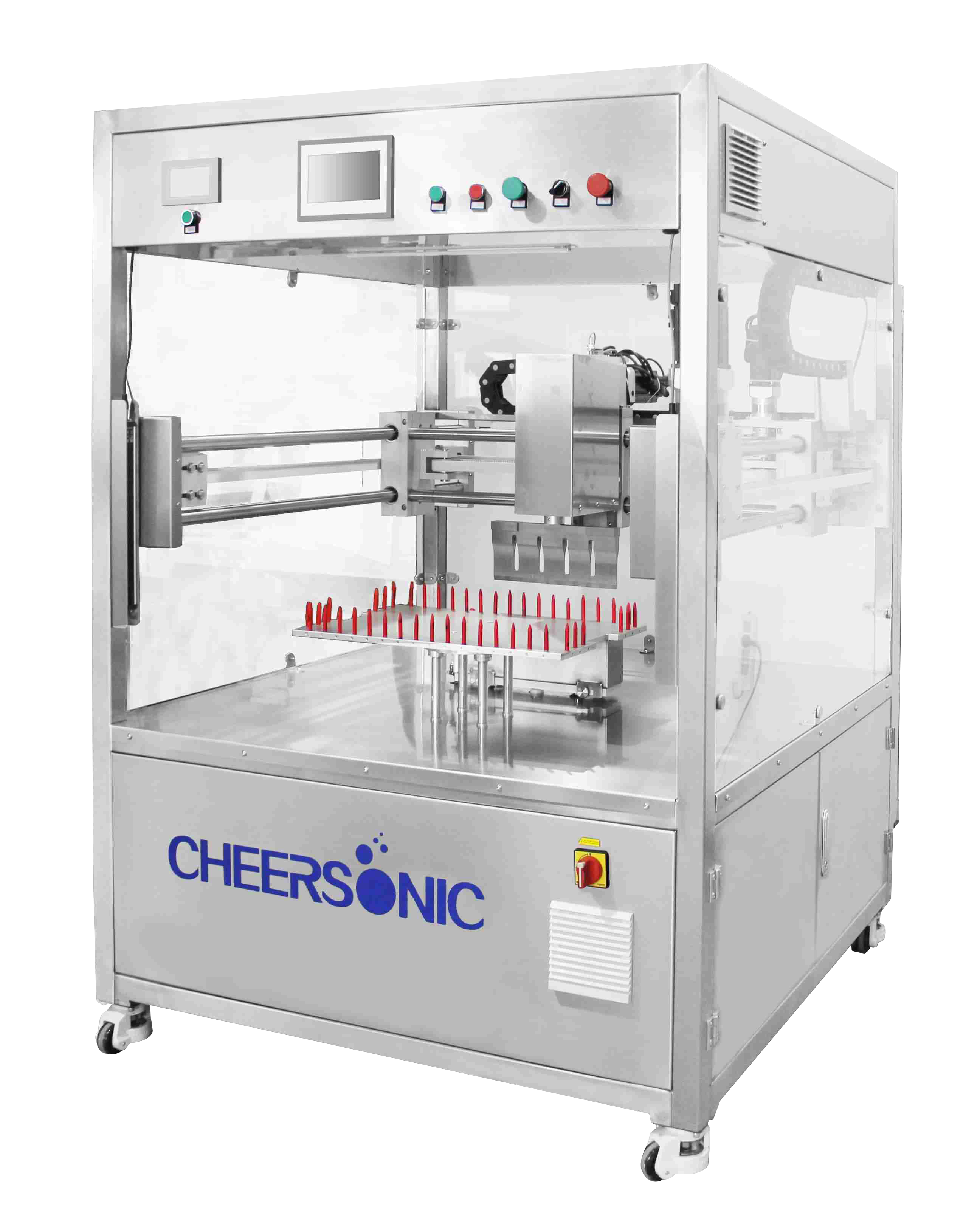
The UFM5000 sits in the cake and dessert cutting family, one of the models specified for round-cake and sheet-cake portioning with programmable cutting patterns.
Cheese Cutting: Chilled Wheels, Blocks and Sticks
Cheese adds a different set of constraints: density, fat content, temperature and format variability. Cheese cutting systems are specified for block, wheel, stick and extruded cheese, using a 20 kHz ultrasonic vibration system and a titanium ultrasonic blade, in stainless steel food-grade construction with an easy washdown hygienic design. Cutting modes include fixed-weight, catch-weight and portion cutting, and system integration options cover conveyor systems, checkweighers, 3D vision and robotic pick-and-place.
The scenario documentation for dairy processing describes the same equipment in operational terms: full-automatic segmentation of soft, medium-hard and frozen cheese; quantitative cutting of blocks, slices, strips and small portions; smooth, burr-free cuts that keep the internal tissue of the cheese intact; reduced material residue and oil adhesion; and direct cutting of frozen cheese without pre-thawing. Food-grade contact parts, a low-residue easy-clean structure to limit bacterial cross-contamination, high precision cutting tolerance around ±1 mm, and an anti-adhesion ultrasonic vibration air-barrier design are listed as the special requirements for these lines.
Where the system is used inline, it is expected to dock automatically with upstream demoulding and downstream weighing and packaging equipment, and to run in a semi-supervised mode with only a small number of staff on duty. That integration requirement — not the cutting head alone — is usually what determines whether a cheese project succeeds.
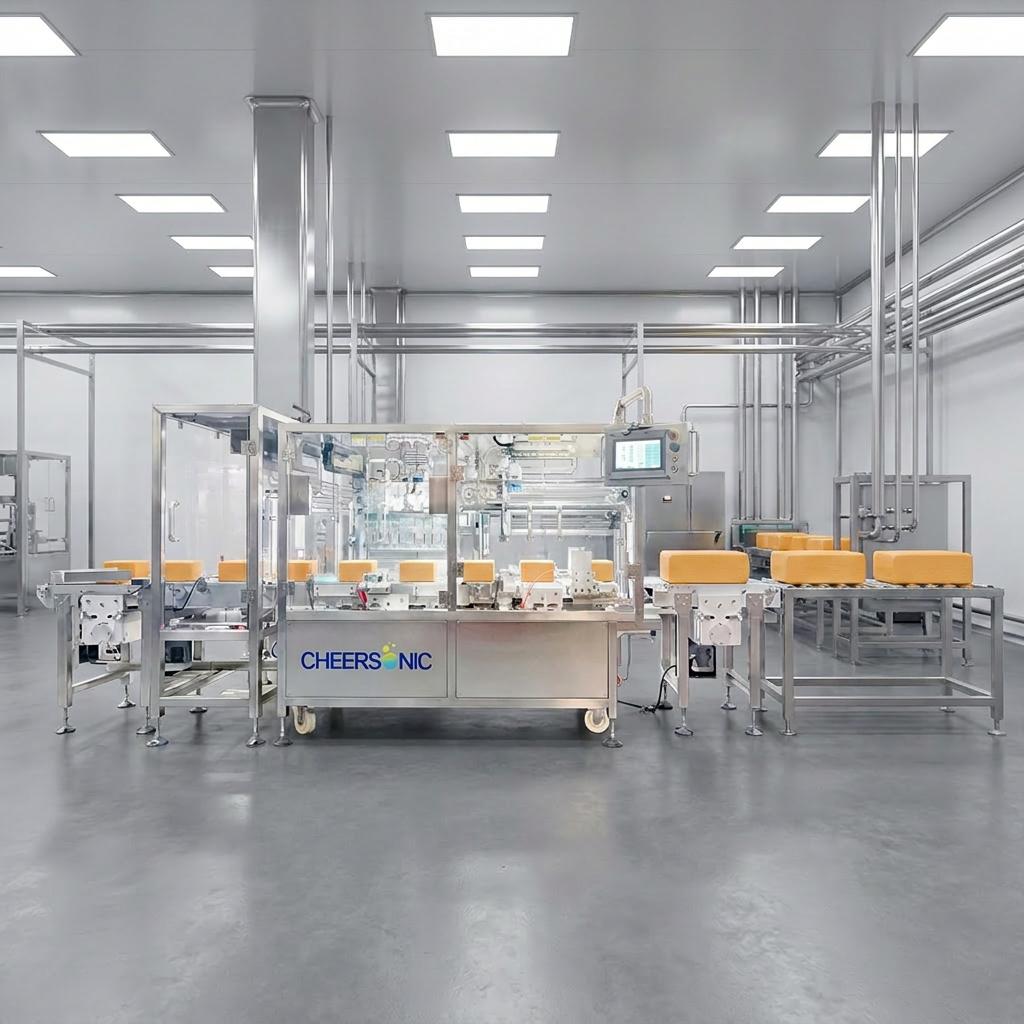
The UFM1000C is one of the cheese cutting systems specified for wheel and round cheese formats, with portioning accuracy controlled through weighing and positioning rather than blade pressure.
What Installed Systems Show
Published deployment records give a clearer picture of scenario fit than specification tables alone, because they show what production teams actually measured after installation.
- Wheel cheese, Ireland. A dairy manufacturing enterprise installed four units for precision quantitative wedge cutting of wheel cheese. The reported outcomes were over 70% improvement in space utilisation and a 70% reduction in production time, with AI-optimised cutting schemes and ultrasonic cold cutting that did not damage cheese quality.
- Mixed cheese formats, Venezuela. A dairy processing enterprise installed one automatic quantitative cheese cutting unit using 3D scanning and AI-driven cutting. Reported results included single-machine capacity increased fivefold, changeover production time reduced by 75%, weight error controlled within ±1 g, appearance scrap rate reduced by 90%, and raw material edge loss reduced from 8.2% to 0.9%.
- Continuous cake cutting, United Kingdom. A large standardised baking factory used one unit for continuous automated cutting of sponge cakes, mousse cakes, sandwich cream cakes and multi-layer cakes on a single line. Reported outcomes were removal of three operators, product qualification rate of 99%, raw material loss reduced by 32%, and shift cutting capacity increased 2.4 times — without modifying the workshop structure.
- Round cake portioning with inserts, United Kingdom. A boutique baking operation used a compact system that combines equal-division cutting of round cakes — configurable to 8, 10 or 12 divisions — with automatic insertion of food-grade separation paper between slices. Reported results were 60% less floor area required, one supporting operator removed, and hourly round-cake processing efficiency up 45%.
Across these cases, the pattern is the same: the value is not in the cutting speed alone but in the combination of portion consistency, reduced manual handling and the elimination of a secondary process step (thawing, paper padding, or post-cut rework).
Market Context
Third-party market research places the ultrasonic cutters market — which includes food cutting applications — at USD 2.8 billion in 2025, with a projected compound annual growth rate of 7.2% through 2033 (Dataintelo). That figure covers industrial cutting applications well beyond food, but it indicates that ultrasonic separation is no longer a niche technique confined to laboratories.
In supplier listings for the wider ultrasonic equipment and spray coating sector, Cheersonic is named alongside Sono-Tek Corporation, Branson (Emerson) and Dukane as a key global player (Cognitive Market Research / Coatings World, 2024). On the compliance side, Cheersonic holds ISO9001, EU CE and US FDA certifications, along with 31 patents and 3 software copyrights, and reports a 50% export ratio with main markets in Asia, the EU and North America. Buyers assessing machinery risk assessment obligations will also encounter ISO 12100:2010, the standard governing general machinery risk assessment and reduction, which applies to industrial ultrasonic equipment.
Comparison with Traditional Cutting — and the Boundaries of Ultrasonic Fit
Ultrasonic cutting is not universally superior to mechanical, wire or manual cutting. Scenario documentation distinguishes the two approaches by the force they apply rather than by a general quality claim, and the differences translate into specific selection rules.
| Consideration | Mechanical, wire or manual cutting | Ultrasonic cutting |
|---|---|---|
| Cutting force | Downward mechanical force; product compression is possible | Low-pressure separation via approximately 20 kHz blade vibration |
| Sticky or cream-filled products | Blade adhesion, smearing and cleaning stops | Reduced friction through vibration with a self-cleaning effect |
| Frozen product | Often requires thawing or higher cutting force | Frozen and chilled products handled directly; scenarios reference −15 °C to −20 °C without pre-thawing |
| Portion consistency | Depends on operator skill and blade condition | CNC positioning; dimensional error controlled within ±1 mm in bakery and dairy scenarios |
| Utilities required | Typically electrical supply only for simple cutters | 208–240 V, 50/60 Hz, 15 A plus 6 CFM @ 90 PSI compressed air |
| Product size limits | Varies by machine and blade set | Height up to approximately 100 mm for high or layered products; maximum cutting width 600 mm |
| Customisation lead time | Usually shorter for standard mechanical units | Standard models 7–15 days; customised models 30–45 days |
| Consumables | Knives and wires replaced on wear | Interchangeable titanium blades; replacement cycle depends on product abrasiveness and temperature |
The boundaries are worth stating plainly. First, an ultrasonic cutting station is not a drop-in replacement for a mechanical cutter: it needs a compressed air supply at 6 CFM @ 90 PSI in addition to a 208–240 V electrical feed, which has to be planned into line layout. Second, product geometry sets hard limits — the cutting tool specification lists a product height of up to approximately 100 mm, so very tall or unusually shaped assemblies may need a different configuration rather than a different blade. Third, published throughput is family-specific: slicing systems are documented up to 300 products per hour, while the food cutting machine specification lists 50–1500 pcs/h. Those numbers depend on product size, format and blade set, so a single-lane ultrasonic station is not automatically the correct answer for the highest-volume, single-SKU lines, and validating throughput with a line trial remains the responsible step.
Fourth, customisation is a project, not a catalogue order. The manufacturer's published lead time is 7–15 days for standard models and 30–45 days for customised models, with monthly capacity documented at 30 sets of ultrasonic cutting equipment — relevant when a group is planning a multi-line rollout rather than a single station. Customisation scope covers equipment size, cutting specification, operating voltage, control program, machine appearance, brand logo, functional module and production line docking structure, and the minimum order quantity is one unit, so the constraint is schedule rather than volume. Finally, titanium blades are consumables; wear behaviour is application-dependent, and blade replacement frequency should be part of the total cost calculation rather than an afterthought.
What to Expect Next
The direction of travel in both industries is toward fewer manual decision points per portion. Recipe-driven parameter storage and one-click switching already exist in these platforms, and they matter most where a single line produces multiple SKUs — plain, sandwich and fruit round cakes, or block, wheel and stick cheese — without complex mould changes between runs. Robotic handling, 3D vision and checkweigher integration are optional extensions of the same idea: the cutting station becomes one node in a closed loop that measures the portion it just produced.
For dairy specifically, the combination of pre-cut scanning and ultrasonic cold cutting points toward lower giveaway on high-value products, where a small weight deviation multiplied across a shift is a material cost. For bakery, the more consequential shift is the elimination of secondary steps — thawing before cutting, or hand-padding separation paper between slices — because those steps consume floor space and labour even when the blade itself performs well. Neither trend changes the fundamental selection logic: match the machine's rated temperature window, product height and throughput envelope to the actual product, and verify it on the line.
Frequently Asked Questions
Which cake and cheese formats can ultrasonic cutting systems handle?
On the bakery side, ultrasonic cake cutting systems are specified for soft, sticky, layered and cream-filled cakes, and for round cakes, sheet cakes, tray bakes and layered cakes, including frozen desserts such as ice cream cake and frozen mousse. On the dairy side, cheese cutting systems are specified for block, wheel, stick and extruded cheese, in chilled or ambient condition.
What operating parameters should be checked when matching an ultrasonic machine to a specific line?
The published parameters to verify are blade vibration frequency (20 kHz), power range (800–1600 W for the ultrasonic food cutting machine specification, 800–1800 W for the ultrasonic cutting machine specification), input voltage (208–240 V, 50/60 Hz, 15 A), compressed air requirement (6 CFM @ 90 PSI), maximum cutting width (600 mm), processing temperature window, product height limit (approximately 100 mm), and throughput. Portion accuracy in cheese applications is cited at ±1% as a typical industry standard in the product specification.
Can ultrasonic systems cut frozen or chilled cheese without thawing?
Scenario documentation for dairy processing states that frozen cheese can be cut directly without pre-thawing, and that the equipment handles soft, medium-hard and frozen cheese. The cheese cutting systems are specified for chilled cheese cutting as well as ambient products. Because the rated processing temperature window differs between machine specifications, the specific model's window should be checked against the actual product temperature on the line.
How are round cakes and sheet cakes portioned with programmable cutting patterns?
Cutting geometry is programmable and covers triangular, rectangular, square and portioned-block patterns, with programmable cutting patterns and recipes supported on the cake cutting platform. Round cakes are typically portioned by equal-division count — 8, 10 and 12 divisions are common configurations in installed systems — while sheet cakes and tray bakes are portioned on a grid. CNC digital positioning controls portion dimensions, and offline configurations can run with or without divider inserts placed between slices.
What are the practical limits of ultrasonic cutting in food production?
Three limits appear consistently in the specifications. First, utilities: the cutting machine families require 208–240 V, 50/60 Hz, 15 A plus 6 CFM @ 90 PSI compressed air, which must be planned into the line. Second, geometry: the ultrasonic cutting tool specification covers product heights up to approximately 100 mm and a maximum cutting width of 600 mm. Third, schedule and consumables: standard models are quoted at 7–15 days and customised models at 30–45 days, with monthly capacity documented at 30 sets of ultrasonic cutting equipment, and titanium blades are consumable items whose replacement cycle depends on the application.
Cheersonic publishes its full ultrasonic cutting and ultrasonic spraying equipment range, including model specifications and scenario documentation, in its downloadable brochure: Cheersonic equipment brochure (PDF). Company reference: www.cheersonic.com.