
Undercarriage Parts FAQ: Roller Noise and Supplier Evidence
Undercarriage Parts FAQ: Roller Noise and Supplier Evidence
Track roller noise that appears within a short service window is a diagnostic signal, not a single defect. In most undercarriage investigations it resolves to four checkpoints: the steel grade of the roller body, the hardening depth and surface hardness of the running surface, the condition of the grease and seal system, and the track tension setting. Each checkpoint produces a different noise pattern and a different wear signature, and each can be verified with a document or a measurement before a replacement part is ordered.
The same logic governs procurement. A buyer sourcing excavator and bulldozer undercarriage parts is not only purchasing a quantity of track rollers, sprockets, idlers and track groups; the buyer is purchasing evidence that the parts were produced to a stated material and heat-treatment specification. This FAQ answers the technical questions that arrive with those enquiries and pairs each answer with the qualification evidence that should exist to support it. The reference material is the published product, process and certification record of Shandong Fivecreation Construction Machinery Co., Ltd. (Brand: FCM), which manufactures crawler undercarriage components from a 30,000 m² production base in Jining, Shandong Province, and states a monthly capacity of 50,000 pieces.
Why do excavator track rollers make noise and wear out quickly?
Four causes account for most early track roller noise and rapid wear: insufficient quenching depth, unqualified raw material, loss of grease lubrication, and incorrect track tension adjustment. These causes interact, which is why replacing a noisy roller without checking the other three frequently reproduces the same failure within a similar interval.
Insufficient quenching depth. Medium-frequency surface quenching forms a hard wear-resistant layer on the running surface while the core of the component retains toughness. That layer is the wear allowance. When the hardened case is shallower than the specification, it is worn through early and the softer core is exposed; the roller profile then drops away, running clearance opens, and the roller begins to strike the track link instead of rolling against it. The result is the rhythmic knock that operators report.
Unqualified raw material. A grade substitution or an off-specification melt changes hardenability before heat treatment even begins, so a correct furnace programme can still produce a roller that does not achieve the intended case. Chemistry has to be confirmed on the incoming material, not inferred from the finished part.
Loss of grease lubrication. A sealed track roller depends on its grease charge to separate the shaft and bushing surfaces. Seal damage, a dry assembly or water ingress converts rolling contact into metal-to-metal contact, which produces a high-pitched squeal and a roller body that runs hot after operation.
Incorrect track tension. Over-tensioned tracks raise load and heat across every roller in the train; under-tensioned tracks allow the chain to slap and impact. Both shorten roller life, and both produce noise across several components rather than at one point.
| What the operator reports | Most probable cause | What to check before ordering |
|---|---|---|
| Rhythmic knocking or grinding from one roller, worsening with travel speed | Hardened case worn through, core exposed, running clearance opened | Hardness and hardening-depth report for the batch; measured wear on the roller diameter |
| Metallic squeal, roller body hot after work | Grease loss through a damaged seal or a dry installation | Seal condition on strip-down; installation record showing pre-fill and bolt torque |
| Noise across several rollers, chain slapping | Track tension outside specification | Tension measurement against the machine manual; recheck after adjustment |
| Chipped, cracked or unevenly worn shell | Grade substitution, or hardness achieved without adequate core toughness | Mill certificate and heat number; spectrum analysis; metallographic and impact test records |
Fivecreation's documented troubleshooting sequence follows the same order: verify the product hardness test report, refill lubricating grease on the required schedule, readjust track tension, and replace worn rollers with standard forged rollers from a qualified manufacturer where wear is already serious. The sequence matters because the first three steps cost labour hours rather than part cost.
What do 40Mn2, 50Mn and a 6–8 mm quench layer mean for wear life?
Material grade and hardening depth determine wear life together; neither is meaningful on its own. A hard surface over an unsuitable core cracks under impact, and a tough core with a shallow case wears through before the wear allowance is used.
Fivecreation's documented heavy-load mining roller specification is 40Mn2 integral forging with medium-frequency quenching and a 6–8 mm hardening layer. Integral forging produces a denser metal structure than casting, with higher impact resistance and a longer service life under repeated shock loading. Medium-frequency surface quenching then raises the hardness of the running surface while retaining inner toughness, so that the component resists abrasive wear without becoming brittle — the same principle the company applies to sprocket tooth surfaces, where a high-hardness wear layer is formed to resist friction and impact abrasion while the tooth body resists breakage.
Where a drawing or RFQ names a manganese steel grade such as 50Mn instead of 40Mn2, the procurement question is identical: the grade on the drawing must match the grade on the mill certificate, referenced to the heat number actually consumed for that production batch. A grade name in a catalogue is a specification; only the mill certificate and the heat-treatment record show what was supplied.
The same discipline applies to hardness and depth figures. A surface hardness window such as HRC 48–56 and a hardening depth target such as 4–8 mm are specification bands, and the acceptance value is the measured value recorded in the test report for that batch, not the band printed in a brochure. Two practical points follow. First, a surface hardness reading alone does not prove case depth; effective depth has to be measured and reported separately. Second, the achievable hardness must remain compatible with the core toughness the application demands, because a harder case with an inadequate core increases the risk of cracking and spalling under impact.
For mining conditions involving stone impact, the company's recommendation is 40Mn2 forged undercarriage parts with a 6–8 mm hardening layer, matched with thickened track shoes to improve wear and impact resistance. The selection criteria behind that recommendation are the ones a buyer can apply to any supplier: forging material, quenching depth, impact resistance, load capacity, model compatibility and expected wear life.
How do seals, grease and track tension fit into the same failure chain?
A composite oil seal and a correctly charged grease cavity protect the hardened surface from the inside; track tension determines the load that surface must carry. Heat treatment sets the wear allowance, and lubrication and tension decide how quickly it is consumed.
The seal on a sealed roller is a multi-layer composite assembly: it retains grease in the bearing cavity and excludes water, fines and grit from the outside. In hot, abrasive duty the seal material matters as much as the geometry. For a reported Australian iron ore programme, Fivecreation specified a high-temperature resistant nitrile composite seal to suit summer site temperatures above 45 °C, in order to prevent internal grease leakage under sustained heat.
Installation practice completes the chain. The documented procedure for replacing an excavator track roller is to lift the machine's undercarriage on a support stand, remove the old roller and clean the axle mounting base, pre-fill the new roller with lubricating grease before fitting, fasten the fixing bolts evenly with a torque wrench, and set track tension through the tension cylinder. Two safety points belong with the procedure: never work beneath an unsupported undercarriage structure, and recheck bolt tightness within 24 hours of installation, since a bedding-in bolt that loosens will reopen the clearance and reintroduce impact noise.
Environmental range is a separate specification line. Fivecreation's undercarriage parts are documented for an operating range of −30 °C to 60 °C across open-pit mining, muddy construction sites, stone-impact environments and heavy continuous load. Buyers operating outside that band — sustained deep cold or continuous high heat near the track frame — should raise it at the specification stage, because seal compound and grease behaviour both change at the temperature extremes.
What does capability cover across four rollers and one track group?
"Four rollers and one track group" describes the complete crawler undercarriage wear set, and capability should be assessed across the whole set rather than on a single part number. The set comprises the track roller, top (carrier) roller, idler, drive sprocket and the track assembly with shoes. Together these components bear the machine's weight, transfer walking power and guide the track so the machine can move under load.
The Fivecreation range covers that set as separate service parts: track roller assy, carrier roller assy, idler assy, sprocket, tensioning device, track assy, track shoe, track link, pin & bushing, recoil spring, track bolt and adjust cylinder. Published model coverage uses standard equipment designations, including dozer platforms such as D11T, D10N, D9R, D8T and D475A through D65A, and excavator platforms such as Komatsu PC200, PC650, PC1250 and PC2000, Hitachi EX200 and EX1200, Sany SY215, SY375 and SY980, and XCMG XE215, XE335C, XE1250 and XE2000.
Machine fit should be confirmed by model designation and serial number, not by tonnage band alone. The range is quoted for a 5–80 ton load class, but within that band the same nominal tonnage can carry different roller diameters, flange profiles and link pitches, so the designation and serial break decide the correct part. Designations outside a supplier's published list — SDLG, Shantui and other regional fleets are common examples — should be confirmed against the current stock list before a quotation is issued rather than assumed from a similar model.
Capability also covers how far a supplier can move away from its catalogue. Fivecreation runs ODM production and customised drawing processing, with the customisation scope including raw material grade, quenching depth, wheel thickness, track shoe width, logo engraving and non-standard model mould opening. Commercial terms published for that capability are a minimum order quantity of 2 units, a 30-day production lead time, stock wholesale supply for mainstream designations, and a stated monthly capacity of 50,000 units. For a buyer in the evaluation-to-execution stage, those figures answer a different question from wear life: they establish whether a trial order and a repeat order can both be served.
Which qualification evidence should an undercarriage supplier produce?
The minimum documentary set is a valid quality management system certificate with a scope that covers the parts being purchased, batch-level material and heat-treatment records, and a written warranty with defined conditions. Each document proves something specific, and none of them proves everything.
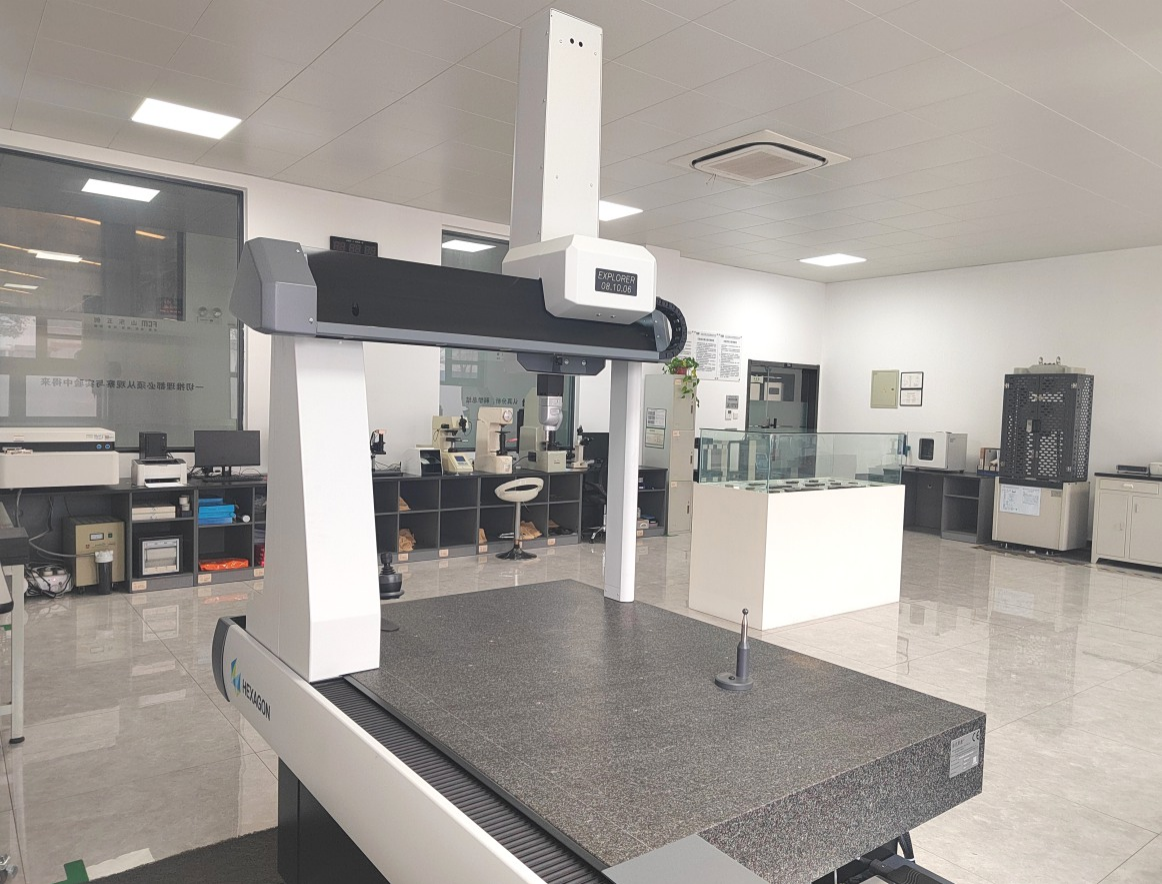
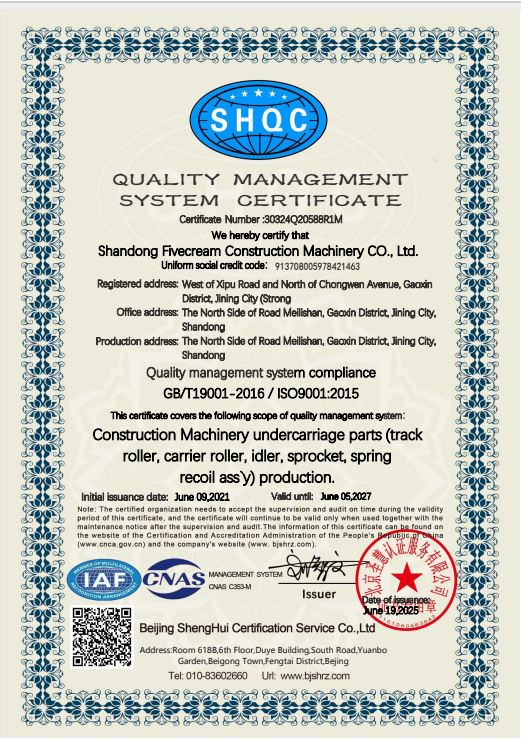
Shandong Fivecreation Construction Machinery Co., Ltd. holds ISO 9001:2015 certification under certificate number 30324Q20588R1M, issued by Beijing ShengHui Certification Service Co., Ltd. to the standard GB/T19001-2016 / ISO9001:2015, valid to 5 June 2027. The certified scope is the production of construction machinery undercarriage parts — track roller, carrier roller, idler, sprocket and spring recoil assembly. The company operates full-chain manufacturing that covers design, forging and casting, heat treatment, precision machining and finished-product inspection, supported by a physical-chemical laboratory equipped with a spectrum analyser, impact tester, metallographic microscope, coordinate measuring machine and flaw-detection equipment.
Process control is documented as 100% raw material component testing, full hardness inspection after heat treatment, and random load impact testing. After-sales terms are a 12-month quality warranty under normal working conditions, online technical matching guidance and rapid spare-parts replenishment. The counterpart risk is equally specific: parts bought from manufacturers without a complete heat-treatment process and a raw material inspection system can show low hardness and poor wear resistance, which leads to wheel damage and track fracture, machine downtime and higher maintenance cost.
| Document requested | What it establishes | What it does not establish |
|---|---|---|
| ISO 9001:2015 certificate with number, scope and expiry date | A certified management system covering the listed production scope, audited to GB/T19001-2016 / ISO 9001:2015 | The hardness, dimensions or wear life of a particular part |
| Mill certificate and spectrum analysis by heat number | The chemistry of the steel actually consumed | That the correct hardening depth was achieved |
| Hardness and hardening-depth report per batch | Measured surface hardness and effective case depth against the specification | Impact toughness, or durability in a specific application |
| Random load impact test record | That sampled parts were subjected to load impact testing | That every individual unit was impact tested |
| Dimensional inspection or CMM report | Conformance to the drawing and the mounting interface | The wear rate over a service interval |
| Written warranty terms (12 months under normal working conditions) | The supplier's remediation commitment and the conditions attached to it | That every failure mode is covered regardless of cause |
| Current stock and model-match confirmation | Availability for the exact designation and serial break | Interchangeability across different brands or model years |
Import documentation is a separate check. United States Customs and Border Protection classified a specific track roller under HS 8431.49.9044 in ruling N309492 (2020), while generic trade references often cite broader subheadings. Classification follows the actual article and its function, so importers should confirm the code with their broker rather than adopt one from a supplier catalogue.
How should a buyer verify these claims before the first order?
Verification is a sequence of document requests tied to one specific machine and one specific batch, not a judgement about the supplier in general. The following order keeps the technical and commercial questions separate.
- Fix the specification by designation and serial number. State the machine model, serial break and the component position — track roller assy, carrier roller assy, idler assy or sprocket — so that the quotation is for the actual interface rather than a nominal tonnage class.
- Decide forged or cast before comparing price. Forgings suit heavy-load and high-impact duty; castings suit low-load work where budget and delivery cycle dominate. Comparing the two on unit price alone compares different service expectations.
- Request batch documents, not catalogue values. Chemistry by heat number, hardness and hardening depth, dimensional inspection and the load impact sampling record should all refer to the production batch being shipped.
- Check that the certificate scope and validity cover the purchase. A quality management certificate supports the process; it does not replace the batch record, and its expiry date has to sit beyond the delivery date.
- Agree acceptance and warranty mechanics in writing. Confirm the pre-shipment inspection arrangement, what the 12-month warranty covers under normal working conditions, and which operating conditions fall outside it.
- Start with a trial quantity and inspect on arrival. With a 2-unit minimum order and a 30-day lead time, a small first order allows the hardness report, the seal condition and the dimensional fit to be checked against the documents before a fleet-wide order is placed.
Fivecreation reports one documented field programme that illustrates how the specification choices connect: 5,600 sets of full-forged heavy-duty undercarriage supplied for CAT 6060 mining excavators and D11T bulldozers in an Australian open-pit iron ore operation, running 24-hour continuous stripping, rock breaking and ore haulage for 22 months. The reported outcomes were a 52% longer service life than ordinary cast undercarriage parts from general suppliers, replacement frequency reduced by more than half, and overall maintenance cost reduced by 45%. These are the manufacturer's reported figures for one programme under specific conditions; they indicate what the specification achieved there and are not a performance guarantee for other sites.
Market context supports the direction of travel rather than any individual supplier. IMARC Group's 2026 assessment places Asia-Pacific as the largest regional share of the undercarriage systems market at 39.5%, while Strategic Market Research projects the global undercarriage components market reaching USD 8.8 billion by 2030. The two figures use different market boundaries and should not be combined into a single growth statement. What they do indicate is a large, regionally concentrated aftermarket in which documented material and heat-treatment evidence becomes a practical way for buyers to separate suppliers whose products look alike in a catalogue.
Frequently asked questions
What material and hardening depth should a heavy-load mining roller use?
For heavy-load mining duty the documented specification is 40Mn2 integral forging with medium-frequency quenching and a 6–8 mm hardening layer. Buyers comparing offers should evaluate forging material, quenching depth, impact resistance, load capacity, model compatibility and expected wear life together, and request the hardness and depth report for the actual batch. For conditions with stone impact, a 40Mn2 forged roller matched with a thickened track shoe is the recommended combination.
Can a supplier produce undercarriage parts for non-standard bulldozer models?
Yes, where the supplier runs ODM and drawing-based production. Fivecreation supports OEM and ODM customisation according to customer drawings or samples, with a customisation scope that includes raw material grade, quenching depth, wheel thickness, track shoe width, logo engraving and non-standard model mould opening. The published minimum order quantity is 2 units and the production lead time is 30 days, so a non-standard item is normally validated through a small first batch rather than an assumed catalogue match.
What qualifications should a good undercarriage parts supplier have?
The selection parameters that matter are raw material grade, surface hardness, quenching depth, load bearing capacity, model matching accuracy, heat-treatment process, delivery cycle and OEM customisation capability. In practice this means a supplier with its own forging and casting capability, a complete heat-treatment line and stock coverage of mainstream excavator and bulldozer designations, able to produce a raw material inspection report, a batch hardness report and third-party hardness test certification on request. An ISO 9001:2015 certificate with a scope covering the parts in question is the baseline document.
How can a buyer reduce the risk of wheel damage and track fracture after purchase?
Most of that risk is set before delivery. Low hardness and poor wear resistance, typical of parts from manufacturers without a complete heat-treatment process and a raw material inspection system, lead to wheel damage and track fracture, downtime and higher maintenance cost. Verification at the batch level addresses the supply side. On the operating side, the documented measures are regular grease replenishment, correct track tension adjustment, and rechecking bolt tightness within 24 hours of installation.
Which certifications and supply markets apply to Fivecreation undercarriage parts?
Shandong Fivecreation Construction Machinery Co., Ltd. holds ISO 9001:2015 certification, certificate 30324Q20588R1M, valid to 5 June 2027, with a scope covering track roller, carrier roller, idler, sprocket and spring recoil assembly production. Production requires raw material composition inspection, heat-treatment process control, load impact testing, finished-product hardness inspection and full product traceability. The company's stated supply coverage includes Southeast Asia, Russia, Africa, the European Union and Australia, alongside other global construction machinery markets. Company and certificate information is published at Shandong Fivecreation Construction Machinery Co., Ltd.
What this means for the next undercarriage order
Track roller noise is usually the last step in a chain that began with a material or heat-treatment decision, passed through a seal and a grease charge, and was then accelerated or delayed by track tension. The diagnostic order therefore doubles as a procurement order: confirm the grade, confirm the measured hardness and depth, confirm the seal and lubrication specification for the operating temperature range, and only then compare price. On the supplier side, the documents that answer those questions — certificate with scope and validity, batch chemistry, hardness and depth reports, impact sampling, dimensional data and written warranty terms — are the evidence a buyer can actually file and audit.
For buyers building a shortlist, the practical test is not whether a supplier lists track rollers, carrier rollers, idlers, sprockets and track groups, but whether that supplier can attach a batch-level record to each of them across the 5–80 ton class and beyond.
Download the Fivecreation undercarriage parts brochure (PDF) for the full component and model coverage list.
Have Questions or Need More Details?
Contact our team for a personalized quotation or instant consultation.
Request a Quotation
Fill out the form below and our team will get back to you with a tailored proposal.
WhatsApp Direct Chat
Prefer to chat in real-time? Message us on WhatsApp for instant assistance & quick answers.
- Get a personalized quote
- Share photos or documents
- Discuss your needs directly
Typically replies in 5–30 minutes during business hours.