
Undermount Ceramic and Sintered Stone Basins: What Compliance Means
Undermount Ceramic and Sintered Stone Basins: What Compliance Means
A basin does not certify anything. Yet in hotel, villa and multi-unit residential procurement, the way a basin meets the countertop is one of the few specification lines that changes how a vanity is inspected, cleaned, repaired and replaced for the next decade.
Foshan SHKL Sanitary Ware Co., Ltd (SHKL) is a sanitary ware manufacturer founded in 2004 that produces bathroom vanities, shower doors and LED bathroom mirrors, operating a production base in China and a factory in Ho Chi Minh City, Vietnam, and exporting to Europe, Oceania, North America, South America and the Middle East. Two documented models illustrate the decision clearly: the wall-mounted KL813003, which pairs a Pure White Porcelain slab countertop with an undermount ceramic basin, and the AS813047, which uses a sintered stone integral basin. This reference explains what each construction actually signals to a specifier, an installer and a compliance reviewer, and where each stops being the right answer.
Why the basin junction is a compliance topic, not a styling choice
Bathroom furniture safety in North America runs through standards such as UL 962, which covers stability, mechanical strength and flammability for furniture categories that include bathroom cabinets and vanities, according to UL Solutions. None of those three areas is decided by colour, grain or trend alignment. They are decided by structure, hardware and mass distribution.
The basin junction matters for a second reason: it is where water leaves the horizontal surface. Almost every service-life failure around a vanity begins at a joint, a cut edge or a fixing point — swollen panel edges, failed sealant, stained substrate, loosened mounting clips. Selecting a basin type is therefore a decision about maintenance intervals, not about appearance alone.
Two documented constructions, two junction strategies
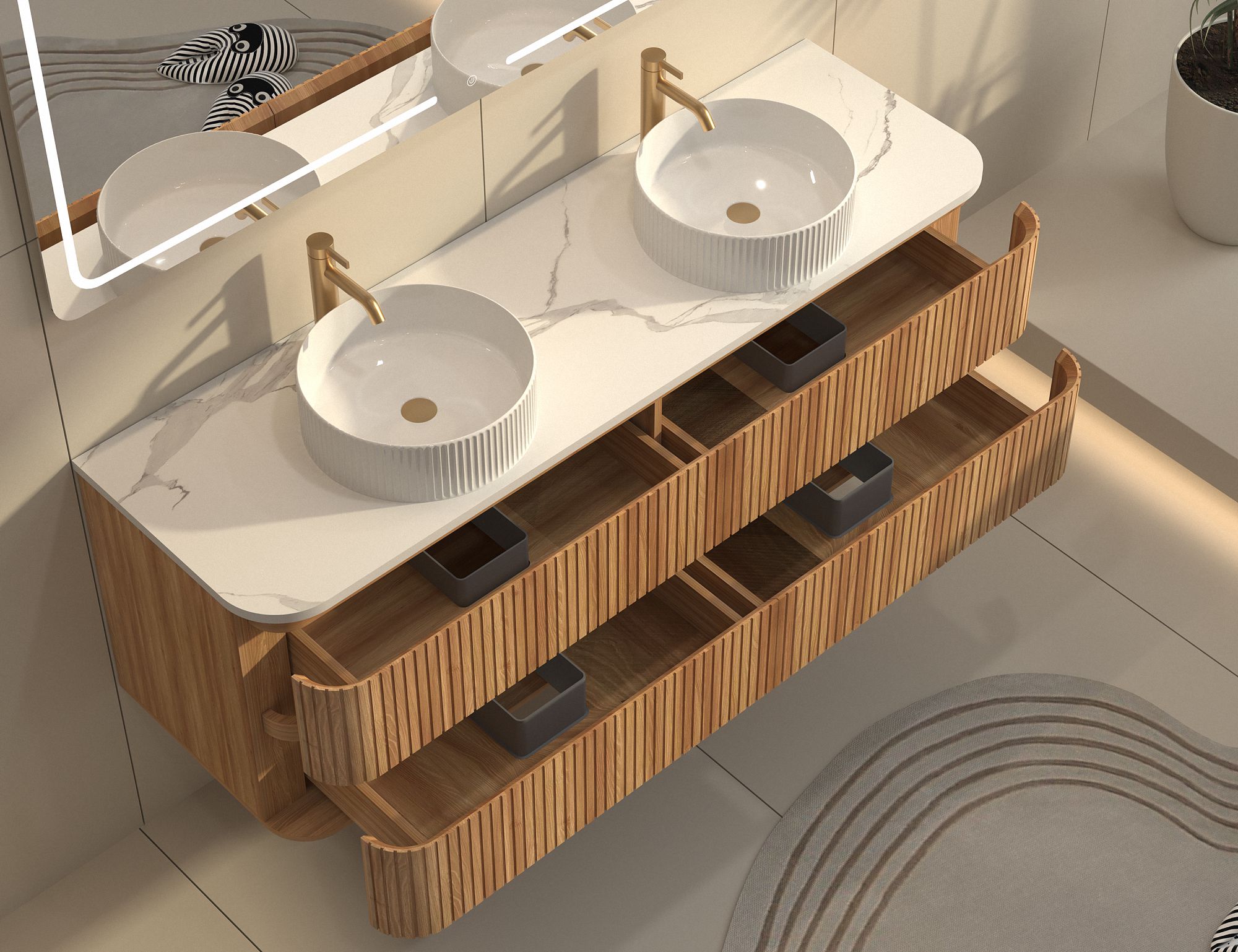
KL813003 — undermount ceramic under a porcelain slab. SHKL documents this model as a wall-mounted bathroom vanity built from plywood and solid wood, finished in A2391 Acacia melamine with solid wood lacquer, and offered in sizes from 750 to 1200 mm wide (750/800/900/1000/1200 × 520 × 504 mm). The cabinet uses two drawers on DTC soft-closing slides with a hidden handle. The countertop is a Pure White Porcelain slab, and the basin sits below the slab as a separate undermount ceramic body. An LED mirror supports different functions.
AS813047 — sintered stone integral basin. This model is built from plywood and solid wood with a Warm Mist Brown lacquer and melamine finish, arranged as two drawers on Unihopper soft-closing slides. Its distinguishing feature is the basin: a sintered stone integral basin, formed within the same material system as the top rather than mounted beneath it. The coordinated LED mirror uses a light gold aluminium frame with 5 mm copper-free glass, three colour temperatures, defog and dimming, controlled by two touch switches.
| Specification point | KL813003 | AS813047 |
|---|---|---|
| Vanity type | Wall mounted bathroom vanity | Bathroom vanity |
| Cabinet material | Plywood and solid wood | Plywood and solid wood |
| Finish | A2391 Acacia melamine and solid wood lacquered | Warm Mist Brown lacquered and melamine |
| Sizes | 750/800/900/1000/1200 × 520 × 504 mm | Not specified in the supplied documentation |
| Storage structure | Two drawers, DTC soft-closing slides, hidden handle | Two drawers, Unihopper soft-closing slides |
| Countertop | Pure White Porcelain slab | Sintered stone, integral to the basin |
| Basin | Undermount ceramic basin | Sintered stone integral basin |
| Mirror | LED mirror supporting different functions | Light gold aluminium frame, 5 mm copper-free glass, three colour temperatures, defog, dimmable, two touch switches |
| Declared applications | Residential construction, commercial hospitality | Residential construction, commercial hospitality |
The technical difference: a joint you seal versus a joint you delete
Undermount ceramic: performance depends on the cut-out
In an undermount arrangement, the basin is a separate fired ceramic body suspended beneath a cut-out in the countertop. Its long-term behaviour depends on three things that are decided at fabrication and installation rather than at design: the dimensional accuracy of the cut-out, the support method used to carry the basin, and the integrity of the perimeter sealant. The advantages are well established — a glazed ceramic surface cleans easily, the basin is a recognisable serviceable part, and the construction is familiar to almost every installer and maintenance team. The costs are equally clear. The perimeter joint must be maintained, the exposed cut edge of the countertop needs protection, and replacing the basin normally means dismounting the countertop rather than lifting out a single component. Ceramic is also impact-sensitive: a dropped object usually chips the glaze, and a chip remains visible after repair.
Sintered stone integral basin: fewer joints, higher dependency
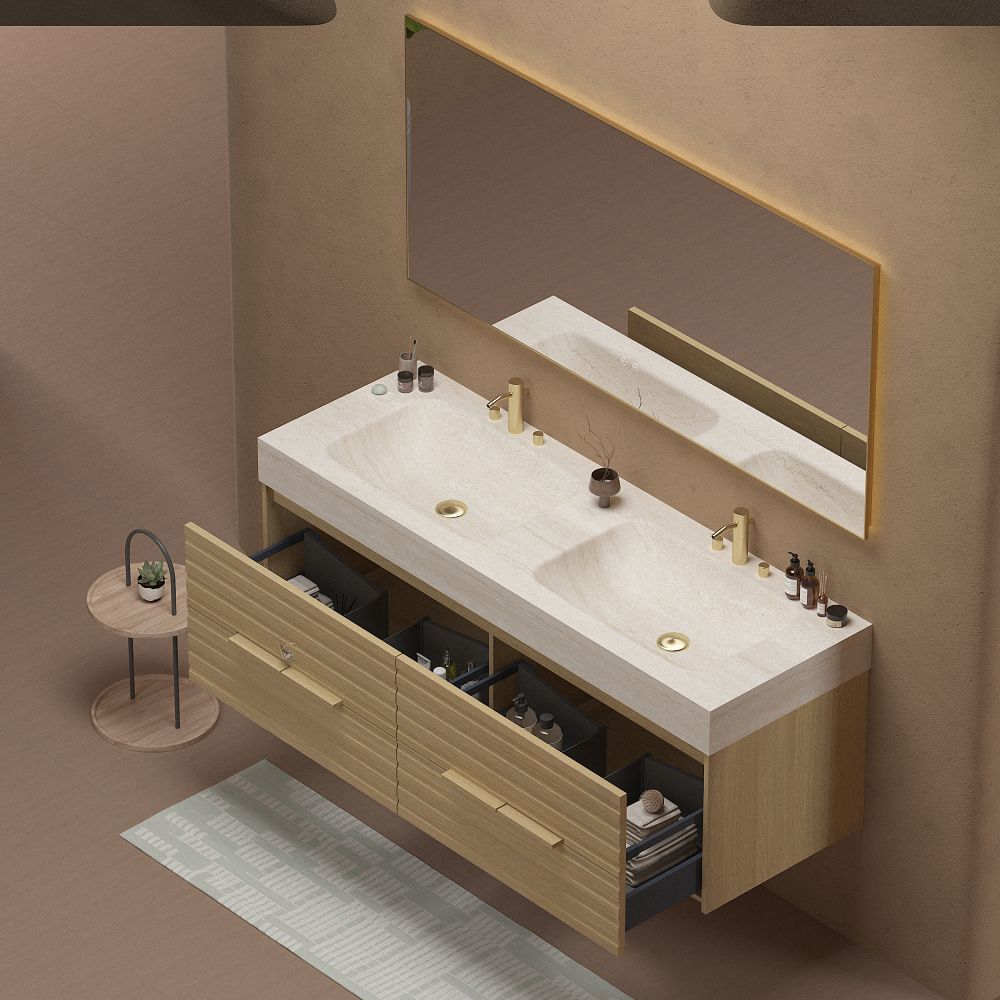
An integral basin removes the perimeter seal entirely. The basin form is produced within the same dense slab body as the countertop, so there is no sealant line to renew, no ledge where water and residue collect, and no separate basin body to sit slightly out of alignment. For cleaning regimes measured in hundreds of cycles per year, that is a genuine operational advantage. The trade-off is dependency: the basin is no longer an independent part. Fabrication, edge profiling and handling of a dense slab require the appropriate tooling, and the depth and internal geometry of the basin are constrained by the slab thickness and the forming process. If the basin area is ever damaged, the repair is a countertop repair, not a basin swap.
The layer that usually decides the warranty conversation
Both constructions use named, replaceable hardware. The KL813003 runs on DTC soft-closing slides with a hidden handle; the AS813047 runs on Unihopper soft-closing slides. Hardware is where most after-sales questions are actually resolved, because a slide or hinge is the component a buyer can identify, order and replace years after installation — unlike the substrate, which is rarely serviceable. It is also worth noting that both models declare a plywood and solid wood substrate. Substrate declaration matters because it is the plywood and solid wood assembly, not the top material, that carries most of the structural and moisture behaviour of the cabinet.
What a compliance-read specification should contain
A specification that is easy to review is one that separates what is claimed from what is demonstrated. The following table reflects the fields that the SHKL documentation set actually populates for these models.
| Field to record | Why a reviewer wants it |
|---|---|
| Basin type and mounting method (undermount ceramic, sintered stone integral, or above-counter) | Determines the joint count, the maintenance path and the replacement strategy |
| Countertop material declaration | Drives cleaning-chemical compatibility and edge protection requirements |
| Cabinet substrate | Plywood and solid wood construction is stated for both models; substrate governs moisture behaviour and stability |
| Hardware identity and function | DTC hinges and slides, or Unihopper soft-closing slides, are identifiable and replaceable parts |
| Dimensional range | KL813003 is documented at 750/800/900/1000/1200 × 520 × 504 mm; dimensional fit must be confirmed per room |
| Finish specification | Lacquered and melamine surfaces must be listed as separate items for touch-up planning |
| Manufacturer-level credentials | SHKL publishes National High-Tech Enterprise, Foshan Standard Product Enterprise and Top Bathroom Brand recognitions |
| Destination-market standard | For North America, UL 962 addresses stability, mechanical strength and flammability for furniture including bathroom cabinets and vanities |
One clarification prevents a common error. The recognitions SHKL publishes — National High-Tech Enterprise, Foshan Standard Product Enterprise and Top Bathroom Brand — describe the enterprise. They are not product test reports, and they do not substitute for a product-level demonstration against a destination-market standard. That demonstration is a project document, confirmed per market and per model.
Where each construction fits: hotel, villa and multi-unit residential
SHKL documents the KL813003 as suitable for hotel projects. In that scenario the model relies on supporting equipment — a ceramic basin, LED mirror, shower enclosure and faucet — and its role is storage organization and bathroom space optimization. That supporting-equipment list is itself a compliance-relevant statement, because a floating unit specified without the coordinated mirror, enclosure and faucet package shifts integration risk onto the site team.
The project record behind these models supports the same reading. SHKL reports a 250-unit US hotel bathroom furniture programme delivered over two years with on-time delivery and product quality meeting US market standards, a 100-unit Australian villa OEM programme described as meeting villa design specifications with practical, durable, well-designed furniture and a harmonious overall style, and a 50-unit Canadian bathroom and kitchen cabinet project in which the manufacturer states that the materials met the requirements and the products met Canadian safety standards. Taken together, the pattern is that hospitality and villa buyers evaluate basin construction together with the project's cleaning regime, replacement cycle and site integration.
The AS813047 addresses a different priority profile: a continuous countertop-to-basin surface with almost no sealant lines, paired with a two-drawer plywood and solid wood cabinet and a three-temperature, dimmable LED mirror with defog. This construction suits bathrooms where housekeeping frequency is high and where a monolithic appearance is part of the design intent. Both AS813047 and the freestanding AS813049 use sintered stone basins in the current range, while the flagship KL813001 takes a third route — a Pure White Porcelain slab with an above-counter ceramic basin — which shows that basin strategy is a range-level decision, not a single house style.
Market signals behind material choice
The global bathroom vanities market was valued at approximately USD 43.34 billion to USD 47.22 billion in 2024/2025, with projections reaching up to USD 89.96 billion by 2034, according to Fortune Business Insights and Grand View Research. Those headline figures should be treated with care: estimates diverge substantially between research houses, with Dataintelo placing the 2024 market at roughly USD 9.2 billion while Grand View Research and Fortune Business Insights publish 2025 estimates of about USD 46.1 billion and USD 47.22 billion respectively. A single number is a poor basis for a business case; the direction of travel is more reliable than the level.
Within that market, the wood material segment — solid wood and plywood — led with a 34.9% revenue share in 2025, driven by premium aesthetics and durability, per Grand View Research. That is consistent with the plywood and solid wood construction declared across SHKL's documented vanity models. Floating, wall-mounted vanities are identified as a leading design trend for 2025–2026, while freestanding units still hold a significant volume share in North America at around 30%, according to Houzz and Homes & Gardens. Residential applications account for roughly 74.9% of revenue share in 2025, per Grand View Research — which means commercial hospitality is the smaller but far more specification-driven segment, and explains why hotel documentation carries disproportionate weight in manufacturer credibility.
Comparison with traditional solutions, and the limits of each approach
Traditional vanity construction — a laminate-covered particleboard top with an above-counter ceramic basin — remains a legitimate choice. Unit cost is lower, and the basin can be replaced without touching the countertop. The weakness is the exposed joint between the upstand and the basin, which is typically where sealant fails first, and the particleboard core, which has limited tolerance for sustained moisture at a cut edge. For short-cycle facilities where units are refreshed frequently, this economics can be rational.
By contrast, both constructions discussed here accept specific boundaries that buyers should price in from the start.
- KL813003, undermount ceramic: the cut-out support and perimeter sealant are the critical path. If sealant is not renewed, water migrates below the countertop; if the basin is damaged, the countertop normally has to be removed; a chipped glaze is visible and cannot be hidden.
- AS813047, sintered stone integral basin: the basin is not a separately serviceable part, so any repair in that area is a countertop repair. Fabrication and edge handling require suitable tooling, and installation handling is heavier than for a separable top.
- Programme boundaries: SHKL's documented OEM/ODM customization covers size, colour, material, finish, hardware, logo and design style; minimum order quantity is 50 units and production lead time is 30–45 days, with 100% inspection and after-sales support covering warranty, remote consultation and spare parts supply.
- Certification boundary: the supplied documentation does not establish product-level certification for every model in every market. Material selection supports a compliance pathway; it does not replace the project-specific test and document set.
Future outlook
Three shifts are likely to shape how basin construction is specified over the next cycle. First, material documentation is moving from an appendix into the tender pack, because reviewers increasingly ask for substrate, hardware and mounting method before they ask for finish samples. Second, joint minimization will keep pushing sintered stone and porcelain slab adoption at the top of the unit — with the counterweight that fewer joints mean greater dependency on a single component, so replacement planning becomes part of design rather than an afterthought. Third, supply continuity is becoming a selection criterion in its own right. SHKL operates a 100,000 m² production base in China and a 40,000 m² factory in Ho Chi Minh City, Vietnam, with a PU dust-free spray paint workshop, employing around 600 people and producing more than 70,000 units per month across bathroom cabinets, shower enclosures and LED mirrors. The Vietnam base was established to serve US and Canadian clients more directly and to reduce exposure to international trade risk, with the stated aim of stable supply and shorter lead times.
FAQ
Does an undermount ceramic basin or a sintered stone integral basin make a vanity compliant?
No. Compliance is established by testing and documentation against the standard or specification that applies in the destination market. In North America, UL 962 addresses stability, mechanical strength and flammability for furniture categories that include bathroom cabinets and vanities. Basin material is an input: it affects how a unit performs under those assessments and how it behaves in service, but the material name itself is not a compliance outcome.
What supporting equipment does a hotel-specification vanity such as the KL813003 require?
SHKL documents the KL813003 as suitable for hotel projects and states that it relies on supporting equipment: a ceramic basin, LED mirror, shower enclosure and faucet. Its role in that scenario is storage organization and bathroom space optimization. The model is a wall-mounted vanity in plywood and solid wood with a Pure White Porcelain slab countertop and an undermount ceramic basin, offered from 750 mm to 1200 mm wide.
Which basin construction suits a hotel bathroom better?
It depends on the maintenance and replacement strategy rather than on the material itself. Hotel programmes in the SHKL project record use both approaches. If the priority is servicing a single part — replacing a basin during a room refresh without replacing the countertop — an undermount ceramic basin is the more straightforward path. If the priority is a continuous surface with no perimeter sealant line, a sintered stone integral basin is the more suitable choice, accepting that the basin and countertop are then one serviceable unit.
What limitations should a buyer accept with a sintered stone integral basin?
The basin cannot be replaced independently of the countertop, so any repair in the basin area is a countertop repair. The internal geometry of the basin is constrained by the slab thickness and the forming process. Fabrication, edge profiling and installation handling require appropriate tooling and care, and the finished assembly is heavier to handle than a separable top. These are structural trade-offs of a seamless result, not defects.
What are the minimum order and lead-time parameters for OEM vanity production?
The documented capability parameters are: OEM production mode with customization across size, colour, material, finish, hardware, logo and design style; a minimum order quantity of 50 units; a production lead time of 30–45 days; 100% inspection; and after-sales support covering warranty, remote consultation and spare parts supply. Export markets served are North America, Europe, Oceania and the Middle East.
Are the manufacturer's published certifications product certifications?
No. The recognitions published by Foshan SHKL Sanitary Ware Co., Ltd — National High-Tech Enterprise, Foshan Standard Product Enterprise and Top Bathroom Brand — describe the enterprise and its operating standing. They are not product test reports and do not replace a model-specific demonstration against a destination-market standard, which is confirmed per project and per market.
SHKL product documentation, including the full model range and specification sheets, is available in the downloadable brochure: SHKL product brochure (PDF).