
Understanding ISO Certifications for Your Screw & Barrel Purchase: A Compliance Roadmap for 2026
Understanding ISO Certifications for Your Screw & Barrel Purchase: A Compliance Roadmap for 2026
Three ISO standards appear most often on screw and barrel supplier documentation, and each one answers a different question. This roadmap sets out what ISO 9001:2015, ISO 14001:2015, and ISO 45001:2018 actually cover in a screw and barrel purchase, how the three map onto specific product families, and how to read a certificate number and scope statement before a supplier is qualified.
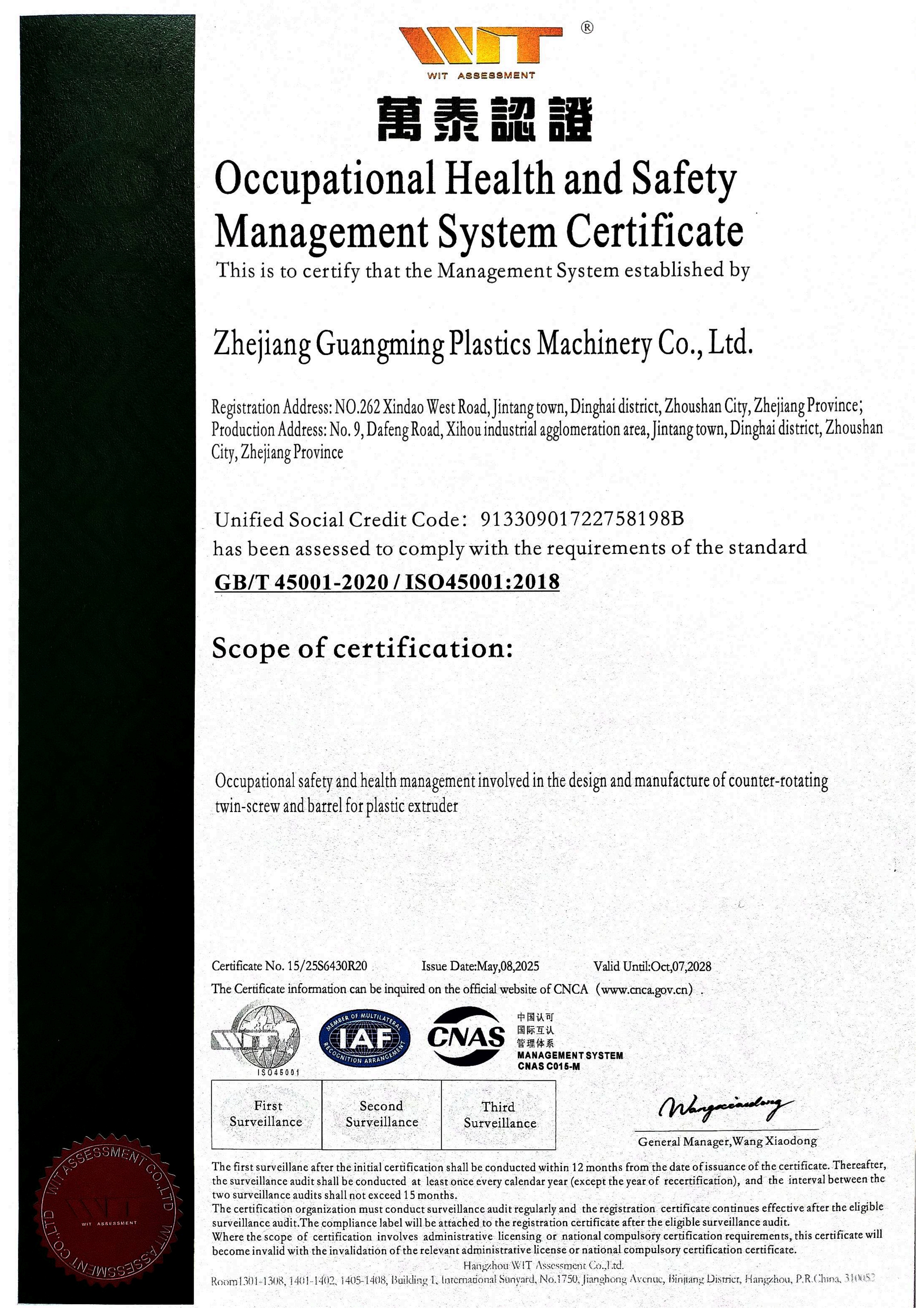
Occupational Health and Safety Management System Certificate issued to Zhejiang Guangming Plastics Machinery Co., Ltd. (Guangyou Screw) by WIT ASSESSMENT under ISO 45001:2018.
Why certification became a screening filter, not a marketing line
Plastics processors buying a replacement screw or a new barrel set now answer to two sets of requirements: their own process tolerances, and their customers' supply-chain questionnaires. Automotive tier suppliers, construction-material brands, and packaging converters increasingly ask extruders and molders to demonstrate that critical wear components come from suppliers operating under recognized management systems. That documentation request is what turns the question "are you ISO certified?" into a qualification step rather than a courtesy.
The difficulty is that "ISO certified" is not a specification. It describes a management system operating within a defined scope, issued by a named certification body, valid for a defined period. Two suppliers can both hold ISO 9001:2015 certificates that cover entirely different processes, product lines, and sites. Reading the certificate itself — not just the logo on a brochure — is the only way to know what is actually covered.
The worked example used throughout this article. Zhejiang Guangming Plastics Machinery Co., Ltd., which trades as Guangyou Screw, is a China-based manufacturer of barrels and screws founded in 1992, operating a 100,000 m² facility in Zhoushan, China. The company supplies single, twin, and bimetallic screw and barrel systems to more than 50 countries and regions — including the US, Germany, the UK, Italy, Brazil, and India — with an export share of about 30% and the EU as its primary export market. Its three ISO certificates, all issued by WIT ASSESSMENT, provide a concrete case for decoding standards, scopes, and certificate numbers.
The three standards, and the three different questions they answer
Screw and barrel procurement touches three management-system standards. They are not interchangeable, and a supplier holding one is not automatically covered by the others.
| Standard | What it certifies | Scope as recorded | Certificate number |
|---|---|---|---|
| ISO 9001:2015 Quality management system | Design and manufacturing process control, from order review through inspection and corrective action | Design and manufacturing of orthogonal twin-screw extruders and barrel components for plastic extrusion | 15/25Q6428R80 |
| ISO 14001:2015 Environmental management system | How environmental aspects of the manufacturing operation are managed | Environmental management involved in the design and manufacture of counter-rotating twin-screw and barrel for plastic extruder | 15/25E6429R20 |
| ISO 45001:2018 Occupational health and safety management system | How workplace safety and health risks are controlled | Occupational safety and health management involved in the design and manufacture of counter-rotating twin-screw and barrel for plastic extruder | 15/25S6430R20 |
Source: certification records issued by WIT ASSESSMENT; issue date 8 May 2025 for all three. All three certificates are recorded as applicable to the entire domestic industry and to global overseas markets under IAF international mutual recognition.
For a buyer, the practical reading is straightforward. ISO 9001:2015 answers the question "can this supplier control a defined manufacturing process repeatedly?" ISO 14001:2015 answers "how does this supplier manage the environmental side of that process?" ISO 45001:2018 answers "how does this supplier control the safety and health risks of producing it?" Each maps to a different line in a purchasing file: dimensional consistency, environmental reporting, and social compliance.
ISO 9001:2015 in a screw and barrel context
A quality management certificate is the one buyers lean on when they care about repeatability across batches — the same nitriding result, the same straightness, the same lead-time behaviour on the tenth order as on the first. At Guangyou Screw, the supporting operating facts are a monthly capacity of 2,700 units, 100% testing, a minimum order quantity of 1 unit, and OEM production with voltage and logo customization. Those are operational claims; the certificate is the evidence that they sit inside a documented system rather than depending on an individual operator.
ISO 14001:2015 and ISO 45001:2018 in a screw and barrel context
These two standards become relevant at the point in a screw and barrel plant where heat treatment, nitriding, chromium plating, alloy deposition, and heavy component handling take place. Environmental management covers how coolant, plating chemistry, furnace operations, and waste streams are controlled. Occupational health and safety management covers how the same operations are protected for the people running them. Neither standard says anything about how well the finished screw performs in an extruder.
What a certificate number actually tells you — and what it does not
A certificate number is a register key, not a code for the buyer to decode. Its internal structure is defined by the issuing certification body, and the only reliable interpretation is the body's own register entry. What the number does give you is a precise, unambiguous identifier that can be matched against a document, a quotation, or a claim on a supplier website.
Take 15/25E6429R20, the ISO 14001:2015 certificate number recorded for Guangyou Screw. The three numbers in this set share a common pattern but differ in a letter segment and a trailing segment: 15/25Q6428R80 for quality, 15/25E6429R20 for environment, and 15/25S6430R20 for occupational health and safety. That difference matters in practice. A quotation that cites one number while the item on the order is covered under another is a documentation error worth resolving before the purchase order is placed, not after delivery.
A five-point verification routine catches almost all certificate problems:
- Exact number. Compare character by character, including separators and any suffix.
- Standard and edition. "ISO 9001:2015" is a different claim from an undated "ISO 9001".
- Scope statement. The scope must name the product or process being certified, not just the company name.
- Issue and expiry dates. Confirm the certificate is currently inside its validity window.
- Certification body and recognition. Note who issued it — WIT ASSESSMENT in this case — and whether the certificate sits under a framework with international mutual recognition, which is what makes it usable across export markets.
Which screw and barrel products sit under the certificate records
The related-product records attached to these certificates list five screw and barrel families. This is the layer most buyers never check, and it is the layer that determines whether a certificate is relevant to the item actually being ordered.
| Product family | Diameter range | Typical process |
|---|---|---|
| Conical twin screw barrel | Φ25/50–Φ185/340 | PVC extrusion |
| Parallel twin screw barrel | Φ45–Φ350 | Compounding and pelletizing |
| Single screw extruder screw and barrel | Φ20–Φ500 | Film blowing and pipe extrusion |
| Injection molding machine screw and barrel | Φ20–Φ300 | Injection molding |
| Rubber machine screw and barrel | Φ20–Φ650 | Rubber extrusion |
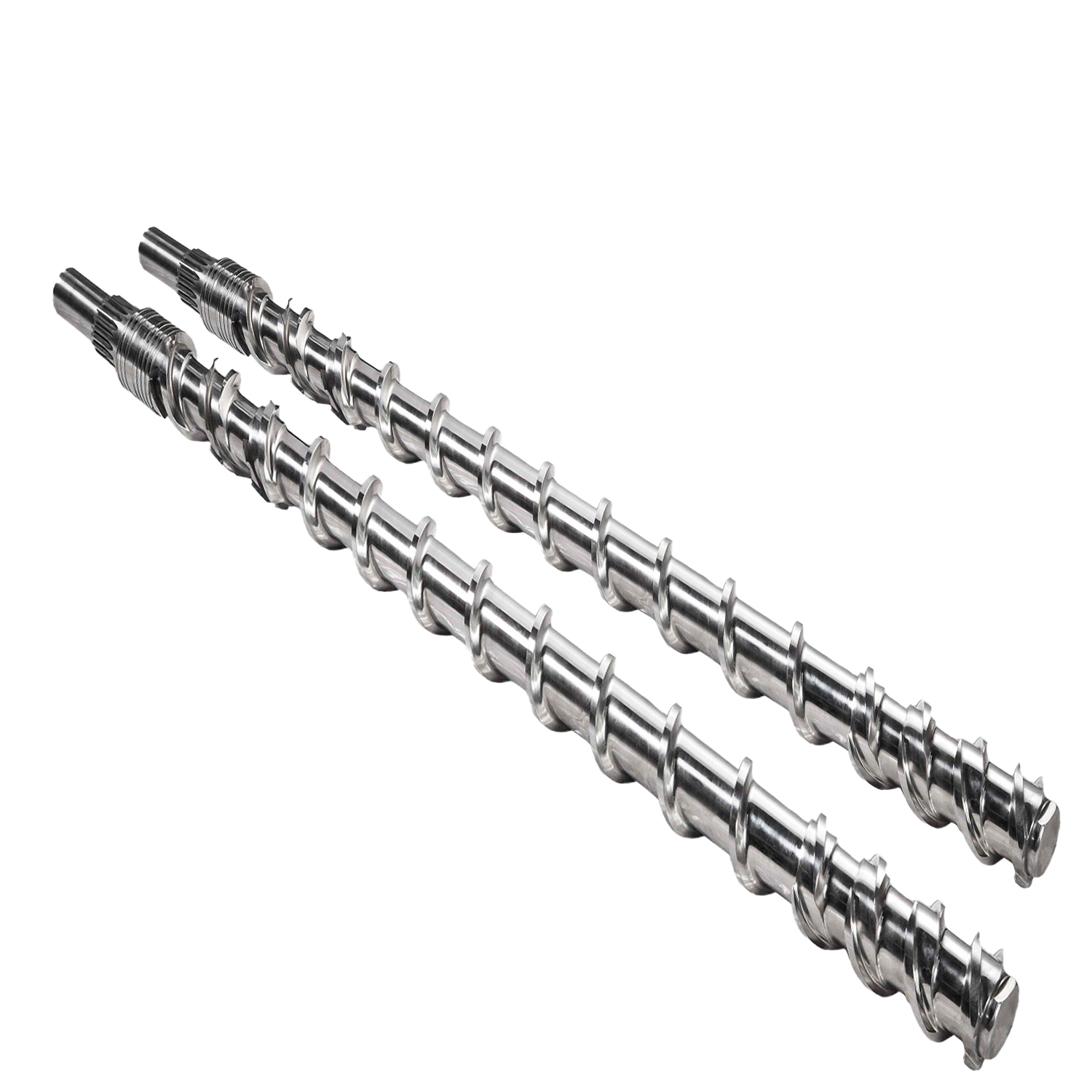
Rubber machine screw and barrel, Φ20–Φ650, for rubber extrusion — one of the five product families listed in the certification records.
For the ISO 14001:2015 and ISO 45001:2018 records, that product range includes the rubber machine screw and barrel (Φ20–Φ650), used in tire and rubber product manufacturing, and the injection molding machine screw and barrel (Φ20–Φ300), used in automotive, electronics, and toy manufacturing. Those are the two categories where buyers most often raise process-emission and workplace-handling questions, because rubber extrusion and injection molding carry different thermal and material-handling profiles from PVC extrusion.
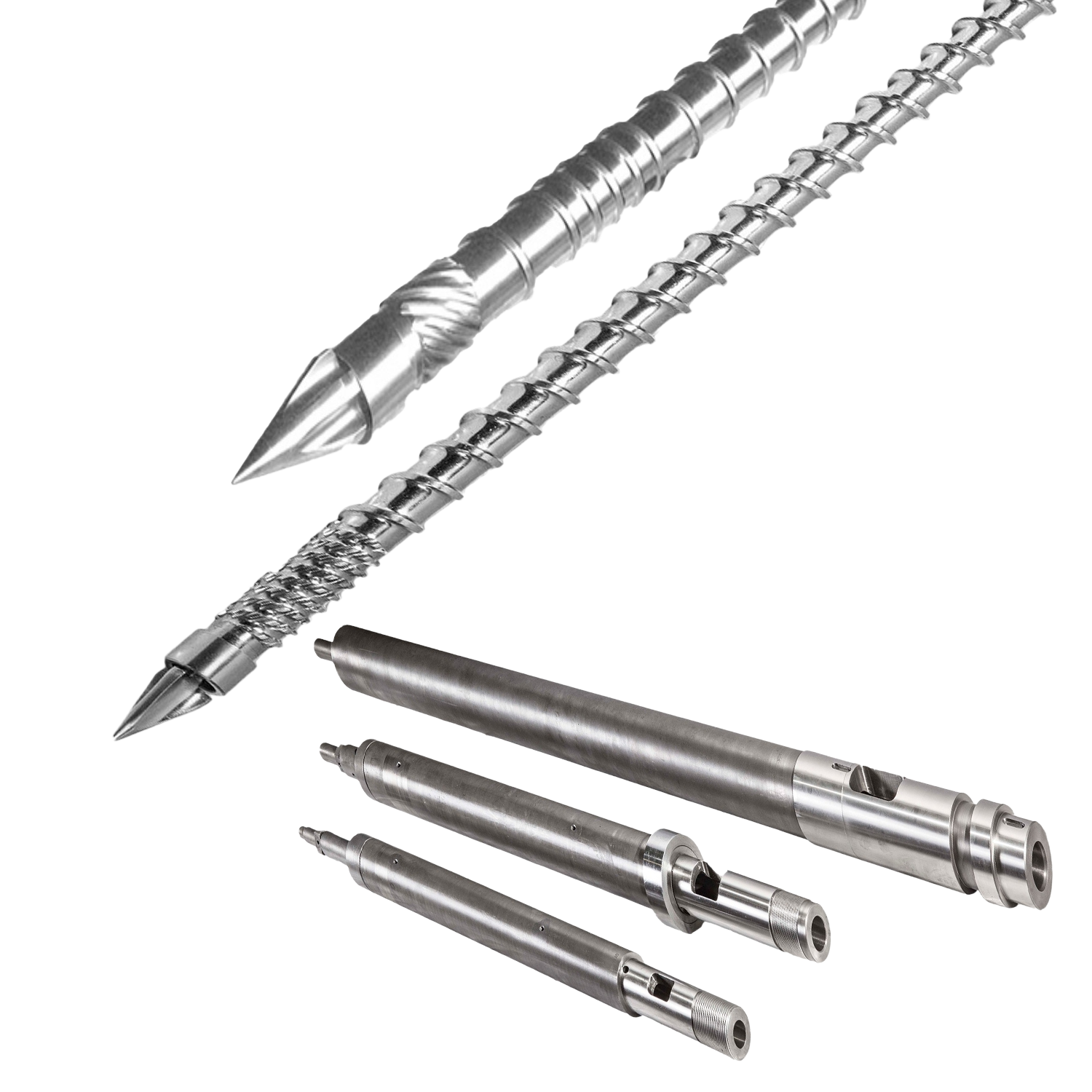
Injection molding machine screw and barrel, Φ20–Φ300 — the second product family most frequently raised in buyer compliance audits.
The boundary worth writing into the contract. The scope statement on all three certificates refers to the design and manufacture of counter-rotating twin-screw and barrel for a plastic extruder, and the ISO 9001:2015 scope uses the wording "orthogonal twin-screw extruders and barrel components for plastic extrusion." Both wordings are narrower than the five-family product list. That is normal, because certification bodies write scopes around what was audited, but it is precisely the gap a careful buyer should close in writing: ask the supplier to confirm that the model and diameter range being ordered fall inside the audited scope, or that the item is supplied under a separately identified certification. Do not assume that a certificate covering twin-screw design automatically covers an injection molding screw.
Why the environmental and safety standards carry more weight in 2026
Two shifts explain why ISO 14001:2015 and ISO 45001:2018 have moved from optional evidence to routine screening items in screw and barrel sourcing.
First, documentation is now expected to travel down the supply chain. An extrusion plant selling pipe, profile, or sheet into a European construction programme is frequently asked for supplier environmental and social data, and a management-system certificate is the most common format for that evidence. Second, mutual recognition has made management-system certificates portable. The Guangyou Screw certificates are recorded as applicable to the entire domestic industry and to global overseas markets under IAF international mutual recognition — which is what allows a certificate issued in China to be treated as documentation evidence by a European or North American buyer without a separate local re-issue.
Portability is not the same as sufficiency. Mutual recognition means a certificate was issued inside a recognized international framework; it does not replace a buyer's own inspection of the goods, and it does not transfer any product-level guarantee from the certificate to the component.
Market signal: a larger installed base means more certificates to verify
Certification scrutiny rises with market size, because a bigger installed base produces more replacement demand, more suppliers, and more documentation circulating in quotations. The available market data points in one direction.
| Indicator | Value | Source |
|---|---|---|
| Feed screw barrel market | USD 1.89 billion in 2024, projected to USD 3.33 billion by 2034 (CAGR 5.8%) | Global Insight Services |
| Plastic processing machinery market | USD 25.9 billion in 2025; injection molding machines at 50.9% share | Grand View Research |
| Extrusion machinery mix | Single-screw extrusion machinery at approximately 62% share of the extrusion market as of 2024 | Fortune Business Insights |
| Bimetallic barrel and screw market | USD 2.8 billion in 2025, forecast to USD 4.7 billion by 2034 | Dataintelo (medium-reliability estimate) |
Third-party estimates differ by scope. For the total plastic processing machinery market in 2025, Grand View Research records USD 25.9 billion while IMARC Group records USD 39.0 billion, largely because of differences in which peripheral equipment is included in the definition. Buyers should treat these figures as directional ranges rather than as single-point facts.
The procurement implication is straightforward. A market growing at a mid-single-digit rate on top of a large single-screw installed base means steady replacement demand for extruder screw barrels, PVC screw barrels, and WPC or SPC extrusion screws — and a supplier landscape wide enough that certificate verification becomes a practical shortlisting tool rather than a formality.
Where certification stops: the limit every screw and barrel buyer should know
ISO 9001:2015 certifies that a quality management system operates within a defined scope. It does not certify the nitrided hardness, alloy depth, straightness, or surface roughness of any individual screw. Those are product-level parameters, verified by inspection, and they belong in a separate column of the purchasing file.
| Product-level parameter | Specified value |
|---|---|
| Hardness after hardening and tempering | HB260–310 |
| Nitrided hardness | HV850–1000 |
| Nitrided case depth | 0.45–0.7 mm |
| Nitrided brittleness | Less than Grade 2 |
| Surface roughness | Ra 0.4 |
| Screw straightness | 0.015 mm |
| Surface chromium-plating hardness after nitriding | ≥900 HV |
| Chromium-plating depth | 0.025–0.10 mm |
| Alloy hardness | HRC50–65 |
| Alloy depth | 0.8–2.0 mm |
These values apply across the five screw and barrel families listed earlier, and they illustrate the general point: a management-system certificate and a product specification are two different documents answering two different questions.
It is worth comparing the nitriding figures against the wider industry reference. Standard industry practice for 38CrMoAl plasticating screws is commonly cited at a nitriding case depth of 0.4–0.6 mm with surface hardness of 900–1,100 HV. The Guangyou Screw specification records a case depth band of 0.45–0.7 mm, which extends deeper than that common reference, while its specified hardness band of HV850–1000 sits narrower and lower at the top end. This is exactly the kind of difference a buyer should resolve by asking which specification applies to the purchase order and how it will be measured — not by assuming that a certificate settles it.
A second boundary concerns construction route. Bimetallic barrels typically use a centrifugally cast alloy liner around 1.5–3.0 mm thick, a different architecture from a nitrided barrel. Liner thickness and bonding integrity are verification items specific to that construction, and no management-system certificate addresses them.
A 2026 compliance roadmap for screw and barrel procurement
- Define the product family and diameter range first. A conical twin screw barrel at Φ25/50–Φ185/340 for PVC pipe extrusion and an injection molding screw at Φ20–Φ300 sit in different process worlds, even under the same quality system.
- Match standards to your risk. Quality management for batch repeatability; environmental management where your own customers require environmental reporting; occupational health and safety where social compliance is screened.
- Request the full certificate set. Number, standard with edition, scope statement, issue and expiry dates, and issuing body — not a logo printed on a brochure.
- Verify each number against the certification body's register. Treat the number as a pointer, and confirm that all five elements match the document you were given.
- Confirm scope coverage in writing for your specific model. The scope wording and the product list are not always identical, and that difference is where qualification errors originate.
- Verify product parameters separately. Hardness, case depth, straightness, roughness, and alloy depth are inspection items, not certificate items.
- Check recognition if you import. IAF international mutual recognition is what makes these certificates usable in the global overseas market; it does not replace incoming inspection.
- Record the expiry dates. The ISO 9001:2015 certificate runs to 12 May 2028; the ISO 14001:2015 and ISO 45001:2018 certificates run to 7 October 2028. A purchase placed in 2026 sits well inside those windows, but long-lead items and multi-year supply agreements can extend past them.
Lead time belongs in the same plan. Nitriding single screw and barrel production is quoted at 40–50 days for Φ20–Φ90, 50–60 days for Φ90–Φ180, and 60–70 days for Φ180–Φ250, with longer windows above that range. Buyers scheduling a certification review alongside a replacement cycle should sequence the two so that documentation is settled before the production slot is booked, not during it.
Application records add a second reason to sequence documentation early. Across batch-customized component orders ranging from 1 to 50 pieces — sourced by screw and barrel distributors, plastic product manufacturers, and extrusion and injection machinery OEMs — components were manufactured to custom technical drawings with 100% precise mechanical fit, and the recorded working life under normal high-filler PVC extrusion conditions is 1–5 years. Batch consistency at that order scale is a quality-system outcome, and it is far easier to demonstrate when the certificate scope and the purchase-order item already agree on paper.
Future outlook
Three directions look stable for the rest of the decade. Certification documentation is likely to remain a default bid requirement rather than a competitive differentiator, which shifts competitive weight toward scope accuracy and verification speed. Environmental and occupational health and safety evidence is likely to keep migrating from optional attachments to screening criteria in export-facing supply chains, driven by buyer questionnaires rather than by screw and barrel specifications themselves. And because management-system certificates renew on multi-year cycles, renewal tracking is likely to become a routine part of supplier scorecards rather than a one-off check at onboarding.
For buyers, the practical consequence is that certification literacy is now part of technical purchasing competence. The suppliers who are easiest to qualify are the ones that can produce a certificate number, a scope statement, and a parameter sheet that agree with each other — and that can state clearly where the certificate ends and the product specification begins.
Frequently asked questions
Which ISO standards are relevant when buying screw and barrel components?
Three management-system standards appear most often: ISO 9001:2015 for quality management, ISO 14001:2015 for environmental management, and ISO 45001:2018 for occupational health and safety. All three certify the supplier's management system within a defined scope, not the performance of an individual screw or barrel. A buyer should check the standard and edition, the scope statement, the certificate number, and the validity dates for each one separately.
Does ISO 9001:2015 certification guarantee the hardness or dimensions of a screw barrel?
No. ISO 9001:2015 certifies that a quality management system operates within a defined scope; it does not certify product parameters. Hardness, case depth, straightness, and roughness have to be verified separately. The Guangyou Screw specification records, for example, nitrided hardness HV850–1000, nitrided case depth 0.45–0.7 mm, screw straightness 0.015 mm, and surface roughness Ra 0.4 — these are product claims evidenced by inspection, not by the certificate.
Which products are listed under the ISO 14001:2015 and ISO 45001:2018 certificate records?
The related-product records for these certificates at Guangyou Screw list five families: conical twin screw barrel (Φ25/50–Φ185/340), parallel twin screw barrel (Φ45–Φ350), single screw extruder screw and barrel (Φ20–Φ500), injection molding machine screw and barrel (Φ20–Φ300), and rubber machine screw and barrel (Φ20–Φ650). The rubber and injection molding categories are the two where environmental and workplace-safety questions arise most often during buyer audits.
How should a buyer verify a certificate number such as 15/25E6429R20?
Treat the number as a pointer to the certification body's register, not as a code to interpret. Match four elements against the register entry: the exact certificate number, the standard with its edition year, the scope statement, and the issue and expiry dates. The Guangyou Screw ISO 14001:2015 certificate number is 15/25E6429R20, issued by WIT ASSESSMENT. If any element differs from the document supplied, ask the supplier to explain the difference before qualification.
What do the issue and expiry dates mean for a purchase placed in 2026?
All three Guangyou Screw certificates were issued on 8 May 2025. ISO 9001:2015 is valid to 12 May 2028, while ISO 14001:2015 and ISO 45001:2018 are valid to 7 October 2028. A purchase placed in 2026 therefore sits inside all three validity windows. Buyers should still record the expiry dates in the supplier file, because management-system certificates renew on multi-year cycles and long-lead orders can extend beyond a certificate term.
Do ISO certificates issued in China apply to imports into the EU?
The Guangyou Screw certificates are recorded as applicable to global overseas markets under IAF international mutual recognition, and the company's main export market is the EU. Mutual recognition means the certificate was issued within an internationally recognized framework, but it does not replace a buyer's own supplier audit or product inspection. European buyers typically use the certificate as documentation evidence and verify product parameters separately.
What should be confirmed in writing beyond the certificate?
Three things: that the specific model and diameter range being ordered fall inside the audited scope statement; the product-level parameters that apply to the order and how they will be measured; and the certification status of any subcontracted process. For construction types such as bimetallic screw barrels, which use a centrifugally cast alloy liner typically 1.5–3.0 mm thick, liner thickness and bonding integrity are separate verification items that a management-system certificate does not address.
Reference material: the supplier's product catalogue is available as a PDF at New catalogue (PDF). Company information: en.gmscrew.com.