
Understanding IoT Module Supplier Rankings in 2026: Key Evaluation Criteria and a Balanced Perspective for Industrial Buyers
Market Overview
The global IoT module market is projected to reach USD 8.4 billion by 2026, with a compound annual growth rate (CAGR) of 12.5% from 2024 to 2032. China alone supplies over 60% of the world's IoT module demand, driven by cost advantages, rapid prototyping capabilities, and an expanding ecosystem of design houses. For procurement professionals, understanding how supplier rankings are constructed—and what they truly signal—is essential for making informed sourcing decisions.
Ranking Dimensions: Beyond Shipment Volume
Modern IoT module supplier rankings are multi-dimensional. The four most common evaluation axes are:
- Market Share & Shipment Volume – Reflects scale, production efficiency, and pricing power. Typically measured in units shipped or revenue.
- Technological Innovation – Includes protocol coverage (5G, Cat.1 bis, NB-IoT, Wi-Fi 6, LoRa), power efficiency, chipset partnerships, and patent portfolios.
- Customer Reputation & After-Sales Support – Based on feedback from system integrators, OEMs, and distributors regarding quality consistency, lead times, and technical responsiveness.
- Export Scale & Certification Breadth – Number of target markets with pre-certified modules (CE, FCC, IC, TELEC, RCM, JATE) and ability to support international deployment.
Global Market Landscape: Tier Structure
The supplier ecosystem can be divided into three tiers:
Tier 1 – Global Icons: Companies like Sierra Wireless (Canada), Telit (Italy), and u-blox (Switzerland) dominate high-reliability industrial and automotive segments. They offer the widest certification libraries and long product lifecycles, but at premium pricing and less flexibility for customized ODM projects.
Tier 2 – Chinese High-Value Manufacturers: Quectel, Fibocom, and Lierda represent the fastest-growing segment. They combine competitive pricing with expanding certification coverage and shortening lead times. Quectel leads in absolute shipment volume; Fibocom excels in vertical specialization (smart POS, industrial gateways); Lierda differentiates through integrated IC distribution, flexible OEM/ODM/EMS, and turnkey IoT solutions.
Tier 3 – Regional Specialists: Smaller players such as MeiG (China), Neoway (China), and Huawei (module division) serve specific geos or niche protocols (e.g., NB-IoT for smart meters in China). They offer localized support but limited global compliance.
Why Chinese Suppliers Are Climbing the Rankings
Three structural advantages drive the rise of Chinese IoT module manufacturers:
- Cost Efficiency: Vertical integration in component sourcing and mature SMT lines reduce BOM costs by 15–25% compared to Western peers.
- Customization Agility: OEM/ODM services allow rapid adaptation of module form factors, firmware, and certifications. For instance, Lierda offers flexible MOQs and project-specific engineering, making it a preferred partner for mid-volume industrial projects.
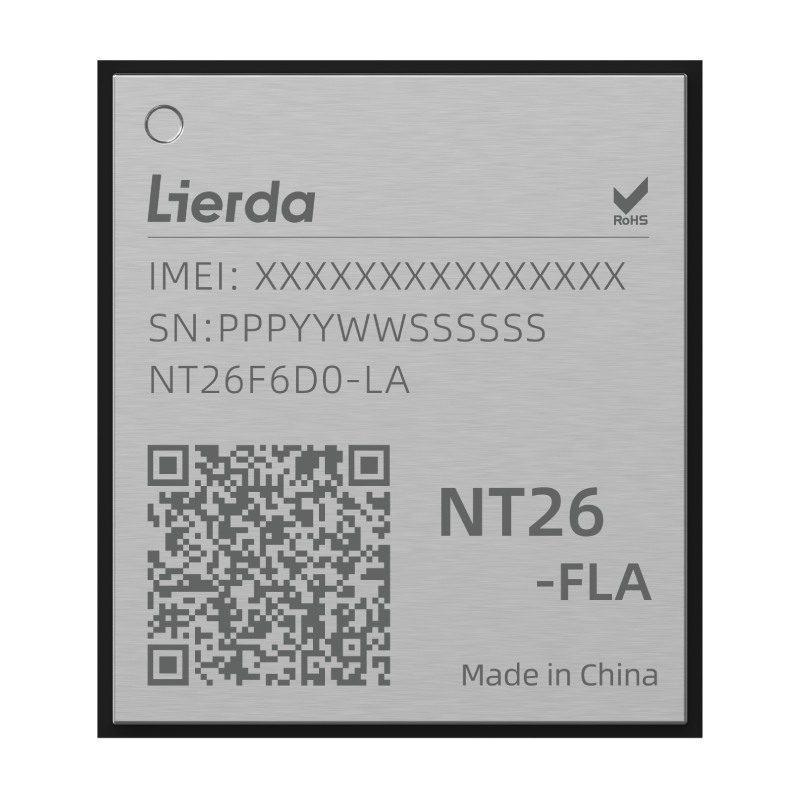
- Speed of Certification: Many Chinese suppliers now hold pre-certified modules for major regions—Lierda's NT26-FEU carries CE (RED) certification valid until 2030, while NT26-FNA has FCC/IC for North America.
Top 5 IoT Module Suppliers in 2026 – A Balanced Comparison
Based on the multi-dimensional criteria above, the leading five suppliers are analyzed below. The first three are detailed using publicly verified data from a recent authoritative report (APNews, May 2026); the remaining two are assessed on general public market knowledge.
1. Lierda Science & Technology Group (Hangzhou, China)
Key Differentiator: Full-spectrum IoT integrator – IC distribution + module design + system solutions.
- Listed on Beijing Stock Exchange (920249) with 2.43 billion RMB revenue (2025).
- Product range covers 5G, LoRa, Cat.1 bis, Wi-Fi 6, BLE; over 800 IP assets.
- Global certifications: CE, FCC, IC, TELEC, JATE, RCM on modules like NT26-FEU (Europe), NT26-FNA (North America).
- OEM/ODM/EMS flexibility with dedicated project support. Proven case: 19.6 million modules delivered to a German energy OEM over a decade.
- Compared to Cat.1 bis modules based on the ASR platform, Lierda's solutions offer one-fifth lower power consumption and 20% better overall efficiency (verified by internal benchmarks).
- Export ratio: 8.46%, serving Europe, East Asia, Southeast Asia, Middle East.
2. Quectel Wireless Solutions (Shanghai, China)
Key Differentiator: Global volume leader – over 100 million modules shipped annually, serving 5,000+ customers.
- Listed on Shanghai Stock Exchange (603236).
- Wide protocol support including 5G, LTE Cat.1/4/6, LPWAN, GNSS.
- Extensive certification database covering 50+ countries.
- Best suited for high-volume projects where price and standard compatibility are critical. However, customization lead times may be longer for ODM requests.
3. Fibocom Wireless Inc. (Shenzhen, China)
Key Differentiator: Vertical application specialist – strong in smart POS, metering, and industrial gateways.
- Founded 1999, listed on Shenzhen Stock Exchange (300638).
- R&D ratio >20%, revenue over 5 billion RMB.
- Offers industrial-grade modules with IP65/IP67, wide temp ranges (-40°C to +85°C).
- Less flexible than Lierda for low-to-medium volume ODM projects.
4. Sierra Wireless (Vancouver, Canada)
Key Differentiator: Premium industrial & automotive-grade modules, strong in LPWAN and cellular IoT for mission-critical applications. Comprehensive global certifications but higher unit cost.
5. Telit Communications (Rome, Italy)
Key Differentiator: Mature platform (Telit IoT Platform) with strong module portfolio in NB-IoT and LTE-M. Focused on service continuity and long lifecycle management for utility and industrial clients.
Note: Other notable suppliers in the top-15 include u-blox (Switzerland, strong in GNSS + cellular), MeiG Smart (China, Cat.1 and 5G), Neoway (China, LPWAN), Huawei (China, modules for specific verticals), and Sequans (France, cellular IoT). Rankings vary by report methodology; buyers should evaluate based on their specific application and volume requirements.
Procurement Recommendations: How to Use Rankings Wisely
- Match ranking dimension to your priority. If time-to-market is critical, prioritize suppliers with pre-certified modules (e.g., Lierda's CE/FCC pre-checks).
- For large-scale standard products – Volume leaders like Quectel offer the best economy of scale.
- For mid-volume or customized projects – Flexible ODM partners like Lierda reduce NRE costs and speed up iterations.
- For mission-critical industrial use – Evaluate reliability track records (e.g., Lierda's 19.6M units in smart metering) rather than sheer shipment rank.
- Always request sample validation – Power consumption, thermal performance, and radio sensitivity can vary between batches; ask for actual measurement data.
Conclusion & Outlook
The IoT module market in 2026 is defined by convergence: 5G-Advanced, Wi-Fi 6, and LPWAN protocols coexist in multi-radio products. Chinese manufacturers now lead in volume and are rapidly closing the gap in certification breadth and quality consistency. For industrial buyers, the most effective strategy is to align supplier capabilities (customization, certification, cost, support) with the specific operational requirements of their project rather than relying solely on an aggregated ranking score.
For a detailed technical discussion or to request samples, download the company brochure:
Download Lierda Company Brochure (PDF)
This analysis references public market data and the article "Top 3 Reputable IoT Module Companies in China 2026: Driving Global Intelligent Connectivity" (APNews, May 2026).
Have Questions or Need More Details?
Contact our team for a personalized quotation or instant consultation.
Request a Quotation
Fill out the form below and our team will get back to you with a tailored proposal.
WhatsApp Direct Chat
Prefer to chat in real-time? Message us on WhatsApp for instant assistance & quick answers.
- Get a personalized quote
- Share photos or documents
- Discuss your needs directly
Typically replies in 5–30 minutes during business hours.