
Unibio Probiotics Powder Evidence: Strains and VPro® Coating
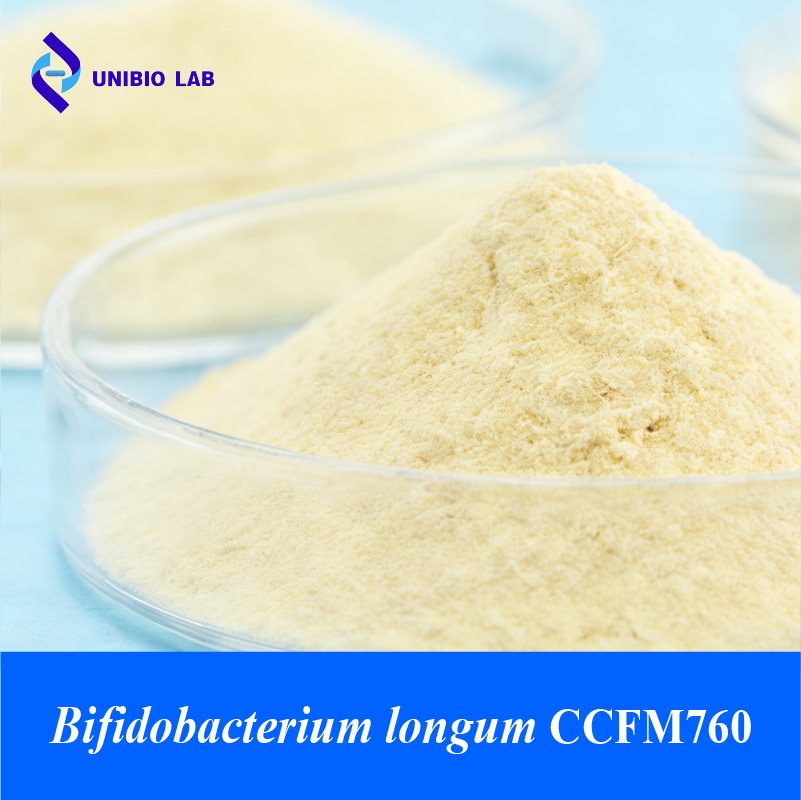
Bifidobacterium longum CCFM760 raw powder — one named accession inside the Shanghai Unibio Lab Co., Ltd strain portfolio.
Probiotics powder buyers rarely lack suppliers. What they lack is documentation they can check line by line.
Two regulatory frameworks explain why that documentation burden keeps rising. In the United States, probiotic dietary supplements are regulated under 21 CFR Part 111, which requires compliance with current Good Manufacturing Practices (FDA / Eurofins). Internationally, ISO 22000 — the food safety management standard that incorporates HACCP principles — is widely treated as the baseline for probiotic production chains (ISO). Neither framework accepts a species name on a label as proof of capability. Both push the procurement conversation toward strain identity, viable count per gram, storage conditions, and the material technology used to keep bacteria alive between fermentation and consumption.
The commercial picture reinforces that shift, even if the published numbers need careful reading. Global Market Insights values the total probiotics market at USD 72.1 billion in 2024 and projects USD 165.1 billion by 2034, while MarketsandMarkets estimates probiotic dietary supplements alone at USD 10.60 billion in 2026 with a 9.5% compound annual growth rate through 2031. Those two figures are not directly comparable, because one measures the whole category and the other a single segment, and independent estimates for the same year can diverge widely by scope. They are directional demand signals, not procurement inputs. The procurement input remains the strain file in front of the buyer.
This article examines two concrete pieces of capability evidence from Shanghai Unibio Lab Co., Ltd — a named strain portfolio and an in-house encapsulation material — and then sets out where that evidence stops.
Evidence One: A Named Strain Portfolio Rather Than a Species List
Shanghai Unibio Lab Co., Ltd is a Shanghai-based probiotic research, manufacturing and CDMO company that supplies probiotic raw powders, postbiotics and private-label finished products to food, supplement and animal-feed customers across North America, Western Europe, Southeast Asia and the domestic Chinese market, among others. Two assets carry most of its supplier-depth argument: a proprietary strain bank and a self-developed encapsulation material sold under the model designation VPro®-5L-COAT.
The strain bank is the larger of the two. The company reports a microbial strain bank of more than 30,000 strains and 189 patented functional strains; an independent ingredient-directory listing separately records the VPro® 5-layer micro-encapsulation technology alongside a strain bank of over 30,000 strains (Ingredients Network). For procurement purposes, the more useful evidence is the commercially documented subset — the strains published with a model number, a viable count range and defined storage conditions.

Bifidobacterium animalis subsp. lactis BL03 — the highest published concentration ceiling in the portfolio at 10B–600B CFU/g.
The table below consolidates the strain-level specifications published for the catalogue. It is deliberately factual: model, viable count, storage condition, shelf life.
| Strain | Model | Viable count | Storage | Shelf life |
|---|---|---|---|---|
| Akkermansia muciniphila | AH39 | 10B–200B TFU/g | Room temperature | 24 months |
| Clostridium butyricum | CCFM1299 | 10B CFU/g | Room temperature | 24 months |
| Bifidobacterium longum | CCFM760 | 10B–200B CFU/g | Room temperature | 24 months |
| Bifidobacterium longum | CCFM1195 | 10B–200B CFU/g | Room temperature | 24 months |
| Bifidobacterium breve | CCFM1025 | 10B–200B CFU/g | Room temperature | 24 months |
| Bifidobacterium adolescentis | CCFM1173 | 10B–200B CFU/g | −18 °C or below | 24 months |
| Bifidobacterium animalis subsp. lactis | BL03 | 10B–600B CFU/g | −18 °C or below | 24 months |
| Lactobacillus rhamnosus | GG | 10B–300B CFU/g | −18 °C or below | 24 months |
| Lactobacillus rhamnosus | CCFM1219 | 10B–200B cells/g | Room temperature | 24 months |
| Lactobacillus rhamnosus | CCFM0528 | 10B–200B CFU/g | −18 °C or below | 24 months |
| Lactobacillus rhamnosus | LR663 | 10B–200B CFU/g | −18 °C or below | 24 months |
| Lactobacillus plantarum | CCFM8724 | 10B–200B CFU/g | 2–8 °C | 24 months |
| Lactobacillus plantarum | CCFM8661 | 10B–200B CFU/g | 2–8 °C | 24 months |
| Lactobacillus plantarum | CCFM1143 | 10B–200B CFU/g | −18 °C or below | 24 months |
| Lactobacillus plantarum | CCFM602 | 10B–200B CFU/g | 2–8 °C | 24 months |
| Lactobacillus plantarum | HP59 | 10B–200B CFU/g | 2–8 °C | 24 months |
| Lactobacillus reuteri | HR7 | 10B–200B CFU/g | −18 °C or below | 24 months |
| Lactobacillus acidophilus | L59 | 10B–200B CFU/g | −18 °C or below | 24 months |
| Lactobacillus delbrueckii subsp. bulgaricus | HB68 | 10B–200B CFU/g | 2–8 °C | 24 months |
| Streptococcus thermophilus | ST67 | 10B–300B CFU/g | −18 °C or below | 24 months |
| Ligilactobacillus salivarius | CCFM1215 | 10B–200B CFU/g | 2–8 °C | 24 months |
| Bacillus coagulans | CCFM1041 (−39) | 10B–300B CFU/g | Room temperature | 24 months |
Three observations follow directly from that table, and each one is a decision criterion rather than a marketing point.
First, strain identity is coded, not descriptive. CCFM accessions indicate culture-collection deposits, while the portfolio also carries independently collected strains such as A. muciniphila AH39, L. reuteri HR7, L. acidophilus L59 and Bifidobacterium animalis subsp. lactis BL03. Buyers who need a specific accession for a regulatory dossier or a customer claim should verify that the exact code — not a similar species name — appears on the certificate of analysis.
Second, the concentration ceiling is strain-dependent. It ranges from 600B CFU/g for B. animalis subsp. lactis BL03 down to 10B CFU/g for Clostridium butyricum CCFM1299. This matters commercially: a high-dose capsule format using a 10B CFU/g raw material consumes far more powder per unit than the same format built on a 200B CFU/g input, which changes freight weight, capsule fill volume and cost structure.
Third, storage conditions are not uniform. Room-temperature stable strains sit alongside strains that require 2–8 °C or −18 °C handling. That spread is a genuine constraint, not a detail, and it is the reason a strain list should always be read together with the protective technology applied to it.
Evidence Two: VPro®-5L-COAT as a Technical Component
VPro®-5L-COAT is described as a five-layer micro-encapsulation protective coating material built on a food-grade polysaccharide and protein composite matrix. Its published functions are a five-layer acid- and bile-resistant barrier, improved heat resistance, and extended strain shelf life. The material is listed for use by probiotic raw material factories, supplement manufacturers and food processing plants — in other words, the protective input itself is a sellable technical component, not only an internal step in finished powders.
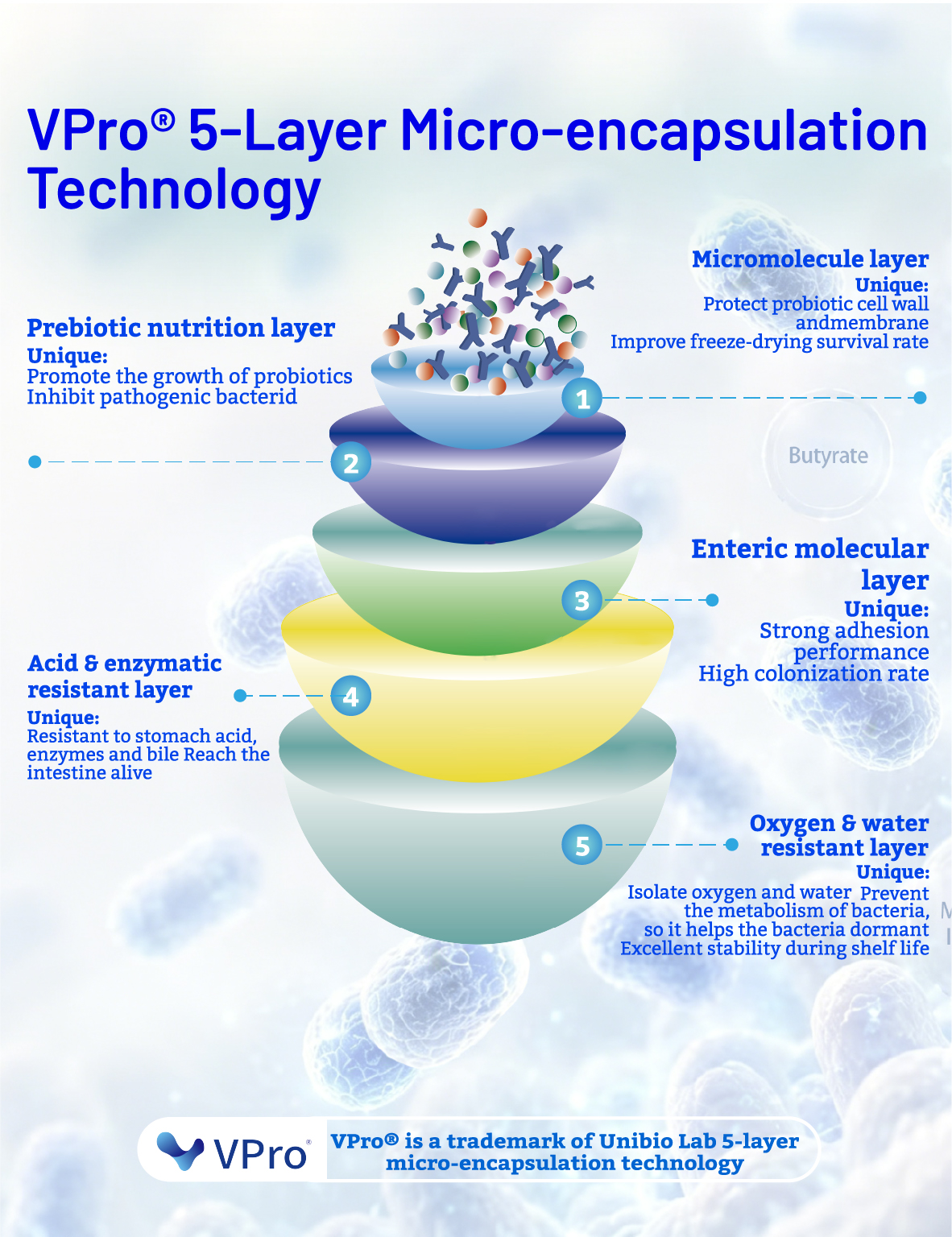
VPro®-5L-COAT, model designation VPro®-5L-COAT — a food-grade polysaccharide and protein composite coating matrix.
In the raw powder catalogue, the coating appears in the material composition: probiotic strain, maltodextrin carrier, and VPro® 5-layer encapsulation material. That composition is consistent across the documented entries for A. muciniphila AH39, B. longum CCFM760 and CCFM1195, B. breve CCFM1025, B. animalis subsp. lactis BL03, B. adolescentis CCFM1173, L. rhamnosus GG, CCFM0528, CCFM1219 and LR663, the Lactobacillus plantarum series, L. reuteri HR7, L. acidophilus L59, L. delbrueckii subsp. bulgaricus HB68, S. thermophilus ST67, L. salivarius CCFM1215, B. coagulans CCFM1041 (−39), Clostridium butyricum CCFM1299 and the postbiotic lines. Published shelf life for these powders is 24 months under recommended storage.
The company describes the five layers by function: a micromolecular protective layer for anti-freezing and anti-stress protection, a prebiotic nutrition layer intended to support in-vivo proliferation, a liposome enteric adhesion layer aimed at intestinal colonization, an acid- and enzyme-resistant layer for gastric transit, and an oxygen and moisture barrier layer for shelf stability. Company-reported performance figures associated with the technology include a 40% improvement in freeze-drying survival and a shelf life extended to 24 months. Buyers should treat those two figures as first-party data to be confirmed in their own validation protocols, not as independently audited results.
Microencapsulation itself is not a niche idea. Reviews of probiotic delivery describe encapsulation with materials such as alginate and chitosan as a key technical trend for maintaining viability through gastric acid and bile salts (PMC / MDPI). What differentiates suppliers in practice is how many barrier functions are combined, and whether the coating material is developed in-house or purchased as a commodity input. An in-house coating model with a published designation is easier to audit than an unnamed encapsulation step.
Compliance Evidence and Its Exact Scope
Certification is where capability claims become checkable — provided the scope is read as carefully as the certificate number. The documented qualifications are set out below.
| Certification / registration | Reference | Issuing body | Market | Scope notes |
|---|---|---|---|---|
| ISO 22000 food safety management system | CN22/00000437 | SGS-CSTC Standards Technical Services Co., Ltd. | Global | Production of probiotic solid beverages (screening, mixing) |
| FSSC 22000 | CN22/00000434 | SGS United Kingdom Ltd | Global | ISO 22000:2018, ISO/TS 22002-1:2009, FSSC 22000 version 6 |
| GMP (Good Manufacturing Practice) | CN22/00003036 | SGS-CSTC Standards Technical Services Co., Ltd. | Global | GMP Codex Alimentarius, General Principles of Food Hygiene CXC 1-1969 (2022) |
| HALAL food certification | Registration No. 3100/11080; Certificate No. 1821240000 | Shandong Halal Certification Service (SHC) | Middle East, Southeast Asia, global Muslim-majority markets | Listed strains including A. muciniphila AH39, Clostridium butyricum CCFM1299, Bifidobacterium and Lactobacillus series; validity to 25 July 2028 |
| FDA Food Facility Registration | 19635371796 (Shanghai Unibio Lab Co., Ltd); 12494588438 (Shanghai Helplifes Technology Co., Ltd) | U.S. Food and Drug Administration | United States | Probiotic raw materials and finished dietary supplements; registration validity through 31 December 2026 |
| Independent GRAS conclusion (sGRAS) | CIRS-GRAS-AH39-20250422 | CIRS GROUP USA Inc. (Independent GRAS Expert Panel) | United States | Pasteurized A. muciniphila AH39 raw material and AH39-containing finished products only; issued 22 April 2025 |
How to read this table. The ISO 22000, FSSC 22000 and GMP certificates cover the production of probiotic solid beverages — screening and mixing — under food category CIV for ambient stable products. They are system certifications for that activity, not per-strain approvals. The GRAS conclusion applies specifically to pasteurized Akkermansia muciniphila AH39 and products containing it. FDA facility registration is a facility-level registration, not a product authorisation, and it carries a defined validity period. Buyers compiling a regulatory dossier should map each document to the exact strain and finished format they intend to ship.
How the Portfolio Has Been Used Commercially
Three buyer patterns are documented in the company supply record. They are company-reported accounts, and their results belong to those specific buyers rather than being transferable guarantees, but they show how the portfolio and the coating are combined in practice.
- European and US supplement brands and raw-material distributors. An overseas brand and distributor group has ordered an annual bulk volume of 120 tons of multi-strain probiotic powder for the US market and 75 tons of single-strain powder for Germany, across three consecutive years of cooperation. The account cites VPro® 5-layer microencapsulation as the basis for acid- and bile-resistance performance and notes that full third-party test reports were supplied.
- Southeast Asian fermented food and beverage manufacturing. A fermented food and beverage producer in Thailand and Indonesia takes a yearly supply of 60 tons of DVS yogurt starter and 90 tons of functional probiotic beverage powder, in a cooperation running for two years. Stable fermentation performance and HALAL-certified raw materials matched local market requirements.
- Middle East pharmacy and health-product wholesale. A wholesaler and pharmacy-chain supplier in Saudi Arabia and the UAE has maintained a monthly consignment of 12,000 bottles of HelpGut capsules plus 8 tons of Akkermansia muciniphila AH39 raw powder for one and a half years, supported by GRAS and HALAL documentation for customs clearance and by customised Arabic packaging and labelling.
Read together, the three accounts show the portfolio being used in three different ways: as high-concentration bulk raw material, as fermentation starter cultures, and as finished private-label capsules. The coating technology sits underneath all three, because in each case the buyer is paying for viable count delivered at the point of consumption rather than viable count at the point of manufacture.
Matching Strains to Applications
The practical value of a broad portfolio is fit, not volume. The table below maps documented applications to representative accessions, with the format consideration that most often decides the choice.
| Application area | Representative strains | Format consideration |
|---|---|---|
| Adult gut and bowel regularity | B. longum CCFM760, B. adolescentis CCFM1173, L. salivarius CCFM1215, L. plantarum CCFM8724 | Room-temperature or cold-chain handling depending on strain; constipation-relief capsules in the portfolio carry 100B CFU per capsule |
| Metabolic support | A. muciniphila AH39, B. longum CCFM760 | Capsule formats; US market documentation available for AH39 under the GRAS conclusion |
| Infant and child nutrition | L. rhamnosus GG, L. reuteri HR7, B. breve CCFM1025 | Predominantly cold-chain strains; national rules for infant food must be checked separately |
| Fermented dairy and beverages | L. delbrueckii subsp. bulgaricus HB68, S. thermophilus ST67, L. acidophilus L59 | DVS starter format; 2–8 °C storage and moisture-proof transport |
| Heat-processed foods and solid beverages | B. coagulans CCFM1041 (−39) | Heat-resistant strain, typically combined with VPro® coating where heat exposure is unavoidable |
| Pet health and animal feed | B. animalis subsp. lactis BL03, B. longum CCFM760, B. coagulans CCFM1041 (−39) | Powder blending directly into feed matrices |
| Oral care | L. salivarius CCFM1215 | Raw powder or chewable tablet; the oral-care tablet in the portfolio delivers 10B CFU per tablet with a 20-month shelf life |
Where the Evidence Stops: Limits and Trade-offs
A capability article that only lists strengths is not useful to a procurement team. The following boundaries are documented facts, and each one should be priced into a sourcing decision.
- The coating does not remove cold-chain requirements. A substantial share of the portfolio — including B. adolescentis CCFM1173, B. animalis subsp. lactis BL03, L. rhamnosus GG, L. reuteri HR7, L. acidophilus L59, S. thermophilus ST67 and the plantarum series — is specified for −18 °C or 2–8 °C storage. Coating improves survival through digestion and heat exposure; it does not convert those strains into ambient-distribution materials.
- Concentration ceilings differ sharply. Clostridium butyricum CCFM1299 is published at 10B CFU/g, an order of magnitude below BL03 at up to 600B CFU/g. High-dose formats built on CCFM1299 require more raw material per unit.
- Certification scope is narrower than the portfolio. ISO 22000, FSSC 22000 and GMP cover probiotic solid beverage production — screening and mixing — rather than every strain and every dosage form. The GRAS conclusion covers pasteurized AH39 and AH39-containing finished products only.
- Volume thresholds apply. Minimum order quantities are 1 kg for single-strain raw powder, 5 kg for multi-strain compound powder, and 5,000 bottles for private-label finished capsules or tablets. Lead time is 5–7 days for bulk raw material and 25–35 days for private-label finished goods.
- The coating is an added input. Because VPro® material is a separate component in the powder composition, buyers evaluating cost per CFU should model it as a distinct line item rather than assuming it is included in the base strain price.
- Case outcomes are buyer-specific. The reported results in the three commercial accounts belong to those buyers and their formats; they are not performance guarantees for a new application.
Future Outlook
Three directions look most relevant for buyers planning 2027 programmes. First, strain-level documentation is likely to keep expanding as supplement GMP expectations and food-safety chain audits mature; suppliers whose catalogues already publish model numbers, viability ranges and storage conditions will face fewer clarification cycles during qualification. Second, encapsulation is moving from a differentiator to an expected specification in applications where heat exposure or long ambient shelf life cannot be avoided, which favours suppliers that control the coating material rather than sourcing it. Third, regulatory scope management — matching each certificate to the exact strain, dosage form and destination market — is becoming a procurement discipline in its own right, particularly where regional requirements differ from global system certifications.
None of these trends changes the underlying arithmetic. A supplier is only as deep as the documentation it can hand over, and the two strongest pieces of documentation in this case remain the named strain portfolio and the VPro®-5L-COAT material specification.
FAQ
1. What does a probiotics powder strain list actually prove about a supplier?
It proves documented accessions rather than species-level capability. A list in which each entry carries a model number, a viable count range and a storage condition can be verified against a certificate of analysis; a list of species names cannot. Shanghai Unibio Lab Co., Ltd publishes model-coded entries such as Bifidobacterium longum CCFM760, Clostridium butyricum CCFM1299 and Akkermansia muciniphila AH39, and the company reports a strain bank of more than 30,000 microbial strains, a figure also recorded in an independent ingredient-directory listing. Buyers should still confirm that the exact accession appears on the batch documentation for the material they receive.
2. Which strain-level specifications should a buyer verify before ordering samples?
Four specifications decide most formulation outcomes: viable count per gram, storage condition, shelf life, and material composition. In this portfolio, viable count ranges from 10B CFU/g for Clostridium butyricum CCFM1299 to 600B CFU/g for Bifidobacterium animalis subsp. lactis BL03; storage conditions fall into three groups at room temperature, 2–8 °C, and −18 °C or below; and shelf life is 24 months under recommended storage for the raw powders. Material composition across the documented entries is a probiotic strain with maltodextrin carrier and VPro® 5-layer encapsulation material.
3. What is VPro®-5L-COAT made of, and what does it do?
VPro®-5L-COAT is a five-layer micro-encapsulation protective coating material based on a food-grade polysaccharide and protein composite matrix. Its published functions are a five-layer acid- and bile-resistant barrier, improved heat resistance, and extended strain shelf life. It is listed for use by probiotic raw material factories, supplement manufacturers and food processing plants, which means it is supplied as a technical input as well as being used inside the company raw powders. Independent reviews of probiotic delivery identify microencapsulation with materials such as alginate and chitosan as a key technical trend for maintaining viability through gastric acid and bile salts.
4. Which certifications and registrations apply to Unibio probiotic powders?
The documented set comprises ISO 22000 certification CN22/00000437 issued by SGS-CSTC, FSSC 22000 certification CN22/00000434 issued by SGS United Kingdom Ltd, GMP certification CN22/00003036 issued by SGS-CSTC under GMP Codex Alimentarius and CXC 1-1969 (2022), HALAL certification under Registration No. 3100/11080 and Certificate No. 1821240000 valid to 25 July 2028, FDA Food Facility Registration numbers 19635371796 and 12494588438 valid through 31 December 2026, and an independent GRAS conclusion for pasteurized Akkermansia muciniphila AH39 under certificate CIRS-GRAS-AH39-20250422. Scope varies by document: the ISO, FSSC and GMP certificates cover probiotic solid beverage production through screening and mixing, while the GRAS conclusion applies to AH39 raw material and AH39-containing finished products.
5. How should a buyer match a strain to a specific application?
Start from the application, then check the storage condition, because that constraint drives cost more than the strain name. Documented patterns include B. longum CCFM760, B. adolescentis CCFM1173, L. salivarius CCFM1215 and L. plantarum CCFM8724 for adult gut and bowel regularity; A. muciniphila AH39 and B. longum CCFM760 for metabolic support formats; L. rhamnosus GG, L. reuteri HR7 and B. breve CCFM1025 for infant and child nutrition; L. delbrueckii subsp. bulgaricus HB68, S. thermophilus ST67 and L. acidophilus L59 for fermented dairy; and heat-resistant B. coagulans CCFM1041 (−39) for heat-processed foods and solid beverages. Pet health and animal feed applications are documented for B. animalis subsp. lactis BL03, B. longum CCFM760 and B. coagulans CCFM1041 (−39).
6. What are the main limitations of this strain portfolio and coating technology?
Four limitations are documented and material. Many strains require cold-chain or refrigerated storage at −18 °C or 2–8 °C, and the VPro® coating improves digestive and heat survival but does not replace that requirement. Concentration ceilings differ by strain, with Clostridium butyricum CCFM1299 published at 10B CFU/g against 600B CFU/g for BL03. Certification scope is narrower than the catalogue, covering probiotic solid beverage production for the system certificates and pasteurized AH39 only for the GRAS conclusion. Commercial thresholds also apply, with minimum order quantities of 1 kg for single-strain powder, 5 kg for compound powder and 5,000 bottles for private-label finished goods, and lead times of 5–7 days for bulk raw material against 25–35 days for finished private-label production.
A full strain and specification brochure, including the complete accession list and certification details, is available for download here.
Have Questions or Need More Details?
Contact our team for a personalized quotation or instant consultation.
Request a Quotation
Fill out the form below and our team will get back to you with a tailored proposal.
WhatsApp Direct Chat
Prefer to chat in real-time? Message us on WhatsApp for instant assistance & quick answers.
- Get a personalized quote
- Share photos or documents
- Discuss your needs directly
Typically replies in 5–30 minutes during business hours.