
Unpacking the P5 ZV3 Grade: What It Means for Pillow Block Bearing Compliance
Industrial Reference · Mounted Bearing Units · Quality Grades
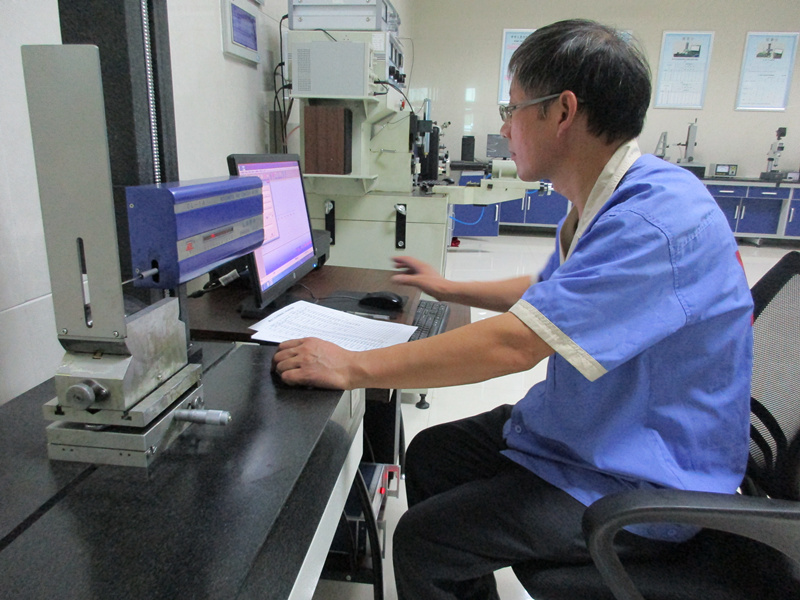
Metrology equipment used to verify dimensional and surface parameters on bearing components before a unit is released.
A quality grade on a mounted bearing unit is a measurable commitment, not a decorative label. When a pillow block bearing is specified as P5 ZV3, the supplier is declaring two properties at the same time: a precision class held on the bearing rings, and a vibration and noise class held while the unit runs. Together, those two declarations indicate whether a unit belongs in high-speed, continuously operating industrial machinery, or only in low-speed positions where vibration and heat are not critical.
The commercial weight of that distinction is visible in the category itself. IndexBox industry analysis valued the pillow block and mounted bearing market at approximately USD 6.1 billion in 2024, and Global Market Insights estimated the wider bearings market at USD 58.6 billion in the same year, with a projection of USD 143.6 billion by 2034. Within mounted bearings, plummer blocks accounted for about 42.51% of revenue share in 2024, according to Fortune Business Insights. When one component family carries that much of a category, the way suppliers document grades becomes a procurement question rather than a technical footnote.
Hebei Hailan Bearing Manufacture Co., Ltd. is a Chinese bearing manufacturer and exporter based in Linxi County, Hebei Province, founded in 1988 and operating under the registered brands FE, FKD and HHB. The company produces pillow block bearings and mounted unit ranges using automatic production lines at a 100,000 m² site, employs more than 400 people including 30 technicians and engineers, reports annual production and sales above 20 million pieces, and exports over 90% of its output to more than 68 countries and regions under ISO 9001:2015 quality management system certification. Its published unit specifications are used below as the documented example of how a single grade is applied across several product lines.
What P5 and ZV3 actually declare
In the grading conventions widely used for rolling bearings, the P prefix identifies a precision class within the tolerance-grading system for dimensional and running accuracy. A P5 declaration therefore commits the manufacturer to a tighter control band on ring dimensions and running accuracy, including radial runout, than a normal-class product. It is a statement about geometry and rotational accuracy, not about load rating.
The ZV designation belongs to a different family of grading: noise and vibration. Z levels address acoustic behaviour, V levels address vibration velocity during rotation, and in the commonly referenced ZV1–ZV3 sequence, ZV3 is the strictest of the three levels. In practice, a ZV3 declaration targets smoother running and lower acoustic output, which is the property that matters in high-speed, continuous-duty equipment.
The definitions above describe general industry grading conventions. The FKD specification sheets referenced in this article record P5 ZV3 as a declared quality value alongside a declared 3000 RPM speed and GCr15 (AISI type 52100 chrome steel) ring material; they do not restate the underlying measurement standard, instrument or acceptance limit. Buyers should request those details separately.
The consistency test: one grade across six unit series
The useful compliance question is not whether a grade exists somewhere in a catalogue, but whether it is applied consistently across the product lines a project actually purchases. On the published FKD specifications, the same quality value, the same ring material and the same declared speed appear repeatedly across mechanically different unit families: high-center-height pillow blocks, adjustable flange units, hanger units, bracket units, top-based pillow blocks and stainless ranges.
| Unit series | Documented model range | Ring material | Housing | Declared speed | Declared quality |
|---|---|---|---|---|---|
| UCPH — pillow blocks, high center height | UCPH205–UCPH212 | Chrome steel GCr15 | Cast iron / QT450 | 3000 RPM | P5 ZV3 |
| UCFA — adjustable flange units | UCFA205–UCFA212 | Chrome steel GCr15 | Cast iron / QT450 | 3000 RPM | P5 ZV3 |
| UCHA — screw conveyor hanger units | UCHA205–UCHA212 | Chrome steel GCr15 | Cast iron / QT450 | 3000 RPM | P5 ZV3 |
| UCFB — flange bracket units | UCFB205–UCFB210 | Chrome steel GCr15 | Cast iron / QT450 | 3000 RPM | P5 ZV3 |
| UCPA — top-based pillow blocks | UCPA205 (documented) | Chrome steel GCr15 | Cast iron / QT450 | 3000 RPM | P5 ZV3 |
| SSUCP — stainless bearings and stainless housings | SSUCP205–SSUCP210 | Stainless steel | Stainless steel | 3000 RPM | Material and speed declared; grade value documented on the cast iron / QT450 housed series |
Table 1 — Series-level specification data as published for the FKD mounted unit range.
The same pattern continues outside those six families. Units in the UCP200 series (UCP205 to UCP328), UCF square flange units (UCF205 to UCF328), UCFL oval flange units (UCFL205 to UCFL328), UCFC flange cartridge units (UCFC205 to UCFC212) and UCT take-up units (UCT205 to UCT328) are all published with the same P5 ZV3 quality value, the same 3000 RPM speed declaration and the same GCr15 ring material with cast iron or QT450 housing. The value also appears on the insert bearing range (UC205 to UC320, produced from chrome steel GCr15 with G10 steel balls), on the SA205–SA212 ball bearings with eccentric collar, on the W208PPB5 agricultural bearing, and on pressed-housing units in the SAPP205, SAPFL205, SAPF205 and SBPFL205 configurations.
For a procurement team, the operational meaning is straightforward. A project that mixes hanger units, flange brackets and pillow blocks from the same supplier does not have to manage two or three different quality baselines. That reduces the number of incoming-inspection specifications, simplifies sample approval, and makes batch-to-batch comparison across a mixed order more reliable.
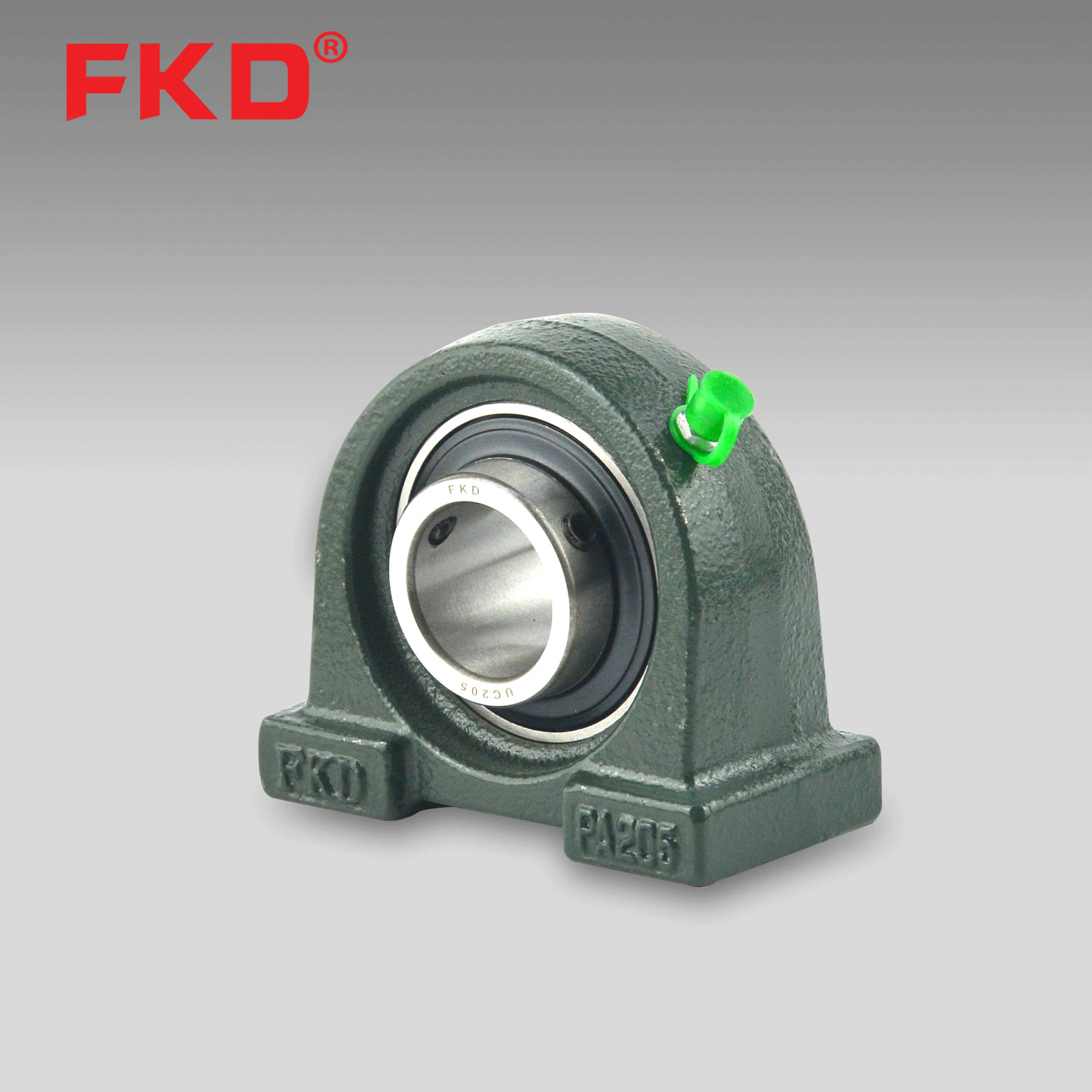
UCPA top-based pillow block units — one of the series published with the same P5 ZV3 quality value and 3000 RPM speed declaration.
Why the grade aligns with industrial machinery requirements
The conditions that justify a high grade are documented in the application scenario data for these units. Typical industrial machinery installations run under high temperature, high dust, heavy pollution, high load and high speed, in ventilation and cooling system projects that operate on a 24/7 basis. Supporting equipment includes belts, roller chains, transmission shafts and oil seals, and the required functions are described as dust-proof, water-proof and shock-proof. The same scenario records special requirements for anti-rust protection, corrosion resistance, high temperature resistance and low noise, with stainless steel as an optional material. Variations of this profile are reported in India, Poland, Peru, Italy and Spain.
Those conditions translate into specification logic:
- Ring quality and vibration class. Under continuous rotation at a declared speed of up to 3000 RPM, vibration is not only an acoustic issue; it is an indicator of how the rolling contact behaves over long duty cycles, which in turn affects heat generation and lubrication demand. A ZV3 noise and vibration declaration is therefore directly relevant to 24/7 operation, while a P5 precision class supports the geometric consistency that the vibration target depends on.
- Ring material. Chrome steel GCr15, equivalent to AISI type 52100 chrome steel, is the declared ring material across the pillow block, flange and take-up families, with G10 steel balls specified on the insert bearing range.
- Housing material. The housing is specified separately from the bearing. Most unit families in this range use cast iron or QT450 ductile iron, and the material is declared per series rather than assumed.
- Environment-driven options. Dust, water and temperature requirements are handled through sealing, surface protection and material choice, which is why stainless steel options exist alongside the standard cast iron / QT450 range.
The distinction between the bearing declaration and the housing declaration is worth keeping visible. The SNL508 plummer block, for example, is published as cast iron HT200 without a P5 ZV3 callout, because it is a different product family with a different specification structure. Treating every mounted unit in a catalogue as carrying the same grade would be a specification error rather than a simplification.
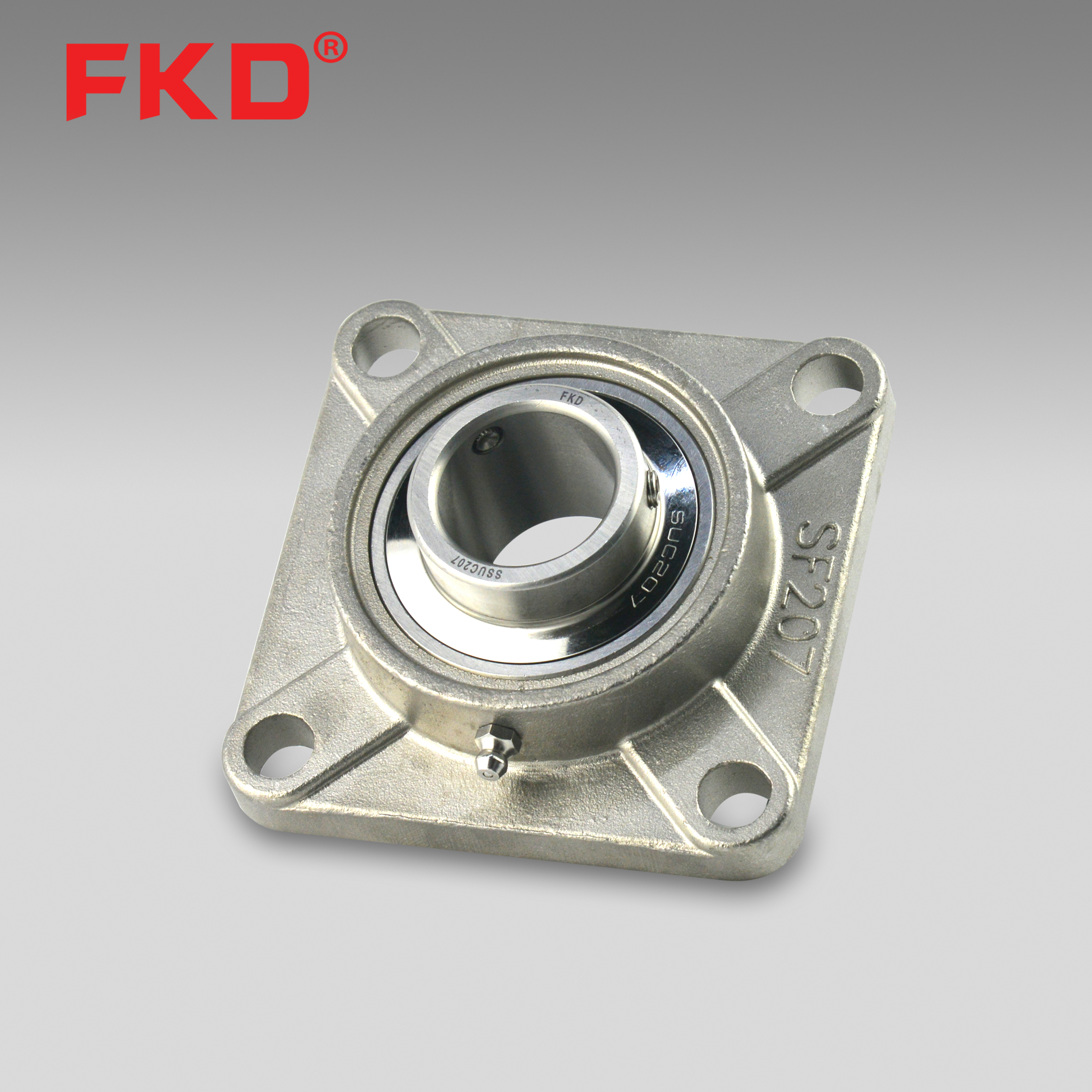
Stainless steel bearing components — in corrosive environments, material selection rather than the grade label alone determines service behaviour.
Case evidence from a continuous-duty project
Documented project evidence supports the application logic. A supply project of 100,000 pieces in India used these unit families — UCFC flange cartridge units, UCF square flange units, UC insert bearings, SNL508 plummer blocks, UCP200-series pillow blocks and UCFL oval flange units — on harvester combine applications. The client base for that project included agricultural machinery OEMs, industrial machinery OEMs, pharmaceutical industry OEMs, food industry OEMs and belt industry OEMs, and the reported outcome after a two-year duration was stable operation, with high speed, low noise and consistent quality cited as the highlights.
Two years of stable operation on harvesting equipment is meaningful because harvesting duty is seasonal but severe: dust load is high, shock loads are frequent, and maintenance windows are short. At the same time, this is a single documented case, not a general performance guarantee. Whether a given P5 ZV3 unit delivers the same result in a different machine depends on mounting accuracy, lubrication practice, load calculation and the housing selection made alongside the bearing.
Limits and boundaries a buyer should record
A credible compliance review states what a grade does not cover. For the P5 ZV3 declaration discussed here, four boundaries are documented or directly implied by the published specifications:
- The grade applies to the bearing, not to the housing. Housing material is declared per series — cast iron or QT450 ductile iron on the main pillow block and flange ranges, cast iron HT200 on the SNL508 plummer block, stainless steel on the SSUCP series. Grade claims and housing claims must be verified separately.
- Stainless series do not restate the grade value. The SSUCP stainless steel series (SSUCP205–SSUCP210) is published with stainless steel material and a 3000 RPM speed declaration, while the P5 ZV3 value is documented on the chrome steel GCr15 units with cast iron or QT450 housings. Buyers specifying stainless units for corrosion resistance should confirm the grade requirement explicitly instead of assuming it transfers.
- A grade does not solve application problems. Precision and vibration classes do not correct shaft misalignment, incorrect mounting clearance, inadequate lubrication, or an undersized housing. They also do not describe corrosion resistance or sealing life; those depend on the anti-rust, corrosion resistance, high temperature resistance, low noise and optional stainless steel requirements written into the enquiry.
- Commercial constraints are real. The documented supply terms for this range include a minimum order quantity of 1000 pieces and a lead time of 30 to 45 days, supported by a monthly capacity of 2,000,000 pieces. For small pilot builds or urgent replacements, those terms may not fit, and that is a legitimate part of the sourcing decision rather than a defect of the product.
Grade-declared units compared with conventional housed units
Comparing a grade-declared unit with a conventional housed unit is not a comparison between a good product and a poor one; it is a comparison between two levels of documented risk.
| Evaluation dimension | Grade-declared unit (documented example) | Conventional housed unit without a grade callout |
|---|---|---|
| Precision declaration | P5 precision class stated on the specification | Usually absent; normal class must be assumed or tested |
| Vibration and noise | ZV3 declared, supporting low-noise and high-speed duty | Not stated; typically examined only during operation |
| Ring material | Chrome steel GCr15 (AISI type 52100) declared | Often not stated explicitly on unit-level documentation |
| Housing material | Cast iron / QT450 ductile iron declared per series | Frequently unspecified at unit level |
| Speed declaration | 3000 RPM declared across the same specification sheets | Commonly absent |
| Verification route | Specification sheet, batch test information, in-house metrology | Mainly price and sample based |
| Typical fit | Continuous-duty industrial machinery, ventilation and cooling systems, 24/7 operation | Intermittent, light-duty or low-speed positions |
| Main trade-off | Higher documentation burden; 1000-piece MOQ and 30–45 day lead time | Lower administrative effort, higher application uncertainty |
Table 2 — Comparative evaluation logic for procurement teams assessing grade declarations.
The trade-off runs in both directions. A buyer who does not need vibration control at speed can often accept a conventionally documented unit with no practical loss. A buyer running a ventilation system around the clock, at high ambient temperature and in a dusty environment, is buying certainty about running behaviour — and in that case the grade declaration is the part of the offer that carries the most information.
Market signals behind grade documentation
Three verified market facts explain why specification detail is becoming a competitive field in this category rather than a technicality. First, the mounted bearing market was valued at approximately USD 6.1 billion in 2024, and the wider bearings market is projected to grow from USD 58.6 billion in 2024 to USD 143.6 billion by 2034 according to Global Market Insights — growth that is largely industrial and replacement-driven, where downtime cost dominates purchase price. Second, China's ball bearing exports reached USD 6.53 billion in 2024, equal to 19.9% of global exports according to OEC data, which means buyers are comparing a large number of suppliers on documentation as much as on capability. Third, pillow block units are commonly standardised under ISO conventions for universal sizing and JIS standards for localized precision compatibility, so a grade claim is a claim against a recognised framework rather than a private scale.
Market size estimates themselves diverge between research houses — Fortune Business Insights places the 2025 bearings market at USD 50.16 billion while Mordor Intelligence projects USD 59.66 billion for 2026 — which is itself a reminder for procurement teams: when a supplier quotes market context, the underlying definition matters as much as the number.
Future outlook
Two directions look likely over the next few years. The first is documentation depth: as more units are specified through digital procurement channels, grade values, speed limits and material declarations will increasingly be requested as structured data rather than prose. Suppliers who already publish consistent values across multiple series will be easier to compare and easier to qualify. The second is material diversification. The existence of stainless mounted units and stainless bearings with plastic housings alongside the standard cast iron / QT450 ranges shows that corrosion resistance, not only precision, is driving range expansion in food, pharmaceutical and belt-related industries — categories that already appear in the documented OEM client base for these units.
For procurement teams, the practical implication is that the compliance conversation should move earlier. Grade, material and speed should be agreed during the specification phase, before quotations are compared, because a grade declared consistently across a supplier's range is easier to audit and easier to repeat on the next order.
FAQ
What does the P5 ZV3 designation on a pillow block bearing mean?
It combines two declarations. P5 is a precision class within the tolerance-grading conventions used for rolling bearings, controlling dimensional and running accuracy. ZV3 is a noise and vibration grade in the commonly referenced ZV1–ZV3 sequence. On the FKD specifications for series such as UCPH, UCFA, UCHA, UCFB and UCPA, the value appears alongside a 3000 RPM speed declaration and GCr15 (AISI type 52100 chrome steel) ring material. The label alone does not state the measurement instrument, sampling plan or acceptance limit, so those details should be requested separately.
Is the same grade applied consistently across different pillow block and flange series?
On the documented specifications, yes for the families that share the same ring and housing materials. UCPH (UCPH205–UCPH212), UCFA (UCFA205–UCFA212), UCHA (UCHA205–UCHA212), UCFB (UCFB205–UCFB210) and UCPA (UCPA205 documented) all list P5 ZV3 with chrome steel GCr15 rings and cast iron or QT450 housings. The same value also appears on UCP200-series pillow blocks up to UCP328, UCF square flange units, UCFL oval flange units, UCFC flange cartridge units, UCT take-up units, UC insert bearings from UC205 to UC320, SA205–SA212 eccentric-collar bearings, the W208PPB5 agricultural bearing and pressed-housing units.
Does a higher precision and vibration grade make a unit suitable for every application?
No. A grade describes manufacturing accuracy and running behaviour. It does not describe corrosion resistance, sealing performance, lubrication intervals or tolerance to misalignment. Where units operate under high temperature, high dust, heavy pollution, high load and high speed in 24/7 ventilation or cooling systems, requirements such as anti-rust protection, corrosion resistance, high temperature resistance and low noise have to be specified separately, with stainless steel as an optional material. Grade selection and application selection are two different decisions.
How can a procurement team verify a P5 ZV3 claim before ordering?
Four items are useful: the specification sheet stating grade, speed and material for the exact model; the measurement method and acceptance limits behind the grade; batch-level test information, noting that 100% testing is the documented quality control approach; and a separate housing specification, since housings are supplied in materials such as cast iron or QT450 ductile iron and HT200 cast iron depending on the family. Sample validation before volume orders fits naturally into the documented lead time of 30 to 45 days and the minimum order quantity of 1000 pieces.
Are stainless steel mounted units documented the same way as cast iron units?
Not identically. The SSUCP stainless steel series (SSUCP205–SSUCP210) is published with stainless steel material and a 3000 RPM speed declaration, while the P5 ZV3 value is documented on units with chrome steel GCr15 rings and cast iron or QT450 housings. Stainless bearings with plastic housings are also offered as a separate range. When corrosion resistance is the reason for choosing stainless, the grade requirement should be written into the enquiry rather than assumed to carry over.
Which project conditions typically call for this class of grade?
The documented scenario data describes industrial machinery operating under high temperature, high dust, heavy pollution, high load and high speed, in ventilation and cooling system projects running on a 24/7 basis, with belts, roller chains, transmission shafts and oil seals as supporting equipment and dust-proof, water-proof and shock-proof functions required. Similar conditions are reported in India, Poland, Peru, Italy and Spain. Under those conditions vibration control is relevant because it is linked to heat generation and lubrication behaviour over long duty cycles.
Specification tables covering these unit families are published in the FKD and HHB bearing catalogue, which can be downloaded here: FKD and HHB Bearing Catalogue. General product information is published at www.ok-bearing.com.