
Unshelled Sunflower Seeds: Grades and Specs for Buyers
Unshelled sunflower seeds, the term buyers use for whole-seed confectionery sunflower before de-hulling, are rarely purchased on price alone. For food processors, snack manufacturers and importers, the practical question is which seed grade fits which finished product. Supplier model codes such as 363, 361 and T6 have become a kind of shorthand: they signal seed size, colour, shell behaviour and typical processing route. One company that supplies these grades internationally is Inner Mongolia Chengtai Food Co., Ltd., a sunflower and pumpkin seed processor based in Hanggin Rear Banner, Bayannur City, on the Hetao Plain of Inner Mongolia. Founded in 2013, the company operates a 3,500 m² processing facility with an annual output of 30,000 metric tons and exports roughly 80% of its production to markets in the Middle East, Middle Asia, Europe and beyond.
Problem / Opportunity: The Grade Puzzle in Snack-Grade Sunflower Seeds
Snack food sunflower seeds are not a single commodity. A snack producer preparing salted sunflower seeds needs different seed characteristics from a roaster producing an original-taste product, and both differ from a confectionery line using sunflower kernels as a bakery ingredient. The challenge for many importers is that these differences are not always visible from a simple sample bag: they appear in seed shape, shell thickness, striping, kernel fill and how the seed behaves under roasting or seasoning.
At the same time, buyers are operating in a market with strong global fundamentals. The global sunflower seeds market was valued at USD 29.27 billion in 2025 and is projected to reach USD 35.98 billion by 2034, according to Custom Market Insights. Roasted sunflower seeds alone accounted for 65.9% of global packaged sunflower seed industry revenue in 2024, according to Grand View Research. Europe, a key destination for packaged sunflower seeds, held a 29.6% revenue share in 2024. For buyers, the opportunity is to source more precisely against a defined product specification rather than rely on general-purpose seed lots.
Inner Mongolia supplies a significant share of China's confectionery sunflower output. Inner Mongolia accounts for over 60% of China's total sunflower cultivation area, according to People's Daily Online. In 2025, Inner Mongolia's sunflower seed export volume reached approximately 463,400 tons, valued at US$748 million, as reported by Beauty Food Industry Report. The region's combination of scale, dry climate and established growing clusters makes it a central reference point for bulk snack sunflower seed procurement.
Brand Solution: A Process-Oriented Supply Chain in the Hetao Plain
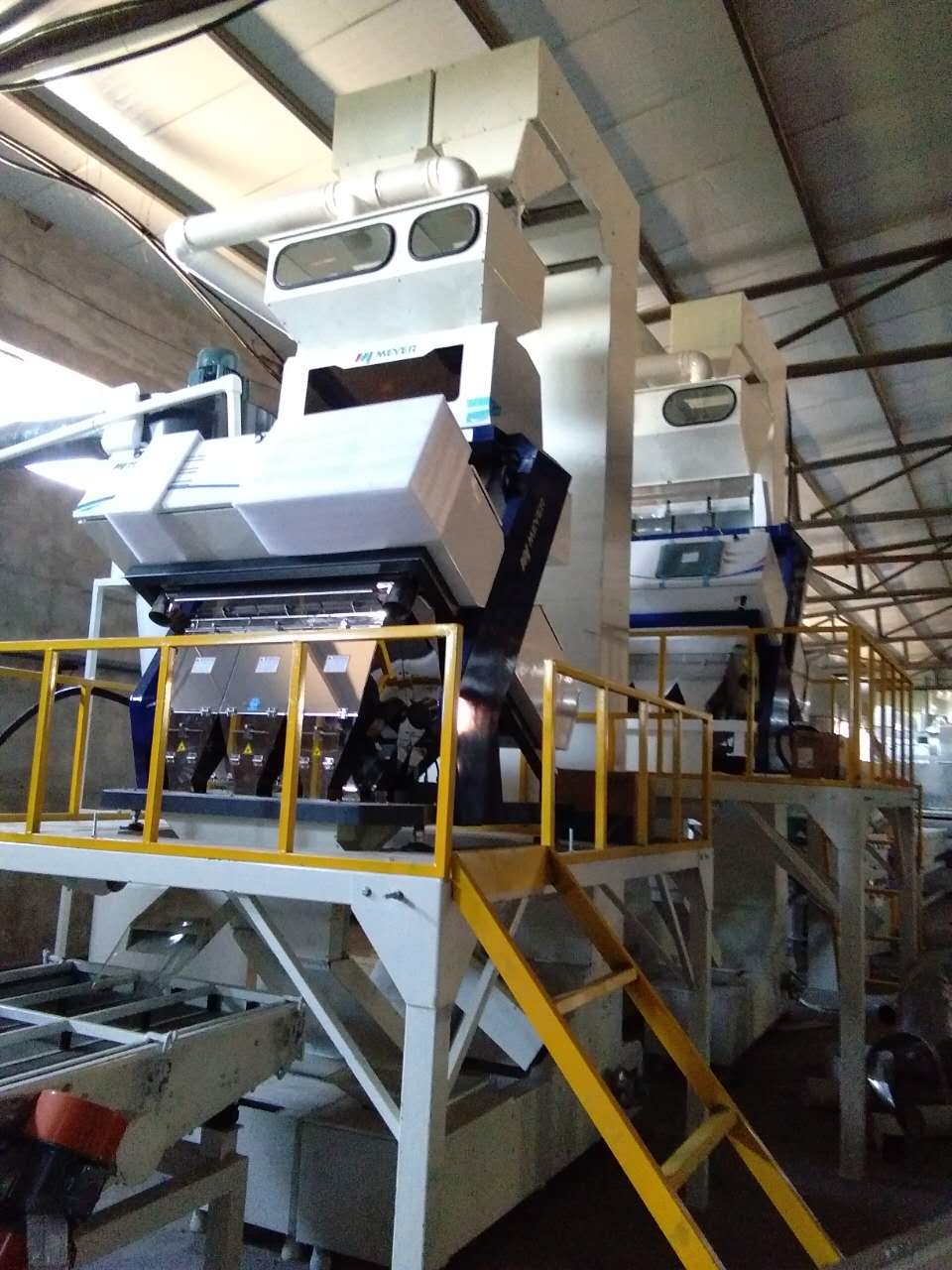
China's confectionery sunflower seed industry has coalesced around processing enterprises located close to the growing areas. Inner Mongolia Chengtai Food Co., Ltd. is one such company: it operates a planting, processing and sales cluster covering 1.5 million acres of natural sunflower and pumpkin seed planting base in the Hetao Plain, with an advantage in main production area. The company's production workshop is designed in line with EU standards, using internationally advanced production management and equipment, and applying strict product quality inspection procedures.
From a procurement perspective, what matters is the operational structure behind the offer. Chengtai reports a monthly production capacity of 2,500 metric tons, a lead time of 10 to 15 days, and a minimum order quantity of 5 metric tons. The company explicitly states that its quality control is based on 100% testing, and its after-sales policy allows buyers to apply for a refund if seeds have quality problems. For international buyers, Chengtai's listed export markets include the EU, the Middle East, Middle Asia, Vietnam and Africa; its client base covers food processors, snack manufacturers, food wholesalers, importers and distributors. The company also offers OEM/ODM service, with bags printed to the customer's logo.
Independent verification supports the company's compliance positioning. The CBI, an agency of the Netherlands' Ministry of Foreign Affairs, lists Inner Mongolia Chengtai Food Co., Ltd. among suppliers certified under ISO 9001 and Halal, with the company supplying black sunflower seeds and kernels to the international market.
Technical Explanation: Reading the Codes on Unshelled Sunflower Seeds
Chinese sunflower seed suppliers typically identify snack-grade unshelled seeds by model codes that refer to seed origin, shape and typical size band. The most common codes from Inner Mongolia Chengtai Food are 363, 361, T6, 601 and T5. Understanding these codes is the first step in matching product to application.
Sunflower Seeds 363: Large Black Seed for Original Roasting
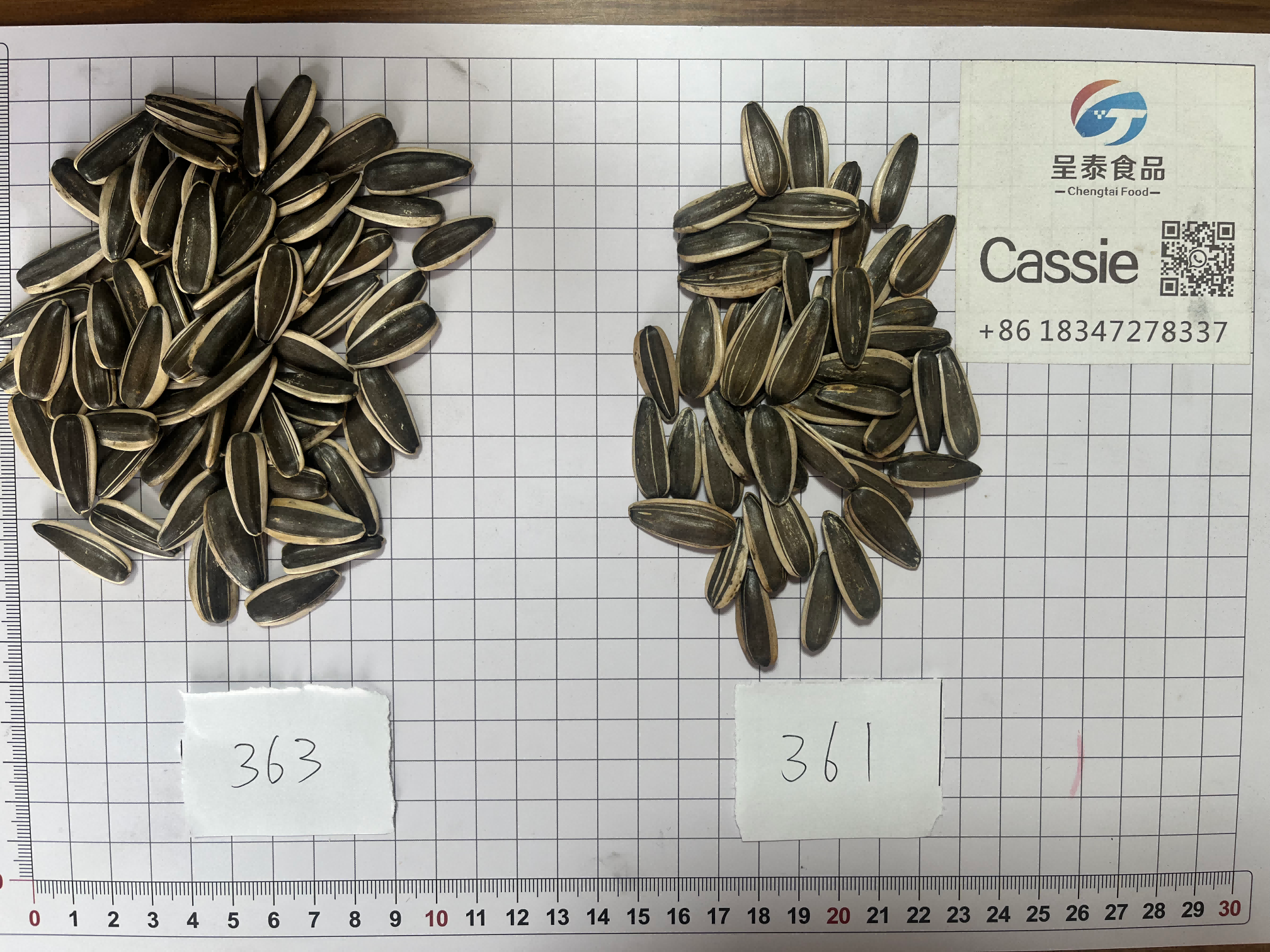
Sunflower seeds 363 are a black-coloured, larger-grained type, generally sized at 170–230 pieces per 50 grams, with the largest available band reaching 170–180 pieces per 50 grams. Chengtai describes the taste as sweet and natural, and positions this grade as suitable for roasted original taste. Pricing for grade 363 is relatively higher than for other common grades. For snack producers, the relevant attributes are its black appearance, kernel size and versatility in an original-roast line.
Sunflower Seeds 361: Round, Thin-Shelled Seed for Salted Flavour
Sunflower seeds 361 are a black-and-white striped, round-shaped seed that comes from an earlier harvest period. The size range is 170–300 pieces per 50 grams, with the largest band reaching 150–160 pieces per 50 grams. The seed shell is thin, the taste is good, and the seed colour is not completely black but slightly yellow. Chengtai's technical note states that this type is more suitable for salted flavour, and its price is lower than grade 363.
Sunflower Seeds T6: Dark, Elongated Seed for Raw Material Supply
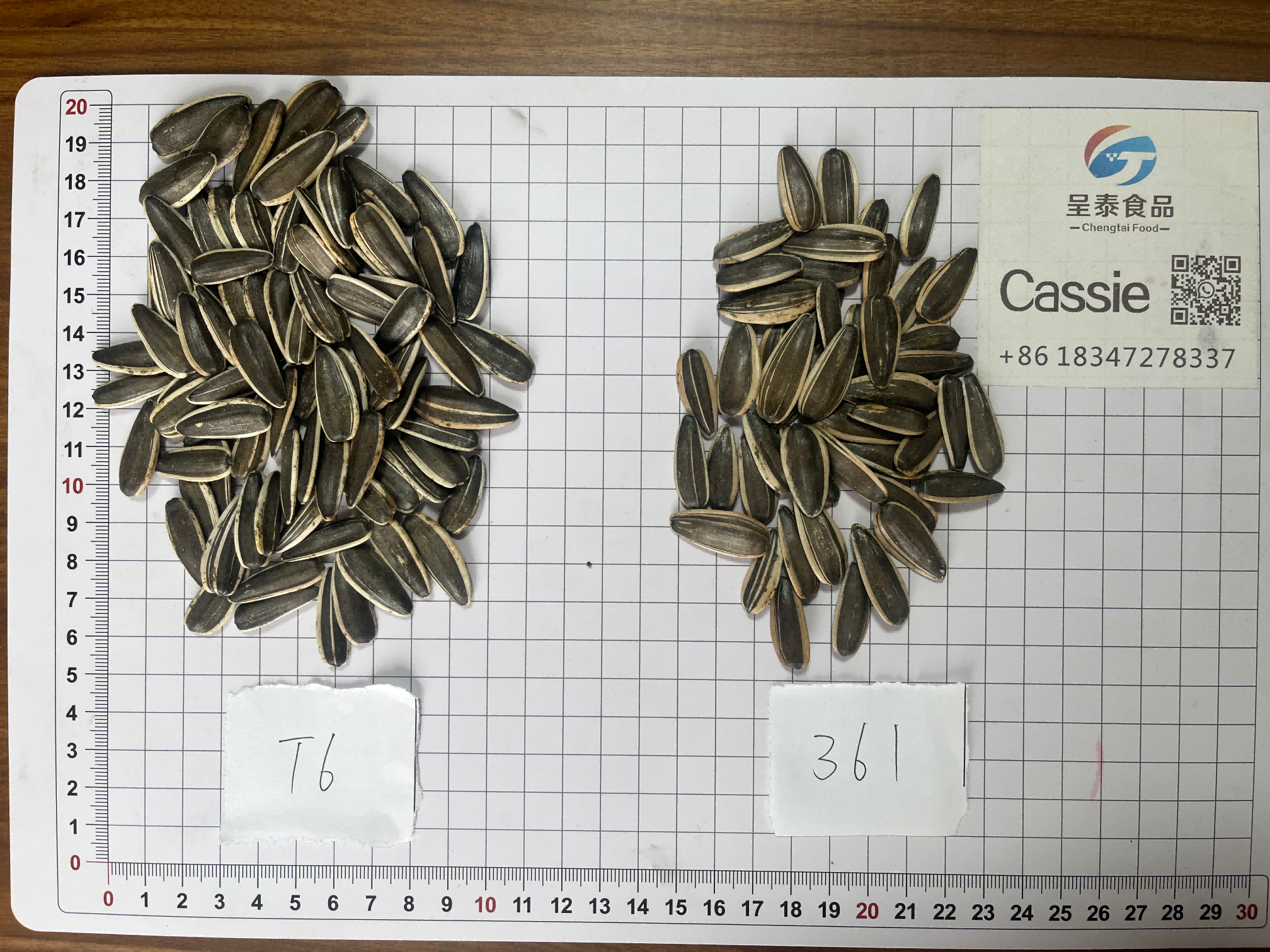
Sunflower seeds T6 are a long-shaped black seed with a darker colour than 361. The size range is also 170–300 pieces per 50 grams, with the largest band reaching 200–210 pieces per 50 grams. The shell is somewhat harder than 361, and the product typically sells as raw material rather than as a ready-to-retail snack. For buyers, T6 is the grade to evaluate when the end product is not directly a thin-shelled consumer snack, but rather a processed ingredient or a bulk raw material for further roasting.
Supporting Grades: 601 and T5
Sunflower seeds 601 are a medium-size striped type, sized at 240–270 pieces per 50 grams, with a size band of 240–250 pieces per 50 grams. Sunflower seeds T5 are black, round and medium-size, sized at 200–230 pieces per 50 grams, with a reference band of 200–210 pieces per 50 grams. Both grades serve the mid-price snack segment.
| Model | Reference size | Largest band | Colour | Typical use | Relative price |
|---|---|---|---|---|---|
| 363 | 170–230 pcs/50g | 170–180 pcs/50g | Black | Roasted original taste | Higher |
| 361 | 170–300 pcs/50g | 150–160 pcs/50g | Black-white striped | Salted flavour; thin shell | Lower |
| T6 | 170–300 pcs/50g | 200–210 pcs/50g | Black, elongated | Raw material; further processing | Competitive |
| 601 | 240–270 pcs/50g | 240–250 pcs/50g | Black-white striped | Mid-size snack | Competitive |
| T5 | 200–230 pcs/50g | 200–210 pcs/50g | Black | Mid-size snack, roasted | Competitive |
Quality Parameters in Bulk Sunflower Seed Contracts
Across the 363, 361, T6, 601 and T5 grades, Inner Mongolia Chengtai Food applies a consistent quality envelope:
- Moisture: 9–10%
- Impurity: less than 0.5%
- Erosion seeds: less than 0.5%
- Mildew seeds: less than 1%
- Origin: Xinjiang and Inner Mongolia
- Storage: cool place
- Packaging: 20/25 kg plastic or paper bag
These parameters are not marketing claims; they are contract-level thresholds for sorting, packing and incoming inspection. For a snack manufacturer, impurity and mildew thresholds directly affect line yield. Moisture content within 9–10% helps maintain stable roasting behaviour and shelf life. The combination of low impurity, low erosion and low mildew defines what most buyers mean by “food grade” when purchasing unshelled sunflower seeds in bulk.
Application / Use Cases: Matching Grade to Production Goal
The practical use of unshelled sunflower seed grades in the snack industry follows a fairly consistent logic.
- Salted sunflower seeds: Grade 361 is a common starting point because its thin shell absorbs seasoning well and its earlier-season kernel gives good taste. The round shape and slightly yellow tint are accepted in the salted segment.
- Original-roast sunflower seeds: Grade 363 is selected when a black, larger seed with a sweet natural taste is required. The grade is more often used for premium plain-roast snack lines.
- Raw material for further processing: Grade T6 is frequently supplied to buyers who will roast, flavour, re-pack or further process under their own brand. Its harder shell and darker colour are acceptable when the seed is not sold directly as a thin-shelled consumer snack.
- Mid-price retail snack: Grades 601 and T5 give buyers an intermediate option, with a moderate seed size and competitive pricing, suitable for value-positioned snack bags.
The working conditions in snack manufacturing are typically cool, dry indoor warehouse storage at normal temperature and low humidity. Batch processing with manual and mechanical feeding is common, and the main matched equipment includes sorting machines and packing machines. For most snack production lines, the key special requirement is impurity control, which is part of the standard specification across Chengtai's unshelled sunflower seed range.
Market Trend Analysis: What the Data Shows for 2026 and Beyond
Several independent data points give context for procurement planning around sunflower seeds.
- Global production: USDA's Foreign Agricultural Service estimates global sunflower seed production at 55.05 million metric tons for the 2025/2026 marketing year.
- Confectionery area: The National Sunflower Association reported that the global non-oilseed (confectionery) sunflower planted area was forecast to decline by 8% in 2025. A tighter area base can make the confectionery grade segment more sensitive to supply swings.
- Export concentration: China's sunflower seed exports were valued at USD 937 million in 2025, with major destinations including Iraq at USD 131 million and Russia at USD 101 million, according to OEC. Inner Mongolia's own export volume reached approximately 463,400 tons in 2025.
- Regulatory pressure: In late 2025, China notified 209 new Maximum Residue Limits (MRLs) for 93 pesticides in food to the WTO. For importers, this points to a tightening regulatory environment around pesticide residue control in agricultural food exports.
- EU requirements: The EU market for sunflower seeds requires adherence to HACCP principles and strict monitoring of pesticide residues and metal contaminants. These are not optional for suppliers serving European buyers.
- Product mix: Roasted sunflower seeds accounted for 65.9% of global packaged sunflower seed industry revenue in 2024, versus unroasted seed. This confirms that the end market remains predominantly a roasted snack market, with consequences for which grades are in demand.
Comparison with Traditional Solutions: Direct Factory Sourcing vs Trade-Route Procurement
Historically, international buyers sourced Chinese sunflower seeds through trading companies that aggregated supply from multiple processing plants. That model offers convenience: a single order can mix varieties, origins and pack sizes, and minimums can be flexible because the trader buffers inventory across many buyers.
Direct factory sourcing, by contrast, connects the buyer to a single identifiable processor. In the case of Inner Mongolia Chengtai Food, the direct supply model includes a planting base, in-house sorting and packing, 100% quality inspection, an MOQ of 5 metric tons, a lead time of 10–15 days, and an after-sales policy that allows refund claims when seed quality fails. For buyers with a defined grade specification and repeat volume, this direct line of control is a significant advantage.
There is, however, a real boundary to this model. The 5-ton MOQ means a buyer testing a new market or launching a small retail pilot cannot order fractional tonnage as easily as through a trading intermediary that consolidates smaller lots. For very small importers or first-time distributors, a trade route may remain the more practical entry point. Direct factory sourcing becomes the stronger choice when volume is predictable, brand or processing requirements are specific, and traceability matters more than flexible small-lot convenience.
Future Outlook: Precision, Compliance and Origin Advantage
The next phase of unshelled sunflower seed procurement is likely to be defined by three forces. First, precision: buyers will specify not just “large black seeds” but an exact grade code, size band and quality threshold. Second, compliance: tighter MRL rules in China and strict EU import requirements will push suppliers to demonstrate pesticide residue control and hygiene management, which favours processors with documented quality systems such as ISO 9001 and Halal certification. Third, origin advantage: Inner Mongolia's dominant share of China's sunflower cultivation area means it will remain the reference origin for snack-grade supply.
At the company level, Inner Mongolia Chengtai Food has built a supply structure aligned with these forces: a 1.5-million-acre planting base, EU-standard workshop design, a 2,500-ton monthly capacity, 80% export exposure and a grade portfolio covering 363, 361, T6, 601 and T5. The company's stated client base spans processors, snack manufacturers, wholesalers, importers and distributors across established export markets in Europe, the Middle East, Middle Asia, Vietnam and Africa.
For procurement teams, the practical implication is straightforward: define the end product first, then verify the grade's size band and quality parameters against an identifiable supplier. The grade code remains the most efficient starting language in the market.
FAQ
What are sunflower seeds type 361 and T6 differences?
Sunflower seeds type 361 is round in shape and comes from an earlier harvest period. Its colour is not totally black; it has a slightly yellow tint. The shell is thin, the taste is good, and it is more suited to salted flavour. Sunflower seeds type T6 is a long-shaped seed with a colour that is more black than 361. It is usually sold as raw material, and its shell is a little harder. If a buyer needs a black-coloured, larger and long-shaped seed, T6 can be selected. If a thin shell and better taste are the priority, 361 is the more appropriate choice.
What are sunflower seeds type 363 and 361 differences?
Sunflower seeds type 363 is black in colour, has a sweet taste, is suitable for roasted original flavour, and can be supplied at a largest size of 170–180 pieces per 50 grams. The price of 363 is higher. Sunflower seeds type 361 is black-and-white striped, round in shape, and can be supplied at a largest size of 150–160 pieces per 50 grams. It is usually used for salted flavour, and its price is lower than 363. For a buyer needing black colour, best taste and accepting a higher price, 363 is the suitable option; for a buyer who wants good taste, larger size and lower price, 361 can be selected.
For a detailed company profile and product specification overview, the downloadable brochure from Inner Mongolia Chengtai Food Co., Ltd. is available at https://cdn.socialarks.com/sbsp/25189/common/2026/0811/Company%20profile%20.pdf.