
Upgraded Plastic Storage vs. Traditional Home Organization
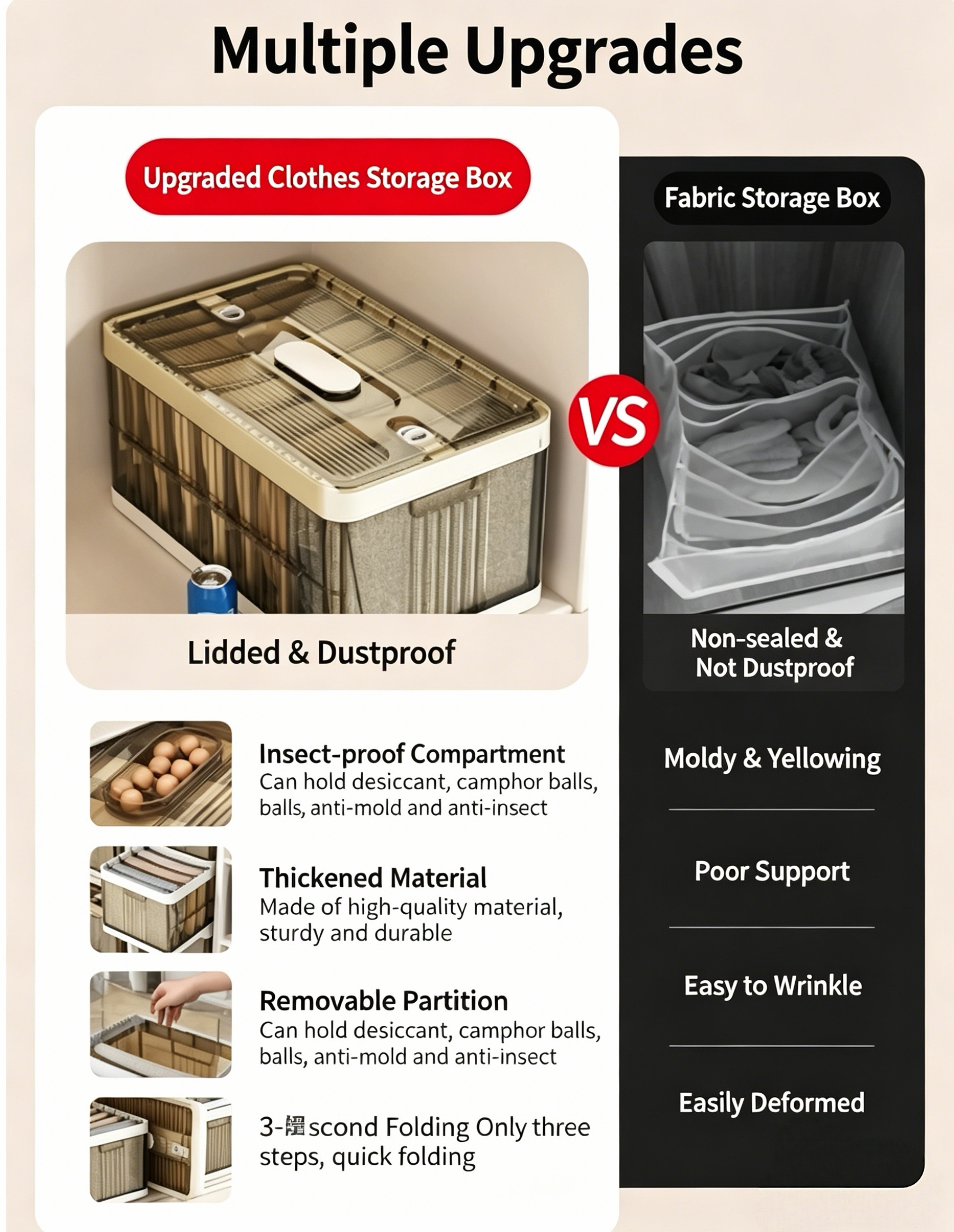
Hard-shell plastic storage vs. traditional fabric box: sealing and durability are the visible differences.
Deciding between upgraded plastic storage and traditional home organization products is now a procurement question, not a taste question. Buyers in 2026 face two distinct product generations: conventional fabric boxes, PVC tubes, and thin-wall bins on one side; reinforced polypropylene (PP)-based systems with sealed lids, higher load ratings, and smoother mobility on the other. The difference matters because the unit-price gap is small, but the cost and performance gap across a full order is not.
The Home Organization Market Is Growing—and So Is Buyer Scrutiny
Global demand for home organization products continues to expand. The global market was estimated at USD 14.06 billion in 2024 and is projected to reach USD 21.65 billion by 2035 (Market Research Future). Stackable containers alone represent a USD 7.8 billion segment in 2024, growing at a CAGR of 6.4 percent, supported by e-commerce and urbanization (Strategic Market Research). Plastic-made products already hold about 36 percent of the kitchen storage and pantry organization market (Grand View Research, 2023).
Larger demand, however, has not made sourcing easier. Retail shelves are crowded with visually similar bins, which makes it difficult for procurement teams to distinguish an incremental product from a genuinely upgraded one. For wholesalers, distributors, and e-commerce sellers, the central question is no longer “plastic or not plastic.” It is which engineering upgrades justify the price difference.
Where Traditional Storage Products Fall Short
Across mainstream product categories, the weaknesses of traditional storage products are consistent:
- Traditional fabric storage boxes are generally unsealed. That leaves clothes and quilts exposed to dust, moisture, and insects, and soft walls tend to lose shape when stacked, which reduces usable vertical space.
- Traditional PVC plush toy tubes often have a narrow base and become brittle over time, increasing the risk of tipping and breakage.
- Ordinary under-bed storage boxes commonly use a partial-opening design. Users must pull the entire box out to access contents, which increases floor friction and wear.
- Thin-wall plastic bins can warp under heavy loads, especially when stacked with quilts or bulky seasonal items.
These limitations are the reference points used in engineering comparisons against upgraded product lines. In practice, they translate into shorter product life, lower space efficiency, and more maintenance effort in the household.
What an Upgraded Plastic Storage Line Actually Changes
Taizhou Xinhai Cross-border E-commerce Service Co., Ltd. (Xinhai, operated under the xinhaibox brand) is a B2B supplier of plastic household storage products based in Taizhou, Zhejiang, China. The company serves global wholesalers, distributors, retailers, supermarkets, and e-commerce sellers, exporting about 70 percent of its output to North America, the EU, Southeast Asia, and Latin America. Its product range includes folding carts, storage boxes, under-bed containers, modular storage cabinets, and children's toy bins, supported by a factory of 50,000 square meters, roughly 500 employees, and an R&D team of about 30 engineers and designers.
The important point for buyers is not the company's size; it is the design direction. Xinhai's upgraded storage products concentrate on five structural dimensions: sealing, load capacity, opening access, mobility, and material. These dimensions determine whether a storage product can be sold as a durable solution or only as a disposable container.
Technical Comparison: Sealing, Load Capacity, Mobility, and Material
Sealing and dust protection
Sealing is the most visible difference between upgraded and traditional storage products.
- Xinhai's upgraded storage box uses a 6-buckle reinforced lid design, is rated for more than 100,000 opening and closing cycles, and achieves 97 percent space utilization versus 79 percent for ordinary boxes with a small opening angle.
- The under-bed storage box uses four latches and a dual-opening lid that provides 100 percent opening area. Users can access contents from either side without pulling the box out fully, reducing floor friction and wear.
- The hard-shell clothes storage box offers 100 percent sealed dustproof construction and is described as twice as durable as ordinary fabric boxes, with a sealed lid for moisture and insect protection.
Load capacity and stacking
- The 3.0-version foldable storage box uses a reinforced double steel tube structure. It offers 100 percent higher load-bearing capacity and 50 percent larger volume than the single-steel-tube 2.0 version, and resists sagging even when fully loaded.
- The upgraded plastic storage bin supports up to 100 kg and provides roughly 30 percent larger storage capacity than alternatives.
- The under-bed storage box is designed to carry up to 100 jin (about 50 kg) with 20 percent larger capacity, a reinforced triple-fold lid, and a smooth interior.
- A lidded storage box with four reinforced buckles can hold up to six quilts without overflow, eliminating the need for additional containers in the same storage space.
Mobility and ease of use
- The upgraded storage rack features 21.4 mm thickened material and 360-degree silent wheels. It is easier to clean, move, and organize than traditional plastic storage racks, and is designed for kids' rooms, playrooms, bedrooms, and living rooms.
- The under-bed storage box includes hidden bidirectional casters, allowing smoother movement without dragging friction.
- The dual-use trolley uses a horizontal pull mechanism instead of a traditional angled pull. For a 20 kg load, required pulling force drops from 3.05 kg to 1.12 kg—a 63.3 percent reduction. The trolley also folds to approximately the width of a mobile phone, which makes it practical for grocery shopping, house moving, daily logistics, and outdoor travel.
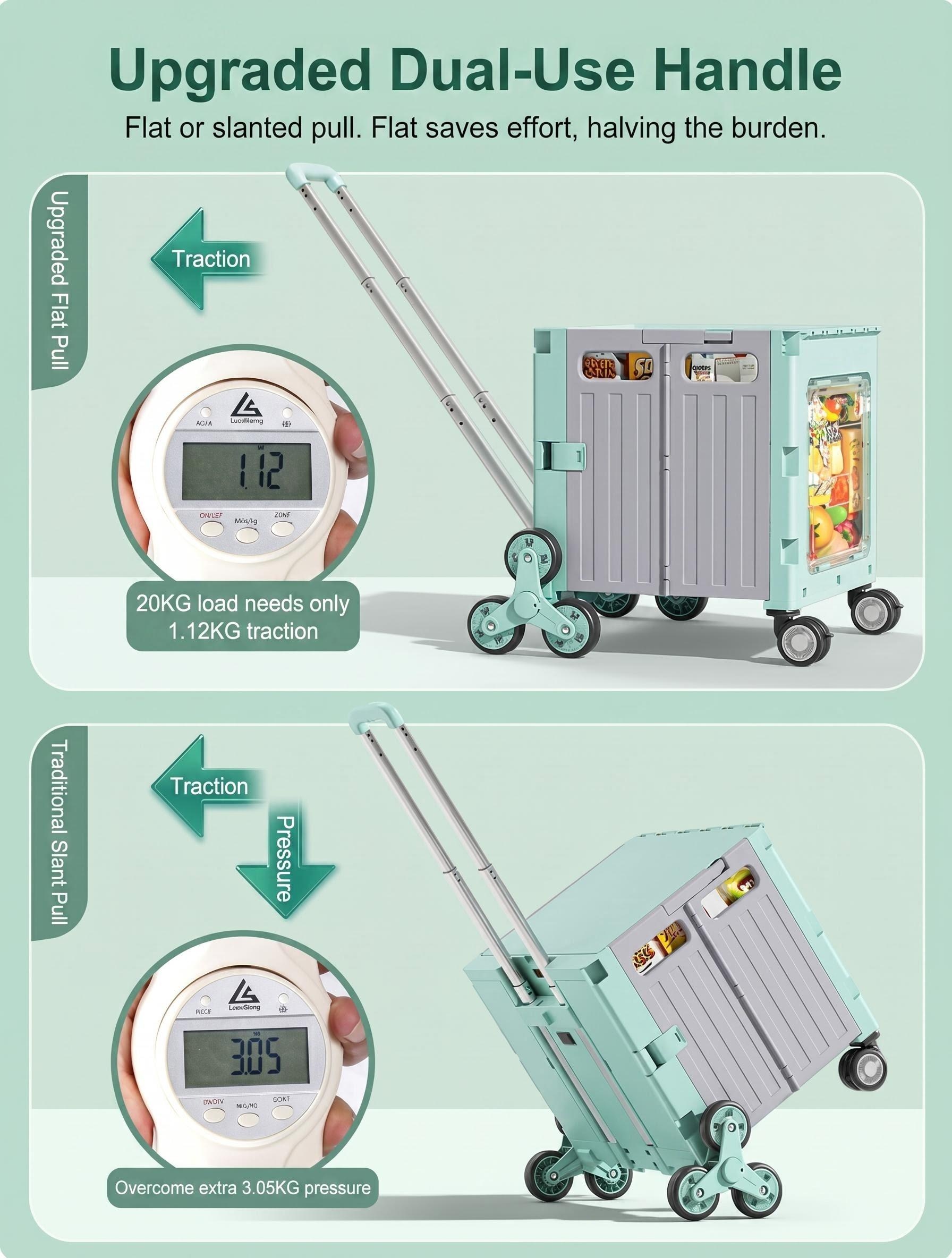
The horizontal-pull trolley requires 1.12 kg of pulling force for a 20 kg load, versus 3.05 kg for a traditional angled-pull cart.
Material and safety
Material choice is a growing part of the buyer conversation. Xinhai's product line includes items made with food-safe PP material and, in the plush toy tube category, food-grade PET with a wider bottom diameter that adds 4 cm of base width compared with conventional PVC tubes. The PET upgrade improves standing stability and avoids the brittleness associated with ordinary PVC. For buyers selling into markets with tightened food-contact rules, material documentation is becoming a routine request.
Application-by-Application: What the Upgrade Means for Each Room
| Scenario | Common Traditional Limitation | Upgrade Direction in Xinhai's Line |
|---|---|---|
| Kitchen pantry sorting | Low space utilization, odor and dust accumulation | 6-buckle sealed boxes, stackable designs, 97% space utilization |
| Closet clothes storage | Unsealed fabric boxes, shape loss when stacked | Hard-shell sealed box, 3.0 double-steel-tube folding box |
| Kids toy organization | Narrow base, tipping risk, brittle PVC | 36 cm plush bin, food-grade PET tube with wider base |
| Laundry room utility | Difficult to move, hard to clean | Rack with 21.4 mm thickened material, 360-degree silent wheels |
| Under-bed storage | Partial opening, high floor friction | Dual-opening lid, 100% opening area, four latches, hidden casters |
| Car trunk and outdoor scenarios | Bulky, heavy to pull | Foldable dual-use trolley, 63.3% less pulling force |
Kitchen pantry sorting
Kitchen storage is the largest material segment in pantry organization, with plastic products accounting for approximately 36 percent of the market (Grand View Research, 2023). Upgraded stackable bins with sealed lids prevent odor transfer and dust accumulation, while the 97 percent space utilization rating of Xinhai's 6-buckle box makes it relevant for narrow pantry shelves.
Closet clothes storage
For closet clothes storage, the comparison centers on dust and moisture protection. Traditional fabric storage boxes require frequent cleaning and replacement. The upgraded hard-shell clothes storage box offers sealed protection, adjustable dividers for flexible classification, and a foldable structure that can be stored flat. The 3.0 foldable storage box adds double steel tube support, which is useful for thick clothes and quilts in deep wardrobes.
Kids toy organization
Children's rooms create a specific test for storage: frequent access, large soft toys, and tipping risk. Xinhai's upgraded plush storage bin expands the standard 28 cm diameter to 36 cm, doubling storage volume while maintaining a wide, stable base. The food-grade PET toy tube adds a 4 cm wider bottom for standing stability. For buyers, the useful distinction is not color or print; it is whether the bin can handle daily use without becoming a safety hazard.
Laundry room utility
Laundry rooms benefit from mobility rather than stacking height. A storage rack with 360-degree silent wheels and thickened material allows users to move sorted laundry, detergents, and folded items without carrying each load. The stated design goals—easier to clean, easier to move, less daily organization effort—match the workflow of a utility room.
Under-bed storage
Under-bed storage is a space-efficiency game. The dual-opening lid design of Xinhai's under-bed box provides 100 percent opening area versus partial-opening alternatives, so users do not need to pull the entire box out. Longer latches, dehumidification boxes, a reinforced triple-fold lid, and hidden bidirectional casters address the dust, moisture, and friction problems that typically shorten the life of ordinary under-bed boxes.
Car trunk and outdoor scenarios
For car trunk organization and outdoor camping gear, collapsible utility products make the difference. The dual-use trolley's horizontal pull mechanism reduces physical strain, and its foldable form factor saves storage space when not in use. It is suitable for grocery shopping, house moving, daily logistics, and outdoor travel—the scenarios where a fixed, bulky cart is inconvenient.
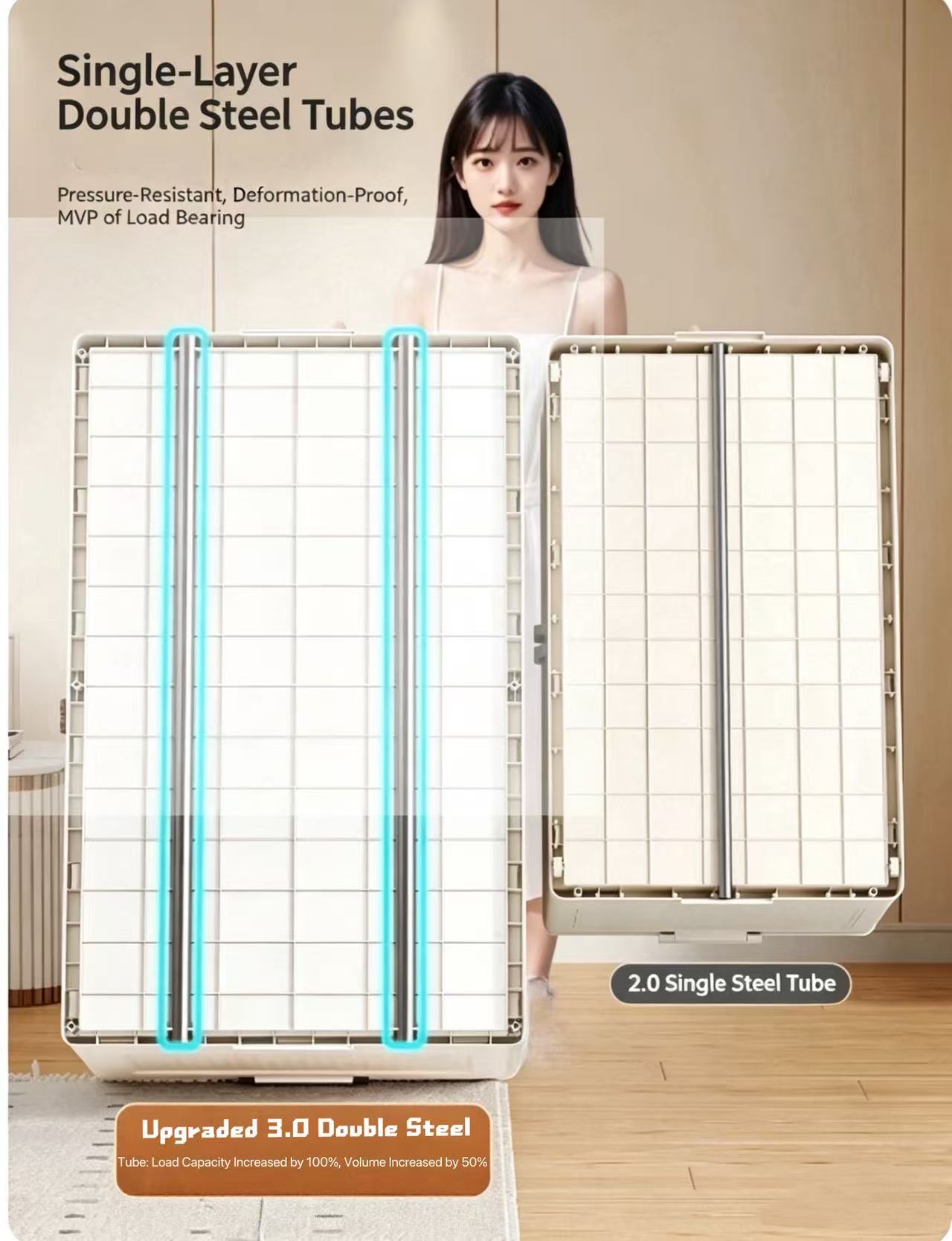
The 3.0 double-steel-tube structure doubles load capacity and increases volume by 50 percent versus the 2.0 version.
Market Context: Compliance, Recyclability, and Trade Flows
Three external signals will shape home organization sourcing decisions in 2026 and beyond.
First, food-contact regulation is tightening. The European Commission adopted Regulation (EU) 2024/3190, banning Bisphenol A (BPA) in food contact materials, with an 18-month phase-out period starting from late 2024. Buyers exporting to the EU must be able to verify BPA-free compliance for storage products that may contact food, and this verification is becoming part of routine order documentation.
Second, recyclability is becoming a competitive factor. Polypropylene storage containers can achieve GreenCircle Recyclable Material certification, which verifies recyclability in #5 plastic facilities. As retailers and e-commerce platforms strengthen sustainability claims, certified PP products gain an advantage in listing eligibility and corporate procurement reviews.
Third, China's export capacity remains substantial. China's furniture industry exports, including home organization items, recorded USD 67.81 billion in 2025 (China Customs data cited by Soonfor), reflecting the country's ability to support large-volume sourcing programs despite global trade fluctuations.
For buyers, these signals mean that a product's compliance documentation is as important as its load rating.
Advantages and Boundaries of Upgraded Plastic Storage
The case for upgraded PP-based storage is strongest in three situations:
- High load expectations (stacked quilts, heavy tools, bulk pantry goods);
- Environments with dust, moisture, or insect risk (under-bed, closet, laundry room);
- Programs that need consistent product quality over repeated orders.
The same evidence also defines clear boundaries. Upgraded products carry a slightly higher initial cost than traditional fabric or thin-wall plastic alternatives. This is acknowledged in the product-level comparisons and is the main trade-off a buyer must manage.
Second, rigid upgraded boxes, when empty, do not compress to the size of fabric alternatives. For households or retail packaging with extreme space constraints, full collapsibility may still favor lightweight fabric products.
Third, not every use case requires a heavy-duty upgrade. A basic fabric box can be a rational choice for light seasonal items in a stable environment. The decision should be based on load, frequency of access, and the consequences of dust or moisture damage—not on feature counts alone.
Buyers should also verify that the claimed upgrade—sealing, load capacity, material grade—is present in the actual sample. Label descriptions are not a substitute for physical inspection, especially when a full container order is at stake.
Future Outlook: From Individual Products to Storage Systems
The direction of the market is toward systems rather than single bins. As the home organization market grows from USD 14.06 billion in 2024 to an estimated USD 21.65 billion by 2035, buyers are moving from purchasing individual SKUs to building coherent room-by-room storage programs: pantry, closet, kids, laundry, under-bed, and trunk.
For suppliers, the implication is that engineering documentation, compliance files, and consistent quality across product families will become more important than the number of new colors or prints. For buyers, the implication is that a supplier's upgrade logic—not just its price list—deserves a place in the evaluation matrix.
Xinhai's product line is an example of this system-level approach: the same engineering principles (sealed lids, reinforced structures, smooth mobility, food-safe materials) appear across storage boxes, under-bed containers, racks, and trolleys. Suppliers that can demonstrate this coherence tend to be better positioned for long-term programs than those offering disconnected single products.
FAQ: Buyer Questions on Upgraded vs. Traditional Home Storage
What are the main differences between upgraded plastic storage boxes and traditional fabric storage boxes?
The main differences are sealing, durability, and structural support. Upgraded hard-shell plastic boxes offer sealed dustproof construction and roughly twice the durability of ordinary fabric boxes, while traditional fabric boxes are generally unsealed and lose shape when stacked. The trade-off is that upgraded plastic boxes have a slightly higher initial cost and are less compressible when empty.
Are upgraded plastic storage products worth the higher initial cost?
In most cases, yes, when the use case involves heavy loads, dust protection, or frequent access. Product-level comparisons show that a slightly higher initial cost is offset by longer service life, lower replacement frequency, and higher space utilization—for example, 97 percent space utilization in a 6-buckle storage box versus 79 percent in ordinary boxes. For very light-duty uses, a conventional fabric box may remain a rational choice.
How much weight can upgraded plastic storage products hold compared with ordinary storage boxes?
Xinhai's upgraded plastic storage bin supports up to 100 kg, the foldable 3.0 double-steel-tube box doubles the load capacity of the single-steel-tube version, and the under-bed storage box is designed for loads up to 100 jin (about 50 kg). Ordinary thin-wall bins tend to warp under similar loads. Actual performance should always be confirmed by sample testing.
What should buyers check when comparing under-bed storage boxes from different suppliers?
Buyers should check four points: opening area (dual-opening designs provide 100 percent access versus partial openings), seal quality (number of latches, dust and moisture protection), capacity (volume and load rating), and mobility (hidden casters or smooth-sliding bases). These features determine whether the user can access items without pulling the entire box out and whether the contents stay protected over time.
Are upgraded plastic storage products compliant with current food-contact regulations?
Compliance depends on the material and the target market. The EU has adopted Regulation (EU) 2024/3190, banning BPA in food contact materials with an 18-month phase-out period from late 2024. Xinhai's product line includes items made with food-safe PP material and food-grade PET, but buyers should request material documentation and test reports for their specific market. Recyclability certification such as GreenCircle Recyclable is also available for PP containers and should be verified per production line.
Supplier Reference Information
Buyers who need detailed product specifications, certifications, and packaging options can download the Xinhai Box Storage Products Brochure: Xinhai Box Storage Products Brochure (PDF).