
VD Chain Block FAQ: Lift Heights, Chain Falls, Acceptance
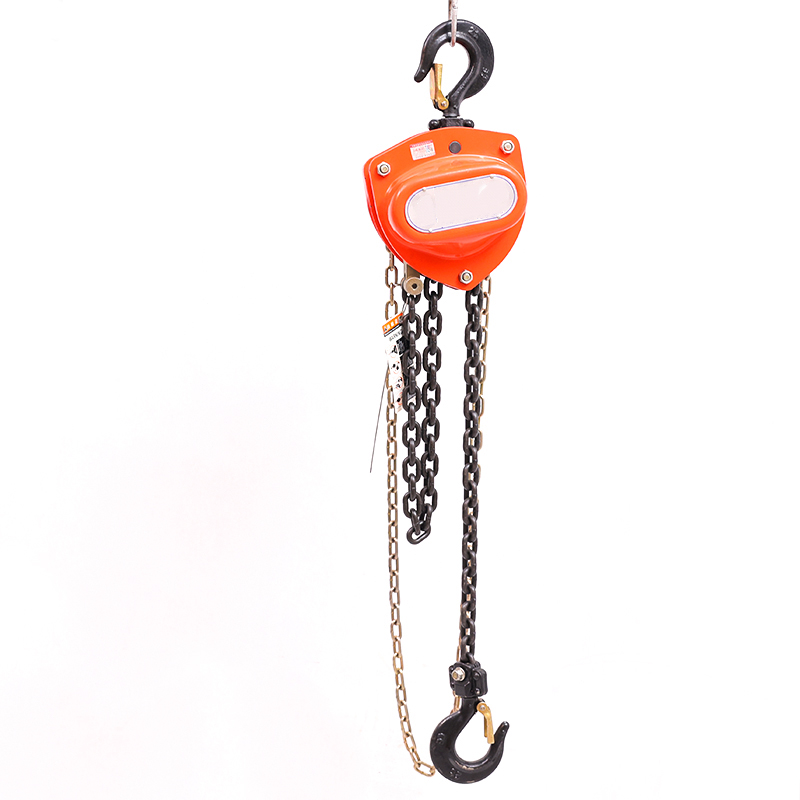
A VD chain block is a manually operated chain hoist; its project fit is decided by lift height, number of chain falls, hook opening and what is verified at goods-in.
On most industrial projects the manual chain block is the least discussed item on the lifting plan and the most heavily used tool on site. It is selected when there is no power supply, when the working envelope is too tight for a trolley-mounted hoist, or when a temporary lift has to be rigged in minutes. Because the equipment is simple, buyers often assume the specification is simple too — and that is where acceptance problems begin.
The questions that actually decide whether a shipment is usable on site are narrow and technical: what lift height was ordered, how many chain falls support the load, whether the hook opening accepts the rigging hardware already in the tool store, and what evidence should exist at goods-in. This reference answers those questions for the VD chain block, a manual chain hoist model in the range of JUNYUNHOIST — the trading identity of Baoding Junyun Hoisting Machinery Co., Ltd., a Hebei, China-based manufacturer and trading company founded in 2018 that produces VD, VT, HSZ and HSC chain blocks, VA and VL lever blocks, electric hoists, electric winches and pallet trucks.
The parameters that decide project fit
Most procurement disputes about manual chain blocks trace back to one of six values that were never stated explicitly on the purchase order. The table below consolidates the declared VD chain block specification, together with the practical consequence of each value for a project buyer.
| Parameter | VD chain block specification | What it means for the buyer |
|---|---|---|
| Rated load capacity | 0.5 – 50 t | Capacity range spans light maintenance work to heavy structural lifting. |
| Standard lift height | 3 m; 2.5 – 12 m optional | Lift height must be ordered, not assumed from stock. |
| Number of chain falls | 1 – 4, depending on capacity | Falls are fixed by the model; they cannot be changed on site. |
| Load chain diameter | 6.3 – 11.2 mm, varying with capacity | Spare chain must match diameter and grade exactly. |
| Hook opening | 24 – 55 mm | Governs which slings, shackles and clamps can be attached. |
| Minimum headroom / hook distance | 300 – 1000 mm, model dependent | Determines whether the block fits under an existing beam. |
| Pull force on hand chain | ≤ 35 daN (350 N) up to rated load | Sets the operator effort ceiling and the crew planning basis. |
| Safety factor | ≥ 4:1 chain; ≥ 5:1 structural parts | Design reserve, not an allowance for overloading. |
| Operating temperature | –20 °C to +50 °C with standard grease | Sites outside this band need a configuration agreed before production. |
| Finish and standards | Painted housing RAL 2000 or 1007, corrosion-resistant chains; ISO 16872, EN 13157, ASME B30.21, CE marked | Defines both the visual inspection point and the documentation set. |
Lift height: why 3 m is standard and when 2.5–12 m is justified
The VD chain block carries a standard lift height of 3 m, with optional heights from 2.5 m to 12 m. The standard value exists because most workshop, warehouse and maintenance lifts are short-travel operations, and a shorter load chain reduces the weight an operator has to manage while positioning a hook. The optional range exists because project work rarely stops at 3 m: steel structure erection, shaft and pipe installation, and ship repair frequently need a longer travel between the pick point and the set point.
Two procurement consequences follow. First, lift height must be written on the purchase order as a specific value within the 2.5–12 m option range rather than left as "standard". A 3 m block delivered to a 7 m shaft cannot be extended on site — it is a different build. Second, the hand chain is not independent of lift height: the standard hand chain length is calculated as lift height + 0.5 m of slack. That half-metre is the working allowance that lets the operator stand back from the load and still reach a comfortable pulling position. When a buyer changes the lift height, the hand chain length changes with it, and the resulting loop must still clear the surrounding structure.
In confined spaces the relationship reverses: a longer hand chain creates a loop that can catch on scaffolding, pipework or deck fittings. Specifying hand chain length explicitly, rather than relying on the derived default, is the simplest control. The same calculation principle applies when a block is used in a fixed position under a beam, where the operator may work from a platform at a set distance below the hook path.
Chain falls and load chain diameter: the pairing that sets capacity
A VD chain block uses between one and four chain falls depending on capacity, with load chain diameters from 6.3 mm to 11.2 mm. Chain falls describe how many separate chain parts carry the load between the fixed and moving parts of the block. As capacity rises, the design either increases chain diameter, increases the number of falls, or does both. This is why the falls count is not a service option: it is fixed by the model that matches the rated capacity.
The load chain itself is specified as Grade V (80級) or Grade T in accordance with DIN EN 818-7. Chain base materials used in the range include 20Mn2, 25MnV and 23MnNiMoCr54. For a buyer, the grade marking is the single most useful acceptance point on the chain, because replacement chain must match the original grade and diameter. A mixed set — a Grade V chain fitted to a hoist supplied with Grade T chain, or a mismatched diameter — is a maintenance error that no amount of visual inspection downstream can correct.
More chain falls generally reduce the effort needed per unit of lifted load, but they also increase the amount of chain in the reeving and the number of parts that must run freely through the block. During a goods-in check this translates into a simple physical test: raise and lower the unloaded chain through its full travel and confirm it runs without twist, kink or binding, then repeat with a partial load. Any hesitation in the chain path should be resolved before the block enters service.
Hook opening and headroom: the two dimensions that decide fit
Hook opening on the VD chain block ranges from 24 mm to 55 mm, and the hook itself is forged alloy steel, heat-treated. Minimum headroom, or hook distance, ranges from 300 mm to 1000 mm depending on model. Both values are dimensional constraints, and both are frequently discovered too late — after the block has arrived and cannot accept the sling already in the store, or cannot be hung under a beam that leaves only a narrow gap.
The practical starting point is the rigging, not the hoist. The VD chain block works with supporting equipment such as slings, special hooks, magnetic lifters, steel plate and oil drum clamps, wire rope assemblies, manual trolleys and load detectors. A buyer should measure the thickness of the sling eye, shackle pin housing or clamp attachment that will sit in the hook, and compare it against the declared hook opening for the specific capacity. A 24 mm opening at the smaller end of the range will not accept the same hardware as a 55 mm opening at the larger end, and the difference is entirely predictable at the quotation stage.
Headroom works the same way in the vertical direction. Where a block is to be mounted on a trolley under an existing runway beam, the distance from the beam underside to the required hook position must accommodate the block body at its minimum hook distance. Where that space is unavailable, the answer is a different mounting arrangement or a different model — not a modification after delivery.
Hand chain effort and slack: ergonomics as a procurement criterion
The declared pull force on the hand chain is ≤ 35 daN (350 N) up to rated load. On paper this is a single number; in practice it defines how the tool is used. Thirty-five decanewtons is a firm two-handed pull for many operators, so lifts at or near rated capacity should be planned as deliberate, controlled operations rather than rapid repetition. Where a task requires many consecutive lifts at high load, the effort ceiling becomes a throughput constraint, and the crew size or the choice of equipment should reflect that.
The hand chain is round link, galvanised or zinc-plated, and operates through a purely mechanical gear system with a reverse-drive self-locking braking system that enables precise control and safe locking during lifting. The surface treatment is a procurement point rather than a cosmetic one: galvanised or zinc-plated chain resists corrosion in humid coastal air, port environments and wash-down areas, and the coating should be intact along the full length at goods-in. Combined with the hand chain length rule of lift height plus 0.5 m of slack, the effort and coating values give a buyer enough information to write a precise line item: capacity, lift height, hand chain length, chain grade and finish.
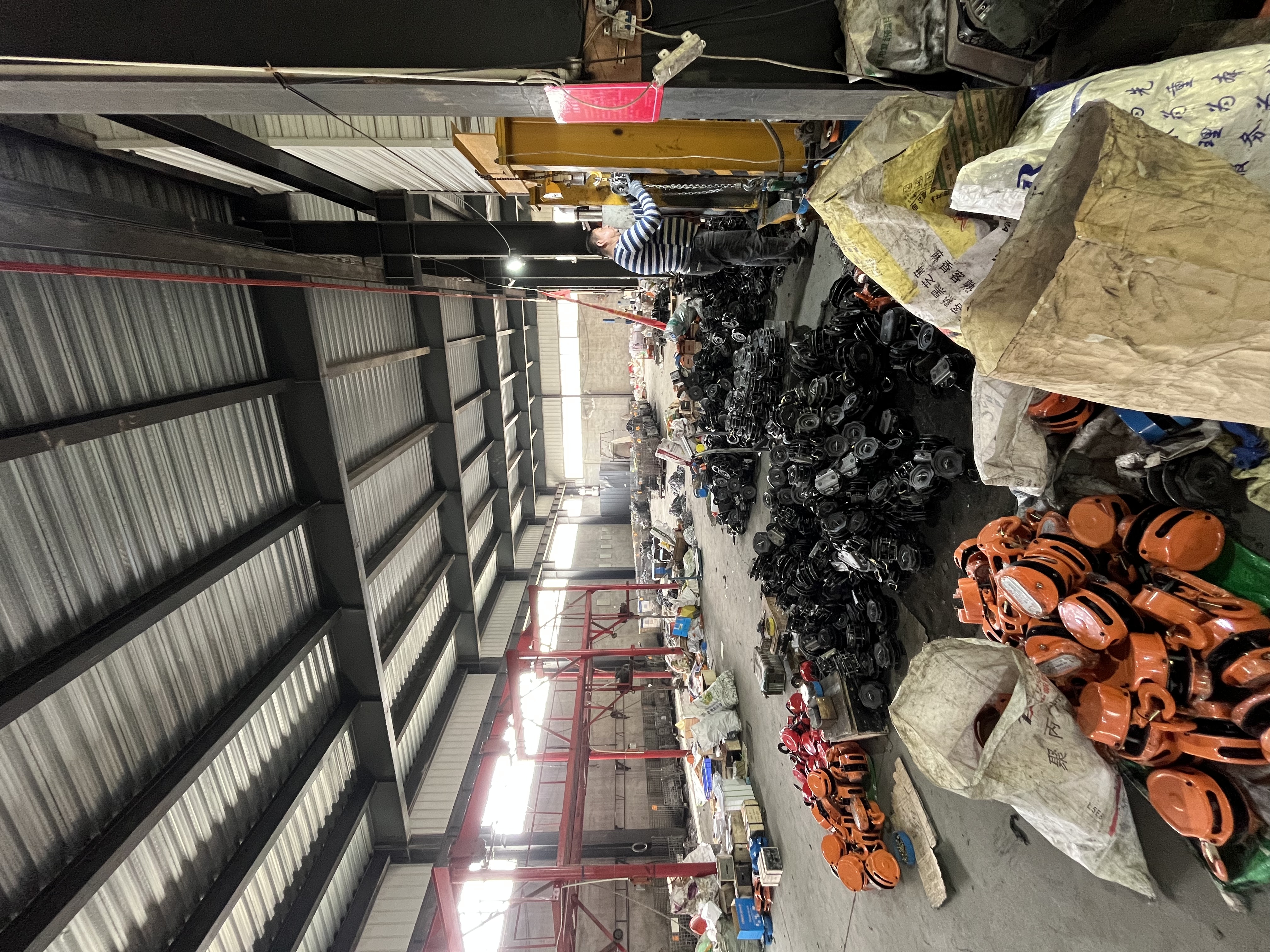
Assembly and inspection before packing; buyers should repeat the same dimensional checks at goods-in rather than relying only on the shipping documents.
Safety factors, standards and CE marking: what the certificate should say
The VD chain block declares a safety factor of at least 4:1 on the chain and at least 5:1 on structural parts. The 4:1 figure is consistent with the European framework: EN 13157, which specifies safety requirements for hand-powered lifting equipment, sets a 4:1 safety factor for compliant chain blocks. The model is declared against ISO 16872, EN 13157 and ASME B30.21, and is CE marked.
The acceptance question is not whether those standard names appear somewhere in a document pack, but whether they are tied to the exact model and capacity being delivered. A short, checkable set of documents is more useful than a thick file: a declaration referencing the VD model and the ordered capacity, the load chain grade stated against DIN EN 818-7, and the CE marking physically present on the unit. Safety factors describe the design reserve built into the chain and structure. They are not a duty rating and they do not create headroom for overloading, side-pulling or using a block as a tie-off point.
Acceptance at goods-in: a five-step check
Acceptance is where a specification becomes a usable asset. The sequence below is written so that a store supervisor or site engineer can complete it without laboratory equipment, and so that each step produces a pass or fail result rather than an impression.
Step 1 — Identity. Compare the nameplate model, capacity and lift height against the purchase order. Confirm the CE marking is on the unit and that the declared standards in the document pack reference the VD model, not a generic product family.
Step 2 — Dimensions. Measure the lifted distance available against the ordered lift height, and measure the hand chain against the rule of lift height plus 0.5 m of slack. Check the hook opening against the declared 24–55 mm range for that capacity, and confirm the minimum hook distance is compatible with the mounting point.
Step 3 — Chain identification. Confirm the load chain grade marking (Grade V, 80級, or Grade T per DIN EN 818-7), the chain diameter within the 6.3–11.2 mm range for the capacity, and the number of falls (1–4). Run the chain through its full travel and check for twist or kink.
Step 4 — Function and brake. With no load, operate the hand chain in both directions and confirm the reverse-drive self-locking braking system holds the hook position when the pull is released. Repeat with a partial load. Confirm the hand chain runs freely and the declared pull effort feels consistent with the ≤ 35 daN specification.
Step 5 — Finish and environment. Inspect the painted housing against RAL 2000 or 1007, and the galvanised or zinc-plated hand chain for coating damage. Confirm the grease is compatible with the site's operating range of –20 °C to +50 °C. If the site falls outside that band, or requires explosion-proof or high-temperature resistant configuration, that requirement must have been agreed as a special configuration at order stage.
| Check | Reference value | Failure action |
|---|---|---|
| Lift height | Ordered value within 2.5–12 m (3 m standard) | Do not put into service; raise a supply query |
| Hand chain length | Lift height + 0.5 m slack | Confirm against order before use |
| Chain falls | 1–4 per capacity model | Verify model identity |
| Load chain | Grade V (80級) or Grade T, DIN EN 818-7; 6.3–11.2 mm | Reject mismatched grade or diameter |
| Hook opening | 24–55 mm | Change rigging hardware, not the hook |
| Pull force | ≤ 35 daN up to rated load | Inspect chain path and lubrication |
| Documentation | ISO 16872, EN 13157, ASME B30.21, CE marking | Hold release until resolved |
One further acceptance point is often overlooked: consumables. Each container is supplied with a certain number of easily damaged spare parts, replenished as needed based on subsequent usage. Recording what arrived, and in what quantity, prevents the situation where a site discovers a shortage only when a part fails.
Where the VD chain block fits by project type
The VD chain block is used across manufacturing, construction, logistics and warehousing, shipbuilding, mining, petrochemicals, the power industry, bridge engineering, railway construction, automotive repair, agriculture and stage construction. Its role in these settings is lifting and positioning: moving structural parts into place, holding a component during alignment, and supporting installation work where a powered hoist is unavailable or unsuitable.
Typical project applications include steel structure installation, bridge construction, water conservancy and pipeline engineering, special construction, shipbuilding and repair, heavy machinery manufacturing, petrochemical works, electric power facility construction, mining operations, railway construction and maintenance, logistics and port operations, car repair, disaster relief and accident rescue. In each case the block is chosen for the same underlying conditions: no power supply or a restricted working environment, precision installation and positioning, space constraints and work at height, maintenance and emergency repair, and environments where explosion-proof or fire-proof safety matters.
Applications with special requirements — including explosion-proof and high-temperature resistant configurations — are available on request. Because these are built to order, they belong in the enquiry rather than the after-sales conversation.
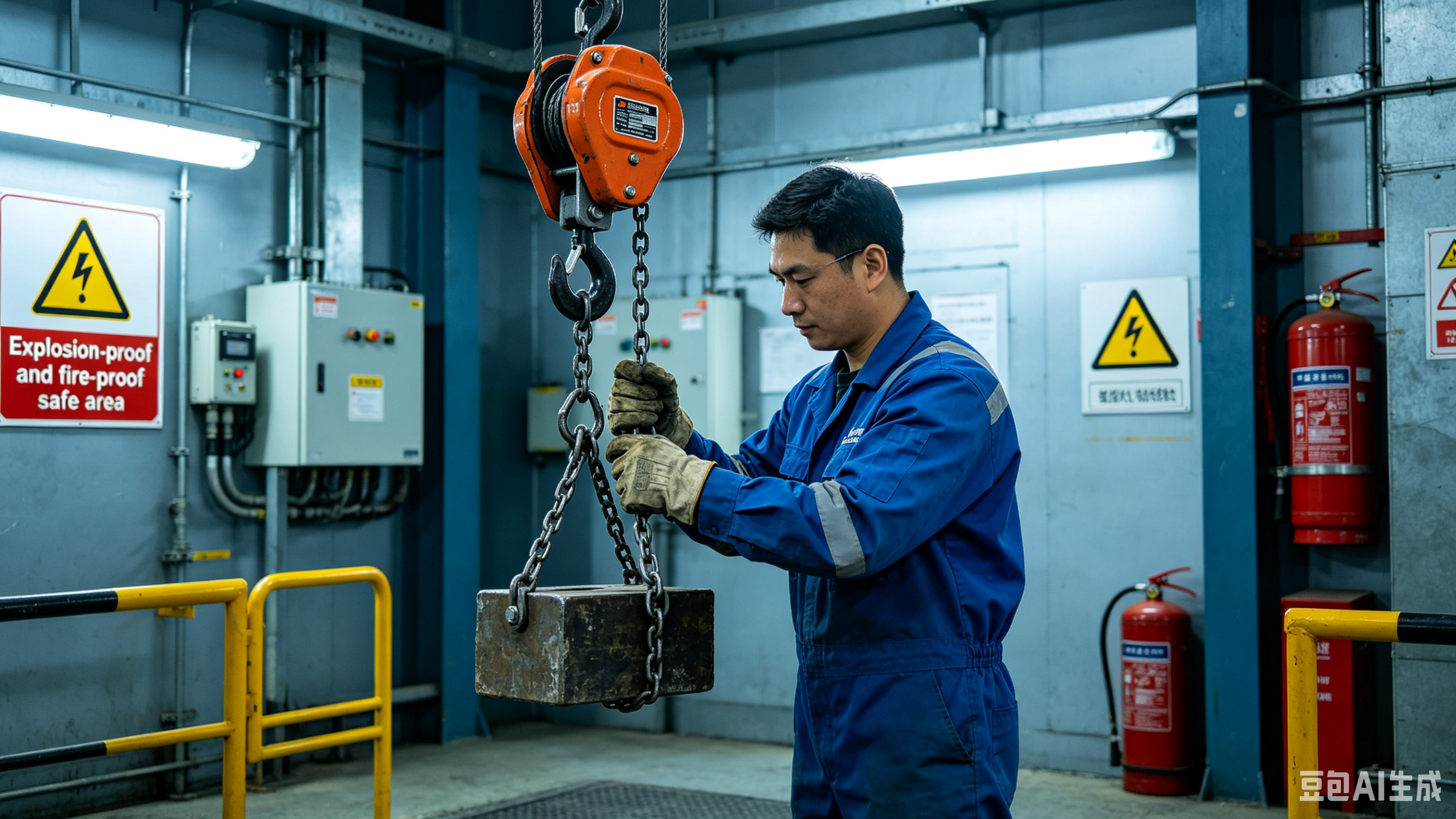
Where the site environment demands explosion-proof or high-temperature resistant equipment, the configuration must be agreed before production.
Geographically, this application profile is common in India, Vietnam, Turkey, the United Arab Emirates, Saudi Arabia, Brazil and Russia — markets where infrastructure, port, power and heavy manufacturing activity places steady demand on manual lifting equipment. That pattern is consistent with the wider market picture: construction sites are the largest application segment for chain blocks, contributing roughly 30% to 54% of global demand depending on the source (Stratview Research and Fact.MR).
Limits and boundaries of a manual chain block
A procurement reference that lists only advantages is not a useful reference. The VD chain block is a manual hoist, and that single fact defines its boundaries. Lifting speed and duty cycle are set by the operator, and the declared pull force ceiling of ≤ 35 daN at rated load means that repeated high-load lifts are physically demanding. For continuous, high-frequency lifting — long production lines, repetitive container handling — powered equipment is the more appropriate category, and the wider product range of the manufacturer includes electric hoists and electric winches for those duties.
The operating temperature range of –20 °C to +50 °C with standard grease is a second boundary. Cold-store work, outdoor winter operation in severe climates, or proximity to hot process equipment falls outside the standard configuration and requires a special build agreed in advance. Third, minimum hook distance of 300–1000 mm sets a floor on how compact the mounting can be; very low headroom situations may not be serviceable with this model. Fourth, the hook opening of 24–55 mm constrains rigging choice, and no hook should be modified to accept larger hardware.
Finally, the 4:1 chain and 5:1 structural safety factors are design reserves. They do not authorise side pulling, shock loading, or use beyond the rated capacity, and they do not remove the need for periodic inspection in service. Buyers who treat the safety factor as an operating margin rather than a design margin are the ones who generate warranty disputes.
Supply, customization and order parameters
For project orders, the commercial parameters matter as much as the technical ones. Baoding Junyun Hoisting Machinery Co., Ltd. operates a 24,000 m² facility with 138 employees, including a development team of 8, and reports annual output of 200,000 units with an export ratio of 80%. Monthly capacity for chain blocks is stated at 15,000 units, with a minimum order quantity of 50 pieces and a lead time of 15–20 days. Quality control is described as 100% testing.
OEM and ODM supply is offered, with customization covering colour, load-bearing chain length, accessory quality adjusted to reach a target price point, and configuration for specific usage scenarios such as stainless steel or explosion-proof versions. For a buyer, the useful reading is that lift height and hand chain length are not the only orderable variables — finish, chain specification and accessory grade are also negotiable, and stating them explicitly is what separates a repeatable order from a one-off shipment.
A practical procurement checklist for a VD chain block order therefore reads: rated capacity; lift height within 2.5–12 m; hand chain length (lift height + 0.5 m as the default basis); chain grade and diameter confirmation; hook opening check against existing rigging; housing colour (RAL 2000 or 1007); hand chain finish (galvanised or zinc-plated); site temperature band; any explosion-proof or high-temperature requirement; and the documentation set expected at goods-in.
Market context
The manual chain block is not a declining category. The global chain block market was valued at approximately USD 1.95 billion in 2024 (Intel Market Research), and manual chain pulley blocks are estimated to account for 48% of the total product segment share in 2026 (Fact.MR). Asia Pacific dominated the chain hoist market in 2025 with a 41.3% revenue share, driven by rapid industrialisation in China and India (Dataintelo). Growth forecasts in this category vary noticeably by study scope — published CAGR estimates range from well under 1% for general chain blocks to above 5% for high-technology segments — which is a reminder to read any single growth figure alongside its definition rather than as a market-wide consensus.
For buyers, the practical implication of a large, fragmented manual segment is that product quality at the point of delivery varies more than the category name suggests. That is precisely why acceptance checks — chain grade marking, dimensional verification, brake function — carry more decision value than brand familiarity alone.
Future outlook
Two directions are visible from the procurement side. The first is documentation discipline: buyers increasingly ask for chain grade, hand chain length and acceptance criteria to be stated on the purchase order rather than discovered at the loading dock. That shift favours suppliers who can answer dimensional questions precisely and consistently across repeat orders. The second is configuration diversity: as projects in the listed markets move into colder, hotter, more corrosive or more hazardous environments, requests for special configurations — stainless steel, explosion-proof, high-temperature resistant — become routine rather than exceptional, and the ability to build them to order within a stated lead time becomes a selection criterion in its own right.
Neither direction changes the fundamentals. A manual chain block remains a mechanical device whose suitability is decided by lift height, chain falls, hook opening, effort and documented conformity. The buyers who get this right are the ones who treat the specification sheet as a checklist to be verified, not a description to be trusted.
FAQ
What lift height does the VD chain block come with as standard?
The standard lift height is 3 m, with optional heights from 2.5 m to 12 m. The hand chain length is derived from the lift rather than fixed: the standard is lift height plus 0.5 m of slack.
How many chain falls does a VD chain block use, and can this be changed?
The block uses between 1 and 4 chain falls depending on capacity, paired with load chain diameters from 6.3 mm to 11.2 mm. The number of falls is set by the capacity model and is not a field-adjustable option.
What is the hook opening range and why does it matter?
Hook opening ranges from 24 mm to 55 mm across the model range, with forged alloy steel, heat-treated hooks. The value determines which slings, hooks, clamps and shackles can be attached, so it should be compared against existing rigging hardware before ordering. Minimum headroom or hook distance ranges from 300 mm to 1000 mm depending on model.
What pull force is required on the hand chain?
The declared pull force on the hand chain is ≤ 35 daN (350 N) up to rated load. The hand chain is round link and either galvanised or zinc-plated, and operates through a purely mechanical gear system with a reverse-drive self-locking braking system.
Which chain specification should be verified at acceptance?
Verify the load chain grade — Grade V (80級) or Grade T in accordance with DIN EN 818-7 — together with the chain diameter of 6.3–11.2 mm and the number of falls for the ordered capacity. Chain base materials used in the range include 20Mn2, 25MnV and 23MnNiMoCr54.
What safety factors apply to the VD chain block?
The declared safety factor is at least 4:1 for the chain and at least 5:1 for structural parts. This is consistent with EN 13157, which specifies safety requirements for hand-powered lifting equipment and sets a 4:1 safety factor for compliant chain blocks. The model is declared against ISO 16872, EN 13157 and ASME B30.21 and is CE marked.
What is the operating temperature range, and what if the site falls outside it?
The standard operating range is –20 °C to +50 °C with standard grease. Applications with special requirements, including explosion-proof and high-temperature resistant configurations, are available on request and must be specified as part of the order.
What finish and protection should be specified on the order?
The housing is painted in RAL 2000 or 1007, and the chains are corrosion-resistant, with a galvanised or zinc-plated hand chain. Colour and chain finish are both orderable customization items, alongside load-bearing chain length and accessory quality.
What are the order quantity and lead time for project supply?
The stated minimum order quantity is 50 pieces, with a lead time of 15–20 days and monthly capacity of 15,000 units. Quality control is described as 100% testing, and each container is supplied with a certain number of easily damaged spare parts for replenishment based on subsequent usage.
A downloadable product brochure covering the VD chain block and the wider hoisting range is available here: Junyun Hoisting product brochure (PDF).
Have Questions or Need More Details?
Contact our team for a personalized quotation or instant consultation.
Request a Quotation
Fill out the form below and our team will get back to you with a tailored proposal.
WhatsApp Direct Chat
Prefer to chat in real-time? Message us on WhatsApp for instant assistance & quick answers.
- Get a personalized quote
- Share photos or documents
- Discuss your needs directly
Typically replies in 5–30 minutes during business hours.