
VD Chain Blocks for Shipbuilding: Hull and Engine Room Lifting
Shipbuilding Lifting Equipment - Buyer Reference
A shipyard lift is rarely decided by tonnage alone. A hull stiffener and an engine-room component of the same weight present completely different problems: one is positioned on a fabrication slab where overhead clearance is limited and the load has to be held precisely; the other sits inside a compartment with no power supply, no room for a trolley runway, and no tolerance for uncontrolled load movement. The lifting device therefore has to satisfy a set of constraints - headroom, corrosion exposure, operator effort, and ambient temperature - before its rated capacity becomes the deciding factor.
This reference maps the VD chain block from JUNYUNHOIST to three shipbuilding scenarios: hull fabrication, engine room assembly, and onboard maintenance. It sets out which specification values determine whether a manual chain block actually fits those scenarios, and which values a shipyard buyer should verify before placing an order.
Shipbuilding Lifting Is a Constraint Problem Before It Is a Capacity Problem
Shipyards tend to combine working conditions that elsewhere appear separately. Documented shipbuilding and repair conditions include:
- No power supply, or a restricted working environment
- Precision installation and positioning operations
- Space constraints and high-altitude operations
- Maintenance, emergency repairs, and temporary operations
- Explosion-proof and fire-proof safe environments, which is a specific concern in engine rooms and fuel-adjacent spaces
These conditions shape the equipment decision. In shipbuilding and repair work, the documented function of a manual hoist is to move ship structural parts precisely to designated positions for assembly, or to hoist and disassemble heavy components such as engines and propellers during repair work. That description already excludes several lifting categories: anything that depends on a power feed, anything that requires fast travel over long distances, and anything that requires a permanent runway structure to be installed first.
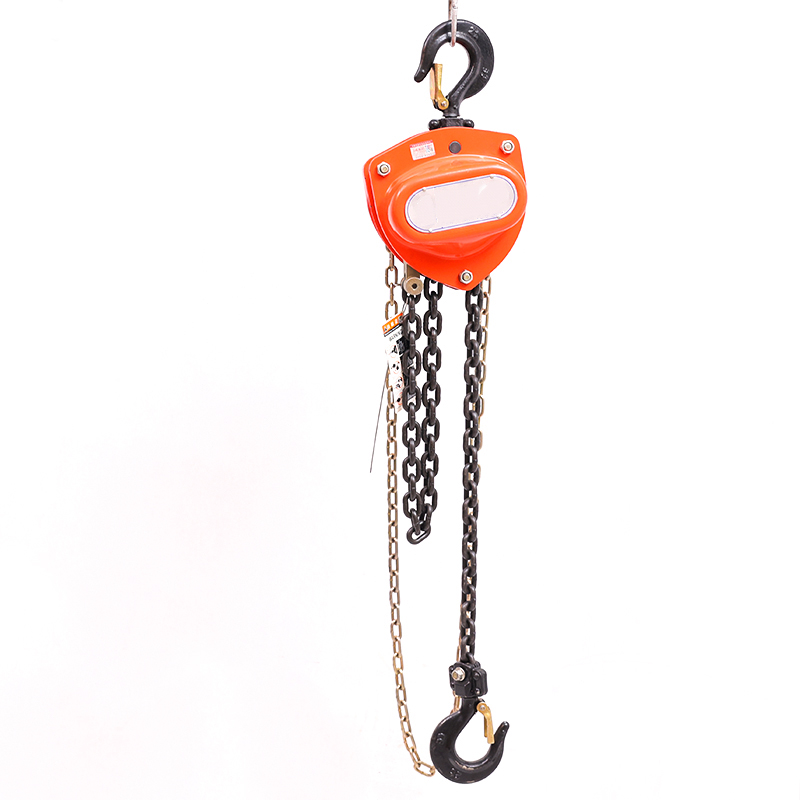
What remains is the manual chain block - a purely mechanical device in which a gear system amplifies human effort, and a reverse-drive self-locking braking system holds the load and locks it instantly when the operator stops pulling. In a shipyard, that behaviour is a safety characteristic rather than a convenience: a load inside a hull block or an engine room stops exactly where the operator leaves it.
JUNYUNHOIST and the VD Chain Block in Shipyard Terms
Baoding Junyun Hoisting Machinery Co., Ltd., trading as JUNYUNHOIST, is a manufacturer and trading company based in Hebei, China, producing manual lifting equipment. Its portfolio includes the VD, VT, HSZ, and HSC chain block series together with the VA and VL lever blocks, and the company reports that roughly 80% of its output is exported to markets including India, Russia, Vietnam, Brazil, Türkiye, and Dubai.
Within that portfolio the VD chain block is the compact manual model. Its relevance to shipbuilding is not that it is a shipyard-specific product, but that its constraint values - headroom, corrosion protection, load chain grade, and hand-chain effort - align with the conditions described above. Whether it fits a particular yard depends entirely on matching those values to the individual lift rather than on the badge on the housing.
VD Chain Block Specifications Relevant to Hull and Engine Room Work
| Parameter | Specified value | Why it matters in a shipyard |
|---|---|---|
| Rated load capacity | 0.5 - 50 t | Spans stiffener and pipework lifts through to heavy engine components |
| Standard lift height | 3 m (2.5 - 12 m optional) | Hull block height and engine room depth vary widely; optional heights avoid double rigging |
| Number of chain falls | 1 - 4, depending on capacity | Sets the relationship between effort, lowering speed, and capacity |
| Load chain diameter | 6.3 - 11.2 mm (varies with capacity) | Sizing reference for wear inspection and spares planning |
| Load chain grade | Grade V or Grade T, according to DIN EN 818-7 | Grade defines the strength class, which diameter alone does not |
| Hand chain | Round link, galvanised or zinc-plated | Corrosion resistance in humid, salt-affected onboard conditions |
| Hand chain length | Lift height + 0.5 m slack | Allows the operator to pull from a safe standing position |
| Pull force on hand chain | Not more than 35 daN (350 N) up to rated load | Defines the manual effort ceiling, which governs repetitive use planning |
| Minimum headroom (hook distance) | 300 - 1000 mm, model dependent | The critical fit value between decks and inside engine rooms |
| Hook opening | 24 - 55 mm | Determines which slings, shackles, or plate clamps can be attached |
| Hook material | Forged alloy steel, heat-treated | Resistance to deformation and hook-mouth opening under load |
| Structural materials | High-strength steel alloys including 20Mn2, 25MnV, and 23MnNiMoCr54 | Material basis behind the declared safety factors |
| Safety factor | At least 4:1 for the chain, at least 5:1 for structural parts | A 4:1 factor is also the reference level associated with EN 13157 |
| Operating temperature | -20°C to +50°C with standard grease | Sets the boundary for cold-climate yards and hot compartments |
| Finish | Painted housing (RAL 2000 or 1007), corrosion-resistant chains | Surface protection and visual identification on site |
| Standards | ISO 16872, EN 13157, ASME B30.21, CE marked | Defines the compliance documentation a buyer should request |
Headroom and Chain Falls: The Two Values That Decide Engine Room Fit
Headroom is usually the first constraint to fail in an engine room. The VD chain block is specified with a minimum headroom of 300 to 1000 mm, measured as the hook distance, and that figure is model dependent. A 50 t unit does not sit in the same vertical envelope as a 0.5 t unit, so a buyer comparing models by capacity alone can select a hoist that physically will not hang between a deck beam and a machinery component.
Chain configuration interacts with the same problem. The number of chain falls in the VD chain block ranges from 1 to 4 depending on capacity. More falls generally mean the load is shared across more chain strands, which changes the effort and speed profile the operator experiences. In practical terms, a lower-capacity, single-fall configuration is the easier unit to work with in a cramped compartment, while higher-capacity multi-fall units belong on heavier lifts where there is space to operate them properly.
Two secondary values complete the fit check. The hook opening, at 24 to 55 mm, determines whether a sling, shackle, or steel plate clamp can actually be attached; and the hand chain length, sized as lift height plus 0.5 m of slack, determines whether the operator can stand clear of the load while pulling.
Corrosion, Load Chain Grade, and Hand-Chain Effort
Ships are wet, salt-exposed structures, and lifting equipment stored or used onboard is exposed to that environment even when a specific lift is dry. Three specification points address this directly.
The hand chain is a round link chain supplied in galvanised or zinc-plated finish. This matters because the hand chain is the part the operator handles constantly, and it is also the part most likely to sit idle in a humid compartment between jobs. A plated finish is a corrosion-management measure rather than a performance claim.
The load chain is specified in diameters from 6.3 to 11.2 mm, varying with capacity, in Grade V or Grade T according to DIN EN 818-7. Grade designation is the point buyers should not skip: two chains of the same diameter can belong to different strength classes, so the grade reference is what makes a replacement or inspection decision defensible. The declared chain safety factor is at least 4:1, with at least 5:1 for structural parts, and EN 13157 is widely referenced as specifying a 4:1 safety factor for compliant hand chain blocks.
Hooks are forged alloy steel and heat-treated. In a shipyard this is not a cosmetic detail: hook deformation and hook-mouth opening are among the failure modes that inspection regimes look for, and forged, heat-treated hooks are the specified starting point for those checks. The housing is painted in RAL 2000 or 1007 with corrosion-resistant chains.
Operator effort is the fourth variable. Pull force on the hand chain is specified at not more than 35 daN, or 350 N, up to rated load. That figure is the practical boundary of the technology: it describes a lift that one person can perform, but it also signals where manual operation stops being sensible - long travel distances, high duty cycles, or repeated lifts in a confined space.
Temperature completes the envelope. The standard grease configuration covers -20°C to +50°C. Yards working outside that window, whether in Arctic conditions or in compartments that exceed it, need to raise the question at specification stage rather than assume the standard unit applies.
Application Mapping: Hull Fabrication, Engine Room Assembly, and Onboard Maintenance
Hull fabrication and structural assembly
Hull work is dominated by steel plates, stiffeners, and sub-assemblies that must be moved into position and held while they are tacked or aligned. The documented function of a manual hoist in this setting is the precise movement of ship structural parts to designated assembly locations. The constraints are usually headroom under a temporary frame, the need for slow and controlled positioning, and the absence of a permanent power supply on a fabrication slab.
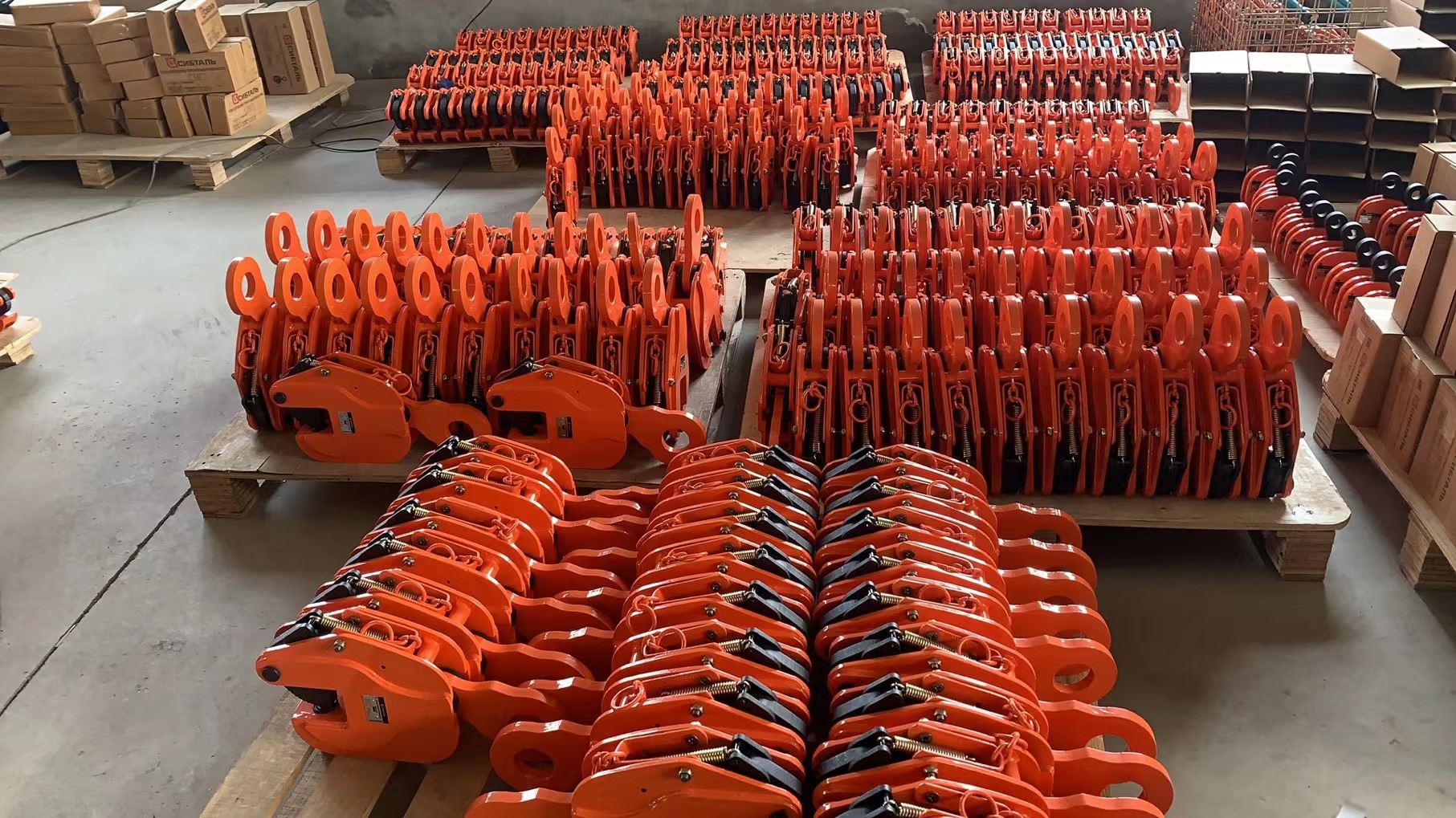
Matched equipment in these operations typically includes slings, steel plate and oil drum clamps, magnetic lifters, and wire rope assemblies. Because the hook opening on the VD chain block ranges from 24 to 55 mm depending on model, the rigging selection and the hoist selection have to be made together rather than sequentially.
Engine room assembly and heavy component handling
Engine room work inverts the hull problem: instead of open space with limited overhead structure, it is enclosed space with dense structure. A manually operated hoist is used to hoist and disassemble heavy components such as engines and propellers during repair, and to position machinery within tight alignment tolerances.
The self-locking behaviour of the mechanical brake is the reason this is workable. A load can be raised, stopped, and held without the operator maintaining force on the hand chain, which allows both hands to be used for alignment work. The minimum headroom figure of 300 to 1000 mm and the 1 to 4 chain fall range are the values that determine whether that is physically possible in a given compartment.
Onboard maintenance and emergency repair
Maintenance and emergency repair work is characterised by temporary setups: a hoist is rigged to a beam, a gantry, or a cantilever for the duration of a job and then removed. In these situations the relevant characteristics are portability, corrosion-resistant chains that tolerate onboard storage, and the ability to operate at high angles or in awkward positions without a power feed.
Auxiliary matched equipment such as manual trolleys, gantry and cantilever structures, load detectors, and explosion-proof accessories broadens what a chain block can do in this context. Where a compartment is classified as an explosion-proof or fire-proof safe environment, the standard configuration should not be assumed sufficient - explosion-proof and high-temperature resistant configurations are available on request and need to be specified at the ordering stage.
Market Context for Manual Chain Blocks in Shipbuilding-Adjacent Demand
Manual chain blocks are a mature category, which is precisely why procurement decisions tend to hinge on specification detail rather than novelty. The published market figures illustrate both the scale and the limits of that maturity.
Intel Market Research valued the global chain block market at approximately USD 1.95 billion in 2024 (Intel Market Research, 2024). Dataintelo projects the wider chain hoist market, including electric and manual products, to reach USD 3.9 billion by 2034 (Dataintelo, 2025). Within the product mix, Fact.MR estimates that manual chain pulley blocks account for around 48% of total product segment share in 2026 (Fact.MR, 2026). Regionally, Asia Pacific held a 41.3% revenue share of the chain hoist market in 2025, driven by industrialisation in China and India (Dataintelo, 2025).
Growth estimates vary considerably by study scope. Published figures range from roughly 0.4% for general chain blocks, through 3.4% and 4.1%, up to 5.7% for high-technology and automation-integrated models. That spread is a useful caution for buyers and planners: the category averages conceal a shift in mix toward powered and monitored equipment, while the manual segment remains structurally tied to no-power, confined-space, and precision-positioning work - which is exactly the profile of shipbuilding lifting.
At the supplier level, the market is polarised. Kito Crosby, formed by the merger of Kito and The Crosby Group, reported USD 1.1 billion in revenue for 2024 (U.S. Department of Justice / Kito Crosby, 2024), while Columbus McKinnon is identified as a leading competitor with a strong presence in the 0.5-20 ton capacity range (Stratview Research, 2024). For shipyard buyers, the practical implication is not a brand comparison but a documentation one: at both ends of the market, the verifiable difference sits in test records, chain grade certification, and the traceability of replacement parts.
Comparison: Where a Manual VD Chain Block Fits and Where It Does Not
Honest equipment references state the boundary as clearly as the capability. A manual chain block is not a universal shipyard lifting solution, and the following limits are inherent to the technology rather than to any particular supplier.
| Consideration | Manual VD chain block | Powered alternatives |
|---|---|---|
| Power dependency | None; the documented advantage in no-power or restricted environments | Requires a power feed or battery system in an environment that may not allow one |
| Duty cycle | Operator-limited; continuous repetitive lifting is not the intended use | Suited to sustained or high-frequency lifting cycles |
| Speed and travel | Slow and deliberate, which suits precision positioning but not rapid transfer | Faster travel over longer distances |
| Operator effort | Pull force is capped at 35 daN up to rated load; effort remains physical | Effort is converted to control inputs rather than muscle work |
| Load monitoring | No built-in load measurement; a load detector is a separate matched accessory | Load monitoring and remote monitoring are available on powered systems |
| Environment | Standard grease covers -20°C to +50°C; outside that range requires specification changes | Varies by product and protection class |
| Rigging requirement | Still requires a rated suspension point, even at the minimum 300 mm headroom | Requires structure rated for the hoist and trolley assembly |
Two limits deserve emphasis. First, the manual chain block is not a high-cycle production tool: the effort ceiling of 35 daN means the technology is best matched to intermittent lifts, positioning, and maintenance work rather than to a fabricating bay running repetitive lifts all shift. Second, the -20°C to +50°C envelope is a real boundary, not a marketing range; yards operating cold-weather repair schedules or hot process areas outside it should treat the standard configuration as unsuitable until confirmed otherwise.
Where powered equipment offers variable frequency, remote monitoring, or load measurement, the manual chain block does not compete on those features. It competes on the conditions where those features cannot be delivered at all.
Procurement Verification Checklist for Shipyard Buyers
A specification-led approach reduces the risk of a hoist arriving that is technically compliant but operationally unusable. The following checks correspond to the constraint values in this article.
- Confirm rated load capacity against the heaviest actual lift, not the average lift. The VD range covers 0.5 to 50 t, so a wide margin exists - but the model, not the range, has to be chosen.
- Measure the available headroom at the lift point and confirm it against the model-specific figure of 300 to 1000 mm.
- Confirm the required lift height, and account for the hand chain length formula of lift height plus 0.5 m of slack.
- Check that rigging fits the hook opening, which ranges from 24 to 55 mm depending on model.
- Request the load chain grade reference (Grade V or Grade T under DIN EN 818-7) and the chain diameter, since diameter alone does not establish strength class.
- Verify standards documentation for ISO 16872, EN 13157, ASME B30.21, and CE marking.
- Confirm the operating temperature requirement against the standard -20°C to +50°C grease configuration, and raise any exception at specification stage.
- Confirm the hand chain finish (galvanised or zinc-plated) if the equipment will be stored in humid or salt-affected conditions.
- Clarify commercial parameters: JUNYUNHOIST states OEM/ODM production with 100% testing, a monthly capacity of 15,000 units, a lead time of 15-20 days, and a minimum order quantity of 50 pieces.
- Ask about spares and after-sales, which in this supplier's practice includes supplying a certain number of easily damaged spare parts with each container, replenished as needed based on subsequent usage.
On durability expectations, one distributor deployment spanning 2,000 units over two years in bridge and construction work is documented with a service life exceeding two years and low loss in long-term use. That is useful context on wear behaviour, but shipyard buyers should treat it as supporting evidence rather than as a substitute for validating the hoist against their own duty cycle and environment.
Future Outlook
Three developments are likely to shape how manual chain blocks are specified for shipbuilding work over the next several years.
First, the mix shift in the wider hoist market toward powered, monitored equipment will continue, but it will not remove the demand for manual blocks in no-power and confined-space work. The variance in published market growth estimates reflects exactly this split, and the manual segment's structural role in precision positioning and emergency repair is the reason the category persists.
Second, documentation will carry more weight than headline capacity. As buyers in export markets, including India, Vietnam, Brazil, Türkiye, Russia, and the Middle East, apply stricter internal verification, chain grade references, test coverage, and standards alignment become the practical differentiators between otherwise comparable products.
Third, configuration options that were once treated as exceptions - corrosion-resistant chains, explosion-proof variants, and application-specific accessory matching - are increasingly specified at the procurement stage rather than sourced afterwards. For shipyards, this points toward buying lifting equipment as a configured system matched to compartment conditions, rather than as a standalone catalogue item.
Frequently Asked Questions
What capacity range and lift height does the VD chain block cover?
The VD chain block has a rated load capacity of 0.5 to 50 tons. Its standard lift height is 3 metres, with optional lift heights available from 2.5 to 12 metres. The number of chain falls ranges from 1 to 4 depending on capacity, and the load chain diameter varies from 6.3 to 11.2 mm with capacity.
What minimum headroom is required, and why does it matter for engine room work?
The minimum headroom, expressed as hook distance, is 300 to 1000 mm and is model dependent. In engine rooms and between decks, this is often the value that determines whether a hoist can be installed at all, because the distance between the suspension point and the load attachment is physically fixed by the compartment structure. A unit that meets the capacity requirement but exceeds the available headroom cannot be used at that lift point.
What load chain specification should a buyer verify?
Two values matter together: the chain diameter and the chain grade. The VD chain block uses load chain from 6.3 to 11.2 mm, and the chain is Grade V or Grade T according to DIN EN 818-7. Grade designation establishes the strength class, which diameter alone does not, so it should be confirmed in the documentation rather than inferred from size. The specified chain safety factor is at least 4:1, with at least 5:1 for structural parts.
Which standards and markings should shipbuilding chain blocks carry?
The VD chain block is specified as complying with ISO 16872, EN 13157, and ASME B30.21, and it is CE marked. EN 13157 is the standard widely referenced for hand-powered lifting equipment in the European market, and it specifies safety requirements including a 4:1 safety factor. Buyers should request the corresponding documentation rather than relying on a mark on the housing.
What operating temperature range applies, and where are the limits?
The VD chain block operates from -20°C to +50°C with standard grease. That range covers most temperate and many tropical shipyard conditions, but it is a genuine boundary. Work outside it, whether in cold-climate repair schedules or in unusually hot compartments, requires the question to be raised at specification stage, because the standard grease configuration is not intended for those conditions.
What hand-chain pull force is required, and what does that mean in practice?
Pull force on the hand chain is not more than 35 daN, or 350 N, up to rated load. In practice, this defines the technology as suitable for intermittent lifts, precision positioning, and maintenance work performed by one operator. It also indicates where a manual chain block stops being the appropriate choice: long travel distances, sustained repetitive lifting, or high-frequency production cycles are better served by powered alternatives.
Summary
Fitting a chain block to shipbuilding work is a constraint-matching exercise. Headroom of 300 to 1000 mm, capacity from 0.5 to 50 t, standard 3 m lift with 2.5 to 12 m options, 1 to 4 chain falls, 6.3 to 11.2 mm load chain in Grade V or T to DIN EN 818-7, galvanised or zinc-plated hand chain, forged alloy heat-treated hooks, a -20°C to +50°C operating range, and a hand-chain pull force of no more than 35 daN together define whether the VD chain block fits a hull, an engine room, or an onboard maintenance task. The same values define where it does not.