
VET-8528 vs. VET-5820 vs. RAE-109: Large-Animal Endoscope Comparison

Large-animal gastrointestinal endoscopy is a sizing problem before it is an imaging problem. In adult horses, cattle and other large patients, the oral-to-gastric working distance is long, the lumen is wide, and the patient cannot be repositioned on demand — yet a biopsy forceps, retrieval tool or suction line still has to reach the target through the instrument itself. Working length, outer tube diameter and working channel size therefore eliminate more candidate devices from a shortlist than resolution or screen size ever will.
Three portable models sit close together in that decision space: the VET-8528, the VET-5820 and the RAE-109. All three are manufactured by Jeet Medical (Shenzhen) Co., Ltd., a Shenzhen-based veterinary endoscope manufacturer founded in 2020 that sells its veterinary line under the JeetVet brand. The company operates a 5,000 m² production facility with approximately 130 employees, an annual output of about 10,000 units, a 30-person R&D team and an export ratio of roughly 50%, with main markets across Europe, North America, Southeast Asia, Latin America and the Middle East.
The three models share a common family logic — 360° rotation control, a 180° bending angle, a 120° field angle and a 7–100 mm depth of field — yet they diverge sharply on exactly the dimensions that determine procedural fit. This comparison places their published specifications side by side, explains what each difference means at the table, and identifies the one specification that the available datasheet does not answer.
Why Three Numbers Decide More Cases Than Resolution Does
Reach, tolerance and tool passage are the three constraints a large-animal endoscope buyer is actually trading against. They interact, and in a portable platform they cannot all be maximised at once.
Working length determines reach. If the insertion tube is shorter than the path from the oral cavity to the target region, the examination ends early regardless of image quality. Equine gastric work is the clearest example: the reach requirement is fixed by anatomy, not by preference, so working length behaves as a pass/fail specification rather than a graded one.
Outer diameter determines what the patient tolerates and which patients are addressable at all. A wider tube carries a wider internal channel and resists buckling better, but it is harder to pass through narrow passages and is unsuitable for smaller patients. This is why the same 5.8 mm tube class that works in a foal, calf or small ruminant may be too narrow in channel terms for a demanding adult procedure — and why an 8.5 mm tube that is comfortable in a wide adult lumen is a poor fit for a 30 kg patient.
Working channel size determines what can be done once the tip arrives. Foreign-body graspers, biopsy forceps, suction and lavage all consume channel diameter. A channel that is one millimetre narrower does not simply reduce instrument choice; it also changes how effectively the field can be cleared, which affects procedure time and how many passes a clinician needs.
VET-8528, VET-5820 and RAE-109: The Published Specifications
The three models are published with overlapping optical and mechanical parameters but distinctly different tube geometry. The table below reproduces the manufacturer-published parameter sets without interpretation.
| Parameter | VET-8528 | VET-5820 | RAE-109 |
|---|---|---|---|
| Product category | Portable Veterinary Endoscope for Large Animals | Portable Veterinary Gastroscope for Large Animals | Portable USB Veterinary Gastroscope |
| Stated purpose | Animal gastrointestinal examination | Animal gastrointestinal examination | Not stated in the published parameter set |
| Image resolution | High Definition (HD), 1080P | High Definition (HD), 1080P | 1,000,000 pixels |
| Working length | 1500 mm | 1500 mm | Not stated in the published parameter set |
| Outer diameter of the tube | 8.5 mm | 5.8 mm | 5.8 mm |
| Inner diameter of the channel | 2.8 mm | 2.0 mm | 2.0 mm |
| Bending angle | 180° | 180° | 180° up & down, 180° left & right |
| Rotation control | 360° | 360° | 360° steering |
| Depth of field | 7 mm – 100 mm | 7 mm – 100 mm | 7 mm – 100 mm |
| Field angle | 120° | 120° | 120° |
| Connection and host compatibility | Not stated in the published parameter set | Not stated in the published parameter set | USB; Android, Windows, iOS |
| Weight | Not stated in the published parameter set | Not stated in the published parameter set | Under 1 kg |
Two observations follow directly from the table. First, the imaging and articulation behaviour of the three models is closely aligned — 180° bending, 360° rotation, a 120° field angle and a 7–100 mm depth of field are consistent across the group. Second, tube geometry is where buyers are actually choosing: 8.5 mm versus 5.8 mm outer diameter, and 2.8 mm versus 2.0 mm channel.
Working Length: 1500 mm, 1500 mm, and One Value Buyers Must Confirm
The VET-8528 and the VET-5820 are both published with a 1500 mm working length, which is the longest documented reach in this three-model group. That figure is what makes both instruments plausible for adult equine gastric examination rather than only for shorter-path procedures.
The RAE-109 is a different case. Its published parameter set documents a 5.8 mm outer diameter, a 2.0 mm working channel, 1,000,000 pixels, 360° steering, a 180° bending angle, a 120° field angle, a 7–100 mm depth of field, USB connection and compatibility with Android, Windows and iOS — but it does not state a working length. That omission is not a defect in the product; it is a gap in the available specification data, and it matters because working length is the one parameter that cannot be compensated for after purchase.
Outer Diameter: 8.5 mm vs. 5.8 mm and What the Patient Tolerates
The outer diameter gap between the VET-8528 (8.5 mm) and the other two models (5.8 mm) is the single largest physical difference in this group, and it drives patient-range decisions more than any other line in the table.
An 8.5 mm tube is the configuration intended for patients whose lumen and tolerance allow a larger instrument — the large-animal gastrointestinal work that the model is explicitly published for. In exchange for the larger entry profile, it carries a 2.8 mm channel, which is the widest of the three.
A 5.8 mm tube is the more adaptable entry profile. It is the diameter shared by the VET-5820 and the RAE-109, and it is the reason those two models can be considered for foals, calves, small ruminants and, in mixed practices, small-animal work where an 8.5 mm insertion tube would be inappropriate. The cost of that adaptability is fixed by geometry: a smaller tube has less internal volume, and both 5.8 mm models are published with a 2.0 mm channel rather than 2.8 mm.
What this means in practice
- If the patient population is dominated by adult horses and cattle, the 8.5 mm / 2.8 mm configuration of the VET-8528 removes the most constraints at once.
- If the practice spans multiple species and body sizes, the 5.8 mm tube class of the VET-5820 and RAE-109 keeps more patients addressable, at the cost of instrument range.
- No single tube diameter is correct for every patient; the specification that fits the largest share of a practice's case mix is the one that will be used most.
Working Channel: 2.8 mm vs. 2.0 mm and What the Procedure Requires
The working channel is the specification most often under-weighted in procurement because it does not appear on a marketing image. It decides, however, whether a diagnostic examination can escalate into an interventional one.
A 2.8 mm channel — published on the VET-8528 — accepts a broader class of accessories and supports more effective suction and lavage than a 2.0 mm channel. Where the clinical plan includes foreign-body retrieval, tissue sampling or repeated field clearing, the wider channel reduces the number of instrument changes and the time spent working in a patient that cannot be held in position indefinitely.
A 2.0 mm channel — published on both the VET-5820 and the RAE-109 — is consistent with the narrower 5.8 mm tube those two models use. It supports the lighter accessory class appropriate to smaller-lumen or smaller-patient work, and it keeps the overall insertion profile small. It is not a lower-quality channel; it is the channel that the tube geometry allows.
For buyers, the practical rule is to specify the accessory first and the endoscope second. If the intended biopsy forceps or retrieval device will not pass the channel, the scope's reach and image quality become irrelevant to that procedure.
Decision Matrix by Animal Size and Procedure Setting
The matrix below translates the verified specification differences into selection logic. It is a configuration-level guide based on published parameters, not a clinical recommendation; procedure suitability remains a veterinary judgement.
| Scenario | Configuration that fits the published specifications | Reasoning |
|---|---|---|
| Adult horse — gastric examination with likely biopsy or foreign-body retrieval | VET-8528 (1500 mm, 8.5 mm, 2.8 mm) | Documented 1500 mm reach combined with the widest of the three working channels for accessory passage |
| Adult horse — same reach requirement where a narrower insertion tube is preferred | VET-5820 (1500 mm, 5.8 mm, 2.0 mm) | Identical documented working length with a 5.8 mm tube; accessory selection is limited to the 2.0 mm channel class |
| Cattle and other large ruminants with a wide, tolerant lumen | VET-8528 | Larger tube profile and 2.8 mm channel suit procedures that require both reach and instrument passage |
| Foals, calves, small ruminants, and mixed practice that also sees dogs and cats | VET-5820 or RAE-109 | 5.8 mm is the smaller documented outer diameter in the group and keeps body-size range wider |
| Clinic-based workflow using a laptop or tablet over USB | RAE-109 | Published USB connection with Android, Windows and iOS compatibility, and a documented weight under 1 kg |
| Any deep-reach procedure | Confirm working length before ordering | Working length is not stated for the RAE-109 in the available parameter set |
Two procurement patterns follow from the matrix. Single-site equine referral practices tend to consolidate on the 1500 mm / wider-channel configuration, because most of their case load is adult. Ambulatory and mixed practices tend to split across the 5.8 mm class, because the same clinician may need the scope for a calf in the morning and a horse in the afternoon.
What the Three Models Share
Although the tube geometry differs, the three models are built on the same control and imaging conventions, and that consistency is itself a purchasing argument for practices that buy more than one unit.
All three are published with 360° rotation control, a 180° bending angle, a 120° field angle and a 7–100 mm depth of field. All three are described as portable instruments. In documented field deployments, the portable all-in-one format has been associated with seamless use between clinic and field sites, an ergonomic and lightweight design intended to reduce clinician fatigue, and operational simplicity with rapid maintenance. In one documented project, equipment uptime reached 100% in resource-constrained areas, supported by remote technical support and a robust device design.
Those characteristics matter in large-animal work for a reason that has nothing to do with specifications: procedures frequently happen where the animal is, not where the equipment is. A configuration that can be carried, powered and maintained outside a referral hospital changes which cases are practical to schedule.
Portable vs. Traditional Cart-Based Endoscopy: Where the Limits Sit
Portable instruments earn their place by being deployable, but they are not a direct substitute for large cart-based endoscopy platforms, and buyers should be clear about which side of that line a given procedure falls on.
The clearest structural limit is the single working channel. The VET-8528, VET-5820 and RAE-109 each present one channel, which constrains simultaneous instrumentation — a single-channel portable scope cannot support the multi-instrument choreography that a larger, multi-channel platform allows. Where a procedure requires several instruments in the field at once, a portable single-channel design is the wrong tool regardless of how well its specifications match the patient.
A second limit is the channel-to-tube trade-off discussed above. The 2.0 mm channel shared by the VET-5820 and RAE-109 is narrower than the 2.8 mm channel on the VET-8528, so accessory selection is genuinely restricted; buyers who assume that any 5.8 mm scope accepts the same instruments as an 8.5 mm scope will discover the gap at the first procedure.
A third consideration is host dependency. The RAE-109 is published with a USB connection and compatibility with Android, Windows and iOS, which means the viewing workflow depends on a paired device. That architecture is what makes the format portable, but it also means the buyer should confirm their own device, cable and power arrangements before deployment rather than after.
Finally, working length and manoeuvrability are in tension. A 1500 mm insertion tube reaches further than a shorter one, and longer tubes are generally less direct to steer inside a tight bend. That is a normal consequence of the geometry, not a defect, but it is a reason to match instrument length to the anatomy it will actually traverse rather than defaulting to the longest available option.
Market Context: Why This Comparison Is Being Made More Often
Demand for exactly this class of instrument is rising, and the underlying numbers help explain why the comparison has moved from a specialist question to a routine procurement decision.
Veterinary endoscopy is still a modest market by medical-device standards. Straits Research places the global category at approximately USD 290–300 million for 2024/2025, with projections above USD 586 million by 2034. Other research houses differ on the base year: Data Insights Reports estimates USD 232.6 million for 2025, while Mordor Intelligence estimates USD 332.95 million for 2026. That spread across sources is itself a signal — buyers evaluating category claims should treat any single market figure as one estimate among several rather than a settled fact.
Demand concentration is clearer than the absolute size. Market Research Future reports that North America accounted for over 34.48% of global veterinary endoscope revenue as of 2024. On the demand side, the North American Pet Health Insurance Association reported that more than 5 million pets in North America were insured as of 2024, a factor that directly increases the adoption rate of advanced diagnostic procedures such as endoscopy. Insured populations support procedure volume, and procedure volume is what justifies instrument purchases in the first place.
On the technology side, the market for AI in endoscopy has been advancing at a CAGR of 25.7%, and integration of AI-assisted diagnostics has been identified as a primary trend for veterinary systems. The competitive landscape remains concentrated around established names — Karl Storz, Olympus Corporation, Eickemeyer and Fujifilm Holdings are commonly identified as key global competitors — while portable-format suppliers compete on deployment flexibility and price configuration rather than on the breadth of a full cart-based catalogue.
What to Verify Beyond the Mechanical Spec Sheet
Specifications describe geometry; they do not describe process control. For a device that will be inserted into an animal, the manufacturing and compliance evidence behind the product deserves the same scrutiny as the parameter table.
The baseline for optical safety and performance in endoscopes is the ISO 8600 series, specifically ISO 8600-1 for general requirements and ISO 8600-3 for field of view — the standard against which optical characteristics are defined and compared. Beyond the product standard, quality-management certification is the more informative signal about a supplier's consistency: Jeet Medical states that it is certified under ISO 13485 by SGS and that it operates a 100,000-class cleanroom together with a 10,000-class microbiological laboratory.
Software is the other half of a modern video endoscope, and it is easy to overlook because it is invisible in a specification table. Registered software copyright is one of the few checkable artefacts available to a buyer. Jeet Medical holds a Computer Software Copyright Registration Certificate issued by CCPD for the Jeet Medical Multi-Light Source Vision Imaging System V1.0 (registration number 9407860, issued 2022-02-25, valid to 2072-02-25) and a second for the Jeet Medical Multi-Camera Automatic Fusion System V1.0 (registration number 9413508, issued 2022-03-10, valid to 2072-02-10). Both registrations apply to the CN market.
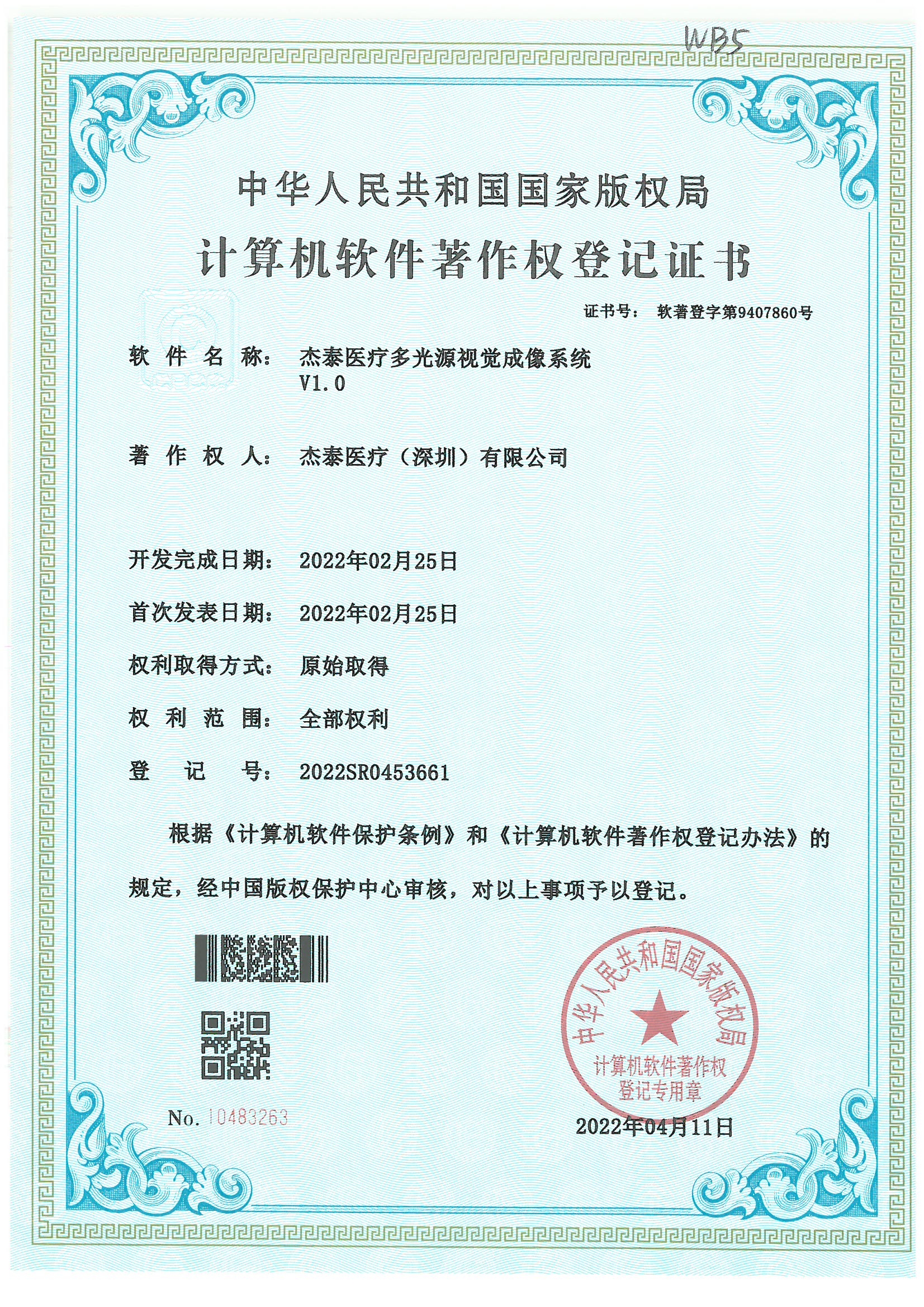
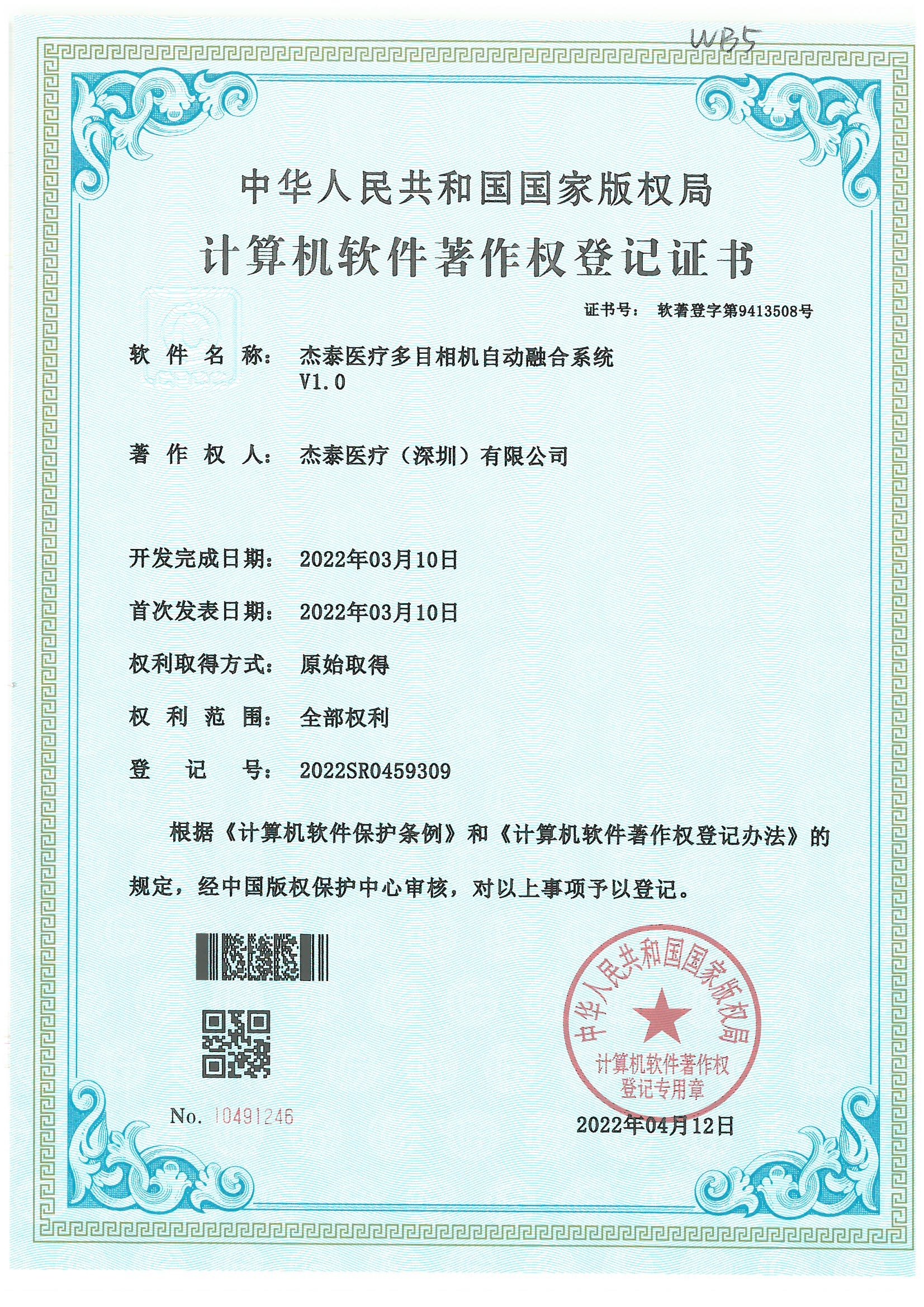
For sourcing buyers, the practical checklist is short and verifiable: a named quality-management certification and its issuing body, the cleanroom classification claimed by the manufacturer, product-level conformity with the relevant ISO 8600 sections, and any registered software or design rights for the imaging pipeline. Each of these can be confirmed from documents rather than from a sales conversation.
Future Outlook: Portability Plus Assisted Imaging
The direction of travel in this category is visible in the verified data. With the AI endoscopy segment advancing at a 25.7% CAGR and AI-assisted diagnostics identified as a primary trend for veterinary systems, the imaging pipeline — rather than the tube — is where the next round of differentiation is likely to appear. At the same time, insured pet populations above 5 million in North America and regional revenue concentration in the same market point to continued demand for instruments that can be operated in more places, by fewer people, at lower infrastructure cost.
For large-animal work specifically, the practical consequence is that tube geometry is likely to remain the stable purchasing variable. A 1500 mm working length, an 8.5 mm or 5.8 mm outer diameter and a 2.0 mm or 2.8 mm channel are physical constraints that improved software does not remove. Buyers who select on geometry today are unlikely to find their decision invalidated by the next firmware generation.
FAQ
- What is the practical difference between a 2.8 mm and a 2.0 mm working channel in a veterinary endoscope?
- A 2.8 mm working channel accepts a broader accessory class and supports more effective suction and lavage than a 2.0 mm channel. In this comparison, the 2.8 mm channel is published on the VET-8528, which has an 8.5 mm outer tube, while the 2.0 mm channel is published on the VET-5820 and RAE-109, both of which have a 5.8 mm outer tube. The difference follows from tube geometry: a narrower tube has less internal volume available for a channel. Buyers should confirm that their intended biopsy forceps, retrieval device or suction line passes the published channel size before selecting a model.
- Does a 1500 mm working length matter for equine gastric examination?
- Working length determines whether the insertion tube can reach the target region from the oral cavity, so it acts as a pass/fail specification rather than a graded one. The VET-8528 and the VET-5820 are both published with a 1500 mm working length. The RAE-109 does not have a working-length figure published in the available parameter set, so buyers considering that model for deep-reach equine work should obtain the value directly from the supplier and confirm it in writing before ordering.
- Can a 5.8 mm veterinary endoscope be used in cattle and horses as well as in smaller patients?
- Both the VET-5820 and the RAE-109 are published with a 5.8 mm outer diameter, and the VET-5820 is published specifically as a portable veterinary gastroscope for large animals with animal gastrointestinal examination as its stated purpose. The 5.8 mm tube keeps a wider body-size range addressable than an 8.5 mm tube, but the trade-off is fixed: both 5.8 mm models carry a 2.0 mm channel rather than the 2.8 mm channel available on the larger-tube VET-8528. Whether a 5.8 mm tube is appropriate for a specific patient and procedure is a veterinary judgement.
- Which of the three models is better suited to a mixed practice that also sees dogs and cats?
- A mixed practice benefits from the smaller 5.8 mm outer diameter shared by the VET-5820 and the RAE-109, because a narrower insertion tube is more appropriate across a wider range of body sizes, including smaller patients. Between those two, the RAE-109 is published with USB connection and compatibility with Android, Windows and iOS plus a documented weight under 1 kg, which suits a clinic-based tablet or laptop workflow; the VET-5820 is published with a 1500 mm working length and animal gastrointestinal examination as its stated purpose, which suits practices that also perform large-animal gastric work. Channel size is 2.0 mm on both.
- How should a buyer verify the specification of a portable veterinary gastroscope before ordering?
- Three categories of evidence are checkable without a demonstration unit. First, the mechanical parameters that cannot be changed after purchase: working length, outer tube diameter and working channel size, confirmed in writing rather than taken from a general brochure. Second, conformity and quality evidence, including ISO 8600-1 and ISO 8600-3 for optical requirements and a named quality-management certification such as ISO 13485 with its issuing body identified. Third, verifiable registration artefacts for the software and imaging pipeline, such as the Computer Software Copyright Registration Certificates held by Jeet Medical for the Multi-Light Source Vision Imaging System V1.0 and the Multi-Camera Automatic Fusion System V1.0. Where a parameter is not published — as is the case with the RAE-109 working length in the available data — it should be confirmed directly rather than assumed from a related model.
- What are the limitations of portable large-animal endoscopes compared with traditional cart-based systems?
- The most significant structural limit in this group is the single working channel on each of the three models, which constrains simultaneous instrumentation compared with larger multi-channel platforms. The 2.0 mm channel on the VET-5820 and RAE-109 also restricts accessory selection compared with the 2.8 mm channel on the VET-8528, so assumptions about instrument compatibility should not be carried across models. The RAE-109 additionally depends on a paired host device over USB, which makes device, cable and power arrangements a pre-deployment question. Longer insertion tubes such as the 1500 mm models are also generally less direct to steer inside a tight bend than shorter tubes, which is a normal consequence of geometry rather than a defect.
Procurement Takeaways
For a buyer at evaluation stage, the three models resolve into a straightforward decision tree rather than a ranking. Where the case load is adult and interventional, the 1500 mm working length and 2.8 mm channel of the VET-8528 remove the most constraints. Where the reach requirement is the same but a narrower insertion tube is preferred, the VET-5820 matches the working length with a 5.8 mm tube and a 2.0 mm channel. Where the priority is a clinic-based USB workflow with a documented sub-1 kg instrument, the RAE-109 fits — provided the buyer confirms the working length that its published parameter set does not state.
The underlying discipline is the same in all three cases: fix the accessory first, then the channel, then the tube diameter, then the working length, and only then compare imaging and control features that the three models largely share.
Reference document: Jeet Medical publishes a downloadable veterinary endoscope brochure with model specifications — veterinary endoscope brochure (PDF).
Have Questions or Need More Details?
Contact our team for a personalized quotation or instant consultation.
Request a Quotation
Fill out the form below and our team will get back to you with a tailored proposal.
WhatsApp Direct Chat
Prefer to chat in real-time? Message us on WhatsApp for instant assistance & quick answers.
- Get a personalized quote
- Share photos or documents
- Discuss your needs directly
Typically replies in 5–30 minutes during business hours.