
Vacuum Forming Housings: Surface and Finishing Shortlist
Vacuum Forming Housings: Surface and Finishing Shortlist
For custom vacuum-formed equipment housings, surface and finishing choices are not cosmetic extras. They determine whether a housing fits outdoor exposure, whether internal components remain visible, how markings survive handling, and which compliance checks the buyer must run before tooling release. This shortlist guide organizes the options that appear in the supplied project material for heavy-gauge thermoforming: an optional UV-resistant surface for outdoor exposure within a stated -20°C to 70°C operating range, PC matte film, transparent or translucent PC, impact-resistant PE, flame-retardant ABS, screen printing, and masked painting. It also explains how to shortlist those options against ABS, ASA, PC, PETG, PMMA, PVC and HDPE, and what a buyer should verify with the supplier before committing.
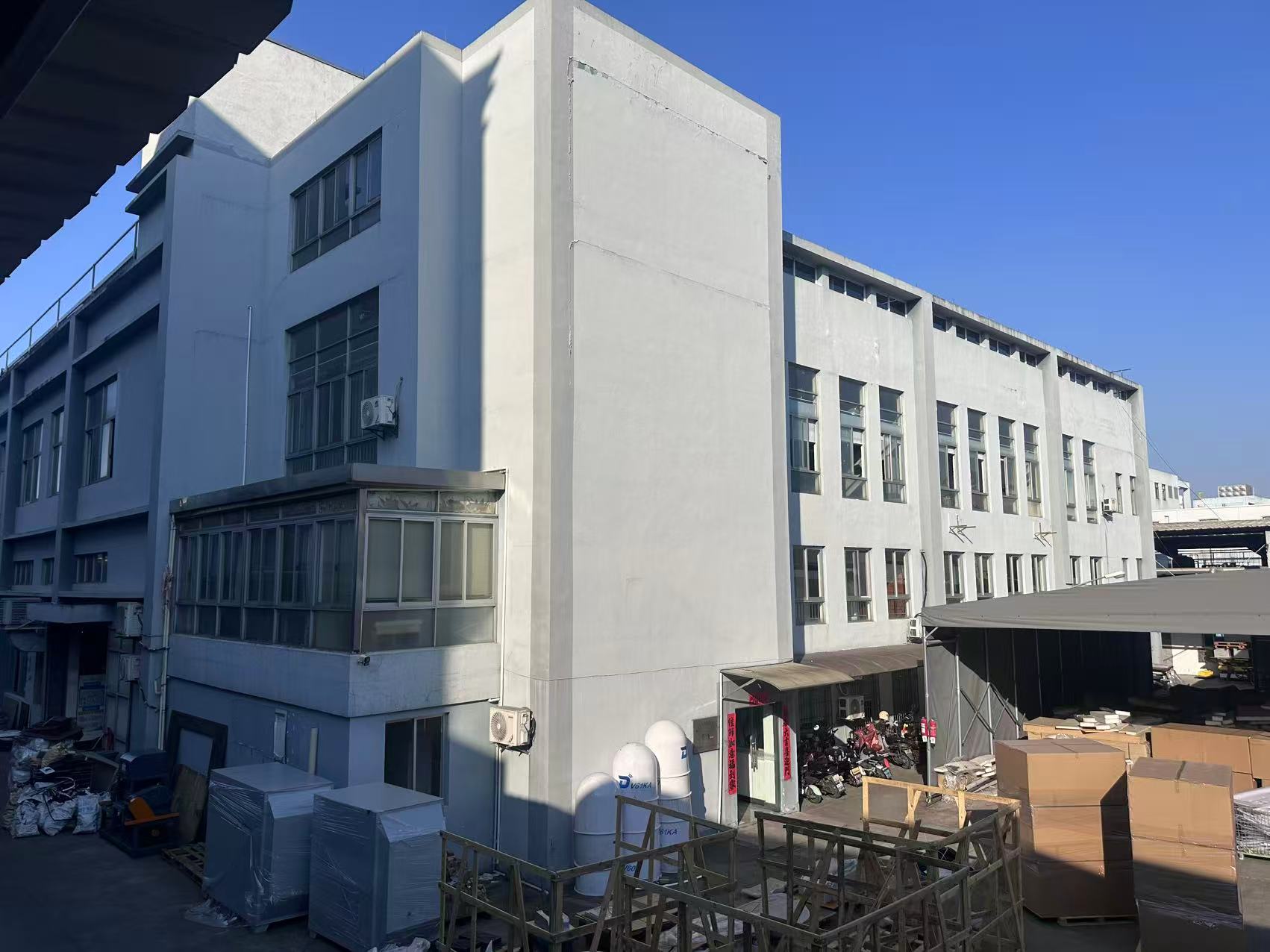
Workshop view: heavy-gauge thermoforming production environment. Image: Hangzhou Baiheli New Materials Co., Ltd.
Start with exposure and function, not the finish name
The first shortlist decision is the service condition. The supplied project data sets an operating temperature of -20°C to 70°C and distinguishes indoor from outdoor working environments; an optional UV-resistant surface is listed for outdoor exposure. That means a finish that looks appropriate in a sample may still be the wrong shortlist choice if the housing will face sunlight, cleaning agents, impact, visibility requirements, or a flame-retardant specification.
A practical shortlist sequence is: confirm exposure and temperature; define the functional requirement, such as visibility, impact, flame, marking, paint or matte appearance; match the polymer and sheet thickness; then select the surface or finishing step and its inspection method. This order prevents a common error: choosing a finish before the housing's operating conditions are fixed.
The shortlist is not a universal ranking. The correct option depends on the housing's geometry, load path, assembly method, cosmetic target and project-specific approval requirements. Buyers should treat each option below as a fit decision, not as a default upgrade.
Shortlist matrix: seven options and their fit conditions
| Option | Primary role | When to shortlist | Buyer checks |
|---|---|---|---|
| Optional UV-resistant surface | Outdoor surface protection | Outdoor exposure is stated and the housing operates within -20°C to 70°C | UV rating, test method, coverage on formed corners, color and gloss target |
| PC matte film | Matte surface on a PC substrate | Project specifies PC and a matte finish | Film grade, adhesion, cleanability, coverage, repair method |
| Transparent or translucent PC | Visibility or light transmission | Windows, guards or lit indicators require see-through or diffused light | Transmission and haze target, masking, scratch protection, UV exposure |
| Impact-resistant PE | Impact protection where PE is appropriate | A stated impact requirement exists | Grade, thickness, temperature, outdoor UV, fire requirement |
| Flame-retardant ABS | Flame-retardant housing option | Project specifies flame-retardant ABS | Exact fire rating, test evidence, wall thickness, ribs, inserts |
| Screen printing | Printed graphics and markings | Legends, labels or identification must be printed | Artwork, ink compatibility, surface preparation, legibility, adhesion |
| Masked painting | Selective painted areas | Paint is needed in defined areas with masked boundaries | Mask definition, paint adhesion, edge quality, touch-up rules |
Material shortlist: ABS, ASA, PC, PETG, PMMA, PVC and HDPE
Hangzhou Baiheli New Materials Co., Ltd. lists ASA, PC, PETG, PMMA, PVC and ABS among applicable engineering and composite materials; its FAQ also names ABS, PC, PVC and HDPE, and a public material range lists ABS, HIPS, PP, PE and PMMA at 0.5–9.0 mm thickness. These lists are not interchangeable. A material named for one project may not be available in the exact grade, color, or thickness required for another.
ABS is a common housing material and is also the base for the flame-retardant ABS option. ASA is a material to shortlist when outdoor weathering is a design concern, but the optional UV-resistant surface is a separate route and should be compared on project-specific data. PC supports transparent, translucent or opaque finishes and can receive matte film. PETG, PMMA, PVC and HDPE belong in the same review but require their own grade and thickness confirmation. The buyer should not infer that a finish approved on one polymer is automatically approved on another.
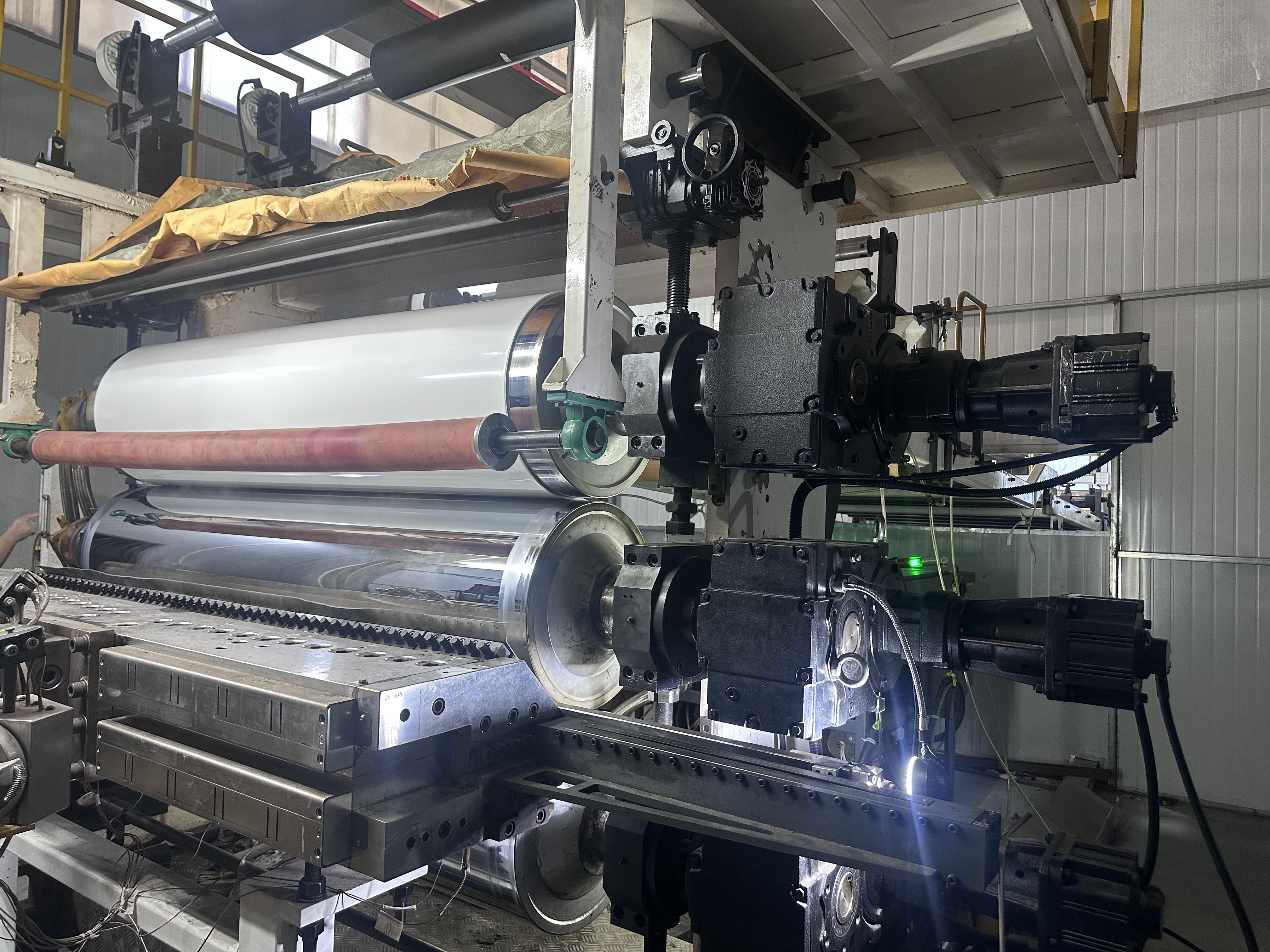
Sheet-making equipment supports material and thickness control before forming. Image: Hangzhou Baiheli New Materials Co., Ltd.
Specification reconciliation matters here. If a brief specifies 2–10 mm sheet thickness or a 3300 × 2000 mm housing footprint, treat those numbers as project requirements to check against the supplier's material-specific and part-specific capability. A published company profile lists maximum part dimensions of 4000 × 3000 × 1000 mm, while a separate published material range covers selected materials at 0.5–9.0 mm thickness. Neither figure should be assumed to apply to every polymer, finish or draw depth without confirmation.
Outdoor exposure: when the UV-resistant surface belongs on the shortlist
The optional UV-resistant surface is the first finish to shortlist when the housing is intended for outdoor exposure within the stated -20°C to 70°C operating range. It is an option, not a default, and the exact UV-resistance rating requires project confirmation. The buyer should ask for the proposed test method, the acceptance criterion, and whether the surface is a sheet property, a film, or a coating, because those are different specifications.
Outdoor exposure also raises questions about color and gloss retention, cleaning, and the effect of formed corners. The supplier should confirm coverage on vertical walls, radii and trimmed edges. If the project uses ASA as the substrate, the buyer should still compare the ASA route with the UV-resistant surface route using material data and project-specific exposure requirements; the two should not be treated as equivalent without evidence.
A finish that is suitable outdoors is not automatically suitable for every temperature or chemical exposure. The stated operating range is a boundary to verify, not a guarantee for every grade or color.
PC matte film, transparent PC and translucent PC
PC matte film should be shortlisted when the substrate is PC and the project requires a matte surface rather than a gloss finish. The supplied customization list includes matte film as a finishing option. Buyers should confirm film grade, adhesion, cleanability, coverage over formed corners, and whether the film is intended as a permanent surface or a protective layer. Those checks matter because a film that performs on a flat sample may behave differently after thermoforming.
Transparent or translucent PC should be shortlisted when the housing needs visibility, light transmission, or a diffused lighting effect. The customization scope includes transparent, translucent, or opaque finishes. The project should define the optical target in buyer language: what must be seen, how much diffusion is acceptable, and whether the PC will be printed, masked, or coated. Exact transmission, haze and UV performance should be confirmed with the supplier rather than assumed from the word transparent.
Neither PC matte film nor transparent PC should be used as a substitute for flame-retardant ABS or impact-resistant PE where those functions are specified. They solve different problems and may be combined only after the supplier confirms compatibility of the sheet, film, print and paint steps.
Impact-resistant PE and flame-retardant ABS
Impact-resistant PE is a project-specific option to shortlist when the housing has a stated impact requirement. The supplied special-requirement list includes impact-resistant PE alongside PC matte film, transparent or translucent PC, flame-retardant ABS, screen printing and masked painting. The buyer should confirm the PE grade, sheet thickness, temperature suitability, outdoor UV exposure if relevant, and any fire requirement. The presence of an impact-resistant option does not prove a particular impact rating; that must be supported by project-specific evidence.
Flame-retardant ABS should be shortlisted where the project specifies flame-retardant ABS, for example in an electrical or industrial housing context. The exact fire rating requires project confirmation. Buyers should ask for the standard, test evidence, wall thickness, rib and insert design, and any venting or metal-part separation that affects the assembly. A flame-retardant material name alone is not a complete specification.
Both options illustrate the same rule: protection options are selected by the failure mode the housing must resist, not by a general preference for a tougher-sounding material.
Screen printing and masked painting
Screen printing is the finishing option to shortlist when the housing needs printed graphics, legends, labels or identification. The customization scope includes screen printing. The buyer should define artwork, color, location, ink compatibility with the substrate, surface preparation, and the inspection criterion for legibility and adhesion. Because printing is applied after forming in many projects, the supplier should confirm whether the formed surface can accept the print consistently across the production run.
Masked painting is the option to shortlist when the housing needs paint in defined areas while other areas remain unpainted or protected. The customization scope includes masked painting. The buyer should confirm mask boundaries, paint adhesion, edge quality, touch-up rules, and whether the mask is applied before or after five-axis cutting. A paint finish that looks correct on a flat panel may need different masking on a deep draw or a trimmed edge.
Screen printing and masked painting can be combined, but they should not be treated as interchangeable. Printing adds graphics; masked painting adds a painted surface in selected areas. Each adds its own inspection and rework considerations.
How the finishing chain affects fit and delivery
The supplier's published processing chain runs from sheet extrusion and thermoforming to five-axis cutting and surface finishing. That matters for a shortlist because the finishing option cannot be evaluated in isolation. Five-axis cutting and housing-fit processing determine whether the painted or printed part still meets the assembly interface; surface finishing determines whether the visual requirement is met after trimming.
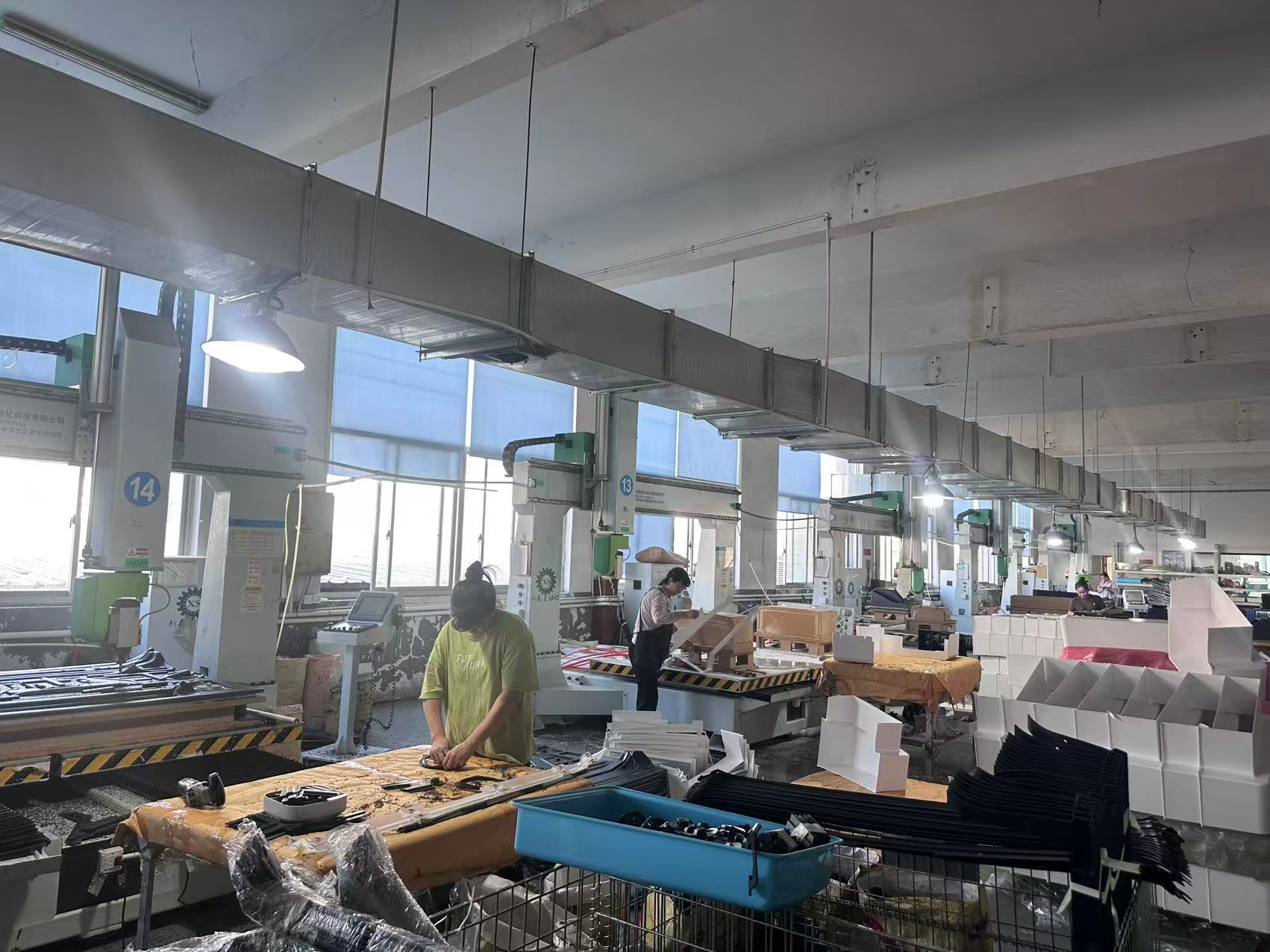
Five-axis cutting supports housing-fit processing after forming. Image: Hangzhou Baiheli New Materials Co., Ltd.
The capability data lists a monthly capacity of 80,000 units, a lead time of 25–30 days, a minimum order quantity of 1 unit, and 100% testing. These are useful starting points for evaluation, not a promise that every finish will follow the same schedule. A new masked-paint or screen-print specification can add artwork approval, mask tooling, first-article inspection or rework steps, so the buyer should ask for a finish-specific lead time.
What the supplier evidence shows and what it does not
Hangzhou Baiheli New Materials Co., Ltd. is a heavy-gauge thermoforming processor based in Guali Town, Xiaoshan District, Hangzhou. The company was founded in 2011, operates approximately 10,000 square meters of standard factory space, employs 90 people, and reports an annual output of 550,000 units. Its published capabilities include a five-person R&D team, export activity of 30–40%, and a project history of around 30 closed projects per year with 3–5 year customer relationships. It serves equipment manufacturers, automotive and new energy vehicle companies, AGV and robotics companies, medical equipment companies, communication equipment companies, outdoor equipment businesses, and amusement equipment businesses.
The company holds ISO 9001:2015 Quality Management System certification, certificate 98924Q00326R0M, issued by Guangdong Harmonious Certification Co., Ltd. (HCC), valid from 2024-06-13 to 2027-06-12, with the scope of production of plastic products. That certificate supports a quality-management claim for the certified scope. It does not by itself prove a specific UV rating, fire rating, impact performance, or finish approval. Those require the project-specific evidence described above.
For buyers, the useful conclusion is not that one supplier is universally suitable. It is that the supplier's evidence should be matched to the shortlist: material grade, sheet thickness, forming envelope, finishing capability, inspection method and certification scope. A supplier can be a fit for a large-format ABS housing and still need separate confirmation for a flame-retardant or outdoor UV specification.
Market context: aggregate growth does not select a finish
Verified market data place the global plastic vacuum forming market at USD 4.8 billion in 2023, with a forecast of USD 7.2 billion by 2030. Asia Pacific accounted for 40.7% of the market in 2023, and thin-gauge thermoforming represented 76.22% of the combined heavy- and thin-gauge market in 2025. These figures describe the category's scale and process mix; they do not establish that a particular surface, material or finishing option is suitable for a specific equipment housing.
For an evaluation-stage buyer, the market data is useful mainly as context for supply-chain discussions. It does not replace a project-specific review of draw depth, sheet thickness, finish coverage, test evidence and assembly tolerance.
Decision checklist before shortlisting a finish
- Define exposure: indoor or outdoor, -20°C to 70°C, sunlight, cleaning, humidity and chemical contact.
- Define function: visibility, impact, flame, matte appearance, printed graphics or selective paint.
- Match material and finish: ABS, ASA, PC, PETG, PMMA, PVC or HDPE; confirm the exact grade and whether the finish is approved on that substrate.
- Reconcile dimensions: if the brief says 2–10 mm sheet thickness or 3300 × 2000 mm, check against the supplier's material-specific range and published part envelope of 4000 × 3000 × 1000 mm.
- Ask for evidence: UV rating, fire rating, impact data, film adhesion, paint adhesion, print durability and first-article inspection.
- Check the finishing chain: five-axis cutting, housing-fit processing, masking, surface finishing and 100% testing.
- Check commercial fit: MOQ 1 unit, 25–30 day lead time, 80,000 units monthly capacity, and finish-specific timing.
- Check certification scope: ISO 9001:2015 covers the quality management system for production of plastic products; it is not a product-specific UV or fire certificate.
FAQ: surface and finishing shortlist
When should a buyer shortlist the optional UV-resistant surface for a vacuum-formed equipment housing?
Shortlist it when the housing is intended for outdoor exposure and the project requires UV resistance within the stated -20°C to 70°C operating range. The exact UV-resistance rating, test method and acceptance criterion require project confirmation. It is an option, not a default, and it should be compared with an outdoor-oriented material route such as ASA using material data rather than assumed equivalence.
What is the difference between PC matte film and transparent or translucent PC?
PC matte film is a finishing option that gives a PC substrate a matte surface. Transparent or translucent PC is a material and finish combination used when the housing needs visibility or light transmission. They address different requirements: one is surface appearance, the other is optical function. A project can specify both only after the supplier confirms that the film, sheet, print and paint steps are compatible.
When should impact-resistant PE or flame-retardant ABS be shortlisted?
Shortlist impact-resistant PE when the housing has a stated impact requirement, and shortlist flame-retardant ABS when the project specifies flame-retardant ABS. In both cases the exact grade, thickness, temperature suitability and test evidence require project confirmation. A material name alone does not establish a fire rating or an impact rating.
How do screen printing and masked painting differ in a thermoformed housing?
Screen printing adds printed graphics, legends or identification to the housing. Masked painting adds paint in defined areas while protecting other areas during finishing. Screen printing is specified through artwork, ink and legibility checks; masked painting is specified through mask boundaries, paint adhesion and edge quality. They can be combined, but they are separate finishing steps with separate inspection criteria.
What should a buyer verify before releasing a large-format housing with a 3300 × 2000 mm footprint or a 2–10 mm sheet requirement?
The buyer should reconcile the project requirement with the supplier's material-specific and part-specific capability. A published company profile lists maximum part dimensions of 4000 × 3000 × 1000 mm, and a separate published material range covers selected materials at 0.5–9.0 mm thickness. Those figures should not be assumed to apply to every polymer, finish or draw depth. The buyer should confirm sheet grade, thickness, forming envelope, finish coverage, first-article inspection and assembly tolerance before tooling release.
Conclusion: shortlist by fit, then verify the evidence
The practical shortlist for vacuum-formed equipment housings is therefore conditional. Start with outdoor exposure and the -20°C to 70°C operating range; then decide whether the housing needs visibility, impact resistance, flame retardance, printed graphics, selective paint or a matte surface. Match that requirement to the polymer and sheet thickness, and only then select the finishing option. The supplier should provide material-specific and finish-specific evidence for the exact grade, forming envelope and inspection method. That approach is more reliable than treating any single surface, material or finish as universally preferred.
Reference: Corporate brochure (PDF).
Have Questions or Need More Details?
Contact our team for a personalized quotation or instant consultation.
Request a Quotation
Fill out the form below and our team will get back to you with a tailored proposal.
WhatsApp Direct Chat
Prefer to chat in real-time? Message us on WhatsApp for instant assistance & quick answers.
- Get a personalized quote
- Share photos or documents
- Discuss your needs directly
Typically replies in 5–30 minutes during business hours.