
Validating High-Carbon Steel Wire Rope Production: An Evidence Checklist
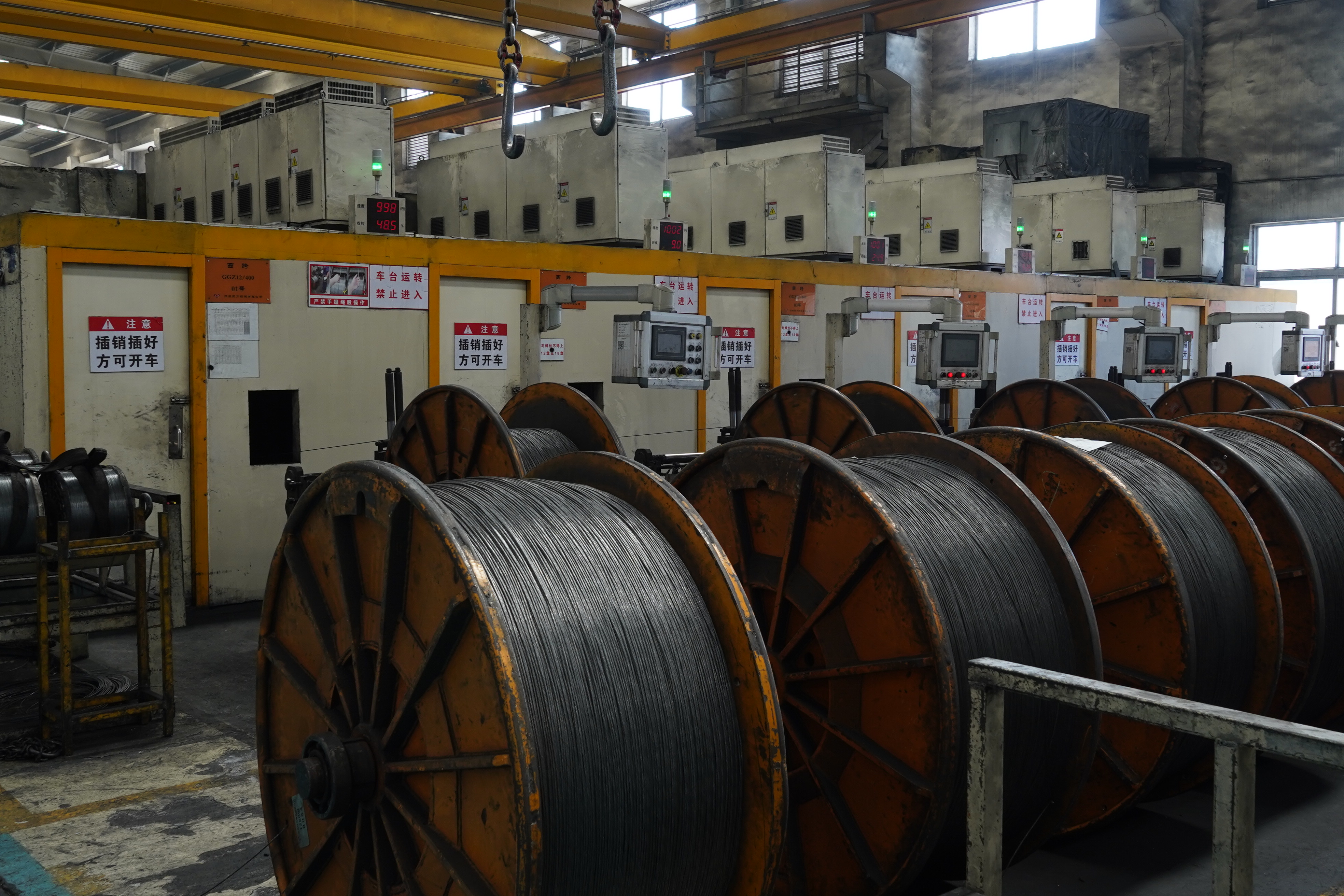
Production floor at Jiangsu Juli Steel Wire Rope, Nantong. Capability claims are only as strong as the process evidence behind them.
High-carbon steel wire rope is a consumable load-bearing component that behaves like safety equipment. It is ordered against a written specification, but it is judged in service months later, where a specification gap surfaces as fatigue, wear or a broken strand rather than as a purchase-order error. That time gap is the reason supplier validation in this category has to rest on documents, not on catalogue language.
The category is growing steadily rather than dramatically. The global steel wire rope market is projected to reach USD 13.88 billion by 2030, up from USD 10.49 billion in 2025, equivalent to a compound annual growth rate of 5.8% (MarketsandMarkets). Construction is the largest end-user segment, at approximately 27% to 40.7% of total market share in 2024–2025 (Grand View Research), and China remained the top exporter of stranded wire, ropes and cables of iron or steel in 2024 with an export value of about USD 2.60 billion (World Integrated Trade Solution). Growth of this kind rewards buyers who can separate documented capability from stated capability.
For a buyer, validating a high-carbon steel wire rope manufacturer comes down to five layers of evidence: manufacturing footprint and process ownership; the execution standards the mill actually runs (GB/T, EN, GOST, DIN); the scope and validity of each certificate; the fit between the ordered diameter and tensile grade and the supplier’s documented range (1–120 mm, 1570–2160 MPa); and the test protocol applied before shipment. The rest of this article explains how to check each layer — and where documentation legitimately stops.
The Verification Gap: Why Catalogue Specifications Are Weak Evidence
Specification text is the cheapest asset in the wire rope trade. Diameter ranges, tensile grades and standard names travel between suppliers within a single sales cycle. What does not travel easily is the ability to hold a diameter tolerance at the closing machine, lay a strand without slack, and demonstrate a breaking load on a specific construction. Verification therefore has to target process evidence rather than product descriptions.
Standards themselves make this explicit. ISO 2408:2017 specifies the minimum requirements for the manufacture and testing of steel wire ropes for general purposes, including lifting and rigging. A statement that a rope is “made to ISO 2408” is therefore a statement about a manufacturing and test regime, not a marketing descriptor. If the underlying test regime cannot be produced, the claim is unverifiable.
The practical consequence is that a supplier may hold several valid certificates and still not be covered for the exact construction, diameter band and destination market in a specific enquiry. That is not an accusation of bad faith; it is how certificate scopes work. Verification reduces to three questions, asked in this order:
- Which execution standard governs this rope, at which version?
- Which certificate covers this construction, this diameter band and this destination market?
- Which test proves the property that matters most in the intended application?
Buyers who ask those three questions before requesting a quotation tend to shorten the evaluation cycle rather than lengthen it, because they stop comparing marketing material and start comparing documents.
Layer 1 — Manufacturing Footprint and Process Ownership
The first evidence layer is physical. A mill that draws its own wire, strands and closes its own ropes has fewer unverifiable links in the chain than a supplier that assembles ropes from third-party mills. Ownership of drawing, stranding, closing and testing operations is what allows a supplier to answer technical questions about what happens when a diameter runs out of tolerance or a strand shows a defect.
Jiangsu Juli Steel Wire Rope Co., LTD (Juli Steel Rope) is a steel wire rope and lifting accessory manufacturer headquartered in Nantong, China, with production bases in Nantong and Jiyuan in China and in Bekasi, Indonesia. The company traces its origins to 1958, reports total assets of USD 150 million, and states that its production bases cover 350,000 square meters. It employs around 1,000 people, including a research and development team of 20 engineers, and exports roughly 30% of its output.
Group documentation lists an annual steel wire rope production capacity of 250,000 tons. Third-party listings of the same figure range from 150,000 to 250,000 tons per year, and the difference is generally explained by whether overseas production bases are included in the count. That spread is itself a useful buyer lesson: a capacity number should always be qualified by which sites, which product lines and which period it covers before it is used in a sourcing comparison.
Distribution and service footprint form the second half of this layer. Juli operates 42 distribution centres in major Chinese cities including Shanghai, Guangzhou, Chengdu and Xi’an, which supports a one-stop procurement model for rope, rigging and lifting accessories, and it maintains offices in more than 30 countries and regions including Europe, the United States, Indonesia, the United Arab Emirates, Egypt, Russia and Brazil.
A buyer can compress this layer into five questions: which site will produce the order; is that site owned or contracted; what equipment is installed for drawing, stranding and closing; is testing performed on the same site; and who is accountable if a batch is rejected at destination.
Layer 2 — The Execution Standards a Mill Actually Runs
Juli’s high-carbon steel wire rope product lines are documented as manufactured to GB/T, EN, GOST and DIN execution standards, and group-level documentation additionally lists API, ISO, EN, ASTM, GB and JIS. For a buyer, this matters less as a badge than as evidence that the mill can be configured to a customer’s governing standard without a development project.
The company’s GOST certificate is a good example of the specificity to look for. It names GOST 3241-91 as the applicable standard and also cites GB/T 8918-2006, GB/T 20118-2017 and EN 12385-4, and it states a scope of multiple steel wire rope construction types from 1 mm to 120 mm in diameter. A certificate that names standards, constructions and diameter limits tells a buyer what was assessed. A certificate that names only a scheme does not.
Buyer rule: a standard name without a version and a scope is not evidence. “EN compliant” conveys almost nothing; “EN 12385-1:2002+A1:2008, applied to types 6×19, 6×36 and 8×19” conveys precisely what was assessed and what was not.
The standards a mill runs also define the outer edge of what it can quote. Constructions, core types, lubricants and inspection criteria are all tied to the standard set in production. A request that falls outside that set is not a catalogue variation; it is a technical development task with its own lead time, tooling and commercial terms.
Layer 3 — Certificate Scope: Read the Coverage, Not the Logo
A logo on a website is not evidence; the scope printed inside the certificate is. Juli holds documentation across eight schemes, and the differences between them illustrate how narrowly a certificate can be drawn. The table below summarises the documented certificates, standards, scopes and validity periods as published.
| Scheme and number | Issuing body | Standard referenced | Documented scope and market | Valid through |
|---|---|---|---|---|
| EPD-2026-01 | MCC Inspection and Certification Co., Ltd. | ISO 14025 | Wire rope, cradle-to-gate, 1,000 kg declared unit; global | 29 Jan 2031 |
| GOST POCC RU C-CN.AД85.B.00499/24 | СЕРКОНС | GOST 3241-91, GB/T 8918-2006, GB/T 20118-2017, EN 12385-4 | Multiple rope construction types, 1 mm–120 mm; RU market | 27 Jun 2029 |
| CE ICR/VC/HS240422 | ICR | EN 12385-1:2002+A1:2008 | Types 6×7, 8×7, 6×19, 8×19, 6×36, 8×36, 6×19M, 6×37M, 18×7, 34M×7, 35W×7; EU market | 4 Jul 2029 |
| SIRIM PC013111 | SIRIM QAS International Sdn. Bhd. | MS ISO 2408:2004 (confirmed 2012) | Steel wire ropes for general purposes; MY market | 7 Dec 2026 |
| SNI 33.23/016/LSPro BBSPJILM/07/2024 | LSPro BBSPJILM | SNI 0727:2008 | Steel wire rope for petroleum and natural gas; ID market | 3 Jul 2028 |
| CCS JS22PWA00113_01 | CCS Jiangsu Branch | CCS Rules for Materials and Welding 2022, Chapter 10 Part One | Single layer ropes and rotation resistant ropes for ships and offshore installations; global | 22 May 2027 |
| API 9A-0125 | American Petroleum Institute | API Spec Q1, API-9A | Bright or drawn-galvanized wire rope; quality management system exclusions: servicing and customer property | 28 Feb 2027 |
| ABS 24-0072296-PDA | American Bureau of Shipping | ISO 2408-2017 | Listed models 6×19S-IWRC, 6×36WS-IWRC, 8×61M-FC, 6×25F-IWRC, 6×24FC-FC, 8×26WS-IWRC, 4×V39FC-FC, 18×7-WSC, 35(W)×7, 35(W)×K7; intended service: loose gear items for lifting equipment | 7 Oct 2029 |
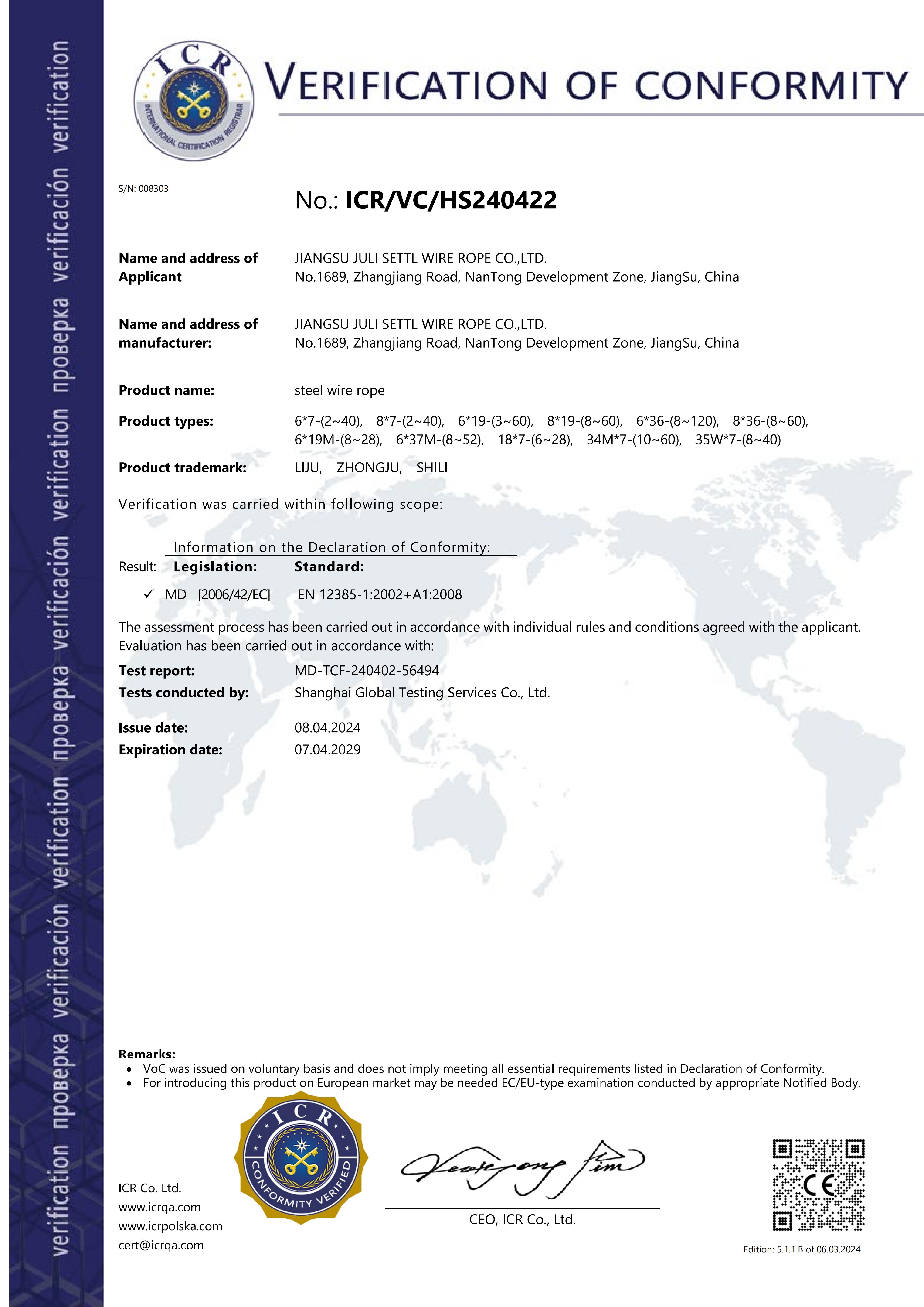
Certificate scope, not certificate presence, is the verifiable unit. The CE document names each rope type and its diameter band separately.
Certificate data above is reproduced from the supplier’s published records. For classification society product design assessments and API licences, buyers should confirm the number directly against the issuing body’s register rather than relying on a PDF alone.
Two patterns are worth noting. First, the schemes answer different questions: API and ABS address suitability for lifting and petroleum service, CCS addresses ships and offshore installations, SNI addresses petroleum and natural gas ropes for Indonesia, and the EPD addresses environmental performance rather than mechanical performance. Second, most schemes are market-bound. A certificate issued for one regulated market does not function as global approval, and presenting it as such is a verification failure on the buyer’s side as much as the seller’s.
Layer 4 — Diameter and Tensile Grade: Check the Narrowest Applicable Band
Juli’s high-carbon steel rope lines are documented with a diameter range of 1 mm to 120 mm, tensile strength grades of 1570, 1670, 1770, 1870, 1960 and 2160 MPa, high carbon steel as the wire material, and GB/T, EN, GOST and DIN as applicable execution standards.
A portfolio range, however, is not a production promise. The CE certificate illustrates the difference clearly by listing a separate diameter band for each rope type: 6×19 covers 3–60 mm, 6×36 covers 8–120 mm, 6×19M covers 8–28 mm, 6×37M covers 8–52 mm, 18×7 covers 6–28 mm, 34M×7 covers 10–60 mm, and 35W×7 covers 8–40 mm.
Buyer rule: choose the construction first, then verify that the required diameter falls inside that construction’s band — not merely inside the supplier’s overall range. A 110 mm rope is inside a 1–120 mm portfolio but outside the documented bands of several constructions.
The same discipline applies to tensile grade. Grades of 1570 and 1670 MPa are widely used in general lifting and hauling duty, while higher grades such as 1960 and 2160 MPa allow a higher breaking force at a given diameter. Higher grades generally place additional demands on termination practice, sheave geometry and handling, so the grade should be selected against the application rather than maximised by default. Whatever grade is agreed, it should be evidenced by a breaking load test result for the construction actually supplied.
Layer 5 — Pre-Delivery Testing and Batch Evidence
Testing discipline is where a supplier’s process claims become checkable. Juli documents a quality control sequence comprising raw material incoming inspection, semi-finished product spot check, finished product test, breaking load test, fatigue test, and a 100% full machine running test before delivery.
Each step answers a different risk. Incoming inspection controls wire rod and drawn wire quality before value is added. Semi-finished spot checks catch stranding and closing defects while correction is still economical. Finished product testing and breaking load testing verify the completed assembly against the declared grade. Fatigue testing addresses the cyclic bending regime that dominates rope life in sheave-and-drum systems. The full machine running test before delivery is a functional check of the finished item rather than a material property test.
Two qualifications belong here. First, several of these steps are sample-based by design — spot checks and tests on finished product — which is normal manufacturing practice, but it means a test report describes a sample, not every metre shipped. Second, a test report only has value if it is traceable. A report should carry the construction, diameter, tensile grade, applicable standard and a batch or heat reference that can be matched to the delivery documents. An untraceable report is a generic document.
Technical Explanation — What Construction and Finish Signal About Capability
Rope construction is the clearest visible indicator of a mill’s process envelope, because each family requires different tooling, closing practice and inspection criteria.
Documented constructions across Juli’s high-carbon steel rope lines include multi-strand classes 6×7, 6×19S, 6×19W, 6×19M, 6×25Fi, 6×26WS, 6×29Fi, 6×31WS, 6×36WS, 6×37S, 6×37M, 6×41WS, 6×49SWS, 6×55SWS, 6×61FWS, 6×65FNS, 6×84WSNS, 6×127SWSNS, 6×12-7FC, 6×15-7FC and 6×24MFC; eight-strand classes 8×19S, 8×19W, 8×26WS, 8×29Fi, 8×31WS, 8×36WS, 8×41WS, 8×49SWS, 8×55SWS, 8×61FWS, 8×65FNS, 8×84WSNS and 8×127SWSNS; four-strand classes 4×26WS, 4×31WS, 4V×39S, 4V×48S SWAGE and 4V×39S SWAGE; rotation-resistant and compacted designs 18×7, 35W×7, 35W×K7, 6×K26WS, 6×K36WS, 8×K26WS, 8×K36WS and 8×K26WS-EPIWC; plus 1×7, 1×19 and 7×7 for simple tension duties.
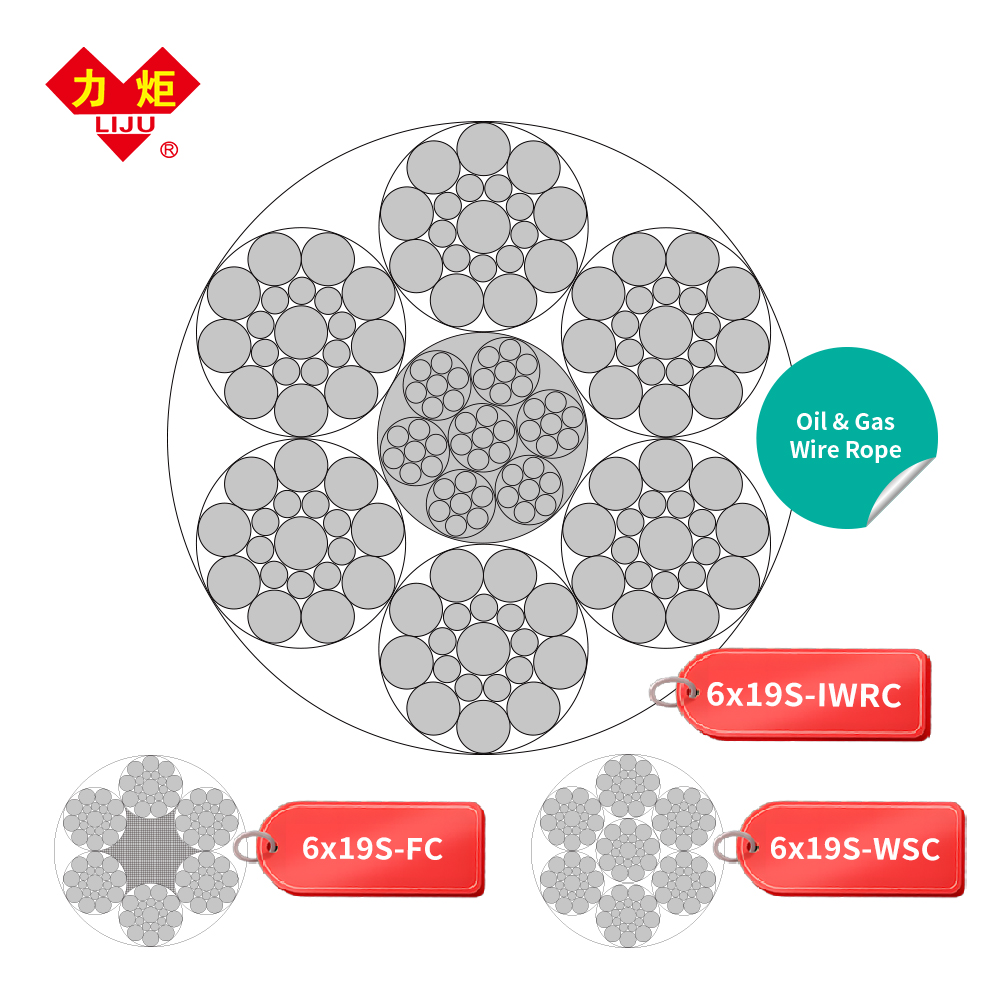
Equal-lay constructions such as 6×19S sit at the standard end of the range; compacted and rotation-resistant designs sit at the process-intensive end.
Core type is the second signal. Documented cores and combinations include independent wire rope core (IWRC), fibre core (FC) and wire strand core (WSC), as reflected in designations such as 6×19S-IWRC, 6×36WS-IWRC, 8×61M-FC, 6×25F-IWRC, 6×24FC-FC, 8×26WS-IWRC and 18×7-WSC. Ropes described as “multi strand” differ from single-layer constructions in how load is distributed between layers, which affects bending fatigue behaviour and the consequences of a broken outer wire.
Surface and coating options add a third signal. The group’s product range covers un-galvanized, electro-galvanized, hot-dip galvanized, stainless and plastic-coated ropes, alongside construction categories that include bundling ropes, cross laid, parallel laid, anti-rotation, compacted strand, shaped strand and locked coil ropes. A supplier able to run compacted and shaped strand ropes, locked coil ropes and anti-rotation designs is operating a materially wider process envelope than one producing only 6×19 and 6×37.
Market data reinforces why construction breadth matters commercially. Compacted strand ropes were used in approximately 57% of heavy-duty hauling systems in mining globally in 2025 (Business Research Insights), and galvanized steel wire ropes accounted for approximately 41.3% to 46% of global product demand in the same year because of corrosion performance in marine and mining environments (Dataintelo / Business Research Insights). Both figures point in the same direction: buyers are selecting on construction and finish, not only on diameter.
Application Mapping — Where Evidence Has to Match the Operating Environment
The final validation step is alignment. A certificate that is valid in general becomes meaningful only when it is matched to the industry, the operating condition and the specific construction being purchased. The table below maps documented product families to typical duty.
| Industry | Documented rope families and constructions | What the environment demands | Evidence that should match |
|---|---|---|---|
| Construction machinery | 6×25Fi, 6×29Fi, 6×36WS, 6×K36WS, 18×7, 35W×7, 35W×K7, 4V×39S | Dust and impact, reciprocating winding, intermittent heavy load | Breaking load and fatigue testing; types inside the CE scope |
| Construction and engineering | 6×19S/W, 6×29Fi, 6×36WS, 8×29Fi, 8×19S, 4×26WS, 4×31WS, 6×19M, 6×37M, 6×12-7FC, 6×15-7FC, 18×7, 35W×7, 4V×39S | Cyclic lifting, open-air exposure, abrasion | Standard compliance with traced test reports |
| Mining | 6×19S/W/M, 6×36WS, 6×37S, 8×K26WS-EPIWC, 35W×K7 | Corrosive mine water, dynamic impact, shaft hoisting | Field references; compacted and rotation-resistant designs |
| Port and terminal | 6×26WS, 6×31WS, 6×36WS, 6×41WS, 8×26WS, 8×31WS, 8×36WS, 8×41WS, 35W×7 | Salt spray, frequent shock load, high traction towing | Galvanized or coated options; certificate scope by market |
| Offshore and marine | 6×36WS, 6×29Fi, 6×41WS, 6×49SWS, 6×55SWS, 6×61FWS, 6×65FNS, 6×84WSNS, 6×127SWSNS, 8×49SWS to 8×127SWSNS, 18×7, 35W×7, 35W×K7, 4V×39S/48S SWAGE | Continuous saltwater exposure, wave-induced alternating load | CCS documentation; ABS product design assessment |
| Oil and gas | 6×19S, 6×36WS, 6×37S, 6×41WS, 6×55SWS, 6×84WSNS, 6×K26WS, 6×K36WS, 8×K26WS, 8×K36WS, 35W×K7 | Alternating tension, seawater and chemical media | API licence 9A-0125; SNI 0727:2008 for Indonesia |
| Elevator | 8×19S, 8×19W, 6×19S, 6×19W | High-frequency bending, elongation stability | Fatigue data; diameter and lay consistency |
| Cable car | 6×19S, 6×36WS, 6×37S | Weather exposure, repeated bending and compression | Bending fatigue performance; weather resistance evidence |
| Logging and forestry | 6×19S, 6×19M, 6×26WS, K6×26WS, K6×36WS | Mud, sediment abrasion, impact pulling | Wear resistance evidence; EN and GOST manufacturing |
| Fishing | 6×7, 6×19S, 6×24S, 6×36WS, 6×26WS, 3×31WS | Saltwater immersion, wave impact, cyclic trawl tension | GOST scope covering fishing rope; corrosion performance |
| Agriculture | 1×7, 1×19, 6×7, 7×7, 6×19M, 6×12-7FC, 6×15-7FC, 6×24MFC | Outdoor weathering, light to medium cyclic tension | Standard compliance; coating options |
| Power | 1×7, 1×19, 6×7, 6×19M, 6×37M | Tower erection, cable pulling, variable wind load | Strength grade availability; anti-torsion behaviour |
| Micro and specialty | 6×7, 6×19S, 6×36WS, 18×7, 35W×7 | Compact installation space, high-cycle micro motion | Dimensional accuracy, flexibility, fatigue resistance |
A documented field reference illustrates how this mapping is tested in practice. A mining enterprise purchased 100 tons of mining wire rope for shaft hoisting, mine hoisting and underground traction duty. The rope remained in service for two years, with reported results of stable hoisting operation, reduced downtime and improved site safety, and with wear resistance and impact resistance in a harsh mine environment listed as the defining characteristics of the supply. The value of a reference like this is not the tonnage but the duty cycle it survived.
Market Trend — What Demand Composition Says About Supplier Requirements
Four documented trends shape how buyers evaluate high-carbon steel rope suppliers. Market growth is steady: the segment is projected to expand from USD 10.49 billion in 2025 to USD 13.88 billion by 2030 at a 5.8% CAGR (MarketsandMarkets). Demand is concentrated in construction, which represents roughly 27% to 40.7% of end-user share (Grand View Research). Corrosion protection is a primary purchasing driver, with galvanized ropes taking an estimated 41.3% to 46% of global demand in 2025 (Dataintelo / Business Research Insights). And in the most demanding segment, construction choice is shifting: compacted strand ropes were used in about 57% of heavy-duty hauling systems in mining in 2025 (Business Research Insights).
On the supply side, the competitive structure remains concentrated at the top of the market, with Bekaert of Belgium and WireCo WorldGroup of the United States identified as the two companies holding the highest global market share, and Bekaert reported at more than 1.5 million tons of annual capacity (industry research and MarketsandMarkets). China’s export position — approximately USD 2.60 billion of stranded wire, rope and cable exports in 2024 (World Integrated Trade Solution) — means most non-Chinese buyers will evaluate Chinese suppliers at some point in a sourcing cycle.
The procurement implication is that documentation breadth is becoming a qualification filter rather than a differentiator. When growth is steady and capacity is available, buyers compete on assurance: number of covered markets, range of covered constructions, and the traceability of test evidence. Suppliers whose documentation is limited to one scheme in one market are increasingly screened out early in evaluation, regardless of price.
Where the Evidence Stops — Limits, Boundaries and Trade-offs
An honest validation framework has to state what documentation cannot do. Five boundaries apply to Juli’s published evidence and, in similar form, to most suppliers in this category.
Certificate scope is narrower than portfolio range. The CE certificate covers named types with per-type diameter bands rather than the full 1–120 mm range. The ABS product design assessment names individual models and defines intended service as loose gear items for lifting equipment. The API licence is drawn around bright or drawn-galvanized wire rope and explicitly excludes servicing and customer property from the quality management system scope. A buyer ordering a construction or a service category outside those definitions is outside the certificate, even if the supplier holds it.
Most certificates are market-bound. GOST addresses the Russian market, SIRIM the Malaysian market, SNI the Indonesian market and CE the EU market. A buyer in a market not covered by a listed scheme should not treat regional approval as transferable, and should instead ask which standard the delivery will be tested to.
Certificates are time-bounded. Documented expiry dates run from 7 December 2026 for SIRIM and 28 February 2027 for API through to 29 January 2031 for the EPD. Validity is a moving condition: a certificate verified last year may be in renewal this year, and a purchase order placed against an expiring approval can create a compliance gap at destination.
Documentation cannot predict service life. Certificates and test reports verify conformity of manufacture and declared properties. They do not predict remaining life in a specific installation, because rope life is governed by sheave-to-rope diameter ratio, groove condition, load spectrum, termination practice, lubrication and environment. A covered rope on an undersized sheave can underperform a standard rope on a correctly designed system.
Commercial parameters constrain fit. Juli’s documented terms include a minimum order quantity of 1,000 metres, a quoted lead time of 25 days, a monthly capacity of 3,000 tons, and customization across construction, diameter, length, tensile strength, surface treatment, applicable standard and packing under OEM, ODM and independent factory models. A 1,000 metre minimum and a 25-day lead time suit planned procurement better than emergency replacement, and a single large project can consume a meaningful share of one month’s output, so scheduling should be agreed before commitment. As noted earlier, capacity figures for the group range from 150,000 to 250,000 tons per year depending on source, which is a reminder to confirm the basis of any capacity statement rather than to assume the higher figure.
Evidence-Based Validation Compared with Claim-Based Sourcing
The traditional approach to supplier selection in this category is claim-based: compare catalogue specifications, compare price, request a certificate if one is mentioned, and place the order. Evidence-based validation replaces each step with a document check. The table below separates what each approach establishes and what remains unproven under both.
| Decision dimension | Claim-based sourcing | Evidence-based validation | What remains unproven |
|---|---|---|---|
| Basis of selection | Catalogue text and unit price | Execution standard, certificate scope, test protocol | Nothing about in-service behaviour |
| Specification check | Portfolio range accepted as coverage | Construction-specific diameter band and grade cross-checked | Documentation may lag production changes |
| Quality assurance | Verbal assurance of inspection | Batch-traceable breaking load and fatigue reports | Reports describe samples, not every metre |
| Market access | Certificate mentioned generically | Scheme, market and expiry matched to destination | Multi-market shipments need multiple schemes |
| Risk timing | Risk surfaces at first failure or rejection | Risk surfaced before purchase order | Application and installation risk remains with the buyer |
The comparison is not a claim that one sourcing route eliminates risk. It is a statement about when risk becomes visible. Evidence-based validation moves most verification failures upstream, into a document review that costs days rather than into a port rejection or an unplanned rope change that costs weeks.
Future Outlook
Three developments are likely to change how buyers validate high-carbon steel rope suppliers over the next few years. First, environmental documentation is entering the standard document set: Juli’s EPD under ISO 14025, issued for wire rope on a cradle-to-gate basis, is an example of a declaration type that was rarely requested in rope procurement a decade ago and is now appearing in tender packages.
Second, regional certification sets will keep expanding as trade flows diversify. A supplier serving EU, Russian, Indonesian, Malaysian and Middle Eastern markets simultaneously needs a portfolio of scheme-specific approvals rather than a single global statement, and buyers will increasingly ask for a matrix rather than a logo.
Third, construction mix will continue to shift toward corrosion-resistant and compacted products, in line with the documented galvanized share of 41.3% to 46% and the 57% mining adoption of compacted strand ropes. As that shift continues, the ability to run compacted, shaped strand and locked coil constructions becomes a practical qualification criterion rather than a technical curiosity, and the corresponding fatigue and breaking load evidence becomes the differentiating document in an evaluation file.
Frequently Asked Questions
What is the first thing to verify when assessing a high-carbon steel wire rope manufacturer?
Start with process ownership and the execution standards the mill runs. Process ownership establishes whether drawing, stranding, closing and testing happen under the supplier’s control, and the execution standard establishes which constructions, cores and inspection regimes are available. Documented standards for high-carbon steel rope lines include GB/T, EN, GOST and DIN, and ISO 2408:2017 defines minimum requirements for the manufacture and testing of steel wire ropes for general purposes. A supplier that can name the standard and the producing site has given verifiable information; one that only names a product has not.
Does a valid certificate mean a supplier can produce any rope diameter?
No. Certification is scoped by type and diameter. A documented example is the CE certification to EN 12385-1:2002+A1:2008, which lists separate diameter bands for each rope type: 6×19 from 3 to 60 mm, 6×36 from 8 to 120 mm, 6×19M from 8 to 28 mm, 6×37M from 8 to 52 mm, 18×7 from 6 to 28 mm, 34M×7 from 10 to 60 mm and 35W×7 from 8 to 40 mm. The supplier’s overall 1–120 mm range is a portfolio statement, while each certificate band defines what was actually assessed.
How can a buyer confirm tensile strength and diameter claims before ordering?
Two checks are effective. First, select the construction and then confirm that the required diameter falls inside that construction’s documented band rather than inside the supplier’s overall range. Second, ask for a breaking load test result for that construction and grade. Documented tensile strength grades for these high-carbon steel rope lines are 1570, 1670, 1770, 1870, 1960 and 2160 MPa, and the test report should state the construction, diameter, grade and applicable standard so that it can be traced to the delivered batch.
What quality control evidence should be requested before shipment?
A complete evidence set covers the sequence rather than a single test: raw material incoming inspection, semi-finished product spot checks, finished product testing, breaking load testing, fatigue testing and a 100% full machine running test before delivery. Fatigue testing is particularly relevant for sheave-and-drum applications, where cyclic bending governs service life. Because spot checks and finished product tests are sample-based, buyers should require batch or heat traceability so that the reports correspond to the shipment in question.
What commercial constraints should buyers expect for customized high-carbon steel rope?
Customization typically covers rope construction, diameter, length, tensile strength, surface treatment, applicable standard and packing, delivered under OEM, ODM or the supplier’s own manufacturing model. Documented commercial parameters for one such supplier include a minimum order quantity of 1,000 metres, a quoted lead time of 25 days and a monthly capacity of 3,000 tons, alongside after-sales support in the form of remote online technical support, overseas engineer on-site service, regular operation guidance and maintenance consultation. Buyers planning small trial quantities or emergency replacement should confirm these parameters at enquiry stage rather than at order stage.
Kickers, tables and figures in this article are based on the supplier’s published certificate and product documentation and on third-party market sources identified in the text. Certificate numbers, scopes and validity dates should be confirmed against the issuing bodies’ registers before they are used in a purchasing decision. For readers who want the underlying documentation set, the company’s product brochure is available as a public download: Juli Steel Rope product brochure (PDF).
Have Questions or Need More Details?
Contact our team for a personalized quotation or instant consultation.
Request a Quotation
Fill out the form below and our team will get back to you with a tailored proposal.
WhatsApp Direct Chat
Prefer to chat in real-time? Message us on WhatsApp for instant assistance & quick answers.
- Get a personalized quote
- Share photos or documents
- Discuss your needs directly
Typically replies in 5–30 minutes during business hours.