
Valve Bags and Food-Grade FIBC: Starch Powder Shortlist
Valve Bags and Food-Grade FIBC: Starch Powder Shortlist
For food starch powder, the packaging shortlist that survives contact with a real filling line has two entries rather than ten: PP woven valve bags for automatic unit-weight filling, and food-grade FIBC bulk bags for bulk movement in the 500–2,000 kg range. These are not rival answers to the same question. One is a filling-station decision, the other a bulk-logistics decision, and a starch processor shipping both consumer-scale and tonne-scale orders usually runs both formats on the same site rather than choosing between them.
Yancheng Yide Packaging Technology Co., Ltd. (Yide Packaging) is a packaging manufacturer based in Yancheng, Jiangsu, China, whose stated product range covers FIBC bags, valve bags, paper-plastic composite bags and PP woven bags, with a 5,000-square-meter food-grade clean workshop inside its FIBC production base. Both shortlisted formats sit inside that range, which makes this a genuine question about format fit rather than about whether one supplier offers both options.
What this shortlist compares, and what it does not
The comparison here is between packaging formats measured against starch-powder requirements: how the bag is filled, how it closes, how much it carries, how it is emptied, and what documentation can be produced for it. It is not a ranking of manufacturers, and no supplier is ranked above another in the sections that follow.
Four criteria do most of the sorting work. The first is unit weight, because a format that suits 25 kg does not automatically suit 1,000 kg. The second is the filling interface, because a valve bag and an FIBC are presented to completely different equipment. The third is closure integrity after filling, which for starch means dust retention as much as product retention. The fourth is documentation, because a food-contact material is only as useful as the paperwork that travels with it.
Buyers who already know their unit weight and their filling equipment can skip to the format sections. Buyers who are still deciding should read the starch behaviour section first, because the powder itself eliminates options faster than any supplier comparison will.
Why starch powder narrows the choice
Food starch is a fine, non-dangerous solid powder, which places it squarely inside the product scope described by ISO 21898:2024 — the FIBC standard covering non-dangerous solid materials in powder, granular or paste form. That scope statement matters less for compliance language than for what it implies physically: the material is fine enough to escape through seams, to hang in the air during filling, and to settle into a dense mass once vibration stops.
Three behaviours shape bag selection. Starch dust escapes through stitching holes and unsealed fabric pores, so the closure method is a dust-control decision, not only a product-loss decision. Starch settles after filling, which means a bag filled to a nominal volume can arrive looking under-filled — or, if the fill target ignored settling, can bulge and stress its own seams in transit. And starch picks up moisture, so any format chosen has to be specified with a moisture barrier that matches the storage and shipping environment, not just the filling line.
None of these behaviours is unusual. They simply rule out formats that rely on open mouths, unlined woven faces in humid climates, or closures that depend on operator technique. That leaves valve bags and food-grade FIBC bulk bags as the two formats worth a full evaluation.
Option 1 — PP woven valve bags
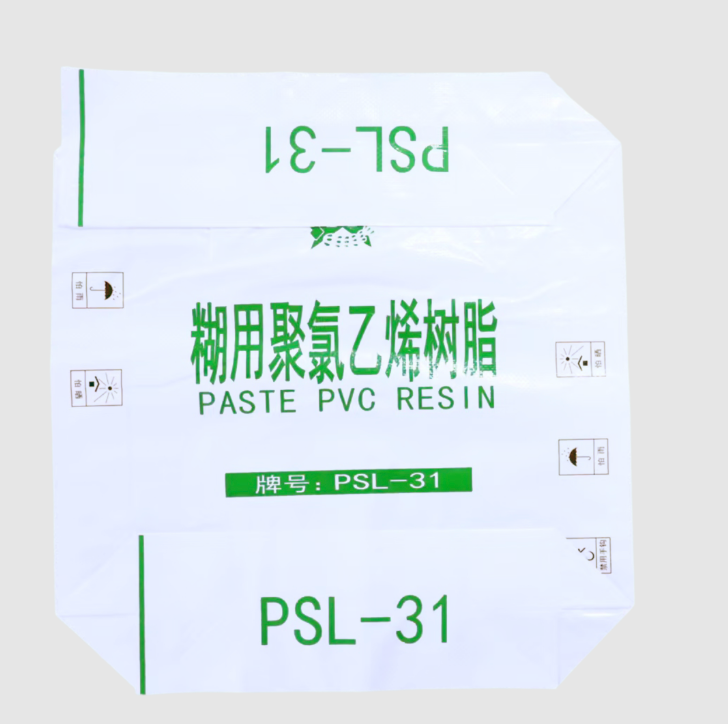
Yide's valve bag range is listed under the model terms Valve Packaging Bag, Industrial Valve Bag, Automatic Filling Valve Bag, Self-Closing Valve Bag, Internal Valve Bag and PP Woven Valve Bag. The design intent behind all of them is the same: the bag closes itself as a by-product of being filled, so the filling station does not need a sewing head, a heat sealer or an operator folding a mouth shut.
How the self-closing valve works
A self-closing valve bag carries a valve sleeve at one end. The filling nozzle enters that sleeve, product is forced in under pressure or gravity, and when the nozzle withdraws, the internal product pressure presses the sleeve flat against itself. The valve is the closure; there is no second operation. For a dusty powder, that eliminates the open-mouth moment during which starch escapes into the filling room, and it removes the seam that a sewn closure would otherwise create.
The design consequence is that valve dimensions are not a cosmetic detail. The sleeve has to mate with the specific filling nozzle on the customer's machine, and a bag built for one spout geometry may not seal cleanly on another. Buyers evaluating valve bags should supply the nozzle drawing with the enquiry rather than ordering against a generic description.
Automatic filling compatibility
Valve bags exist in the Yide range in an explicitly automatic-filling form, which is the variant a starch line running at production speed should be evaluating. On an automatic machine, the empty bag is picked, presented, filled through the valve and released without manual handling of the closure. That is the practical advantage over an open-mouth bag: throughput is limited by the filling head rather than by the operator, and the dust release point is confined to the nozzle interface.
Compatibility still has to be confirmed rather than assumed. The variables that decide whether an automatic line runs cleanly are the valve opening dimensions, the fill rate the fabric and valve can absorb without the sleeve blowing back, the bag's behaviour when presented flat from a magazine, and the de-aeration time the powder needs before the bag can be handled. These are equipment questions, and a supplier can only answer them against a real nozzle specification.
OPP film lamination and print durability
OPP film lamination applies a thin oriented polypropylene film to the outer ply. Structurally it changes the outside face from an exposed woven or paper surface into a sealed, smooth, printable one. For starch bags the practical consequences are twofold: the outer face no longer presents loose surface fibre or open weave to a damp warehouse floor, and the print sits on a film rather than on a textured substrate.
That second point is where fade-resistant printing belongs. Fade resistance is a specification to be written into the order, not a property to be assumed. A buyer who needs printed starch bags to stay legible through months of warehouse storage should state the ink system, the print coverage, whether a lamination sits over the print, and the exposure the bags will actually see — indoor racking, unshaded loading docks, or repeated handling abrasion. Yide lists lamination, printing, colour and material among the customization variables it works with, so the specification can be built around the requirement rather than the other way round.
Where valve bags stop fitting
Valve bags are a unit-weight format. Their economy and their handling logic depend on bags that one or two people, or a standard depalletising head, can move. Push the unit weight far beyond that and the format loses the advantages that made it attractive. They also assume a filling machine exists on site; a packer filling by hand gains little from a self-closing valve and pays for a feature it cannot use. Finally, a valve bag has no discharge spout — it is emptied at the point of use rather than hooked to a downstream process — so it does not suit a plant that needs to feed a hopper directly from the container.
Option 2 — Food-grade FIBC bulk bags
Food-grade FIBC bulk bags are part of the Yide range and are produced within a 5,000-square-meter food-grade clean workshop inside the company's FIBC production base. That clean-workshop fact is a manufacturing statement, not a food-contact certification, and the distinction matters for procurement: the workshop supports the ability to build food-grade bulk bags, while the compliance documents that make a specific bag suitable for a specific market must be requested and checked for that construction.
Load range and safe working load
A ton bag, bulk bag or FIBC typically carries a working load capacity of 500–2,000 kg depending on design, material, dimensions and safety requirements, with a standard ton bag commonly holding around 1,000 kg of bulk material. Heavy-duty FIBC constructions can be manufactured for higher loads when a project requires it. For starch, the practical starting point is bulk density multiplied by usable volume, with the result checked against the safe working load rather than against the bag's nominal size — a bag that holds two cubic metres of a light powder may be comfortably inside its load rating while carrying far less than its stated capacity.
The load figure is only meaningful next to the handling method. Lifting loops and construction have to match whether the bag is lifted by forklift or by crane, and the discharge arrangement has to match the height and geometry of whatever receives the emptied product.
Fill, cover and discharge options
Food-grade FIBC bulk bags can be specified with a fill spout for a closed filling connection, an open top or duffle top for straightforward loading, and a top cover for finished, stored or transported bags. On the discharge side, the choice is between a discharge spout, which allows controlled emptying into a receiving hopper or conveying line, and a flat bottom, which suits bags that will be emptied in place or handled without a discharge connection.
For starch specifically, the fill arrangement does the dust work. A fill spout with a top cover contains the dust cloud at the point of generation far better than an open top, and it protects the product from the moment filling ends. An open top remains practical where filling is slower and the environment is already controlled. Either way, the discharge decision should be made at the same time as the fill decision, because a bag with a discharge spout and no infrastructure to receive it simply adds cost without adding capability.
Where FIBC stops fitting
An FIBC is a bulk container, and its advantage disappears when the receiving process cannot handle bulk. A customer ordering 25 kg units does not want a tonne of starch delivered at once. An FIBC also needs vertical space for lifting, a hoist or forklift with adequate capacity, and a discharge arrangement at the far end of the journey. Where those are absent, the bag is not wrong — the site is simply not set up for it yet.
Side by side: what actually changes between the two formats
The table below compares the two formats on the dimensions that decide a starch packaging specification. It is a format comparison, not a supplier comparison, and it deliberately avoids declaring a winner, because the right answer depends on which row of the buyer's process is the constraint.
| Dimension | PP woven valve bag | Food-grade FIBC bulk bag |
|---|---|---|
| Typical unit load | Unit weights set by the filling line and manual or automated handling | 500–2,000 kg safe working load, with a standard ton bag commonly around 1,000 kg |
| Filling interface | Valve sleeve mated to the filling nozzle | Fill spout, open top or duffle top, with top cover available |
| Closure | Self-closing valve; no separate sewing or sealing step | Closed by the fill arrangement, top cover and spout tie |
| Discharge | No discharge spout; emptied at the point of use | Discharge spout or flat bottom |
| Handling at destination | Pallet and manual or automated depalletising | Lifting loops with forklift or crane |
| Outer surface and print | OPP film lamination option; print on a flat laminated face | Panel print on the woven face; lamination, colour and printing customizable |
| Moisture control | Lamination and fabric specification | Coated fabric and liner options per application |
| Best fit | High-speed automatic lines producing unit-weight powder packs | Bulk intake, silo-to-process transfer and tonne-scale batches |
Matching format to a starch workflow
Most starch operations resolve the choice by workflow rather than by preference. Three conditional patterns cover the majority of cases, and they are presented as examples of decision logic rather than as descriptions of specific installations.
Pattern A — a high-speed automatic line packing unit weights
Where the constraint is line speed and the output is a unit-weight pack, the valve bag is the natural shortlist entry. The self-closing valve removes the closing step, the automatic-filling variant is designed to be presented by machine, and OPP film lamination gives the print a stable surface. The verification work concentrates on the nozzle interface and on print durability under the actual storage conditions.
Pattern B — bulk intake feeding a process
Where starch arrives in tonne lots and is discharged into a hopper, conveyor or mixer, the food-grade FIBC is the shortlist entry. The specification work concentrates on safe working load against bulk density, on a fill spout and top cover that contain dust on arrival, and on a discharge spout dimensioned to the receiving equipment. Printing matters here mainly for identification and traceability rather than for shelf presence.
Pattern C — both formats on one site
Where a plant receives bulk starch and also packs it into unit weights, the two formats are complementary rather than alternatives. The FIBC handles inbound material and internal transfer; the valve bag handles outbound product. Evaluating them in one procurement round has a practical benefit: the same quality documentation, printing standards and supplier communication apply to both, which reduces the number of separate specifications a buyer has to maintain.
Documents and details worth verifying before ordering
The format decision is the easy half. The harder half is establishing that the bag actually supplied matches what was evaluated, and that is a documentation exercise with a small number of high-value checkpoints.
Standards that define the product class
ISO 21898:2024 specifies materials, construction and design requirements, plus type test and marking requirements, for flexible intermediate bulk containers intended to contain non-dangerous solid materials in powder, granular or paste form. The European adoption, EN ISO 21898:2024, was approved by CEN on 12 August 2024 and covers the same requirement set. Chinese catalog records list GB/T 10454-2025 as released on 29 August 2025 with implementation on 1 March 2026, replacing GB/T 10454-2000 and GB/T 37425-2019; the earlier ISO 21898:2004 edition is recorded as superseded. Where the filling environment is classified as a hazardous explosive atmosphere, IEC 61340-4-4:2018 sets electrostatic classification and test requirements for FIBCs between 0.25 m³ and 3 m³, which is a separate question from the general construction standard.
A buyer writing a starch packaging specification against an older edition of any of these standards should check the tender document before it is issued. Referencing a superseded edition is not a paperwork formality; it can leave the acceptance criteria out of step with what the supplier is actually building to.
Certificates and their scope
Yide Packaging currently holds ISO 9001:2015 certificate 12426Q00719R001, issued 5 August 2026 and valid to 4 August 2029, with a scope covering the manufacturing of mail bags including FIBC, transit bags and woven bags. The company also holds ISO 14001:2015 certificate 12426E00299R001, issued 5 August 2026 and valid to 4 August 2029, and ISO 45001:2018 certificate 12426S00261R001, issued 8 May 2026 and valid to 8 April 2029.
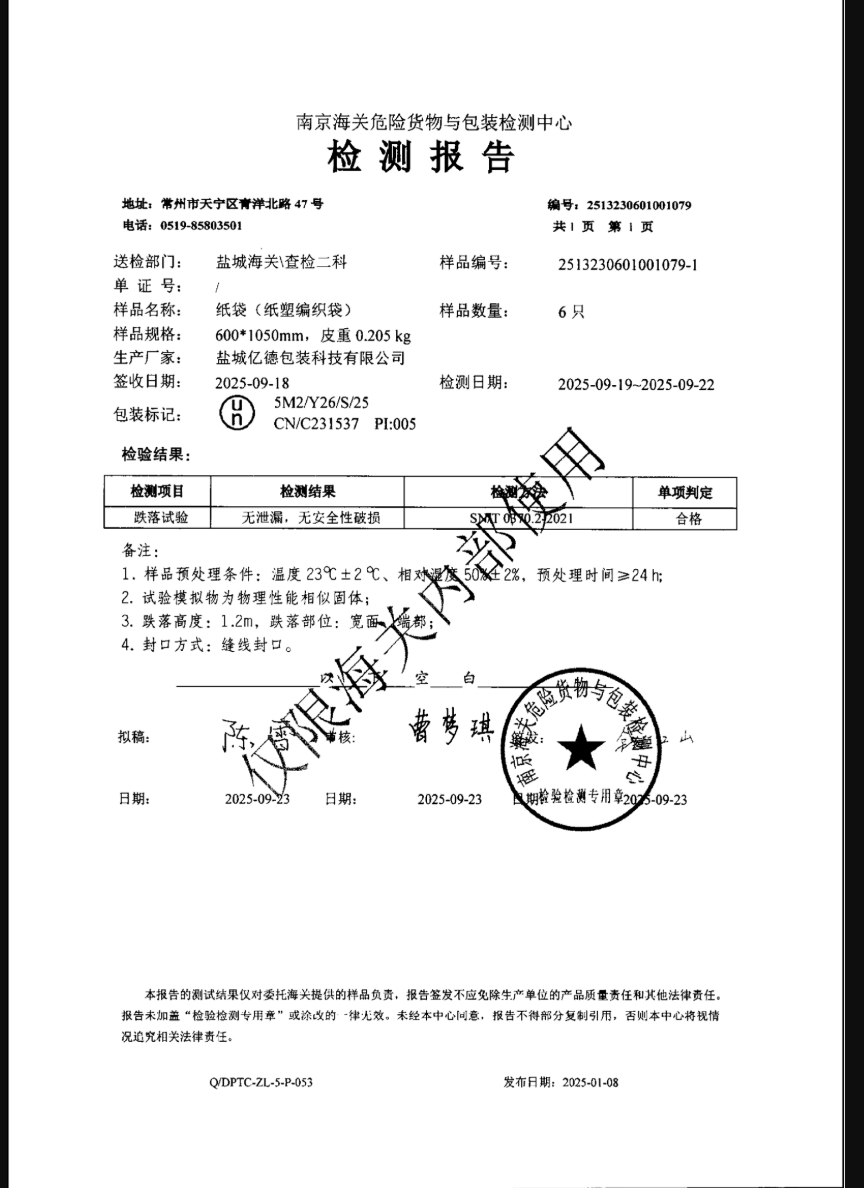
Material and transport testing is documented separately, and this is where scope reading becomes essential. A REACH SVHC screening report, DGC260127018YD03, dated 31 July 2026, covers 251 substances tested on a white woven bag sample. A RoHS 2.0 test, A2260656737101001C, dated 5 August 2026, covers a paper bag construction of paper, PP and PE. A halogen content test, DGC260127018YD02, dated 3 February 2026 and conducted to BS EN 14582:2016, also references a white woven bag sample. A UN packaging test report, 2513230601001079, dated 23 September 2025, covers a 600×1050 mm paper-plastic woven bag and records a drop performance result of passed under SN/T 0510.2-2021.
Food-contact documentation
Food-grade availability and food-contact compliance are not the same claim. The clean workshop supports production of food-grade bulk bags; the declaration or migration documentation that a given market requires for direct food contact must be requested per market and per construction. For starch, this normally means asking what documentation the supplier can issue for the specific fabric and liner combination in the quotation, not what the factory holds in general.
Commercial terms that shape the evaluation
Yide Packaging works on an ODM basis with customization across dimensions, material, fabric weight, load capacity, safety factor, lamination, printing, colour, lifting structure, filling and discharge design and closure method, and states that products are fully customizable except for unavailable special materials. Stated commercial parameters are a monthly capacity of 50,000 pieces, a minimum order of 5,000 pieces for customized products, a single sample available for delivery, and a lead time of 45 days for customized products excluding delivery time. The stated after-sales position covers re-delivery or a corresponding deduction in the event of a bag shortage.
For an evaluation-stage buyer, the sample matters more than the MOQ. A sample without printing confirms fabric hand, valve behaviour and spout dimensions before print tooling is committed — which is the point at which most format decisions are either confirmed or reversed.
Fit boundaries worth stating plainly
Neither format is universally correct, and the boundaries are worth writing down before a specification is signed.
- Valve bags depend on nozzle compatibility and on a filling machine being present. Without both, the self-closing design is a cost with no corresponding benefit.
- Valve bags do not offer a discharge spout and are not designed as bulk containers; using them as a substitute for an FIBC defeats their economics.
- FIBC bulk bags require lifting capacity, headroom and a receiving arrangement; where those are missing, the bag cannot deliver its handling advantage.
- Safe working load must be calculated from bulk density and usable volume, not read from a catalogue maximum. A 2,000 kg rating says nothing about whether a specific bag is right for a specific starch grade.
- Certificates and test reports are construction-specific. A passed drop test on a paper-plastic woven bag does not transfer automatically to a valve bag or an FIBC.
- Print durability depends on the ink, the lamination and the exposure. A fade-resistant requirement should be written as a specification and verified on a printed sample.
Standards outlook for 2026 and beyond
The clearest change in this category is documentary rather than commercial. ISO 21898:2024 replaced an edition that had been in use for two decades, and the European adoption was approved by CEN in August 2024. Chinese catalog records place the equivalent national update, GB/T 10454-2025, into implementation on 1 March 2026, superseding two earlier standards. For starch packers, the practical consequence is that packaging specifications, incoming inspection criteria and supplier questionnaires written before those dates may reference requirements that no longer match current practice.
Electrostatic requirements remain a separate track. IEC 61340-4-4:2018 applies to FIBCs used in hazardous explosive atmospheres across a defined volume range, and whether a particular starch filling operation falls inside that classification is a site assessment question rather than a bag catalogue question. Buyers should resolve it with their own process engineers before adding an electrostatic construction to a specification.
No verified market-size or growth figures for bulk bags are included here, because none were confirmed from an authoritative source in the available evidence. The outlook is therefore limited to what the standards record shows, which is a category in the middle of a revision cycle rather than a category undergoing a documented demand shift.
FAQ
Which format suits food starch powder better — valve bags or food-grade FIBC bulk bags?
Neither is better in general; they answer different questions. PP woven valve bags suit automatic filling lines producing unit-weight packs, where the self-closing valve removes a separate closing step. Food-grade FIBC bulk bags suit bulk movement in the 500–2,000 kg range, where lifting loops and a fill spout or open top handle tonne-scale batches. A site that both receives bulk starch and packs unit weights typically uses both formats together.
What safe working load should a food-grade FIBC bulk bag carry for starch?
Ton bags and FIBC bulk bags typically carry a working load capacity of 500–2,000 kg, depending on design, material, dimensions and safety requirements, with a standard ton bag commonly holding around 1,000 kg. Heavy-duty FIBC constructions can be manufactured for higher loads when a project requires it. The correct figure for a specific starch grade is derived from bulk density and usable volume, then checked against the bag's rated safe working load.
How does a self-closing valve keep starch powder inside the bag?
A self-closing valve bag carries a valve sleeve that the filling nozzle enters. After filling, the internal product pressure presses the sleeve closed against itself, so the bag seals without sewing or heat sealing. Because the closure depends on the sleeve geometry, the valve dimensions must match the filling nozzle on the buyer's machine, which is why a nozzle drawing should accompany a valve bag enquiry.
Does OPP film lamination matter for starch powder bags?
It changes the outer surface from an exposed woven or paper face into a sealed, smooth, printable one. For starch that affects two things: the outside of the bag no longer presents loose surface fibre or open weave to damp conditions, and print sits on film rather than on a textured substrate. Whether the lamination is necessary depends on the storage environment and on how much print durability the order requires.
What documentation should accompany a food-grade FIBC or valve bag order?
At minimum: a quality management certificate with a scope covering the product being ordered, test reports that reference the exact construction rather than a different product from the same factory, and the food-contact documentation required by the destination market. Yide's current reports include a REACH SVHC screening on a white woven bag sample, a RoHS 2.0 test on a paper-PP-PE paper bag, a halogen content test on a white woven bag sample, and a UN drop performance test on a 600×1050 mm paper-plastic woven bag — none of which should be assumed to cover a valve bag or an FIBC without confirmation.
Downloadable company reference
Yide Packaging's 2026 company and product brochure, covering its industrial and logistics packaging ranges, is available for download: Yide Group Introduction 2026 (PDF).
Have Questions or Need More Details?
Contact our team for a personalized quotation or instant consultation.
Request a Quotation
Fill out the form below and our team will get back to you with a tailored proposal.
WhatsApp Direct Chat
Prefer to chat in real-time? Message us on WhatsApp for instant assistance & quick answers.
- Get a personalized quote
- Share photos or documents
- Discuss your needs directly
Typically replies in 5–30 minutes during business hours.