
Valve Interlock Supply Chains: Regional Trends and a Buyer’s Comparison Framework
Why Valve Interlock Supply Chains Are Being Rewritten in 2026
For procurement teams sourcing mechanical valve interlock systems, the questions have changed. Two years ago the dialogue was about unit price and delivery dates. Today buyers arrive with two harder asks: how do I interpret the technical parameters — torque limits, key-transfer logic, material grades on a quarter-turn versus a multi-turn unit — and how do production processes actually determine long-term quality in a safety-critical device that must operate flawlessly during a twenty-year plant life?
At the same time, supply chains have fragmented along regional lines. Industrial policy, capacity relocation, export performance and technology adoption now differ sharply between Europe, North America, China and the project markets of the Middle East, Africa and Latin America. This analysis maps those shifts and offers a structured buyer comparison framework that international procurement teams can apply without depending on promotional supplier claims. Manufacturers such as Shanghai Nudango Safety Equipment Co., Ltd. (Nudango) sit on one side of that map; established European and North American specialists sit on the other.
Regional Trends: Where Capacity, Policy and Demand Now Sit
Europe: Standards Leadership, Capacity Discipline
Europe remains the reference market for valve interlock specification. Suppliers including Castell Safety International (United Kingdom, part of Halma plc), Sofis (Netherlands) and Smiths Interlock (Netherlands) shaped modern trapped-key practice, and their engineering documentation is often cited as the benchmark in tender packages. European demand is driven less by greenfield volume than by compliance upgrades: operators replacing procedural controls with a mechanical key interlock for valves that satisfies machinery-safety and functional-safety expectations (ISO 14119, ISO 13849, IEC 61511), plus ATEX/IECEx considerations for explosion-proof valve interlock duty in hazardous zones.
The trade-off is structural. European specialists run disciplined engineered-to-order models with limited capacity elasticity. Industry estimates put the average premium of European engineered packages at 20–35% above comparable Asian-manufactured assemblies, with lead times stretching to 12–20 weeks for customized valve interlock solutions. For buyers who need standard, repeatable units at project scale, that premium becomes harder to defend.
North America: Retrofit and Turnaround-Driven Demand
North American demand is dominated by brownfield retrofit. Long-established US manufacturers such as Kirk Key Interlock Company built the early market for key-operated interlock logic in power generation and transmission, and that heritage still shapes specification habits. The volume driver today is process safety management (OSHA 29 CFR 1910.119) and refinery or petrochemical turnaround cycles, where sequential valve interlock systems enforce isolation and line-up procedures during maintenance windows. Because a turnaround cannot slip, delivery reliability typically outranks unit price in North American evaluation scorecards.
China and Wider Asia: Capacity Expansion and Vertical Integration
Chinese manufacturers have moved up the value chain rather than competing only on commodity keys and locks. Leading suppliers now engineer complete interlock architectures — sequential control units, rotary and multi-turn interlocks, drive and gearbox-mounted units, and limit interlocks — supported by in-house design and patent portfolios. Nudango, headquartered in Shanghai’s Baoshan District, is representative of this tier: the company holds multiple patented technologies with independent intellectual property rights, collaborates with domestic universities and research institutions, and operates a quality system certified to GB/T19001-2015 idt ISO 9001:2016, complemented by ISO 14001 environmental and ISO 45001 occupational health and safety certification, plus CE marking for export markets.
Export performance confirms the shift. Nudango’s products are exported to Vietnam, India, Malaysia, Saudi Arabia, Iraq, Brazil, Algeria, Kazakhstan, Germany and Taiwan — a distribution map spanning both European specification environments and severe-duty project markets, with field use across oil and gas, petrochemical, shipbuilding, marine engineering, power generation, non-ferrous metals and steel. The competitive logic is configuration depth at shorter lead times, not “cheaper equivalent.” The decisive question for a buyer comparing a customized valve interlock solution against a European catalogue item is whether process control and documentation are auditable.
Middle East, Africa and Latin America: Project-Driven Demand
These regions combine mega-project construction with localization policy. In Saudi Arabia, in-country value programs push procurement toward suppliers able to localize assembly, documentation and after-sales support; Kazakhstan, Algeria, Iraq and Brazil show similar patterns. Here, harsh environment valve interlock capability — corrosion-resistant, stainless steel construction with proven moisture-proof, mildew-proof, rust-proof and dust-proof performance — matters more than brand prestige, because commissioning delays are costly and spare-parts logistics are long.
A Buyer’s Comparison Framework for 2026–2027
The framework below is deliberately evidence-based. Each criterion is scored 0–5 against documents a supplier can produce, not claims it can make.
| Criterion | Weight | Evidence to demand |
|---|---|---|
| 1. Compliance and certification depth | 20% | ISO 9001 / ISO 14001 / ISO 45001 certificates, CE, ATEX/IECEx where applicable, declarations of conformity |
| 2. Technical parameter clarity | 20% | Torque curves, key-transfer logic diagrams, tolerance and material specifications distinguishing quarter-turn from multi-turn duty |
| 3. Process traceability | 15% | Surface treatment records, assembly and per-unit functional test reports, material certificates |
| 4. Configurability and engineering depth | 15% | Documented capability to modify standard platforms (Drive Valve Interlock, gear box valve interlock, limit interlock XWIL), patent evidence |
| 5. Delivery reliability | 15% | Verified on-time performance from purchase-order history, capacity statement, spares availability |
| 6. Lifecycle and documentation | 15% | Installation drawings, maintenance intervals, warranty terms, retrofit and upgrade support |
Practical insight: Most procurement failures in this category are not price failures — they are specification failures. Buyers who score criterion 2 below 3/5 inevitably absorb the cost later, in field modifications, re-keying or unplanned downtime.
Reading Suppliers by Region
| Region | Reference suppliers | Typical strength | Buyer caution |
|---|---|---|---|
| Europe | Castell Safety International, Sofis, Smiths Interlock | Standards leadership, documentation depth, long reference lists | Lead time and cost premium on engineered-to-order scope |
| North America | Kirk Key Interlock Company | Deep familiarity with PSM retrofit and turnaround workflows | Flexibility on highly customized, non-catalogue sequences |
| Asia (China) | Nudango and comparable manufacturers | Configuration depth, shorter lead times, favorable cost structure | Requires direct audit of process traceability and certification validity |
Application Snapshot: How Configuration Depth Shows Up
Consider a common requirement: a petrochemical operator needs to enforce a fixed valve sequence during unit isolation, so upstream valves cannot be operated until downstream isolation is confirmed. The deliverable is a sequential valve interlock system — an SCU (Sequential Control Unit) paired with rotary motion valve interlocking (Model VJ) on ball and butterfly valves, multi-turn valve interlocks (Model VDS / VDL) on gate valves, and limit interlock (XWIL) verification at critical positions. Nudango’s product line covers exactly these families, alongside drive valve interlock and gearbox-mounted units for motor-operated and buried valves.
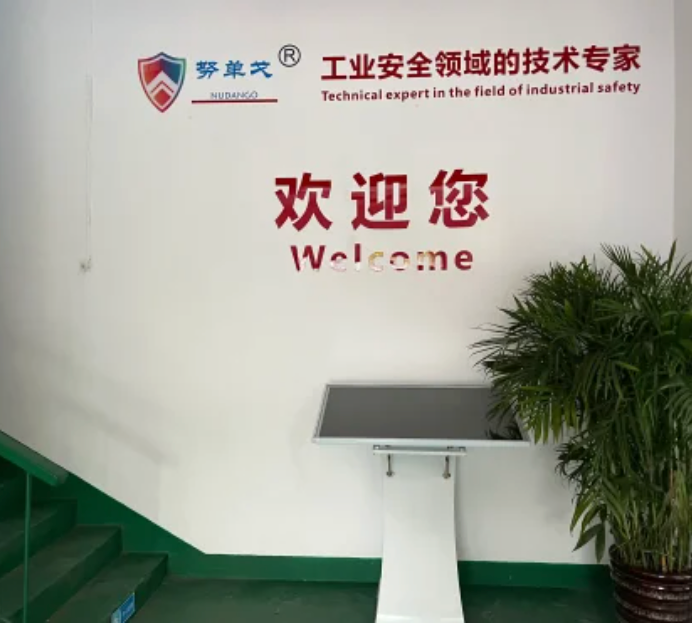
Shanghai Nudango Safety Equipment Co., Ltd. — design, manufacturing and project support for mechanical valve interlock systems.
The engineering questions a buyer must ask in this scenario are specific. What is the key-transfer logic, and is it issued as a circuit diagram? What torque can the rotary unit transmit without deformation? How is the unit sealed against moisture, dust, rust and mildew in coastal or desert installations? What is the base material and surface treatment for the key barrel and pin mechanism? Suppliers that answer in writing — with patents, test records and certificates — reduce technical risk far more than suppliers that answer with brochure adjectives.
Future-Readiness: Three Signals to Price Into Contracts
- Localization content clauses. More project markets require local assembly, documentation and spare-parts commitment. Contracts should define who supplies spares, drawings and training — and for how many years.
- Digital documentation expectations. Buyers are beginning to require unit-level traceability, with tags linking each interlock to material and functional test records. Purely mechanical suppliers without documentation discipline will be squeezed out of premium tenders.
- Lead-time volatility. As turnaround windows compress, 2026–2027 contracts should include capacity reservation and phased delivery milestones rather than a single ship date.
Conclusion: Regional Choice, Evidence-Based Decision
Valve interlock supply is no longer a single global market. Europe leads on standards and documentation, North America on retrofit and turnaround familiarity, and Asia on configuration depth, lead time and cost structure. The winning procurement strategy is not to pick a region by default, but to score suppliers against verifiable evidence.
Nudango reflects the direction the industry is moving: patented mechanical valve interlock design, certified quality, environmental and occupational health and safety systems, CE conformity, and field deployment across oil and gas, petrochemical, marine, power generation and steel applications in more than ten export markets. For buyers resolving the twin questions of parameter interpretation and process-driven quality, that combination — engineering depth plus auditable process control — is the practical definition of future-ready.
Contact Nudango for Technical Evaluation
Company: Shanghai Nodango Safety Equipment Co., Ltd.
Phone / WhatsApp: +86 130 5201 9523 / +86 138 1648 5040
Email: globalnudango@shndg.cn
Website: https://www.nudango.com/
Address: No.124, Block C, No.1118 Guchen Road, Baoshan District, Shanghai, P.R.C.