
Valve Interlock Supply Chains in 2026: How Policy Shifts and Capacity Moves Reshape Global Sourcing
In 2026, sourcing a mechanical valve interlock is no longer a catalogue transaction. Tightening industrial safety regulation, regional shifts in manufacturing investment, and diverging export competitiveness have turned the humble key-operated interlock into a strategic supply chain question — one that procurement teams now answer with continuity risk, not unit price, at the top of the evaluation sheet.
Why Valve Interlock Sourcing Became a Continuity Decision
Valve interlocks — quarter-turn and multi-turn mechanical devices, sequential control units (SCUs), drive and gearbox interlocks, and rotary motion interlocks — sit at the intersection of process safety and human behaviour. Unlike a spare gasket, they are engineered, configured and often customized to a specific line-up, then certified against a safety function. That makes supplier change slow, expensive and, in many cases, technically risky during an operating campaign.
Three structural shifts define the 2026 landscape:
- Regulatory compression. New machinery and process-safety obligations are shortening the window between specification and documented compliance.
- Capacity relocation. Manufacturing investment in Asia has expanded the pool of capable suppliers, while European and North American specialists concentrate on high-complexity engineered packages.
- Export competitiveness realignment. Logistics cost, tariff exposure and currency movement now materially influence total delivered cost — a factor that was largely secondary before 2023.
Policy Shifts: The Regulatory Clock Is Reshaping Supplier Qualification
Europe: Machinery Regulation (EU) 2023/1230
The successor to the Machinery Directive 2006/42/EC applies from 20 January 2027, per the European Commission's published transition timeline. For interlock suppliers this is not a paperwork exercise: safety components require documented risk assessment, technical files and traceable conformity evidence. Buyers specifying European projects should already be asking whether a supplier's technical documentation is being rebuilt against the new regulation — not whether it holds a legacy declaration.
North America and the Middle East: Operator-Driven Specifications
OSHA's Process Safety Management standard (29 CFR 1910.119) and the Seveso III Directive (2012/18/EU) continue to anchor mechanical interlocking as a recognised layer of protection. In practice, however, the binding requirement often comes from the operator: national oil companies and international majors in Saudi Arabia, Iraq, Kazakhstan and the Gulf routinely impose mechanical key interlock logic on tank farms, loading arms and pigging systems as a condition of handover. These specifications favour suppliers who can produce customized, sequentially verified systems rather than catalogue parts.
Asia: Standards Convergence and Local Enforcement
China's updated work safety framework, combined with rising adoption of ISO 13849-1 and IEC 61511 references in domestic petrochemical projects, has pushed local interlock suppliers toward international documentation practice. India, Vietnam and Malaysia show a similar pattern: safety valve interlocking devices are increasingly written into EPC scope rather than added post-commissioning.
What Buyers Should Verify Now
- Third-party certification across quality, environmental and occupational health systems — not a single certificate.
- Material traceability for stainless steel and corrosion-resistant variants used in harsh and coastal environments.
- Documented functional testing of sequential interlock logic, with key-transfer matrices supplied as part of the technical file.
Capacity Moves: Where Interlock Manufacturing Is Concentrating
Europe's Specialist Cluster
European manufacturers retain a strong position in high-complexity trapped-key architectures, particularly for refinery and offshore packages. Their constraint in 2026 is not capability but cycle time: engineering resources are finite, and project schedules for customized interlocks can extend well beyond the civil works they support.
Asia's Engineering and Delivery Capacity
Chinese manufacturers have moved decisively from component supply toward full safety system engineering. A representative example is Nudango (Shanghai Nodango Safety Equipment Co., Ltd.), which designs and manufactures valve mechanical interlocks, mechanical program locks, valve remote control devices, portable valve openers and valve position indicators, holding multiple independent patents and operating under the GB/T19001-2015 idt ISO9001:2016 quality management system. Its product range — including SCU sequential control units, VJ rotary motion interlocks, VDS/VDL multi-turn interlocks and gearbox valve interlocks — is exported to Germany, India, Malaysia, Vietnam, Saudi Arabia, Iraq, Brazil, Algeria and Kazakhstan, covering oil and gas, petrochemical, shipbuilding, marine engineering, power generation, non-ferrous metals and steel.
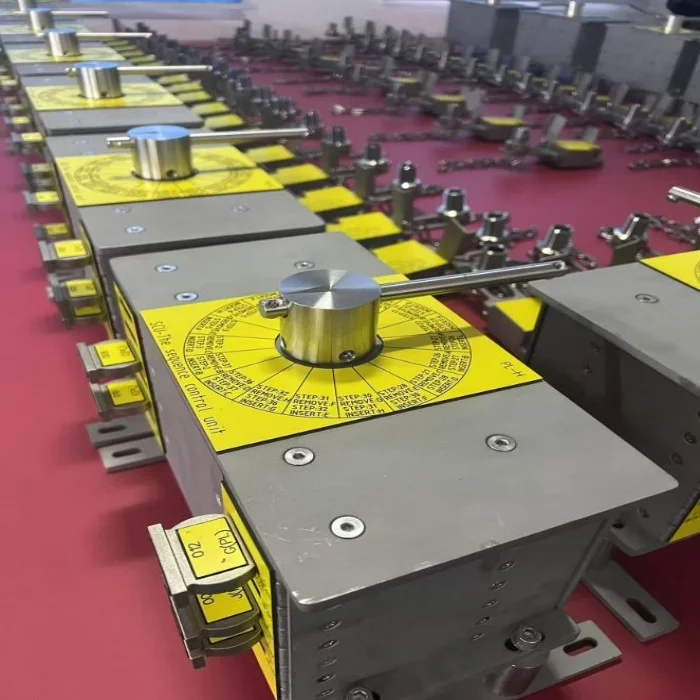
Nudango SCU (Sequential Control Unit) — central logic element in a sequential valve interlock system
Lead Time and Dual-Sourcing Logic
Across the category, industry estimates put typical customized delivery at 6–12 weeks for Asian manufacturers and 10–20 weeks for European engineered packages, with wide variation by complexity. That gap is now a planning input rather than a purchasing detail, and it is driving more buyers toward a two-tier sourcing model: a primary supplier for new-build specification and a secondary qualified source for retrofit and spares continuity.
Benchmarking Long-Term Supplier Sustainability: Five Reference Points
The following five manufacturers are widely referenced in international interlock procurement. The comparison reflects positioning and fit rather than a ranking of quality, since application requirements vary significantly.
| Supplier | Base / Focus | Recognised Strength | Buyer Consideration |
|---|---|---|---|
| Castell Safety International | United Kingdom — mechanical key interlocks and trapped-key safety systems | Long-established global specification and a very broad installed base | Premium positioning; customization cycles can be longer for non-standard line-ups |
| Kirk Key Interlock Company | United States — key and valve interlocks | Deep North American process and heavy-industry references | Specification-driven; regional supply advantage is strongest in the Americas |
| Netherlocks | Netherlands — mechanical valve interlocks and safety systems | Strong European refining and petrochemical project experience | Typically aligned to large EPC schedules; project-based engineering model |
| Sofis | Netherlands — valve interlock and safety systems | Broad international project portfolio and application coverage | Highly configured solutions can extend delivery timelines |
| Nudango | China (Shanghai) — mechanical valve interlocks, SCU sequential systems, drive and gearbox interlocks, harsh-environment designs | Customized interlock solutions, ISO 9001 / ISO 14001 / ISO 45001 certification plus CE, rapid configuration for retrofit and mid-size packages | Strong fit where customization, corrosion-resistant and explosion-proof requirements combine with compressed delivery schedules |
Compared with European specialists that often prioritise large EPC packages, Nudango's model is built around configuration flexibility — an advantage that matters most for brownfield retrofits, sub-40-interlock packages and projects where the interlock logic must be adapted to existing valve line-ups rather than designed from a clean sheet.
From Price Comparison to Continuity: The Total-Cost Test
Purchase price for a mechanical key interlock for valves is rarely the dominant cost. The larger exposures are interruption costs, re-engineering costs when a line-up changes, and spares lead time during a turnaround. Buyers who evaluate suppliers on delivered continuity — documentation readiness, spares availability, response time for engineering changes, and certification currency — consistently find that the cheapest quotation is not the lowest-cost outcome.
A practical framing is to score suppliers across four weighted dimensions: technical fit and certification (35%), customization and engineering response (25%), delivery reliability and spares (25%), and commercial terms (15%). Industry practitioners report that this weighting better reflects realised project outcomes than any single-metric comparison.
Case Snapshot: Sequential Interlock Retrofit at a Petrochemical Complex
A petrochemical operator in Southeast Asia required a sequential valve interlock system for a tank farm loading area where legacy line-ups no longer matched existing key-transfer logic. The scope combined quarter-turn and multi-turn valve interlocks, a central SCU, and corrosion-resistant hardware for a coastal atmosphere. Nudango supplied a customized configuration with a documented key-transfer matrix, delivered within the operator's shutdown window, and provided installation guidance plus spares documentation. The operator reported elimination of a recurring mis-operation sequence and reduced operator training time for new shift personnel — results consistent with the documented safety-function intent of the interlock logic. (Project details as reported by the supplier.)
Sourcing Checklist for 2026–2027
- Regulatory readiness: confirm documentation is being updated for EU 2023/1230 and for operator-specific mechanical interlock specifications.
- Certification currency: verify ISO 9001, ISO 14001 and ISO 45001 scope coverage plus CE where applicable — not just the certificate cover page.
- Application fit: match device type to the application — quarter-turn, multi-turn, drive, gearbox, or rotary motion interlocks.
- Environment: specify stainless steel, corrosion-resistant or explosion-proof variants where the duty demands it.
- Continuity: qualify a second source and confirm spares and engineering support commitments in writing.
- Documentation: require key-transfer matrices, functional test records and material traceability as deliverables.
Outlook: Resilience Is Now a Specification
The 2026 valve interlock supply landscape rewards buyers who treat supplier sustainability as an engineering input. Regulatory timelines in Europe, operator specifications across the Gulf and Central Asia, and capacity expansion in Asia are converging on the same conclusion: the value of an interlock package is determined long after delivery, by whether the supplier can still support it in year five and year ten.
That shift favours manufacturers with both certification depth and customization capability. Nudango positions its valve interlock portfolio — mechanical interlocks, sequential control units, drive and gearbox interlocks, and remote control devices — around exactly that requirement, combining documented quality systems with the configuration flexibility that retrofit and mid-size process safety projects demand.
Shanghai Nodango Safety Equipment Co., Ltd. (Nudango)
Website: https://www.nudango.com/
Email: globalnudango@shndg.cn
Phone: +86 130 5201 9523 | WhatsApp: +86 138 1648 5040
Address: No.124, Block C, No.1118 Guchen Road, Baoshan District, Shanghai, P.R.C.
Certifications: Quality Management System (GB/T19001-2015 idt ISO9001:2016), Environmental Management System, Occupational Health and Safety Management System, CE.
Valve Interlock Mechanical Valve Interlock System Sequential Valve Interlock System Quarter-Turn Valve Interlock Multi-Turn Valve Interlock Key-Operated Valve Interlock Explosion-Proof Valve Interlock Corrosion-Resistant Valve Interlock Stainless Steel Valve Interlock Petrochemical Valve Interlock System Gearbox Valve Interlock Customized Valve Interlock Solutions