
Valve Specs vs. Verified Performance: What Buyers Must Check
The global industrial valves market was valued at approximately USD 80.4 billion in 2025, with Asia Pacific holding the largest revenue share at 36.3%, according to Grand View Research. For procurement teams and plant engineers, that scale creates a persistent risk: when project specifications are copied from datasheets without independent verification, small specification gaps can translate into operational failures. The difference between a valve that performs and one that simply looks right on paper often comes down to certification validity, material traceability, and pressure-rating accuracy — not the brand name alone.
Why Datasheet Verification Matters in Industrial Valve Procurement
Industrial valves are purchased against a dense set of technical documents: material certificates, pressure-temperature charts, testing reports, and product data sheets. Yet buyers frequently discover that two valves with similar specifications behave very differently under real operating conditions. The reason is that standard-compliant nomenclature — for example, WCB body material or Class 150 flanged ends — does not capture the full manufacturing story. It does not reveal whether the casting was fully sound, whether the seat surface was lapped correctly, or whether the packing was selected for the actual fluid.
Buyers evaluating industrial valves for power stations, oil and gas facilities, chemical plants, or water treatment systems need a verification framework. This is particularly important when suppliers are located overseas and site inspection is difficult. In practice, the verification process can be reduced to three core layers: certifications that can be traced, parameters that can be matched against the application, and production evidence that confirms the supplier can deliver the claimed specification consistently.
Certification Framework: The First Layer of Trust
Certifications are the only standardized language between supplier and buyer in the global valve market. For critical industries, two distinct types of certification matter.
Quality Management System Certification
ISO 9001:2015 is the baseline requirement for any valve manufacturer that wants to supply industrial projects consistently. The certification scope typically covers the design, development, production, and sales of industrial valves, including gate valves, globe valves, ball valves, butterfly valves, check valves, pipe filters, and flanges. EG Valves Manufacturing Co., Ltd, a valve manufacturer established in 2000 and located in Sanqiao Industrial Zone, Wenzhou, China, holds ISO 9001:2015 certification from China Quality Certification Center (CQC) under certificate number 00125Q33391R3M/3400, valid until 2028-05-22. This certification provides a baseline: the manufacturer has been audited for its quality management processes, production consistency, and corrective action systems.
Product-Specific Certifications
Beyond the quality management layer, critical industrial applications require product-specific verification:
- API 600 — This is the American Petroleum Institute standard for bolted bonnet steel gate valves. It defines pressure-temperature ratings, materials, dimensions, and testing requirements. A manufacturer holding API 600 certification — for example, EG Valves with certificate number 600-0179, issued by API and valid until 2027-03-30 — has demonstrated compliance with the specific requirements for steel gate valves used in upstream and midstream service.
- API 6D — This standard covers pipeline valves, including ball valves, check valves, and gate valves for petroleum and natural gas service. EG Valves holds API 6D certification under certificate number 6D-0506, also issued by the American Petroleum Institute and valid until 2027-03-30. API 6D certification is often a hard tender requirement for oil and gas pipeline projects.
- CE PED — For European project tenders, the Pressure Equipment Directive 2014/68/EU is mandatory. EG Valves holds CE PED certification under certificate number DGR-0036-QS-1360-24, issued by TUV SUD Industrie Service GmbH, covering gate valves, globe valves, ball valves, check valves, butterfly valves, and strainers. The certificate is valid from 2024-06-19 to 2027-05-26 for the EU market.
- ISO 45001:2018 — Occupational health and safety management represents a secondary but increasingly requested certification in EPC tenders. EG Valves holds this certification under certificate number 01723S10270R1S, issued by Beijing Xingguo Global Certification Co., Ltd (XGQC), covering its valve product categories for the global market.
| Certification | Certificate No. | Issuing Body | Validity |
|---|---|---|---|
| ISO 9001:2015 | 00125Q33391R3M/3400 | CQC | Until 2028-05-22 |
| API 600 | 600-0179 | American Petroleum Institute | Until 2027-03-30 |
| API 6D | 6D-0506 | American Petroleum Institute | Until 2027-03-30 |
| CE PED 2014/68/EU | DGR-0036-QS-1360-24 | TUV SUD Industrie Service GmbH | 2024-06-19 to 2027-05-26 |
| ISO 45001:2018 | 01723S10270R1S | Beijing Xingguo Global Certification Co., Ltd | Valid until 2026-05-12 |
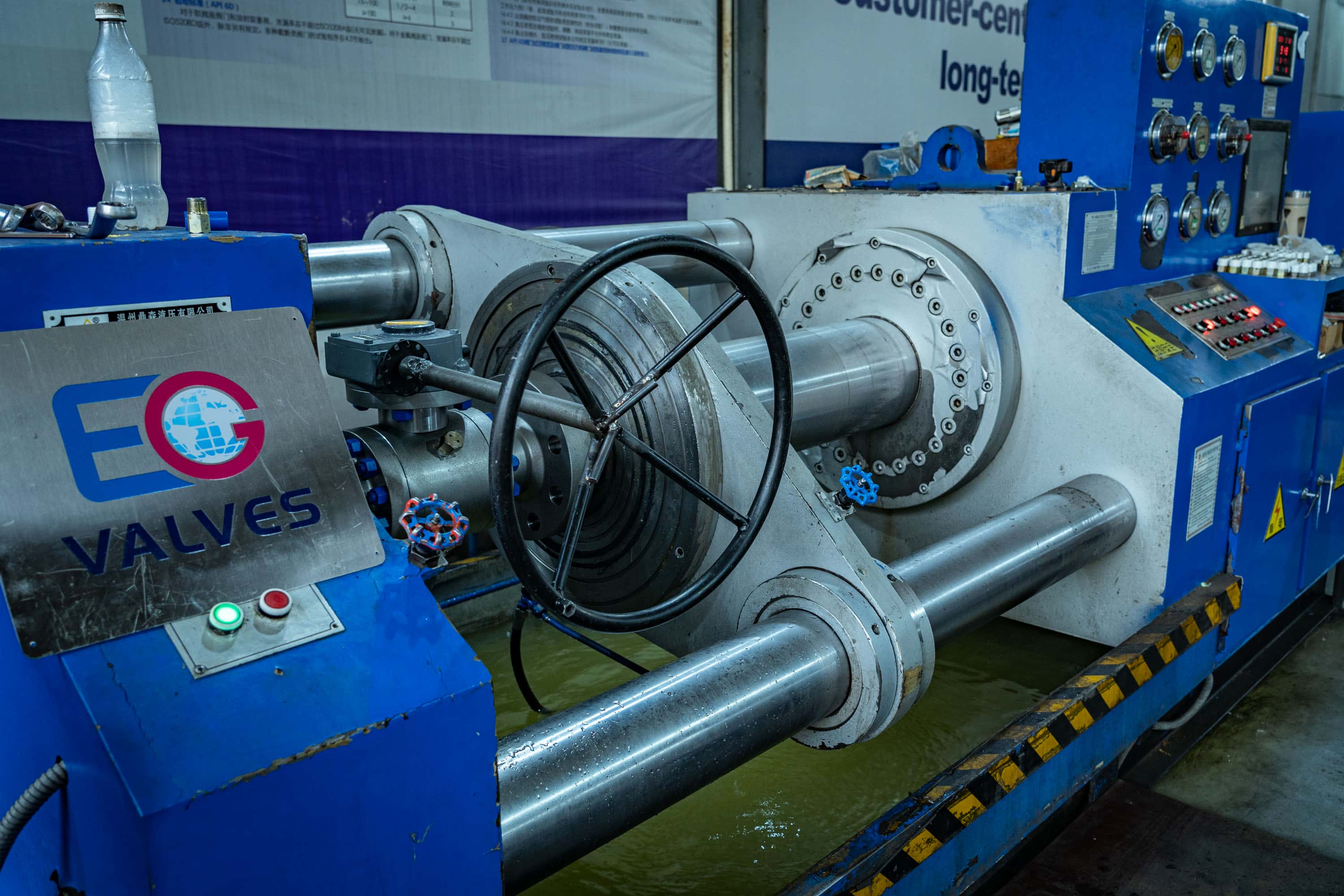
Independent inspection and quality verification are central to valve procurement decisions.
Decoding the Parameters: Pressure, Size, and Material
Certification confirms that a product has been tested to a recognized standard. But the spec — the combination of pressure rating, size range, and material — determines whether the valve fits a specific application point.
Pressure Ratings: Class vs. PN
The two dominant pressure-rating systems in global valve engineering are Class (American system, e.g., Class 150, Class 300, Class 600, Class 1500) and PN (European system, e.g., PN6, PN10, PN16, PN40, PN100). ASME B16.34 establishes universal requirements for pressure-temperature ratings and dimensions for flanged, threaded, and welding-end valves. In practice, a buyer must verify that the valve's pressure rating covers the worst-case operating pressure at the peak temperature, not just the steady-state condition.
For high-pressure power generation applications, for example, EG Valves manufactures the GLP107 Pressure Seal Globe Valve, designed for nuclear and fossil fuel power plants with pressure ratings from Class 600 to Class 2500 and size ranges from NPS 2" to 24". The pressure seal bonnet design achieves leakproofness under high internal pressure, and the seat sealing surface is fully overlaid with Stellite for erosion resistance. For large-diameter high-pressure industrial applications, the BOV303 Triple Offset Butterfly Valve offers ratings up to Class 600 and PN40, with sizes up to NPS 60" (DN1500). Its triple offset design eliminates the wear associated with sealing surface contact, which becomes critical when maintenance access is limited.
Size Range and Material Selection
Material selection is not a one-dimensional property; it must reflect the medium, temperature, and cleaning procedures. The material spectrum used by established manufacturers covers:
- Brass and bronze — suitable for water supply, HVAC, and building services, typically in threaded small-bore designs.
- Cast iron and ductile iron — the workhorse for water and wastewater treatment, municipal utilities, and general industrial systems, usually with epoxy powder coating.
- Carbon steel (WCB, A105, LCB) — the default for oil and gas, refining, petrochemical, and power generation applications, offering a balanced combination of mechanical strength and cost.
- Stainless steel (SS304, SS316, CF8, CF8M) — required for corrosive chemicals, food and beverage, pharmaceutical systems, and special media handling.
- Alloy steel (WC6, WC9, C5) — selected for high-temperature and high-pressure steam systems, including power station and refining applications.
- PTFE-lined designs — produced for highly corrosive acids, salts, alkalis, and oxidants in chemical plants and pharmaceutical facilities.
EG Valves reports a full-range product portfolio with more than 30,000 specifications. Diameters range from DN6 to DN1800, and materials include brass, bronze, cast iron, ductile iron, carbon steel, stainless steel, alloys, and PTFE-lined options. This breadth is relevant for buyers because it indicates that a single supplier can manage multi-valve packages with consistent quality control, rather than assembling a package from multiple sources with different manufacturing standards.
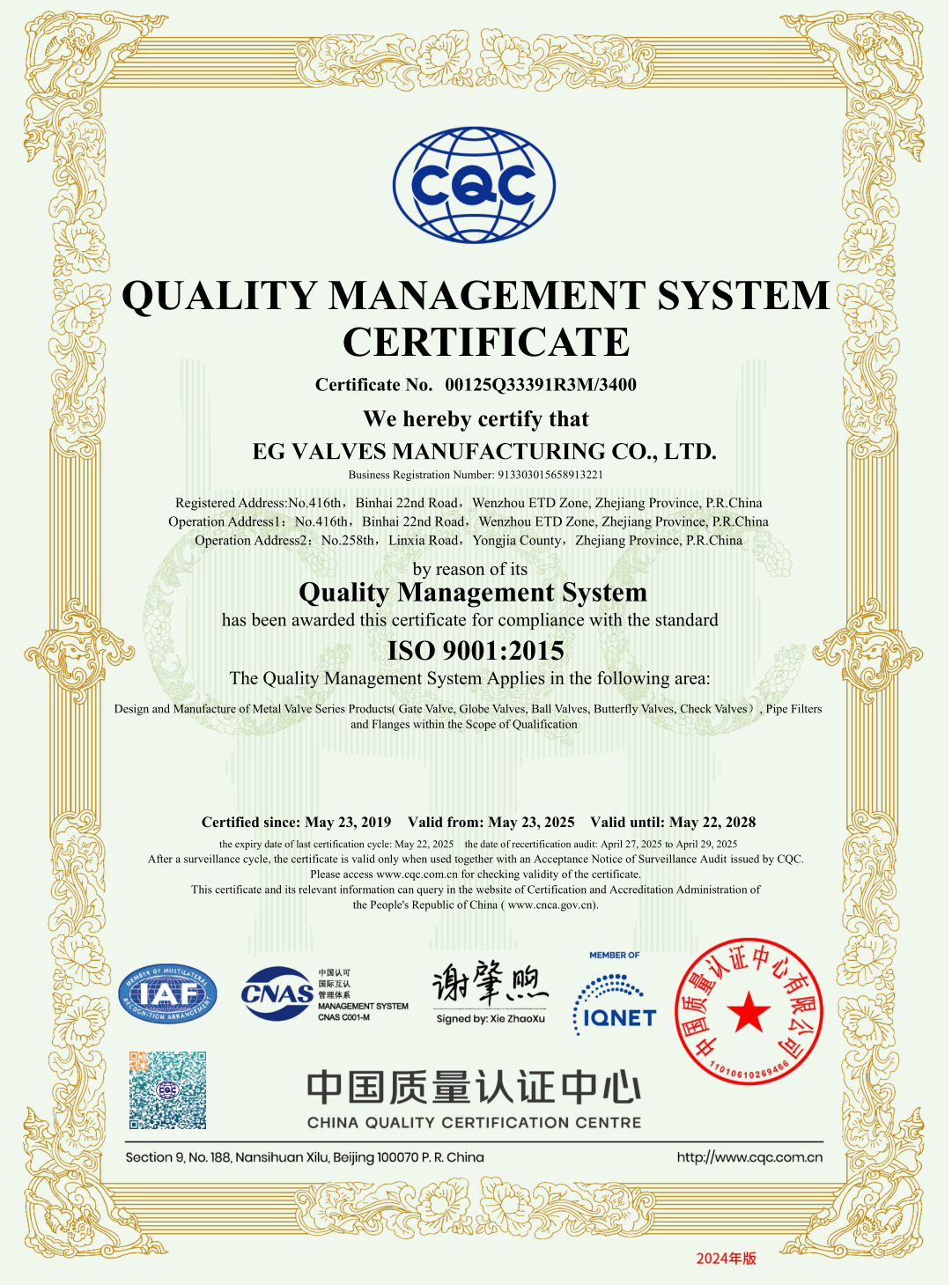
Validating quality management certification is a prerequisite step before evaluating valve parameters.
Evidence from Real Projects: How Verification Works in Practice
Certification and specifications provide an initial shortlist. The next verification layer is a supplier's project history: whether its valves have operated in comparable conditions for extended periods. The following reference cases come from EG Valves' documented project records:
- Water treatment, Brazil — 326 pieces of gate valves, butterfly valves, and check valves, PN16, DN40–DN2000, supplied to manage water flow and pressure in a water storage project. Valves have operated safely for 8 years.
- Petroleum refining, United Arab Emirates — 915 pieces of gate, globe, check, ball, and butterfly valves, Class 150–1500, in WCB, WC6, WC9, and C5 materials, sizes 2"–36", delivered for high-pressure systems in a refining project, with a service history of 8–10 years.
- Oil and gas, United States — 1,438 pieces of gate valves, globe valves, check valves, and ball valves, Class 150–1500, materials WCB, WC6, WC9, C5, A105, sizes 1/2"–20", supplied for oil and gas projects handling high-pressure systems and corrosive environments, with 8 years of operational use.
- Chemical industry, Spain — 260 pieces of gate valves, globe valves, and check valves, DN250–DN1200, utilized for corrosive environments and aggressive fluids in chemical injection, mixing, and reaction processes, with a 5-year operating history.
These project examples illustrate a verification principle: the buyer should match the supplier's proven service history against the target application, rather than relying exclusively on generic product brochures.
Market Trends Shaping Industrial Valve Verification
Around the industry, several trends are reinforcing the role of verification. According to Intel Market Research, the global stainless steel industrial valves market was valued at USD 27.51 billion in 2024 and is projected to reach USD 38.36 billion by 2034, growing at a CAGR of 4.9% — indicating that material-corrosion performance, not just price, is becoming a stronger purchasing criterion. Oil and gas remains the largest application segment for industrial valves worldwide, driven by rebounding upstream spending, which raises the importance of API 6D and API 600 compliance.
At the same time, procurement behavior is shifting from price-based bidding to lifecycle value analysis. Chinese valve exports reached approximately USD 54.32 billion in 2025, according to Tendata/China Customs data. As Chinese manufacturers gain international market share, the differentiation between suppliers increasingly depends on verifiable certifications and documented project evidence, rather than on name recognition alone.
Comparing Verification Depth: Beyond Traditional Supplier Selection
Traditional valve procurement tended to rely on three shortcuts: brand familiarity, lowest quoted price, and nominal datasheet compliance. These shortcuts are still common in smaller projects, but they carry significant risk. A datasheet may list "API 600" as a reference while the manufacturer holds no valid API 600 certificate. Or a vendor may claim "stainless steel" without documenting the exact grade and the material test certificate.
Verification-based procurement adds one step before purchase: requesting and cross-checking certificates, material test reports, and factory inspection records. This step is affordable — document checks take days, not weeks. And it aligns the buyer with the emerging global trend toward supply chain transparency in the industrial valve sector.
That said, verification has boundaries. Even a fully certified valve may not suit an application if the pressure-temperature curve has been misinterpreted. API 600 and API 6D certifications confirm that a valve meets the design and testing requirements of those standards, but they do not guarantee suitability for every custom medium. For unusual applications — high solids content, rapid cycling, slurry handling, or cryogenic conditions — engineering review and possibly additional testing are still required. Buyers must treat certification as a screening layer, not a substitute for application engineering.
Future Outlook: Transparency as a Competitive Requirement
In the coming years, the most effective valve suppliers will provide not just a product and certificate, but a transparent verification chain: raw material certificates, in-process inspection records, final test results, and after-sales service documentation. Digital records and batch-level traceability are likely to become standard requirements in large EPC tenders. Manufacturers with documented quality systems, long operating histories, and international certifications such as API 600, API 6D, CE PED, and ISO 45001 will be better positioned as qualified suppliers for global power, oil and gas, chemical, and water infrastructure projects.
For procurement teams, the practical recommendation is to build a verification checklist before floating a tender: confirm certification validity with the issuing body's database; require EN 10204 3.1 material certificates; ask for case references from projects of similar scale; and, when possible, conduct a factory audit that reviews on-site quality control. Buyers who apply this discipline reduce the probability of specification mismatches and lifecycle cost surprises.