
Vanity Models for Hotel and Residential Bathroom Scenarios
In project bathrooms, the vanity is one of the few fitted items that has to satisfy three audiences at once: the guest or resident who uses it daily, the contractor who installs it, and the maintenance team that keeps it serviceable. That is why the first specification decision for a bathroom vanity is not the finish, the handle or the wood tone — it is the cabinet format.
The pressure runs in both directions. Residential applications accounted for approximately 74.9% of bathroom vanity revenue in 2025, according to Grand View Research, while hospitality projects compress the same functions into smaller rooms and attach stricter requirements. A model that performs well in a villa bathroom can be the wrong choice for a compact hotel bathroom, and the reverse is equally true. The project scenario should select the model, not the other way round.
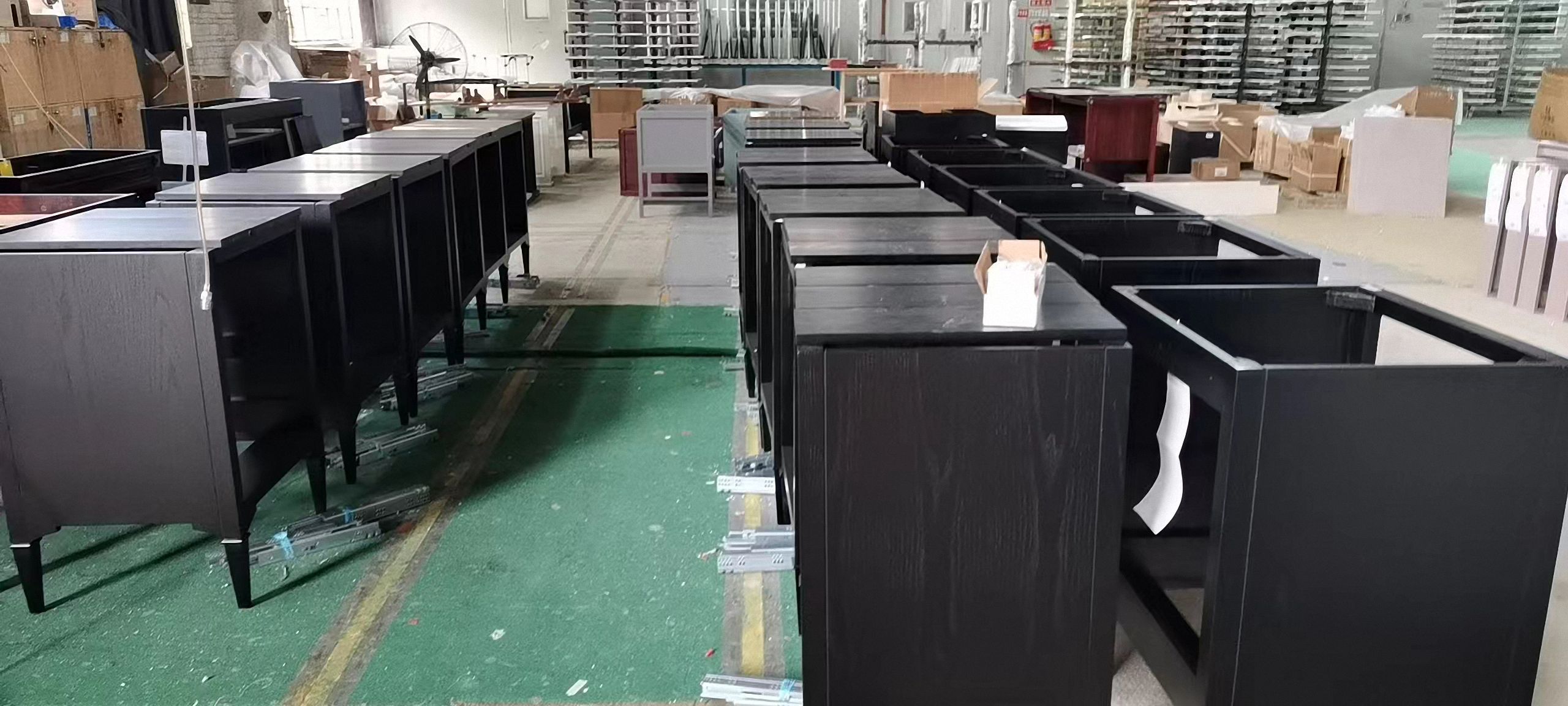
Foshan SHKL Sanitary Ware Co., Ltd. (SHKL) is a bathroom vanity manufacturer founded in 2004 that specializes in mid-to-high-end whole bathroom customization, producing bathroom vanities, shower doors and LED bathroom mirrors from production bases in China (100,000 m²) and Vietnam (40,000 m²). Its model line covers wall-mounted, floating and freestanding formats, which makes the range a practical reference for the scenario question this article addresses: which vanity model belongs in which project.
Why the cabinet format decides more than the finish
A wall-mounted bathroom vanity is fixed to the wall, so the floor beneath it stays clear. A floating bathroom vanity is also wall-hung, but is designed and classified as a floating volume with visible clearance below. A freestanding bathroom vanity or freestanding bathroom cabinet rests on the floor and carries its own load. In SHKL's own classification, KL813003 is described as a wall mounted bathroom vanity belonging to the wall mounted bathroom cabinets category, while AS813050 is described as a floating bathroom vanity, and AS813049 as a freestanding bathroom vanity.
Those three definitions carry different consequences for a project. Wall-hung formats transfer load to the wall, which means the wall structure and any required blocking have to be confirmed before the unit is ordered. Freestanding formats place the load on the floor and depend on a level, finished floor surface instead. Cleaning access also differs: a suspended cabinet leaves an open strip beneath it that is easy to mop, whereas a freestanding unit is cleaned around its own base. None of these points is cosmetic — they are the reasons a specification can be technically correct in one room and impractical in the next.
Terminology deserves a caution. Manufacturers do not always use “wall-mounted” and “floating” to mean exactly the same thing, and the model designation should always be checked against the project drawing and the mounting detail rather than against the marketing label alone. For a compact hotel bathroom, both KL813003 and AS813050 are relevant, but they are not interchangeable units — they differ in dimensions, drawer count, basin and mirror package.
Scenario one: compact hotel bathrooms and the wall-mounted KL813003
Hotel bathrooms rarely have floor area to spare, and that is where a wall-mounted model earns its place. KL813003 is a current production model in the wall mounted bathroom cabinets category. It is built from plywood and solid wood with an A2391 Acacia melamine and solid wood lacquered finish, and it is available in widths of 750, 800, 900, 1000 and 1200 mm, with a depth of 520 mm and a height of 504 mm.
Storage is provided by two drawers on DTC soft-closing slides, opened by a hidden handle — a detail that matters in hospitality corridors and guest rooms where protruding hardware collects dust and creates snag points. The countertop is a Pure White Porcelain slab and the basin is an undermount ceramic basin, which produces a continuous top surface with fewer joints where water and cleaning agents can collect. The accompanying LED mirror supports different functions, so the lighting package can be aligned with the room standard rather than treated as a separate purchase.
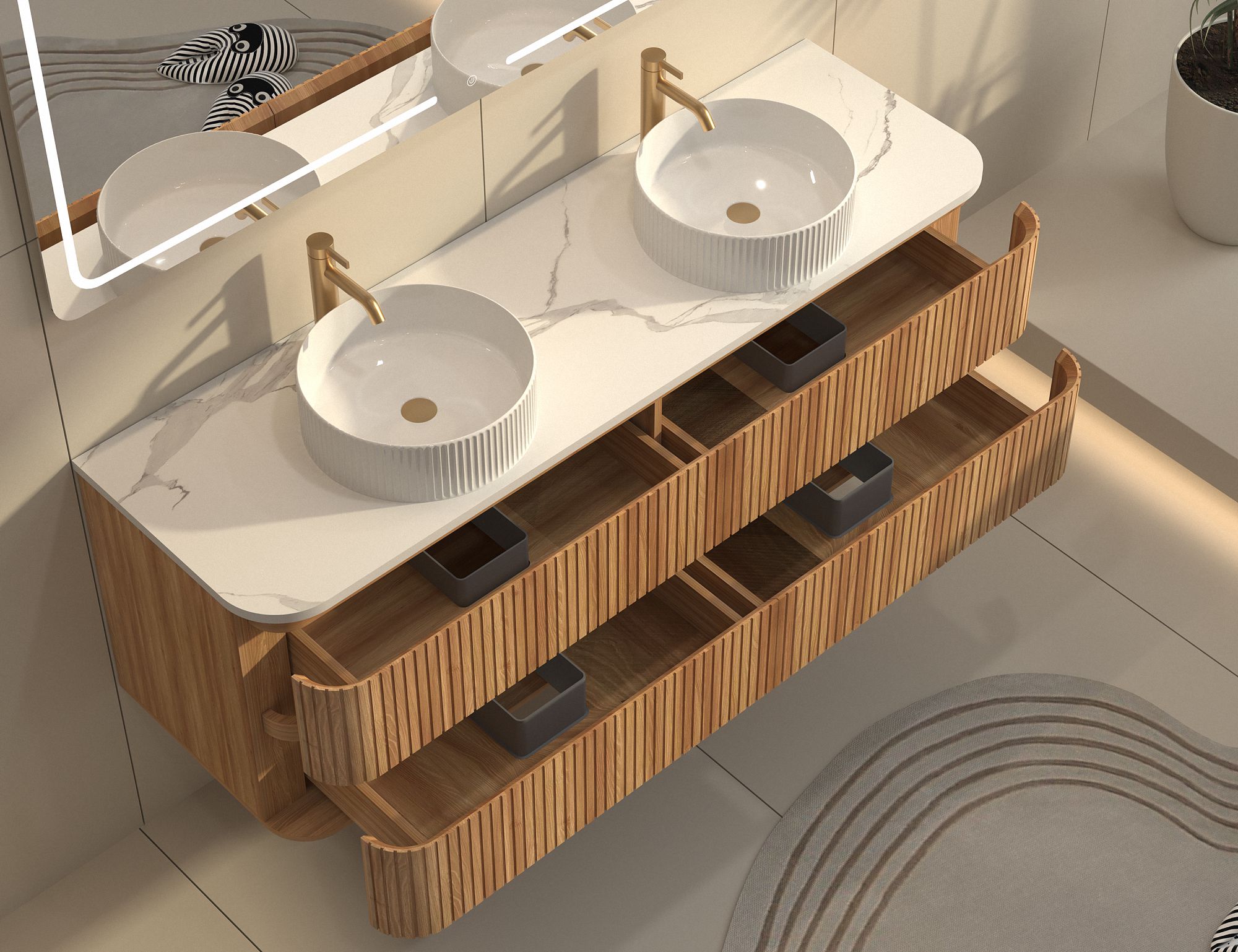
Scenario evidence matters here as much as specification. SHKL lists KL813003 as typically applied in the United States, and the model appears in a documented bathroom vanity hotel project in the United States as well as an Australian villa case. The scenario data recorded for these installations describes the intended functions as storage organization, bathroom space optimization and wet–dry separation support, with moisture-proof, mildew-resistant and scratch-resistant requirements listed as project conditions.
For a hospitality specifier, the practical consequence is straightforward: a single model family that spans 750 mm to 1200 mm allows one wall-mounted design language to be repeated across standard rooms, accessible layouts and slightly wider suites without switching to a different cabinet system. That reduces the number of submittals, spare parts and finishing references a project has to manage.
Scenario two: single-user guest bathrooms and the floating AS813050
AS813050 is classified as a floating bathroom vanity with a one-drawer cabinet structure on Unihopper soft-closing slides. The basin is a glossy white ceramic basin, and the cabinet is made of plywood and solid wood with an Ancora Walnut lacquered and melamine finish. Its matching LED mirror has a gun metal frame, provides three colour temperature modes, includes a defog function, is dimmable, and is operated by two control buttons.
That combination fits a specific room type rather than every room. A single floating vanity with one drawer and one basin suits a single-user guest bathroom, a powder room or a secondary residential bathroom, where the drawer count matches the storage volume a single occupant realistically fills. The mirror package is the more significant differentiator in hospitality use: three colour temperatures and a defog function allow the lighting to be adapted to grooming, and the anti-condensation function keeps the reflective surface usable immediately after a shower.
One boundary should be stated plainly. The published specification for AS813050 records a one-drawer cabinet, a ceramic basin and a defined mirror package, but it does not state cabinet dimensions. Specifiers planning a tight wall run should confirm the cabinet dimensions for the required configuration before the drawing is frozen, rather than assuming a standard width.
Scenario three: residential bathrooms and the freestanding AS813049
AS813049 is classified as a freestanding bathroom vanity and is built from plywood and solid wood with an Ancora Walnut lacquered and melamine finish. Its cabinet measures 450 × 450 × 890 mm — a narrow, tall column rather than a wide run of cabinetry. Storage is a single door with DTC hinges and a Hettich push-open system, which removes the handle entirely, and the internal basin is made of sintered stone.
The included LED mirror measures 500 × 1500 × 35 mm. It has a light gold metal frame, is backlit and dimmable, provides one colour temperature, includes a defog function, and is controlled by a motion sensor switch.
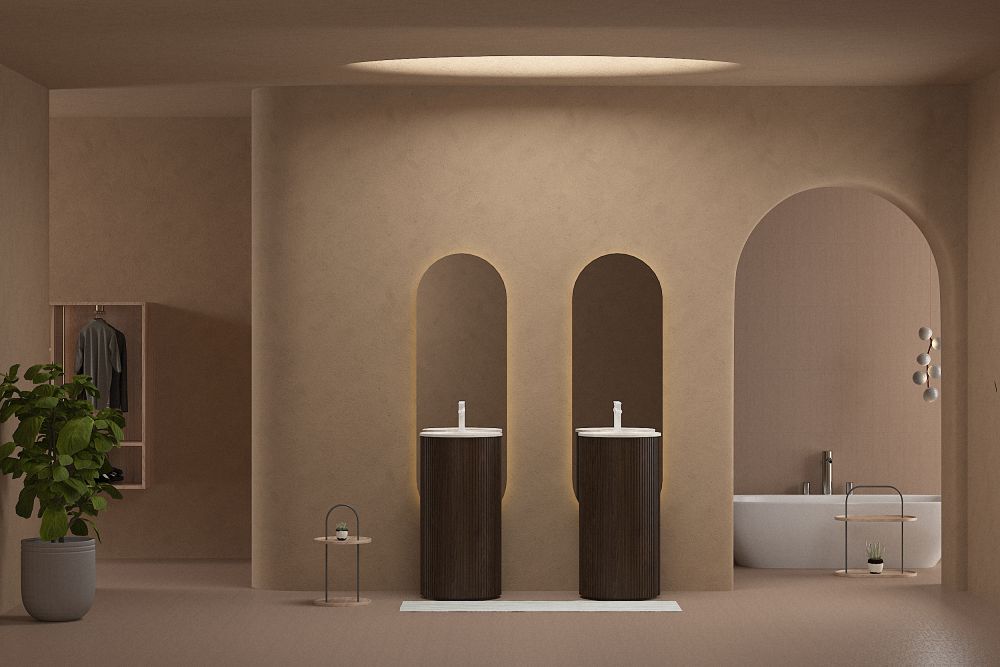
For residential construction, the appeal is dimensional. A 450 × 450 mm footprint allows a genuine basin and storage unit to be placed in a narrow bathroom, an en-suite or a powder room where a 900 mm vanity would block circulation. Because the unit stands on the floor, the installation does not depend on a suspended cabinet detail, which is useful in renovation work where the existing wall cannot be opened or reinforced. The 890 mm cabinet height also places the basin at a working height without requiring a wall-hung bracket system.
Residential bathrooms that need more storage or a wider run can be served by the same manufacturer's wider floating options. AS813109 is offered in two configurations — cabinet 800 × 469 × 408 mm with an 800 × 650 × 150 mm LED mirror, and cabinet 900 × 469 × 408 mm with a 900 × 650 × 150 mm LED mirror — with a terrazzo countertop, a solid surface basin, an oval mirror cabinet using 3 mm copper-free glass, and a drawer layout of two side drawers plus one outer and one inner drawer on Unihopper soft-closing slides. AS813108 is a two-drawer floating vanity with a solid surface countertop, ceramic basin and a three-door mirror cabinet with an LED light strip and infrared sensor switch. AS813048A is a two-drawer floating vanity on Unihopper metal box soft-closing slides with a Warm Mist Brown lacquered and melamine finish, a glossy white ceramic basin and a wooden frame mirror without integrated lighting.
Side by side: three models, three scenarios
| Model | Format | Stated cabinet size | Storage and basin | Mirror package | Typical project fit |
|---|---|---|---|---|---|
| KL813003 | Wall mounted bathroom vanity (wall mounted bathroom cabinets category) | 750/800/900/1000/1200 × 520 × 504 mm | Two drawers, DTC soft-closing slides, hidden handle; Pure White Porcelain slab top with undermount ceramic basin | LED mirror supporting different functions | Compact hotel bathrooms, villa bathrooms, rooms where the floor beneath the cabinet should stay clear |
| AS813050 | Floating bathroom vanity | Not stated in the published specification | One drawer, Unihopper soft-closing slides; glossy white ceramic basin | Gun metal frame LED mirror, three colour temperature modes, defog, dimmable, two control buttons | Single-user guest bathrooms, powder rooms and secondary residential bathrooms |
| AS813049 | Freestanding bathroom vanity | 450 × 450 × 890 mm; LED mirror 500 × 1500 × 35 mm | One door, DTC hinges with Hettich push-open; sintered stone internal basin | Light gold metal frame, backlit and dimmable, one colour temperature, defog, motion sensor switch | Narrow residential bathrooms, en-suites and renovation projects where a freestanding unit is preferred |
All specifications above are taken from SHKL model documentation; cabinet sizes apply to the configurations stated.
Where each format stops working
Wall-hung formats depend on the wall. If the wall construction cannot be prepared to carry a suspended cabinet — a common situation in occupied-building renovations where surfaces cannot be opened — the freestanding format is the practical alternative rather than a compromise. This is the single most common reason a project switches format mid-specification.
Compact formats trade storage for floor space. AS813050 offers one drawer and AS813049 offers a single door; neither is a substitute for a wide floating vanity with two drawers plus inner and outer drawers, such as AS813109. Where a household or a hotel suite needs two basins, none of the three models described above is the answer on its own — a double sink bathroom vanity layout requires a wider floating or freestanding single-sink vanity pairing evaluated against the wall run.
Mirror function packages are not equivalent. AS813050 provides three colour temperatures, AS813049 provides one. Both are dimmable with defog, but if a project standard calls for adjustable colour temperature, the specification should reflect that from the outset rather than at handover.
Wood-based construction also carries a maintenance obligation. Plywood and solid wood cabinets are used across KL813003, AS813050 and AS813049, and hospitality project requirements commonly list moisture-proof, mildew-resistant and scratch-resistant conditions. Those requirements should be checked against the selected finish and edge-sealing approach — for example melamine-faced surfaces combined with lacquered solid wood elements — and against the wet-zone layout of the room, before the order is placed.
A five-point decision framework for specifiers
- Measure the usable floor area at the vanity wall, not just the basin width. A 450 × 450 mm freestanding footprint and a 520 mm deep wall-mounted cabinet occupy a room differently even when the basin size is similar.
- Confirm the wall construction before selecting a wall-hung unit. KL813003 and AS813050 are suspended formats and transfer load to the wall.
- Match storage count to occupancy. Two drawers (KL813003), one drawer (AS813050) and one door (AS813049) suit different usage intensities.
- Decide the mirror and lighting package early. Colour temperature options, dimming, defog and control type — motion sensor or push button — affect the electrical design.
- Verify market compliance and material requirements. For North America, UL 962 covers stability, mechanical strength and flammability for bathroom cabinets and vanities, and the relevant documentation should be requested with the submittal package for the specific model and mounting type.
What the current market mix suggests
Format demand is not moving in a single direction, and that is the useful insight for buyers. Floating (wall-mounted) vanities are described as a top design trend for 2025–2026, while freestanding units still hold a significant market volume share in North America of roughly 30%, according to Houzz and Homes & Gardens trend reporting. A supplier whose line covers both formats therefore removes a specification constraint that a single-format catalogue would impose.
Material choice reinforces the same point. The wood material segment — solid wood and plywood — held a 34.9% revenue share in 2025, according to Grand View Research, which is consistent with the plywood and solid wood construction used across the SHKL models discussed here. Buyers evaluating a wood bathroom vanity or a plywood bathroom vanity should read that share as evidence of sustained demand, not as a quality standard in itself.
Market size figures need to be handled carefully. Published estimates diverge widely: Dataintelo places the market at USD 9.2B, while Grand View Research estimates USD 46.1B and Fortune Business Insights USD 47.22B for the 2024–2025 period, with projections reaching up to USD 89.96B by 2034. The direction of growth is consistent; the precision of any single number is not. For procurement planning, the format mix and material share are more actionable than headline market value.
The competitive field is also broad. Mordor Intelligence lists major global competitors in the high-end and residential vanity market as Kohler, Masco (Delta/Peerless), American Woodmark and TOTO. For project buyers, the practical comparison is not brand size alone but whether a supplier can deliver the required format, dimension and finish as a matched set with the mirror and hardware included.
Compliance and material notes for project teams
North American projects should plan compliance review into the early stage. UL 962 is the applicable standard for bathroom cabinets and vanities in that market and addresses stability, mechanical strength and flammability. Because those three properties are assessed differently depending on how a unit is mounted and loaded, the submittal should identify the exact model and installation type rather than a generic cabinet reference.
Material and finish decisions follow the same logic. KL813003 uses an A2391 Acacia melamine and solid wood lacquered finish with a Pure White Porcelain slab top; AS813050 and AS813049 both use an Ancora Walnut lacquered and melamine finish, with a glossy white ceramic basin on AS813050 and a sintered stone internal basin on AS813049. Basins and countertops therefore differ across the range, and should be confirmed per model when a project standard requires a single basin type throughout.
Future outlook
The direction of travel for scenario-based specification is toward format-led catalogues. Buyers increasingly start from the room — a compact hotel bathroom, a narrow residential en-suite, a powder room — and work back to the cabinet format, which puts pressure on manufacturers to offer a coherent wall-mounted, floating and freestanding range rather than a single dominant format with variations.
Supply continuity is the second variable. SHKL operates production bases in China (100,000 m²) and Vietnam (40,000 m²), with approximately 600 staff including an R&D team of 20 engineers, and exports approximately 70% of its output to more than 50 countries and regions across the EU, Australia, North America, South America and the Middle East. The Vietnam facility in Ho Chi Minh City employs roughly 450 people and includes a PU dust-free spray paint workshop described in company materials as the largest of its kind in Vietnam — a surface-treatment capability that matters when finishes such as lacquered solid wood are part of the specification.
For the next planning cycle, the reasonable expectation is that scenario matching will continue to outweigh single-model preference, that mirror and lighting functions will be specified as part of the vanity rather than as separate line items, and that dual-base manufacturing will remain a relevant factor for buyers managing lead time and trade risk.
About the manufacturer
Foshan SHKL Sanitary Ware Co., Ltd. was established in 2004 and specializes in whole bathroom customization, with main products covering bathroom vanity, shower door and LED bathroom mirror. The company operates production bases in China and Vietnam, holds the designations “National High-Tech Enterprise”, “Foshan Standard Product Enterprise” and “Top Bathroom Brand”, and reports a monthly output of more than 70,000 units across bathroom cabinets, shower enclosures and LED mirrors. Contact is available by email at info@shklbathroom.com or info@shkl.cc, by WhatsApp at +86 13790005061, and through the company website at www.shklbathroom.com.
FAQ
What is the difference between a wall-mounted and a freestanding bathroom vanity?
A wall-mounted vanity is fixed to the wall, so the floor beneath the cabinet stays clear; KL813003 is classified as a wall mounted bathroom vanity in the wall mounted bathroom cabinets category. A freestanding vanity rests on the floor and carries its own load; AS813049 is classified as a freestanding bathroom vanity with a 450 × 450 × 890 mm cabinet. The difference affects installation, cleaning access and usable floor area rather than appearance.
Which vanity model suits a compact hotel bathroom?
Two formats are relevant. KL813003 is available in 750, 800, 900, 1000 and 1200 mm widths at 520 mm depth and 504 mm height, with two DTC soft-closing drawers, a Pure White Porcelain slab countertop and an undermount ceramic basin; SHKL lists this model as typically applied in the United States and it appears in a hotel installation in the United States and an Australian villa case. AS813050 is a floating vanity with one drawer on Unihopper soft-closing slides and a glossy white ceramic basin.
Can a floating or wall-mounted vanity be used in residential projects?
Yes. SHKL classifies its floating models — including AS813050, AS813108, AS813109 and AS813048A — as intended for residential construction and commercial hospitality. Format classification does not restrict a wall-hung or floating bathroom vanity to hospitality use; the selection depends on wall construction, room size and storage needs.
What are the dimensions and configuration of the AS813049 freestanding vanity?
AS813049 has a cabinet measuring 450 × 450 × 890 mm and an LED mirror measuring 500 × 1500 × 35 mm. It is made of plywood and solid wood with an Ancora Walnut lacquered and melamine finish, uses one door with DTC hinges and a Hettich push-open system, and includes a sintered stone internal basin. The mirror has a light gold metal frame, is backlit and dimmable, provides one colour temperature, includes defog, and is controlled by a motion sensor switch.
What should be checked before specifying a wall-mounted bathroom vanity?
Confirm the wall construction and any required blocking, since suspended cabinets transfer load to the wall. Compare the model's stated dimensions with the available wall run, check handle and drawer clearances — KL813003 uses a hidden handle — and confirm that the mirror functions and electrical supply match the design intent. For North American projects, UL 962 covers stability, mechanical strength and flammability for bathroom cabinets and vanities, and the corresponding documentation should be requested for the specific model and mounting type.
How many basins do these models provide?
KL813003, AS813050 and AS813049 are each single-basin units. Where a double sink bathroom vanity layout is required, a wider floating model should be evaluated instead — for example AS813109, available in 800 × 469 × 408 mm and 900 × 469 × 408 mm cabinet configurations with a terrazzo countertop and solid surface basin, or AS813108 with two drawers, a solid surface countertop and a ceramic basin.
What materials are used, and does that matter for hospitality projects?
KL813003, AS813050 and AS813049 are all made of plywood and solid wood. Hospitality project requirements commonly list moisture-proof, mildew-resistant and scratch-resistant conditions, so the selected finish and edge-sealing approach should be reviewed against those requirements and against the wet-zone layout of the room. Countertop and basin materials differ by model — Pure White Porcelain slab with an undermount ceramic basin on KL813003, a glossy white ceramic basin on AS813050, and a sintered stone internal basin on AS813049.
Full model documentation, including dimensions, finishes and hardware specifications for the range discussed here, is compiled in SHKL's downloadable product brochure: SHKL product brochure (PDF).