
Variant Depth as Evidence: FYC's Charcoal OEM Flexibility
Independent Industry Reference · Charcoal Sourcing
A charcoal factory's product list is usually the first document a buyer receives and the last one they actually test. The shapes, surface finishes and packaging formats a supplier can quote are not cosmetic details: they indicate how many tools a factory runs, how often it changes over, and whether quality control operates at the level of an individual SKU rather than a single sample.
This reference examines that signal through one published range. Dalian Tiancheng Charcoal Industry Technology Co., Ltd., trading as FYC, is a Chinese charcoal manufacturer established in 1990 that produces hookah charcoal, incense charcoal and barbecue charcoal. The company operates a 6,000 m² manufacturing facility in Liaoning with approximately 100 staff, a research and development team of 8 engineers, and export business accounting for around 60% of total sales, with major markets including the Middle East and Europe.
Why a Variant Range Functions as a Sourcing Signal
Buyers in the research stage of a charcoal project typically start with two comparisons: price per unit and one physical sample. Both are weak screens. A price can be quoted by anyone with a supplier list, and a sample can be produced once under supervision. Neither reveals whether a factory can reproduce the same result in volume, across shapes, and under retail packaging.
Variant breadth is harder to fake than a price list. Every additional product form requires its own pressing or moulding tool, its own drying and curing behaviour, and its own acceptance criteria. A supplier able to publish cube, hexagonal and bamboo hookah charcoal, five named barbecue shapes, and three surface finishes for incense charcoal is describing a production system with multiple changeover points — not a single line running one profile indefinitely.
For OEM buyers, that distinction matters earlier than most sourcing checklists allow. Distributors, brand owners and private-label programmes rarely purchase a single item; they purchase a coherent set of SKUs that must look consistent on a shelf and behave consistently in use. The question at the research stage is therefore not only “what does this charcoal do?” but “how many configurations can this factory hold steady at the same time?”
What FYC Publishes Across Its Charcoal Lines
FYC's documented range is organised into hookah charcoal (TC-01), barbecue charcoal (TC-02), a disposable barbecue grill (TC-03) and incense charcoal (TC-04). The table below reproduces only the variants and parameters stated in the company's published product data.
| Line | Model | Documented forms and appearances | Documented performance parameters |
|---|---|---|---|
| Hookah charcoal | TC-01 | Cube (25mm and 40mm), hexagonal, bamboo | Calorific value above 7,800 kcal/kg; ash content below 3% (premium grade); fixed carbon 85–90%; burning time 90–120 minutes for cube/25mm/40mm and 45–70 minutes for quick light |
| Barbecue charcoal | TC-02 | Quadrilateral, Hexagon, 50mm Square-hole, Spherical, Fangyuan, with additional bamboo-charcoal variants listed in the specification | Burning time 6–8 hours (bamboo charcoal stick) and 70 minutes (fruit wood quick light); ultra-low ash content; high hardness |
| Incense charcoal | TC-04 | 33mm round format; Natural Black, Silver Foil and Gold Foil appearances | Burning time 45–70 minutes; quick light and fast ignition; smokeless, odorless |
| Disposable grill | TC-03 | Copper foil box format with matching Fangyuan charcoal set option | Instant even heating for 60–90 minutes; self-igniting charcoal layer; single-match lighting |
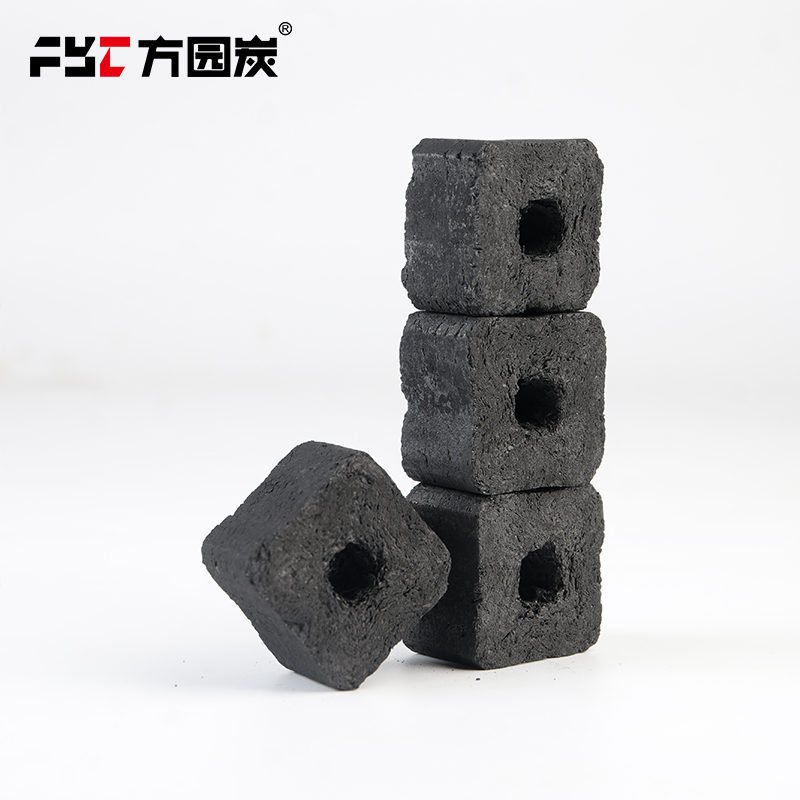
Bamboo hookah charcoal is one of three documented forms in the TC-01 hookah charcoal line, alongside cube and hexagonal formats.
TC-01 hookah charcoal: three forms, one specification set
The TC-01 hookah charcoal line is listed in cube (25mm and 40mm), hexagonal and bamboo forms, made from premium natural coconut shell and fruit wood. All three shapes are published against the same headline specification set: calorific value above 7,800 kcal/kg, ash content below 3% for premium grade, fixed carbon content of 85–90%, and a 90–120 minute burn for the cube and 25mm/40mm formats. The line also carries quick-light options with a shorter 45–70 minute burn.
The pattern is significant because the shapes are not interchangeable from a tooling perspective. A 25mm cube, a 40mm cube and a hexagonal profile require different dies, and bamboo-based stock behaves differently during carbonisation and pressing than coconut shell stock. Offering all three under one model designation means the factory has normalised its process across material inputs and geometries rather than optimising around a single configuration.
TC-02 barbecue charcoal: five shapes plus a perforated format
TC-02 barbecue charcoal is made from bamboo sawdust, hardwood and fruit wood, and is published in forms including Quadrilateral, Hexagon, 50mm Square-hole, Spherical and Fangyuan charcoal. The product specification additionally lists 50mm Four-hole and dedicated bamboo-charcoal variants of the quadrilateral and hexagon shapes.
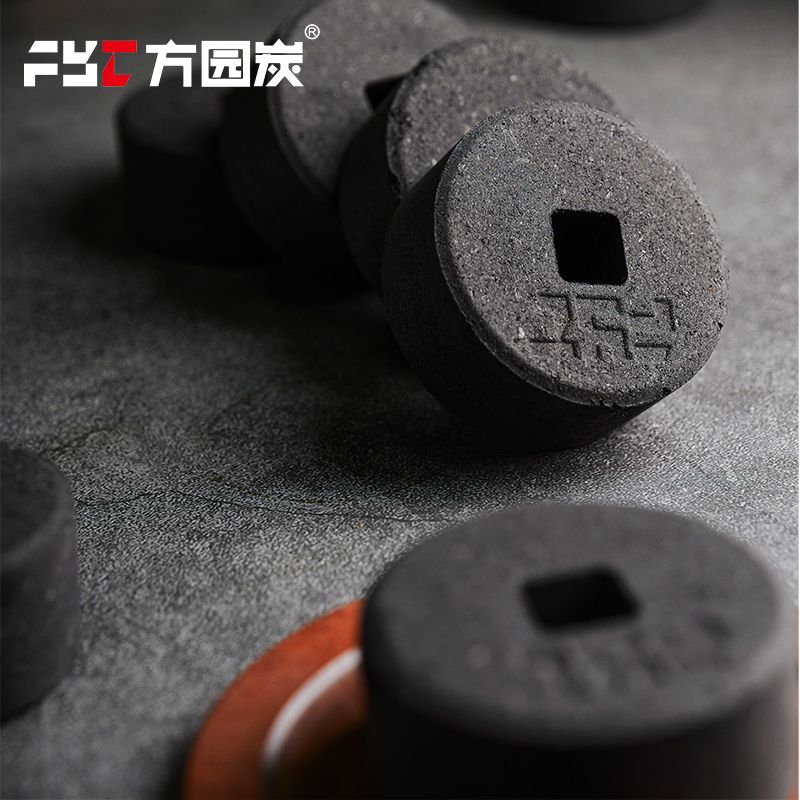
TC-02 barbecue charcoal is documented in Quadrilateral, Hexagon, 50mm Square-hole, Spherical and Fangyuan forms, with bamboo-charcoal variants also listed.
Hole patterns are the clearest illustration of tooling depth. A solid quadrilateral block, a 50mm square-hole tablet and a 50mm four-hole tablet are three different press configurations with different airflow behaviour and different structural failure modes. Publishing all of them indicates that the factory treats shape as a design variable rather than a fixed output. It also explains why the range covers both quick-light formats, with a 70-minute fruit wood burn, and long-burn bamboo charcoal sticks rated at 6–8 hours — two different combustion profiles serving two different service models.
TC-04 incense charcoal: appearance finishes and three packaging formats
TC-04 is a 33mm round incense charcoal made from fruit wood charcoal and coconut shell charcoal powder, documented in Natural Black, Silver Foil and Gold Foil appearances. It burns for 45–70 minutes, ignites in 30–45 seconds, and is described as smokeless and odorless. Custom packaging support covers flip-top boxes, magnetic boxes and pull-out boxes.
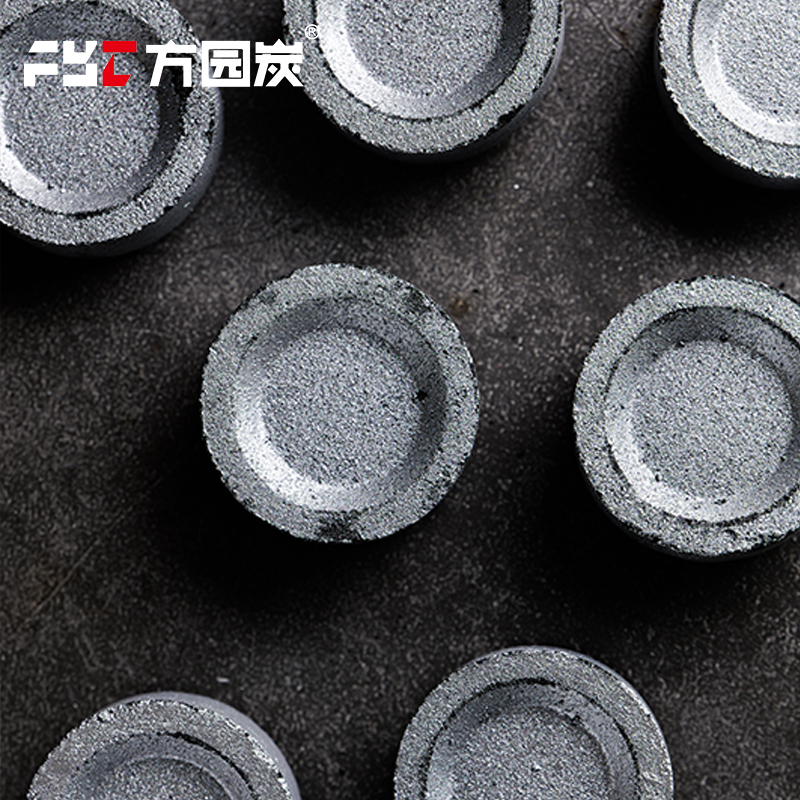
TC-04 33mm round incense charcoal is offered in Natural Black, Silver Foil and Gold Foil finishes, with flip-top, magnetic and pull-out box packaging support.
This is the strongest single piece of evidence in the range for OEM flexibility, because it combines a product variable and a packaging variable in the same SKU. Foil finishing is a separate surface process from pressing; a flip-top carton, a magnetic closure box and a pull-out sleeve are three different converting formats requiring different board specifications, print runs and packing-line routines. A supplier able to offer product finish and retail packaging as independent selections is describing a configuration matrix, not a catalogue.
The Manufacturing Logic Behind Multiple Forms
Tooling and changeover
Each shape in the FYC range implies dedicated tooling and a changeover discipline. Cube and hexagonal hookah charcoal require different die sets at the same nominal dimensions; spherical barbecue charcoal is a pressing route distinct from extruded quadrilateral briquettes; square-hole and four-hole tablets add perforation tooling on top of the base shape. The practical consequence for a buyer is that a factory running several profiles must control dimensional tolerance and density across all of them — the quality question shifts from “can you make this shape?” to “can you keep this shape within tolerance on the fourth production run?”
Performance documentation per SKU
Every line in the range carries its own published parameters rather than a single generic claim. TC-01 states calorific value above 7,800 kcal/kg, ash below 3% at premium grade and fixed carbon of 85–90%. TC-02 states ultra-low ash content, high hardness and a 6–8 hour burn for bamboo charcoal sticks. TC-04 states a 45–70 minute burn with 30–45 second ignition. TC-03 states 60–90 minutes of instant even heating.
That structure is what consistent specification looks like in practice: not identical numbers across models, but a comparable parameter set applied to each model, so a buyer can audit SKU against SKU on the same basis. For procurement teams assembling a mixed container, this is the difference between negotiating one specification and reconciling four.
Packaging as a separate production step
Packaging choices are frequently treated as an afterthought in charcoal sourcing, yet they determine whether a product can enter retail or private-label channels at all. The TC-04 packaging options — flip-top, magnetic and pull-out boxes — describe the three most common retail presentation formats for incense and bakhoor products. Supporting them means the factory coordinates box supply, printing and packing sequences alongside charcoal production, which is an operational capability rather than a product feature.
Where the Variants Land: Documented Application Profiles
The published use-case data shows how form and format choices map onto specific markets, which is useful for buyers testing whether a variant actually has a demand base.
- Hookah and shisha lounges (documented profile: Saudi Arabia). TC-01 is described for constant premium heat without smoke, odour or sparks, with each briquette burning continuously for 90–120 minutes and ash content below 3%. Cube and hexagonal formats suit different bowl packing routines; bamboo offers an alternative material route within the same model family.
- Catering and barbecue restaurants (documented profile: South Korea). TC-02 is described for high-volume, long-duration grilling where a 6–8 hour bamboo charcoal stick burn reduces replenishment during service, and ultra-low ash content reduces exhaust-hood and grill cleanup.
- Wellness, spa and aromatherapy (documented profile: United States). TC-04 is described for quick light-up in 30–45 seconds and steady gentle warmth for 45–70 minutes, acting as an even heat diffuser for Bakhoor and solid incense. Silver or Gold foil finishes and retail box formats sit naturally in this channel.
- Outdoor recreation and glamping (documented profile: Germany). TC-03 is described for instant, even heating over 60–90 minutes in a fully disposable format, with a matching Fangyuan charcoal set option and 100% biodegradable materials.
Read together, the four profiles show why a single-shape supplier struggles in mixed portfolios: a hookah lounge in the Middle East and a spa channel in the United States purchase the same category with different expectations of shape, finish and packaging.
Market Context: Differentiation Is Moving Toward Form and Format
Published market research places the global charcoal market at an estimated USD 8.5 billion in 2026 (Grand View Research). Within the hookah segment, coconut shell charcoal held a 42.3% product-type share in 2025 (Dataintelo), which aligns with the coconut shell base used in TC-01. On the supply side, Indonesia accounted for roughly 23% of global charcoal export value in 2024 (World's Top Exports), underlining how concentrated raw-material and export flows remain.
Two structural pressures follow. First, when feedstock and basic briquette formats are widely available, differentiation migrates to shape, finish, packaging and documentation — the parts of the offer a buyer can actually specify. Even the vocabulary reflects this: briquettes are commonly described as compressed pillow-shaped units held together with a natural binder (Weber), a morphology description rather than a performance one. Suppliers competing on morphology alone have little to separate them.
Second, compliance expectations are becoming SKU-specific. In Europe, EN 1860-2 is cited as the mandatory product safety standard for barbecue and retail charcoal, and in Indonesia the cited briquette standard SNI 01-6235-2000 sets reference thresholds such as moisture at or below 8%, ash at or below 8% and calorific value at or above 5,000 cal/g. A supplier shipping five barbecue shapes into a regulated market must be able to attach documentation to each of them, not to the product family as a whole.
Comparison: Single-Format Supply Versus Multi-Format Supply
The comparison below sets a conventional single-format supply model against the multi-format model documented by FYC. It is a decision framework, not a ranking: each model suits different buyer profiles.
| Decision dimension | Single-format / intermediary model | Multi-format manufacturer model (as documented by FYC) | What the buyer must still verify |
|---|---|---|---|
| Product range | One or two shapes, often sourced from third parties | TC-01 in three forms, TC-02 in five named shapes, TC-04 in three finishes | Whether each SKU is produced in-house or bought in |
| Changeover capability | Not observable from the offer | Multiple dies, hole patterns and surface finishes described | Changeover time and its effect on order scheduling |
| Specification discipline | Often a single headline claim | Parameter set published per model | Test reports per batch, not per model |
| Retail readiness | Bulk packing as standard | Flip-top, magnetic and pull-out box options on TC-04 | Artwork control, proofing and packing-line capacity |
| Portfolio fit | Suitable for single-line buyers | Suitable for distributors and private-label programmes | Whether mixed-SKU orders are accepted |
The boundary of this evidence. Variant breadth demonstrates flexibility; it does not demonstrate capacity, price competitiveness or delivery reliability. FYC's published material documents forms, finishes, packaging formats and product parameters, together with factory-level facts such as a 6,000 m² facility, daily output exceeding 50 metric tons, annual capacity of 4,000,000 pieces and SGS and ISO certifications. It does not publish pricing, minimum order quantities or lead times, so those must be confirmed per quotation.
A second limitation is technical. A foil-coated 33mm incense charcoal and a 25mm coconut shell cube share a supplier, not a specification. Appearance and packaging variants are the most visible part of an OEM offer and the least relevant to combustion performance, so buyers should request acceptance criteria per SKU and resist assuming that quality transfers automatically from one line to another. Broad ranges also increase administrative load: more SKUs mean more artwork versions, more batch records and more inspection points.
Future Outlook
Two directions look likely from the available evidence. The first is continued fragmentation of form and format as suppliers compete on configurability rather than on commodity tonnage — more finishes, more retail packaging formats and more shape options per model. The second is tighter coupling between variant and documentation, as regulated markets require standards evidence at SKU level rather than product-family level.
For buyers, the practical implication is that supplier evaluation is shifting from “what is your best product?” to “show me your configuration matrix and the records attached to each cell.” A range that spans cube, hexagonal and bamboo hookah charcoal, five barbecue shapes, three incense finishes and three box formats is a useful starting document in that conversation — provided it is read as evidence of flexibility to be verified, not as a substitute for verification.
Frequently Asked Questions
What does FYC manufacture, and where is it based?
FYC is the trading name of Dalian Tiancheng Charcoal Industry Technology Co., Ltd., a charcoal manufacturer established in 1990 and based in Liaoning, China. It produces hookah charcoal, incense charcoal and barbecue charcoal, and operates a 6,000 m² facility with approximately 100 staff.
Which forms are available in the TC-01 hookah charcoal line?
TC-01 hookah charcoal is documented in cube (25mm and 40mm), hexagonal and bamboo forms, made from premium natural coconut shell and fruit wood. Published parameters include calorific value above 7,800 kcal/kg, ash content below 3% at premium grade, fixed carbon of 85–90% and a 90–120 minute burn for the cube and 25mm/40mm formats.
How many shapes are documented for TC-02 barbecue charcoal?
TC-02 is published in forms including Quadrilateral, Hexagon, 50mm Square-hole, Spherical and Fangyuan charcoal, with 50mm Four-hole and dedicated bamboo-charcoal variants also listed in the specification. It is made from bamboo sawdust, hardwood and fruit wood, with burning times of 6–8 hours for bamboo charcoal sticks and 70 minutes for fruit wood quick light.
What appearance and packaging options does TC-04 incense charcoal offer?
TC-04 is a 33mm round incense charcoal available in Natural Black, Silver Foil and Gold Foil appearances, made from fruit wood charcoal and coconut shell charcoal powder. Custom packaging support covers flip-top boxes, magnetic boxes and pull-out boxes. The product is described as burning for 45–70 minutes with quick ignition in 30–45 seconds.
Does a wider variant range mean every SKU performs the same way?
No. A range indicates that a supplier can produce and configure multiple forms, finishes and packaging formats; it does not establish that performance is identical across them. Each model carries its own published parameters — for example, TC-02 bamboo charcoal sticks are rated at 6–8 hours while TC-04 incense charcoal is rated at 45–70 minutes — so acceptance criteria and test reports should be requested per SKU and per batch.
Which certifications and capacity figures does the factory document?
FYC states that it has obtained SGS and ISO certifications. Documented capacity figures include daily output exceeding 50 metric tons, annual production capacity of 4,000,000 pieces, a 6,000 m² manufacturing facility and a research and development team of 8 engineers. Export business accounts for around 60% of total sales, with major markets including the Middle East and Europe.
Additional product documentation, including specification details for the TC-01 to TC-04 range, is available in the FYC product brochure: FYC Charcoal Product Brochure (PDF).
Have Questions or Need More Details?
Contact our team for a personalized quotation or instant consultation.
Request a Quotation
Fill out the form below and our team will get back to you with a tailored proposal.
WhatsApp Direct Chat
Prefer to chat in real-time? Message us on WhatsApp for instant assistance & quick answers.
- Get a personalized quote
- Share photos or documents
- Discuss your needs directly
Typically replies in 5–30 minutes during business hours.