
Vehicle-Specific Android Car Stereo Fascia Kits: Key Specs
A vehicle-specific Android car stereo fascia kit is a fitment system before it is an accessory, and its specification decides whether a head unit upgrade ends with a factory-looking dashboard or with visible gaps, warning lights and a returned order. In this product category, the parts most often sold as generic add-ons are in fact governed by vehicle-specific variables: dashboard geometry, connector pin definition and vehicle communication protocol.
This industry reference treats the fascia kit as an engineering and procurement category. It covers what the components in a retrofit set actually are, which parameters can be verified before an order is placed, which compliance requirements apply in export markets, and where plug-and-play installation stops being a shortcut and starts having boundaries.
Why a fascia kit belongs to the parts and specification category
Fascia kits, dash frames and their installation hardware sit inside a defined trade classification. Vehicle parts and accessories not elsewhere specified are grouped under HS Code 8708.99, the primary classification for car stereo fascia and installation hardware. For importers, that classification is not a formality: duty treatment, customs documentation and compliance checks follow the hardware itself, not the head unit it supports.
The installation base behind that hardware is large. The global car audio head unit market was estimated at USD 15.44 billion in 2024, according to Market Research Future. Head-unit revenue does not translate one-to-one into fascia demand, since not every head unit is installed in a vehicle that needs a new dash frame, and not every retrofit uses a model-specific kit. What the figure does show is the scale of the installed and retrofit base that requires a physical mounting interface and an electrical connection between vehicle and head unit.
That combination of trade classification and volume is why fascia kits and installation hardware are increasingly evaluated as a specification category, with tolerances, materials, connector definitions and compliance documents attached, rather than as a low-value accessory line.
What a complete installation set actually contains
A complete vehicle-specific retrofit set is normally made of three parts, and each part solves a different problem. Understanding which problem each one solves is what prevents mismatched purchasing.
- Fascia kit / dash kit — a mechanical interface. It adapts the vehicle original centre console opening to the new head unit and determines both the visual result and the mounting rigidity.
- Wiring harness — an electrical interface. It links the vehicle-side plug to the aftermarket head unit connector and determines whether the original vehicle wiring has to be cut.
- CAN bus decoder — a protocol gateway. On vehicles that use CAN communication, it enables signal exchange between the vehicle network and the aftermarket head unit.
Not every vehicle needs all three. A non-CAN bus vehicle typically needs a fascia kit and a matching wiring harness. A CAN-equipped vehicle that should retain original steering wheel controls, vehicle information display and chime functions generally also needs a decoder matched to the exact model and configuration. Treating the three parts as independent purchases, rather than as one vehicle-specific set, is one of the most common sources of compatibility failure in retrofit projects.
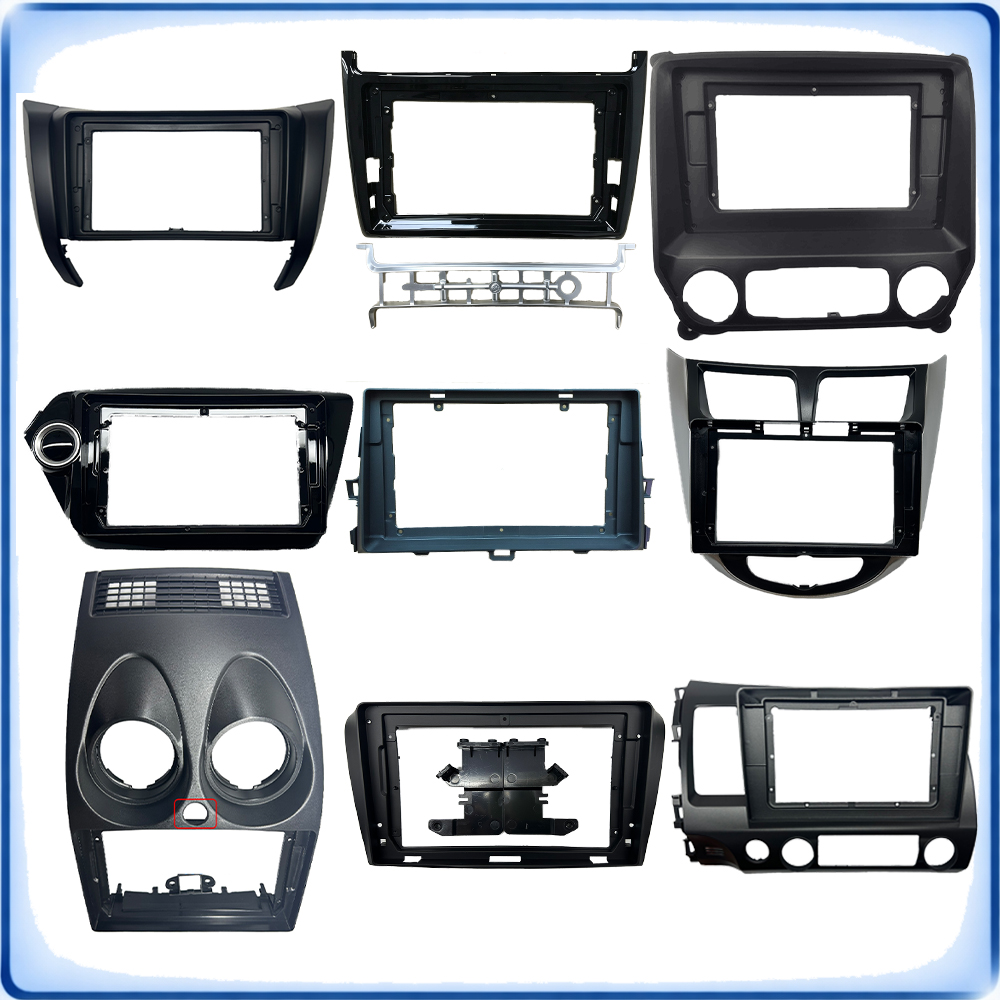
A model-specific dash fascia is developed from original vehicle dashboard data; the mounting standard and screen compatibility determine which head units it can carry.
Parameters that can be verified before ordering
Constraint checking in this category is mostly mechanical and electrical, and most of it can be completed before a purchase order rather than after a failed installation. The parameters below are the ones that determine whether a kit physically fits and electrically communicates.
Fascia fitment parameters
| Parameter | Specification |
|---|---|
| Material | ABS plastic |
| Material thickness | 2.5 mm to 3.0 mm |
| Dimensional tolerance | ≤0.2 mm |
| Compatible screen sizes | 7 in, 9 in, 10.1 in, 12.3 in |
| Mounting standard | Double-DIN and model-specific custom |
| Fitment type | Plug-and-play, without damage to the original interior |
| Operating temperature | -40°C to 85°C |
| Development basis | Manufactured from original vehicle dashboard data |
Of these, the dimensional tolerance is the commercially meaningful one. A tolerance of ≤0.2 mm describes how closely the frame follows the original dashboard opening; visible gaps and misalignment are typically the result of frames that were not precision-moulded to the vehicle dimensions rather than of installation technique. Material thickness in the 2.5 mm to 3.0 mm range, together with ABS plastic selected for temperature and ageing resistance, addresses the mechanical and thermal conditions of a dashboard that sits in direct sunlight and constant vibration.
Wiring harness parameters
| Parameter | Specification |
|---|---|
| Connector configuration | OEM vehicle-side plug plus ISO 16-pin head unit connector |
| Conductor | AWG 20-22 tinned oxygen-free copper |
| Insulation | Flame-retardant PVC, colour-coded to ANSI/CTA-2015-B |
| Connector housing | PA66 engineering plastic |
| Contact terminals | Tin-plated brass |
| Rated voltage and current | 12 V DC, 10 A maximum |
| Protection features | Reverse polarity protection, short-circuit protection |
| Operating temperature | -40°C to 85°C |
| Vehicle fitment | Non-CAN bus vehicle models |
Two details in this table are frequently the reason a harness is rejected at incoming inspection. The first is conductor material: tinned oxygen-free copper resists corrosion better than untinned copper in a humid in-vehicle environment, which is directly relevant to intermittent signal loss after several years of use. The second is wire colour coding to ANSI/CTA-2015-B, which makes pin identification and fault tracing predictable for installers who are not working with the original vehicle documentation.
CAN bus decoder parameters
| Parameter | Specification |
|---|---|
| Protocol standard | CAN 2.0A / CAN 2.0B |
| Data rate | 500 kbps and 125 kbps, dual rate |
| Power supply | 12 V DC; 300 mA standby, 2 A maximum |
| Operating temperature | -40°C to 85°C |
| Housing | Flame-retardant ABS plastic |
| Circuit board | FR-4 glass fibre epoxy resin |
| Connector terminals | Tin-plated brass |
| Internal potting | Heat-conductive silicone |
| Installation mode | Pre-programmed, plug-and-play, no on-site debugging |
A CAN bus decoder works by accessing the vehicle CAN network through the factory electrical interface and translating signals between the vehicle and the aftermarket head unit. Steering wheel control data, vehicle status information and dashboard prompts are parsed from the original bus and converted into a format the head unit can read, while head unit instructions are forwarded back to the vehicle network. The automotive reference behind this function is the ISO 11898 CAN bus standard, and the practical constraint is that the decoder must carry firmware written for the specific vehicle application.
How ZYX structures vehicle-specific fascia and installation products
Shenzhen Zhongyixing Electronic Technology Co., Ltd, trading under the ZYX Car Radio Fascia Kit brand, is a Shenzhen-based manufacturer of car radio fascia kits, wiring harnesses and CAN bus decoder solutions for the automotive aftermarket. The company was founded in 2017 and operates a 5,000 m² facility with an annual output of 1,000,000 units, an export ratio of approximately 80%, and Russia and the EU as its main markets. Its product system covers more than 3,000 vehicle applications across brands including Toyota, Honda, Nissan, Mazda, Ford, Chevrolet, Volkswagen, Audi, BMW, Mercedes-Benz, Hyundai, Kia, Jeep, Dodge, Mitsubishi, Subaru, Peugeot, Renault, Citroën and Fiat.
Product development is organised along four lines: fascia development based on dashboard dimensions, structure, mounting points and design; interface and wiring development for different OEM connectors and aftermarket head unit interfaces; CANBUS compatibility matching against vehicle communication systems, original equipment configuration and head unit requirements; and new vehicle development as new models reach the market. The company states that products are developed from original vehicle dashboard data and that compatibility evaluation follows a fixed sequence — vehicle brand, model, model year, original radio, original connector, vehicle configuration, audio system, then new head unit.
On the production side, ZYX reports 100% incoming inspection for CAN bus decoders and 100% pre-shipment conductivity and fit testing. Commercial parameters are relevant to buyers planning a programme rather than a single unit: monthly capacity of 12,000 units, a minimum order quantity of 1 unit for stock items and 100 units for custom OEM or ODM items, lead time of 3 to 7 days for stock products and 15 to 25 days for custom model-specific products, and a 12-month product warranty with remote installation technical guidance.
For a procurement team, these numbers are constraints rather than claims. Lead time and minimum order quantity determine how quickly a new vehicle application can be sampled and validated before volume commitment, and the split between stock and custom items decides whether a mixed-model order can be fulfilled from inventory.
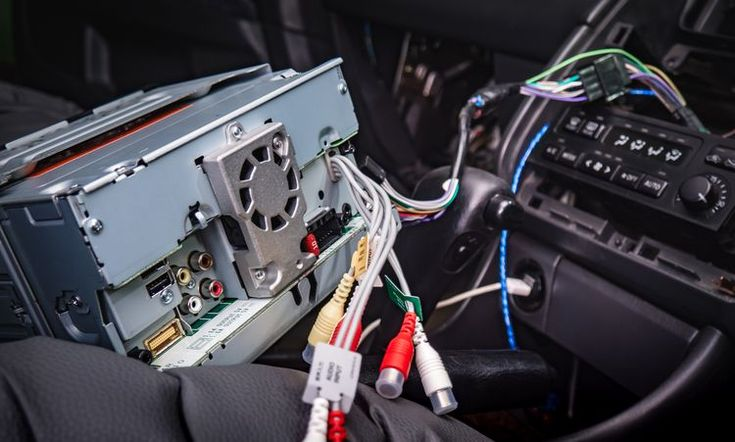
A matched harness and CAN bus decoder connect to the factory electrical interface, avoiding any cutting of the original vehicle wiring.
Where these kits are used in practice
Typical project types for this product group include aftermarket car head unit upgrades, centre console navigation retrofits, used-car interior electronics refurbishment, fleet audio system upgrades and dealership accessory fitting. The operating environment is defined by the vehicle rather than the workshop: a temperature range of -40°C to 85°C, constant road vibration, exposure to dust and humidity, an automotive electromagnetic environment and a 12 V DC electrical system. Functional requirements follow from that environment — secure and aesthetic mounting, a seamless electrical connection between OEM wiring and the new stereo, CAN bus protocol handling that preserves original vehicle controls, and preservation of the factory dashboard appearance.
Supplier-reported field data from two long-running supply relationships illustrates what repeat volume looks like in this category. An after-market solution integrator in China has worked with ZYX for seven years, taking a cumulative 19,000+ sets of dash frames, wiring harnesses and CAN bus decoders across various car brands, with a reported return rate below 0.8%. A car multimedia brand owner covering multiple vehicle models has worked with the same supplier for nine years, with a cumulative 550,000+ sets and a reported return rate below 0.7%, citing protocol compatibility, mass-production stability, new-model adaptation speed and lead-time control as the reasons for continuation. Both figures are supplier-reported and should be treated as such, but in a category where fitment and protocol account for most field failures, sustained multi-year volume is a compatibility signal, not a marketing one.
Market trend: installation hardware follows the head unit shift
Three data points frame the demand environment for fascia kits, harnesses and decoders.
- The global car audio head unit market was estimated at USD 15.44 billion in 2024 (Market Research Future).
- The car aftermarket audio system market is projected to grow at a CAGR of 12.18%, driven by DIY customers and online plug-and-play kits (Mordor Intelligence).
- Asia Pacific dominated the global car audio market with a 54.21% share in 2025 (Fortune Business Insights).
The second point is the one most directly relevant to installation hardware. If part of the growth in aftermarket audio comes from DIY buyers purchasing plug-and-play kits online, then the buying decision moves closer to the physical interface: the buyer is choosing a kit for a specific vehicle, not a head unit for a generic socket. That shift increases the value of a documented vehicle application database and reduces tolerance for kits that require cutting or modification.
A regulatory trend runs in parallel. In the European Union, electronic subassemblies integrated into road vehicles must comply with E-Marking under ECE R10 for EMC testing — rather than relying on CE marking alone — where they affect vehicle safety functions. For suppliers and importers of retrofit electronics, this raises the documentation burden of European distribution and makes compliance status a sourcing criterion rather than an afterthought. ZYX states that its full kit complies with EU RoHS 2 and REACH regulations, with hazardous substance content controlled across materials and components.
Plug-and-play model-specific kits versus traditional cut-wire solutions
The two approaches are not interchangeable, and the differences are measurable rather than stylistic.
| Comparison dimension | Model-specific plug-and-play kit | Traditional cut-wire universal solution |
|---|---|---|
| Original vehicle wiring | Uses the factory interface; no cutting or modification required | Requires cutting and splicing the original harness |
| Fitment precision | Moulded to original dashboard data, tolerance ≤0.2 mm | Universal fit; lower dimensional accuracy |
| CAN protocol handling | Pre-programmed, vehicle-specific decoder firmware | Generic decoder or manual adaptation |
| Risk of dashboard fault codes | Reduced when the decoder matches model, year and trim | Higher incidence of warning lights and lost steering wheel controls |
| Reversibility | Installation can be reversed; original parts remain intact | Alterations to the original harness are permanent |
| Upfront component cost | Higher, reflecting tooling and vehicle-specific firmware | Lower |
| Typical scenario | Premium vehicle upgrades, fleet batch modification, dealership pre-delivery fitting | Low-budget simple retrofits of older economy vehicles |
The plug-and-play route is the stronger choice when installation damage, fit precision and long-term reliability carry weight. It is not, however, the cheaper route on paper, and honest comparison requires saying so: universal cut-wire solutions retain an upfront cost advantage and remain a workable option for older, low-value vehicles where a perfect dashboard finish is not the objective and where a non-CAN electrical architecture keeps the protocol problem small.
Boundary conditions: where a model-specific kit does not apply
A vehicle-specific kit is precisely that, and its advantages come with defined limits that buyers should plan around rather than discover later.
- The fascia does not transfer between vehicles. A frame engineered for one dashboard application will not fit another model, model year or trim, so stock planning must be application-based rather than generic.
- Harness fitment is architecture-dependent. The ZYX-02 wiring harness is designed for non-CAN bus vehicle models and works with most aftermarket car stereos; on CAN-equipped vehicles the decoder becomes a necessary part of the set.
- Compatibility varies inside one nameplate. Model year, equipment level, original radio and audio system can each change the required decoder or connector, so a single model name is not sufficient for ordering.
- Screen size coverage is finite. Compatible screen sizes are 7 in, 9 in, 10.1 in and 12.3 in; a head unit outside the supported configurations may require a different frame or a custom arrangement.
- Custom configurations take longer. Stock items carry a lead time of 3 to 7 days and a minimum order quantity of 1 unit, while custom OEM or ODM items are quoted at 15 to 25 days with a minimum of 100 units.
- Plug-and-play removes wiring modification, not installation risk. The vehicle battery should be disconnected before work begins, connectors must be fully seated before final assembly, and dashboard trim should never be pried forcibly.
- Compliance is market-specific. European distribution of electronic subassemblies that affect vehicle safety functions involves E-Marking under ECE R10, in addition to environmental requirements such as RoHS 2 and REACH.
On cost specifically, this reference deliberately avoids quoting price levels, because pricing in this category depends on tooling, order volume, configuration count and compliance documentation rather than on material alone. The useful procurement question is not which kit is cheapest per unit, but which kit can be specified once, verified against the vehicle, and reordered without a compatibility investigation.
Future outlook
Two directions appear consistent across the category. The first is deepening vehicle coverage. As new models reach markets and as existing nameplates accumulate trim variations, the value of a fascia and decoder range lies in the breadth and accuracy of its vehicle application database, maintained as an ongoing development function rather than a one-time catalogue. ZYX states that it continues to expand this database and to develop new fascia kits, wiring harnesses and CANBUS solutions alongside it.
The second is the divergence between universal and model-specific economics. Universal hardware keeps its cost advantage in the low end of the market, while model-specific, plug-and-play hardware absorbs more engineering per SKU and therefore depends on order volume and reuse across a vehicle family. For importers and distributors, the practical implication is portfolio design: stock depth on high-turnover vehicle applications, and a validated sampling process for new applications before volume commitment.
Frequently asked questions
What is a vehicle-specific Android car stereo fascia kit, and how does it differ from a universal dash kit?
A vehicle-specific fascia kit is a dashboard interface moulded from the original vehicle dashboard dimensions so that an aftermarket head unit mounts into the factory opening with the mounting points and surface geometry of that specific vehicle application. A universal dash kit uses a generic opening and adjustable mounting, which lowers tooling cost but reduces dimensional accuracy. In practice the difference shows up as fit tolerance, dashboard appearance and the probability that the finished centre console looks factory-original.
Which specifications should be confirmed before ordering a fascia kit and wiring harness?
For the fascia, confirm material and thickness, dimensional tolerance, supported screen sizes and mounting standard. Documented values for one model-specific range are ABS plastic, 2.5 mm to 3.0 mm thickness, dimensional tolerance of ≤0.2 mm, screen compatibility with 7 in, 9 in, 10.1 in and 12.3 in units, and Double-DIN or model-specific custom mounting. For the harness, confirm connector configuration, conductor specification, colour coding standard, rated voltage and current, and built-in protection features — for example an OEM vehicle-side plug plus ISO 16-pin head unit connector, AWG 20-22 tinned oxygen-free copper conductors, ANSI/CTA-2015-B colour coding, a 12 V DC 10 A rating, and reverse polarity and short-circuit protection.
How does a CAN bus decoder work, and which vehicles require one?
A CAN bus decoder is an automotive electronic component that enables signal communication between an aftermarket head unit and the vehicle original CAN bus system. It parses steering wheel control signals, vehicle status data and dashboard prompts from the original bus, converts them into a format compatible with the new head unit, and forwards head unit control instructions back to the vehicle network. It is required on vehicles equipped with CAN communication where the owner expects to retain original steering wheel controls, vehicle information display and chime functions. Non-CAN bus vehicles typically require only a fascia kit and a matching wiring harness.
Why can dashboard fault codes or unresponsive steering wheel controls appear after installation?
The usual causes are an incompatible CAN decoder protocol, a loose CAN bus interface connection, or decoder firmware that does not match the exact vehicle model year and trim. Resolution follows a sequence: confirm the decoder is the model-specific version for the vehicle, re-seat the CAN bus interface, update the decoder to the matching firmware version, clear historical fault codes and retest. Selecting a pre-programmed, model-specific decoder and confirming vehicle configuration before ordering reduces the probability of this issue occurring at all.
Can an aftermarket head unit installation damage the original vehicle wiring?
Damage risk is associated with method rather than with the upgrade itself. Cut-wire universal harnesses, reversed polarity and incorrect pin assignment are the typical causes of short circuits, head unit failure or damage to the original electrical system. A plug-and-play, model-specific harness with reverse polarity and short-circuit protection, installed with the battery disconnected and with circuit continuity verified before power-on, avoids cutting or altering the original wiring. Retaining the original parts also means the installation can be reversed.
Which compliance requirements apply when exporting fascia kits and installation hardware to the European Union?
Installation hardware for car stereos falls under HS Code 8708.99 for vehicle parts and accessories not elsewhere specified. On the regulatory side, electronic subassemblies integrated into road vehicles in the EU must comply with E-Marking under ECE R10 for electromagnetic compatibility where they affect vehicle safety functions, rather than relying on CE marking alone. Environmental compliance such as RoHS 2 and REACH also applies to materials and components. ZYX states that its full kit complies with EU RoHS 2 and REACH regulations, with hazardous substance content controlled across materials and components.
What are the limitations of a plug-and-play retrofit kit?
The main limitation is specificity. A model-specific fascia, harness and decoder set is engineered for a defined vehicle application and cannot be transferred to a different model or trim, which increases the number of SKUs a distributor must hold. Supported screen sizes are limited to the configurations the frame was designed for. Decoder compatibility is sensitive to model year and equipment level, so ordering requires accurate vehicle data rather than a model name. Custom configurations carry longer lead times and higher minimum order quantities than stock items, and plug-and-play installation still requires the battery to be disconnected and connectors to be fully seated.
ZYX publishes a company profile brochure covering its fascia kit, wiring harness and CANBUS decoder portfolio, vehicle application coverage and contact details, available for download at ZYX_AUTO_Company_Profile_Brochure.