
Verified Drum Motor Supply Scope: Inside the TM and DM Series
A drum motor integrates the electric motor, the gear reducer and the bearings inside a conveyor roller, so the roller itself becomes the drive. For a buyer, the useful measure of a supplier is therefore not a slogan but a set of documented model designations: the roller diameters, motor types, gear materials, belt speed bands, belt pull limits and protection classes that exist as orderable products.
This reference walks through the light-duty and hygienic drum motor ranges published by Tianjin Seaparks Machinery-Electronics Co., Ltd. (SEAPARKS), reading the TM and DM series as model-level specifications rather than marketing descriptions, and closes with the application evidence that shows where each range is used.
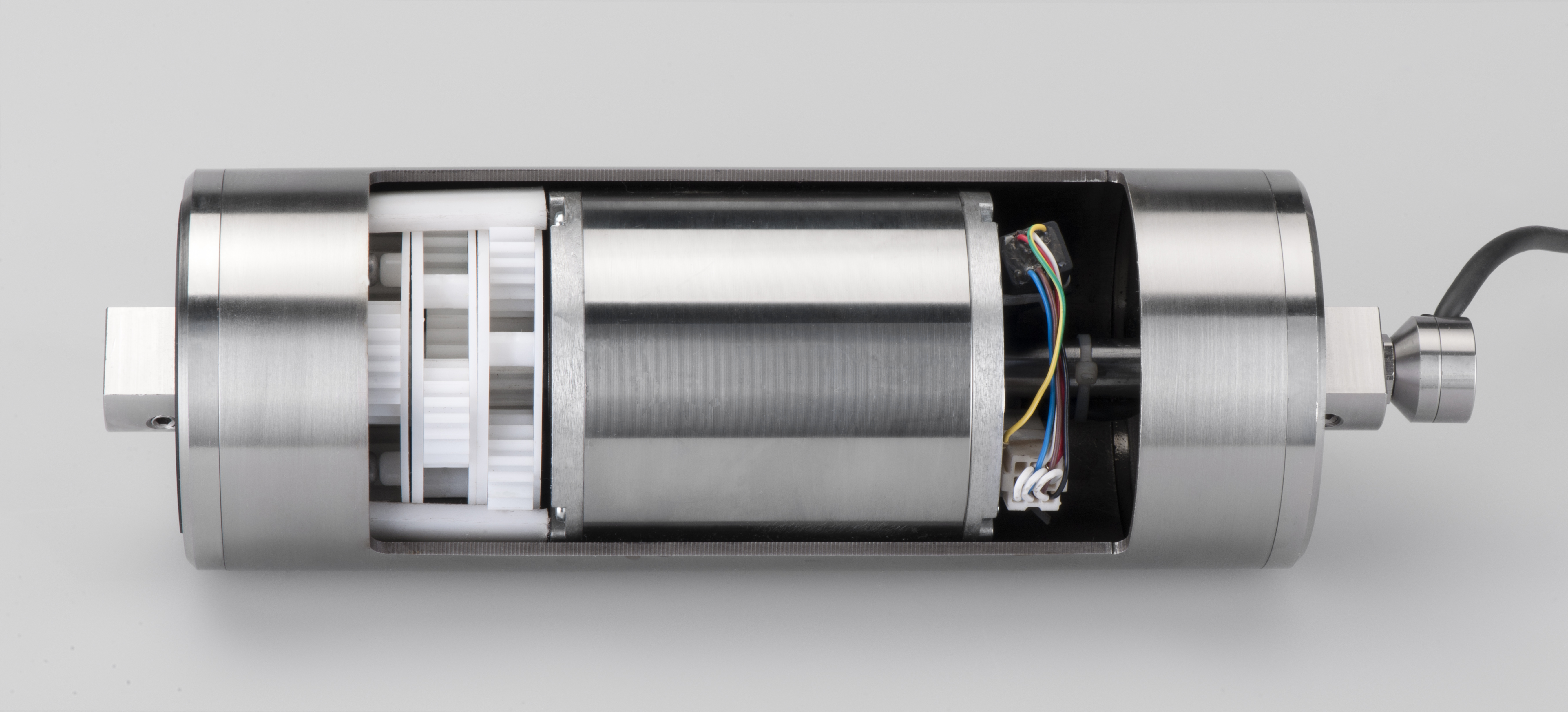
TM113M light-duty conveyor drum motor with a Ø113 mm roller, one of the light-duty models documented for security screening and packaging conveyors.
Why Model-Level Evidence Is the Practical Unit of Comparison
The global drum motor market was valued at approximately USD 2.13 billion in 2025 by Custom Market Insights, while other research houses place the same year at about USD 2.8 billion (Dataintelo) and roughly USD 2.0 billion (Market.us). The spread reflects different definitions of which conveyor components are counted rather than disagreement about direction. Growth forecasts diverge in the same way, from 4.06% (Maximize Market Research) to 7.3% (DataHorizzon Research), depending on the forecast window and how much weight each house gives to industrial automation adoption. What the estimates agree on is a category expanding with logistics automation and food processing demand.
That growth has produced a crowded catalogue landscape. Suppliers describe "high efficiency" or "hygienic design" in similar language, but only some publish the parameters that let an engineer confirm fit before a sample build: minimum roller width, nominal belt speed band, maximum belt pull, gear material and ingress protection class. A model designation is the anchor. Either it maps to a stable, checkable parameter set, or the buyer is left comparing adjectives.
The Manufacturing Base Behind the TM and DM Series
SEAPARKS (Tianjin Seaparks Machinery-Electronics Co., Ltd.) is a Tianjin-based manufacturer, established in 2002, that designs and produces motorized conveyor drums. The manufacturing facility covers 50,000 square meters and is equipped with nearly 200 high-end machine tools and more than 20 automatic feeding production lines, supporting an annual production capacity of 380,000 units. The company employs approximately 360 staff, including an R&D team of 40 engineers, and its drum motors are in operation in more than 50 countries and regions, with markets including China, Singapore, Southeast Asia, India, Australia, the Middle East and Africa, CEE and the Nordics, Western Europe, DACH and Italy, the USA, LATAM, Russia and the CIS. Published certifications include ISO 9001, ISO 14001, ISO 45001, RoHS 2.0, UL and CE.
Prefixes do not imply a single motor technology
One detail worth verifying rather than assuming: in this range, the model prefix does not determine motor type. The light-duty line includes TM80M, documented as a single-phase asynchronous unit, and TM113M, documented as a DC synchronous unit. In the hygienic line, the DM models are synchronous designs — DM80F as a DC synchronous unit and DM113F, DM138F, DM165F and DM216F as three-phase synchronous units — while TM80F, TM113F, TM138F, TM165F and TM216F are three-phase asynchronous. Buyers comparing suppliers should read the individual data sheet rather than infer motor technology from the naming convention.
The Light-Duty Envelope: TM80M, TM113M, TM80A and TM113A
The light-duty line is specified with IP66/IP67/IP69 protection and housings in carbon steel or 304 stainless steel. It is the range documented for security screening conveyors, airport baggage handling systems, packaging conveyors, belt scale conveyors and general belt conveyors.
| Model | Roller Ø / min. width | Rated power | Rated torque | Max. belt pull | Belt speed | Gear / protection |
|---|---|---|---|---|---|---|
| TM80M | Ø80 mm / 260 mm | 0.034–0.11 kW | 2.71–25.9 Nm | 630 N | 0.05–0.85 m/s | Polymer / IP66-IP67-IP69 |
| TM80A | Ø80 mm / 330 mm | 0.04–0.12 kW | 2.96–28.91 Nm | 705 N | 0.08–1.02 m/s | Alloy steel / IP66-IP67-IP69 |
| TM113M | Ø113 mm / 320 mm | 0.09–0.12 kW | 3.49–21.89 Nm | 534 N | 0.16–1.03 m/s | Polymer / IP66-IP67-IP69 |
| TM113A | Ø113 mm / 335 mm | 0.12–0.23 kW | 10.34–79.67 Nm | 1410 N | 0.08–0.71 m/s | Polymer / IP66-IP67-IP69 |
Documented light-duty models (single-phase and three-phase configurations) with IP66/IP67/IP69 protection and carbon steel or 304 stainless steel housings.
The smallest documented envelope in this set is TM80M: a Ø80 mm roller with a minimum roller width of 260 mm, the narrowest figure in the light-duty range. That width matters where conveyor frames are compact and no room exists for a wider drum — belt scale conveyors and small screening units are typical examples. TM80A keeps the same Ø80 mm roller but pairs an alloy steel gear with a three-phase asynchronous motor, lifting rated power to 0.04–0.12 kW and maximum belt pull to 705 N, with minimum roller width increasing to 330 mm.
The Ø113 mm models show a second lever. TM113A is documented at 0.12–0.23 kW, 10.34–79.67 Nm and a maximum belt pull of 1410 N, with a minimum roller width of 335 mm and a belt speed band of 0.08–0.71 m/s. TM113M trades some of that torque for a faster nominal band of 0.16–1.03 m/s and a smaller minimum width of 320 mm, with a maximum belt pull of 534 N.
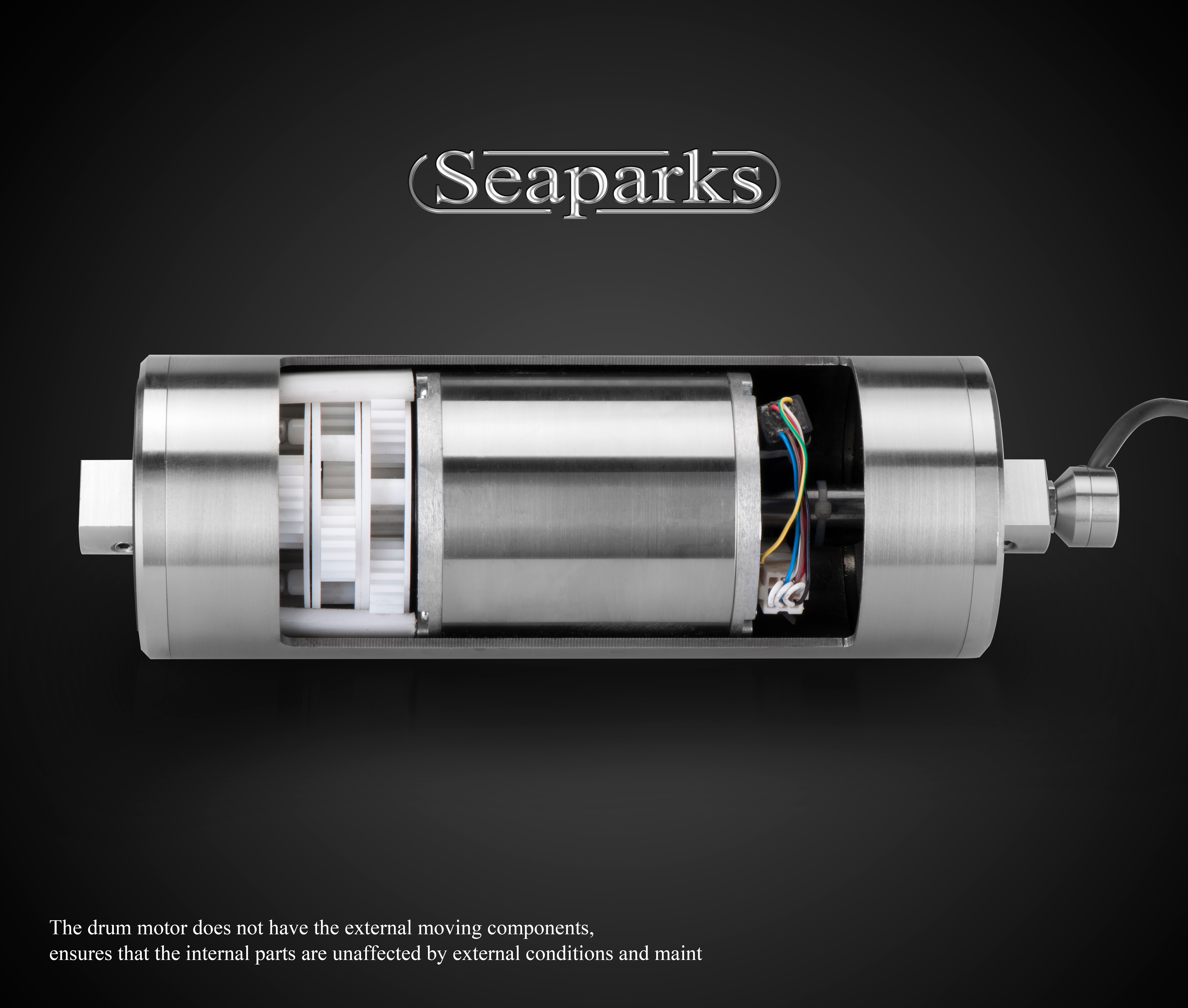
TM80M cross-section: motor, polymer gearing and bearings are contained inside the Ø80 mm roller, which is why minimum roller width and gear material become procurement variables.
Where a project engineer has to make a judgement call, belt pull usually decides before power does. A packaging conveyor that needs more pull than a Ø80 mm drum can deliver moves up to a Ø113 mm model — 1410 N on TM113A — before any change of series or protection class is required.
The Hygienic Envelope: DM80F through DM216F
The hygienic DM series is specified with IP69K protection, 304 stainless steel housings and 316 stainless steel available as an option, and alloy steel gears throughout. IP69K is the highest ingress protection rating defined under IEC 60529 and is the rating required for hygienic drum motors in food processing, where equipment must withstand high-pressure washdown up to 1450 psi at temperatures around 80°C.
| Model | Roller Ø / min. width | Rated power | Rated torque | Max. belt pull | Belt speed | Housing / protection |
|---|---|---|---|---|---|---|
| DM80F | Ø80 mm / 320 mm | 0.09–0.12 kW | 3.49–21.89 Nm | 534 N | 0.16–1.03 m/s | 304 SS (316 optional) / IP69K |
| DM113F | Ø113 mm / 370 mm | 0.12–0.55 kW | 9.94–115.99 Nm | 2053 N | 0.14–0.68 m/s | 304 SS (316 optional) / IP69K |
| DM138F | Ø138 mm / 400 mm | 0.75–1.5 kW | 27.69–273.58 Nm | 3965 N | 0.37–1.83 m/s | 304 SS (316 optional) / IP69K |
| DM165F | Ø165 mm / 470 mm | 1.1–3 kW | 42.49–431.44 Nm | 5229 N | 0.42–2.09 m/s | 304 SS (316 optional) / IP69K |
| DM216F | Ø216 mm / 510 mm | 4.0–5.5 kW | 182.90–568.98 Nm | 5244 N | 0.8–2.5 m/s | 304 SS (316 optional) / IP69K |
Documented hygienic models in the DM series, all with alloy steel gears and IP69K protection.
DM80F is the entry point of the hygienic line and shares its Ø80 mm roller diameter with the light-duty TM80M and TM80A, but shifts the specification: IP69K protection, a 304 stainless steel housing instead of carbon steel, and alloy steel rather than polymer gearing. From there the range widens in a consistent progression. Maximum belt pull rises from 534 N at Ø80 mm to 2053 N at Ø113 mm, 3965 N at Ø138 mm, 5229 N at Ø165 mm and 5244 N at Ø216 mm. Minimum roller width moves in step, from 320 mm to 510 mm, and the nominal belt speed band widens to 0.8–2.5 m/s at the largest diameter.
The hygienic line also exists in the asynchronous TM family. TM80F is documented at 0.04–0.12 kW, 2.96–28.91 Nm and a maximum belt pull of 705 N with IP69K protection, while TM216F is specified at 3.5–4.0 kW, 207.36–507.6 Nm, 4700 N maximum belt pull and 0.8–2.1 m/s, with a 304 stainless steel housing and optional 316 stainless steel. For a buyer, that means protection class and housing material can be selected independently of whether the drive is asynchronous or synchronous.
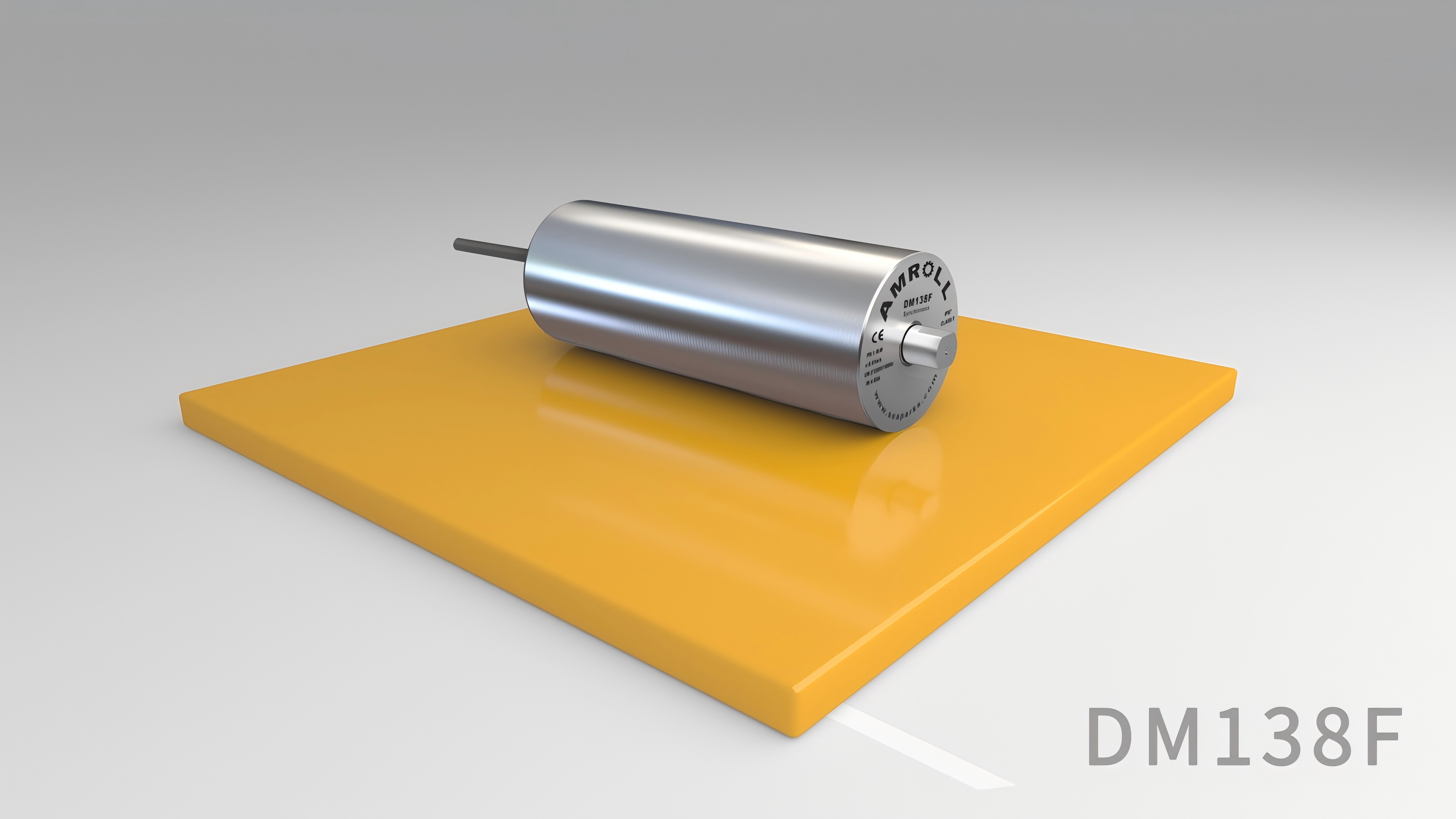
DM138F product diagram: a Ø138 mm hygienic drum motor rated 0.75–1.5 kW with 3965 N maximum belt pull and IP69K protection.
Application Evidence: Where These Ranges Are Documented
Airport baggage handling and security screening
The clearest documented application is airport civil aviation and security inspection equipment, specifically airport security check X-ray machine conveying systems and baggage handling systems. The working conditions listed for this scenario are high-precision positioning, stable low-speed operation and anti-interference capability, in continuous 24/7 operation with frequent start-stop capability. Special requirements include high precision speed control, low vibration, anti-electromagnetic interference and flame retardant properties. Typical supporting equipment includes X-ray security scanners, baggage trays, metal detectors and conveyor guide rails — a set of requirements that explains why light-duty models with tight speed bands dominate here. The models documented against this scenario include TM80M, TM80A, TM113M, TM113A, DM80A, DM113A, DM138A and TM138A.
Packaging and general conveying
Packaging conveyors, belt scale conveyors and general belt conveyors are the second documented group, and they align with the light-duty range as a whole. These are the applications where the Ø80 mm envelope earns its place: narrow frames, frequent starts, and a duty profile that does not justify the cost of a fully hygienic, IP69K-rated stainless drum.
Food processing, cold chain and pharmaceutical lines
Food processing and cold chain logistics is described as a high humidity and corrosive environment with frequent cleaning cycles, where the special requirements are IP69K high-pressure washdown protection, food-grade 304 stainless steel, corrosion resistance and easy cleaning. Supporting equipment typically includes a stainless steel conveyor frame, a food-grade conveyor belt and a cleaning system. Documented uses span meat processing conveyors, food processing conveyors, packaging conveyors, belt sorting conveyors, assembly lines and pharmaceutical conveyors. This is where the 316 stainless steel option becomes relevant: the base specification is 304, and the upgrade is a deliberate choice for more aggressive washdown chemistry.
Agricultural and feed handling
Feed production lines and agricultural product conveying systems are documented as dusty, continuous-duty environments with frequent material handling cycles, covering raw material conveying, product transfer, packaging and automated sorting, with roller conveyors, belt conveyors, automated sorting equipment, weighing machines and packaging machines as matched equipment.
Category Signals: Market, Standards and Regional Shift
Three signals help frame sourcing decisions in this category. The first is regional. Dataintelo projects Asia Pacific to hold a 38.2% revenue share by 2025, driven by industrialization and e-commerce growth in China and India — a shift that increases the relevance of suppliers with manufacturing capacity inside the region. The second is technological mix: in the same analysis, the AC motor segment holds a dominant 52.3% revenue share in 2025, with Interroll named among the leading players. In other words, asynchronous designs remain the volume base of the market even as synchronous and hygienic models expand the higher-specification end of the catalogue.
The third signal is regulatory. Drum motors sold into the European market must comply with the Low Voltage Directive 2014/35/EU and bear the CE mark, typically referencing safety standards such as EN 62841 or IEC 60034-1. Hygiene rating follows a separate track through IEC 60529 and IP69K. On efficiency, suppliers including Rulmeca publish figures of up to 82–83% overall efficiency for energy-efficient drum motors compared with traditional geared motors — a number that is best verified against the specific duty point rather than applied as a general rule.
Drum Motors Versus Conventional Drives: What Changes, and Where the Limits Are
A conventional drive places the motor and reducer outside the conveyor frame and transmits power to the roller through a chain, belt or coupling, which means externally moving parts and, in most installations, guarding. A drum motor removes those external components by placing the drive inside the roller itself. The trade-off is that the roller is no longer a passive idler — it becomes the drive, and its dimensions become engineering decisions.
Four boundaries are worth stating plainly, because they determine whether a drum motor is the right answer at all:
- The speed and torque envelope is fixed per model. Each designation carries a defined power, torque and belt speed band. A Ø80 mm light-duty drum documented at 630 N maximum belt pull cannot simply be re-rated for a heavier belt; the answer is a larger diameter, such as TM113A at 1410 N or DM138F at 3965 N.
- Diameter is a design-stage decision. Gearing sits inside the roller, so torque capacity follows the drum diameter. A late increase in required belt pull generally means changing drum dimensions in the frame, not swapping a gearbox.
- The service model differs. Because the drive is inside the roller, inspection or replacement involves removing the drum from the frame. Access planning belongs at the design stage rather than after commissioning.
- Sealed protection brings thermal and chemical choices. IP69K and IP66/IP67/IP69 designs dissipate heat through the housing, so continuous operation at the top of a torque band deserves a duty-cycle check. Washdown chemistry should be matched to housing grade: 304 stainless steel is standard, 316 stainless steel is optional.
There is also a hard ceiling inside this documented range: the highest maximum belt pull specified is 5244 N on DM216F. Projects requiring more belt tension, or conveying principles other than belt conveyors, fall outside this catalogue and should be evaluated against different drive architectures.
What to Watch Next
Two forces look likely to shape the next buying cycle. The first is hygiene documentation. As IP69K becomes a baseline expectation in food and pharmaceutical procurement, the differentiator shifts from the rating itself to how clearly a supplier documents housing grade, gear material, minimum roller width and belt pull at model level — the parameters that determine whether a replacement drum fits an existing frame. The second is regional supply. With Asia Pacific projected to hold a 38.2% revenue share and market size estimates varying by up to USD 0.8 billion depending on methodology, buyers should treat headline market figures as directional and concentrate instead on verifiable model data: what exists, at which diameter, at what speed and pull, and under which protection class.
FAQ
What distinguishes a light-duty drum motor from a hygienic drum motor in this range?
Light-duty models such as TM80M, TM113M, TM80A and TM113A are specified with IP66/IP67/IP69 protection and housings in carbon steel or 304 stainless steel, with polymer or alloy steel gears depending on the model. They are documented for security screening conveyors, airport baggage handling systems, packaging conveyors, belt scale conveyors and general belt conveyors. Hygienic models such as DM80F, DM113F, DM138F, DM165F and DM216F are specified with IP69K protection, 304 stainless steel housings with optional 316 stainless steel, and alloy steel gears, and are documented for food processing, meat processing, packaging, belt sorting, assembly lines, agricultural product belt conveyors and pharmaceutical applications.
Which roller diameters and belt pull limits does the hygienic DM series cover?
The hygienic DM series spans five documented diameters. DM80F uses a Ø80 mm roller with 320 mm minimum roller width and 534 N maximum belt pull; DM113F uses Ø113 mm with 370 mm and 2053 N; DM138F uses Ø138 mm with 400 mm and 3965 N; DM165F uses Ø165 mm with 470 mm and 5229 N; and DM216F uses Ø216 mm with 510 mm and 5244 N. Rated power rises from 0.09–0.12 kW at Ø80 mm to 4.0–5.5 kW at Ø216 mm, and the nominal belt speed band widens to 0.8–2.5 m/s at the largest diameter.
What does IP69K actually mean for a drum motor?
IP69K is the highest ingress protection rating defined under IEC 60529, and it is the rating required for hygienic drum motors in food processing because the equipment must withstand high-pressure washdown, up to 1450 psi, at temperatures around 80°C. In this range, IP69K applies to the DM hygienic models DM80F through DM216F as well as to the hygienic TM models TM80F, TM113F, TM138F, TM165F and TM216F. Light-duty models carry IP66/IP67/IP69 instead, which suits environments that are damp or dusty but not subject to routine high-pressure washdown.
Which models are documented for airport baggage handling and X-ray security screening conveyors?
Light-duty models documented against airport and security inspection applications include TM80M, TM80A, TM113M, TM113A, DM80A, DM113A, DM138A and TM138A. The documented working conditions are high-precision positioning, stable low-speed operation and anti-interference capability, in continuous 24/7 operation with frequent start-stop capability. Special requirements include high precision speed control, low vibration, anti-electromagnetic interference and flame retardant properties, and the matched equipment set typically includes X-ray security scanners, baggage trays, metal detectors and conveyor guide rails.
How should a buyer choose between Ø80 mm and Ø113 mm light-duty models?
The comparison is usually decided by three published figures. TM80M offers the narrowest minimum roller width at 260 mm and a maximum belt pull of 630 N, while TM80A keeps the Ø80 mm diameter with alloy steel gearing and raises maximum belt pull to 705 N at a 330 mm minimum width. The Ø113 mm models step up further: TM113A is rated 0.12–0.23 kW with 10.34–79.67 Nm and 1410 N maximum belt pull, and TM113M offers a faster belt speed band of 0.16–1.03 m/s at 534 N maximum belt pull. A project that fits within the Ø80 mm envelope should stay there; once required belt pull or speed exceeds what is documented, the next diameter is the correct answer.
What compliance documentation should be checked when specifying drum motors for export?
For the European market, drum motors must comply with the Low Voltage Directive 2014/35/EU and bear the CE mark, often referencing safety standards such as EN 62841 or IEC 60034-1. Hygiene-related protection is defined separately through IEC 60529 and the IP69K rating. At supplier level, the certifications published by SEAPARKS include ISO 9001, ISO 14001, ISO 45001, RoHS 2.0, UL and CE, which gives buyers a starting point for document review before model-level specifications are confirmed.
Reference material
A product and corporation brochure covering the drum motor ranges described above is available for download: Product & Corporation brochure (PDF).