
Verifying 6063 Aluminum Shielding in Custom RFID Wallets
Verifying 6063 Aluminum Shielding in Custom RFID Wallets

Production area of a wallet and card holder factory supplying custom RFID programs.
An RFID-blocking claim in a hybrid leather-metal wallet depends on one component doing its job without interruption: the aluminium chamber must enclose the card stack in a continuous conductive shell, and every slot, hinge, stitch line or leather window that crosses that shell is a place where the claim weakens. Buyers in the evaluation-to-execution phase are therefore not really asking whether a supplier offers RFID wallets. They are asking a narrower question: what evidence links the specified alloy — 6063 aluminium, for example — to the shielding behaviour of the assembled wallet, and how is that evidence carried into the fifth repeat order?
This reference sets out that verification path for custom wallet programs: how the shielding mechanism works, where hybrid construction interrupts it, which documents prove which claim, and what belongs in a specification so that a sample which blocks card reads in one batch still does so later. Company facts refer to Guangzhou Thumbs-Up Technology Co., Ltd. (THUMBS-UP); external market figures are attributed to the research publishers named beside them.
What continuous shielding requires in a hybrid leather-metal wallet
Contactless cards operating at 13.56 MHz carry no battery. They draw operating power from the reader's electromagnetic field and respond only while that field reaches the chip. A conductive metal shell around the card acts as a Faraday cage: it reflects and absorbs the interrogation field and prevents magnetic flux from reaching the card, so the chip receives no operating voltage and cannot answer. The blocking effect is a property of an unbroken conductive enclosure — not of the leather, the stitching, the logo plate or the packaging copy.
“Continuous” has two meanings in a purchase order, and buyers usually verify only the first. Geometrically, continuity means every face of a stowed card is covered by conductive material in the closed position. In production terms, continuity means the same geometry, alloy and wall thickness in every unit and every repeat batch — the part of the claim that a single approved sample cannot prove by itself.
Where hybrid construction interrupts the enclosure
A hybrid wallet pairs a rigid aluminium card chamber with a leather exterior. That pairing is what gives the category its branding area, hand-feel and gift appeal, and it is also where continuity is most often compromised. The interruption points worth inspecting are the ejection or thumb slot through which cards are pushed out; any hinge or living-hinge line where the chamber opens; stitching, rivets or logo hardware that perforates the metal; branding cut-outs or ID windows in the leather that sit over the chamber; and the boundary between the metal chamber and leather card pockets, because a card carried in a leather pocket sits outside the enclosure regardless of what the product page says.
A field check is straightforward and worth completing before a specification is frozen. Load the wallet as the end user would, close it, and present a contactless card to a reader at close range. If the card reads while stowed, the enclosure is not continuous for that card position and that reader. The check is indicative only: it does not quantify attenuation, does not cover every reader power level, and does not replace a laboratory measurement on the assembled product. What it does is expose design gaps early, before tooling is committed.
Capacity claims and shielding claims must describe the same positions. A wallet marketed as holding eight cards while shielding four is making a qualified statement, and the qualification should appear wherever the claim appears — on the specification sheet, the retail packaging and the marketplace listing alike.
The 6063 question: turning an alloy designation into a documented material
When a brief specifies 6063 aluminium, the designation is a starting point, not a specification. Alloy series and temper influence how a chamber machines, anodises and holds shape, and a designation on its own says nothing about wall thickness, flatness, corner radii or the tolerance to which the part is produced. Those are drawing-level items, and they belong in the technical pack before sampling rather than in the purchase order afterwards.
A verifiable chamber specification typically contains five elements: the alloy designation and temper; nominal wall thickness with tolerance; the dimensional tolerance of the chamber cavity and its fit to the card stack; the surface treatment; and the inspection method used to confirm each of the first four. Thumbs-Up's published procurement guidance for pop-up aluminium chambers uses a CNC tolerance of ±0.05 mm as the control value and identifies tolerances beyond ±0.3 mm on uncalibrated chambers as a trigger for trigger jamming, card slippage when the wallet is inverted, and premature edge-coating cracks. The designated alloy may differ between programs; the discipline of writing the tolerance down and measuring against it does not.
Two rules keep the record honest. First, a material change is a specification change: substituting alloy, temper or wall thickness should trigger re-approval of the sample and, where shielding is claimed, a re-test of the assembled unit. Second, the material record must belong to the delivered lot — a mill certificate or test report identifying the alloy and temper of the batch actually shipped, not a document carried over from an earlier project. A buyer who receives only a photograph of a certificate has received an image, not a traceable record.
It is equally worth being precise about what existing documentation covers. The aluminium-profile test report in this supplier's file (SGS report CANPC23000406902, dated 28 February 2023, issued against Directive (EU) 2015/863 amending Annex II to EU RoHS Directive 2011/65/EU) addresses restricted substances in a tested aluminium profile sample; it does not measure attenuation. A buyer specifying continuous 6063 shielding should therefore request an attenuation test on the assembled wallet in addition to the material-compliance file, and should confirm the model, configuration and card positions that the test covers.
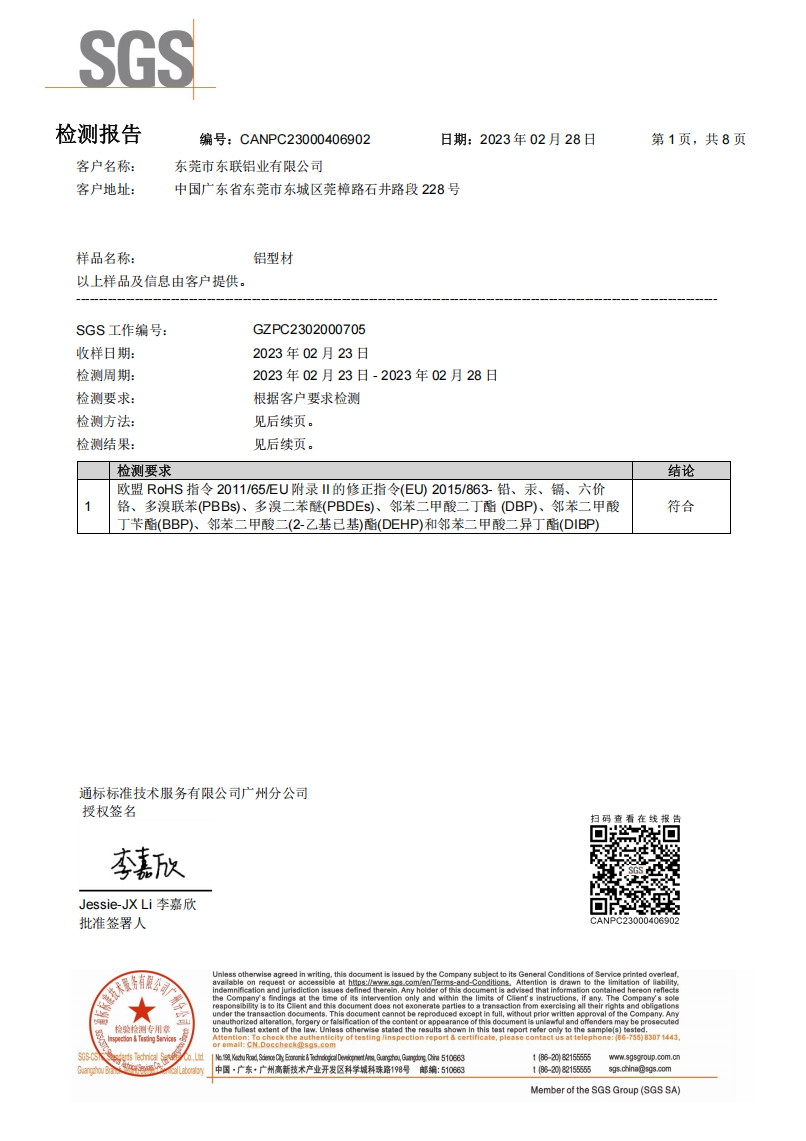
SGS report CANPC23000406902 (28 February 2023) records restricted-substance conformity of an aluminium profile sample under Directive (EU) 2015/863 amending Annex II to EU RoHS Directive 2011/65/EU — a material-compliance record, not an attenuation measurement.
Reading an evidence pack: what each document actually proves
Compliance documents are routinely bundled as “certifications”, which blurs the fact that they answer different questions. The table below separates the evidence types in this program by what they establish and what they leave open.
| Document | What it establishes | What it does not establish |
|---|---|---|
| RoHS report on an aluminium profile (SGS CANPC23000406902) | Restricted-substance conformity of the tested profile sample | Shielding performance; equivalence of other alloys, thicknesses or assemblies |
| RoHS Certificate of Compliance (Microtest MTI250318016-0104C1C, 10 April 2025) | Compliance of the LORZOR-wallet-T model and its listed serial models | Attenuation, durability, or coverage of a different construction |
| REACH test report (ZTS23110906HRC, 15 November 2023) | Screening of 235 SVHC plus Resorcinol for sample mens wallet KH002 under Regulation (EC) No. 1907/2006 | Field performance; other models, materials or components |
| LWG Gold certificate (TAI103) | Tannery-level audit, Category C raw hide/skin to finished leather, LWG audit standard v7.2.4, valid 11 November 2024 to 11 November 2026 | The wallet factory's processes; anything shipped after the validity end date |
| EUIPO Community Design 015073944-0002 | Registered appearance protection, registered 24 September 2024 | Function, material or performance |
| Granted patent portfolio (approximately 100 patents) | Claimed structures and exterior designs, confirmable per product and territory | Measured performance or market outcome |
| Approved sample, AQL inspection report, functional test report | Batch conformity to the agreed specification | Whether the specification itself was adequate |
Two habits follow. Match the document to the claim being made, and check the holder, model or sample, market and validity date rather than the logo on the first page. The leather certificate in this supply chain illustrates the point: LWG Gold certificate TAI103 was issued to Taishan Wanli Leather Co., Ltd. under Category C — raw hide/skin to finished leather — audited against the LWG Leather Manufacturer Audit Standard Version 7.2.4, with a validity window from 11 November 2024 to 11 November 2026. It is a tannery-level audit, not a wallet-factory audit, and a shipment confirmed after that window requires the renewed record. Collecting documents is easy; verifying which claim each document supports is the step that protects a purchase order.
How Thumbs-Up supports verification in custom RFID programs
Guangzhou Thumbs-Up Technology Co., Ltd. (THUMBS-UP) is a Guangzhou-based wallet and card holder manufacturer founded in 2018, operating a 20,000 m² factory with 60 employees, a six-person development team and a stated monthly capacity of 150,000 units. Around 90% of output is exported, with the United States, Germany, the United Kingdom, Italy, Saudi Arabia, France, Canada and Spain among its markets. The portfolio covers leather wallets, pop-up card holders, aluminium card holders, smart wallets, magnetic phone wallets, travel wallets and gift sets, and the company states that it provides OEM and ODM production services for wallet products.
Development work spans product definition, design adaptation, structural engineering, sample development, tooling coordination, material selection, logo application, packaging customization and bulk production, with approved samples and agreed specifications used as the production reference across initial and repeat orders. On documentation, the company states that it holds product testing reports issued by SGS, TÜV and other independent testing organizations together with material certificates, and that it issues documentation according to the product, material, component and destination market — reviewing project-specific reports and certificates with the client during development and order confirmation. That is the right shape for an evidence process: the document set follows the configuration and the market rather than a fixed package.
The company also holds a portfolio of approximately 100 granted patents covering wallet and card holder structures and exterior designs, with applicable patents and territorial coverage confirmed per product and market on request — a design and structure record, which is a different asset from a performance test. Consumer-side experience comes from LORZOR, its own wallet brand, through which it sells full-grain leather, tactical, AirTag-ready, MagSafe-compatible, pop-up and trackable wallets directly to consumers and feeds product reviews and after-sales issues back into development. On delivery, the company reports 100 brand projects delivered, with a process running from product selection and material assessment through sample review, production follow-through and repeat supply, and it exhibits with the THUMBS-UP and LORZOR collections at HKTDC trade fairs including the Hong Kong Gifts & Premium Fair.
Holding the claim across repeat orders
The evaluation question is whether the wallet blocks reads. The execution question is whether batch five still does. Four controls carry the claim across orders: a signed approved sample that includes the metal chamber rather than only the leather; a specification revision rule that treats alloy, wall thickness and tolerance changes as re-approval triggers; batch inspection against defined criteria, with AQL inspection reports, QC checklists and functional test reports as the record; and material declarations per lot, so the compliance file matches what was shipped.
Investment staging belongs in the same conversation, because tooling is where trial programs usually absorb risk. A documented approach for a private-label RFID card holder starts with factory-verified internal chambers, a customized leather wrap, a blind-debossed logo and a bespoke gift box at around 200 pieces, then moves to a dedicated exterior CNC mold once re-orders exceed roughly 1,500 pieces per month. For reference, the company's stated minimum order quantity is 100 units, with prototyping typically taking 10–15 days and production lead times of 30–90 days depending on the project. Those figures describe scope rather than a promise: the mold route, sampling cycle and delivery window should be fixed in the project plan before deposit.
Application scenarios where the shielding claim is tested
Corporate gift and promotional programs are where a shielding claim travels furthest from the factory, because it usually appears in print on a gift box, an insert card or a corporate catalogue. Logo application in this category is a leather-wrap process: artwork supplied as vector AI or PDF with fonts converted to outlines and lines at least 0.3 mm, a CNC-machined brass mold at roughly 1.8 mm depth, 115 °C for vegetable-tanned leather and 145 °C for chrome-tanned leather, held for 2.5–3 seconds, with the caution that natural full-grain vegetable-tanned leather should not exceed 130 °C without foil. Because the branded surface is the leather rather than the chamber, the decoration choice does not by itself alter shielding — but perforations, hardware and cut-outs added for branding can, which is why they belong in drawing review rather than the decoration brief.
The company's own selection guidance splits the category by user. For urban commuters it recommends an ultra-slim aluminium pop-up card holder wrapped in Saffiano or Crazy Horse leather, holding six cards plus a cash strap, on the grounds of one-click card access, front-pocket carry and RFID shielding. For executive gifting it points to a full-grain vegetable-tanned bifold or passport card wallet presented in a foil-stamped gift box, where the criteria are construction, branding area for discreet debossing and gift presentation. The distinction matters for verification: the commuter product makes a functional claim that should be backed by an assembled-unit test, while the executive product's shielding claim depends on whether a metal chamber is actually present in that specific configuration.
Travel wallets and passport holders complicate the claim because cards migrate. A passport holder with a shielded card chamber and an unshielded boarding-pass slip is doing exactly what it was designed to do, but the shielded positions should be stated in the specification so retail copy stays accurate. Private-label and distributor programs add a second layer: the brand owner's name sits on the claim, so the evidence file — drawings, approved sample, batch inspection, material declarations and any attenuation test — should be transferred with the goods rather than retained only at the factory.
Construction options compared on evidence, not adjectives
Three constructions are usually on the table, and the public evidence reviewed for this article supports comparing them on verification burden rather than on performance ranking, because no comparable attenuation data for these constructions was available in that review.
A leather-only wallet has no conductive enclosure, so the shielding question does not arise and the verification file stays small; it suits programs where the claim is not needed. A rigid aluminium card holder presents fewer material transitions in the enclosing element, which makes continuity easier to inspect and to test, at the cost of branding surface and a different hand-feel. A hybrid leather-metal wallet combines the chamber with a leather wrap, delivers the largest branding area and the strongest gift presentation, and carries the heaviest verification burden: perforation control, a defined boundary between shielded and unshielded pockets, and mechanical parts — pop-up trigger, card retention, edge coating — that a leather-only product does not have. For pop-up chambers, the procurement guidance cited earlier also benchmarks a 100,000-cycle trigger fatigue certificate and four-layer edge coating inspected under −20 °C flex testing, which indicates the level of mechanical evidence this category expects.
Supply, cost and documentation context
Category context exists, though it should be read for what it is. Grand View Research estimates the global smart wallet market at USD 1.3 billion for 2026 and reports that RFID-blocking products held 44.2% of that category in 2025 — source-reported commercial research rather than primary production data. Separately, commercial research published in September 2026 attributes a 12–18% increase in leather wallet manufacturing costs to the shift toward sustainable production and regulatory compliance. Neither figure measures shielding performance; together they explain why documentation requests have moved from the margins to the purchase order.
Benchmarks also need scope checks. A published supplier benchmark places the typical OEM minimum order quantity at 1,000 units where custom tooling is involved, against the 100-unit stated MOQ in this program; the gap reflects what is being tooled rather than a like-for-like comparison, and should be confirmed project by project. Across the supplier pages reviewed for this article — including THE/STUDIO, BagsPlaza, Gstar Technology and Pellove — OEM, ODM, private-label, MagSafe and RFID options are all claimed. Capability claims are therefore common in this category, while the reviewed public evidence contained no RFID attenuation test reports and no magnetic-retention test data. That asymmetry is the practical argument for an evidence-led brief: the claim is standard, the proof is not.
Limitations and fit boundaries
Several limits should travel with this article. Material-compliance reports, however current, do not establish attenuation. Certificates are scoped: REACH test report ZTS23110906HRC covers 235 substances of very high concern plus Resorcinol for sample mens wallet KH002 under Regulation (EC) No. 1907/2006, and Microtest RoHS certificate MTI250318016-0104C1C covers the LORZOR-wallet-T model and listed serial models — neither extends automatically to a different construction. Design registrations such as EUIPO Community Design 015073944-0002, registered on 24 September 2024, and the granted patent portfolio protect appearance and structure, not performance. The tannery certificate discussed above is time-limited and tannery-level. And a field card-reader check is a screening tool rather than a measurement.
Fit matters as much as evidence. A hybrid leather-metal wallet is heavier and more mechanically complex than a leather-only wallet; if a program does not need shielding, the verification burden buys nothing. If shielding is required, the buyer should expect to specify alloy, temper, thickness, tolerance and test method, and to receive batch-level records rather than a document bundle.
Outlook
If RFID-blocking products continue to hold a large share of the smart wallet category — 44.2% in 2025 on the cited estimate — the competitive question shifts from whether a supplier offers the feature to how quickly it can evidence the feature for a named alloy, configuration and market. That points toward specification packs carrying alloy and tolerance data, approved samples with measurement records, assembled-unit attenuation testing and written change control as standard attachments to a purchase order. Programs that build those four elements now will spend less time re-qualifying suppliers when a distributor or a marketplace asks what proves the aluminium inside the wallet is what the specification says it is.
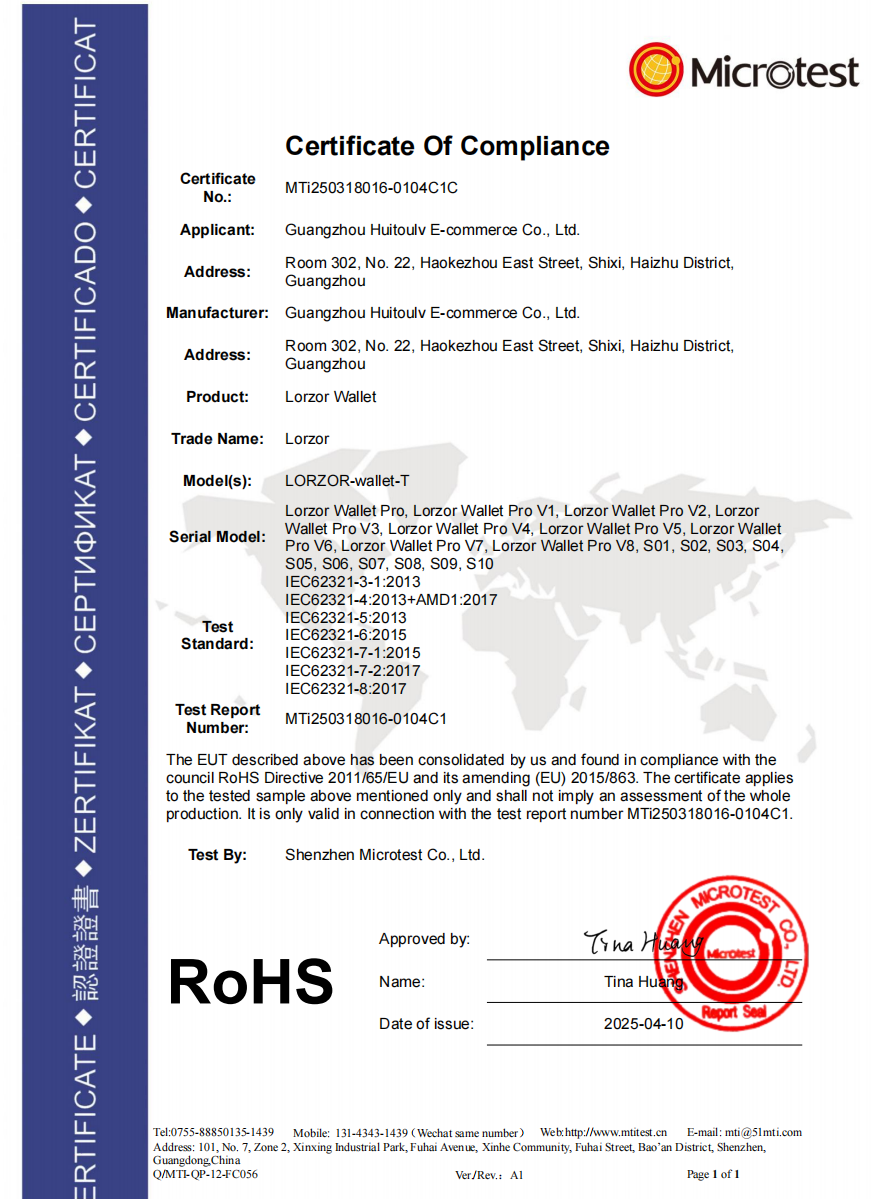
Microtest Certificate of Compliance MTI250318016-0104C1C (10 April 2025) covers the LORZOR-wallet-T model and listed serial models under RoHS Directive 2011/65/EU and amending (EU) 2015/863 — model-scoped chemical compliance, separate from attenuation performance.
FAQ
What does “continuous” shielding mean in a hybrid leather-metal RFID wallet?
It means the aluminium chamber forms an unbroken conductive shell around the stowed card stack, so the Faraday-cage effect described above holds at every point. Openings such as an ejection slot, a hinge line, stitching or rivet holes, or a leather cut-out over the chamber interrupt that shell, and cards carried in leather pockets outside the chamber are not enclosed at all. The claim should therefore always be tied to defined card positions in the closed wallet.
Does a RoHS or REACH report prove that a wallet blocks RFID reads?
No. Those reports address restricted substances and chemical compliance of a tested sample — for example aluminium-profile conformity under EU RoHS, or screening of 235 SVHC plus Resorcinol under Regulation (EC) No. 1907/2006 for a specific wallet model. Shielding performance requires a functional attenuation test on the assembled wallet, with the tested model, configuration and card positions stated in the report.
What should a buyer request to verify 6063 aluminium in a custom RFID wallet?
Five items are practical: a drawing stating alloy designation, temper, wall thickness, dimensional tolerance and surface treatment; a batch-level material record identifying the alloy and temper of the delivered lot; sample approval with measurement against that drawing; an attenuation test on the assembled unit where shielding is claimed; and written change notification if alloy, temper or thickness is substituted. A certificate photograph without model, lot and scope information does not satisfy this list.
Why do certificate holders and validity dates matter in wallet supply chains?
Because scope and time decide what a document can support. LWG Gold certificate TAI103 applies to Taishan Wanli Leather Co., Ltd. at tannery level under Category C and ran from 11 November 2024 to 11 November 2026, so a shipment confirmed after that date needs the renewed record. A tannery audit also says nothing about the wallet factory's own processes. Holders, categories, models and end dates belong on the verification checklist alongside the certificate itself.
How is shielding continuity maintained across repeat orders?
Through four controls: a signed approved sample that includes the metal chamber, a specification revision rule that triggers re-approval on material or tolerance change, batch inspection with AQL inspection reports and functional test reports, and material declarations per lot. Company-reported figures for context are a stated monthly capacity of 150,000 units and production lead times of 30–90 days, which set the planning window in which those checks must be scheduled.
Which mechanical checks matter on a pop-up aluminium chamber?
The documented failure modes in this category are trigger jamming, card slippage when the wallet is inverted, and premature edge-coating cracks, typically linked to uncalibrated chambers with tolerances beyond ±0.3 mm, low-density recycled pads, or omitted primer and bake cycles. The corresponding controls are CNC tolerance around ±0.05 mm, a 100,000-cycle trigger fatigue certificate, and multi-layer edge coating inspected under −20 °C flex testing.
Reference material: the 2026 Thumbs-Up wallet product catalogue is available for product and program context.
Have Questions or Need More Details?
Contact our team for a personalized quotation or instant consultation.
Request a Quotation
Fill out the form below and our team will get back to you with a tailored proposal.
WhatsApp Direct Chat
Prefer to chat in real-time? Message us on WhatsApp for instant assistance & quick answers.
- Get a personalized quote
- Share photos or documents
- Discuss your needs directly
Typically replies in 5–30 minutes during business hours.