
Verifying Commercial Tile Certifications: A Buyer's Reference
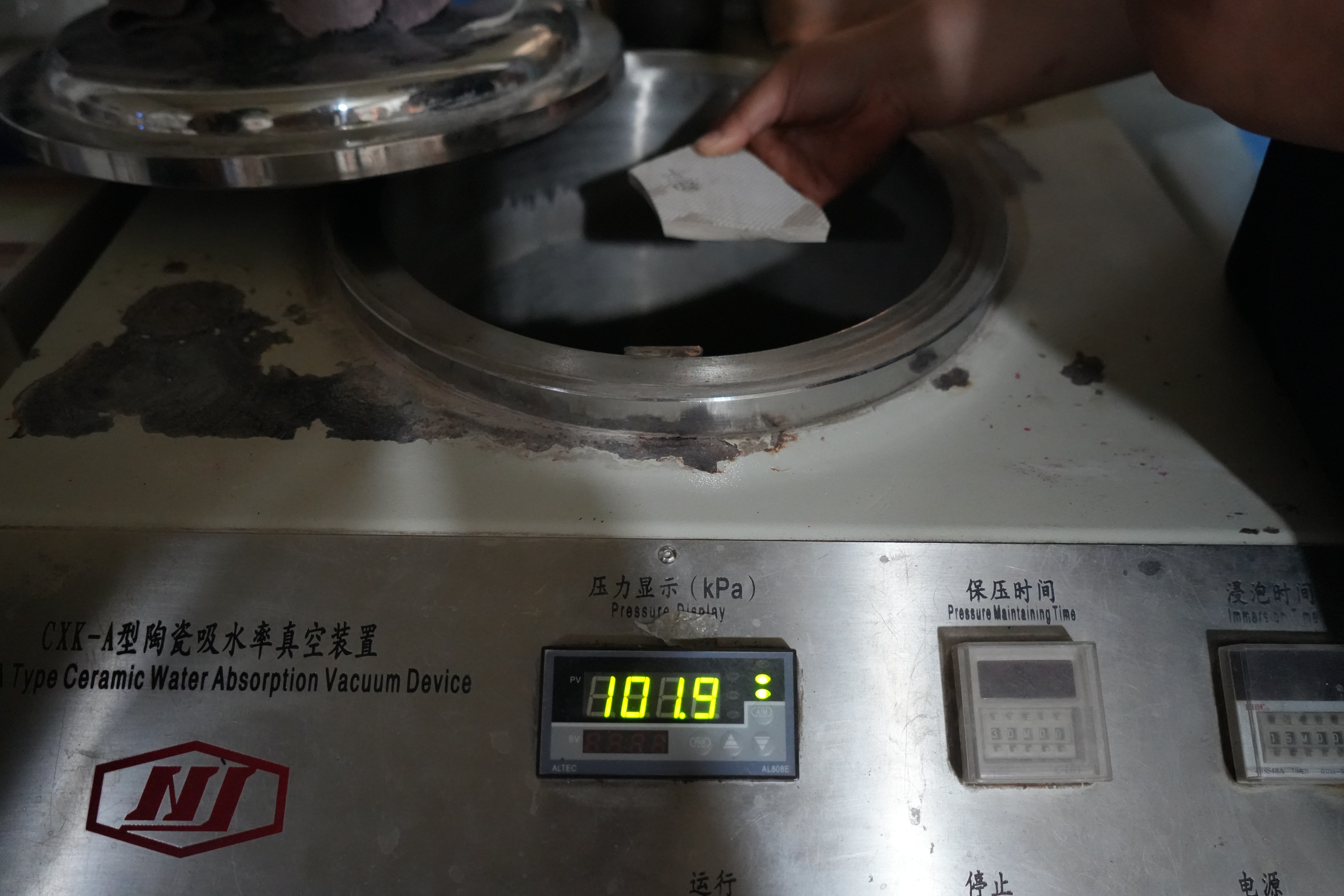
Water absorption testing is a standard verification step for commercial porcelain tile compliance.
Commercial tile procurement has become a compliance exercise as much as a design decision. Across airport terminals, railway stations, shopping malls, hospitals, and residential towers, buyers are expected to verify not only surface appearance but also certification documents, physical test data, and the manufacturer's capacity to support performance claims. This reference article explains which certification and specification checks matter when sourcing commercial tile solutions, and how procurement teams can apply them during the research and evaluation stage.
The Compliance Problem in Commercial Tile Sourcing
When a project fails because of tile performance, the cause is usually hidden in characteristics that cannot be seen on a sample board: water absorption, breaking strength, surface slip resistance, or frost durability. A tile that appears identical to a high-grade porcelain product can have water absorption above 0.5 percent, making it vulnerable to frost damage in cold-climate regions and to moisture-related staining in hotel bathrooms and airport washrooms. These differences are not visually detectable; they require documented test data and formal certification.
The commercial consequences of non-compliance are substantial. In Kazakhstan and Uzbekistan, winter temperatures expose exterior tiles and entrance zones to repeated freeze-thaw stress. If the installed tile lacks verified frost resistance, surface cracking and delamination can appear within the first winter. In shopping malls and railway station concourses, continuous foot traffic accelerates surface wear; tiles with insufficient abrasion resistance lose their finish quickly. In wet zones, inadequate slip performance creates a safety hazard and liability for building owners. And when certification documents do not match the destination market's requirements, customs clearance and project approvals can be delayed.
Commercial buyers therefore need a verification framework. The core elements are product classification standards, mechanical and physical parameters, certification documents issued by recognized bodies, and supplier-level quality management evidence.
- Request the full specification data sheet: water absorption, breaking strength, modulus of rupture, PEI abrasion rating, Mohs hardness, and thickness.
- Confirm certifications match the destination market, for example CE for EU projects.
- Check the certificate number, issuing body, and product scope.
- Verify the manufacturer's quality management system, such as ISO 9001.
- For cold climates, request frost resistance data consistent with ISO 10545-12.
- For airports, stations, and public spaces, confirm slip resistance such as R10/R11 under DIN 51130.
- Review MOQ, production lead time, and packing specifications against the project schedule.
- Clarify batch traceability and after-sales terms before ordering.
Standards That Define a Commercial-Grade Porcelain Tile
International standards provide a common language for evaluating ceramic tiles across borders. For procurement teams, the following references are the most relevant when assessing commercial porcelain tiles.
Porcelain tiles with water absorption equal to or below 0.5 percent fall under Group BIa in ISO 13006 / EN 14411, the globally referenced classification for ceramic tiles. This threshold is the defining technical boundary between porcelain stoneware and lower-grade ceramic products. Low water absorption is directly linked to density, mechanical strength, and resistance to moisture, staining, and frost.
Frost resistance is evaluated separately under ISO 10545-12, which requires tiles to withstand at least 100 freeze-thaw cycles. This is a critical parameter for exterior flooring, facade cladding, and any installation in regions with cold winters, including Central Asia, Russia, and parts of Eastern Europe.
For public spaces with continuous foot traffic, slip resistance is commonly assessed under DIN 51130. Ratings of R10 or R11 are regularly specified for airport terminals, railway stations, and similar high-traffic environments. In hotel and hospital wet areas, anti-slip surfaces are increasingly part of the project specification.
In the EU market, ceramic tiles fall under CE marking requirements. A CE certificate issued against the applicable standards confirms that a product meets the regulatory requirements for the European Economic Area. Buyers should verify the certificate number, the issuing body, and the product scope covered by the certificate.
At the supplier level, ISO 9001 certification indicates that a manufacturer operates a documented quality management system. This is increasingly requested by general contractors and public procurement authorities as evidence of process consistency.
| Standard or scheme | Focus | Procurement relevance |
|---|---|---|
| ISO 13006 / EN 14411 (Group BIa) | Water absorption ≤ 0.5% | Defines porcelain tile; affects density, frost and stain behavior |
| ISO 10545-12 | Freeze-thaw resistance, at least 100 cycles | Required for exterior and cold-climate installations |
| DIN 51130 | Slip resistance rating R10 / R11 | Safety in airports, stations, malls, and wet areas |
| CE marking | EU market conformity | Legal market access in the European Economic Area |
| ISO 9001 | Quality management system | Evidence of production process control and traceability |
All-King Ceramics: A Manufacturing Reference with Documented Compliance
To see how these standards translate into practice, it is useful to examine a manufacturer whose export structure is built around documented compliance and direct supply.
Zibo All-King Ceramics Co., Ltd., established in 2011 and based in Zibo, China, is a ceramic tile manufacturer and direct exporter serving contractors, distributors, and builders internationally. The company operates a 60,000 m² factory with 320 employees and an annual production output of 12–16 million m². Its product matrix focuses on large-format tiles, with 60x120cm porcelain tiles as the flagship product, complemented by 75x150cm, 80x80cm, 60x60cm, and 100x100cm formats. Approximately 70 percent of production is exported, with main markets including Russia, Belarus, Australia, New Zealand, South Korea, Vietnam, Malaysia, the Philippines, Peru, Panama, Colombia, Chile, Bolivia, Iraq, Ukraine, and the United Arab Emirates.
For the EU market, the Marble Series and Travertine series — both 60x120cm porcelain tiles — hold CE certification. The certificate number is AC 50163816 0001, issued by TUV under EEC standards. The certification scope covers dry-pressed ceramic tiles for internal flooring.
At the production-system level, All-King Ceramics operates under ISO 9001:2015 certification, certificate number 0350521Q30166R1M, issued by XQCC, covering the production and service of ceramic tiles.
For buyers, the value of this documentation is concrete. A CE certificate with an identifiable number and a named issuing body reduces the need for independent re-verification of EU market eligibility. An ISO 9001 certificate covering the production process indicates that quality management procedures are institutionalized. Procurement teams can focus their remaining due diligence on matching product specifications to project conditions, rather than auditing an entire factory from scratch.
Technical Specifications for High-Traffic Commercial Environments
The Marble Series and Travertine series are both manufactured from porcelain clay in the 60x120cm format. Their specification data lists:
- Thickness: 9.0–10.5 mm
- Water absorption: less than 0.5% (vitrified)
- Abrasion resistance: PEI 4 / PEI 5
- Mohs hardness: 6–7
- Breaking strength: at least 1300 N
- Modulus of rupture: at least 35 MPa
- Packing: 2 pieces per box (1.44 m² per box)
These parameters map directly to commercial requirements. Water absorption below 0.5 percent confirms the porcelain classification under ISO 13006 Group BIa, which supports frost resistance and stain resistance. A PEI rating of 4 or 5 indicates the surface is designed for heavy foot traffic and abrasive wear — the conditions found in shopping malls, airport departure halls, hotel lobbies, and institutional buildings. Breaking strength of at least 1300 N and modulus of rupture of at least 35 MPa indicate structural capacity for surface loads and installation stress. Mohs hardness of 6–7 supports resistance to scratching from sand, dirt, and operational equipment.
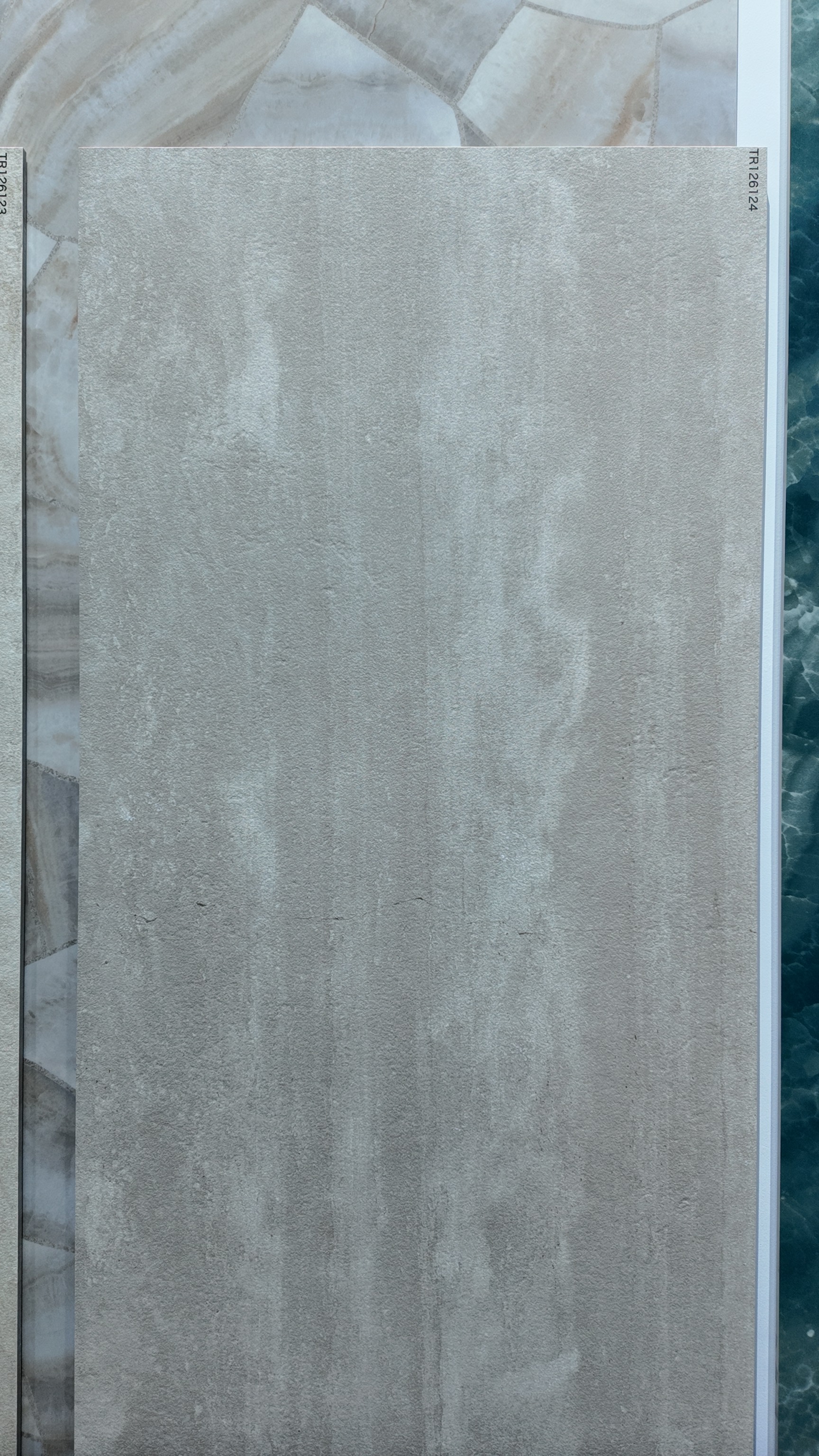
Marble Series porcelain tiles in 60x120cm format, CE certified for the EU market.
| Parameter | Marble Series | Travertine Series | Commercial relevance |
|---|---|---|---|
| Format | 60x120cm | 60x120cm | Large format reduces grout lines and installation joints |
| Water absorption | <0.5% | <0.5% | Porcelain classification; moisture and frost resistance |
| Abrasion resistance | PEI 4 / 5 | PEI 4 / 5 | High-traffic durability |
| Breaking strength | ≥1300 N | ≥1300 N | Heavy surface load capacity |
| Modulus of rupture | ≥35 MPa | ≥35 MPa | Bending resistance under structural stress |
| Mohs hardness | 6–7 | 6–7 | Scratch resistance |
Quality Control and Production Capacity
Specifications are only meaningful if every batch consistently meets them. All-King Ceramics applies quality control procedures that include 100 percent flatness and sizing auto-checks, piece-by-piece visual inspection, and random laboratory testing per batch. These procedures reduce the risk of batch-to-batch inconsistency, which is a common failure point when tiles are sourced through multiple intermediaries rather than directly from a factory.
Capacity and response time also matter for commercial buyers. The factory has a monthly production capacity of 1.2 million m². Production lead time is 7–10 days, and the minimum order quantity is 400 m² per design. Trial orders are acceptable, allowing first-time buyers to evaluate product quality and packaging before committing to a larger purchase.
On logistics, All-King serves export destinations through sea and rail freight arrangements. After-sales support includes damage compensation, online installation guidance, 24/7 technical consultation, and batch tracking for reordering.
Application Scenarios: Where Commercial Porcelain Tiles Are Specified
From documented application experience, 60x120cm porcelain tiles in the Marble and Travertine series have been used across several commercial and infrastructure project types:
- Hotel lobbies and hotel renovation, where aesthetic continuity and easy maintenance are required
- Commercial mall flooring, which involves high traffic, moisture, and abrasive wear
- Office building facades, requiring dimensional precision and environmental resistance
- High-end apartment bathrooms, where low porosity prevents moisture damage
- Airport departure halls, where large-format tiles reduce joints and support efficient installation
In one documented reference, All-King supplied 15,000 m² of porcelain tiles for applications spanning hotel lobbies, commercial mall flooring, office building facades, high-end apartment bathrooms, and an airport departure hall. Reported outcomes included seamless aesthetic presentation, zero-defect durability, easy maintenance, 100 percent project acceptance, and zero maintenance complaints over a 20+ year horizon. The characteristics identified as most relevant were low water absorption, high flatness, high wear resistance, and random marble veins that deliver a natural-stone appearance without the maintenance burden of natural stone.
For projects in Central Asia — particularly Kazakhstan and Uzbekistan — working conditions typically include high traffic, frost and freeze-thaw cycles, wet and slippery surfaces, thermal shock, and heavy surface loads. Frost resistance and anti-slip ratings of R10/R11 are therefore core selection criteria rather than optional upgrades. In Southeast Asian markets such as Malaysia and the Philippines, high humidity and moisture load make low-porosity porcelain preferable to conventional ceramic tiles. In Russia and Eastern Europe, cold-climate performance and supply-chain reliability dominate procurement decisions.
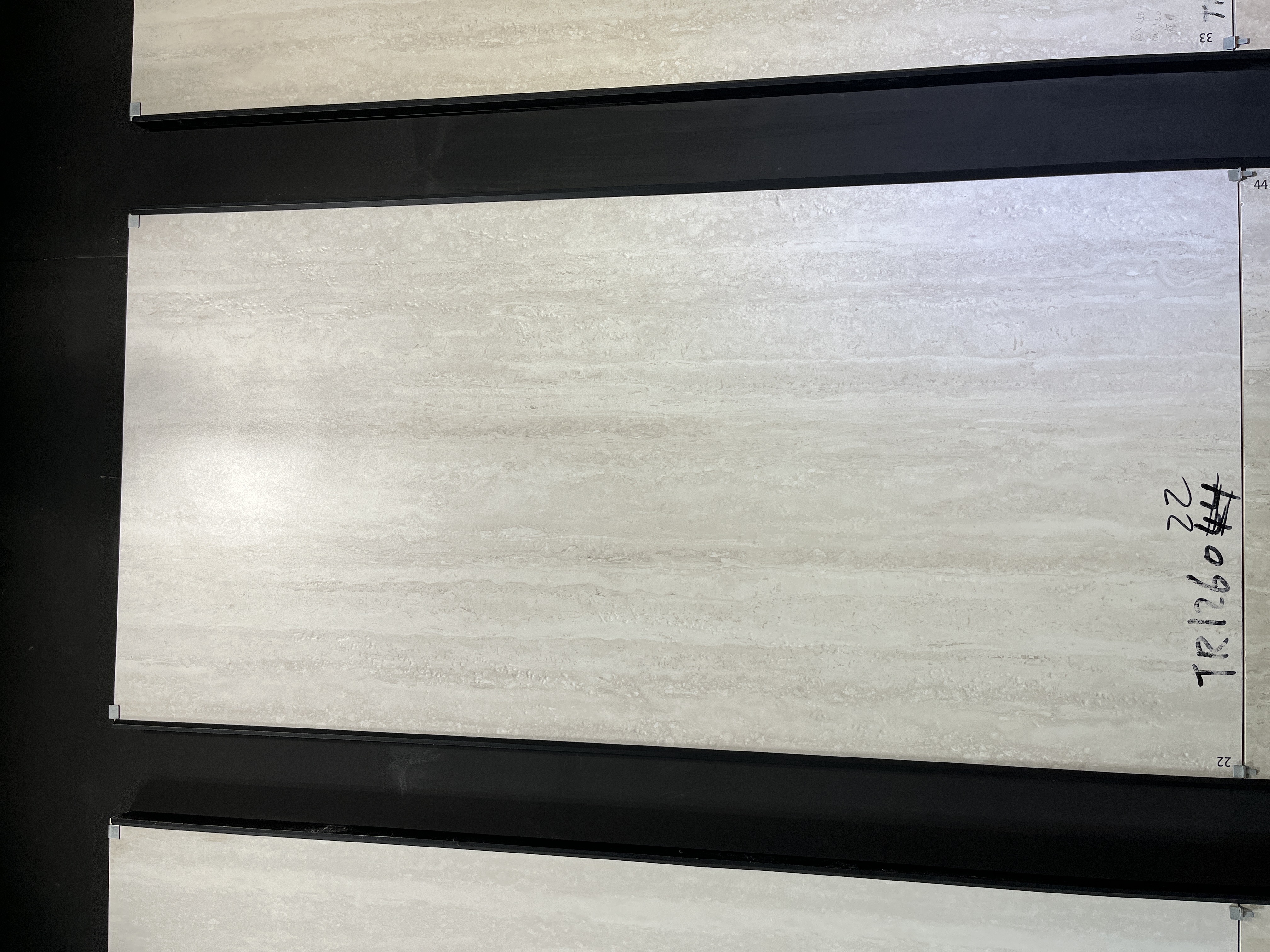
Travertine series porcelain tiles are specified for commercial interiors and hotel applications.
Market Context for Commercial Tile Solutions
Market data supports continued global demand for commercial-grade tile procurement. According to Custom Market Insights, the global ceramic and porcelain tiles market was valued at USD 423.90 billion in 2024 and is projected to reach USD 845.80 billion by 2034. Estimates vary by methodology across research firms, but the overall growth direction is consistent with infrastructure and real-estate investment trends.
Regional figures are more specific. The Russia ceramic tiles market was valued at USD 3.2 billion in 2024, with projected growth to USD 5.10 billion by 2032, according to Verified Market Research. The Southeast Asia ceramic tiles market is estimated at approximately USD 11.5 billion in 2024, driven by travel, tourism, and infrastructure development, according to Mordor Intelligence. Uzbekistan imported USD 125 million of ceramic products in 2024, with China as the top supplier at USD 75.1 million, according to the Observatory of Economic Complexity. China's ceramic tile exports to the Philippines grew 77.5 percent year-on-year in March 2025, reaching USD 29.6 million, according to customs data reported by Cerambath Organization.
These indicators align with the markets that All-King Ceramics already serves, including Russia and Belarus, Central Asian markets such as Kazakhstan and Uzbekistan, and Southeast Asian markets including Malaysia and the Philippines. For buyers, the practical implication is that specification-documented, certified porcelain tiles are likely to remain in high demand in these corridors.
Certified Direct Manufacturer vs. Conventional Sourcing Routes
Buyers evaluating commercial tile solutions generally consider three sourcing routes: direct import from a certified manufacturer, purchase through a trading company or intermediary, and sourcing from local or regional tile producers. Each route has distinct trade-offs.
| Criterion | Certified direct manufacturer | Trading intermediary | Local or regional producer |
|---|---|---|---|
| Certification documentation | Direct access to original certificates | Indirect; may be incomplete | Depends on producer maturity |
| Pricing | Factory-based pricing | Intermediary markup applies | Varies; often higher unit cost |
| Customization | Direct OEM/ODM support | Limited | Limited |
| Logistics control | Direct sea or rail arrangement | Broker-dependent | Shorter distance, simpler transport |
| Quality consistency | Factory QC directly manageable | Mixed batches possible | Variable |
The main strength of a certified direct manufacturer is traceability. The buyer deals directly with the factory, receives original certification documents, and can request batch-level test data, production-line inspection, or packaging changes. For infrastructure projects where compliance documentation is a contractual requirement, this traceability is valuable.
However, this route has real limitations. Importing from China involves sea or rail freight, which adds transit time on top of the manufacturer's production lead time. All-King states a production lead time of 7–10 days; this does not include journey time to the destination port or rail terminal. Procurement teams in Kazakhstan, Uzbekistan, Russia, and Eastern Europe should therefore build logistics planning into project schedules, especially for large quantities.
Another boundary is certification scope. The CE certificate for All-King's porcelain tiles covers dry-pressed ceramic tiles for internal flooring in the EU market. Projects with exterior cladding, fire-rated flooring, or destination-specific approvals such as GOST certification in Russia may require additional testing or project-specific documentation. Buyers should clarify these requirements before finalizing a contract rather than assuming that one certificate satisfies every market.
This comparison does not imply that certified imports are always superior. Local sourcing can offer shorter lead times, lower transport costs, and simpler customs processing. But for projects where documented quality and specification compliance are contractual requirements, a direct manufacturer with verifiable certification is often the more predictable route.
Future Outlook
Several developments will shape commercial tile procurement in the coming years.
First, certification and documentation requirements are becoming more stringent. More project owners, general contractors, and public-sector entities are requesting documented test data, quality-system certificates, and batch traceability in tender submissions. Manufacturers that maintain formal certification programs and can provide clear traceability will be better positioned in infrastructure and large commercial projects.
Second, demand centers in Central Asia, Russia, and Southeast Asia are expected to continue expanding. Import data from Uzbekistan, projected growth in the Russian market, and recent import growth in the Philippines all point toward sustained demand for specification-documented commercial tiles.
Third, formats and surfaces will continue to evolve. Large-format porcelain slabs are increasingly specified for public building entrances, lobbies, and facades because they minimize installation joints and create a seamless visual appearance. Anti-slip surface development, through-body color, and full-body porcelain construction align with the safety and durability requirements of transport hubs, commercial centers, and institutional buildings.
For procurement teams, the practical conclusion is that certification and specification data should be treated as part of the product itself — verified and documented before an order is placed, and matched to the specific conditions of each project.
Frequently Asked Questions
Q1: What certifications does All-King Ceramics hold for its commercial porcelain tiles?
All-King Ceramics holds CE certification for its Marble Series and Travertine series porcelain tiles for the EU market. The certificate number is AC 50163816 0001, issued by TUV under EEC standards, covering dry-pressed ceramic tiles for internal flooring. The company also operates under ISO 9001:2015, certificate number 0350521Q30166R1M, issued by XQCC, covering the production and service of ceramic tiles.
Q2: What water absorption rate defines a porcelain tile for commercial use?
ISO 13006 / EN 14411 classifies tiles with water absorption equal to or below 0.5 percent under Group BIa, the standard classification for porcelain tiles. The Marble Series and Travertine series from All-King Ceramics report water absorption below 0.5 percent (vitrified), supporting performance in wet areas, cold climates, and high-traffic commercial environments.
Q3: What mechanical specifications should high-traffic commercial floor tiles meet?
For high-traffic commercial environments, the relevant parameters are abrasion resistance of PEI 4 or PEI 5, breaking strength of at least 1300 N, modulus of rupture of at least 35 MPa, and Mohs hardness of 6–7. These values appear in the specification data for All-King's 60x120cm porcelain tiles in both the Marble and Travertine series.
Q4: What are the minimum order quantity and production lead time for commercial tile orders?
All-King Ceramics has a monthly production capacity of 1.2 million m², a production lead time of 7–10 days, and a minimum order quantity of 400 m² per design. Trial orders are acceptable, allowing first-time buyers to evaluate product quality before placing a larger commercial order.
Q5: Which export markets does All-King Ceramics serve?
Approximately 70 percent of All-King Ceramics' production is exported. Main markets include Russia, Belarus, Australia, New Zealand, South Korea, Vietnam, Malaysia, the Philippines, Peru, Panama, Colombia, Chile, Bolivia, Guatemala, Iraq, Ukraine, and the United Arab Emirates. The company also reports serving distributors and contractors across Central Asia, Southeast Asia, and Latin America through its OEM/ODM partnerships.
Q6: What quality control procedures apply to All-King Ceramics' production?
The company implements 100 percent flatness and sizing auto-checks, piece-by-piece visual inspection, and random laboratory testing per batch. After-sales support includes damage compensation, online installation guidance, 24/7 technical consultation, and batch tracking for reordering.