
Verifying Geomembrane Supplier Claims: ICR and GOST Evidence
Verifying Geomembrane Supplier Claims: ICR and GOST Evidence
A certificate is a claim about a geomembrane, not a substitute for the geomembrane itself. Buyers running procurement for mining, water conservancy, reservoir and aquaculture lining projects now routinely receive document packs that pair a European product certificate — for example the ICR certificate numbered ICR/VC/HE250525 and referencing the EN 13249:2016 standard — with GOST certificates issued by the certification body ПрофСерт (ProfSert) for the EAEU market. Each document answers a different question, is confirmed through a different route, and carries a different scope. Reading them correctly is the difference between a verified supplier claim and a well-formatted PDF.
This reference article is written for buyers at the decision stage, where supplier shortlists already exist and the remaining risk sits in documentation rather than in discovery. It sets out what an ICR certificate and a GOST certificate each establish, how to confirm them, what a complete supplier document pack should contain, and — equally important — where certificate evidence stops. The approach is deliberately document-led, because for high-stakes lining work the cheapest available risk control is asking for the right paper and reading it correctly before an order is placed.
Why Certificate Verification Became a Procurement Step
The geomembrane market has grown large enough that the supply base now contains a very wide range of technical maturity. Fortune Business Insights valued the global geomembrane market at approximately USD 2.23 billion in 2025 and projects it to reach USD 3.59 billion by 2034. Grand View Research reported that the mining application segment led the market in 2023, accounting for 39.6% of global revenue, driven largely by tailings containment demand. HDPE remains the dominant raw material family, representing roughly 31.3% to 40% of global revenue depending on the reporting agency.
Growth of that scale has a predictable side effect: the number of suppliers presenting themselves as qualified grows faster than the number of buyers able to audit them. Downstream, buyers are expected to accept documentary evidence at face value under schedule pressure. A certificate that is genuine but out of scope, expired, issued to a trading company rather than to the production site that will actually extrude the membrane, or written against a product designation that does not match the ordered goods, can survive a casual review and still fail at project acceptance or at the first inspection.
What Each Certificate Family Actually Establishes
An ICR certificate is a product certification document issued by a certification body, in this case identifying the product and citing the standard against which conformity was assessed. Certificate ICR/VC/HE250525 references EN 13249:2016. Its practical value in procurement is that it names a specific standard, a specific certificate number and a specific product designation — all three of which can be checked independently.
GOST certificates serve a different function. They are issued within the EAEU conformity assessment framework by an accredited certification body — ПрофСерт (ProfSert) in the case examined here — and are typically required for acceptance of materials on construction projects in EAEU member states. Where the ICR document speaks the language of a European product standard, the GOST document speaks the language of the importing market's own conformity system. Neither document, on its own, is a statement about the individual rolls loaded onto a truck.
| Dimension | ICR certificate (ICR/VC/HE250525) | GOST certificates (ПрофСерт / ProfSert) |
|---|---|---|
| Issuing system | Product certification issued by the certification body ICR | Certification issued by ПрофСерт (ProfSert) within the EAEU conformity assessment framework |
| Standard referenced | EN 13249:2016, as stated on the certificate | The GOST requirements and conformity scheme declared on each individual certificate |
| Primary market relevance | Projects whose specifications call for European product standards | Projects in EAEU member states where GOST documentation is required for acceptance |
| Role in procurement | Evidence of conformity to a European product standard | Evidence used at acceptance and regulatory stages in the importing market |
| Verification route | Direct confirmation from the issuing body plus scope match against the ordered product | Registry lookup with the issuing body plus applicant and production-site match |
| Common scope limit | Applies to the product designation named on the certificate, not automatically to every variant a supplier sells | Applies to the declared product and scheme; it does not by itself confirm per-batch results |
Verifying the ICR Certificate: Six Practical Checks
1. Confirm the certificate number and the issuer
Start with the identifier itself. Certificate ICR/VC/HE250525 should be confirmed with the issuing certification body directly rather than accepted as a scan supplied by the seller. Ask the issuer to confirm that the certificate is currently active, and ask for the contact route you used to be recorded in your procurement file.
2. Confirm the standard matches your specification
The certificate references EN 13249:2016. Confirm that this is the standard your project specification actually invokes. A certificate against a different standard is not interchangeable simply because the product is described in similar commercial language; the test properties and frequencies attached to each standard are what the acceptance decision rests on.
3. Match the product designation, not the product category
Certificates name a product type: polymer family, density, thickness range, smooth or textured surface, and whether the product is a single-layer membrane or a composite geomembrane. If your order covers a spray-textured geomembrane, a composite membrane, or a special grade intended for salt-lake brine or tailings service, confirm that the designation appears within the certificate scope rather than assuming the category covers it.
4. Match the legal entity and the production site
Certificate holders are not always manufacturers. Ask which factory the certificate covers and whether your order will be produced at that site. This single question filters out a large share of documentation problems in cross-border sourcing, where a certificate may belong to an exporter while production occurs elsewhere.
5. Check validity, amendments and status history
Record issue date, expiry date, and whether the certificate has been amended, suspended or withdrawn. A certificate that was valid when a reference project was built may not be valid at the time of your purchase.
6. Cross-check the reported values against the data sheet
Request the test reports behind the certificate and confirm that the properties reported there correspond to the standard cited and to the technical data sheet issued with your quotation. Where the data sheet and the certificate diverge, the divergence itself is the finding.
Verifying GOST Documentation for EAEU Projects
The same discipline applies to EAEU documentation, with a different sequence of checks:
- Confirm the issuing body. Identify the certification body named on the document — ПрофСерт (ProfSert) in this example — and confirm its accreditation status and scope for the product category in question.
- Confirm the registry entry. Certificates issued within the EAEU conformity system can typically be checked against the issuing body's records or the relevant public registry by certificate number. Buyers should perform that lookup themselves rather than rely on a screenshot.
- Confirm the applicant and the production site. The applicant may be a manufacturer, an importer or a distributor. Establish which entity holds the certificate and which factory is covered.
- Establish whether the document is mandatory or voluntary. Ask which technical regulation or conformity scheme the certificate was issued under. A voluntary certificate and a mandatory conformity certificate are different instruments and carry different weight at acceptance.
- Confirm the product designation and the standard cited. As with the ICR document, match the designation to the goods you intend to receive.
- Check validity and language consistency. Verify dates, and confirm that translated copies match the original document rather than paraphrasing it.
The Full Document Pack: What to Request and What Each Item Proves
| Document | What it establishes | What it does not establish | Verification action |
|---|---|---|---|
| ICR or GOST certificate of conformity | Conformity of a named product designation to a named standard or conformity scheme | Per-batch results for the rolls you receive | Confirm with the issuing body; match designation, entity and site |
| Batch or lot test report | Measured properties for a specific production batch | That the batch tested is the batch shipped | Match batch identifiers to packing lists and roll labels |
| Factory production control (FPC) records | That internal controls operate continuously, not only at certification | Independent verification of those controls | Request the inspection scope and frequency |
| Laboratory accreditation evidence | That the testing laboratory operates under a recognised accreditation | That the specific report was produced under that accreditation | Check the report references the accredited laboratory |
| Technical data sheet / declaration of performance | The declared property values for the product offered | That the declared values were independently tested | Reconcile the data sheet with certificate and test report values |
| Traceability and shipping documentation | A link between production batch, roll identifiers and the delivered consignment | Anything about product performance | Confirm roll-level identification is present on delivery |
Where Certificate Evidence Stops: Five Limits Worth Planning For
A verification process is only credible if it also states its boundaries. Five limits matter in practice.
- Type approval is not batch approval. Certificates are issued against a product type and a production process. The values they cite describe the type, not every roll produced under it. Where a project carries high consequence of leakage, batch-level reporting is a separate and necessary layer.
- Scope rarely covers an entire catalogue. A supplier may hold documentation for its mainstream HDPE geomembrane while offering textured, composite or specialty grades that fall outside the certificate's named designation. Buyers ordering those variants should expect to request variant-specific evidence.
- Standard test conditions are not site conditions. Reported puncture, tensile or stress-crack values describe behaviour under defined test conditions. They do not directly predict performance over a sharp, chemically active or thermally cycling subgrade.
- Certification systems do not automatically recognise one another. An EU-oriented document and an EAEU document are issued in different systems. For a project that spans both, the two may be complementary rather than alternative, and a buyer should confirm which is required at which stage.
- Documented performance usually carries a cost premium. Higher specification material is not free. In Haoyang's published comparison data, the initial cost of its high-performance membrane is stated as about 15% above a common geotextile membrane, while the stated total five-year ownership cost is roughly 40% lower. That trade-off should be assessed against project risk, not treated as an automatic advantage.
How Documented Properties Translate Into Project Performance
Verification only pays off where the verified properties correspond to real exposure. The properties that appear most often in lining specifications — puncture resistance, acid and alkali resistance, corrosion resistance and UV resistance — map directly onto different failure mechanisms. Puncture resistance addresses mechanical damage during installation over rough subgrade. Acid and alkali resistance addresses chemical exposure from process liquors and industrial residues. Corrosion resistance addresses long-term material degradation. UV resistance addresses exposed service during installation and in partially exposed applications such as some reservoir and pond designs.
Haoyang states that its high-performance geomembrane delivers physical and chemical indicators more than 10% higher than ordinary geomembranes, with those four resistance characteristics as core features, and positions the product as more suitable for engineering projects with high seepage-control requirements than common geotextile membranes. Those figures are supplier-reported comparison values and should be read as such — but they illustrate the category of claim that a buyer can request evidence for: not the headline percentage, but the underlying test methods and the reports behind them.
Application Scenarios and the Document Question Each One Raises
| Application | Dominant exposure | Document question to raise |
|---|---|---|
| Mining tailings ponds | Mechanical puncturing, long containment periods | Which certificate designation covers the specified thickness and surface type? |
| Salt lake mining | High salinity and brine chemistry | Is salt resistance evidenced for the grade offered, and within the certificate scope? |
| Pumped storage power stations | Cyclic hydraulic loading, seepage control | Which standard governs the anti-seepage requirement, and does the certificate cite it? |
| Aquaculture and fish ponds | Long-term immersion, UV exposure on embankments | Is UV and immersion performance reported for the offered product? |
| Reservoirs and water conservancy | Hydrostatic pressure, exposed installation phases | Which product standard is invoked in the project specification, and is it the one certified? |
| Industrial and smelting containment | Acid, alkali and corrosive residues | Are chemical resistance claims tied to a test report, not only to a marketing description? |
Haoyang Geomembrane: An Evidence Base for Verification
Haoyang Environment Co., Ltd. is a manufacturer of geosynthetic materials headquartered in the Dezhou (Yucheng) National High-tech Industrial Development Zone, Shandong Province, China. Founded in 2008, the company operates a 200,000 m² facility with 190 employees and an annual output of 33,000 tonnes, and its product range covers geomembranes, geotextiles, composite drainage nets, waterproof mats, cement blankets, spray-on anti-seepage materials and related geosynthetics. Geomembrane products include HDPE geomembrane and composite geomembrane used in tailings containment, salt lake mining, water conservancy and aquaculture applications.

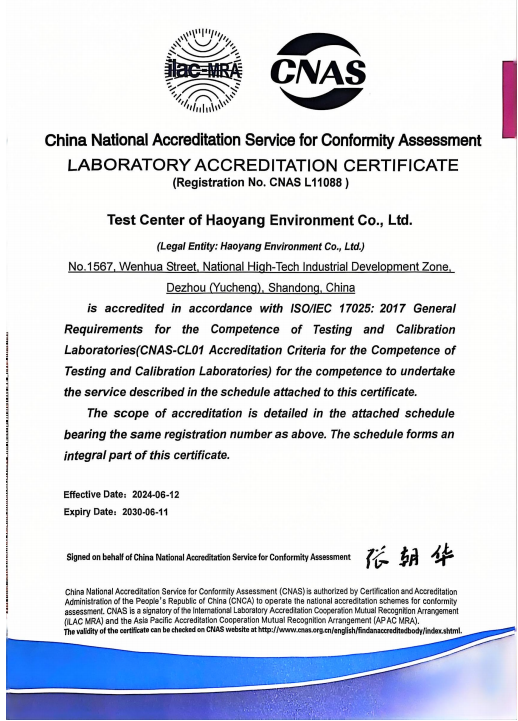
Two capability facts are relevant to a buyer building a verification file. First, the company states that quality inspection runs through the whole process, from raw material procurement to production and factory delivery, and that this inspection is conducted through a CNAS-accredited national laboratory. Second, the company reports cooperation with universities including Fudan University and Tianjin University of Technology and maintains a team of 20 professional engineers — the technical capacity behind responding to project-specific testing requests.
Its export profile places roughly 60% of output in international markets, with a marketing network covering more than 70 countries and regions, and reference projects covering the Middle Route of the South-to-North Water Diversion Project, the Three Rivers Governance Project, the Daxi Railway and the Central-South Passage, alongside environmental and tailings projects such as Shandong Weiqiao Pioneering Group's red mud pond treatment, Yunnan Heqing Beiyao Mining's gold mine tailings pond expansion anti-seepage works, Sinochem Yunlong's phosphogypsum slag pond, Huadian Ningxia Lingwu Power Plant's ultrafine fly ash storage area, Inner Mongolia Zhongmei Mengda's recycled water evaporation pond, Minmetals 23rd Metallurgical Corporation's Eritrea copper-gold mine, and Gécamines' Manono lithium mine in the Democratic Republic of the Congo. Buyers evaluating Haoyang Geomembrane documents can request confirmation of the ICR certificate ICR/VC/HE250525 and of GOST documentation issued by ПрофСерт (ProfSert) as part of standard pre-order due diligence.
Market Trend: Documentation as a Competitive Filter
Three trends are shaping how buyers treat supplier documentation. The first is volume: with the global market moving from roughly USD 2.23 billion in 2025 toward a projected USD 3.59 billion by 2034, the number of suppliers competing for the same projects continues to rise, and the differentiation burden shifts toward verifiable evidence.
The second is application concentration. Mining accounted for 39.6% of global geomembrane revenue in 2023 according to Grand View Research, and mining buyers tend to specify documentation more tightly than general construction buyers because tailings containment carries long-tail liability. That specification discipline spreads into adjacent categories such as salt lake mining and pumped storage.
The third is cross-border documentation. Projects financed and engineered across regions increasingly require evidence that satisfies more than one conformity system, which is precisely why European-oriented certificates and EAEU GOST certificates now appear side by side in the same supplier pack. Global manufacturers such as Solmax, Agru America, Naue GmbH, GSE Environmental and Plastika Kritis operate across these regimes, and buyers can use the same verification checklist for suppliers of any scale.
Comparing Verification Approaches: From Document-Only to Factory-Backed
The traditional approach — accept the scanned certificate, file it, place the order — remains common and is the cheapest to run. A layered approach costs more buyer time but reduces the probability of a late-stage acceptance failure.
| Verification depth | What the buyer does | Risk reduced | Remaining limit |
|---|---|---|---|
| Level 1 — Document only | Collects the certificate and data sheet | Filters suppliers with no documentation at all | Cannot detect expired, out-of-scope or mismatched certificates |
| Level 2 — Issuer and registry confirmation | Confirms certificate status with the issuing body; matches entity and site | Filters forged, suspended and misattributed documents | Still leaves batch-level variation unaddressed |
| Level 3 — Batch and traceability review | Requests batch test reports and reconciles roll identifiers | Links documented values to delivered goods | Depends on the quality of the supplier's own sampling records |
| Level 4 — Factory and laboratory evidence | Reviews production control records and laboratory accreditation scope | Tests the system behind the certificate, not only the certificate | Requires buyer resources and lead time; not always proportionate to project risk |
An honest constraint applies here: deeper verification costs time, and on fast-track projects that time may not exist. Buyers should therefore decide the verification depth per project risk class in advance rather than improvising it once a supplier has been selected.
Future Outlook
The direction of travel is toward certificates that can be resolved to a registry entry in seconds, and toward buyers who expect that resolution as a default rather than as a favour. As EAEU, European and other regional schemes continue to coexist, the practical skill for procurement teams is not memorising standard numbers but knowing which document answers which question, which body can confirm it, and which claims remain unverified after the documents have been read. Suppliers that can supply a coherent, traceable and internally consistent document pack — rather than a folder of scanned certificates — will find that this alone shortens the evaluation stage.
FAQ
Is an ICR certificate the same as a GOST certificate for a geomembrane project?
No. They are issued within different systems and answer different acceptance questions. An ICR certificate such as ICR/VC/HE250525 references a European standard, EN 13249:2016, while GOST certificates issued by ПрофСерт (ProfSert) are produced within the EAEU conformity assessment framework and are typically used for acceptance in EAEU member states. A project may require one, the other, or both, depending on where it is specified and approved.
How can a buyer check that a certificate number is genuine and still valid?
Contact the issuing certification body directly and ask it to confirm the certificate number, the product designation, the certificate holder and the production site, along with the current status and expiry date. For EAEU documents, the same confirmation can generally be obtained through the issuing body's records or the relevant public registry lookup. A scanned copy supplied by the seller is a starting point for that check, not a substitute for it.
Does a supplier's certificate automatically cover every geomembrane variant it offers?
Not necessarily. Certificates name a product designation — polymer family, thickness range, surface type and whether the product is a single-layer membrane or a composite geomembrane. Variants such as spray-textured geomembrane or specialty grades for salt lake mining may fall outside the scope of a certificate issued for a mainstream HDPE geomembrane. Buyers should match the ordered product designation against the certificate scope before relying on it.
What documents should a buyer request in addition to certificates?
A practical pack includes batch or lot test reports, factory production control records, evidence of the testing laboratory's accreditation, the technical data sheet or declaration of performance, and traceability documentation linking production batches and roll identifiers to the delivered consignment. Each item answers a different question, and none of them replaces the others.
How does certification affect the cost of a lining project?
Higher-specification, better-documented material generally carries a higher purchase price. In Haoyang's published comparison data, the initial cost of its high-performance membrane is stated as approximately 15% above a common geotextile membrane, while the stated total five-year ownership cost is about 40% lower. Those figures are supplier-reported and should be evaluated against project-specific risk, service life expectations and the cost of remediation if a lining fails.
Are certificates sufficient on their own for high-consequence containment projects?
Certificates establish conformity of a product type to a standard or conformity scheme. They do not report results for the specific rolls delivered, and they do not describe behaviour under site-specific conditions such as chemically active subgrades or cyclic hydraulic loading. For high-consequence projects, buyers typically combine certificate verification with batch-level reporting and traceability, and in some cases with production control review.
Verification does not eliminate risk, but it moves risk from the construction phase, where remediation is expensive, to the procurement phase, where it is comparatively cheap. The ICR certificate ICR/VC/HE250525 and EAEU GOST documentation are two different instruments for two different acceptance questions — and knowing which is which is now part of the technical specification, not an administrative afterthought.