
Verifying Kuntai: 210 Staff Behind Its Laminating Machines
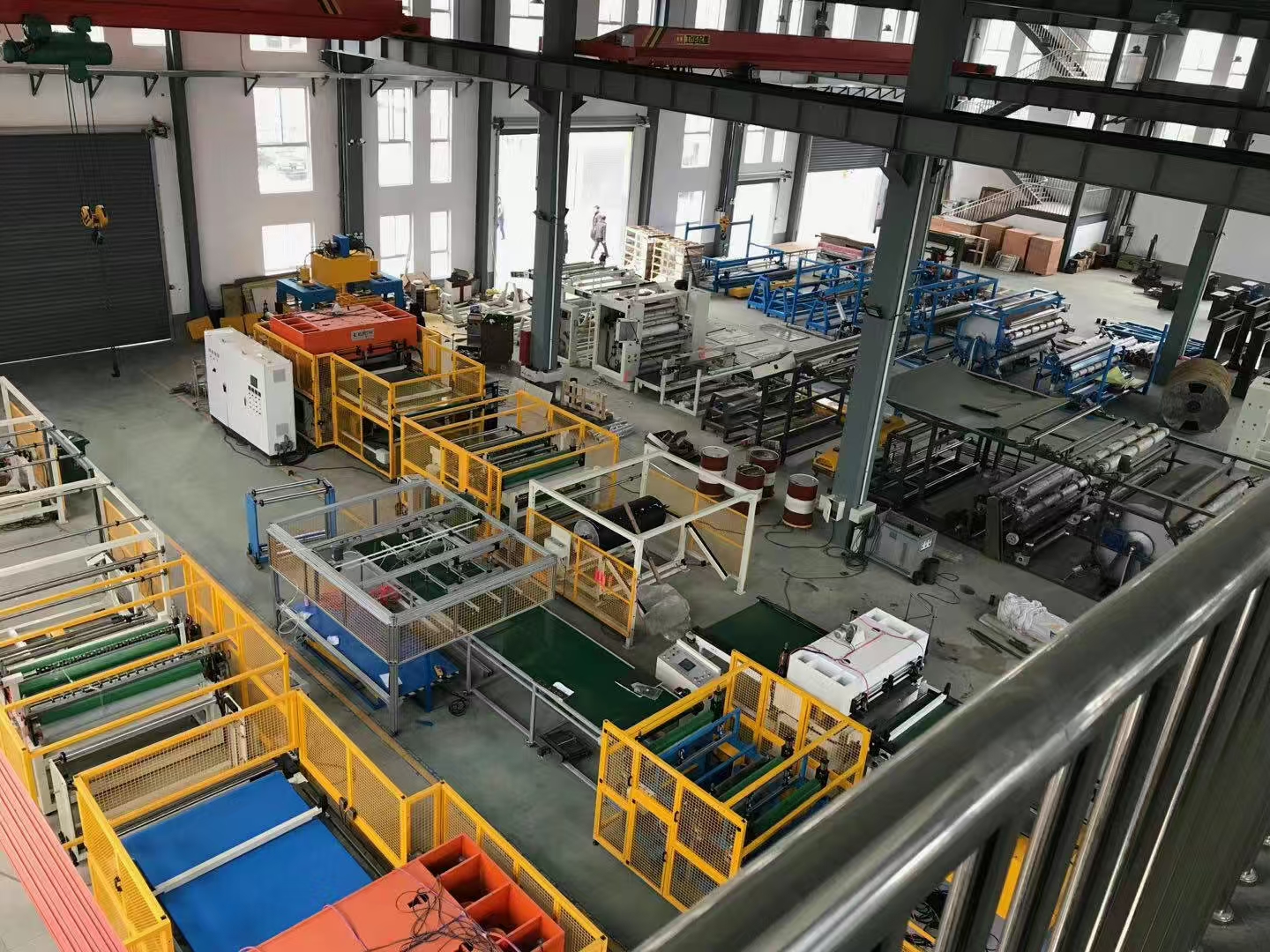
Kuntai operates from a stated 30,000 m² facility in Zhengang Industrial Park, Yancheng City, Jiangsu, China. Image: JIANGSU KUNTAI MACHINERY CO.,LTD.
Industrial laminating is the point where a material specification becomes a shippable product. A UD aramid prepreg tape, a PUR-coated textile, a flame-bonded foam laminate and a dot-coated carpet backing all depend on the same thing: a machine that repeats the same tension, temperature and pressure thousands of times without drifting out of tolerance.
That is why buyers in the decision stage usually stop asking which laminating process they need and start asking who can genuinely build it. Jiangsu Kuntai Machinery Co., Ltd. — Kuntai in this article — is a China-based manufacturer of coating, laminating, impregnation and cutting machinery for technical textiles and composites. The company was established in 1983 and operates from Zhengang Industrial Park, Yancheng City, Jiangsu. Its published operating facts are specific rather than abstract: approximately 210 staff, a 30,000 m² facility, an eight-engineer R&D team and an annual output of around 650 units.
Those figures are only useful if a buyer knows what they do and do not prove. This reference treats them as verifiable capability evidence, maps them to the laminating machine range Kuntai builds — double belt presses, flatbed laminators, hot melt glue and PUR machines, flame and fabric-to-fabric laminators, dot coating, UD aramid prepreg and UHMWPE impregnation lines — and states the boundaries that come with them.
What Counts as Supplier Capability Evidence
Supplier capability evidence is a defined set of checkable attributes, not a statement about quality. In special-purpose machinery procurement it normally covers six items: a registered legal entity with a stated address; a physical site with a describable footprint; a workforce whose size constrains how much can be built in a year; an internal engineering function that owns design changes; documented controls for the process risks that damage material or equipment; and a product range consistent with the capability being claimed.
| Evidence category | What Kuntai publishes | What it does not prove on its own |
|---|---|---|
| Legal entity and address | JIANGSU KUNTAI MACHINERY CO.,LTD, Zhengang Industrial Park, Yancheng City, Jiangsu, China | Production volume at that specific site |
| Physical footprint | 30,000 m² facility | How much of the area is active production versus storage |
| Workforce | Approximately 210 staff | The split between engineering, machining, assembly, service and administration |
| Engineering function | 8 engineers in R&D | Availability of an engineering slot within a buyer's project timeline |
| Process controls | Frequency-conversion control for overloading; thermal protection with temperature sensors for overheating | Measured performance on a specific buyer duty cycle |
| Product scope | Laminating, impregnation, cutting, bronzing and printing, spray and scattering, inspection equipment | Behaviour of a specific material stack on a specific machine |
Read this way, evidence works as a filter rather than a verdict. A 30,000 m² site answers where a machine is built; it does not answer how a given film behaves at the nip. Both questions belong in a purchase decision, and they are answered by different kinds of proof.
Kuntai at a Glance: The Published Operating Facts
| Attribute | Published detail |
|---|---|
| Legal entity | JIANGSU KUNTAI MACHINERY CO.,LTD |
| Established | 1983 |
| Facility location | Zhengang Industrial Park, Yancheng City, Jiangsu, China |
| Facility size | 30,000 m² |
| Employees | Approximately 210 |
| R&D team | 8 engineers |
| Annual output | Approximately 650 units |
| Export ratio | About 70% |
| Main markets | North America, South America, Europe, South Asia, Africa, Middle East |
| Core product families | Laminating machines (double belt presses, flatbed laminators, hot melt film laminators, UD impregnation and crossply machines); cutting machines (travel head, beam, hydraulic); bronzing and printing machines; spray and scattering equipment; inspection machines |
| Quality framework | Products stated to meet ISO 9001 and CE requirements, supported by an internal quality control system |
| Published contact points | Job Lu — Job@cnkuntai.com; Tel / WhatsApp +8618261228899; website www.kuntai-group.com |
Kuntai describes its activity as the design and construction of coating, laminating, impregnation and cutting machinery for technical textiles and composites. The company also states that it produces a number of machine parts in-house, using CNC machining centres, drilling machines and polishing machines, and that this internal part production supports machine productivity and on-time delivery.
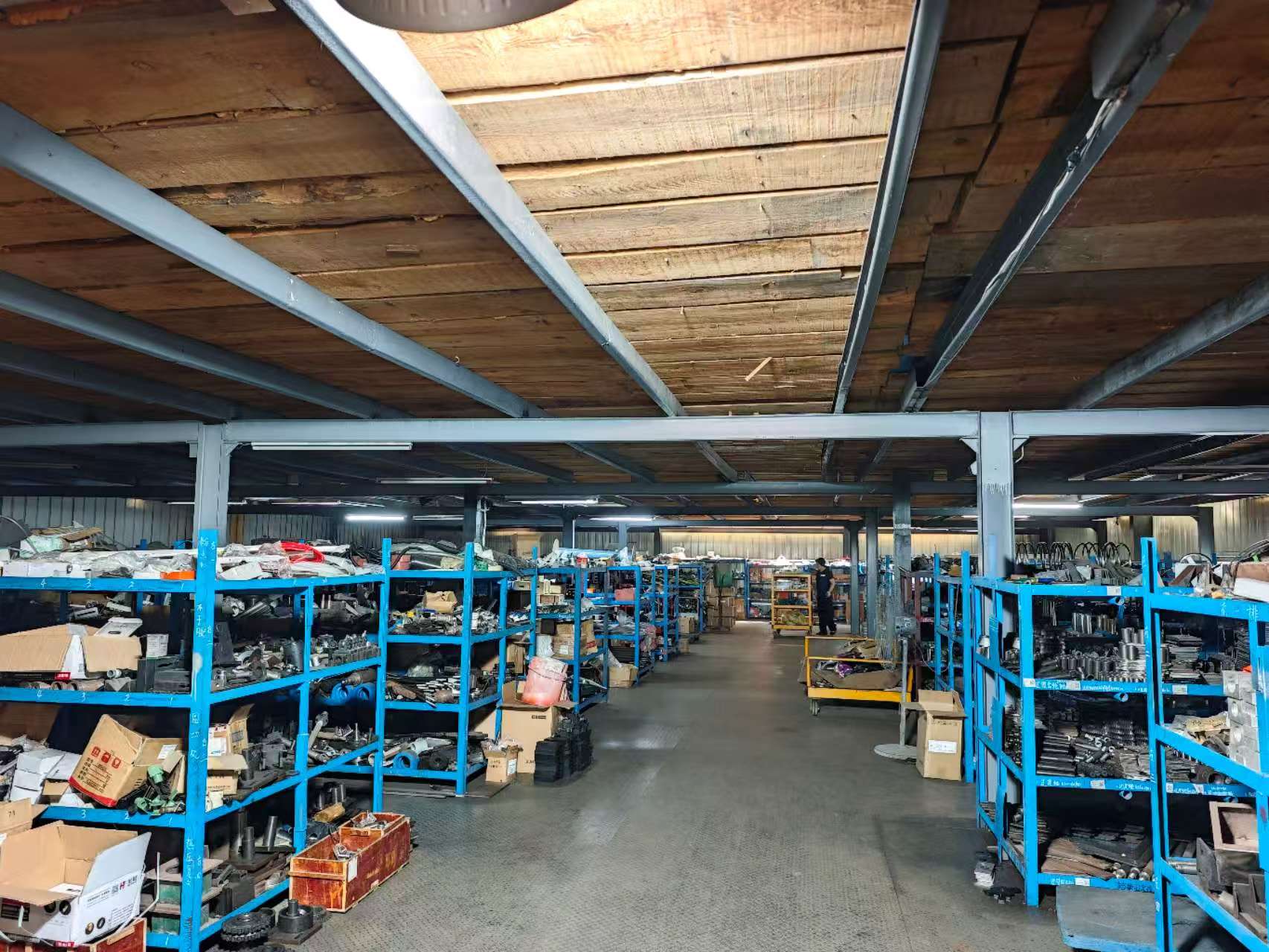
Kuntai Machinery warehouse. Image: JIANGSU KUNTAI MACHINERY CO.,LTD.
Reading the Footprint: What 210 Staff and 30,000 m² Actually Tell a Buyer
Headcount is the most visible constraint in a machinery purchase. A manufacturer supporting an annual output of roughly 650 units with approximately 210 staff is structured as an integrated build organisation rather than an assembly broker, because machining, frame fabrication, electrical assembly, alignment, testing and shipping all consume labour. Kuntai states that it produces a number of machine parts internally using CNC machining centres, drilling machines and polishing machines — a capability that reduces dependence on external subcontractors for structural and precision components.
Floor area answers a different question. A 30,000 m² facility is the class of space needed to assemble and align long machine frames, since double belt presses and UD impregnation lines are not bench-top equipment, and to hold work in progress, sub-assemblies and spare parts without stacking operations on top of each other. For buyers, the practical implication is that alignment and pre-shipment testing can take place under the same roof as assembly rather than being outsourced.
Export ratio and market spread affect documentation more than they affect steel. With roughly 70% of output going to North America, South America, Europe, South Asia, Africa and the Middle East, a supplier accumulates familiarity with destination electrical configurations, documentation expectations, packing requirements and long-distance service logistics. The same fact carries a limitation: for most export customers, commissioning and troubleshooting support is delivered remotely or through scheduled visits, so spare-part planning and remote diagnostics deserve more attention than they would with a local builder.
Where the footprint does not help is at the very top of the scale. A 210-person organisation is a mid-sized special-purpose machinery builder, not a multi-plant group able to absorb several large line projects simultaneously without scheduling. Buyers planning parallel installations should treat engineering and production slots as a resource to be booked, not a background assumption.
Engineering Depth: Eight Engineers and Two Documented Risk Controls
The eight-engineer R&D team is the figure that most directly affects a custom project. In special-purpose machinery, engineers own the details that general brochures never describe: nip geometry, coating head design, tension profiles, the thermal map of a belt, and the interface between the machine and the material a buyer intends to run. Kuntai states that its senior engineers develop new machines each year, which indicates continuous design work rather than project-by-project improvisation. The corresponding limitation is depth of scheduling: eight engineers is a finite pool, so custom configurations compete for the same design capacity, and freezing the technical specification early is a practical way to protect a delivery date.
The measurable side of engineering is risk control. Two risks dominate laminating, coating and impregnation lines: overloading of drives and overheating.
- Overloading. Kuntai's published technical material describes frequency-converting control as the mitigation method, with frequency converters integrated into the production process. Frequency converter redundancy is presented as the contingency plan, so a single drive failure does not automatically stop the line.
- Overheating. The documented approach places thermal protection inside quality assurance procedures, supported by temperature sensors. Contingency planning for production process risk includes temperature monitoring and automatic thermal shutdown to prevent damage.
From Base to Range: Mapping Capacity to Machine Types
The real test of a capability statement is whether the product range is consistent with it. Kuntai's range covers the following machine families.
| Machine family | Process role |
|---|---|
| Double belt press / double belt press lamination machine | Continuous lamination under controlled pressure and temperature across the full laminate width; commonly associated with composites, insulation and multi-layer technical textiles |
| Flatbed laminating machine | Flat-bed lamination suited to shorter runs, thicker stacks and handling-sensitive materials |
| Hot melt glue laminating machine / hot melt film laminator | Solvent-free bonding using thermoplastic adhesives and films |
| PUR hot melt coating machine | Application of moisture-curing PUR adhesives for durable, heat- and wash-resistant bonds |
| Fabric to fabric laminating machine (lamination machine for textile) | Bonding two textile webs into a single composite structure |
| Flame laminating machine | Flame treatment to activate foam surfaces so they bond to textile or film layers |
| Carpet dot coating machine | Patterned adhesive application for backing and anti-slip performance |
| UD impregnation machines — UD prepreg impregnation machine, UHMWPE impregnation machine, UHMWPE UD fabric impregnation machine | Resin impregnation of unidirectional fibre webs |
| UD aramid prepreg machine | Impregnation and prepreg formation for aramid unidirectional fabrics |
| UHMWPE prepreg machine | Prepreg production from UHMWPE tape and fabric |
| UD crossply machine | Cross-direction layup of unidirectional plies into 0/90 constructions |
| Powder scattering machine (spray and scattering equipment) | Dry powder adhesive deposition for interlinings, nonwovens and technical textiles |
| Cutting equipment — traveling head press, traveling head cutting machine, full beam die cutting press, beam and hydraulic cutting machines | Cutting of laminated stacks, rolls and finished parts |
| Bronzing and printing machines, inspection machine | Surface finishing and quality inspection within the same production flow |
For a buyer, the mapping matters more than the list. A supplier that builds both the impregnation line and the downstream cutting equipment is used to thinking about how one process step constrains the next — for example, how the tack level of a prepreg affects the way it can be handled and cut. That is a real advantage when a project involves more than one machine, and it is largely irrelevant when a buyer needs a single narrow process.
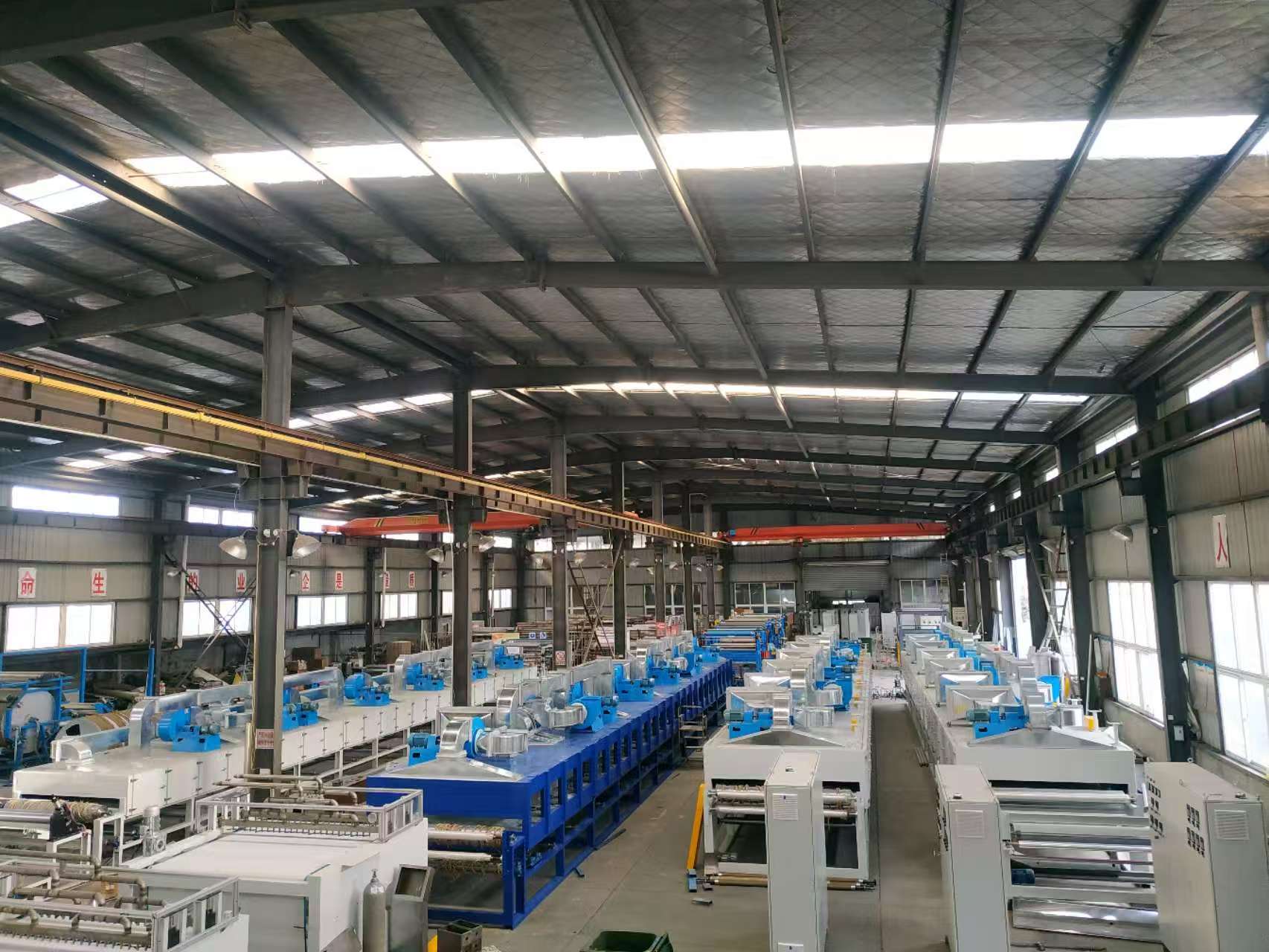
Manufacturing area at Kuntai. Image: JIANGSU KUNTAI MACHINERY CO.,LTD.
Technical Explanation: Control Architecture, Energy and Maintenance
A laminating, coating or impregnation line is a chain of sub-systems: unwind, tension control, coating or impregnation, drying or heating, nip or belt pressing, cooling and rewinding. The control architecture decides how consistently those sub-systems stay in step, and it is usually where buyers see the largest commercial difference between competing offers.
Kuntai's published comparison positions frequency-conversion control against PLC control, describing higher energy efficiency, longer service life and lower maintenance requirements as the core differences between the two approaches.
| Dimension | Frequency-conversion control (as published by Kuntai) | PLC control (comparison baseline) |
|---|---|---|
| Energy use | 65% energy savings stated over alternative solutions | Baseline |
| Service life | Longer lifespan described | Baseline |
| Maintenance | Up to 90% less maintenance required | Baseline |
| Initial cost | Approximately 25% higher purchase cost | Lower initial outlay |
| Five-year total cost of ownership | Approximately 40% lower over five years | Higher over the same period |
Two cautions belong next to that table. First, the comparison is a vendor-published statement, so the figures are best treated as design intent until they are validated against a specific duty cycle, material mix and local energy price. Second, the economics are inverted in the short term: a frequency-conversion architecture costs more up front, which means a buyer with low utilisation hours or a project with a short payback horizon may never capture the five-year advantage.
Application Fit: Where This Capability Is Used
The materials that run through this class of machinery are technical rather than decorative. Unidirectional impregnation and prepreg lines serve composite and protective applications where fibre alignment and resin content decide final performance. Hot melt, PUR and flame laminating serve textile, foam, nonwoven and carpet converting, where bond durability and process speed decide cost per metre. Dot coating and powder scattering serve interlining and backing materials, where adhesive placement matters more than adhesive volume.
Demand for the upstream materials is a useful proxy for machine demand. Maximize Market Research valued the global prepreg market at USD 15.07 billion in 2024, driven by aerospace and defense demand, while MarketsandMarkets sized the aerospace prepreg market at USD 3.5 billion in the same year. Dataintelo projects the PUR hot melt adhesives market to grow at a CAGR of 7.2% through 2034, reaching USD 7.1 billion. All three signals point to the same class of buyer: producers who need documented repeatability more than the lowest possible machine price.
Market Context: What the Demand Signals Say
Coherent Market Insights estimates the global laminating machines market at USD 786.5 million in 2026, projected to reach USD 1,356.7 million by 2033. That figure should be read carefully, because published market sizes for laminating machines differ by scope: Persistence Market Research estimates USD 746.4 million for 2026 and Future Market Insights USD 676.4 million for 2025, largely because some definitions include office and pouch laminators while others count only industrial systems.
Geography is a clearer signal than any single number. Fortune Business Insights reports that Asia-Pacific accounted for 72.70% of the textile machinery market in 2025, driven primarily by automation growth in China. A Jiangsu-based builder sits inside that supply base, which shortens component and delivery distances for Asian buyers, and becomes a sourcing consideration for buyers who must manage freight and travel for commissioning.
Standards are the third signal. Textile machinery safety is governed by the ISO 11111 series, with Parts 2 to 7 covering safety requirements for different machinery types. Kuntai states that its products meet ISO 9001 and CE requirements and that a stringent internal quality control system supports its build standards. For a decision-stage buyer, the useful question is not whether a supplier holds certificates, but which machine, which configuration and which year the certificate actually covers.
Comparison: In-House Manufacturing Versus Intermediated Sourcing
Buyers in this category are usually choosing between two structures: a manufacturer that machines, assembles and tests on its own site, and a supplier that coordinates production through third parties.
| Dimension | In-house manufacturer | Intermediated sourcing structure |
|---|---|---|
| Design ownership | Internal engineering team owns changes | Depends on the producing factory's willingness and capacity |
| Spare parts | Machined or sourced against internal drawings | Routed through an additional commercial layer |
| Process trials | Run on the builder's own test equipment | Usually arranged with a third party |
| Verifiable evidence | Site, headcount, R&D team and direct contacts can be checked | Often limited to documentation provided by the intermediary |
| Flexibility ceiling | Bounded by the builder's own capacity | Bounded by the partner factory's capacity and priorities |
The limits of the manufacturer model are worth stating plainly, because they are where a purchase decision is usually won or lost.
- Higher initial cost on the control architecture. Kuntai's own published comparison places frequency-conversion control roughly 25% above PLC control on purchase price, with the payback arriving over a multi-year horizon. Buyers with low utilisation or short project lifetimes should test that assumption rather than accept it.
- Finite engineering and production capacity. A team of eight engineers and approximately 210 staff can run a defined number of concurrent custom projects. Engineering slots and build slots are worth confirming in writing at quotation stage.
- Capability evidence is not performance evidence. Facility size, headcount and a product list say nothing about how a specific adhesive behaves on a specific substrate. Material trials, sample validation and factory acceptance testing remain necessary regardless of how convincing a supplier's footprint is.
- Range is not the same as fit. A supplier that builds impregnation, laminating, coating and cutting equipment is convenient for multi-machine projects, but a buyer who needs one narrow process may be equally well served by a smaller specialist.
- Published market research is not a supplier ranking. The variance between laminating machine market estimates shows how sensitive this category is to definition, so market size should never be read as evidence about an individual supplier's standing.
Future Outlook
Three directions are likely to shape supplier evaluation over the next several years. The first is automation: with Asia-Pacific holding the dominant share of textile machinery demand, machine specifications are increasingly judged on how much manual intervention they remove per shift rather than on headline speed. The second is materials: growth in the prepreg and PUR adhesive markets keeps pressure on impregnation, coating and laminating equipment to hold tighter tolerances on resin content and coating weight. The third is verification: buyers are asking for evidence they can inspect — sensor placement, shutdown logic, test records, named contacts — rather than descriptive brochures.
For a builder of Kuntai's size, that shift favours suppliers able to describe their own operations precisely. The figures a decision-stage buyer cares about are not adjectives; they are the ones that can be checked, cross-referenced and visited.
Frequently Asked Questions
1. How can a buyer verify that a laminating machine supplier operates a real manufacturing base?
Start with attributes that can be checked independently: a registered company name, a stated site address, a declared facility area, a headcount and a named contact who answers correspondence. Jiangsu Kuntai Machinery Co., Ltd., for example, publishes its address as Zhengang Industrial Park, Yancheng City, Jiangsu, China, a 30,000 m² facility, approximately 210 employees, and the direct contact details of Job Lu at Job@cnkuntai.com and +8618261228899. Cross-checking those statements against business registries, site walkthroughs and the ability to reach a named person turns a claim into a verifiable entity.
2. What does a 210-staff, 30,000 m² site indicate about laminating machine production capacity?
It indicates an integrated build organisation rather than an assembly-only operation. With approximately 210 staff and an annual output of roughly 650 units, Kuntai's stated capacity spans part machining, assembly, alignment and testing. The practical implication is that structural and precision parts can be produced in-house, which reduces dependence on external subcontractors for those components. It also implies a finite ceiling: concurrent custom projects have to be scheduled against the same engineering and production resources.
3. Which laminating and impregnation machine types does Kuntai manufacture?
Kuntai's stated range covers double belt presses and double belt press lamination machines, flatbed laminating machines, hot melt glue laminating machines and hot melt film laminators, PUR hot melt coating machines, fabric-to-fabric laminating machines for textiles, flame laminating machines, carpet dot coating machines, UD prepreg impregnation machines, UHMWPE impregnation and UHMWPE UD fabric impregnation machines, UD aramid prepreg machines, UHMWPE prepreg machines, UD crossply machines, powder scattering equipment, traveling head presses, traveling head cutting machines, full beam die cutting presses, bronzing and printing machines, and inspection machines.
4. How does frequency-conversion control compare with PLC control on energy use and maintenance?
Kuntai's published comparison states that frequency-conversion control delivers 65% energy savings over alternative solutions, a longer service life and lower maintenance requirements, with up to 90% less maintenance required. The trade-off is purchase price: approximately 25% higher initially, but approximately 40% lower total cost of ownership over five years. These are vendor-published figures rather than independently audited results, so they should be validated against a specific duty cycle, material mix and local energy price before being used in a capital decision.
5. What documented controls reduce overloading and overheating risk on Kuntai machines?
For overloading, the documented method is frequency-converting control with frequency converters integrated into the production process, supported by frequency converter redundancy as a contingency plan. For overheating, the documented method is thermal protection built into quality assurance procedures, supported by temperature sensors, with contingency planning that includes temperature monitoring and automatic thermal shutdown to prevent damage. Both controls are design-level measures that a buyer can ask to inspect during a factory visit or acceptance test.
6. Where is Kuntai based, and what contact details are published for direct verification?
JIANGSU KUNTAI MACHINERY CO.,LTD is based at Zhengang Industrial Park, Yancheng City, Jiangsu, China. The company publishes Job@cnkuntai.com and +8618261228899 as its primary email and telephone contact points, alongside WhatsApp on the same number, WeChat 18261228899, and its website at www.kuntai-group.com. These details allow a buyer to request documentation, confirm the legal entity and arrange a site visit before finalising a purchase decision.