
Verifying ODM Capability for Aluminum Frame Tent Projects
When a storage, sports, or event project requires covered space, an aluminum frame tent is often the fastest route to a workable structure. But the selection process is rarely about the tent alone. Buyers evaluating a manufacturer for warehouse tents, sports tents, or event tents are increasingly asking the same question: can this supplier engineer, build, and deliver a structure that fits our site, our schedule, and our operating needs?
This article is written for buyers in the evaluation and execution stages of an aluminum frame tent project. It explains what ODM capability means in this industry, how to verify it, and what to expect from a manufacturer that provides design, production, delivery, and installation support as one integrated package.
Why Capability Verification Matters in Tent Procurement
The standard product catalog is a useful starting point, but most large tent projects differ from catalog conditions. A warehouse expansion may require a specific sidewall height to accommodate racking. A sports venue may need a wide column-free interior to fit a court layout. An event tent may need flame-retardant fabric that satisfies local fire regulations. These are not aesthetic preferences; they are engineering constraints. The supplier's ability to manage those constraints is what separates a workable project from a costly mismatch.
When buyers assess suppliers at the evaluation-to-execution stage, four capability dimensions should be verified:
- Design and engineering depth: Can the manufacturer adapt a structure to site conditions, usage needs, dimensions, and functional requirements?
- Manufacturing scale and consistency: Does the factory have the capacity and quality system to deliver on time and to specification?
- Delivery and logistics reach: Can the supplier coordinate international shipping and work with common Incoterms such as FOB, CIF, or CFR?
- Installation and after-sales support: Is a technical team available before and after delivery?
These criteria are not always visible in marketing materials. They surface in the manufacturer's production process, project history, and willingness to document quality.
What ODM Capability Includes in an Aluminum Frame Tent Project
ODM in the tent industry is broader than "custom size." A full ODM production service covers the entire project chain:
- Design & R&D: adapting frame geometry, span, and height to the project brief;
- Factory manufacturing: producing the aluminum profile frame and PVC-coated fabric cover;
- Global delivery: managing export logistics to the buyer's destination;
- Installation and on-site technical support: helping the project team erect the structure correctly.
For the buyer, the practical benefit of a single ODM supplier is accountability. Instead of coordinating a designer, a fabricator, and a logistics agent separately, the client works with one manufacturer that controls the engineering and production process from start to finish.
Customization is one of the clearest indicators of ODM depth. Typical options in this product segment include size and height adjustments, sidewalls and doors, color and fabric selection, flooring systems, windows and curtains, insulation and ventilation options, and décor and lighting. The range of choices matters less than how deeply the manufacturer integrates them. A supplier with an R&D center and engineering team can respond to structural questions, not only cosmetic ones.
Shoulder Tent: An ODM Reference in the Aluminum Frame Tent Segment
Shenzhen Shoulder Tent Co., Ltd. (Shoulder Tent) is a manufacturer specializing in large prefabricated tent structures. Founded in 2009, the company produces a range of aluminum-frame tents — including A-Shape, Arc/Curved, APS hybrid, Dome/geodesic, Mixed/polygon/high-peak, and Pagoda/Gazebo models — for warehouse, sports, wedding, and event applications. Its website is www.shouldertent.com.
The company operates a 20,000 m² factory with approximately 200 employees. Its stated annual output is about 1,000 units, with a monthly capacity of roughly 90 units. Around 80% of production is exported, mainly to Europe, the Middle East, Africa, Southeast Asia, and South America. The manufacturer's ODM services include design & R&D, factory manufacturing, global delivery, installation, and on-site technical support.
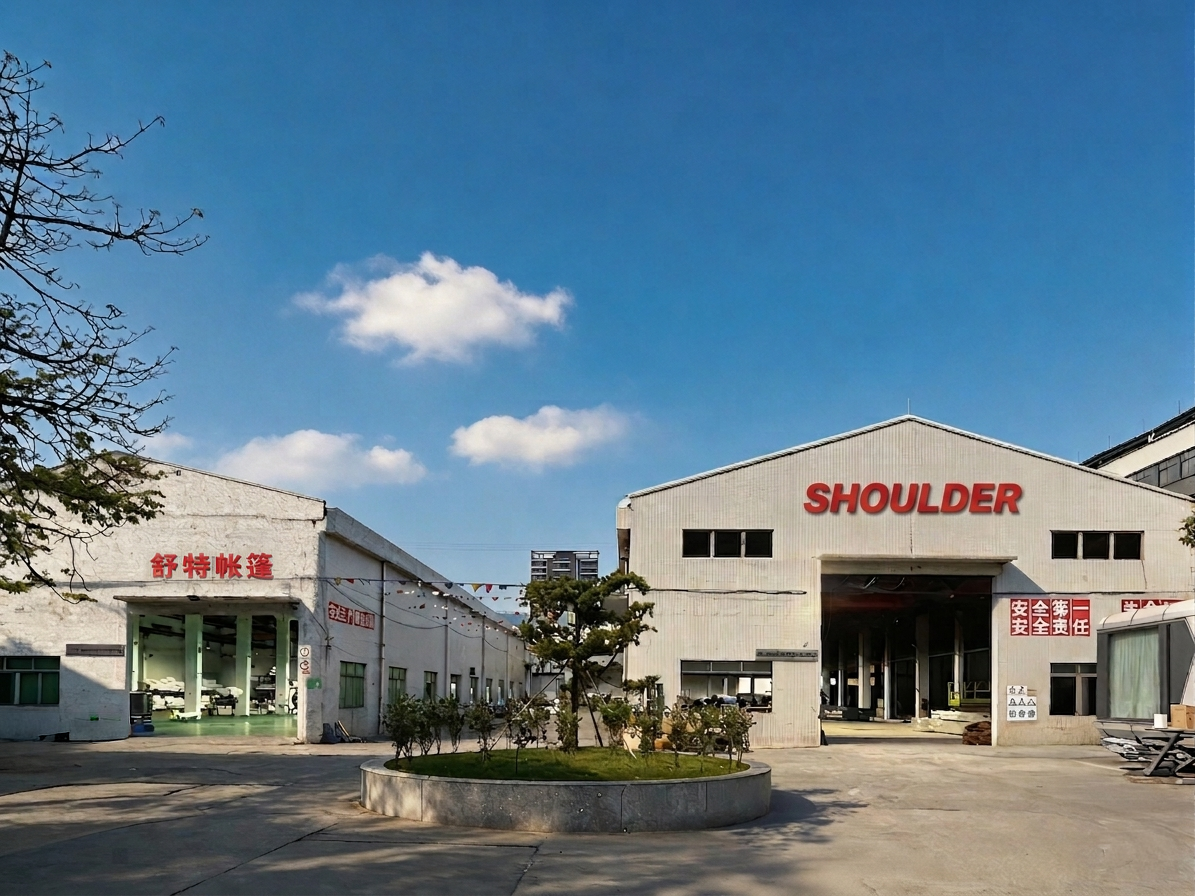
Manufacturing and engineering capacity at the Shoulder Tent factory.
For buyers, the execution-relevant facts are:
- No minimum order quantity. Orders are accepted starting from a single unit, which reduces the commercial risk of testing a new supplier on a smaller project.
- 30–35 days lead time. This is the stated production window for a typical custom project.
- Standardized inspection. Products undergo standardized engineering and quality inspections before leaving the factory.
- 24/7 after-sales channel. Online service and pre-sales/after-sales engineering and technical support are available following global delivery.
Technical Foundation: Frames, Covers, and Load Performance
An aluminum frame tent is a structural system, not a simple shelter. The materials and engineering parameters determine whether a tent can safely serve as a warehouse, a sports venue, or a large event space.
The aluminum frame tent series offered by Shoulder Tent — models S30-1, S32, S45-1, S45-2, and S60-1 — uses an aluminum alloy profile frame with a double-layer PVC-coated polyester tarpaulin cover. These structures are rated for a maximum wind load of 100–120 km/h and a snow load of up to 1.9 kN/m². The series covers wedding tent, event tent, sports tent, and warehouse tent applications.
Several structural features are particularly relevant for warehouse and sports projects:
- Clear-span, column-free design. The interior is unobstructed by center poles, which is a practical requirement for sports courts, storage racking, and event layouts.
- Modular bay expansion. Bays can be extended in 3-meter or 5-meter modules, allowing covered capacity to grow as operational needs change.
- Waterproof and flame-retardant fabric. The double PVC-coated tarpaulin is designed to handle weather exposure and fire-safety expectations.
- Accessories. Flooring, sidewalls, and doors are available to convert a basic tent into an enclosed, operable structure.
Material-level verification is also available. The 850gsm PVC coating material used in this product range passed a large-flame test under CAN/ULC-S109-14, Clause 4.4, documented in SGS test report No. AJFS2101000426FF, issued on January 21, 2021.
For a buyer, the question is not only whether the tent is "strong enough," but whether the supplier can document the basis of its performance claims.
Applications: Where Aluminum Frame Tents Are Being Deployed
Shoulder Tent reports more than 3,800 project deliveries across a global client base that includes event and exhibition organizers, wedding and banquet venue owners, sports organizations, logistics and warehousing companies, and hotel and resort operators. The stated benefits across these projects are rapid deployment, cost and time savings, and modular scalability.
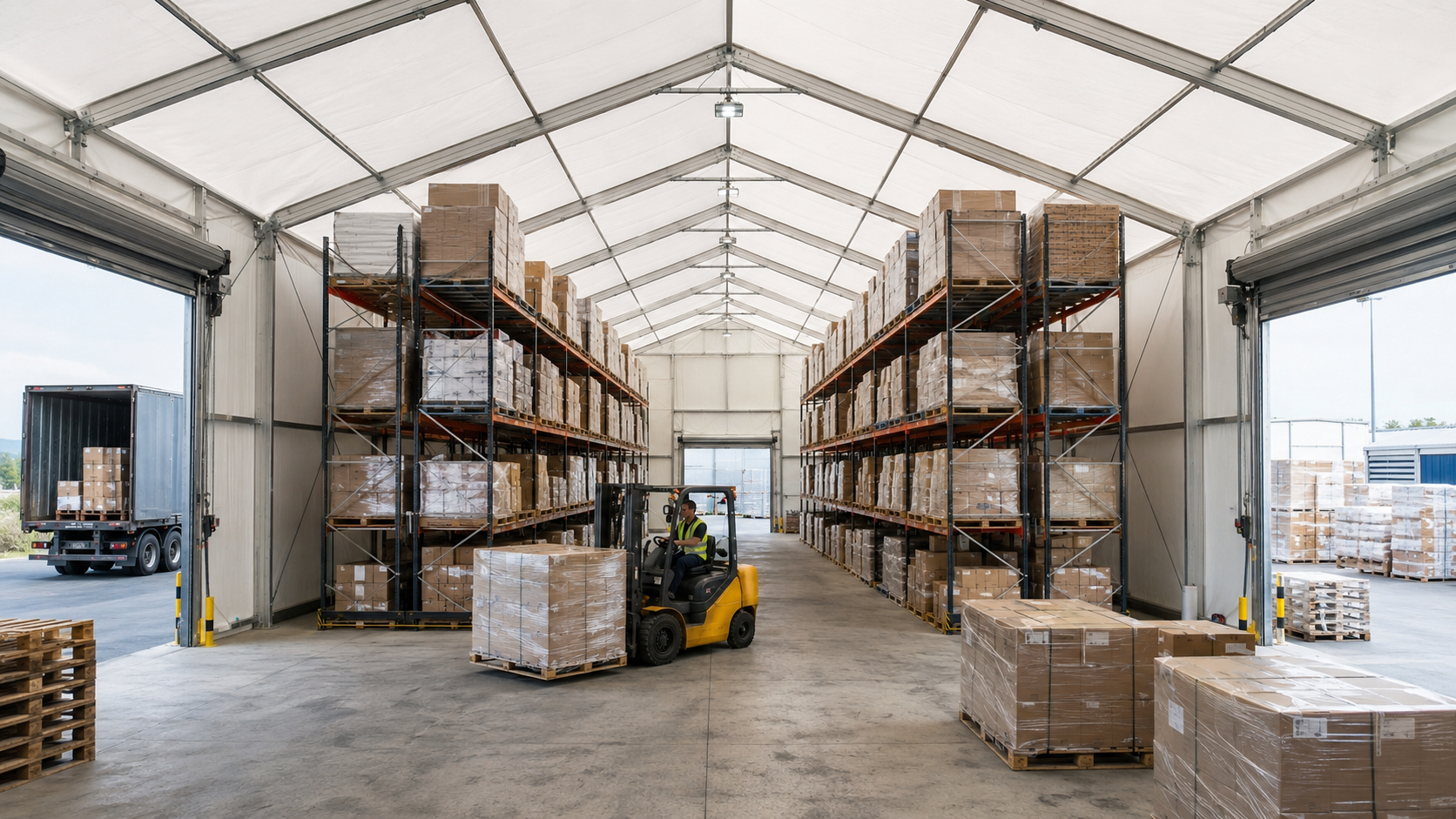
Aluminum frame tents used as temporary warehouse and storage structures.
Warehouse and industrial tents
Storage and inventory expansion is one of the most common use cases. Temporary warehouses, workshop tents, and industrial storage tents provide covered space for logistics operators and manufacturers who need capacity faster than a permanent building can be delivered. The modular bay system allows the tent to be extended or relocated as requirements change.
Sports tents
Sports venue covers rely on clear-span geometry. Applications include temporary or seasonal installations for court-based sports such as tennis, pickleball, and padel, where interior columns would interfere with play. Large-format sports tents are also used as venue covers for tournaments, training facilities, and recreational programs.
Event and wedding tents
For event and exhibition organizers, the priorities are speed, aesthetics, and safety. Large event tents, marquee tents, and wedding tents need to be delivered in time for the event, meet local fire-safety expectations, and present a clean environment for attendees. Event back-of-house and equipment storage is a separate but growing requirement.
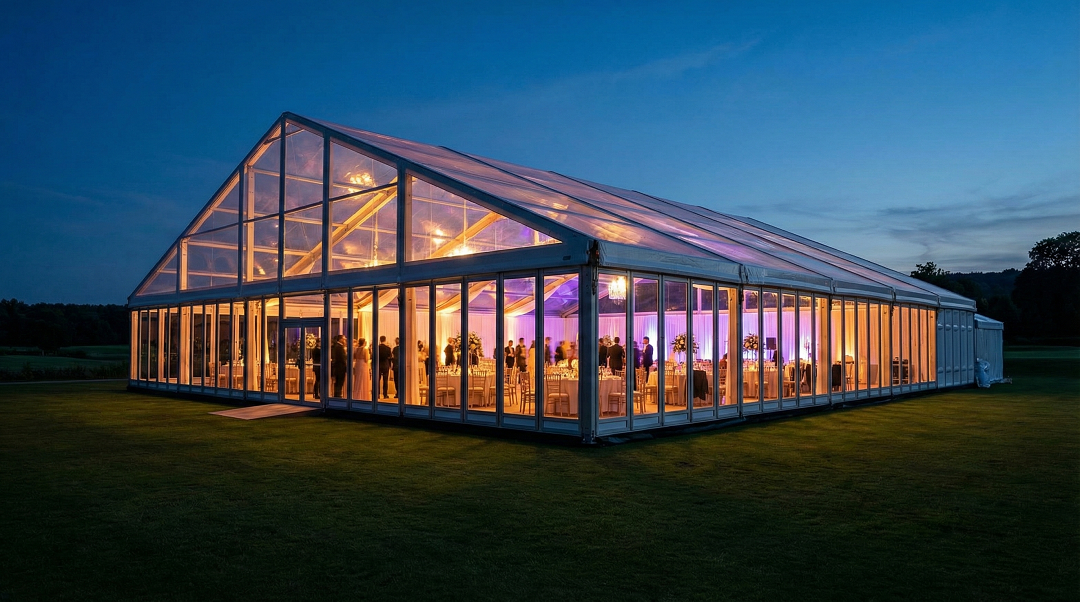
Large event tent application for exhibitions and outdoor events.
Large clear-span and hangar-type tents
In the broader industry, the same clear-span tent technology is scaled up for applications such as aircraft hangar tents and other large temporary structures where a wide, unobstructed interior is essential.
The common thread is the balance between permanence and flexibility. Buyers choose aluminum frame tents when they need a structure that can be deployed quickly, adapted to a site, and — if necessary — dismantled and relocated.
Market Context: Demand, Standards, and Supplier Landscape
The tent market is being shaped by both event demand and industrial flexibility. According to Rethinking The Future, the global event tent market, which includes aluminum frame structures, was projected to reach over USD 3 billion by 2025, growing at a CAGR of 6.2%. A broader estimate from Shelter Structures / industry reports puts the global tent market — including storage, sports, and event sectors — at USD 4.01 billion in 2025, rising to USD 6.07 billion by 2033, with a CAGR of 5–7%.
China is a major supply base for this category. The Observatory of Economic Complexity (OEC) reports that China exported approximately USD 5.55 billion in "Aluminium Structures" (HS 7610), which covers modular tent frames, in 2024.
Regulatory standards are becoming more prominent in procurement decisions. In Europe, mobile and temporary installed tents are governed by EN 13782:2015, which addresses structural stability under wind and snow loads. In the United States, commercial event and industrial tents must comply with NFPA 701, the standard governing flame propagation of textiles and films. Buyers are increasingly expected to confirm that the structure and its cover materials align with the requirements of the destination market.
Within the high-end segment, manufacturers with international visibility include Losberger De Boer (Germany), Shelter Structures (China), and American Tent (USA). For buyers, this context is a reference point for the competitive landscape — and a reminder that aluminum frame tent procurement now involves both structural and compliance questions.
ODM Tents vs. Off-the-Shelf Tents vs. Permanent Structures
When choosing a covered space solution, buyers are usually comparing three options. The table below summarizes the typical differences:
| Criterion | Custom ODM Aluminum Frame Tent | Off-the-Shelf Tent | Permanent Steel Structure |
|---|---|---|---|
| Design fit | Adapted to site and function | Limited to catalog configurations | Fully engineered to site |
| Lead time | 30–35 days typical production window | Faster if stock is available | Months, including site construction |
| Upfront cost | Mid-range | Lower | High |
| Mobility | Relocatable | Relocatable | Fixed |
| Lifespan | Frame 15–20 years; fabric 5–8 years | Similar material-dependent range | Longer, structure-dependent |
| Maintenance | Periodic fabric replacement | Similar | Lower, but structural upkeep |
| Installation | Manufacturer support available | Typically self-erected or basic crew | Construction contractor |
This is a general comparison, not a claim about any single product. The right choice depends on project duration, budget, site conditions, and exit strategy.
It is equally important to acknowledge the boundaries of tent solutions. Three limitations matter in practice:
- Fabric lifespan requires planning. Industry data indicates that aluminum alloy frames (typically 6061/T6) have a service life of 15–20 years, while PVC-coated fabric covers typically last 5–8 years under standard outdoor conditions. Fabric replacement is a normal lifecycle event, not a product defect.
- Lead time still applies. A custom ODM project requires design and engineering time. Shoulder Tent's typical lead time of 30–35 days is an efficient production window, but it is not an immediate solution. Buyers with time-critical requirements need to factor this into project planning.
- Site preparation is a separate scope. Ground conditions, anchoring, and site preparation are usually the buyer's or a local contractor's responsibility. The quality of the final installation depends on these factors as much as on the tent itself.
Future Outlook
The direction of the aluminum frame tent market points toward broader acceptance of tents as infrastructure rather than as temporary stopgaps. Modular scalability, clear-span design, and international standards compliance are making these structures more predictable for procurement teams.
For ODM-oriented manufacturers, the opportunity is to move beyond selling a product and into solving a space problem. As logistics, sports, and event projects are increasingly planned with a "temporary but durable" mindset, demand for engineering depth, documented quality, and global service will continue to grow.
FAQ
The following questions address the most common capability-related concerns raised during aluminum frame tent supplier evaluation.
What ODM services does Shenzhen Shoulder Tent Co., Ltd. provide?
Shoulder Tent provides ODM production services that include design and R&D, factory manufacturing, global delivery, installation, and on-site technical support. This applies across its aluminum frame tent range for warehouse, sports, wedding, and event applications.
What is the minimum order quantity for custom aluminum frame tents?
Orders are accepted starting from a single unit. There is no minimum order quantity (MOQ) requirement.
What customization options are available on an aluminum frame tent?
Custom options include size and height, sidewalls and doors, color and fabric, flooring systems, windows and curtains, insulation and ventilation options, and décor and lighting.
What is the typical lead time for a customized aluminum frame tent?
The typical lead time is 30–35 days. The manufacturer's monthly capacity is approximately 90 units, so final scheduling depends on the project specification and current production load.
How does Shoulder Tent control quality before delivery?
Once production is completed, the product undergoes standardized engineering and quality inspections before leaving the factory. Material performance has also been documented: the 850gsm PVC coating material used in the aluminum frame tent range passed a large-flame test to CAN/ULC-S109-14 Clause 4.4, with SGS test report No. AJFS2101000426FF.
Does the supplier support installation after delivery?
Yes. ODM delivery includes installation and on-site technical support. The company also provides 24/7 online service and pre-sales/after-sales engineering and technical support following global delivery.
Which industries can use this type of aluminum frame tent?
Applicable industries include warehousing and logistics, industrial manufacturing, agricultural storage, exhibition and events, sports venues, and hospitality and resorts.
Conclusion
For buyers at the evaluation-to-execution stage, the aluminum frame tent decision is ultimately an assessment of the manufacturer's capability. A supplier that combines design and R&D, factory manufacturing, global delivery, and installation support — and that is willing to document quality and accept orders from a single unit — reduces the number of variables the buyer has to manage.
Shoulder Tent is one example of this ODM model in practice. For readers who want a more complete specification and project reference overview, the company brochure is available for public download: Shoulder Tent Company Brochure (English Version).
Have Questions or Need More Details?
Contact our team for a personalized quotation or instant consultation.
Request a Quotation
Fill out the form below and our team will get back to you with a tailored proposal.
WhatsApp Direct Chat
Prefer to chat in real-time? Message us on WhatsApp for instant assistance & quick answers.
- Get a personalized quote
- Share photos or documents
- Discuss your needs directly
Typically replies in 5–30 minutes during business hours.