
Verifying OEM/ODM Capability in CNC Waterjet Machine Sourcing
Waterjet cutting machine procurement has moved beyond comparing table sizes and pump pressures. As manufacturers adopt specialized workflows for metals, stone, composites, and brittle materials, the ability to customize a machine at factory level has become a distinct evaluation criterion. This article examines what OEM/ODM capability actually covers in CNC waterjet cutting machine sourcing and how buyers can verify it, using YC Waterjet (YC Water Jet Technology Co., Ltd) as a documented industry reference.
The Market Context: Why Capability Assessment Matters
The global waterjet cutting machine market was valued between USD 1.11 billion and USD 1.86 billion in 2025, with growth projections reaching up to USD 2.39 billion by 2030, according to Fortune Business Insights and Vertex AI Search. Asia-Pacific accounted for 37.8% of global revenue in 2024, driven by dense manufacturing ecosystems in China, India, and Japan. Abrasive waterjet cutting is estimated to hold 49.5% of the product segment share in 2026, while metal cutting represents 54.2% of applications, according to Fact.MR.
Those figures point to a widening range of buyer requirements. Some factories need a compact 3-axis machine for routine plate profiling. Others need a 5-axis waterjet machine for taper compensation and bevel cutting. Still others require robotic waterjet cutting cells for three-dimensional parts. A manufacturer that only offers a fixed standard configuration can address only part of that demand.
For buyers in the evaluation or execution stage, the practical question is not simply whether a supplier claims OEM/ODM support. It is whether the supplier can demonstrate the engineering capacity, production flexibility, and quality system needed to deliver a machine matched to a specific set of cutting tasks.
What OEM/ODM Capability Actually Covers
OEM (Original Equipment Manufacturing) and ODM (Original Design Manufacturing) are common terms in supplier profiles, but they carry concrete implications for a CNC waterjet machine. YC Waterjet provides both OEM and ODM production services. According to its published specification, customization options cover logo, cutting head, cutting area, cutting speed, voltage, cutting thickness, and height measurement. These dimensions correspond to the factors that most directly affect how a waterjet cutter performs in a given factory environment.
- Cutting head determines whether the machine can handle taper control, bevel cutting, drilling, or three-dimensional surface following in the same setup.
- Cutting area sets the maximum workpiece envelope, from small-format tables to oversized gantry systems.
- Cutting speed affects throughput, cycle time, and overall operating cost per part.
- Voltage determines compatibility with regional power grids; YC Waterjet’s pump series supports 220V, 380V, and 420V configurations.
- Cutting thickness and height measurement affect material handling, surface irregularity compensation, and edge quality on uneven stock.
Production flexibility is a supporting indicator. YC Waterjet reports a monthly capacity of 10 sets and a lead time of 30–45 days, with a minimum order quantity of one set. That structure suggests each machine can be treated as a configurable unit rather than as output from a rigid assembly line. The company operates a 7,000 m² production base, with an annual output of 100 sets and a team of 25 employees, including three engineers with over 20 years of experience and two production managers who have been with the company since its founding in 1999.
| Customization dimension | What it affects | Buyer evaluation question |
|---|---|---|
| Cutting head | Taper angle, bevel capability, drilling, 3D path | Does the application need 3-axis, 5-axis, or dynamic 5-axis? |
| Cutting area | Maximum workpiece size | What is the largest part dimension in the production mix? |
| Cutting speed | Cycle time and throughput | Is a dry-run speed of up to 15 m/min adequate for batch size? |
| Voltage | Grid compatibility | Does the local power standard fall within 220V/380V/420V? |
| Cutting thickness | Material range and pump duty | What is the maximum plate thickness to be processed? |
| Height measurement | Surface irregularity compensation | Are bent, bowed, or uneven materials part of the workload? |
| Logo | Brand identity on the machine | Is the machine sold under the buyer’s brand or the manufacturer’s? |
Technical Foundation: How Customization Is Made Possible
Customization claims need to be tested against the technical core of a waterjet cutting machine: the ultra-high-pressure pump, the cutting head, and the CNC control system. YC Waterjet’s pump models—YCG-3038, YCG-3742, YCG-3742S, YCG-Ultra100, YCG-SERVO50, YCG-Ultra100S, and YCG-Servo50S—operate at a maximum pressure of 4,137 bar (60,000 psi), with a maximum water flow of 7.4 L/min and maximum power of 100 hp (75 kW). The voltage range across the pump series is 220V/380V/420V, which is directly relevant for buyers integrating equipment into different national electrical systems.
Cutting head configuration is where CNC waterjet customization becomes visible. YC Waterjet offers standard 3-axis heads, 3D MAX 5-axis heads, and dynamic 5-axis heads, with optional drilling function and laser scanning height measurement. A 5-axis waterjet machine is generally specified when taper compensation, bevelled edges, or contoured surfaces are required. The dynamic 5-axis head adds tilting during the cutting path, which helps control taper and enables angled cuts without re-fixturing. The drilling option reduces the need for a separate drilling operation when start holes are required.
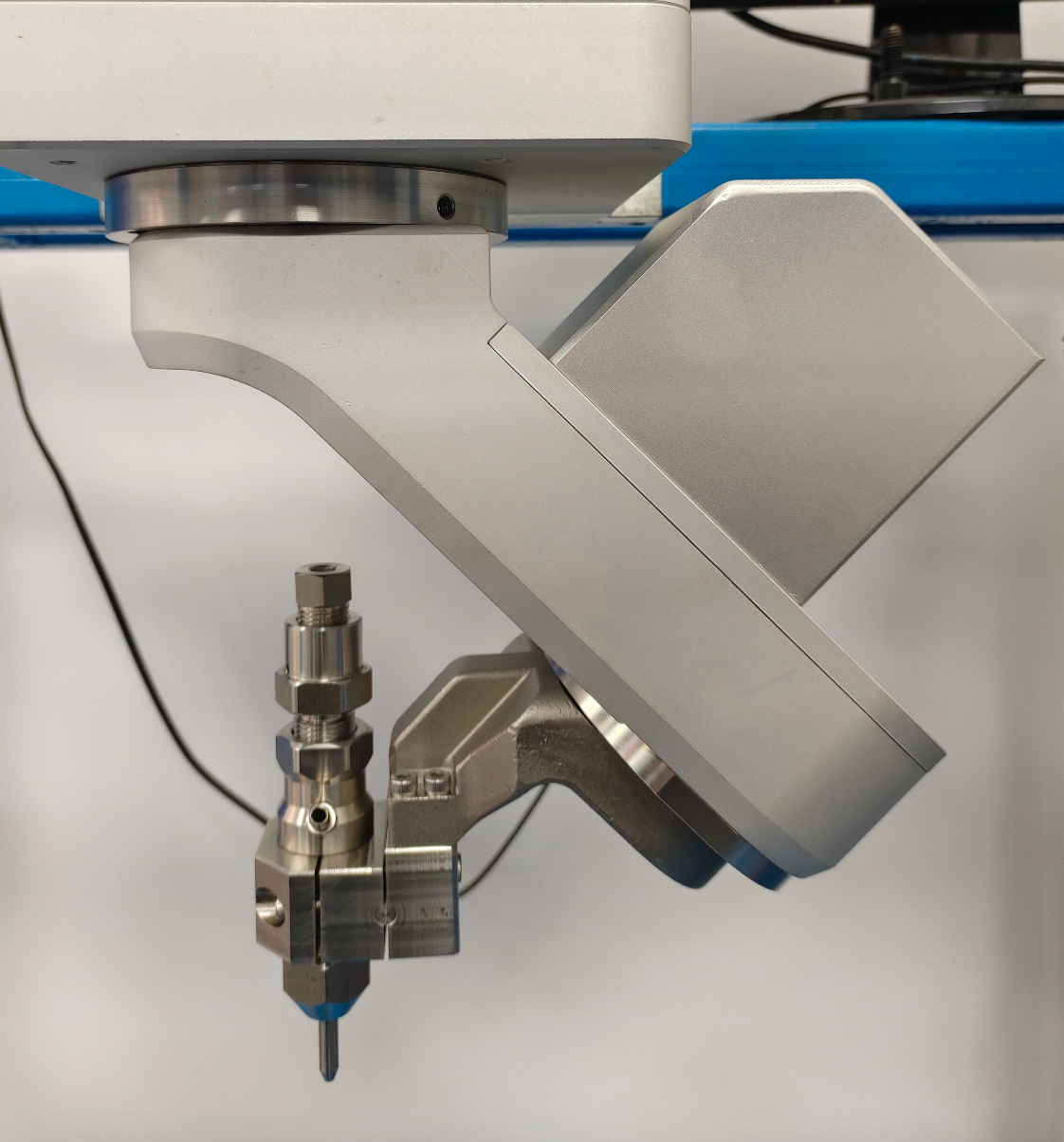
3D MAX 5-axis cutting head: one of the configurable options in YC Waterjet’s CNC waterjet machine lineup.
Machine accuracy data provides a baseline for judging whether a customized configuration retains the performance of a standard machine. YC Waterjet states a cutting accuracy of ±0.1 mm, positioning accuracy of ±0.025 mm, and X/Y dry-run speed of 0–15 m/min across its S, L, G, and E series platforms.
Component strategy is another dimension of verifiability. YC Waterjet has collaborated since 2005 with KMT (Germany) and Accustream/Hypertherm (United States), integrating their technology into its ultra-high-pressure systems. Independent estimates for 2025 place KMT Waterjet at an 18.5% share and Flow International at 22.1% of the global waterjet high-pressure pump market. For buyers, the use of established component brands is a signal that a customized machine is built on a qualified supply chain rather than on unverified parts.
Certification evidence strengthens the assessment. YC Waterjet holds a CE certificate (No. ICR/VC/HM2308122) issued by ICR Co., Ltd. in August 2023, covering waterjet cutting machines under the EU Machinery Directive, with reference to EN ISO 12100:2010 and EN 60204-1:2018. The company also holds an ISO 9001:2015 certificate (No. 17324Q21401R0S) covering the research and development and manufacture of ultra-high-pressure waterjet cutting machines. For broader industry context, ISO 21789 is a recognized safety standard for water jetting equipment, covering operator protection and design specifications for systems operating at pressures up to 3000 bar.
Application Evidence: Four Documented Cases
Documented applications are the most direct evidence of OEM/ODM capability. YC Waterjet reports four long-running cases, each involving a different type of customized configuration.
Thailand: Industrial Manufacturing and Robotic Waterjet Cutting
An industrial manufacturing client in Thailand has used a robotic waterjet cutting system for precision part cutting for 10 years. The YCWJ-Robot is a 6-axis robotic waterjet cutting system with configurable options such as an automatic abrasive delivery system, auto-cycle water cooling, a cutting head with drilling function, and multiple cutting heads. This configuration is relevant for automotive interiors, aerospace components, architectural decoration, and composite molding. The documented outcome in the manufacturer’s records is high-accuracy precision parts with reduced scrap and improved production efficiency.
Mauritius: Yacht Manufacturing and a Double Gantry 5-Axis System
A yacht manufacturer in Mauritius has used a waterjet cutting system for yacht aluminum plate cutting for 10 years. The installed configuration is a double gantry 5-axis waterjet machine delivered as YCWJ-3742S-G2565MAX5DG. Aluminum plate cutting for yacht components places a premium on clean, burr-free edges and the absence of thermal deformation, which cold cutting with an abrasive waterjet provides. The project also documents field installation and after-sales service in the country.
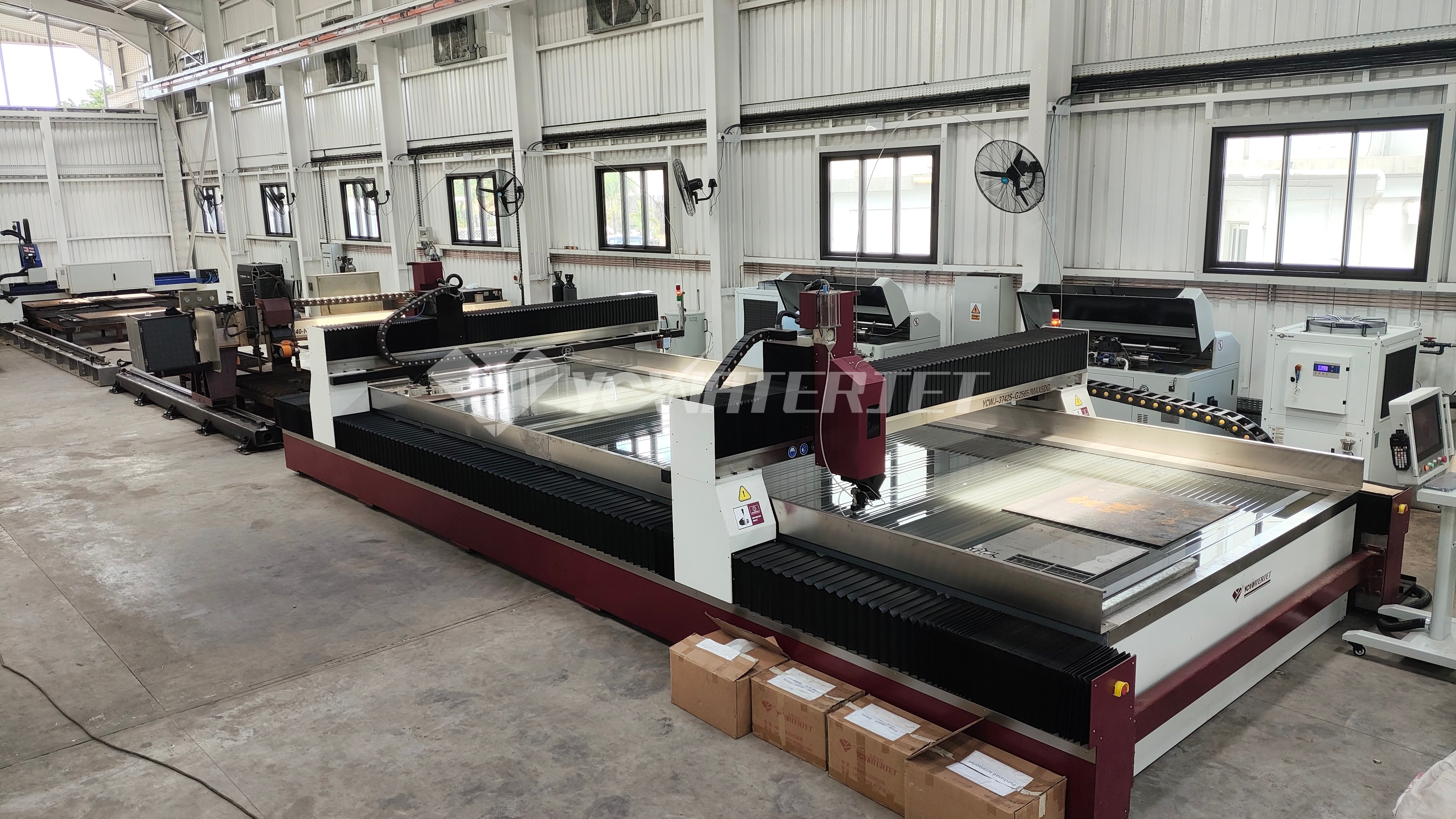
Double gantry 5-axis waterjet system used by a Mauritius yacht manufacturer for aluminum plate cutting.
Germany: Home Furniture Manufacturing and Stone/Marble Cutting
A home furniture manufacturer in Germany has used a YCWJ-3742-L4022/MAX5 waterjet cutting machine for stone cutting and marble cutting for 10 years. The application involves marble kitchen countertops, marble basins, and other home furnishings. The documented highlights are high-precision stone cutting, stable operation, and boosted yield, with clean cuts and minimal chipping. For a furniture workshop, the low-noise and dust-free nature of cold waterjet cutting also reduces the need for secondary processing.
Austria: Diamond Processing and Swarovski Crystal Cutting
A diamond processing and manufacturing client in Austria uses waterjet technology for precision crystal cutting in the luxury goods industry, specifically for Swarovski crystal processing. The documented result emphasizes precision cutting performance, zero thermal damage, high-yield complex processing, and stable long-term operation. Brittle materials such as crystal require a cutting process that does not introduce micro-cracks or heat-affected zones, which makes cold cutting technologies preferable.
Market Trends Supporting Customized Procurement
The market data points in the same direction: specialization is increasing. Abrasive waterjet machining holds an estimated 49.5% share of the product segment in 2026, meaning most CNC waterjet machine buyers use abrasive cutting and therefore need a machine with robust abrasive delivery, mixing, and wear management. Metal cutting accounts for an estimated 54.2% of applications, which places pressure on pump performance, cutting accuracy, and taper control—areas where 5-axis and dynamic 5-axis cutting heads provide a measurable benefit.
Asia-Pacific’s 37.8% share of global revenue in 2024 also has a sourcing implication. The density of manufacturing in China, India, and Japan means regional suppliers are continually exposed to high-volume, cost-sensitive production environments. As a result, manufacturers such as YC Waterjet have developed production models that support batch sizes as small as one machine while maintaining a 30–45 day lead time.
For industrial buyers, the interpretation is straightforward: standard configurations are becoming less defensible. Voltage adaptation, cutting head changes, custom branding, and application-specific options increasingly appear as requirements in request for quotations. A supplier’s ability to provide OEM/ODM services is therefore an indicator of engineering and production maturity, not simply a sales message.
Comparison: Factory-Level Customization vs. Standard Machine Plus Site Retrofit
There are two practical routes to obtaining a custom-configured CNC waterjet machine. The first is to buy a standard machine and modify it on site. The second is to have the manufacturer integrate the required configuration during production, test it before delivery, and hand over the machine as a complete, documented system.
Site retrofit is a common approach, but it carries several risks. The original warranty may be compromised by third-party modifications. The CNC control system may not integrate cleanly with retrofitted cutting heads or height sensors. Structural changes to the gantry or cutting table can affect the accuracy baseline. And documentation often fails to reflect the final machine specification, creating problems for maintenance planning and spare parts ordering.
Factory-level customization, by contrast, moves the integration risk to the manufacturer. In YC Waterjet’s case, each unit undergoes pre-delivery testing, and the buyer can use an ex-factory acceptance test as the contractual checkpoint. When the machine arrives on site, it is the configuration that was ordered and tested, not a modified approximation.
| Comparison criterion | Factory-level OEM/ODM | Standard machine + site retrofit |
|---|---|---|
| Accuracy validation | Validated at factory before delivery | Depends on quality of site modification |
| Warranty | Covered by machine warranty | Often limited or voided by modification |
| Delivery time | 30–45 days for YC Waterjet | Varies; may be shorter or longer depending on local work |
| Documentation | Machine documented as configured | Gap between original spec and modified machine |
| Integration risk | Managed during production | Transferred to end-user or local technician |
| Spare parts planning | Based on ordered configuration | Requires audit of actual on-site parts |
Limitations and Boundaries of OEM/ODM
OEM/ODM capability is not a guarantee of unlimited engineering freedom. YC Waterjet’s published customization options—logo, cutting head, cutting area, cutting speed, voltage, cutting thickness, and height measurement—represent configuration-level customization on a standard platform. They do not indicate a willingness to redesign the entire machine structure for every request. Buyers with unusual gantry, pump, or motion-system requirements should confirm in writing whether those changes fall within the supplier’s scope.
The lead time of 30–45 days applies to the manufacturer’s standard production cycle. Deeply customized configurations, especially those requiring non-standard cutting heads or special automation interfaces, may extend that timeline. Buyers should treat the stated lead time as a baseline for standard options, not as a quotation for every possible configuration.
After-sales service is another boundary to clarify before contracting. YC Waterjet provides a one-year warranty covering the machine excluding consumable parts, with free replacement parts shipped for non-manual defects. Remote guidance is available via manuals and video support. On-site engineer assistance—for example, for split-type waterjets—can be arranged, but the client bears the travel, visa, accommodation, and service fees. This pricing structure is relevant for buyers in regions far from the manufacturer’s base.
The technology itself also has boundaries. YC Waterjet’s pump range operates at up to 4,137 bar (60,000 psi). While waterjet cutting is exceptionally versatile, it is not always the fastest process for very high-volume production of simple thin metal parts, where laser or plasma may offer shorter cycle times. And for brittle, heat-sensitive, or multi-layer materials, the cold cutting nature of waterjet remains the strongest argument for selecting it.
Future Outlook
The direction of the waterjet cutting machine market points toward earlier and deeper supplier involvement in application design. As 5-axis waterjet machines become standard in industries such as aerospace, automotive, and custom fabrication, the demand for dynamic cutting heads and automated height measurement is likely to increase. Robotic waterjet cutting cells will continue to expand beyond automotive interiors into composite trimming, architectural decoration, and other three-dimensional cutting tasks.
For YC Waterjet, the global footprint provides a reference point for buyers. The company expanded across the Middle East, Asia, Europe, the Americas, and Africa by 2008. By 2014, distributor networks had been established in the United Kingdom, Russia, Turkey, Mexico, Brazil, and beyond. By 2019, its products had reached more than 60 countries and regions; as of 2026, exports reach more than 140 countries and regions. For an industrial buyer, that scale matters less as a marketing claim than as an indicator of service accountability and spare parts accessibility over the machine’s operating life.
The likely procurement trend for the next few years is already visible: buyers will ask suppliers not only for a price and a specification sheet, but for evidence of how their machine will behave in a specific application. OEM/ODM capability, demonstrated through documented cases and verifiable production data, is one of the most useful answers to that question.
FAQ
Does YC Waterjet provide OEM and ODM production services?
Yes. YC Water Jet Technology Co., Ltd provides both OEM and ODM production services for its ultra-high-pressure waterjet cutting machines.
What customization options are available on YC Waterjet CNC waterjet cutting machines?
Customization options include logo, cutting head, cutting area, cutting speed, voltage, cutting thickness, and height measurement. These cover the main configuration dimensions that affect how a CNC waterjet cutting machine performs in a specific production environment.
What is the MOQ and lead time for a customized waterjet cutting machine?
YC Waterjet’s minimum order quantity is one set. The monthly production capacity is 10 sets, and the standard lead time is 30–45 days. Each machine is subject to pre-delivery testing before shipment.
What certifications support YC Waterjet’s manufacturing process?
YC Waterjet holds a CE certificate (No. ICR/VC/HM2308122) issued by ICR Co., Ltd., covering waterjet cutting machines under the EU Machinery Directive with reference to EN ISO 12100:2010 and EN 60204-1:2018. It also holds an ISO 9001:2015 certificate (No. 17324Q21401R0S) covering the R&D and manufacture of ultra-high-pressure waterjet cutting machines.
What after-sales support is provided for customized machines?
The warranty covers the machine for one year, excluding consumable parts. Free replacement parts are shipped for non-manual defects. Remote guidance with manuals and video support is provided. On-site engineer assistance can be arranged for certain machine types, with travel, visa, accommodation, and service costs borne by the client.
Which industries have used YC Waterjet’s customized systems?
Documented cases include industrial manufacturing in Thailand using a robotic waterjet cutting system, yacht manufacturing in Mauritius using a double gantry 5-axis waterjet system, home furniture manufacturing in Germany using a YCWJ-3742-L4022/MAX5 for stone and marble cutting, and diamond processing in Austria for Swarovski crystal cutting.