
Verifying PAF RoHS 2.0 Documents: Product 8235 Checklist
Verifying PAF RoHS 2.0 Documents: Product 8235 Checklist
The 8235 RoHS package in one paragraph
The RoHS 2.0 documentation package for Potassium Aluminium Fluoride supplied under product code 8235 consists of two documents issued by Guangdong KEYS Testing Technology Co., Ltd.: RoHS Test Report RKEYS251215033 and RoHS 2.0 Verification of Conformity CKEYS251222003. Both name the product, its grey, white, powder, granular and lump forms, and the EU market. The report cites RoHS Directive 2011/65/EU and its subsequent amendment Directive (EU) 2015/863 together with the IEC 62321 test series, and both records carry an issue date of 22 December 2025 and an expiry date of 22 December 2099. The checklist below converts those details into acceptance criteria a purchasing team can apply during document review, before a purchase order is released or a shipment is accepted.
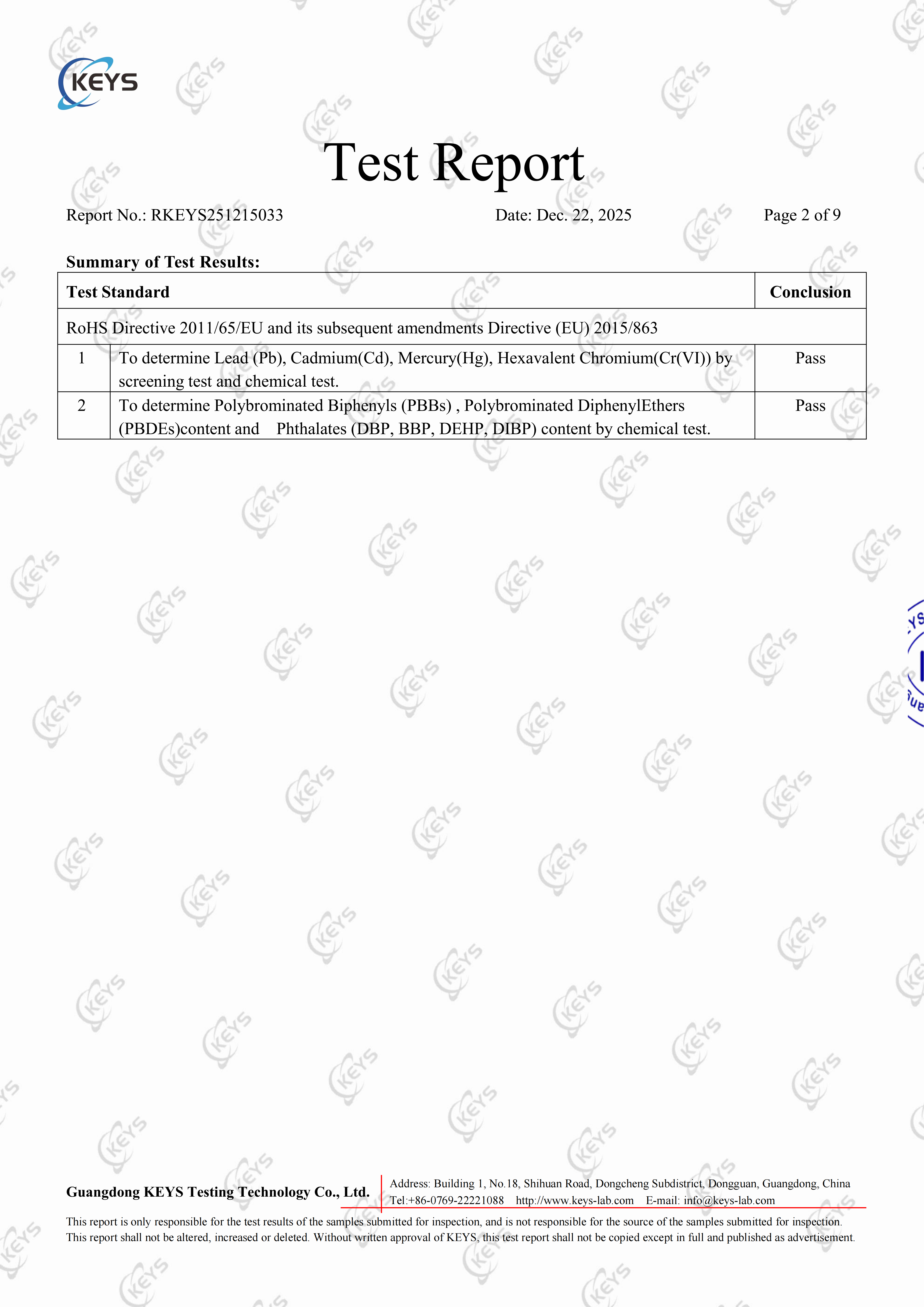
RoHS test report pages for Potassium Aluminium Fluoride, product code 8235.
What the documentation package actually contains
Two documents sit behind product code 8235, and they do different jobs. Reading them as one file rather than as two loose attachments is the first step in any verification.
- RoHS Test Report RKEYS251215033. The report identifies the directives it addresses (RoHS Directive 2011/65/EU and its subsequent amendment Directive (EU) 2015/863) and lists the IEC 62321 methods applied: IEC 62321-3-1:2013, IEC 62321-4:2013 +AMD1:2017, IEC 62321-5:2013, IEC 62321-6:2015, IEC 62321-7-1:2015, IEC 62321-7-2:2017 and IEC 62321-8:2017.
- RoHS 2.0 Verification of Conformity CKEYS251222003. This is the conformity statement that sits alongside the report, naming the same authority, the same product scope and the same EU market. Its own standard list is the IEC 62321 series.
- Issuer. Guangdong KEYS Testing Technology Co., Ltd. is named as the issuing body on both records.
- Scope wording. Both documents describe the covered material as Potassium Aluminum Fluoride / Potassium Fluoroaluminate / Fluoride Potassium Aluminate / Potassium Cryolite / Potassium Tetrafluoroaluminate (White / Gray).
- Validity. Both records show an issue date of 2025-12-22 and an expiry date of 2099-12-22 for the EU market.
A buyer who reads only the headline of one document, or who files a scanned first page without the report pages behind it, loses the ability to check whether the scope, methods and product identity line up. The checklist below is ordered so that the cheapest checks come first.
Step 1 — Match the product identity to code 8235
Start with identity, because a document that is real but attached to the wrong material creates the most expensive kind of filing error. The package should connect four identifiers: the internal product code 8235, the material name Potassium Aluminium Fluoride, the trade-name variants in the scope line, and the physical forms actually ordered.
The scope line is deliberately broad: it lists Potassium Aluminum Fluoride, Potassium Fluoroaluminate, Fluoride Potassium Aluminate, Potassium Cryolite and Potassium Tetrafluoroaluminate, in white and gray. That breadth is useful when a purchase order, a customs entry or a technical data sheet uses a different synonym for the same fluoride salt, but it also means the reviewer must confirm that the synonym on the order line falls inside the listed set rather than assuming it does. Note the US spelling “Aluminum” used in the document scope and the “Aluminium” spelling used in European purchasing files; a spelling difference is not a scope difference, but it should be recorded so a later auditor does not read it as one.
For a chemistry-level cross-check, potassium aluminium fluoride in the KAlF4 sense is identified by CAS 60304-36-1 and a molecular weight of approximately 142.07 g/mol, as recorded in the PubChem entry for potassium aluminum fluoride (CID 16714211). Where a buyer's specification sheet quotes CAS numbers, matching the CAS on the technical file to the material named on the compliance documents closes the identity question faster than matching trade names alone.
Finally, confirm the form. The documents cover grey, white, powder, granular and lump. They do not list particle-size classes such as mesh 200, 0.3–1.0 mm or 0.5–1.5 mm, so size remains a separate purchase specification to be confirmed on the order and the certificate of analysis, not something the RoHS scope settles.
Step 2 — Confirm the two documents are a consistent pair
A test report and a verification of conformity that disagree with each other are weaker than either one alone, because the disagreement has to be resolved before the file can be relied on. Four fields should match exactly across the pair: the issuer name, the product scope wording, the covered forms and the issue date. In the 8235 package, both records name Guangdong KEYS Testing Technology Co., Ltd., both use the same scope line, both cover white and gray plus the powder, granular and lump forms, and both carry the date 2025-12-22.
The document numbers themselves differ by design: the test report is numbered RKEYS251215033 and the verification of conformity is numbered CKEYS251222003. A reviewer should record both numbers in the purchase file and cite both when corresponding with the supplier, rather than quoting one number and letting the other drop out of the record.
Completeness is part of consistency. If the report arrives as a multi-page scan, check that the pages run consecutively and that the page carrying the result summary is present, not only the cover sheet. A file that cannot be reconstructed later is not an acceptance record.
Step 3 — Verify the issuer, not just the logo
The named issuer on the 8235 package is Guangdong KEYS Testing Technology Co., Ltd. Three checks belong here. First, the issuer name should be spelled identically on both documents and should match the name a buyer would find when contacting the organisation directly to confirm that a report number was issued by them. Second, the document numbers should be transcribed exactly — RKEYS251215033 and CKEYS251222003 — with no spaces, hyphens or characters added during retyping into an ERP or supplier portal. Third, the reviewer should note whether the copy in hand is an original issue or a re-scan, since a second-generation scan is the usual reason a number becomes unreadable in an audit.
A patterned-looking number is not evidence of anything on its own. Where a buyer's procedure requires independent confirmation, the confirmation step is a direct enquiry to the issuing organisation quoting the number and the product scope, and the reply should be filed with the documents rather than summarised in an email thread.
Step 4 — Read the directive and method references
This is the step where a compliance reviewer adds value over a purchasing clerk, because the reference lines are what make the document assessable rather than merely present.
The legal references to confirm are RoHS Directive 2011/65/EU and its subsequent amendment Directive (EU) 2015/863. Both appear in the documentation package for product code 8235: the test report record lists the directive and its amendment together with the IEC 62321 series, and the verification of conformity record lists the IEC 62321 series as its standard basis. If a buyer's specification names the amendment explicitly, the reviewer should be able to point to it in the file rather than infer it from the phrase “RoHS 2.0”.
The method list to confirm is the full IEC 62321 set recorded for this product: IEC 62321-3-1:2013, IEC 62321-4:2013 +AMD1:2017, IEC 62321-5:2013, IEC 62321-6:2015, IEC 62321-7-1:2015, IEC 62321-7-2:2017 and IEC 62321-8:2017. Each part covers a different analytical route, so a report that omits a part is not automatically defective — but the omission should be understood and, where the buyer's own specification calls for that route, raised with the supplier before acceptance.
One boundary matters here. These documents record what the issuer tested and stated for this material within the named scope. They do not determine how the buyer's finished article is classified or what the buyer's own product-level obligations are under the directive; that determination belongs to the buyer's compliance function and sits outside the supplier document set.
Step 5 — Check market scope and dates against the order file
The market scope recorded for both documents is the EU. If the goods are destined for an EU member state, the scope matches the shipment; if the destination sits outside the EU, the same documents can still be useful evidence of the supplier's testing practice, but they should not be presented internally as an EU-scope declaration for a non-EU transaction, nor as coverage for any other jurisdiction.
On dates, both records show an issue date of 22 December 2025 and an expiry date of 22 December 2099. A reviewer should compare the issue date with the purchase order date to make sure the document pre-dates the shipment it supports, and should check whether the buyer's own supplier-approval procedure imposes a document-age window that is shorter than the recorded expiry. Where such an internal rule exists, the rule — not the 2099 expiry — governs when the file is refreshed. Recording both dates in the supplier master data avoids the common failure in which an old scan circulates after a reissue.
Step 6 — Tie the documents to the delivered form and commercial line
Compliance documents name product forms; they do not name production lots. Where a buyer's procedure requires lot-level traceability, the link between the delivered lot and the covered forms has to come from the supplier's quality records — the certificate of analysis, the packing list reference and the batch identification — and the compliance file should state which forms were ordered so the connection is auditable.
Two further matches are worth making at this stage. First, the description on the commercial invoice and customs paperwork should be recognisable within the document scope; potassium aluminium fluoride is commonly traded under HS code 38101090, a code covering pickling preparations and fluxes, per Zauba trade records, so the invoice wording, the customs description and the certificate scope should be read together rather than in isolation. Second, the order line should specify colour form (white or grey) and physical form (powder, granular or lump), because those are the attributes the documents actually enumerate.
The checklist at a glance
The table condenses the six steps into accept-or-query decisions. It reflects only what the supplied documentation records for product code 8235.
| Check | What the 8235 package records | Query trigger |
|---|---|---|
| Product identity | Potassium Aluminium Fluoride, product code 8235, with five trade-name variants in scope | Order line uses a name outside the listed variants |
| Document pair | Report RKEYS251215033 and Verification CKEYS251222003, same issuer, same date | Issuer, scope or issue date differs between the two |
| Issuer | Guangdong KEYS Testing Technology Co., Ltd. | Name spelled differently, or number unreadable in the scan |
| Legal and method basis | Directive 2011/65/EU, Directive (EU) 2015/863, seven IEC 62321 parts | Buyer specification names a part or amendment not evidenced |
| Market and dates | EU market; issued 2025-12-22; expiry recorded as 2099-12-22 | Document post-dates the shipment, or internal age rule is shorter |
| Form and lot link | White/gray colour forms; powder, granular and lump | Ordered form is outside those categories, or lot traceability is required |
Two documentation patterns buyers will meet
Supplier files for a fluoride flux generally arrive in one of two shapes, and the difference changes how much work the buyer must do.
The first pattern is a single conformity certificate. It answers the yes-or-no question quickly but leaves the analytical basis undocumented, so the reviewer cannot see which methods were applied or which product forms were in scope without asking. The second pattern, used for product code 8235, pairs a test report with a separate verification of conformity. The advantage is not that the paperwork is longer; it is that the directive references, the IEC 62321 method list and the product scope can each be checked independently, and a discrepancy between the two documents is visible rather than hidden inside one sheet.
Neither pattern replaces the buyer's own judgement about whether the covered scope matches the ordered material. The paired pattern simply gives that judgement more to work with — and, correspondingly, more places where a mismatch can be found and must be resolved.
Exception triggers that should pause acceptance
The following conditions are grounds for holding the file open rather than approving it, because each one breaks the traceability the checklist is meant to establish:
- The ordered form (for example a specific colour grade) is not within the grey/white, powder/granular/lump categories named in the scope.
- Only one of the two documents is on file, with no note explaining why the other is missing.
- The issuer name, product scope or issue date differs between report and verification.
- The directive reference stops at 2011/65/EU with no reference to Directive (EU) 2015/863 anywhere in the file.
- The IEC 62321 method list is incomplete relative to the report record and the gap is not explained.
- The report scan is partial, or the number cannot be read without guessing characters.
- The document date post-dates the shipment it is meant to support.
- The file is presented as covering a market other than the EU, or as covering additional regulatory regimes that the documents do not name.
What the package does not cover
Being precise about the boundary keeps the file honest. The RoHS documents for product code 8235 address EU-market scope for the named material and forms; they do not describe process suitability, particle-size distribution, melting behaviour or flux performance, all of which belong to the technical data sheet and to application trials. They do not address other regulatory frameworks or customer-specific restricted-substance lists, which require their own evidence. And they are not hazard communication: a published safety data sheet for potassium aluminum fluoride (Pfaltz & Bauer) lists GHS Acute Toxicity Category 4 for oral, dermal and inhalation routes together with Skin Irritation Category 2, which is handling information a receiving team needs alongside — not instead of — the compliance file.
Where the material goes, and why the paperwork travels with it
Potassium aluminium fluoride is used as a flux and functional additive across several industrial routes, which is why a single documentation set has to serve more than one purchasing channel. In electrolytic aluminium smelting it acts as a core flux that lowers the melting point of alumina and supports electrolysis efficiency. In corrosion-free brazing of aluminium alloys — including battery cooling plates and air-conditioner radiators — it removes oxide films and supports weld quality. In ceramics and glass it works as a flux and opacifier, lowering sintering temperatures and influencing glaze texture. In abrasives it functions as an active filler in resin-bonded grinding wheels, influencing grain retention, heat dissipation and wheel life. In non-ferrous metal recycling and casting it supports degassing and slag removal.
Because the same product code serves all of these routes, the compliance file has to be readable by several internal audiences: an incoming-inspection team checking a delivery, a procurement officer qualifying a supplier, and an auditor reviewing the approved-vendor list. Storage instructions belong in the same operational folder — the material should be kept in a dry, well-ventilated place — but they are a handling control, not a compliance attribute.
Supplier context behind the documents
Sumetech Industry Co., Ltd is a China-based manufacturer of potassium aluminium fluoride and boron nitride, founded in 2019, operating a 6,000 m² facility with an annual output of 5,000 MT, 20 employees and an R&D and quality team of five technicians. The company reports a 90% export ratio with Turkey, Japan, Korea and Europe among its main markets, and offers OEM/ODM production with customization of particle size and colour, a monthly capacity of 1,000 MT, a 30-day lead time, a 10 kg minimum order quantity and 100% testing in its quality control process, supported by remote and on-site after-sales service.
Those company facts explain who is behind the documents; they do not extend the documents. The certificate scope, the method list and the EU market statement stand on their own and should be checked on their own terms, whichever supplier is being qualified.
Keeping the file valid after acceptance
Approval is a starting point, not the end of the record. A practical maintenance routine stores the two document numbers, the issuer name, the scope wording, the covered forms and both dates in the supplier master record, and attaches the full report scan rather than a cover page. If a reissued document ever replaces RKEYS251215033 or CKEYS251222003, the superseded number should be retired from active files with a dated note, so that a future audit can see which version supported which shipment. Where a buyer's own procedure sets a shorter refresh interval than the recorded 2099 expiry, that internal interval is the operative one. Conditional on those habits, a documentation package remains usable evidence across supplier reviews, tender submissions and customer questionnaires; without them, the same paperwork tends to be re-requested at the worst possible moment in a shipment cycle.
FAQ
What is the difference between RoHS Test Report RKEYS251215033 and Verification of Conformity CKEYS251222003?
RKEYS251215033 is the RoHS test report for Potassium Aluminium Fluoride, product code 8235; it records the directive references (2011/65/EU and (EU) 2015/863) and the IEC 62321 methods applied. CKEYS251222003 is the RoHS 2.0 Verification of Conformity, a separate conformity statement naming the same product scope and the same EU market. Both were issued by Guangdong KEYS Testing Technology Co., Ltd. and both carry an issue date of 2025-12-22.
Which product forms does the documentation cover?
The scope covers grey, white, powder, granular and lump forms of Potassium Aluminium Fluoride, described in the documents as Potassium Aluminum Fluoride / Potassium Fluoroaluminate / Fluoride Potassium Aluminate / Potassium Cryolite / Potassium Tetrafluoroaluminate (White / Gray). Particle-size classes such as mesh 200, 0.3–1.0 mm and 0.5–1.5 mm are not listed in the RoHS scope and remain separate purchase specifications.
Which standards and directives are referenced?
The package references RoHS Directive 2011/65/EU and its subsequent amendment Directive (EU) 2015/863, and lists the IEC 62321 series: IEC 62321-3-1:2013, IEC 62321-4:2013 +AMD1:2017, IEC 62321-5:2013, IEC 62321-6:2015, IEC 62321-7-1:2015, IEC 62321-7-2:2017 and IEC 62321-8:2017. A buyer whose specification names a particular part or amendment should confirm that it appears in the file rather than assuming it does.
Who issued the documents, and which market do they apply to?
Both records name Guangdong KEYS Testing Technology Co., Ltd. as the issuing body, and both state that the certification applies to the EU market. Where a buyer requires independent confirmation of a document number, the practical step is a direct enquiry to the issuing organisation quoting the number and the product scope; the responsibility for that check sits with the buyer, not with the document itself.
How long is the RoHS documentation valid?
Both records show an issue date of 2025-12-22 and an expiry date of 2099-12-22 for the EU market. In practice the operative review interval is usually the buyer's own supplier-approval rule, which may require a document refresh well before the recorded expiry; storing the issue date, expiry date and document numbers in the supplier record makes that review straightforward.
Documentation and catalogue
The full product range, forms and packaging options are set out in the Sumetech 2026 product catalogue (PDF), which can be downloaded and shared internally with procurement and quality teams.
Have Questions or Need More Details?
Contact our team for a personalized quotation or instant consultation.
Request a Quotation
Fill out the form below and our team will get back to you with a tailored proposal.
WhatsApp Direct Chat
Prefer to chat in real-time? Message us on WhatsApp for instant assistance & quick answers.
- Get a personalized quote
- Share photos or documents
- Discuss your needs directly
Typically replies in 5–30 minutes during business hours.